
Revision Notes
OxfordAQA International GCSE History (9245): Post-war Germany, 1945-49 – Revision Notes
Revision notes for 9245 Life in Germany, 1945-49: zero hour, expulsions, zones, denazification, Nuremberg, reparations, the Blockade and two states.
- Subject
- World History
- Level
- IGCSE
- Topic
- Paper 2 – Studies in Change
- Author
- Marlbridge Academic Team
- Updated
- Reviewed by
- Azam Siddique (what this means)
Aligned to OxfordAQA IGCSE World History (9245), Version 1.1. Official specification .
Syllabus page (what it covers and how it is assessed): OxfordAQA IGCSE World History.
Syllabus points this page covers
9245
- 3.2.1 Section A – Societies in change
- 3.2.1.1 Life in Germany, 1919-1949
Found an error? Report a correction.
Need help with this topic? Request a free trial class for IGCSE World History (9245).
Condensed notes on “Post Second World War Germany, 1945-49”, the last part of Life in Germany, 1919-1949. The specification names people’s problems (“refugees, living conditions and forced labour”), “Allied control and the division of Germany; Denazification and the Nuremberg Trials; the expulsions of ethnic Germans; penalties imposed on the Soviet zone and sector, including reparations”, and “the Marshall Plan… life for Berliners during the Berlin Blockade; the creation of the Federal Republic and GDR.” The full explanation is in the post-war Germany study guide; the earlier parts of the option are in the Paper 2 Section A revision notes.
Timeline
| Date | Event |
|---|---|
| February 1945 | Yalta Conference |
| 7-8 May 1945 | Unconditional surrender; “zero hour” |
| June 1945 | Allies assume supreme authority; four zones |
| July-August 1945 | Potsdam Conference: zones, reparations, transfer of German populations |
| 1945 | Land reform in the Soviet zone |
| November 1945 | Nuremberg International Military Tribunal opens |
| April 1946 | SED formed by forced merger in the Soviet zone |
| October 1946 | Nuremberg verdicts |
| Winter 1946-47 | Severe winter: hunger and cold |
| June 1947 | Marshall Plan announced |
| June 1948 | Deutsche Mark in western zones; Berlin Blockade begins |
| May 1949 | Blockade ends; Basic Law adopted |
| September 1949 | Adenauer becomes first West German chancellor |
| October 1949 | German Democratic Republic founded |
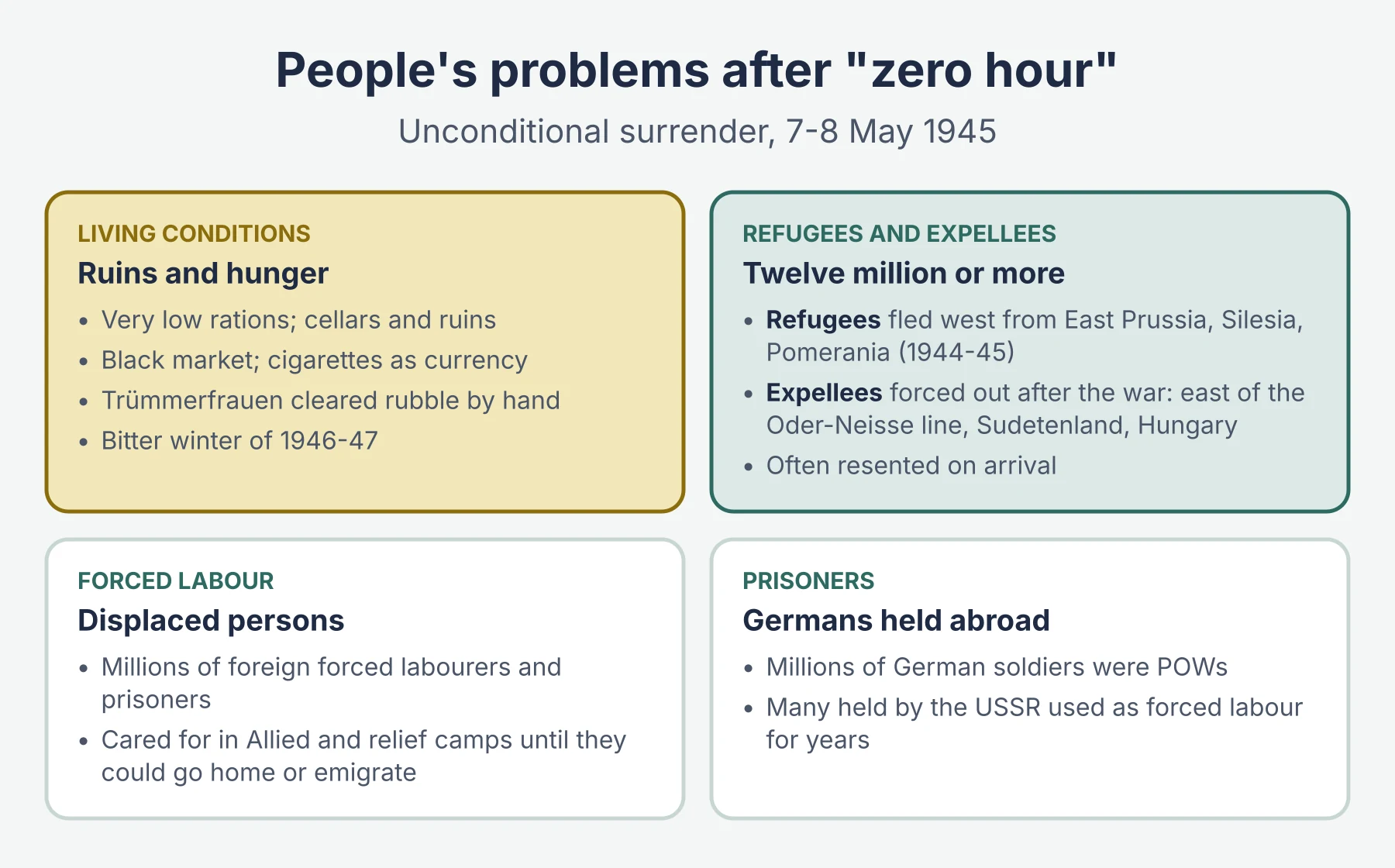
People’s problems in 1945
- Ruins: cities bombed; homes destroyed; utilities broken.
- Food: low rations; trips to the countryside to barter; black market; cigarettes as currency.
- Women: outnumbered men; Trümmerfrauen cleared rubble.
- Refugees and expellees: millions fled the Red Army; then expulsions from lands east of the Oder-Neisse line, the Sudetenland and elsewhere; estimates commonly twelve million or more.
- Forced labour: millions of foreign forced labourers became displaced persons; German prisoners of war held by the USSR worked for years.
Allied control
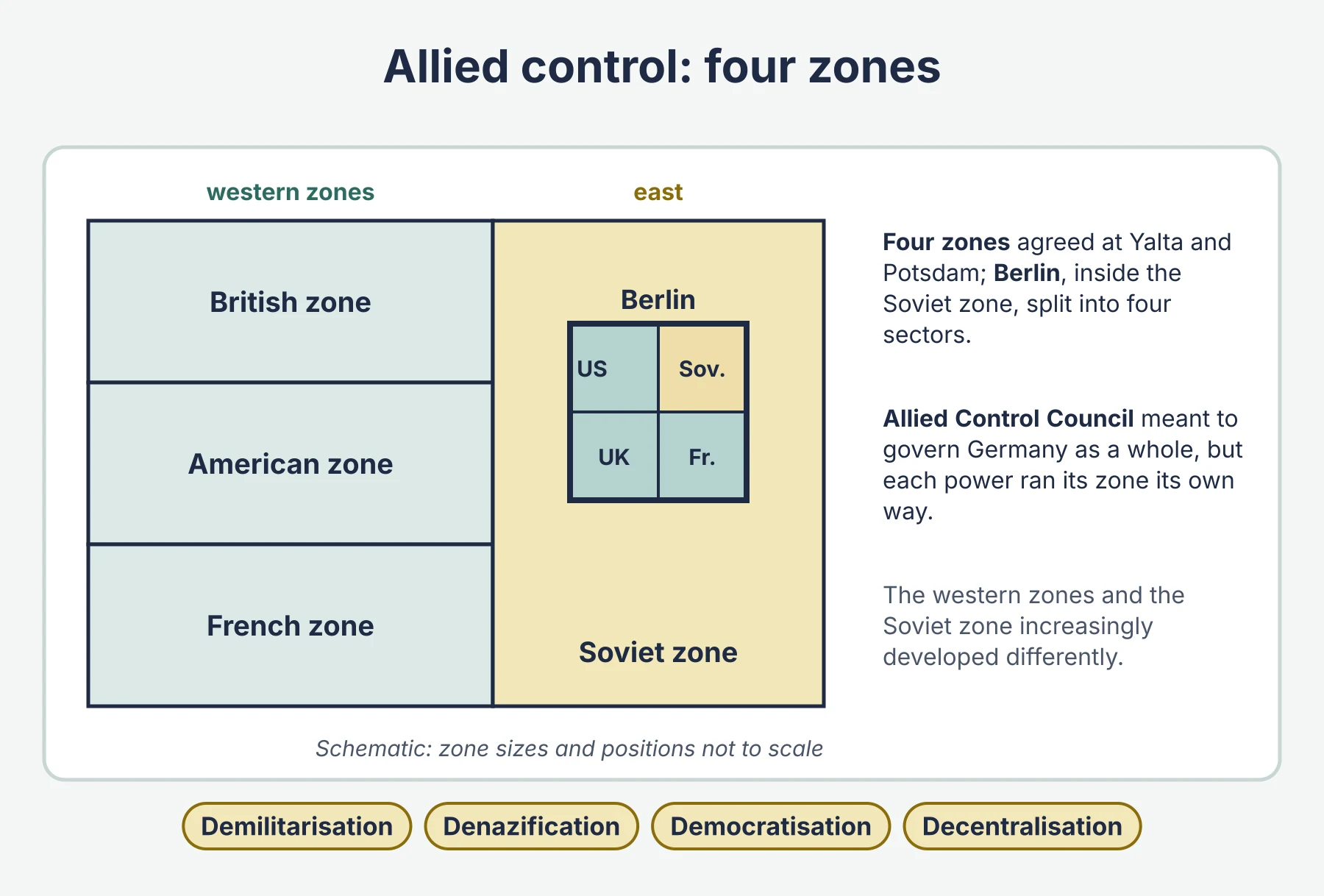
- Four zones (US, British, French, Soviet); Berlin in four sectors.
- Allied Control Council for Germany as a whole.
- Potsdam aims: demilitarise, denazify, democratise, decentralise.
- Zones drifted apart as the Cold War grew.
Denazification and Nuremberg
| Detail | Impact | |
|---|---|---|
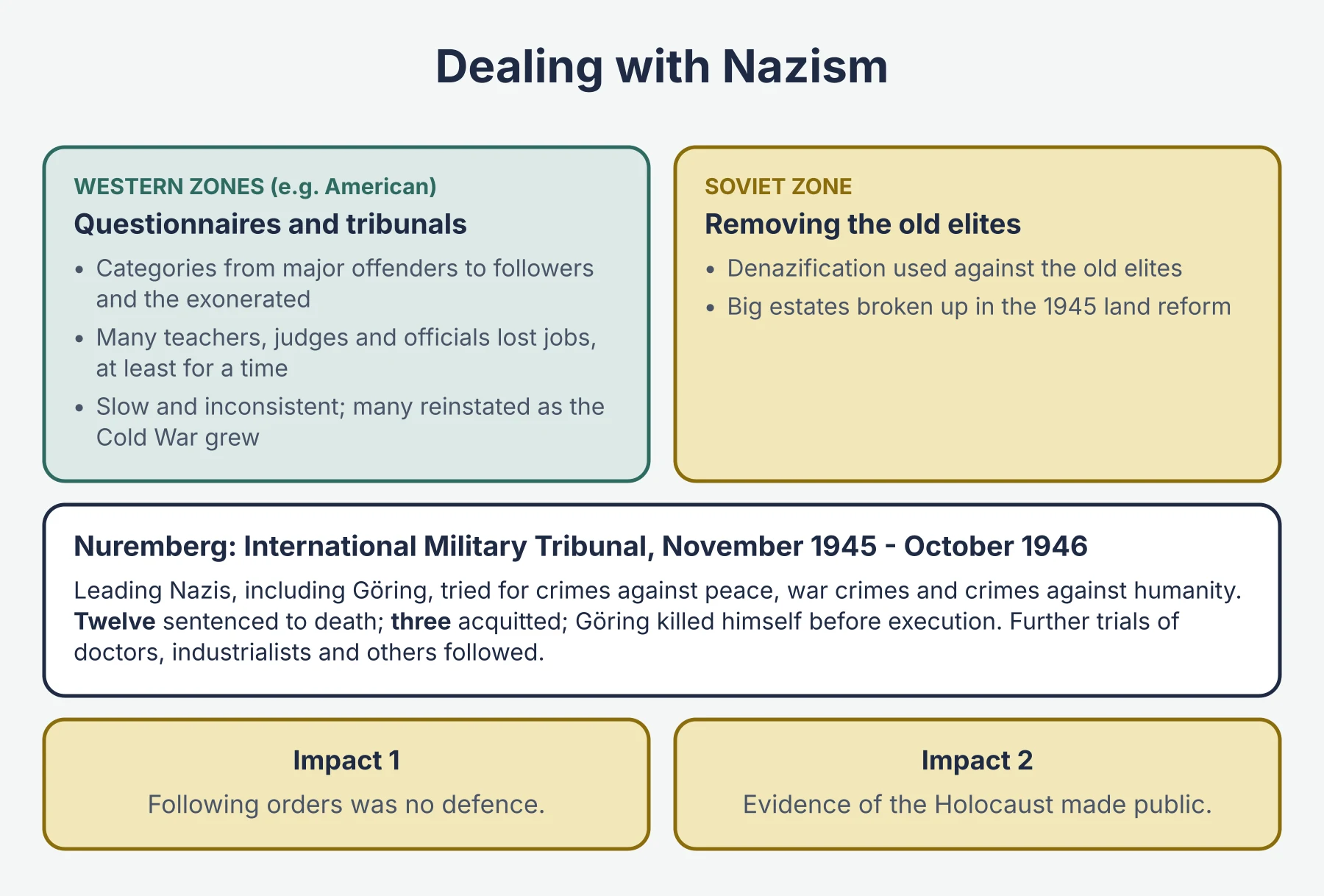
| Denazification (west) | Questionnaires; tribunals; categories from major offenders to exonerated | Slow, inconsistent; many reinstated as the Cold War grew |
| Denazification (Soviet zone) | Removal of old elites; land reform | Used to reshape society along communist lines |
| Nuremberg Tribunal | November 1945-October 1946; Göring and others; crimes against peace, war crimes, crimes against humanity | Twelve death sentences, three acquittals; “following orders” no defence; Holocaust evidence made public |
Penalties on the Soviet zone
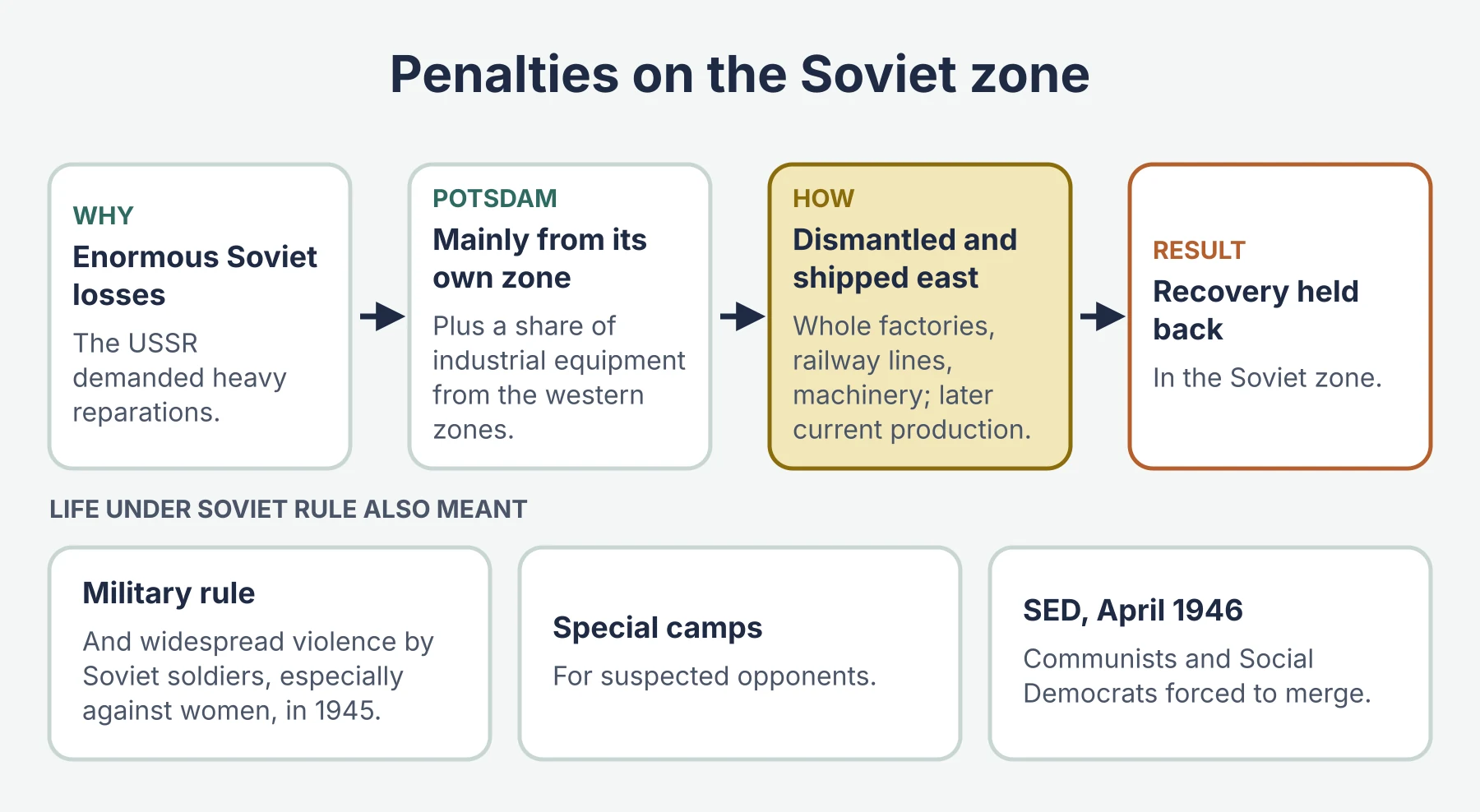
- Reparations mainly from its own zone, plus a share of western equipment.
- Factories, railway lines and machinery dismantled and taken to the USSR; later, goods from current production.
- Military rule, violence by Soviet soldiers in 1945, special camps, the SED merger.
- Result: slower recovery than in the west.
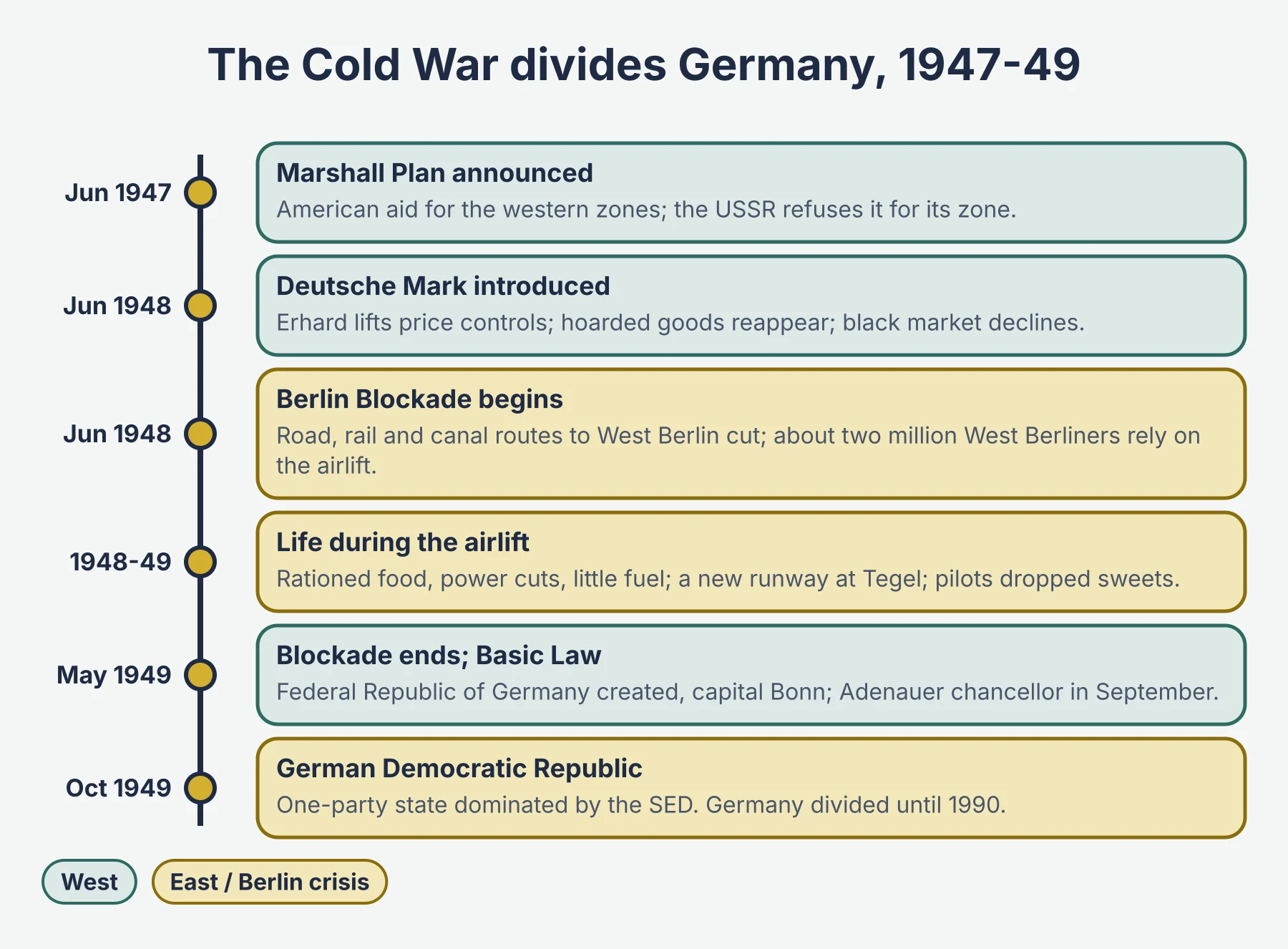
The Cold War’s impact
- Marshall Aid for the western zones; refused for the Soviet zone.
- Deutsche Mark (June 1948) and Erhard’s lifting of price controls: shops filled, black market declined.
- Blockade (June 1948-May 1949): about two million West Berliners supplied by air; rationing, power cuts, cold; Tegel runway built; Western powers seen as protectors.
- Two states (1949): Federal Republic (Basic Law, Bonn, Adenauer); GDR (SED one-party state).
Key terms
| Term | Meaning |
|---|---|
| Zero hour | Stunde Null, the collapse of 1945 |
| Expellee | German forced to leave eastern lands after the war |
| Displaced person | Foreigner in Germany, often a former forced labourer, awaiting return |
| Black market | Illegal trade in scarce goods |
| Trümmerfrauen | “Rubble women” who cleared bomb damage |
| Denazification | Removing Nazi influence from public life |
| Reparations | Payments in money, goods or equipment for war damage |
| Dismantling | Removal of factories and equipment as reparations |
| SED | Socialist Unity Party, the ruling party of the GDR |
| Basic Law | The constitution of the Federal Republic (1949) |
Exam traps
- Four zones, not two.
- Refugees fled; expellees were forced out after the war.
- The Blockade was the Soviet response to the new currency.
- Denazification was not complete: many former Nazis returned to posts.
- In a 9-mark answer, give two clearly separate ways, each explained.
- In a 12-mark answer, compare the given factor with at least one other and reach a judgement.
Self-test
- What did Germans call May 1945?
- Who were the Trümmerfrauen?
- Why were cigarettes used as currency?
- Which conference approved the transfer of German populations?
- Name two regions from which Germans were expelled.
- What were displaced persons?
- How many zones was Germany divided into?
- Name two of the Potsdam aims for Germany.
- What were the three main charges at Nuremberg?
- How did the USSR take reparations from its zone?
- What did the Deutsche Mark change in the western zones?
- When were the Federal Republic and the GDR founded?
Answers
- Stunde Null, “zero hour”.
- Women who cleared the rubble of bombed cities.
- The Reichsmark had little value, so goods and cigarettes were used instead.
- Potsdam (July-August 1945).
- Any two: lands east of the Oder-Neisse line (Silesia, Pomerania, East Prussia); the Sudetenland; Hungary.
- Foreigners in Germany, mostly former forced labourers or prisoners, awaiting return or emigration.
- Four.
- Any two: demilitarisation; denazification; democratisation; decentralisation.
- Crimes against peace, war crimes, crimes against humanity.
- By dismantling factories, railway lines and machinery and, later, taking goods from production.
- It ended the worthless Reichsmark, goods reappeared in shops and the black market declined.
- The Federal Republic in May 1949 (Basic Law; government in September); the GDR in October 1949.
Try the post-war Germany practice questions.
Related resources
-
Study guides
OxfordAQA International GCSE History (9245): The Printing Revolution, c1440-c1800
The Printing Revolution for 9245 Technology and change: Asian printing, Gutenberg, the book trade, vernaculars, copyright, Reformation, literacy and science.
World History · OxfordAQA · IGCSE
Read guide -
Practice questions
OxfordAQA International GCSE History (9245): The Printing Revolution, c1440-c1800 – Practice Questions
Eleven original 9245 Technology and change questions on the Printing Revolution, from 3-mark recall to 12-mark judgements, with point-by-point marking guides.
World History · OxfordAQA · IGCSE
Try questions -
Revision notes
OxfordAQA International GCSE History (9245): The Printing Revolution, c1440-c1800 – Revision Notes
Revision notes for the 9245 Printing Revolution: Asian printing, Gutenberg's press, the book trade, type, women, copyright, Reformation, literacy and science.
World History · OxfordAQA · IGCSE
Revise topic
Get free revision emails (optional)
Occasional emails with practice questions, worked explanations and links to free resources for the qualification and subjects you choose. No spam, and you can unsubscribe from any email. The free tools on this site never need an email.