
Study Guides
Cambridge IGCSE Physics (0625): Mass and weight
Study guide to Cambridge IGCSE Physics 0625 section 1.3: mass, weight, gravitational field strength g = W/m, balances and weight as a field effect.
- Subject
- Physics
- Level
- IGCSE
- Topic
- Motion, forces and energy
- Author
- Marlbridge Academic Team
- Updated
- Reviewed by
- Iftikhar Azeemi (what this means)
Aligned to Cambridge IGCSE Physics (0625), For examination in 2026, 2027 and 2028. Official specification .
Syllabus page (what it covers and how it is assessed): Cambridge IGCSE Physics.
Syllabus points this page covers, with Core and Extended
0625
- 1.3 Mass and weight · Core and Extended
"Core and Extended" means part of that syllabus point is Extended only. The page's own tier notes say which part.
Found an error? Report a correction.
Need help with this topic? Request a free trial class for IGCSE Physics (0625).
This guide teaches section 1.3, Mass and weight, of the Cambridge IGCSE Physics 0625 syllabus for examination in 2026, 2027 and 2028. Core statements 1 to 4 define mass, weight and gravitational field strength and cover comparing them with a balance. Supplement statement 5, describing weight as the effect of a gravitational field on a mass, is examined only on Papers 2 and 4 and is labelled Extended only. The Motion, forces and energy study guide shows where this section sits in Topic 1; this page goes further into the definitions, the equation and the instruments.
What the syllabus asks for
| Statement | Tier | Content |
|---|---|---|
| 1 | Core | Mass is a measure of the quantity of matter in an object at rest relative to the observer |
| 2 | Core | Weight is a gravitational force on an object that has mass |
| 3 | Core | Gravitational field strength is force per unit mass; recall and use g = W/m; know that g is equivalent to the acceleration of free fall |
| 4 | Core | Weights (and masses) may be compared using a balance |
| 5 | Extended only | Describe, and use the concept of, weight as the effect of a gravitational field on a mass |
Mass
Mass is a measure of the quantity of matter in an object. It is measured in kilograms (kg) and is a scalar. The syllabus wording adds “at rest relative to the observer”: the mass you measure is for an object that is not moving relative to you. In practice, at IGCSE, take the point that matters: an object’s mass does not depend on where it is. A 2.0 kg bag of rice has a mass of 2.0 kg in your kitchen, on a mountain, on the Moon or in a spacecraft.
Weight
Weight is a gravitational force on an object that has mass. As a force it is measured in newtons (N), acts downwards towards the centre of the Earth (or whichever planet or moon the object is on) and is a vector. Because weight depends on how strongly the object is pulled, it does change from place to place.
| Mass | Weight | |
|---|---|---|
| What it is | quantity of matter | gravitational force |
| Unit | kg | N |
| Scalar or vector | scalar | vector (downwards) |
| Changes with location? | no | yes |
| Measured with | beam balance (comparison) | spring balance (newton meter) |
Gravitational field strength, g
Gravitational field strength is the force per unit mass:
g = W / m       g in N/kg,  W in N,  m in kg
W = m g         m = W / g
Near the Earth’s surface g is about 9.8 N/kg: each kilogram of mass has a weight of 9.8 N. Other bodies have different values; the Moon’s surface value is about 1.6 N/kg and Mars’s about 3.7 N/kg.
Why g is also the acceleration of free fall
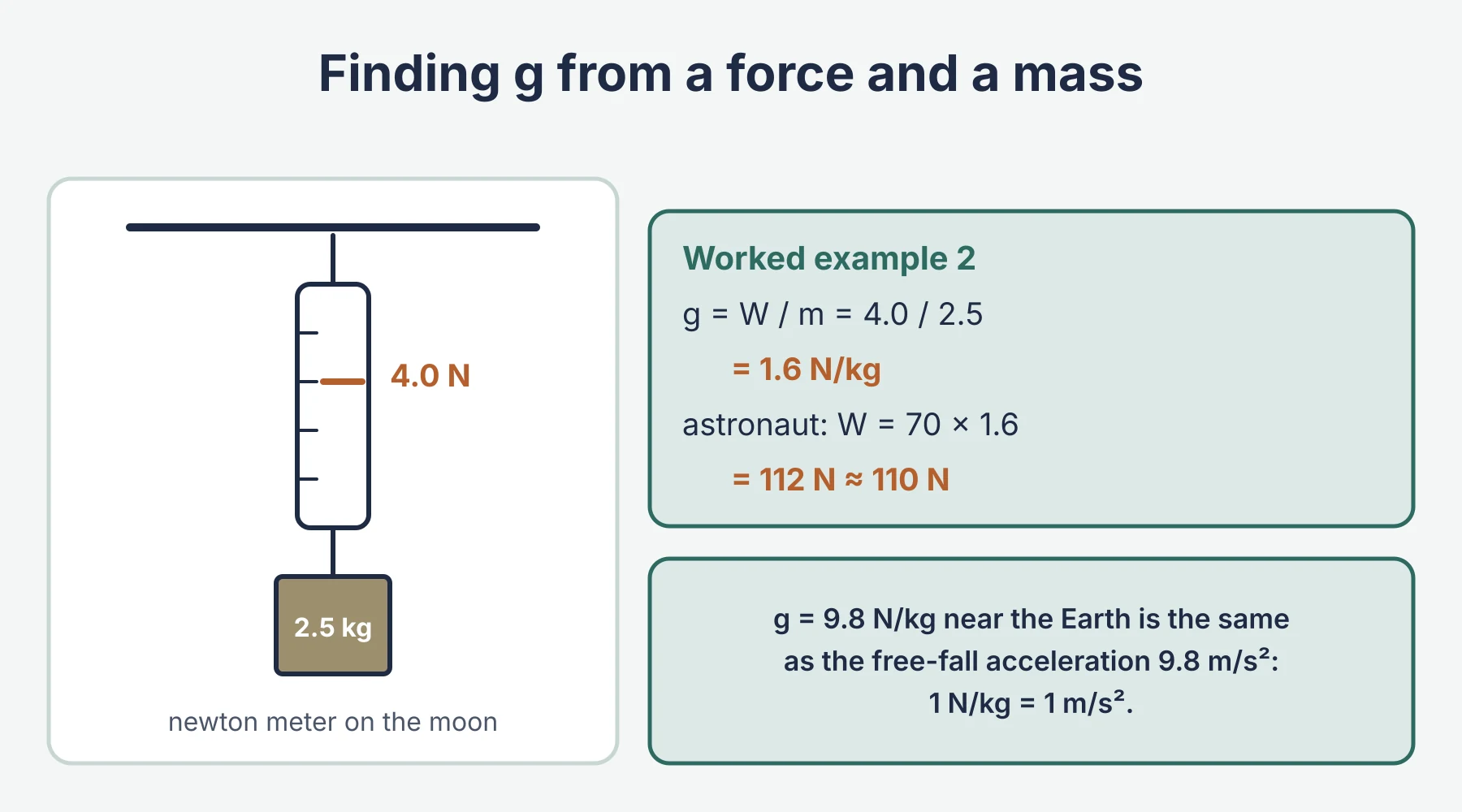
Section 1.2 gives the acceleration of free fall near the Earth as about 9.8 m/s². That is the same number as the field strength, 9.8 N/kg, and the syllabus asks you to know the two are equivalent. A freely falling object has only its weight acting on it, so each kilogram is pulled with 9.8 N and speeds up by 9.8 m/s every second. The units agree too: 1 N is the force that gives 1 kg an acceleration of 1 m/s², so 1 N/kg = 1 m/s².
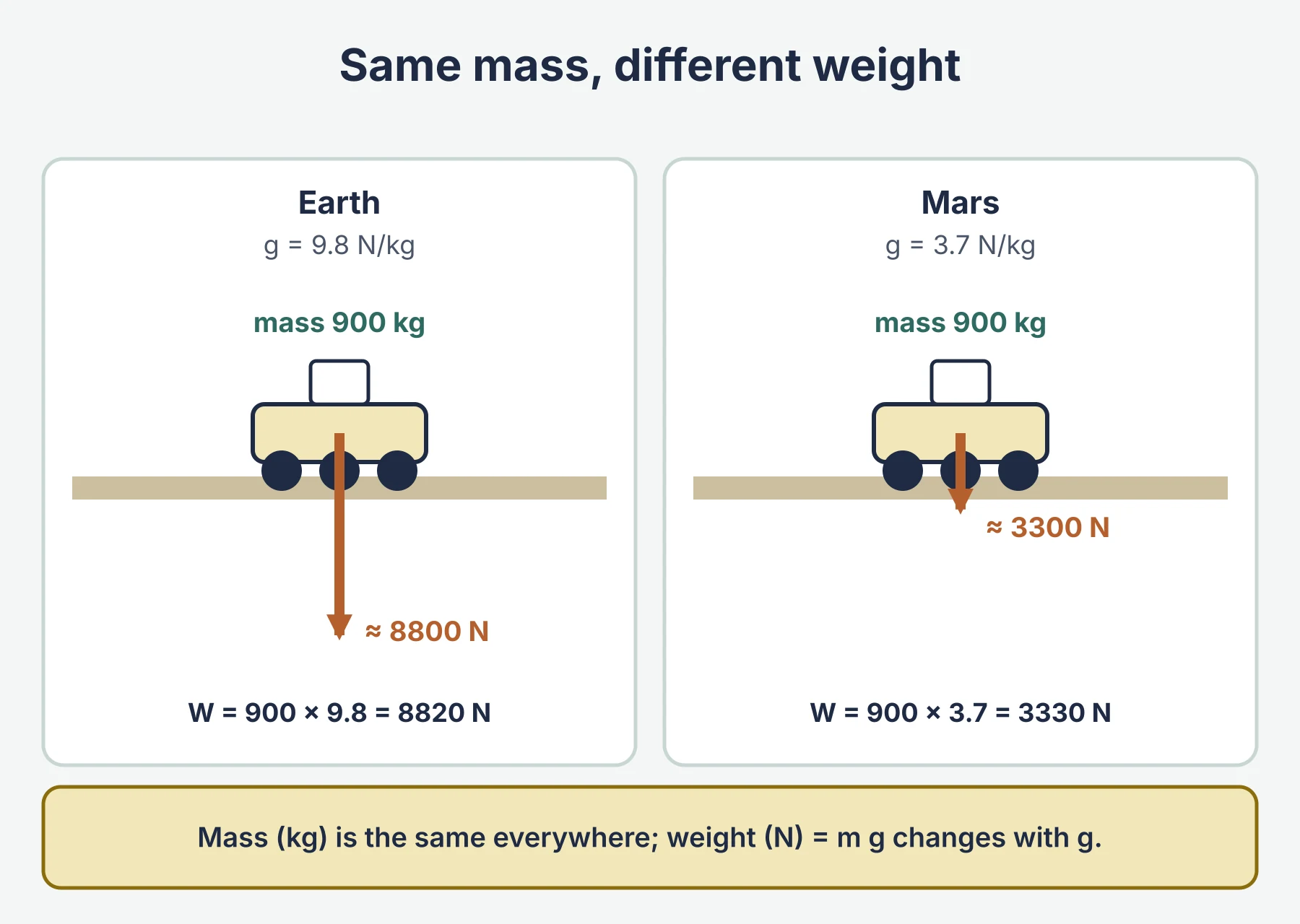
Worked example 1. A planetary rover has a mass of 900 kg. Find its weight on the Earth (g = 9.8 N/kg) and on Mars (g = 3.7 N/kg).
Earth:  W = m g = 900 × 9.8 = 8820 N  ≈ 8800 N
Mars:   W = m g = 900 × 3.7 = 3330 N  ≈ 3300 N
mass on Mars: still 900 kg
Worked example 2. On a newly explored moon, a 2.5 kg test mass hangs from a newton meter that reads 4.0 N. Find g there, and the weight of a 70 kg astronaut.
g = W / m = 4.0 / 2.5 = 1.6 N/kg
astronaut: W = 70 × 1.6 = 112 N  ≈ 110 N
Notice what the question gave you: a force and a mass. Always convert grams to kilograms first: 250 g is 0.250 kg, not 250 kg.
Measuring and comparing: balances
Statement 4 says weights (and masses) can be compared using a balance.
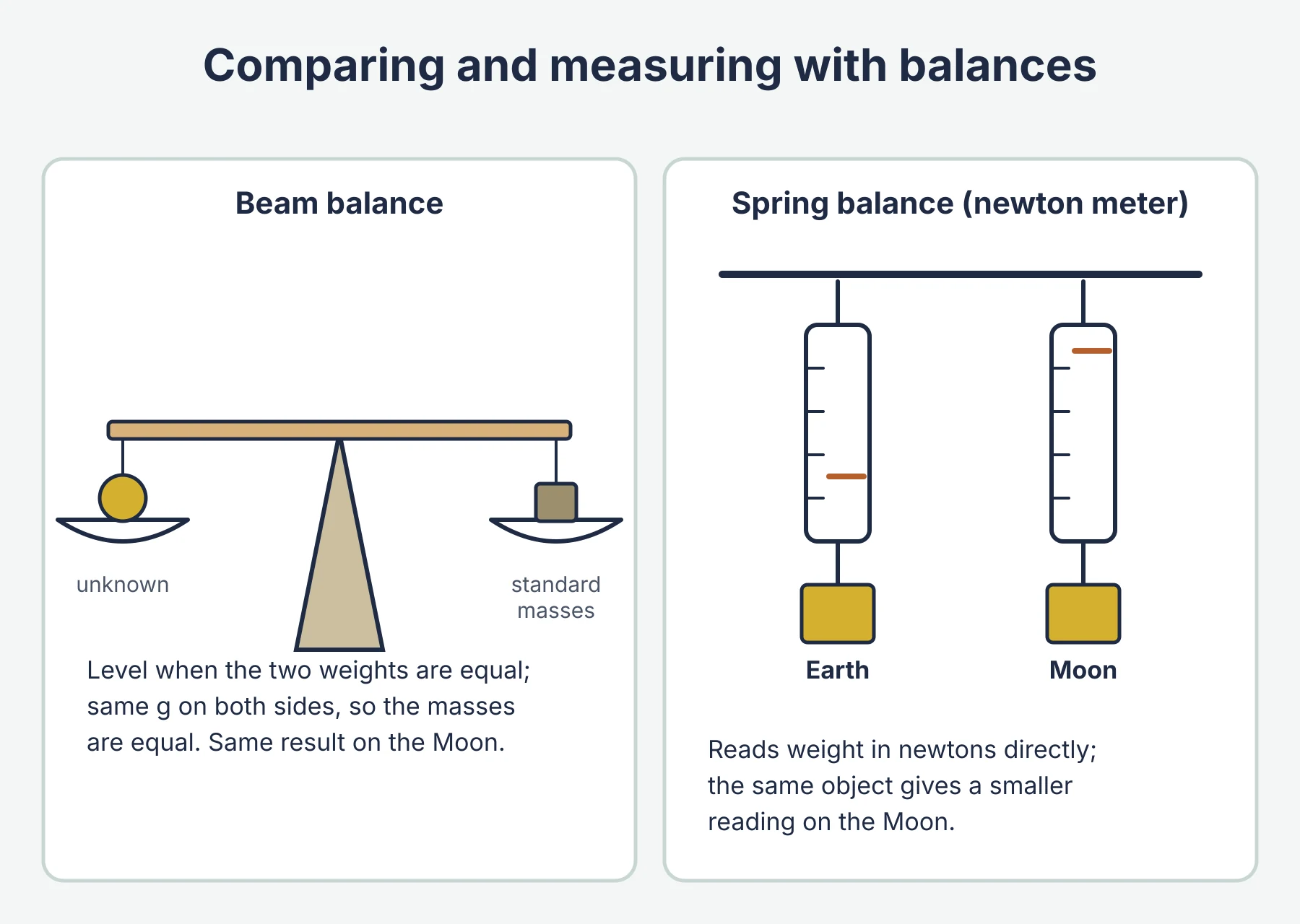
- Beam balance (two pans). An unknown object sits in one pan and standard masses are added to the other until the beam is level. The beam balances when the two weights are equal. Both pans are in the same gravitational field, so equal weights mean equal masses. The method gives the same result on the Moon: everything weighs less, but by the same factor on both sides.
- Spring balance (newton meter). The spring stretches in proportion to the force pulling it, so the scale reads weight directly, in newtons. Taken to the Moon, the same object gives a smaller reading.
- Electronic top-pan balance. It measures the force on its pan but displays the result in grams or kilograms, using Earth’s value of g. On the Moon it would show a mass about one sixth of the true value, because the force on it is smaller.
Finding g in the laboratory
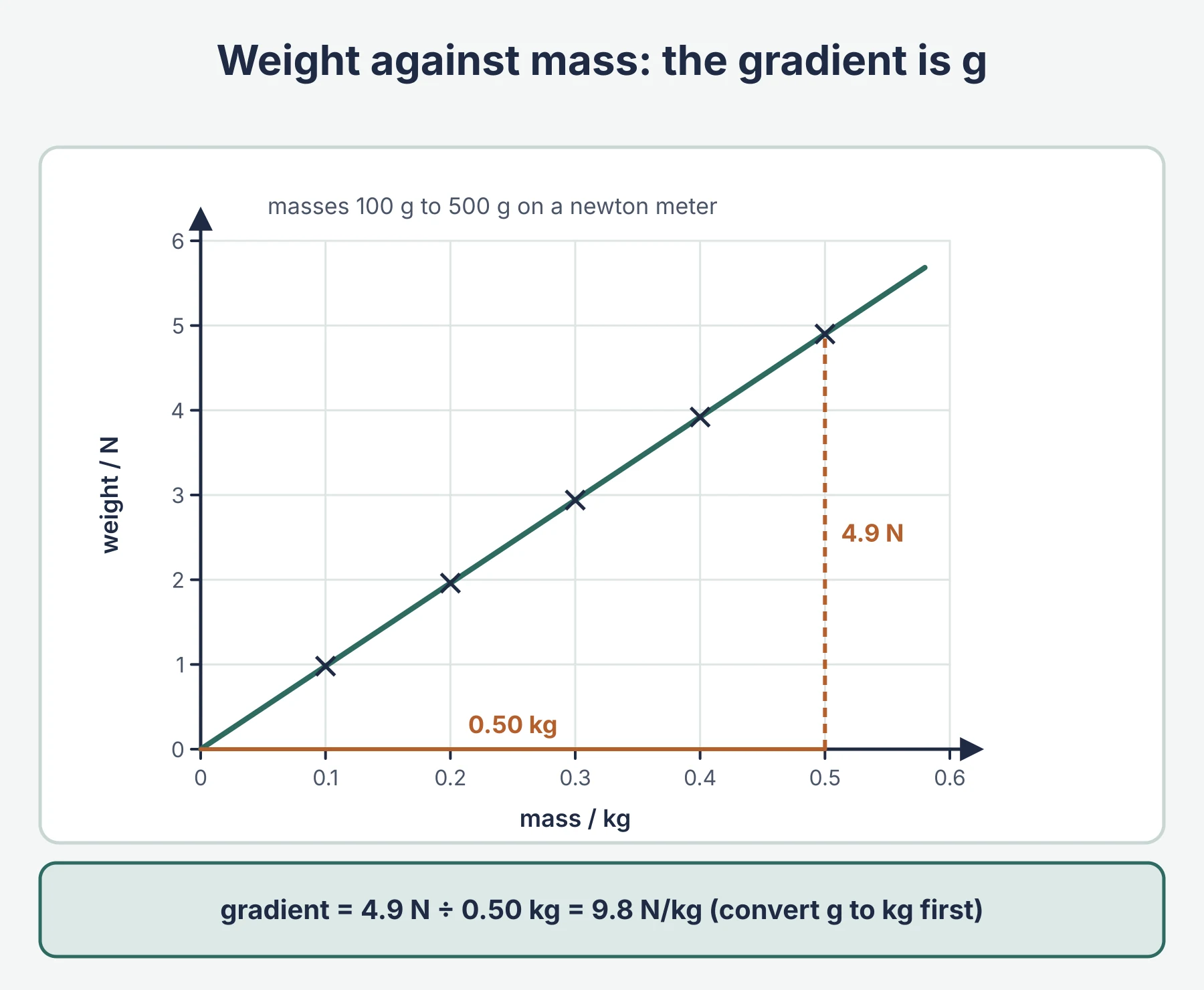
Hang a newton meter from a clamp. Hang masses of 100 g, 200 g, up to 500 g from it in turn, reading the weight each time with your eye level with the pointer. Convert each mass to kilograms and plot weight (y-axis) against mass (x-axis). The points lie on a straight line through the origin, and its gradient is g. For example, a gradient of 4.9 N ÷ 0.50 kg = 9.8 N/kg.
Weight as the effect of a gravitational field (Extended only)
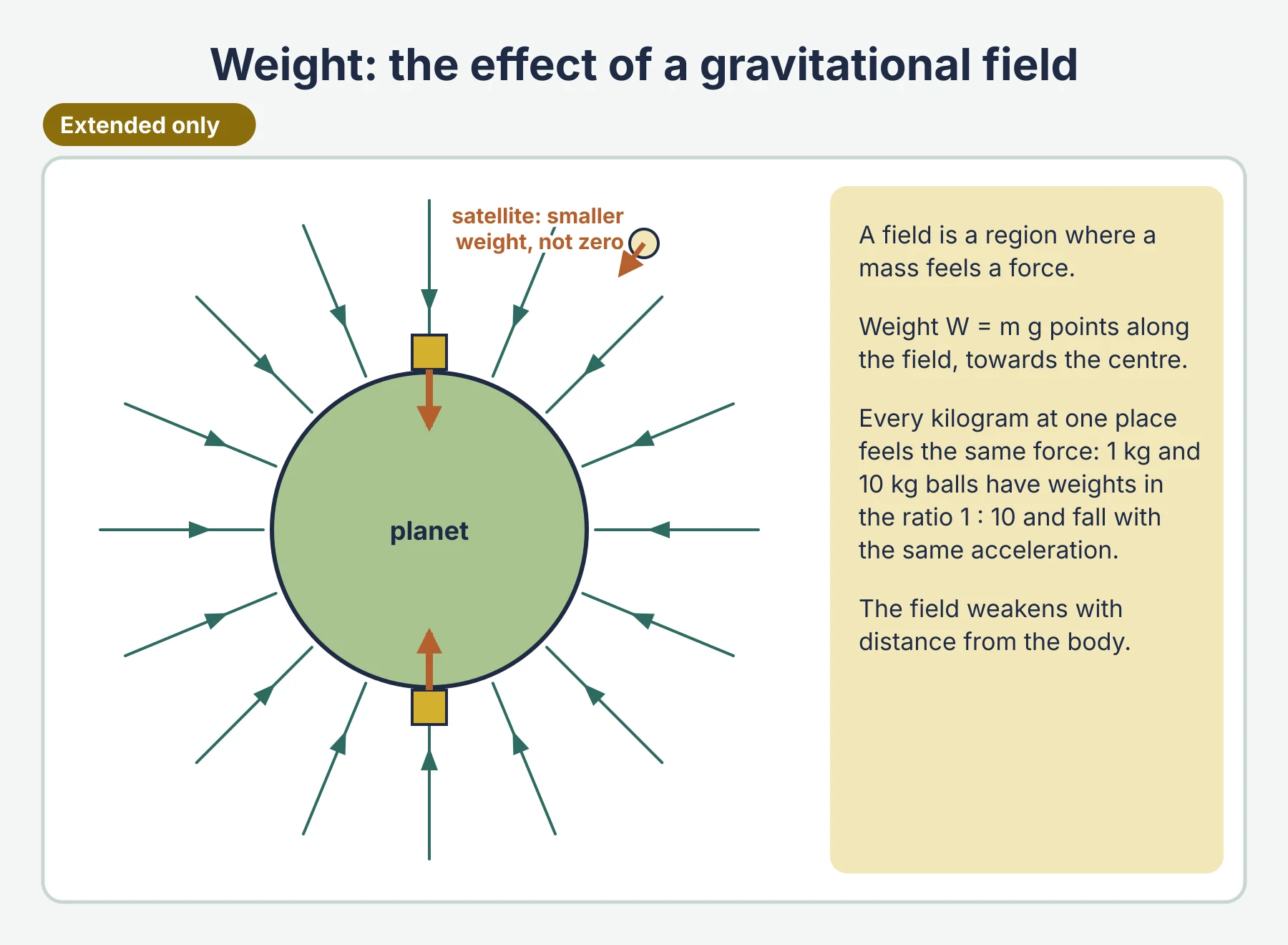
A gravitational field is a region in which a mass experiences a force. Weight is the effect of that field on a mass: the field is there whether or not an object is in it, and any mass placed in it is pulled with a force W = mg in the direction of the field.
Using this idea:
- The field, not the object, sets g. At a given place every mass experiences the same force per kilogram, so a 1 kg and a 10 kg ball have weights in the ratio 1 : 10 and fall with the same acceleration.
- g depends on the body and the distance from it. A body with more mass produces a stronger field at its surface, and the field weakens with distance from the body, so a satellite’s weight is less than it was on the launch pad, but not zero.
- Weight is a vector pointing along the field, towards the centre of the planet or moon. On opposite sides of the Earth, two people’s weights point in opposite directions.
Typical questions: compare the weight of an object on two planets, given g for each; explain why a beam balance gives the same reading on the Moon; explain why a dropped hammer and feather fall together on the airless Moon (same field strength, so the same acceleration for every mass).
Common mistakes
- Giving weight in kilograms, or mass in newtons.
- Saying mass changes on the Moon. Mass is unchanged; weight is smaller.
- Using grams in g = W/m.
- Writing “gravity” when the question asks for the name of the force: say weight or gravitational force.
- Saying a beam balance measures weight only. It compares weights, and so compares masses.
- (Extended) Saying there is “no gravity” in orbit. The field is weaker but still there.
Exam technique: command words
- State what is meant by mass or weight: use the syllabus definitions, word for word if you can. “Mass is how heavy something is” scores nothing.
- Define gravitational field strength: “force per unit mass”. Writing only g = W/m usually earns the mark only if the symbols are defined.
- Calculate: equation, substitution, answer with unit (N, kg or N/kg).
- Explain a balance result: say what is equal at balance (the weights), then why that means the masses are equal (same g on both sides).
- Describe (Extended): weight as “the effect of a gravitational field on a mass”, then apply W = mg to the situation.
Check your recall with the revision notes on mass and weight and then try the practice questions on mass and weight. Weight is the force behind free fall in the study guide on motion, and mass is half of the density equation in the study guide on density.
Related resources
-
Practice questions
Cambridge IGCSE Physics (0625): Mass and weight – Practice Questions
Twelve original Cambridge IGCSE Physics 0625 questions on mass, weight, g = W/m, balances and gravitational fields, with mark-by-mark worked answers.
Physics · Cambridge · IGCSE
Try questions -
Revision notes
Cambridge IGCSE Physics (0625): Mass and weight – Revision Notes
Revision notes for Cambridge IGCSE Physics 0625 section 1.3: mass and weight definitions, g = W/m, balances, gravitational fields and a 12-question self-test.
Physics · Cambridge · IGCSE
Revise topic -
Study guides
Cambridge IGCSE Physics (0625): Momentum
Study guide to Cambridge IGCSE Physics 0625 section 1.6 Momentum (Extended): p = mv, impulse, conservation of momentum in collisions and F = Δp/Δt.
Physics · Cambridge · IGCSE
Read guide
Related articles
Get free revision emails (optional)
Occasional emails with practice questions, worked explanations and links to free resources for the qualification and subjects you choose. No spam, and you can unsubscribe from any email. The free tools on this site never need an email.