
Study Guides
Cambridge IGCSE Physics (0625): Momentum
Study guide to Cambridge IGCSE Physics 0625 section 1.6 Momentum (Extended): p = mv, impulse, conservation of momentum in collisions and F = Δp/Δt.
- Subject
- Physics
- Level
- IGCSE
- Topic
- Motion, forces and energy
- Author
- Marlbridge Academic Team
- Updated
- Reviewed by
- Iftikhar Azeemi (what this means)
Aligned to Cambridge IGCSE Physics (0625), For examination in 2026, 2027 and 2028. Official specification .
Syllabus page (what it covers and how it is assessed): Cambridge IGCSE Physics.
Syllabus points this page covers, with Core and Extended
0625
- 1.6 Momentum · Extended only
"Core and Extended" means part of that syllabus point is Extended only. The page's own tier notes say which part.
Found an error? Report a correction.
Need help with this topic? Request a free trial class for IGCSE Physics (0625).
This guide teaches section 1.6, Momentum, of the Cambridge IGCSE Physics 0625 syllabus for examination in 2026, 2027 and 2028. The whole section is Supplement content: it is examined only on the Extended papers (Papers 2 and 4), and Core-only candidates do not need it. The Motion, forces and energy study guide gives a short note on objects pushed apart from rest; this page develops every statement in 1.6 with worked calculations and the safety applications examiners ask about.
What the syllabus asks for (all Extended only)
| Statement | Content |
|---|---|
| 1 | Define momentum as mass × velocity; recall and use p = mv |
| 2 | Define impulse as force × time for which the force acts; recall and use impulse = FΔt = Δ(mv) |
| 3 | Apply the principle of the conservation of momentum to simple problems in one dimension |
| 4 | Define resultant force as the change in momentum per unit time; recall and use F = Δp/Δt |
Momentum
Momentum = mass × velocity:
p = m v p in kg m/s, m in kg, v in m/sBecause velocity is a vector, momentum is a vector: it has the direction of the velocity. In one-dimensional problems, choose one direction as positive and give velocities the other way a minus sign.
| Object | Mass | Velocity | Momentum |
|---|---|---|---|
| tennis ball served | 0.058 kg | 50 m/s | 2.9 kg m/s |
| sprinter | 70 kg | 10 m/s | 700 kg m/s |
| lorry | 12 000 kg | 15 m/s | 180 000 kg m/s |
| the same lorry reversing | 12 000 kg | −2.0 m/s | −24 000 kg m/s |
A slow, massive object can have far more momentum than a fast, light one.
Impulse
Impulse = force × time for which the force acts, and it equals the change in momentum:
impulse = F Δt = Δ(m v) units: N s (equal to kg m/s)The units match: 1 N = 1 kg m/s², so 1 N s = 1 kg m/s.
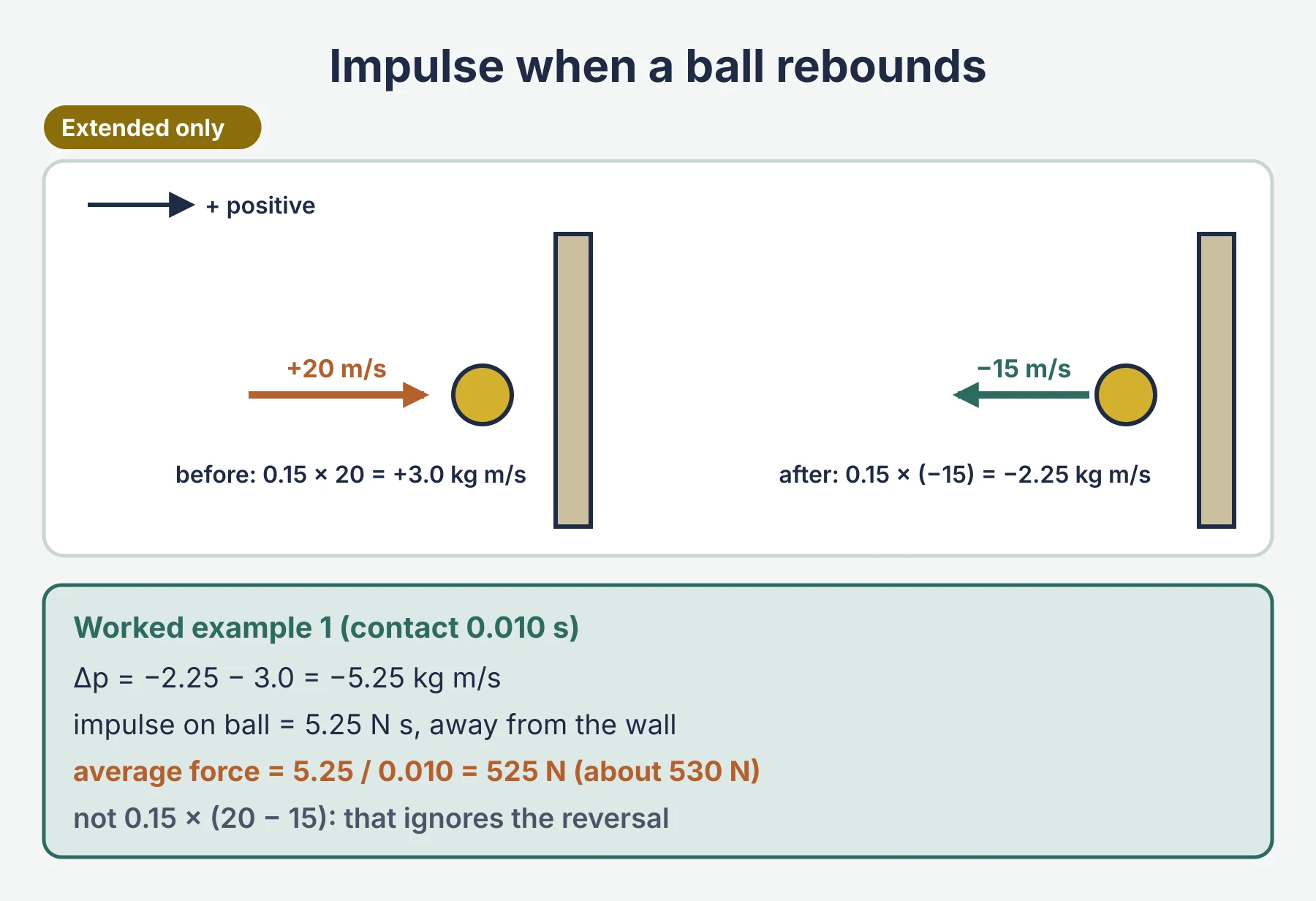
Change in momentum with a rebound. A ball that bounces back has a much larger change in momentum than one that stops, because its velocity reverses.
Worked example 1. A 0.15 kg ball hits a wall at 20 m/s and rebounds at 15 m/s. Contact lasts 0.010 s. Take the original direction as positive.
initial momentum = 0.15 × 20      = +3.0 kg m/s
final momentum   = 0.15 × (−15)   = −2.25 kg m/s
Δp = −2.25 − 3.0                  = −5.25 kg m/s
impulse on ball = 5.25 N s, directed away from the wall
average force = Δp / Δt = 5.25 / 0.010 = 525 N   (about 530 N)
Writing Δp = 0.15 × (20 − 15) = 0.75 kg m/s is the commonest error: it ignores the reversal.
Conservation of momentum
The principle: when objects collide or push each other apart, the total momentum before = total momentum after, provided no external resultant force acts on them. The forces the objects exert on each other are equal and opposite and act for the same time, so the momentum one gains, the other loses.
Method
- Choose and state a positive direction.
- Write the total momentum before, with signs.
- Write the total momentum after, with the unknown.
- Set them equal and solve. Give the direction of any velocity you find.
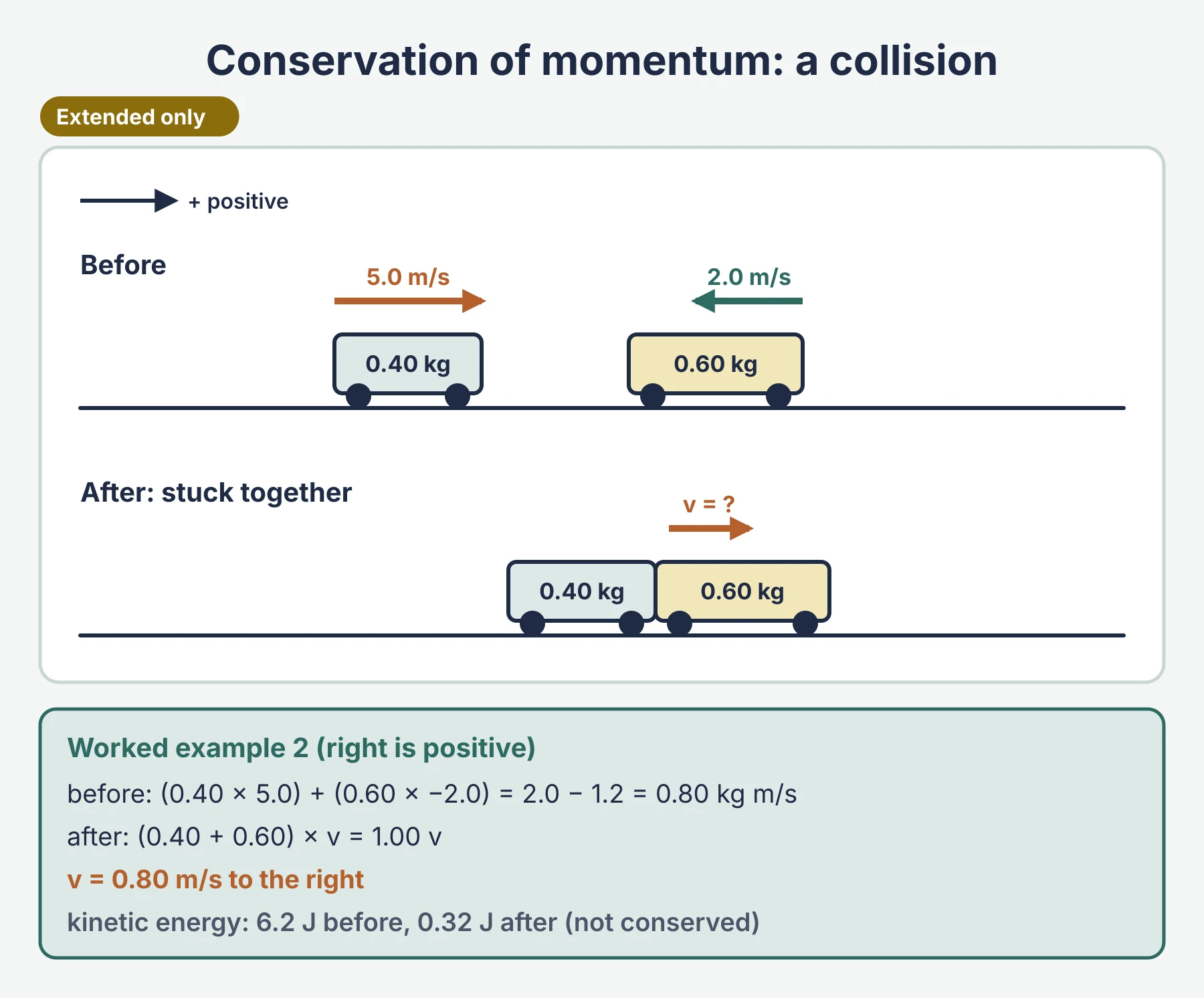
Worked example 2 (objects that join). A 0.40 kg trolley moving right at 5.0 m/s collides with a 0.60 kg trolley moving left at 2.0 m/s. They stick together. Take right as positive.
before: (0.40 × 5.0) + (0.60 × −2.0) = 2.0 − 1.2 = 0.80 kg m/s
after:  (0.40 + 0.60) × v = 1.00 v
v = 0.80 m/s to the right
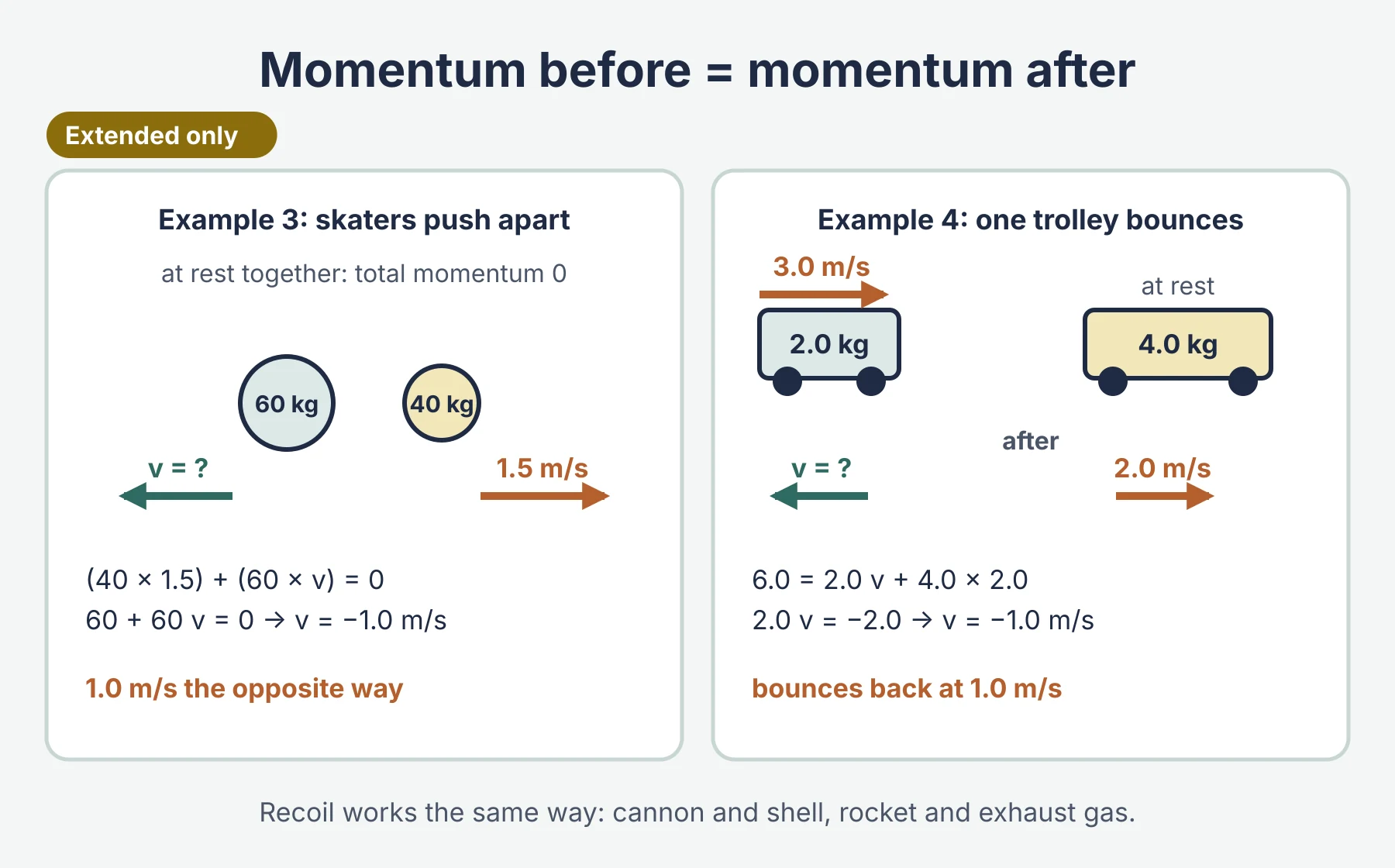
Worked example 3 (pushing apart from rest). Two ice skaters, 60 kg and 40 kg, stand together at rest and push apart. The 40 kg skater moves off at 1.5 m/s. Find the velocity of the 60 kg skater.
before: total momentum = 0
after:  (40 × 1.5) + (60 × v) = 0
        60 + 60 v = 0   →   v = −1.0 m/s
the 60 kg skater moves at 1.0 m/s in the opposite direction
The same reasoning explains recoil: a cannon moves backwards when it fires a shell forwards, and a rocket is pushed forwards as exhaust gas is pushed backwards.
Worked example 4 (one object bounces). A 2.0 kg trolley moving at 3.0 m/s hits a stationary 4.0 kg trolley. Afterwards the 4.0 kg trolley moves at 2.0 m/s in the original direction. Find the velocity of the 2.0 kg trolley.
before: 2.0 × 3.0 = 6.0 kg m/s
after:  2.0 v + 4.0 × 2.0 = 2.0 v + 8.0
2.0 v = 6.0 − 8.0 = −2.0   →   v = −1.0 m/s  (it bounces back at 1.0 m/s)
Momentum is always conserved in these problems, but kinetic energy (section 1.7) usually is not: in example 2 the trolleys have 5.0 + 1.2 = 6.2 J of kinetic energy before and 0.32 J after; the rest is transferred mainly to the internal stores of the trolleys and surroundings, and some by sound.
Resultant force and rate of change of momentum
Resultant force is the change in momentum per unit time:
F = Δp / ΔtThis is the same law as F = ma when the mass is constant, because Δp/Δt = mΔv/Δt = ma. It is useful when you know momenta and a time rather than an acceleration.
Safety: stretching out the time
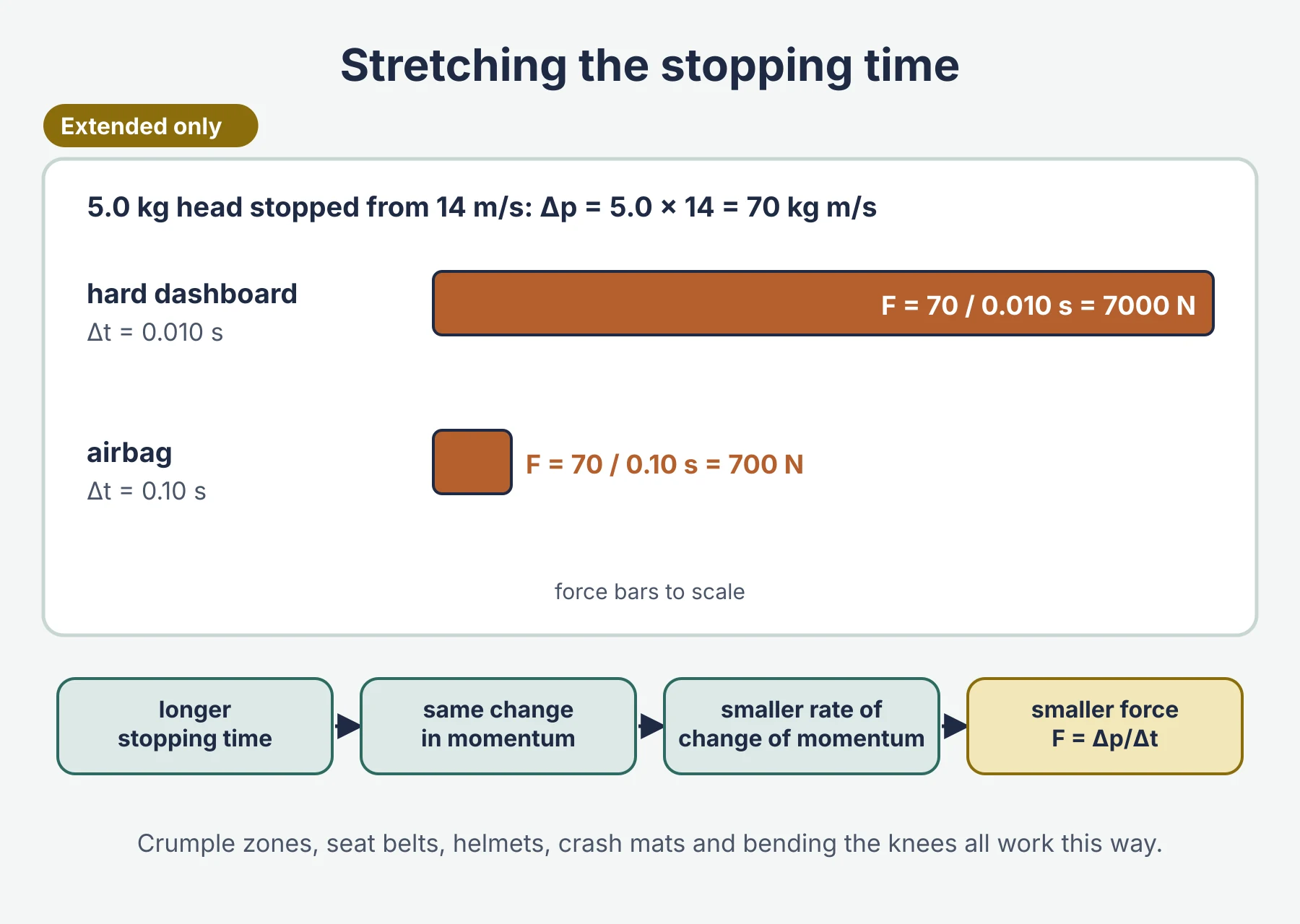
For a given change in momentum (a person stopping from a given speed), a longer stopping time means a smaller force.
Worked example 5. A passenger’s head (mass 5.0 kg) moving at 14 m/s is brought to rest.
Δp = 5.0 × 14 = 70 kg m/s
hitting a hard dashboard, Δt = 0.010 s:   F = 70 / 0.010 = 7000 N
stopped by an airbag, Δt = 0.10 s: F = 70 / 0.10 = 700 N| Safety feature | How it reduces the force |
|---|---|
| crumple zone | front of the car crushes, so the car takes longer to stop |
| airbag | head and chest slow down over a longer time |
| seat belt | stretches slightly, increasing stopping time |
| cycle helmet | foam liner crushes, increasing the time of impact |
| bending knees on landing | body stops over a longer time |
| crash mat | soft surface increases stopping time |
In each, the change in momentum is the same; only the time changes.
Common mistakes
- Forgetting signs, so momenta in opposite directions are added instead of subtracted.
- Ignoring the rebound when finding a change in momentum.
- Giving a velocity from a conservation calculation without a direction.
- Using a combined mass “after” for objects that do not stick together.
- Saying a safety feature “reduces the momentum” or “absorbs the momentum”. It increases the time, so the force is smaller for the same change in momentum.
- Writing the unit of momentum as N/s or kg/m s.
Exam technique: command words
- Define momentum or impulse: give the words of the definition (“mass × velocity”; “force × time for which the force acts”), not only the symbols.
- State the principle of conservation of momentum: total momentum before = total momentum after, when no external resultant force acts.
- Calculate: state the positive direction, write “momentum before = momentum after”, substitute, and give magnitude, unit and direction.
- Explain a safety feature: use the chain “longer time → same change in momentum → smaller rate of change of momentum → smaller force”, and name F = Δp/Δt.
Revise with the revision notes on momentum and try the practice questions on momentum. Resultant force and acceleration are covered in the study guide on forces, and kinetic energy in the study guide on energy, work and power.
Related resources
-
Practice questions
Cambridge IGCSE Physics (0625): Momentum – Practice Questions
Twelve original Cambridge IGCSE Physics 0625 Extended momentum questions on p = mv, impulse, collisions, recoil, F = Δp/Δt and safety, with full answers.
Physics · Cambridge · IGCSE
Try questions -
Revision notes
Cambridge IGCSE Physics (0625): Momentum – Revision Notes
Revision notes for Cambridge IGCSE Physics 0625 section 1.6 Momentum (Extended): p = mv, impulse, conservation, F = Δp/Δt, safety features and a self-test.
Physics · Cambridge · IGCSE
Revise topic -
Study guides
Cambridge IGCSE Physics (0625): Motion
Study guide to Cambridge IGCSE Physics 0625 section 1.2 Motion: speed, velocity, distance–time and speed–time graphs, acceleration and terminal velocity.
Physics · Cambridge · IGCSE
Read guide
Related articles
Get free revision emails (optional)
Occasional emails with practice questions, worked explanations and links to free resources for the qualification and subjects you choose. No spam, and you can unsubscribe from any email. The free tools on this site never need an email.