
Study Guides
Cambridge IGCSE Physics (0625): Forces
Study guide to Cambridge IGCSE Physics 0625 section 1.5 Forces: extension, resultant force, friction, F = ma, circular motion, moments and stability.
- Subject
- Physics
- Level
- IGCSE
- Topic
- Motion, forces and energy
- Author
- Marlbridge Academic Team
- Updated
- Reviewed by
- Iftikhar Azeemi (what this means)
Aligned to Cambridge IGCSE Physics (0625), For examination in 2026, 2027 and 2028. Official specification .
Syllabus page (what it covers and how it is assessed): Cambridge IGCSE Physics.
Syllabus points this page covers, with Core and Extended
0625
- 1.5 Forces · Core and Extended
"Core and Extended" means part of that syllabus point is Extended only. The page's own tier notes say which part.
Found an error? Report a correction.
Need help with this topic? Request a free trial class for IGCSE Physics (0625).
This guide teaches section 1.5, Forces, of the Cambridge IGCSE Physics 0625 syllabus for examination in 2026, 2027 and 2028, in its three parts: 1.5.1 Effects of forces, 1.5.2 Turning effect of forces and 1.5.3 Centre of gravity. Supplement content is examined only on Papers 2 and 4 and is labelled Extended only. The Motion, forces and energy study guide already describes the spring experiment, everyday moments and the plumb-line method; this page concentrates on interpreting results, resultant forces, F = ma, circular motion, multi-force moments and stability.
What the syllabus asks for
| Part | Core | Extended only |
|---|---|---|
| 1.5.1 | Forces change size and shape; load–extension graphs and the experiment; resultant of forces along a line; an object stays at rest or at constant velocity unless a resultant force acts; a resultant force can change speed or direction; solid friction; drag in liquids and gases | Spring constant k = F/x; limit of proportionality; F = ma, with force and acceleration in the same direction; qualitative circular motion |
| 1.5.2 | Moment as turning effect; moment = force × perpendicular distance from the pivot; principle of moments with one force each side; equilibrium | Principle of moments with more than one force each side; an experiment to show no resultant moment in equilibrium |
| 1.5.3 | Centre of gravity; finding it for an irregular lamina; effect on stability | – |
Effects of forces (1.5.1)
Changing shape: load–extension graphs
A force can change the size and shape of an object: it can stretch, squash, bend or twist it. For an elastic solid such as a spring, extension = stretched length − original length.
Worked example 1. A spring is 15.0 cm long with no load.
| Load / N | 0 | 1.0 | 2.0 | 3.0 | 4.0 | 5.0 | 6.0 |
|---|---|---|---|---|---|---|---|
| Length / cm | 15.0 | 16.6 | 18.2 | 19.8 | 21.4 | 23.3 | 25.8 |
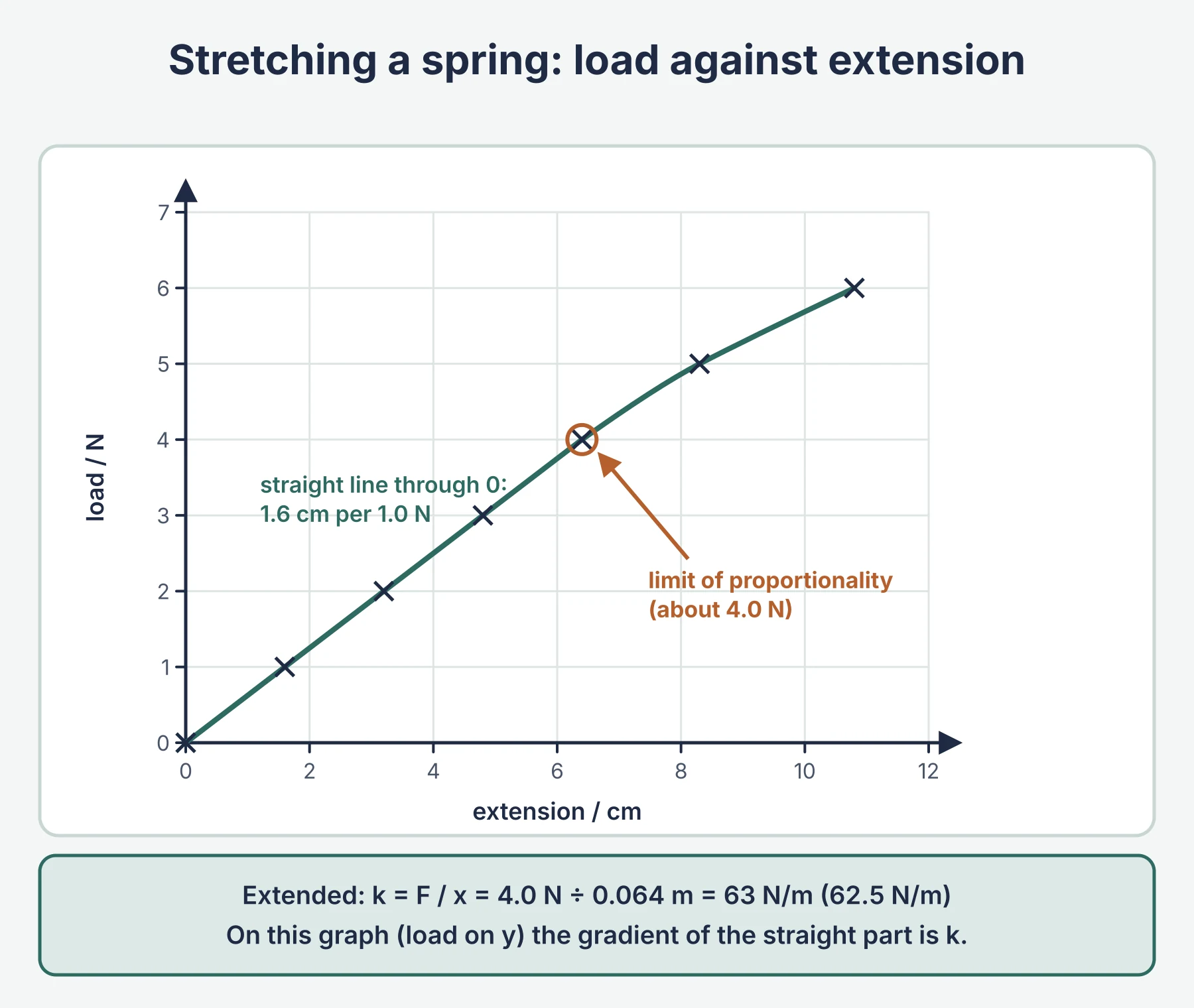
| Extension / cm | 0 | 1.6 | 3.2 | 4.8 | 6.4 | 8.3 | 10.8 |
Up to 4.0 N the extension rises by 1.6 cm for every 1.0 N: the graph of load against extension is a straight line through the origin. Beyond 4.0 N it rises faster and the graph curves.
Extended only. The spring constant is the force per unit extension, k = F/x. From the straight part: k = 4.0 N ÷ 0.064 m = 63 N/m (62.5 N/m). The point where the graph stops being straight is the limit of proportionality; here it is at about 4.0 N. Beyond it, F = kx no longer applies. (The elastic limit is not required.)
Read the axes before using a gradient: on a load (y) against extension (x) graph the gradient is k; on an extension (y) against load (x) graph it is 1/k.
Resultant force along a line
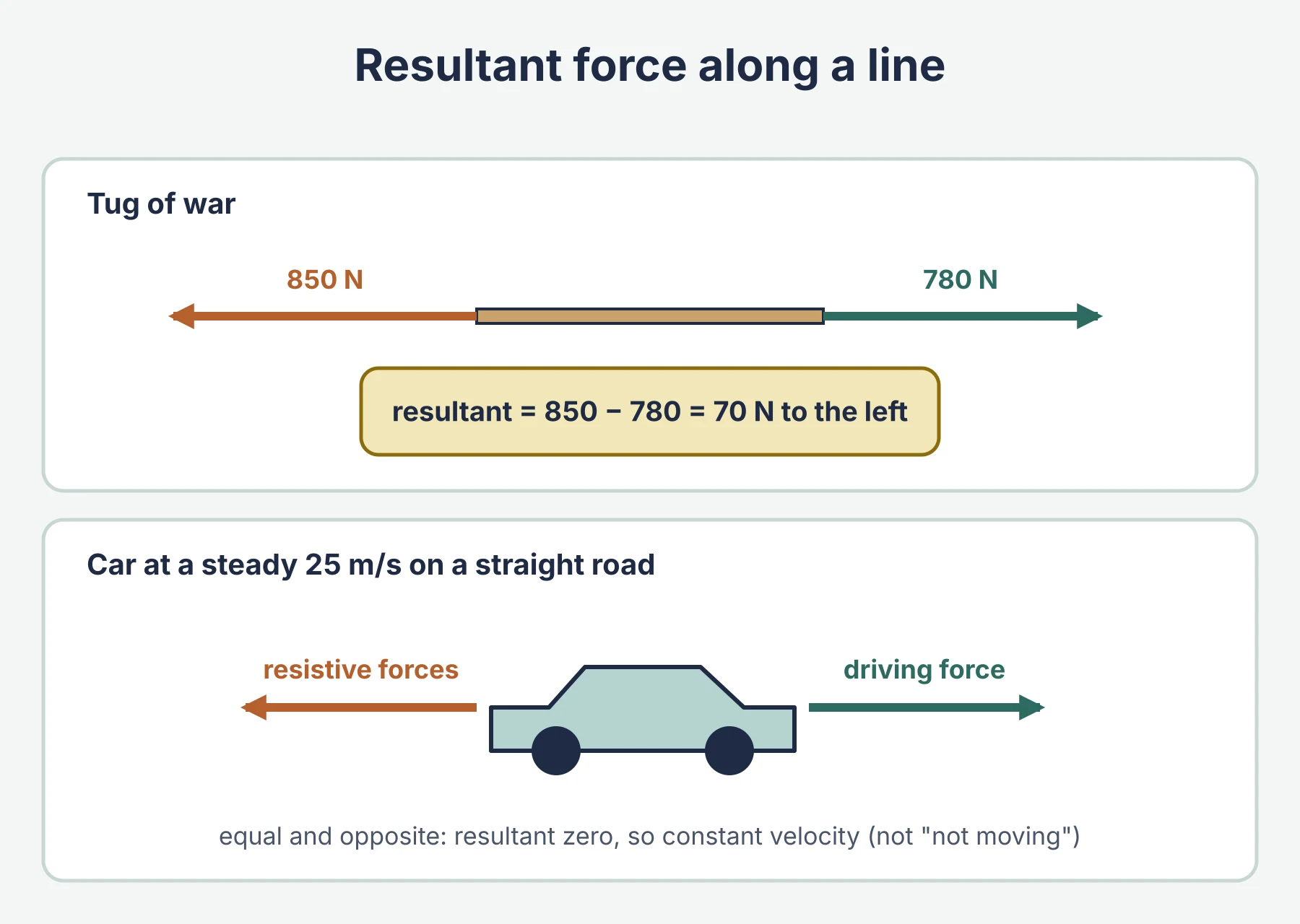
Forces along the same line add if they point the same way and subtract if opposite. In a tug of war, 850 N to the left and 780 N to the right give a resultant of 70 N to the left. Always state the direction.
Resultant force and motion
- An object remains at rest, or continues in a straight line at constant speed, unless acted on by a resultant force. A puck sliding on ice keeps going because the friction on it is very small.
- A resultant force may change the velocity of an object by changing its speed (speeding up or slowing down) or its direction.
- Balanced forces (zero resultant) do not mean “not moving”. A car cruising at a steady 25 m/s on a straight road has a driving force equal to the resistive forces.
Friction and drag
- Solid friction is the force between two surfaces that may impede motion and produce heating. Rub your hands together and they warm up; brake pads get hot.
- Drag (friction in a fluid) acts on an object moving through a liquid (a swimmer, a submarine) or a gas (air resistance on a cyclist). Drag increases as speed increases.
F = ma (Extended only)
Resultant force = mass × acceleration, with the force and the acceleration in the same direction. F is the resultant force, so find it first.
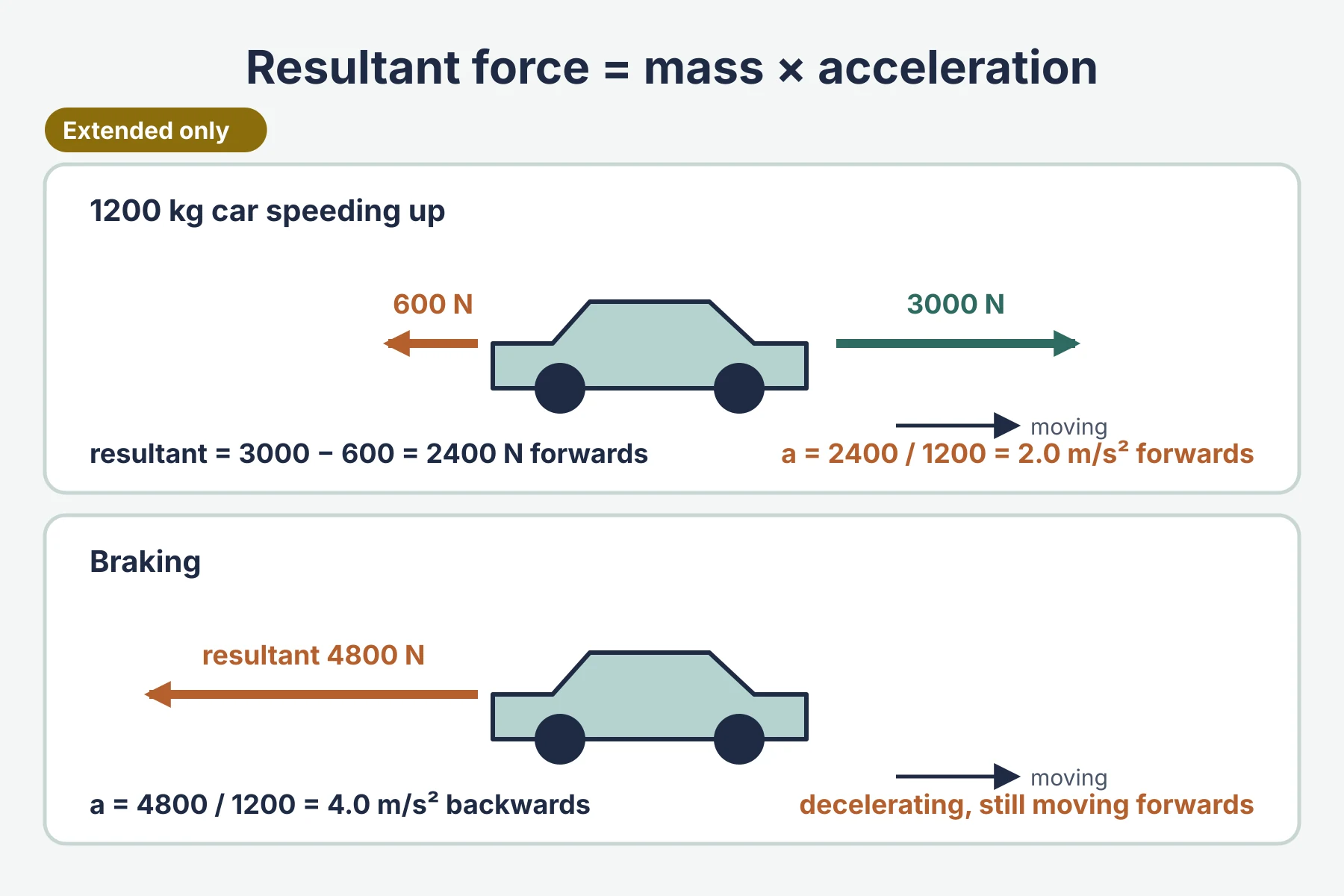
Worked example 2. A car of mass 1200 kg has a driving force of 3000 N and resistive forces of 600 N.
resultant force = 3000 − 600 = 2400 N forwards
a = F / m = 2400 / 1200 = 2.0 m/s² forwards
If the driver then brakes and the resultant force is 4800 N backwards, a = 4800 ÷ 1200 = 4.0 m/s² backwards: the car decelerates while still moving forwards.
Motion in a circle (Extended only)
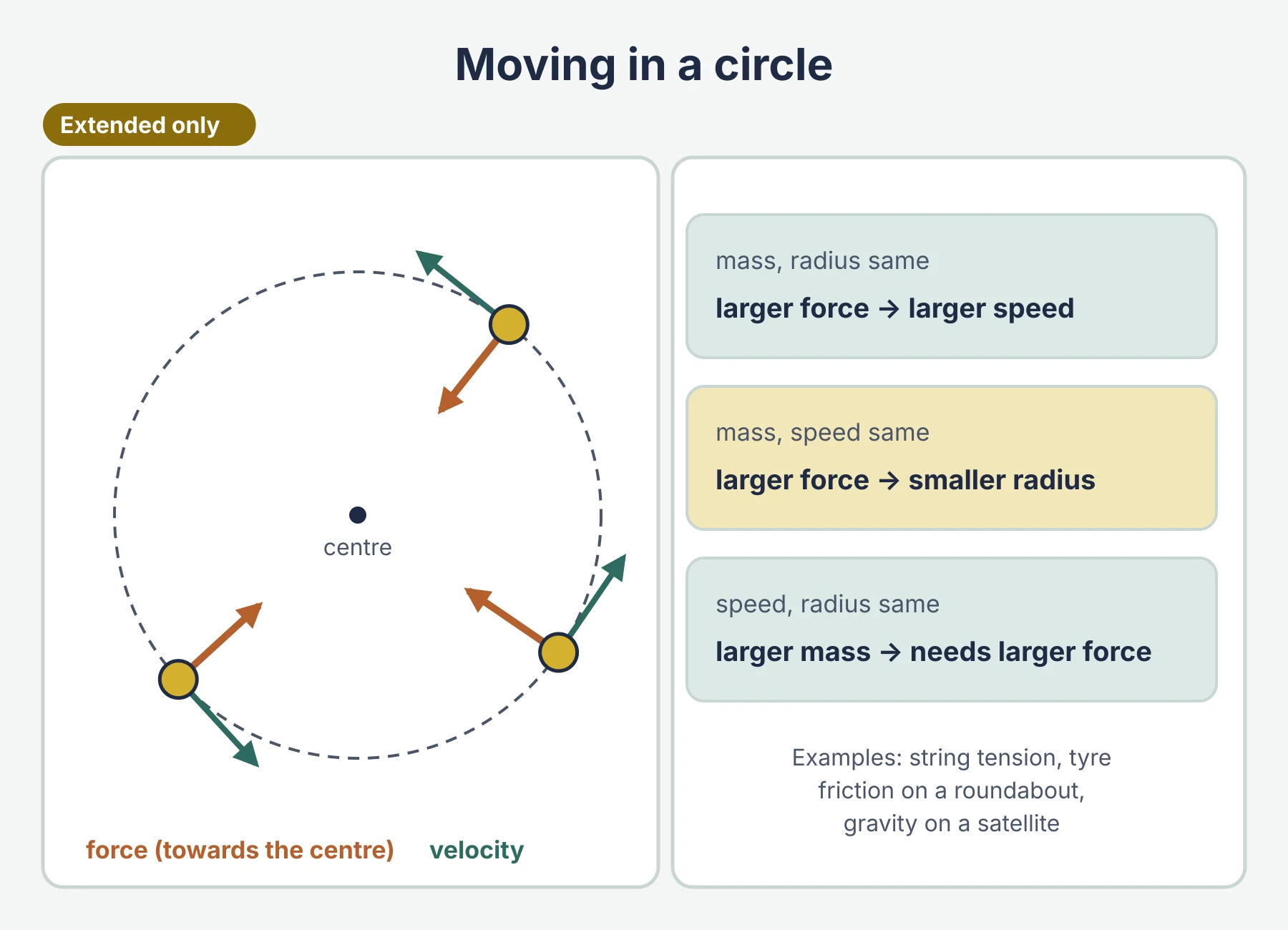
An object moves in a circle when a force acts perpendicular to its motion, towards the centre of the circle. The force changes the direction of the velocity, not the speed. Examples: tension in a string whirling a ball, friction between tyres and road on a roundabout, gravity on a satellite.
Qualitatively:
- (a) with mass and radius constant, a larger force means a larger speed;
- (b) with mass and speed constant, a larger force means a smaller radius;
- (c) a larger mass needs a larger force to keep the same speed and radius.
So a car taking a tight bend fast needs a large sideways friction force; on an icy road friction is small and the car cannot follow the bend. No equation (F = mv²/r) is needed.
Turning effect of forces (1.5.2)
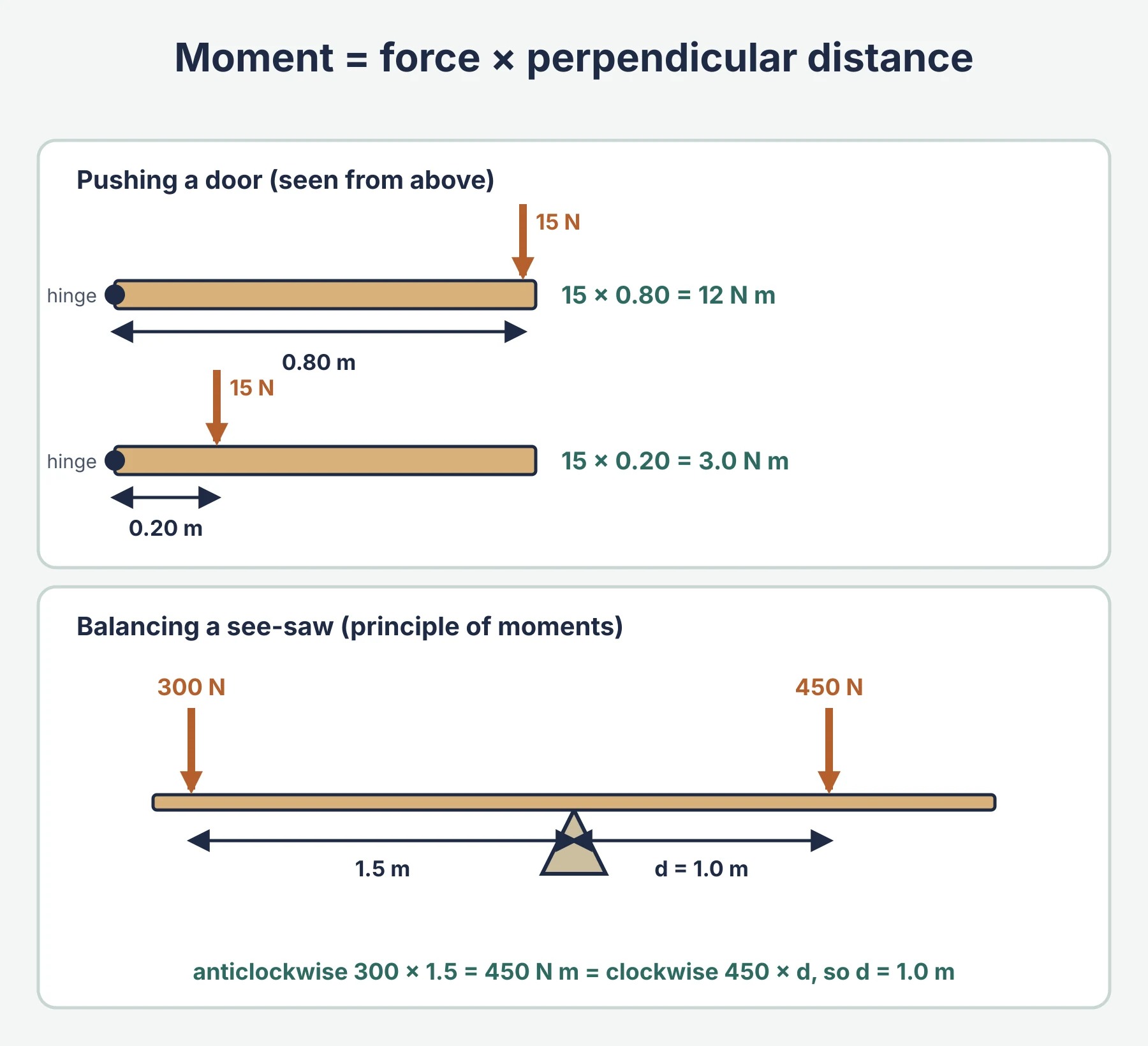
The moment of a force is its turning effect:
moment = force × perpendicular distance from the pivot (N m)The distance must be perpendicular to the line of the force. Pushing a door at its handle, 0.80 m from the hinge, with 15 N gives a moment of 12 N m; pushing at 0.20 m gives only 3.0 N m.
Principle of moments. For an object in equilibrium, the sum of the clockwise moments about any pivot equals the sum of the anticlockwise moments.
Core example. A child of weight 300 N sits 1.5 m from the pivot of a see-saw. Where must a 450 N child sit to balance it?
450 × d = 300 × 1.5 = 450 N m → d = 1.0 m on the other sideEquilibrium. An object is in equilibrium when there is no resultant force and no resultant moment. A balanced see-saw is in equilibrium: the moments balance, and the upward force of the pivot equals the total weight.
More than one force each side (Extended only)
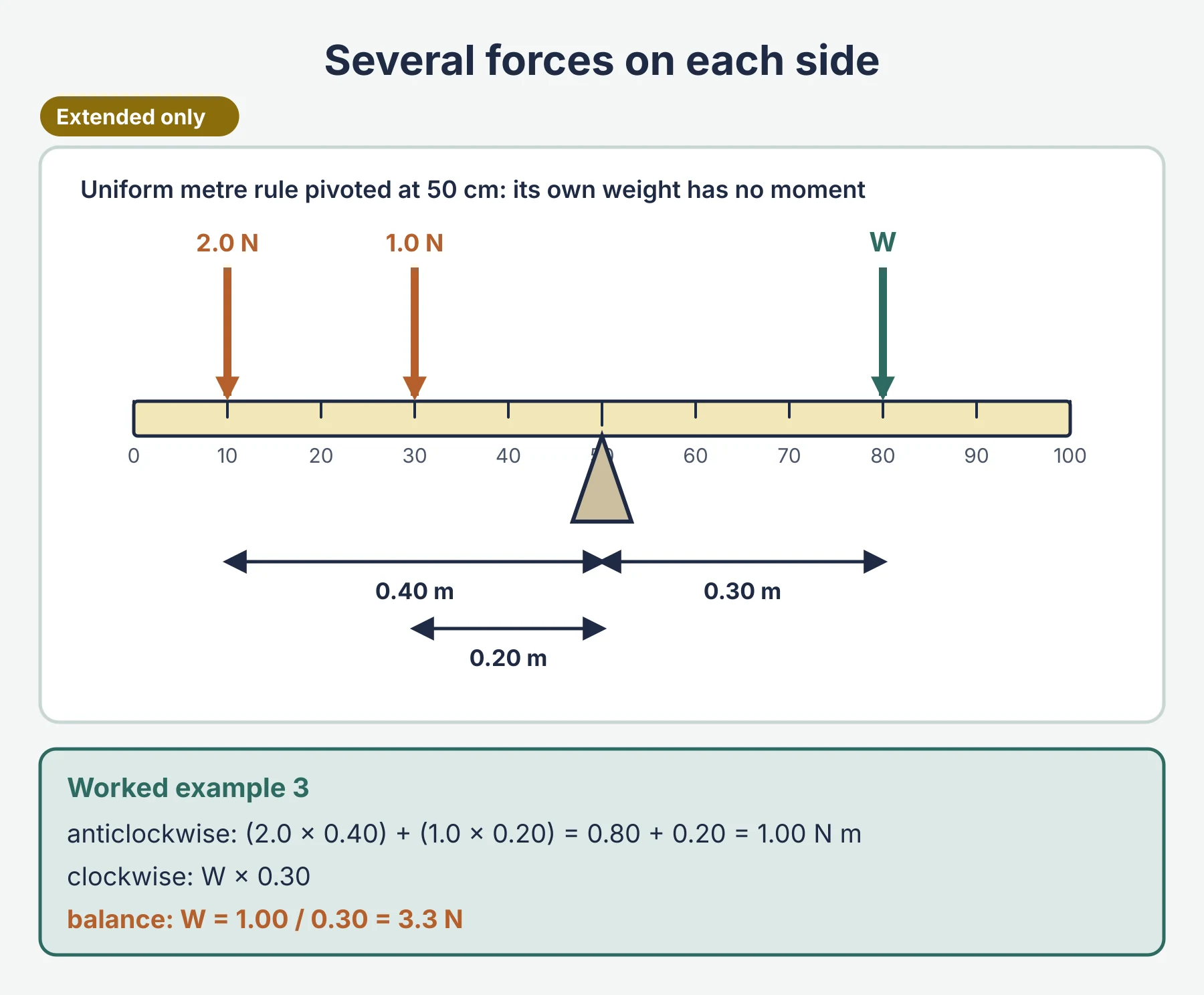
Worked example 3. A uniform metre rule is pivoted at its centre (50 cm mark). A 2.0 N weight hangs at the 10 cm mark and a 1.0 N weight at the 30 cm mark. Find the weight W at the 80 cm mark that balances it.
anticlockwise: (2.0 × 0.40) + (1.0 × 0.20) = 0.80 + 0.20 = 1.00 N m
clockwise:     W × 0.30
balance:       W = 1.00 / 0.30 = 3.3 N
The rule is uniform and pivoted at its centre, so its own weight acts through the pivot and has no moment. If the pivot were elsewhere, the rule’s weight (acting at its centre) would need to be included.
Experiment: no resultant moment in equilibrium (Extended only). Balance a metre rule on a pivot (a knife-edge) through its centre. Hang different known weights at various positions on both sides, using thread loops, and slide them until the rule balances horizontally. Record each weight and its distance from the pivot. Calculate the total clockwise and total anticlockwise moments: they are equal (within experimental error) every time, so there is no resultant moment. Repeat with new positions and weights.
Centre of gravity (1.5.3)
The centre of gravity of an object is the point through which its whole weight appears to act. For a uniform ruler it is at the centre; for an irregular lamina it is found with a plumb line, as described in the topic guide.
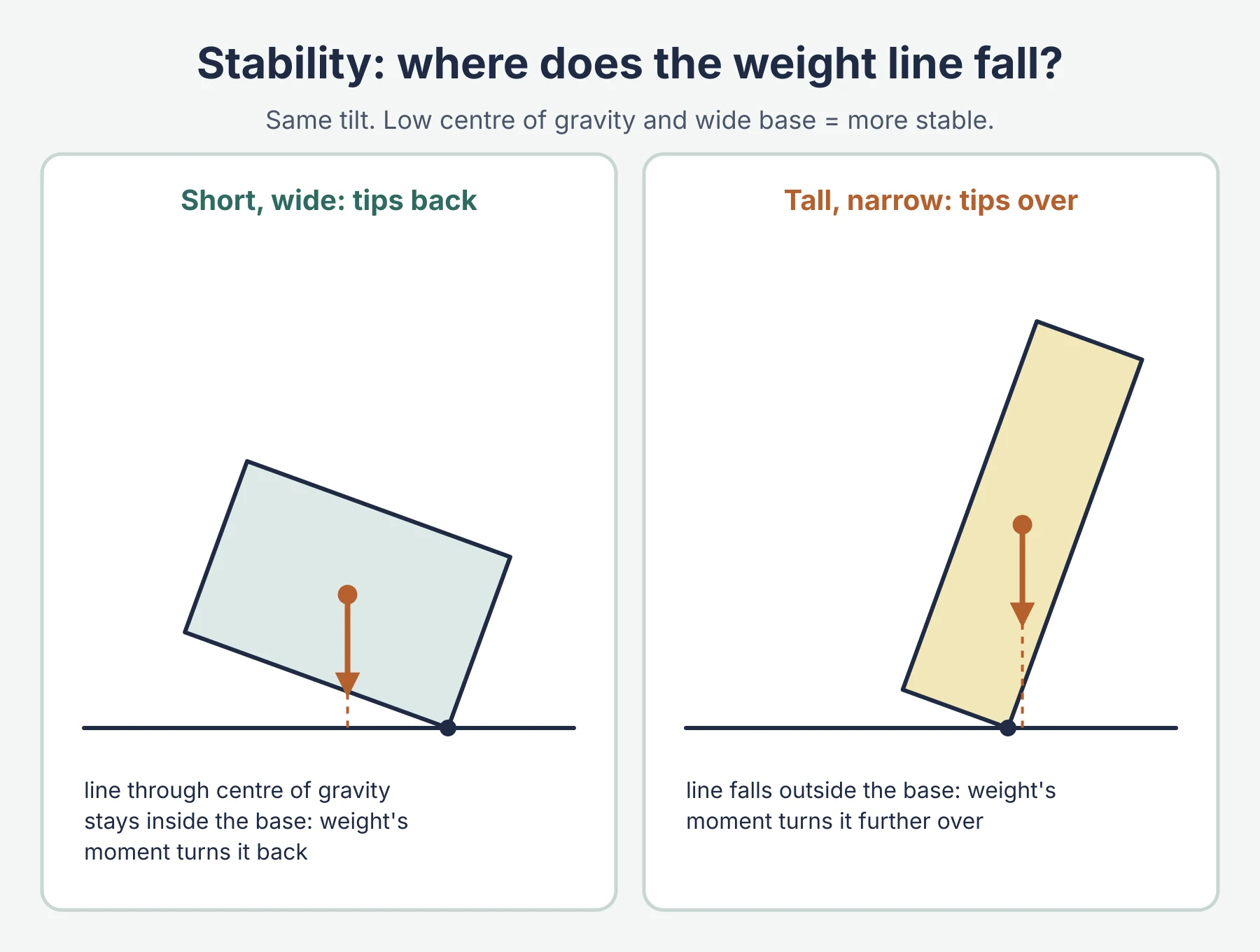
Stability. An object tips over when the vertical line through its centre of gravity falls outside its base. Its weight then has a moment about the edge it is tilting on that turns it further over. While the line stays inside the base, the moment of the weight turns it back.
An object is more stable when it has:
- a low centre of gravity, so it can tilt further before the line passes outside the base;
- a wide base.
Examples: racing cars are low and wide; a laboratory stand has a heavy base; a double-decker bus is loaded so most of its mass is low down; a tall, narrow vase tips over more easily than a short, wide bowl of the same mass.
Common mistakes
- Using the length of a spring instead of its extension.
- Calling the limit of proportionality the elastic limit (Extended).
- Saying a moving object must have a resultant force on it.
- (Extended) Using one of the forces, not the resultant, in F = ma.
- (Extended) Describing a “force outwards” on an object moving in a circle; the force is towards the centre.
- Using a distance that is not perpendicular to the force, or measuring it from the end of the beam rather than the pivot.
- Forgetting units: moments are in N m.
Exam technique: command words
- State the conditions for equilibrium: both “no resultant force” and “no resultant moment”.
- Describe an experiment: apparatus, what you measure and how, how you avoid parallax, and what you calculate or plot.
- Calculate a moment or a resultant: show the products or the subtraction, and give a direction where relevant.
- Explain a stability question: use “centre of gravity”, “base” and “moment” in your answer.
- Describe, qualitatively (Extended): say what changes and in which direction, holding the other two quantities constant.
Check your recall with the revision notes on forces, then try the practice questions on forces. Resultant force links to the study guide on momentum, and work done by a force to the study guide on energy, work and power.
Related resources
-
Practice questions
Cambridge IGCSE Physics (0625): Forces – Practice Questions
Thirteen original Cambridge IGCSE Physics 0625 forces questions: springs, resultants, friction, F = ma, circular motion, moments and stability, with answers.
Physics · Cambridge · IGCSE
Try questions -
Revision notes
Cambridge IGCSE Physics (0625): Forces – Revision Notes
Revision notes for Cambridge IGCSE Physics 0625 section 1.5 Forces: extension, resultants, F = ma, circular motion, moments, centre of gravity and a self-test.
Physics · Cambridge · IGCSE
Revise topic -
Study guides
Cambridge IGCSE Physics (0625): Mass and weight
Study guide to Cambridge IGCSE Physics 0625 section 1.3: mass, weight, gravitational field strength g = W/m, balances and weight as a field effect.
Physics · Cambridge · IGCSE
Read guide
Related articles
Get free revision emails (optional)
Occasional emails with practice questions, worked explanations and links to free resources for the qualification and subjects you choose. No spam, and you can unsubscribe from any email. The free tools on this site never need an email.