
Revision Notes
Cambridge IGCSE Physics (0625): Density – Revision Notes
Revision notes for Cambridge IGCSE Physics 0625 section 1.4 Density: ρ = m/V, unit conversion, experiment steps, floating rules, liquid layers and a self-test.
- Subject
- Physics
- Level
- IGCSE
- Topic
- Motion, forces and energy
- Author
- Marlbridge Academic Team
- Updated
- Reviewed by
- Iftikhar Azeemi (what this means)
Aligned to Cambridge IGCSE Physics (0625), For examination in 2026, 2027 and 2028. Official specification .
Syllabus page (what it covers and how it is assessed): Cambridge IGCSE Physics.
Syllabus points this page covers, with Core and Extended
0625
- 1.4 Density · Core and Extended
"Core and Extended" means part of that syllabus point is Extended only. The page's own tier notes say which part.
Found an error? Report a correction.
Need help with this topic? Request a free trial class for IGCSE Physics (0625).
These notes condense section 1.4, Density, of the Cambridge IGCSE Physics 0625 syllabus for examination in 2026, 2027 and 2028. Supplement content, marked Extended only, is examined on Papers 2 and 4. Full explanations and worked examples are in the study guide on density; the Motion, forces and energy revision notes cover the whole of Topic 1.
Definition and equation
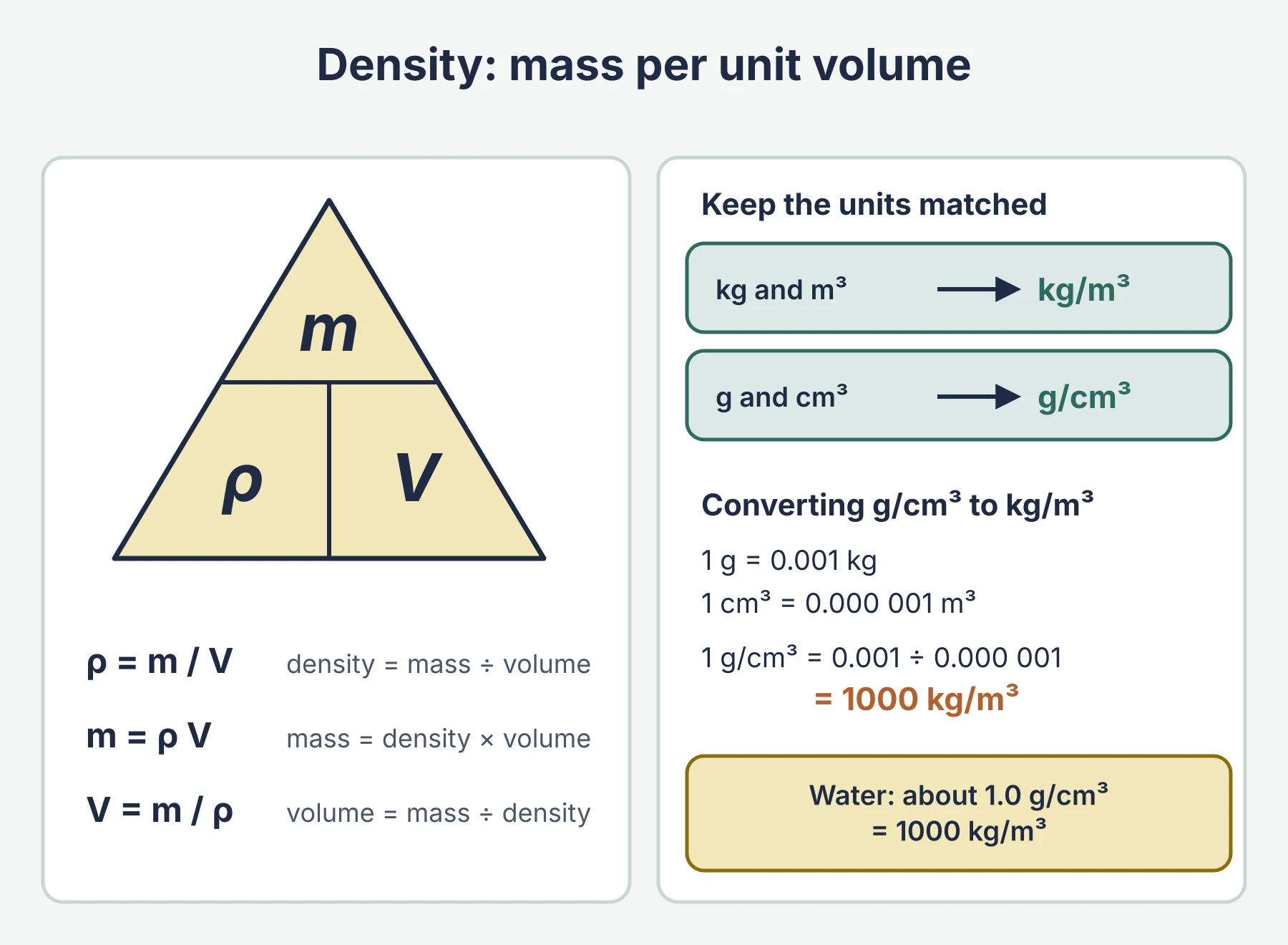
- Density: mass per unit volume.
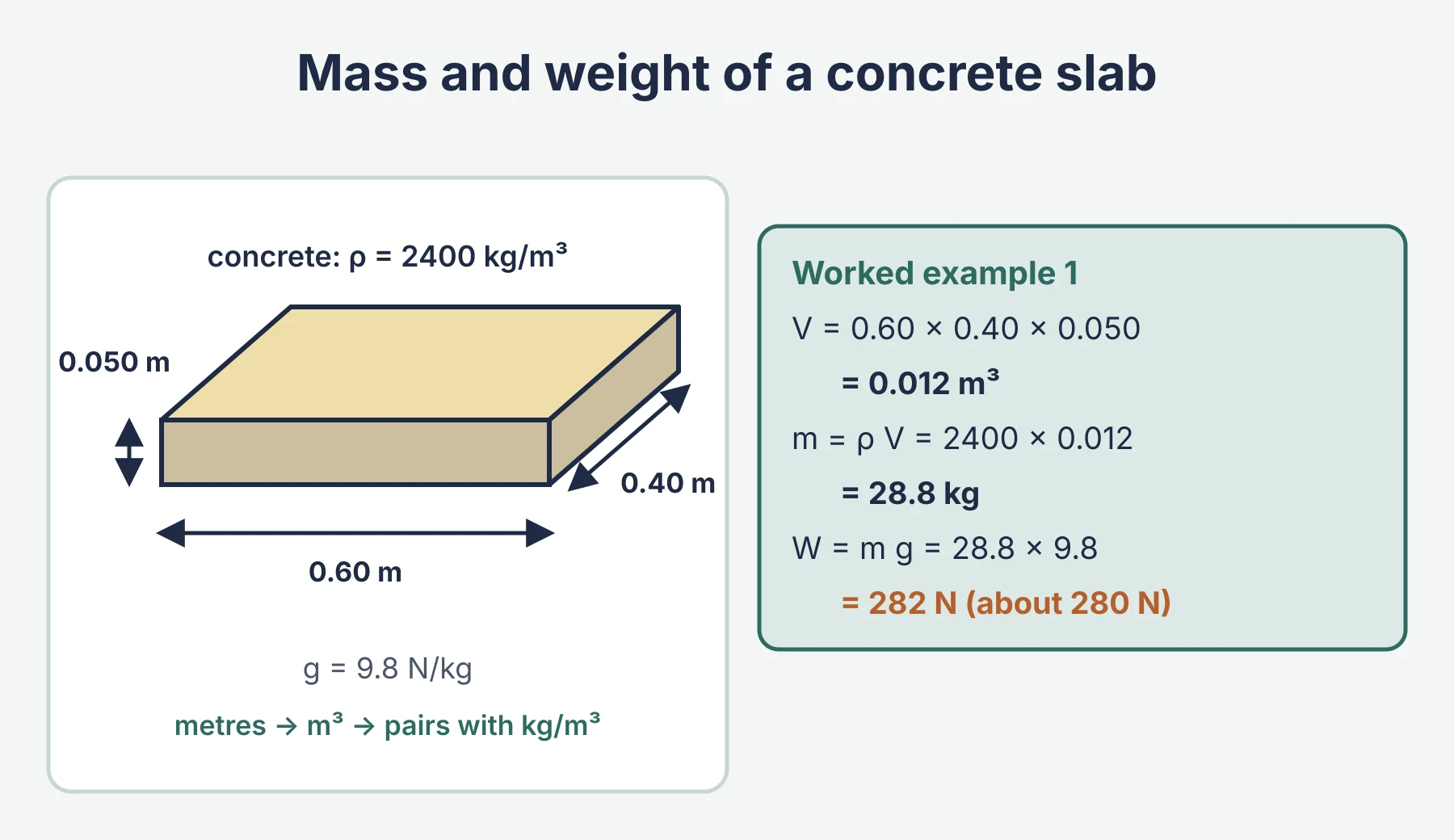
- ρ = m / V; rearranged, m = ρV and V = m/ρ.
| Mass in | Volume in | Density in |
|---|---|---|
| kg | m³ | kg/m³ |
| g | cm³ | g/cm³ |
Conversions
- 1 g/cm³ = 1000 kg/m³ (so 2.7 g/cm³ = 2700 kg/m³; 850 kg/m³ = 0.85 g/cm³).
- 1 m³ = 1 000 000 cm³; 1 litre = 1000 cm³ = 0.001 m³.
- 1 cm³ = 1 ml.
- Water ≈ 1.0 g/cm³ = 1000 kg/m³.
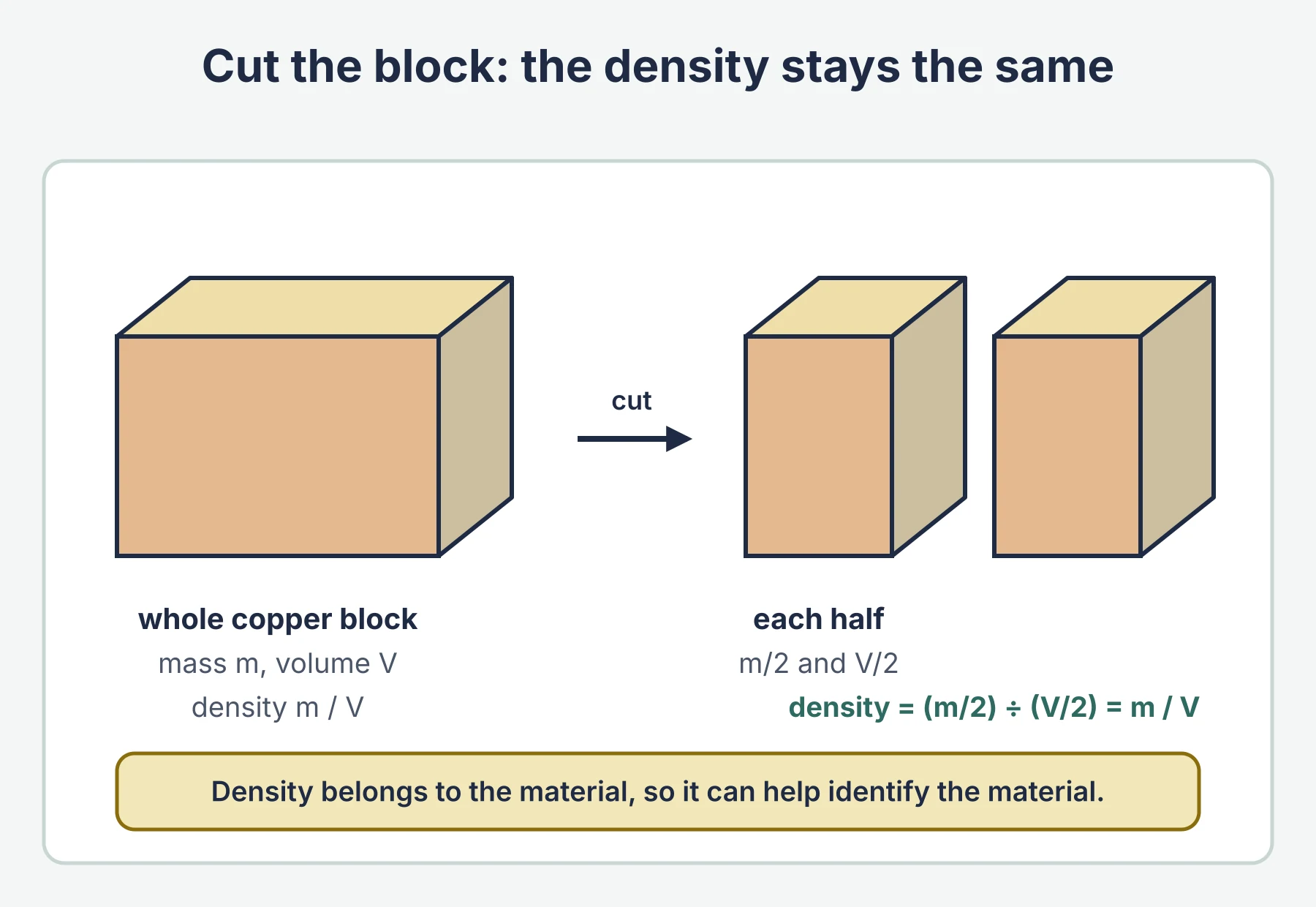
Density is a property of the material: it does not change when the object is cut into pieces.
Experiments in steps
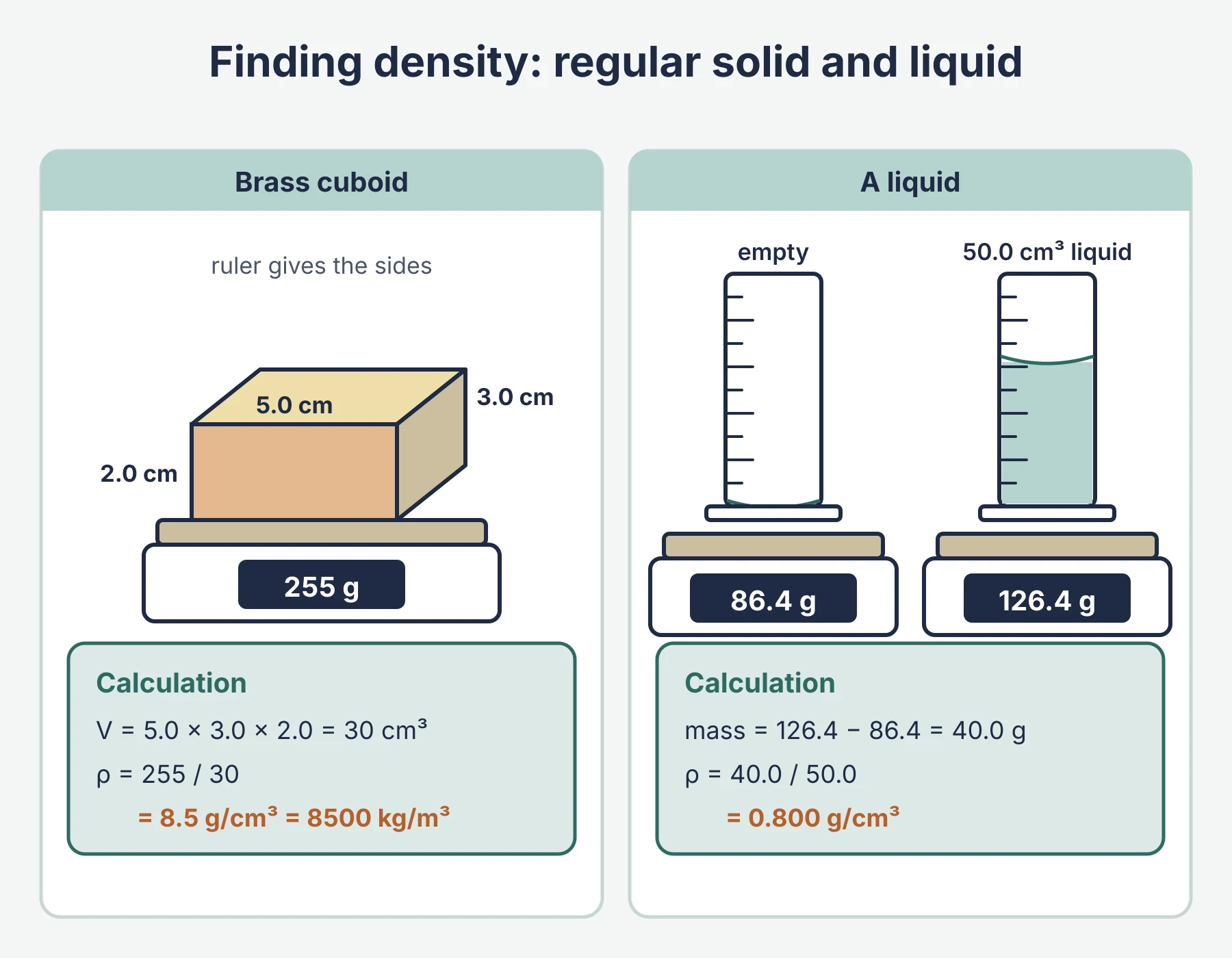
Regular solid
- Mass on a balance.
- Measure length, width and height with a ruler.
- V = l × w × h (cylinder: πr² × length).
- ρ = m/V.
Liquid
- Mass of the empty measuring cylinder (or tare the balance with it on).
- Add liquid; read the volume (bottom of meniscus, eye level).
- Mass of cylinder + liquid.
- Liquid mass = difference; ρ = m/V.
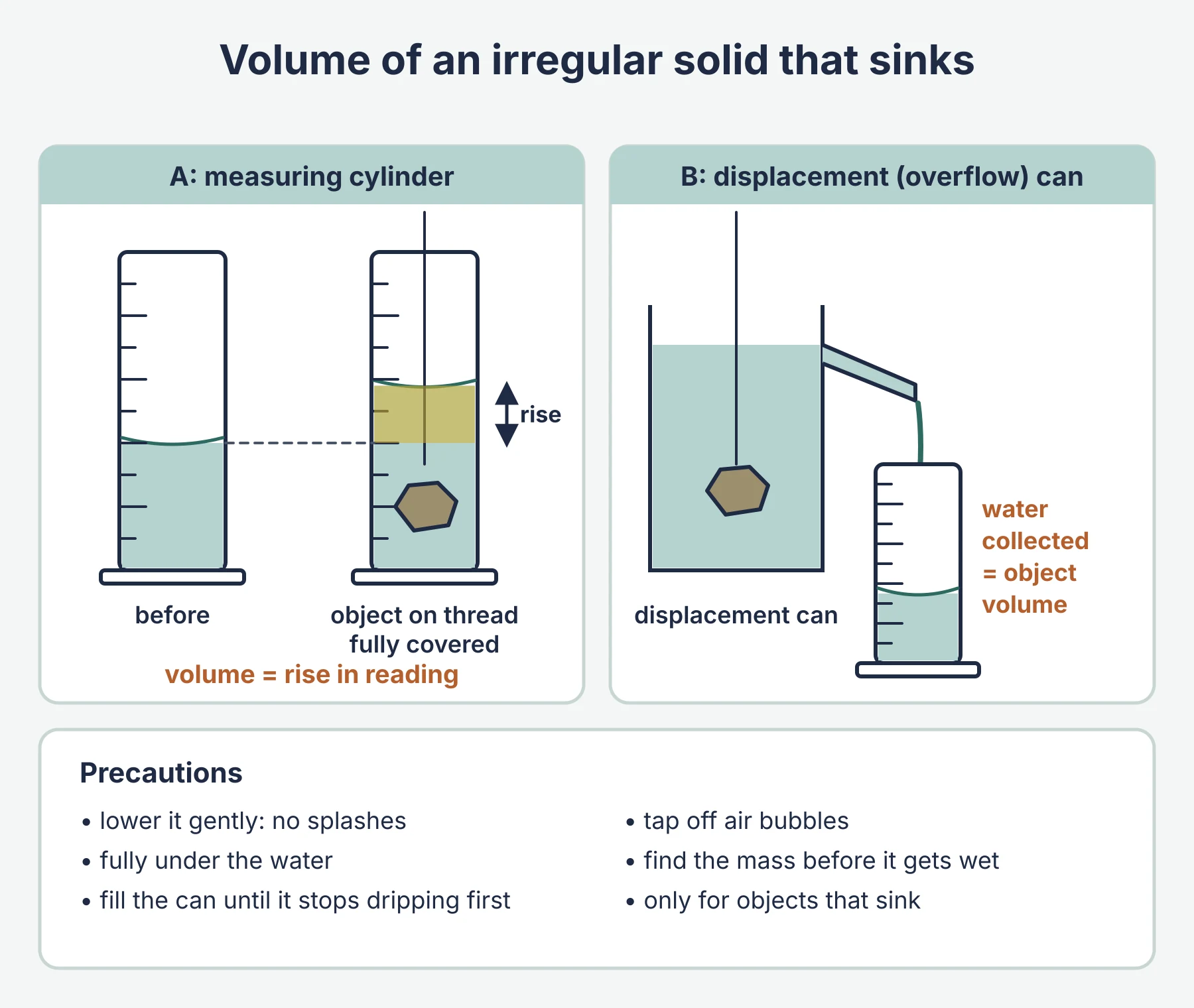
Irregular solid that sinks
- Mass on a balance first (dry).
- Part-fill a measuring cylinder with water; read V₁.
- Lower the object in on a thread until fully covered; read V₂.
- Volume = V₂ − V₁; ρ = m/(V₂ − V₁).
Alternative: a displacement (overflow) can filled to the spout; collect the water the object pushes out in a measuring cylinder.
Precautions: no splashing; object fully covered; no trapped air bubbles; read the bottom of the meniscus.
Which method?
| Object | Find its volume by | Reason |
|---|---|---|
| cuboid or cylinder | measuring its dimensions | regular shape |
| small pebble | rise in a measuring cylinder | fits in the cylinder and sinks |
| large rock | overflow can | too wide for a cylinder |
| cork | not by simple displacement | floats, so it is not fully covered |
Small dimensions give large percentage errors: a 1 mm error in a 1.0 cm side is 10%, so measure each side in several places and average, or use a larger sample.
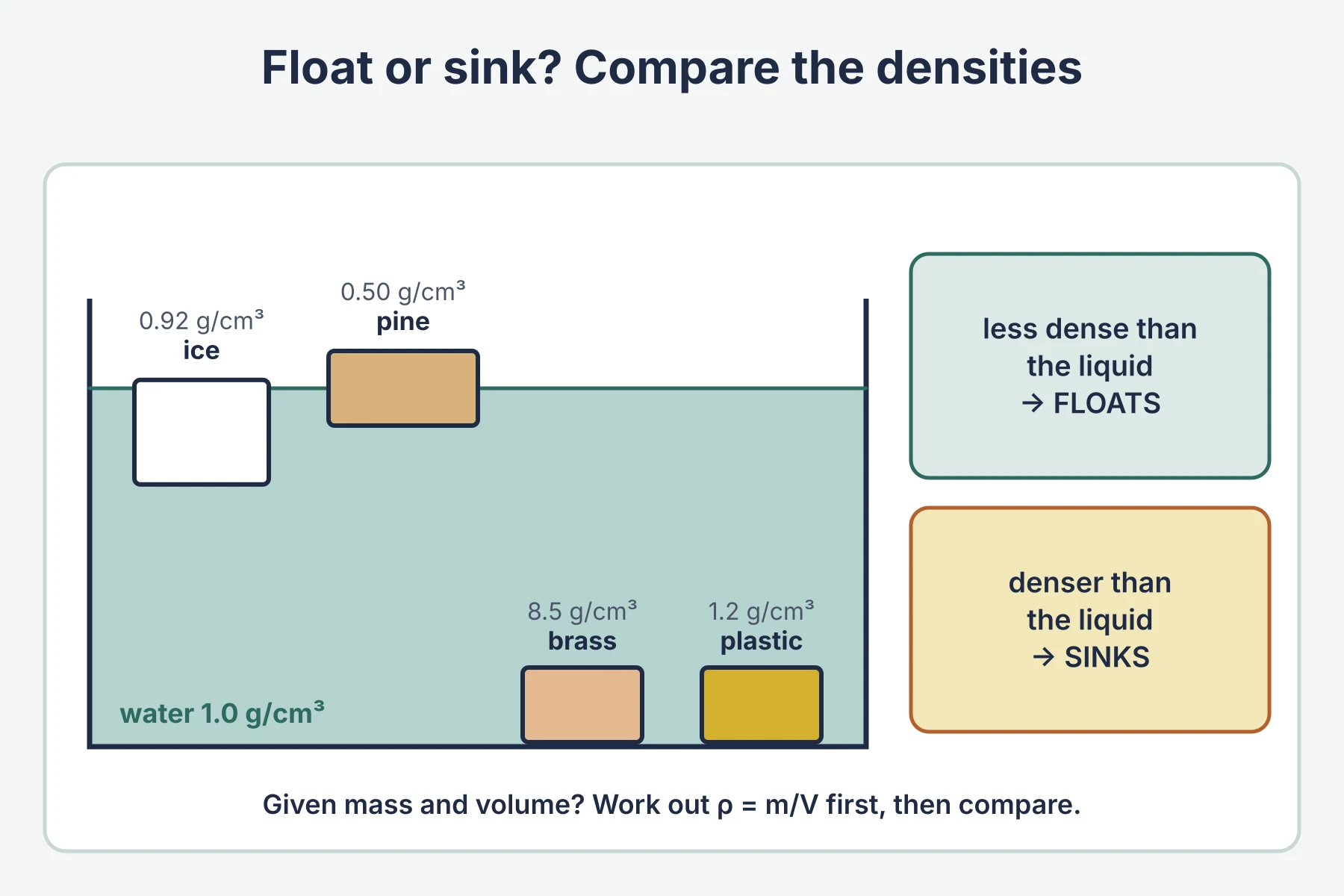
Floating
- ρ(object) < ρ(liquid) → floats.
- ρ(object) > ρ(liquid) → sinks.
- Given mass and volume? Work out the density first.
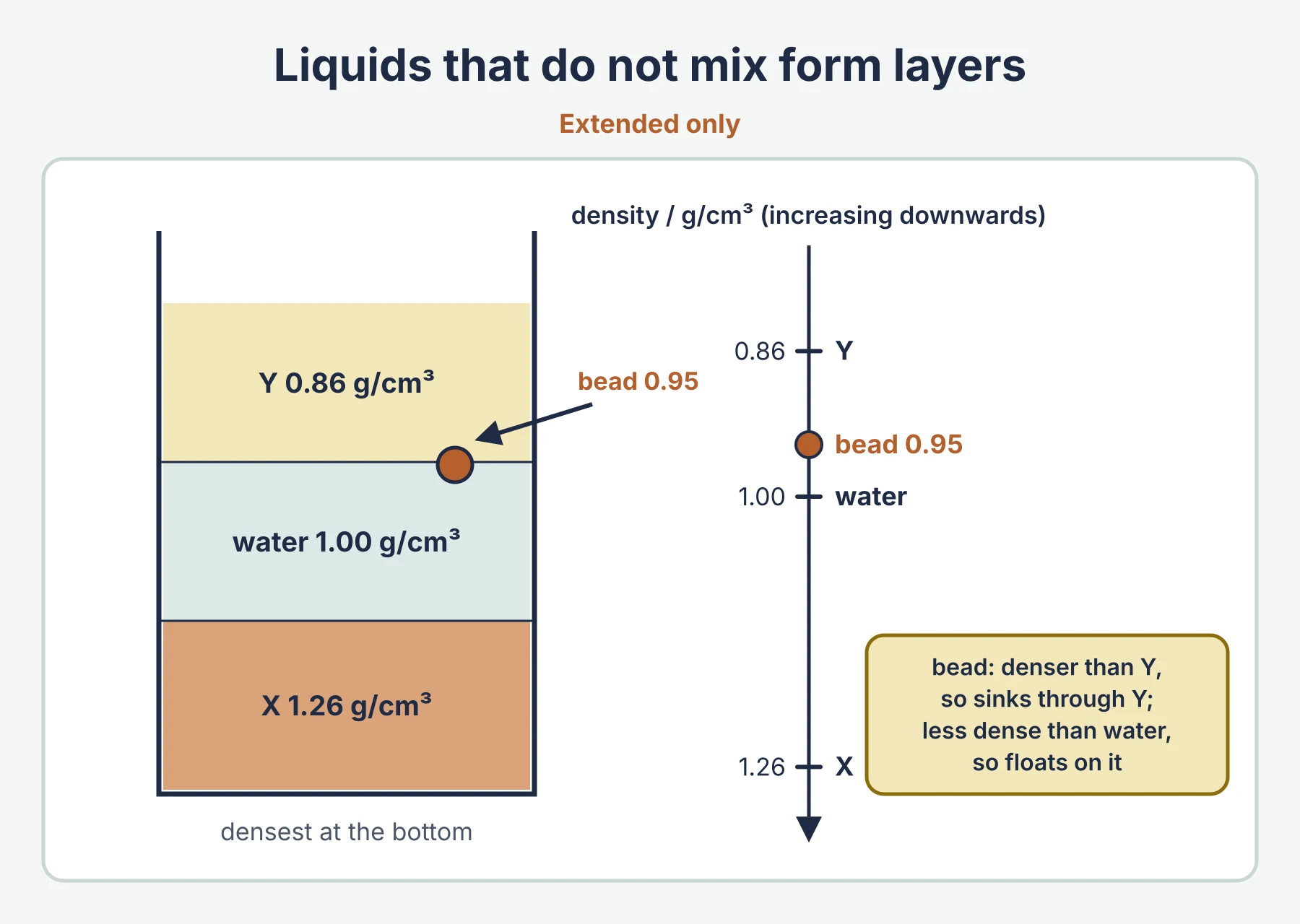
Liquids that do not mix (Extended only)
- Layers form with the densest liquid at the bottom.
- A less dense liquid floats on a denser one.
- An object settles at the boundary between two layers if its density lies between theirs.
- Liquids that mix form no layers.
Key terms
| Term | Meaning |
|---|---|
| Density | Mass per unit volume |
| Displacement | Water pushed aside by an object; its volume equals the volume of the submerged object |
| Displacement (overflow) can | Can with a spout; water that overflows when an object is added is collected and measured |
| Meniscus | Curved liquid surface; read the bottom for water |
| Tare | Set a balance to zero with a container on it |
| Immiscible liquids (Extended) | Liquids that do not mix |
Exam traps
- ρ = V/m written by mistake: check that a metal gives a density bigger than 1 g/cm³.
- Mixed units: never combine g with m³ or kg with cm³.
- Factor of 1000: g/cm³ × 1000 = kg/m³.
- Final level as volume: the object’s volume is the rise in level.
- Container mass included: subtract the empty cylinder’s mass.
- Floating objects by displacement: the syllabus method is for solids that sink.
- “Heavy things sink”: compare densities, not masses.
- (Extended) Liquid order by mass or volume: order is by density only.
Quick self-test
- Define density.
- Convert 7.9 g/cm³ to kg/m³.
- Convert 920 kg/m³ to g/cm³.
- A metal cube of side 2.0 cm has a mass of 72 g. Find its density.
- A liquid has a density of 1.2 g/cm³. Find the mass of 250 cm³ of it.
- A stone is lowered into a measuring cylinder; the level rises from 35 cm³ to 47 cm³. The stone’s mass is 30 g. Find its density.
- An empty measuring cylinder has a mass of 92.0 g. With 40.0 cm³ of oil in it, the mass is 128.0 g. Find the density of the oil.
- A block has a mass of 600 g and a volume of 750 cm³. Does it float in water?
- A gold ring and a gold bar are made of the same gold. Compare their densities.
- Why should an object be weighed before it is put into the water?
- (Extended) Liquids A (0.79 g/cm³) and B (1.6 g/cm³) do not mix. Which forms the top layer?
- (Extended) A cork of density 0.24 g/cm³ is dropped into the jar in question 11. Where does it end up?
Answers
- Mass per unit volume.
- 7.9 × 1000 = 7900 kg/m³.
- 920 ÷ 1000 = 0.92 g/cm³.
- V = 2.0³ = 8.0 cm³; ρ = 72 ÷ 8.0 = 9.0 g/cm³.
- m = 1.2 × 250 = 300 g.
- V = 12 cm³; ρ = 30 ÷ 12 = 2.5 g/cm³.
- m = 36.0 g; ρ = 36.0 ÷ 40.0 = 0.900 g/cm³.
- ρ = 600 ÷ 750 = 0.80 g/cm³, less than 1.0 g/cm³, so it floats.
- The same: density depends on the material, not the size.
- Water clinging to it would add to its measured mass.
- A (it is less dense).
- It floats on top of liquid A (0.24 < 0.79).
Where to go next
Work through the practice questions on density, then move on to the revision notes on forces.
Related resources
-
Study guides
Cambridge IGCSE Physics (0625): Energy, work and power
Study guide to Cambridge IGCSE Physics 0625 section 1.7: energy stores and transfers, kinetic and potential energy, work, resources, efficiency and power.
Physics · Cambridge · IGCSE
Read guide -
Practice questions
Cambridge IGCSE Physics (0625): Energy, work and power – Practice Questions
Thirteen original Cambridge IGCSE Physics 0625 questions on energy stores, work, power, Ek, Ep, efficiency and energy resources, with mark-by-mark answers.
Physics · Cambridge · IGCSE
Try questions -
Revision notes
Cambridge IGCSE Physics (0625): Energy, work and power – Revision Notes
Revision notes for Cambridge IGCSE Physics 0625 section 1.7: stores, transfers, Ek, Ep, work, power, efficiency and energy resources, with a self-test.
Physics · Cambridge · IGCSE
Revise topic
Related articles
Get free revision emails (optional)
Occasional emails with practice questions, worked explanations and links to free resources for the qualification and subjects you choose. No spam, and you can unsubscribe from any email. The free tools on this site never need an email.