
Study Guides
Cambridge IGCSE Physics (0625): Density
Study guide to Cambridge IGCSE Physics 0625 section 1.4 Density: ρ = m/V, unit conversions, the three density experiments, floating and liquid layers.
- Subject
- Physics
- Level
- IGCSE
- Topic
- Motion, forces and energy
- Author
- Marlbridge Academic Team
- Updated
- Reviewed by
- Iftikhar Azeemi (what this means)
Aligned to Cambridge IGCSE Physics (0625), For examination in 2026, 2027 and 2028. Official specification .
Syllabus page (what it covers and how it is assessed): Cambridge IGCSE Physics.
Syllabus points this page covers, with Core and Extended
0625
- 1.4 Density · Core and Extended
"Core and Extended" means part of that syllabus point is Extended only. The page's own tier notes say which part.
Found an error? Report a correction.
Need help with this topic? Request a free trial class for IGCSE Physics (0625).
This guide teaches section 1.4, Density, of the Cambridge IGCSE Physics 0625 syllabus for examination in 2026, 2027 and 2028. Core statements 1 to 3 cover the definition, the three experiments and deciding whether an object floats. Supplement statement 4, deciding whether one liquid floats on another, is examined only on Papers 2 and 4 and is labelled Extended only. The Motion, forces and energy study guide outlines the experiments briefly; this page adds the unit work, the precautions examiners look for and fuller calculations.
What the syllabus asks for
| Statement | Tier | Content |
|---|---|---|
| 1 | Core | Define density as mass per unit volume; recall and use ρ = m/V |
| 2 | Core | Describe how to find the density of a liquid, a regularly shaped solid and an irregularly shaped solid that sinks (volume by displacement), with calculations |
| 3 | Core | Decide whether an object floats from density data |
| 4 | Extended only | Decide whether one liquid floats on another, from density data, when the liquids do not mix |
Density and its units
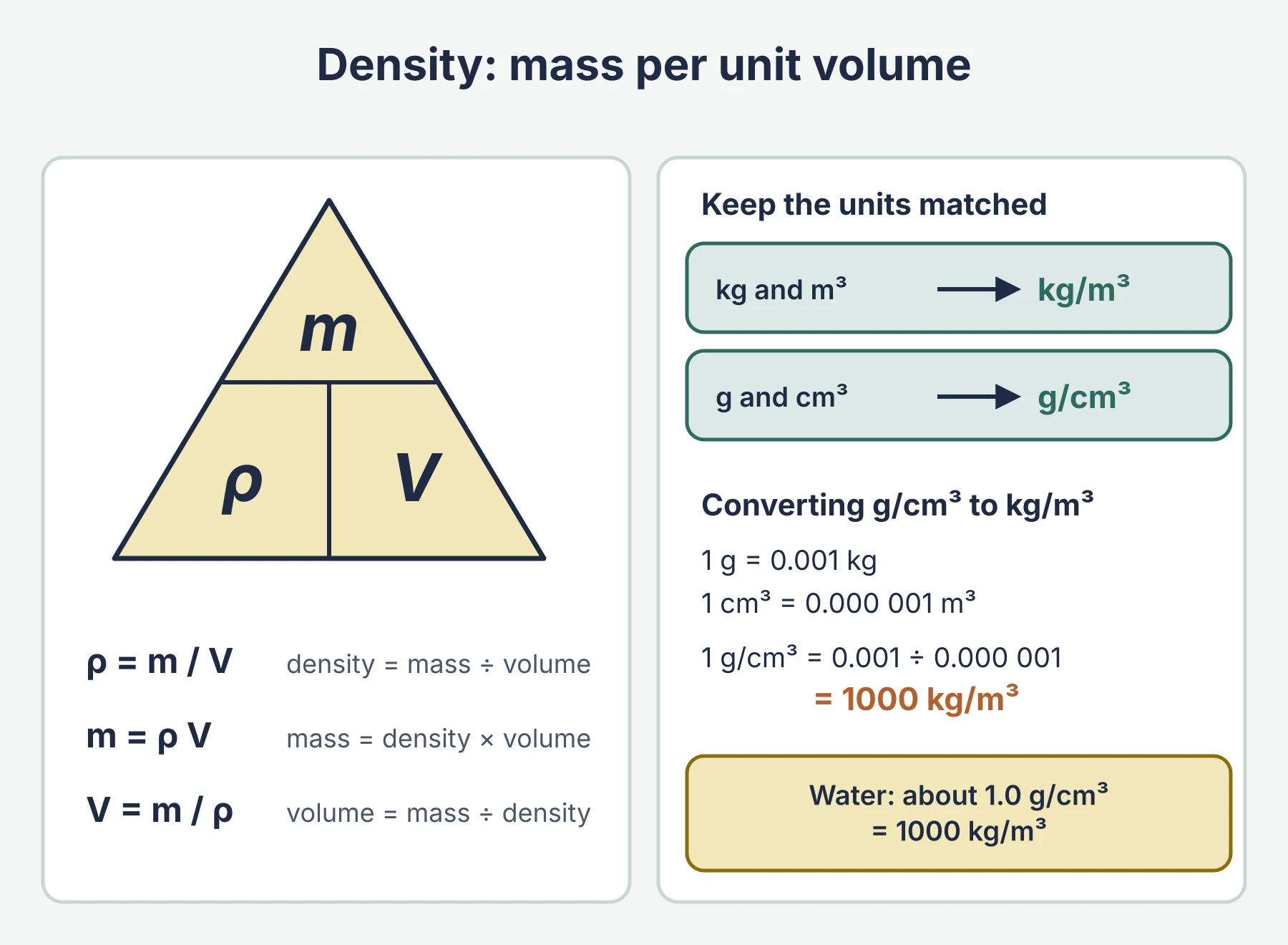
Density is mass per unit volume:
ρ = m / V m = ρ V V = m / ρρ (the Greek letter rho) is in kg/m³ when m is in kg and V in m³, or in g/cm³ when m is in g and V in cm³.
Converting. 1 g/cm³ = 1000 kg/m³, because 1 g = 0.001 kg and 1 cm³ = 0.000 001 m³, so 1 g/cm³ = 0.001 ÷ 0.000 001 = 1000 kg/m³. Water has a density of about 1.0 g/cm³ = 1000 kg/m³.
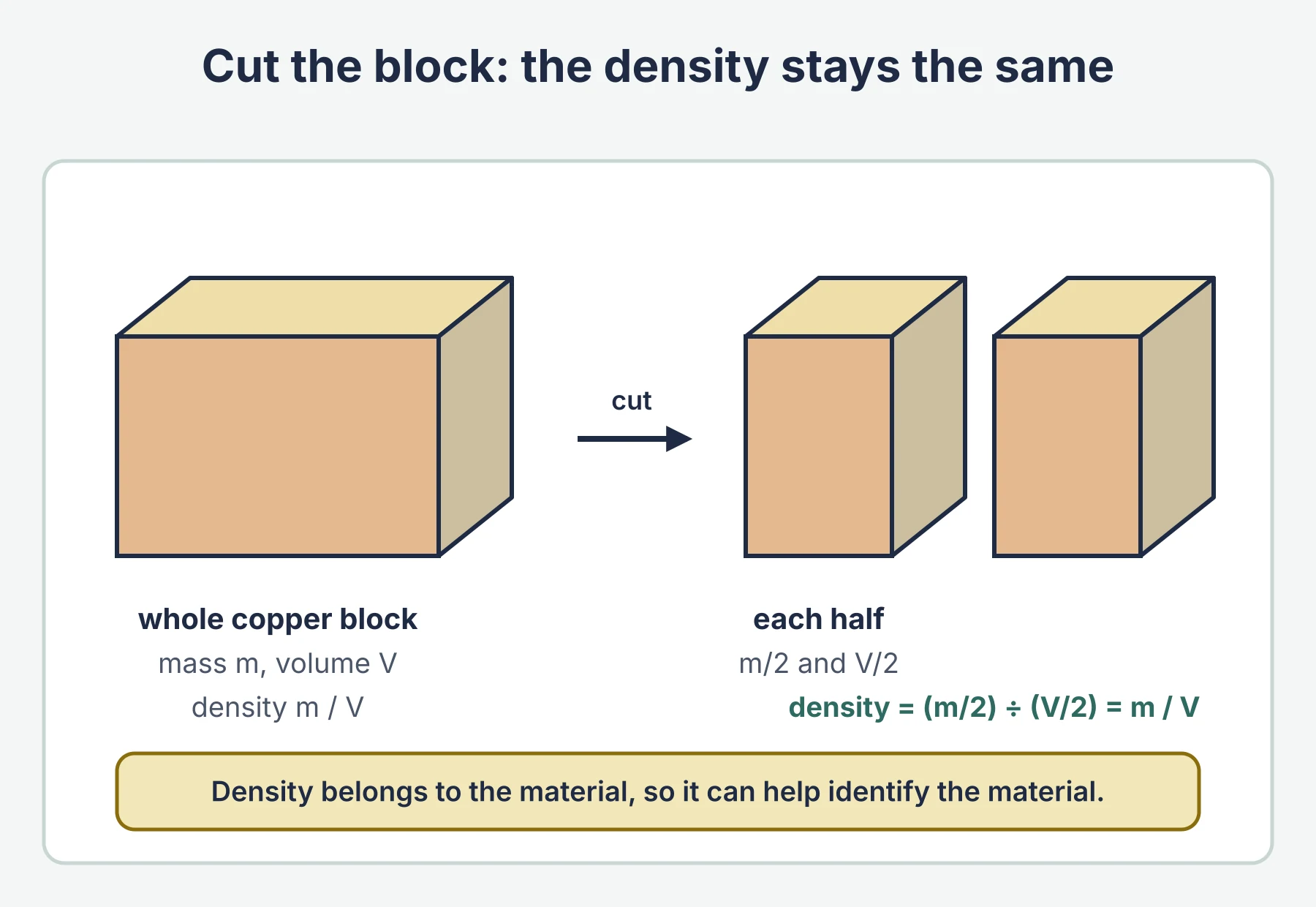
Density is a property of the material, not of the object. Cut a copper block in half and each half has half the mass and half the volume, so the density is unchanged. That is why density can help identify a material.
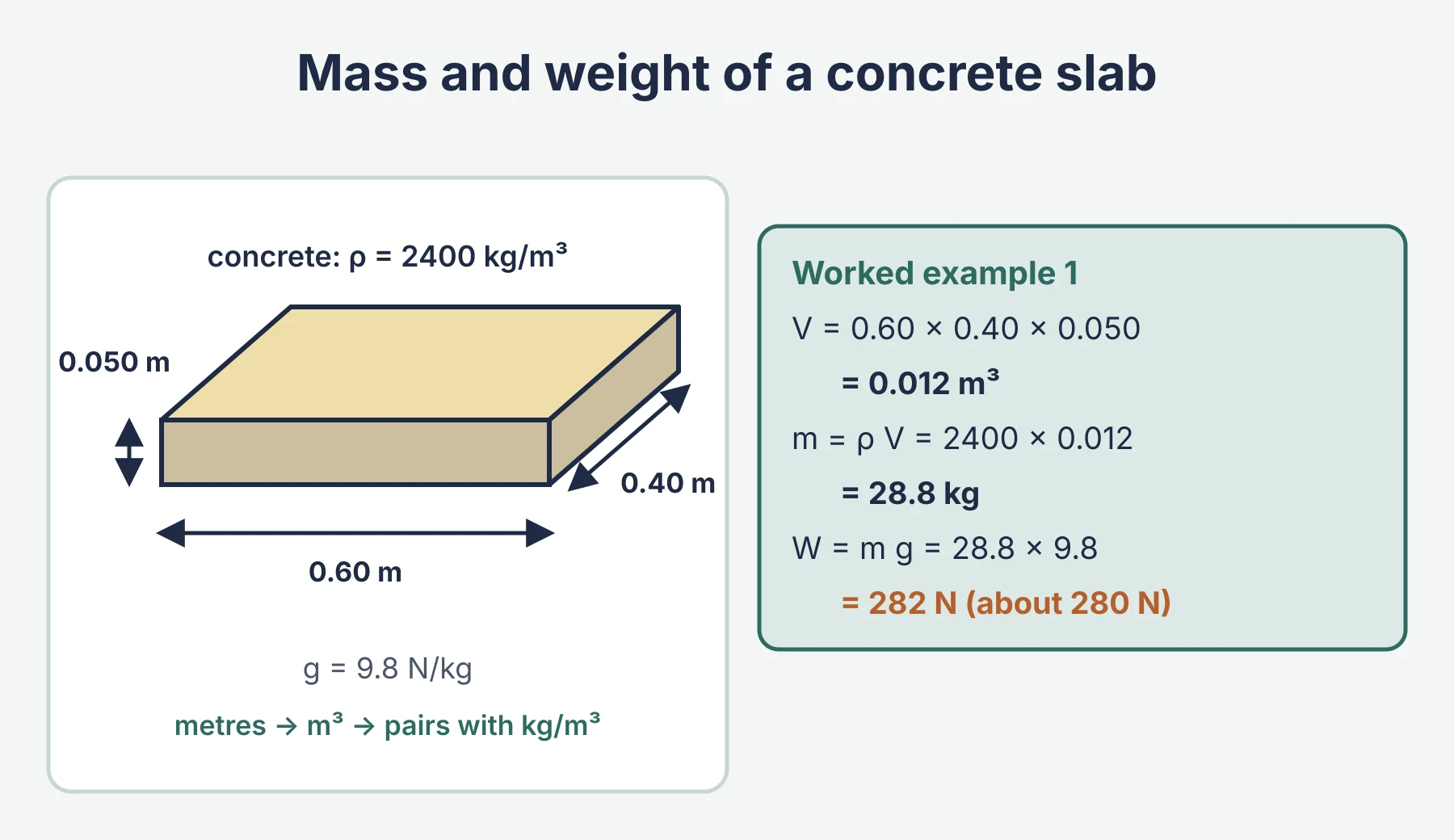
Worked example 1 (large object). A concrete paving slab measures 0.60 m × 0.40 m × 0.050 m. Concrete has a density of 2400 kg/m³. Find the slab’s mass and its weight (g = 9.8 N/kg).
V = 0.60 × 0.40 × 0.050 = 0.012 m³
m = ρ V = 2400 × 0.012 = 28.8 kg
W = m g = 28.8 × 9.8 = 282 N   (about 280 N)
Keep the units consistent: lengths in metres give a volume in m³, which pairs with kg/m³.
The three experiments
Each experiment needs a mass (from a balance) and a volume (found differently each time).
A regularly shaped solid
- Find the mass on a balance.
- Measure the dimensions with a ruler (or, for small objects, more precisely with the multiples method from section 1.1 where possible). Measure each dimension in two or three places and average.
- Calculate the volume: a cuboid is length × width × height; a cylinder is π × radius² × length.
- ρ = m ÷ V.
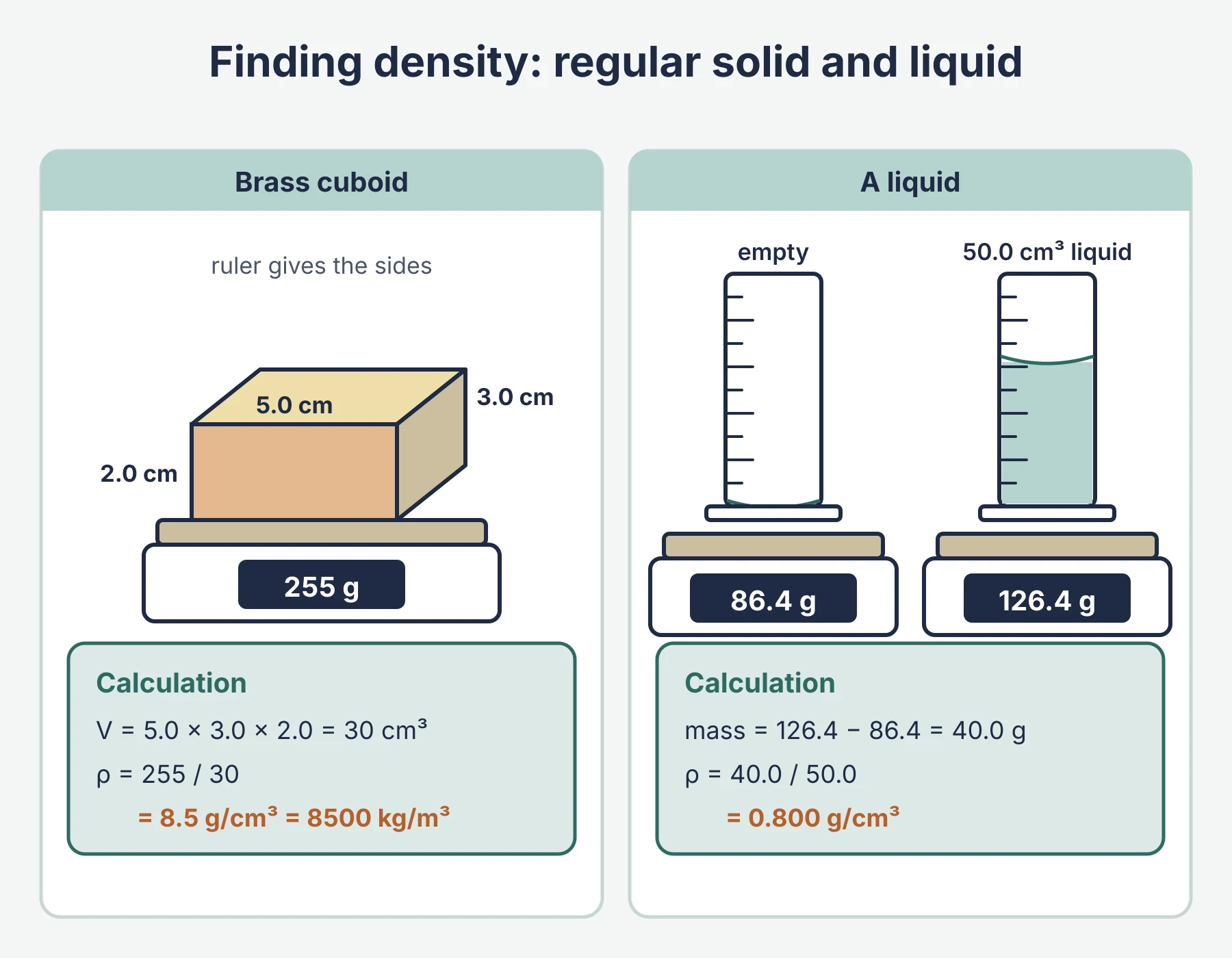
Worked example 2. A brass cuboid is 5.0 cm × 3.0 cm × 2.0 cm and has a mass of 255 g.
V = 5.0 × 3.0 × 2.0 = 30 cm³
ρ = 255 / 30 = 8.5 g/cm³  =  8500 kg/m³
A liquid
- Find the mass of an empty, dry measuring cylinder.
- Pour in some liquid and read the volume at the bottom of the meniscus, eye level, cylinder on a level bench.
- Find the mass of the cylinder and liquid.
- Mass of liquid = second mass − first mass; ρ = m ÷ V.
For example: empty cylinder 86.4 g; with 50.0 cm³ of liquid, 126.4 g. Mass of liquid = 40.0 g, so ρ = 40.0 ÷ 50.0 = 0.800 g/cm³. Many electronic balances can be “zeroed” (tared) with the empty cylinder on them, so the display then shows the liquid’s mass directly.
An irregularly shaped solid that sinks (displacement)
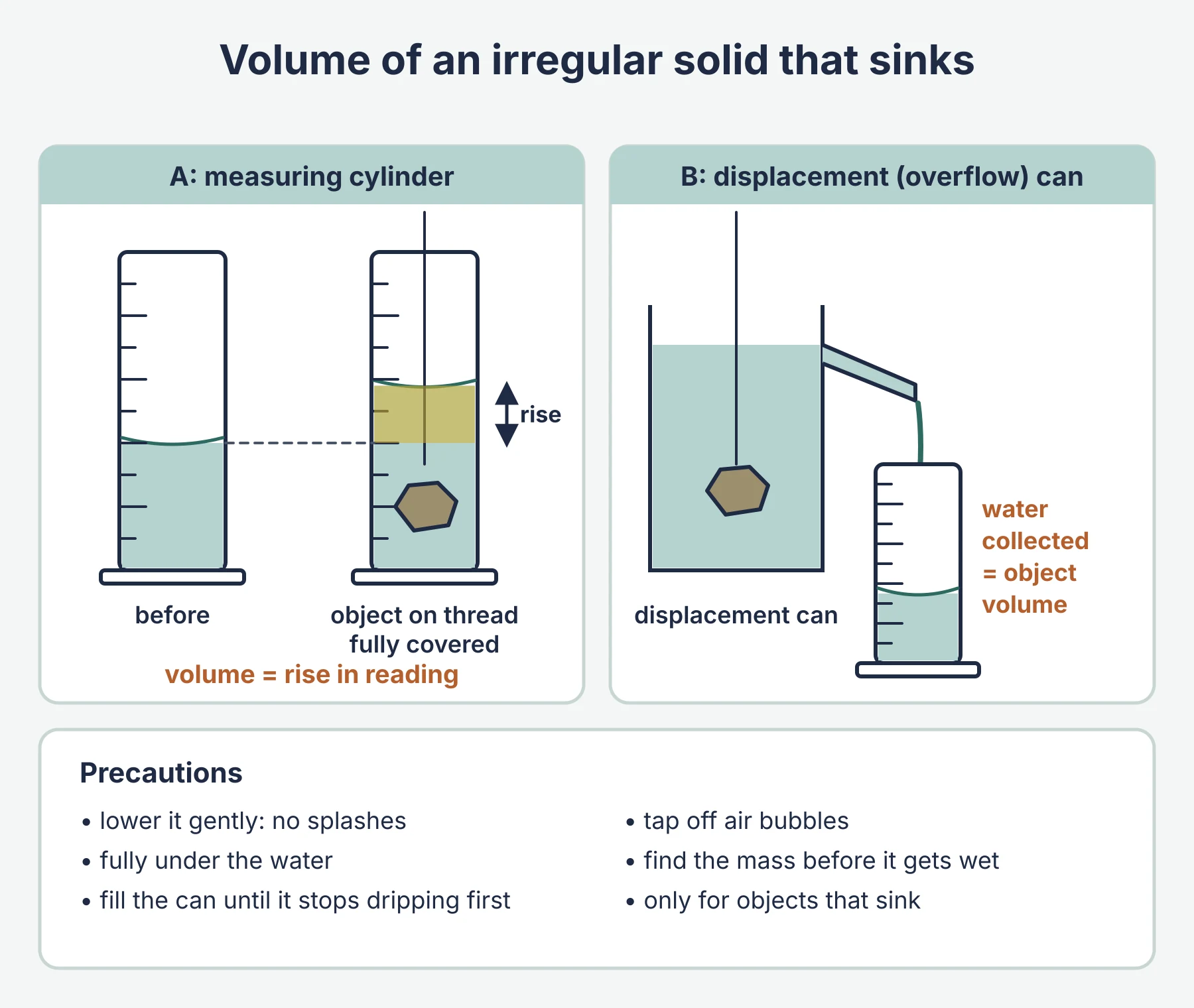
Method A: measuring cylinder. Part-fill a measuring cylinder with water and read the volume. Tie the object to a thread and lower it gently until it is completely covered. Read the new volume. The object’s volume is the rise in the reading.
Method B: displacement (overflow) can. Fill the can until water runs out of the spout; wait for it to stop. Place an empty measuring cylinder under the spout and lower the object in. The volume of water collected equals the object’s volume. Use this for objects too wide for a measuring cylinder.
Precautions: lower the object gently so no water splashes out; make sure it is fully under water; tap away any air bubbles clinging to it (they add to the apparent volume); find the mass before putting it in water, or dry it first.
The method only works for objects that sink: a floating object is not fully under water, so it displaces less than its own volume.
Floating and sinking
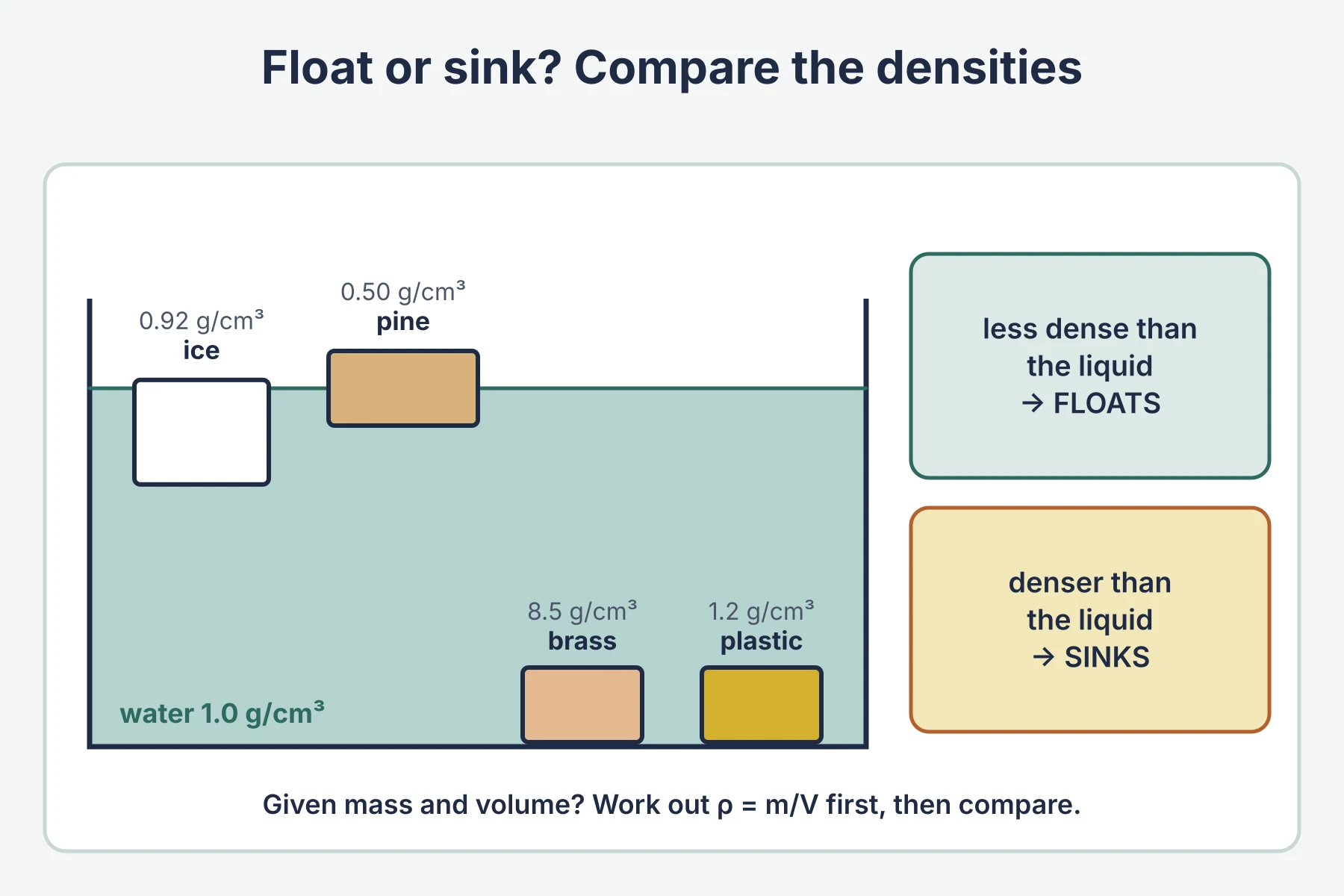
An object floats in a liquid if its density is less than the liquid’s density, and sinks if its density is greater.
| Object | Density / g/cm³ | In water (1.0 g/cm³) |
|---|---|---|
| ice | 0.92 | floats |
| a pine block | 0.50 | floats |
| brass cuboid above | 8.5 | sinks |
| plastic with density 1.2 | 1.2 | sinks |
You may be given mass and volume instead of density: calculate the density first, then compare.
Liquids in layers (Extended only)
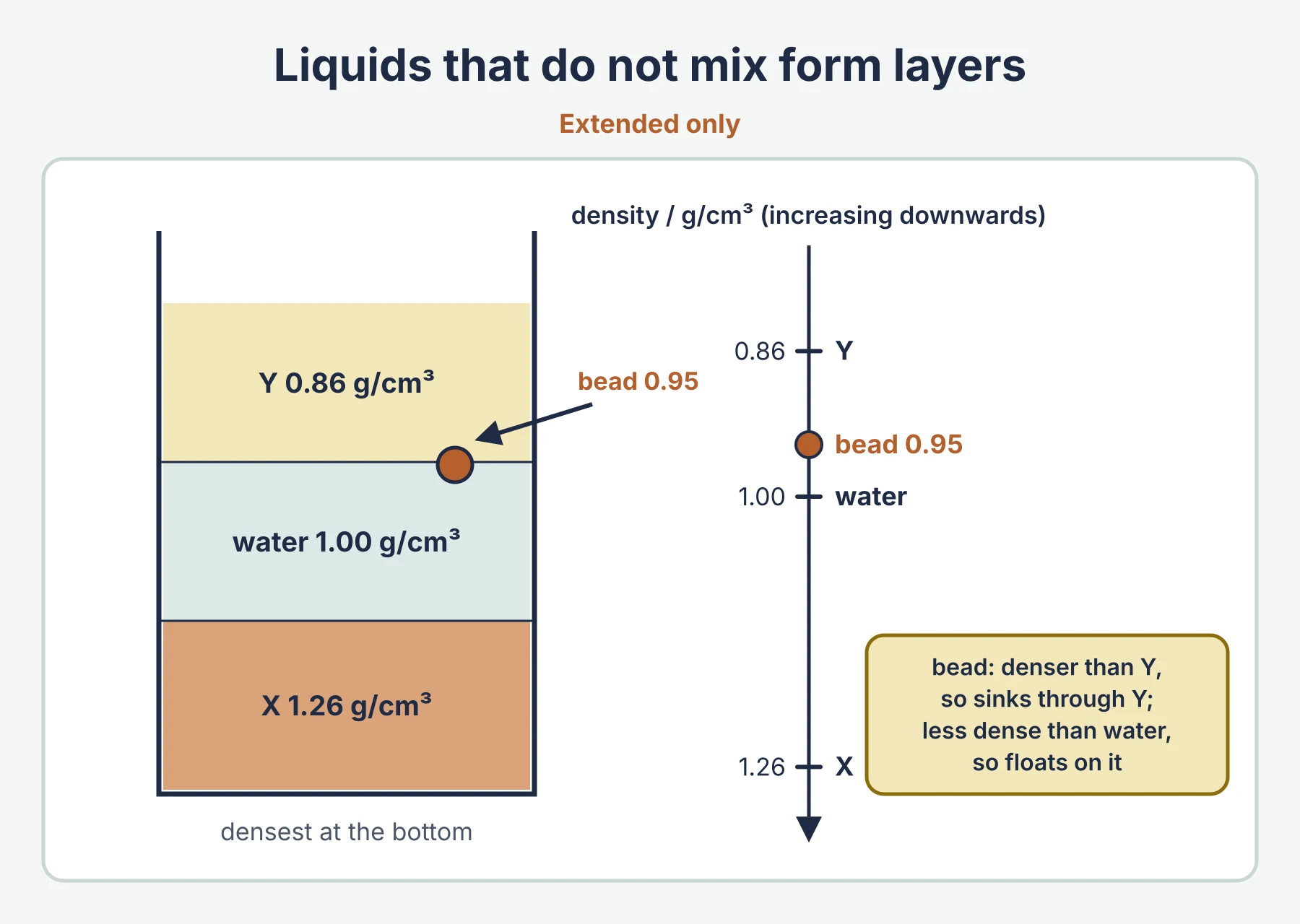
When liquids that do not mix are poured into the same container, they settle into layers with the densest at the bottom and the least dense at the top.
Worked example 3. Three liquids that do not mix are poured into a tall jar: liquid X, 1.26 g/cm³; liquid Y, 0.86 g/cm³; water, 1.00 g/cm³. A small bead of density 0.95 g/cm³ is dropped in.
order from the top:  Y (0.86)  →  water (1.00)  →  X (1.26)
bead (0.95): denser than Y, so it sinks through Y;
             less dense than water, so it floats on the water
bead rests at the boundary between Y and water
Two liquids that do mix (such as water and alcohol) do not form layers, which is why the syllabus states “given that the liquids do not mix”.
Common mistakes
- Writing ρ = V/m.
- Mixing units: grams with m³, or kilograms with cm³.
- Using the total mass of cylinder and liquid as the liquid’s mass.
- Taking the final water level as the object’s volume, rather than the rise in level.
- Converting 1 g/cm³ to 100 kg/m³ (it is 1000 kg/m³).
- Saying heavy objects sink: a large log is heavy but floats, because its density is low.
- (Extended) Saying the “heavier” liquid goes to the bottom. A large volume of a less dense liquid can be heavier but still floats on top.
Exam technique: command words
- Define density: “mass per unit volume”. “Mass ÷ volume” is accepted only if you name both quantities.
- Describe an experiment: list the measurements, the instruments, how volume is found, at least one precaution, and the calculation. Number your steps.
- Calculate: show the volume calculation, the substitution into ρ = m/V, and the unit.
- Determine / State and explain whether something floats: quote the two densities and compare them in a sentence (“0.92 g/cm³ is less than 1.00 g/cm³, so it floats”).
- (Extended) For layers, give the order and the reason (density) for each position.
Revise with the revision notes on density, then try the practice questions on density. Density reappears in liquid pressure in the study guide on pressure and in convection in the study guide on transfer of thermal energy.
Related resources
-
Practice questions
Cambridge IGCSE Physics (0625): Density – Practice Questions
Twelve original Cambridge IGCSE Physics 0625 density questions: ρ = m/V, unit conversions, the three experiments, floating and liquid layers, with answers.
Physics · Cambridge · IGCSE
Try questions -
Revision notes
Cambridge IGCSE Physics (0625): Density – Revision Notes
Revision notes for Cambridge IGCSE Physics 0625 section 1.4 Density: ρ = m/V, unit conversion, experiment steps, floating rules, liquid layers and a self-test.
Physics · Cambridge · IGCSE
Revise topic -
Study guides
Cambridge IGCSE Physics (0625): Energy, work and power
Study guide to Cambridge IGCSE Physics 0625 section 1.7: energy stores and transfers, kinetic and potential energy, work, resources, efficiency and power.
Physics · Cambridge · IGCSE
Read guide
Related articles
Get free revision emails (optional)
Occasional emails with practice questions, worked explanations and links to free resources for the qualification and subjects you choose. No spam, and you can unsubscribe from any email. The free tools on this site never need an email.