
Study Guides
Cambridge IGCSE Physics (0625): Pressure
Study guide to Cambridge IGCSE Physics 0625 section 1.8 Pressure: p = F/A, area conversions, everyday examples, pressure in liquids and Δp = ρgΔh.
- Subject
- Physics
- Level
- IGCSE
- Topic
- Motion, forces and energy
- Author
- Marlbridge Academic Team
- Updated
- Reviewed by
- Iftikhar Azeemi (what this means)
Aligned to Cambridge IGCSE Physics (0625), For examination in 2026, 2027 and 2028. Official specification .
Syllabus page (what it covers and how it is assessed): Cambridge IGCSE Physics.
Syllabus points this page covers, with Core and Extended
0625
- 1.8 Pressure · Core and Extended
"Core and Extended" means part of that syllabus point is Extended only. The page's own tier notes say which part.
Found an error? Report a correction.
Need help with this topic? Request a free trial class for IGCSE Physics (0625).
This guide teaches section 1.8, Pressure, of the Cambridge IGCSE Physics 0625 syllabus for examination in 2026, 2027 and 2028. Core statements 1 to 3 cover p = F/A, everyday examples and a qualitative description of pressure in liquids. Supplement statement 4, the equation Δp = ρgΔh, is examined only on Papers 2 and 4 and is labelled Extended only. The Motion, forces and energy study guide notes that liquid pressure does not depend on the container’s shape; this page builds the calculations and explanations around that.
What the syllabus asks for
| Statement | Tier | Content |
|---|---|---|
| 1 | Core | Define pressure as force per unit area; recall and use p = F/A |
| 2 | Core | Describe how pressure varies with force and area in everyday examples |
| 3 | Core | Describe, qualitatively, how pressure beneath the surface of a liquid changes with depth and density |
| 4 | Extended only | Recall and use Δp = ρgΔh for the change in pressure beneath the surface of a liquid |
Pressure = force ÷ area
p = F / A        p in pascals (Pa),  F in newtons (N),  A in m²
1 Pa = 1 N/m²
The force is the force acting at right angles (normal) to the surface, such as the weight of an object resting on the floor. You may also see N/cm² when areas are small.
Converting areas
Areas are often given in cm² or mm², and the conversion is the step most often wrong.
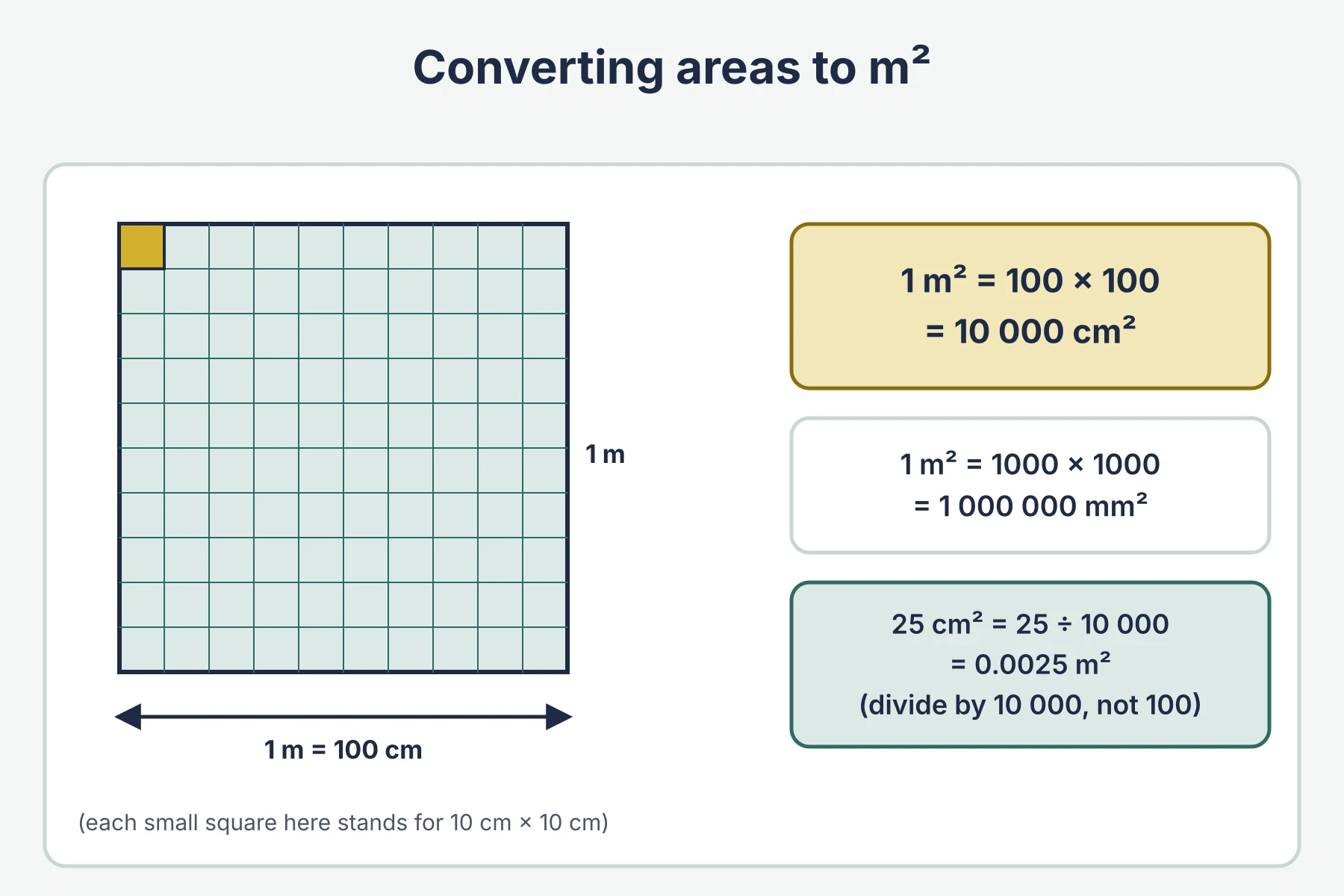
- 1 m = 100 cm, so 1 m² = 100 × 100 = 10 000 cm². Divide cm² by 10 000 to get m².
- 1 m = 1000 mm, so 1 m² = 1 000 000 mm².
- 25 cm² = 25 ÷ 10 000 = 0.0025 m².
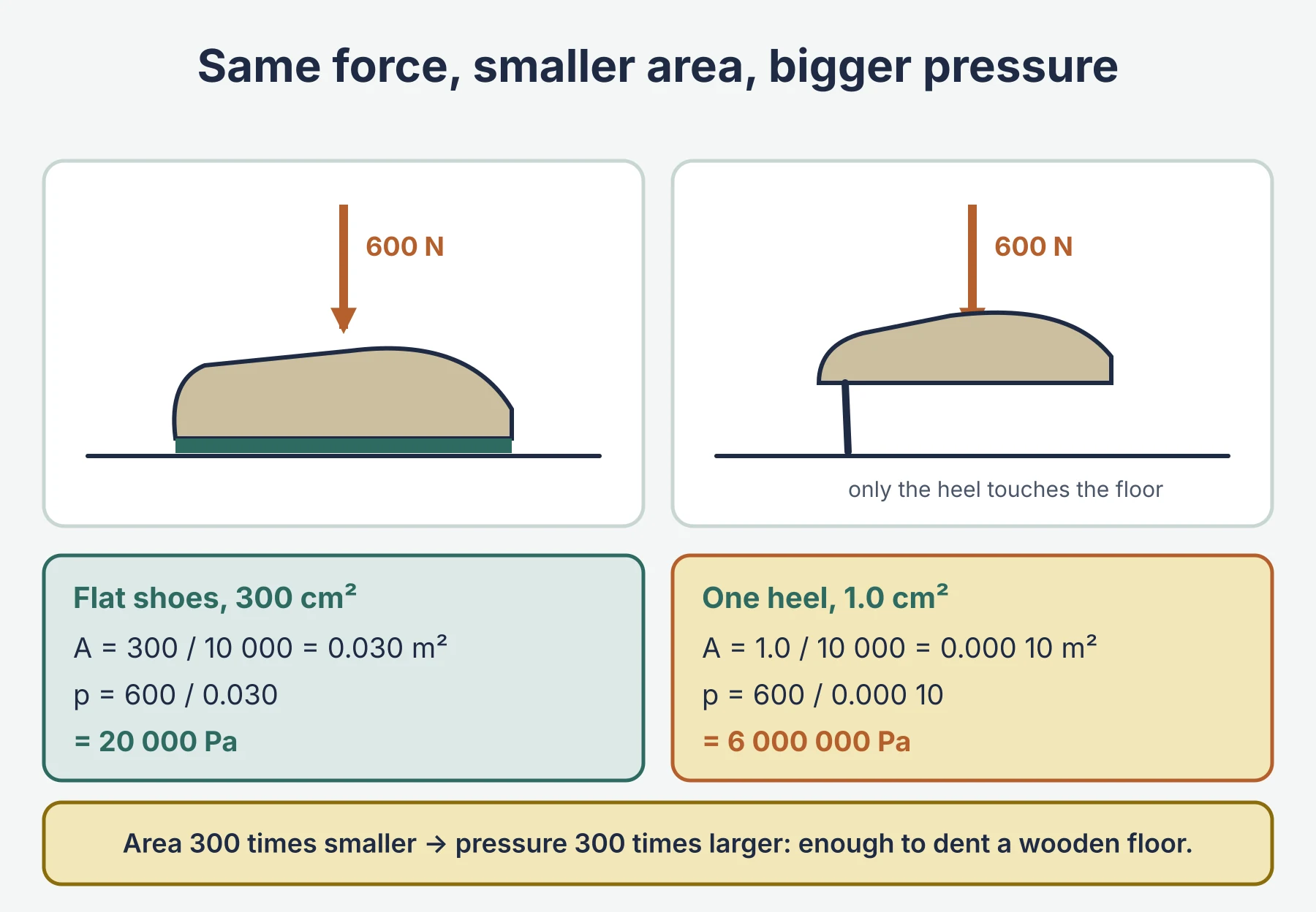
Worked example 1. A person of weight 600 N stands in flat shoes with a total area of 300 cm² on the floor. Later, they balance all their weight on one stiletto heel of area 1.0 cm². Compare the pressures.
flat shoes:  A = 300 / 10 000 = 0.030 m²      p = 600 / 0.030  = 20 000 Pa
heel:        A = 1.0 / 10 000 = 0.000 10 m²   p = 600 / 0.000 10 = 6 000 000 Pa
The same force on an area 300 times smaller gives a pressure 300 times larger, enough to dent a wooden floor.
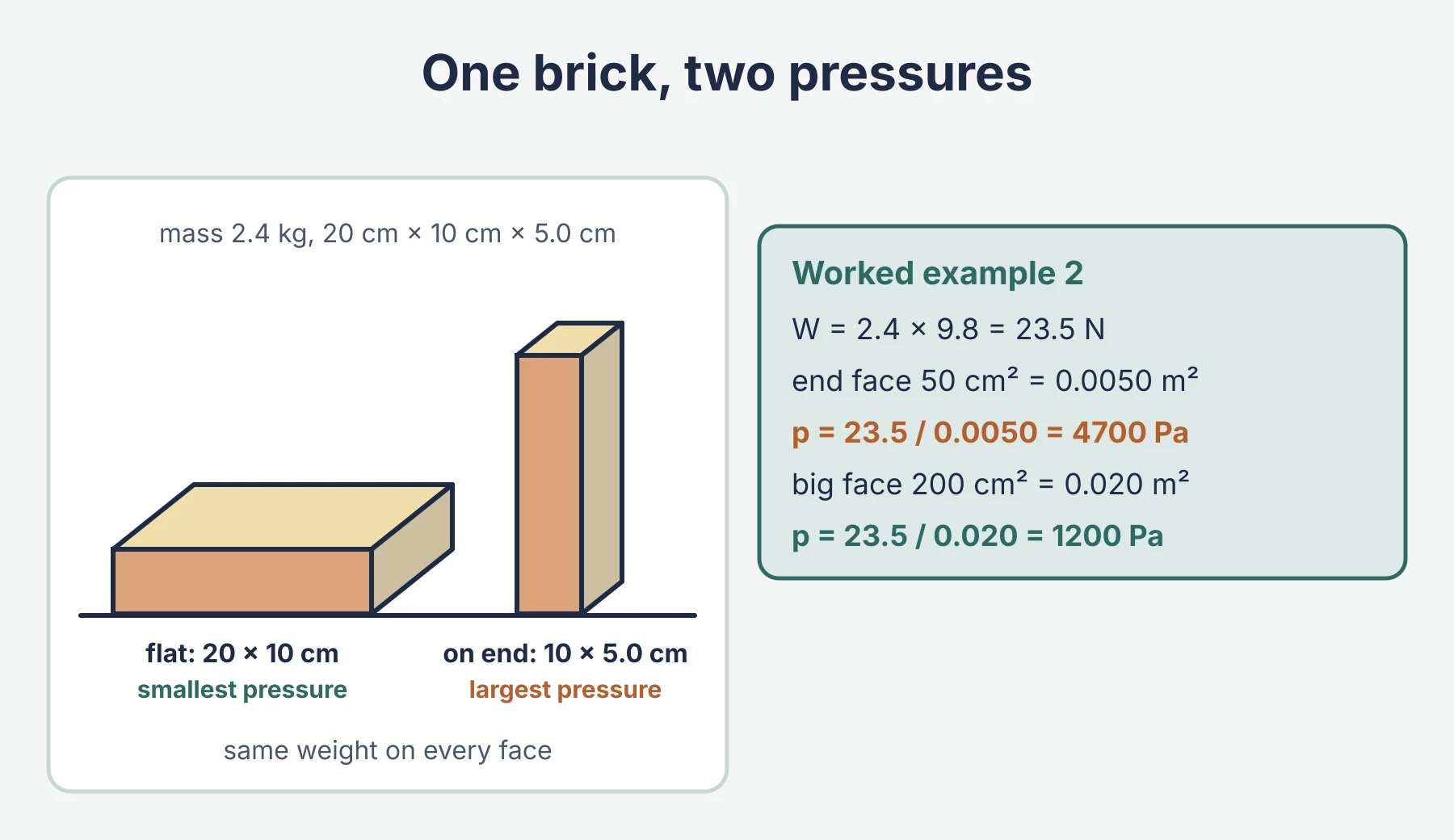
Worked example 2 (choosing the face). A brick of mass 2.4 kg measures 20 cm × 10 cm × 5.0 cm (g = 9.8 N/kg). Find the largest and smallest pressures it can exert on the ground.
W = 2.4 × 9.8 = 23.5 N
smallest face: 10 cm × 5.0 cm = 50 cm² = 0.0050 m²   → p = 23.5 / 0.0050 = 4700 Pa (largest)
largest face:  20 cm × 10 cm = 200 cm² = 0.020 m²    → p = 23.5 / 0.020  = 1200 Pa (smallest)
The weight is the same whichever face it rests on; only the area changes.
Everyday examples
| Example | Large or small area? | Effect on pressure | Why it is useful |
|---|---|---|---|
| snowshoes and skis | large | low | the person does not sink into soft snow |
| wide tractor tyres | large | low | the tractor does not sink into soft mud |
| wide straps on a heavy bag | large | low | less painful on the shoulder |
| building foundations | large | low | the ground beneath does not sink |
| knife blade (sharp) | very small | high | cuts easily with a small force |
| drawing pin point | very small | high | pushes into a board easily |
| needle, nail, football studs | small | high | pierce material or grip the ground |
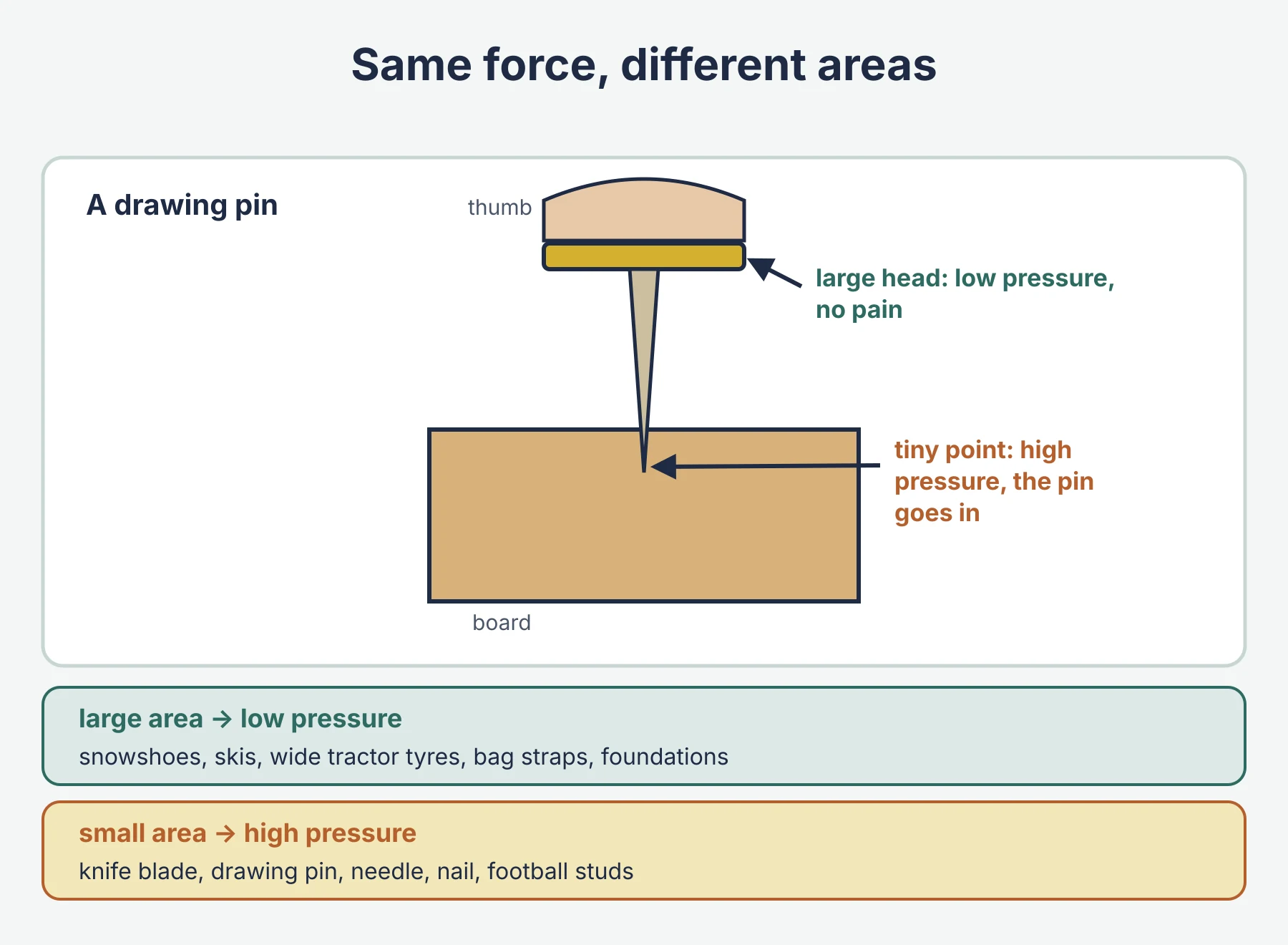
The head of a drawing pin is a neat two-sided example: the same force acts on your thumb (large head, low pressure, no pain) and on the board (tiny point, high pressure, the pin goes in).
To describe how pressure varies: for the same area, a larger force gives a larger pressure; for the same force, a smaller area gives a larger pressure.
Pressure in liquids
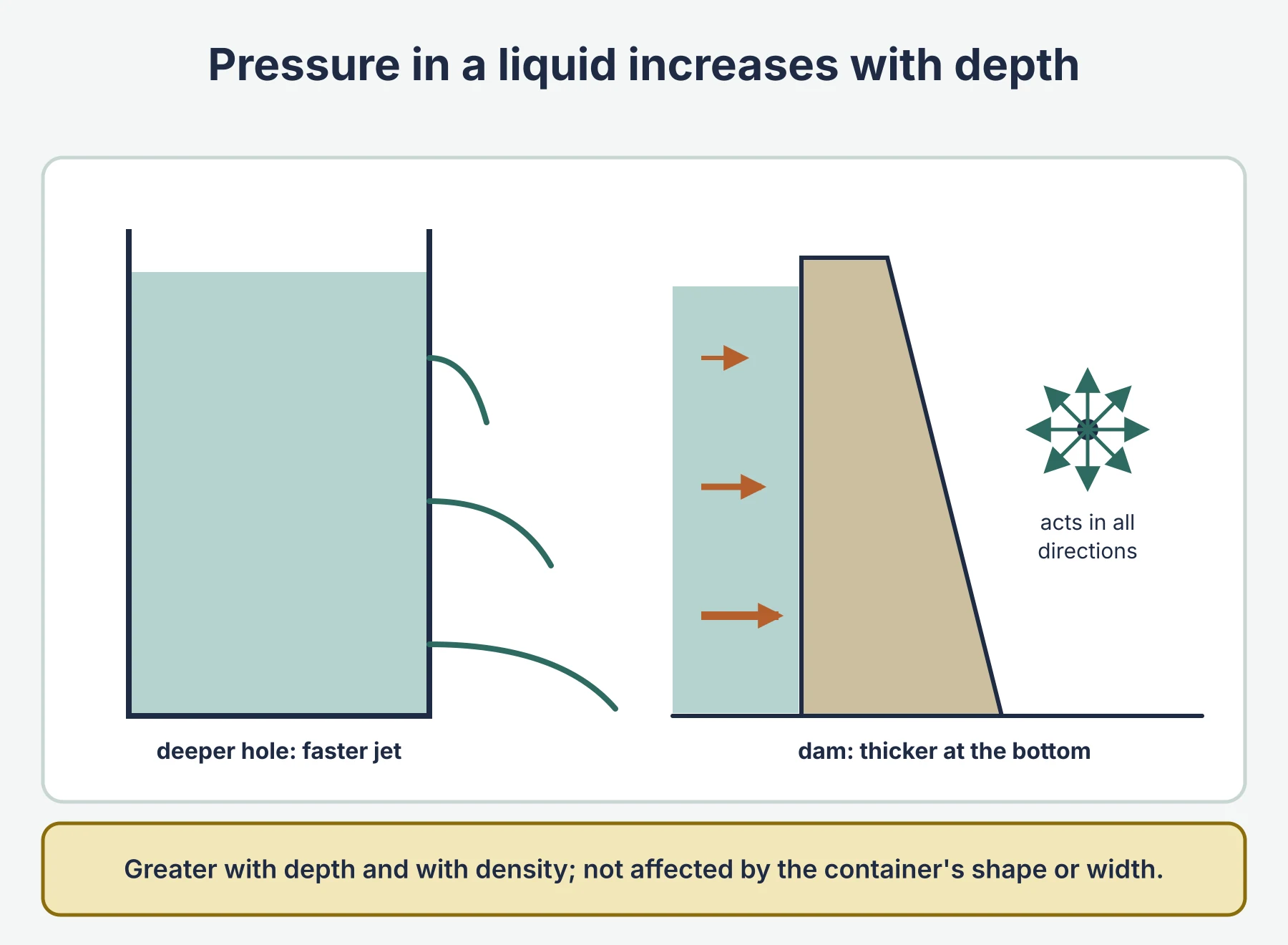
Beneath the surface of a liquid, the pressure:
- increases with depth, because there is more liquid above pushing down;
- is greater in a denser liquid at the same depth;
- acts in all directions at a given depth;
- depends only on depth and density (and g), not on the shape or width of the container.
Consequences:
- A dam is built thicker at the bottom, where the water pressure is greatest.
- Water squirts out faster from a hole near the bottom of a tall container than from a hole near the top.
- A diver feels increasing pressure on the ears as they swim deeper.
- Water-storage tanks are placed high up, so the pressure in taps below is large.
Δp = ρgΔh (Extended only)
Δp = ρ g Δh Δp in Pa, ρ in kg/m³, g in N/kg, Δh in mΔh is the vertical depth below the surface (or the vertical difference between two points in the liquid).
Worked example 3. A diver goes from the surface to a depth of 25 m in sea water of density 1030 kg/m³. Find the increase in pressure.
Δp = ρ g Δh = 1030 × 9.8 × 25 = 252 350 Pa ≈ 2.5 × 10⁵ PaThe pressure on the diver also includes the pressure of the atmosphere pushing on the surface. Δp = ρgΔh gives only the extra pressure due to the water; if a question gives atmospheric pressure and asks for the total pressure, add the two.
Worked example 4 (comparing liquids). Find the pressure due to the liquid 0.40 m below the surface of oil (density 800 kg/m³) and of water (density 1000 kg/m³).
oil:   Δp = 800  × 9.8 × 0.40 = 3136 Pa  ≈ 3100 Pa
water: Δp = 1000 × 9.8 × 0.40 = 3920 Pa  ≈ 3900 Pa
Worked example 5 (finding a depth). At what depth in fresh water is the pressure due to the water 49 000 Pa?
Δh = Δp / (ρ g) = 49 000 / (1000 × 9.8) = 5.0 m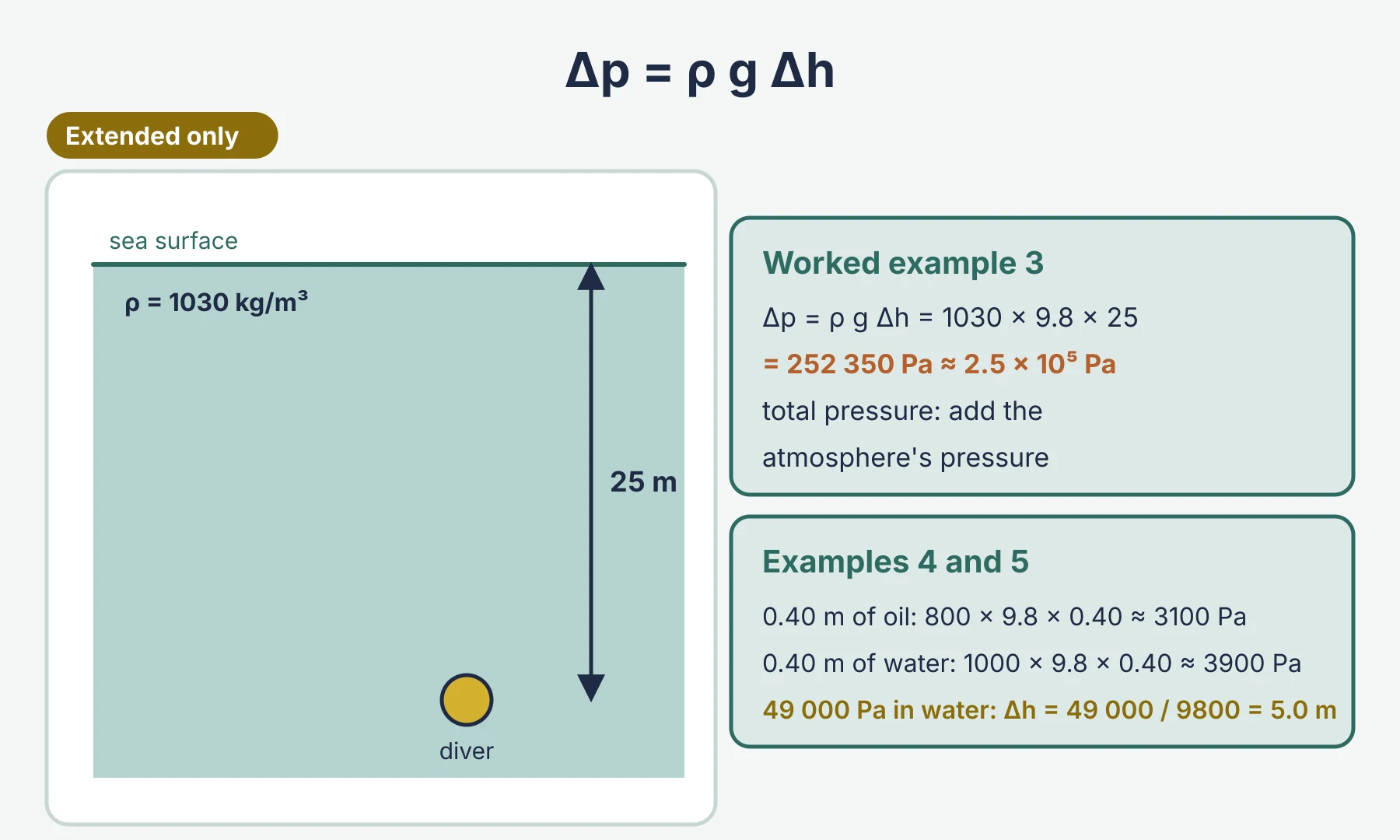
Common mistakes
- Dividing cm² by 100 instead of 10 000.
- Using mass (kg) instead of weight (N) as the force.
- Saying a sharp knife has “more force”; it has a smaller area and so a larger pressure for the same force.
- Thinking a wider container has a greater pressure at the bottom for the same depth.
- (Extended) Using the distance from the bottom of the container instead of the depth below the surface.
- (Extended) Using density in g/cm³ in Δp = ρgΔh: convert to kg/m³ first.
Exam technique: command words
- Define pressure: “force per unit area”. The equation alone may not earn the mark.
- Calculate: convert areas to m² before substituting; give the unit Pa (or N/m²).
- Describe how pressure varies in an everyday example: say what happens to the area, then what happens to the pressure, for the same force.
- Explain a design (a dam, a tractor tyre): link the shape to the pressure and the pressure to the result.
- Describe, qualitatively, liquid pressure: “increases with depth; greater in a denser liquid”.
Revise with the revision notes on pressure and then try the practice questions on pressure. Density, needed for Δp = ρgΔh, is in the study guide on density; gas pressure in terms of particles is in the study guide on the kinetic particle model of matter.
Related resources
-
Practice questions
Cambridge IGCSE Physics (0625): Pressure – Practice Questions
Twelve original Cambridge IGCSE Physics 0625 pressure questions on p = F/A, area conversions, everyday examples and liquid pressure Δp = ρgΔh, with answers.
Physics · Cambridge · IGCSE
Try questions -
Revision notes
Cambridge IGCSE Physics (0625): Pressure – Revision Notes
Revision notes for Cambridge IGCSE Physics 0625 section 1.8 Pressure: p = F/A, area conversions, everyday examples, liquid pressure, Δp = ρgΔh and a self-test.
Physics · Cambridge · IGCSE
Revise topic -
Study guides
IGCSE Physics: Motion, Forces and Energy (Cambridge 0625)
Cambridge IGCSE Physics 0625 Topic 1 study guide for 2026-2028: motion graphs, mass and weight, density, forces, momentum, energy, work, power and pressure.
Physics · Cambridge · IGCSE
Read guide
Related articles
Get free revision emails (optional)
Occasional emails with practice questions, worked explanations and links to free resources for the qualification and subjects you choose. No spam, and you can unsubscribe from any email. The free tools on this site never need an email.