
Revision Notes
Cambridge IGCSE Physics (0625): Energy, work and power – Revision Notes
Revision notes for Cambridge IGCSE Physics 0625 section 1.7: stores, transfers, Ek, Ep, work, power, efficiency and energy resources, with a self-test.
- Subject
- Physics
- Level
- IGCSE
- Topic
- Motion, forces and energy
- Author
- Marlbridge Academic Team
- Updated
- Reviewed by
- Iftikhar Azeemi (what this means)
Aligned to Cambridge IGCSE Physics (0625), For examination in 2026, 2027 and 2028. Official specification .
Syllabus page (what it covers and how it is assessed): Cambridge IGCSE Physics.
Syllabus points this page covers, with Core and Extended
0625
- 1.7 Energy, work and power · Core and Extended
"Core and Extended" means part of that syllabus point is Extended only. The page's own tier notes say which part.
Found an error? Report a correction.
Need help with this topic? Request a free trial class for IGCSE Physics (0625).
These notes condense section 1.7, Energy, work and power (1.7.1 to 1.7.4), of the Cambridge IGCSE Physics 0625 syllabus for examination in 2026, 2027 and 2028. Supplement content, marked Extended only, is examined on Papers 2 and 4. Worked examples are in the study guide on energy, work and power, and the full resources table is in the Motion, forces and energy study guide.
Equations
| Equation | Units | Tier |
|---|---|---|
| W = F d = ΔE | J = N × m | Core |
| P = W / t | W = J/s | Core |
| P = ΔE / t | W = J/s | Core |
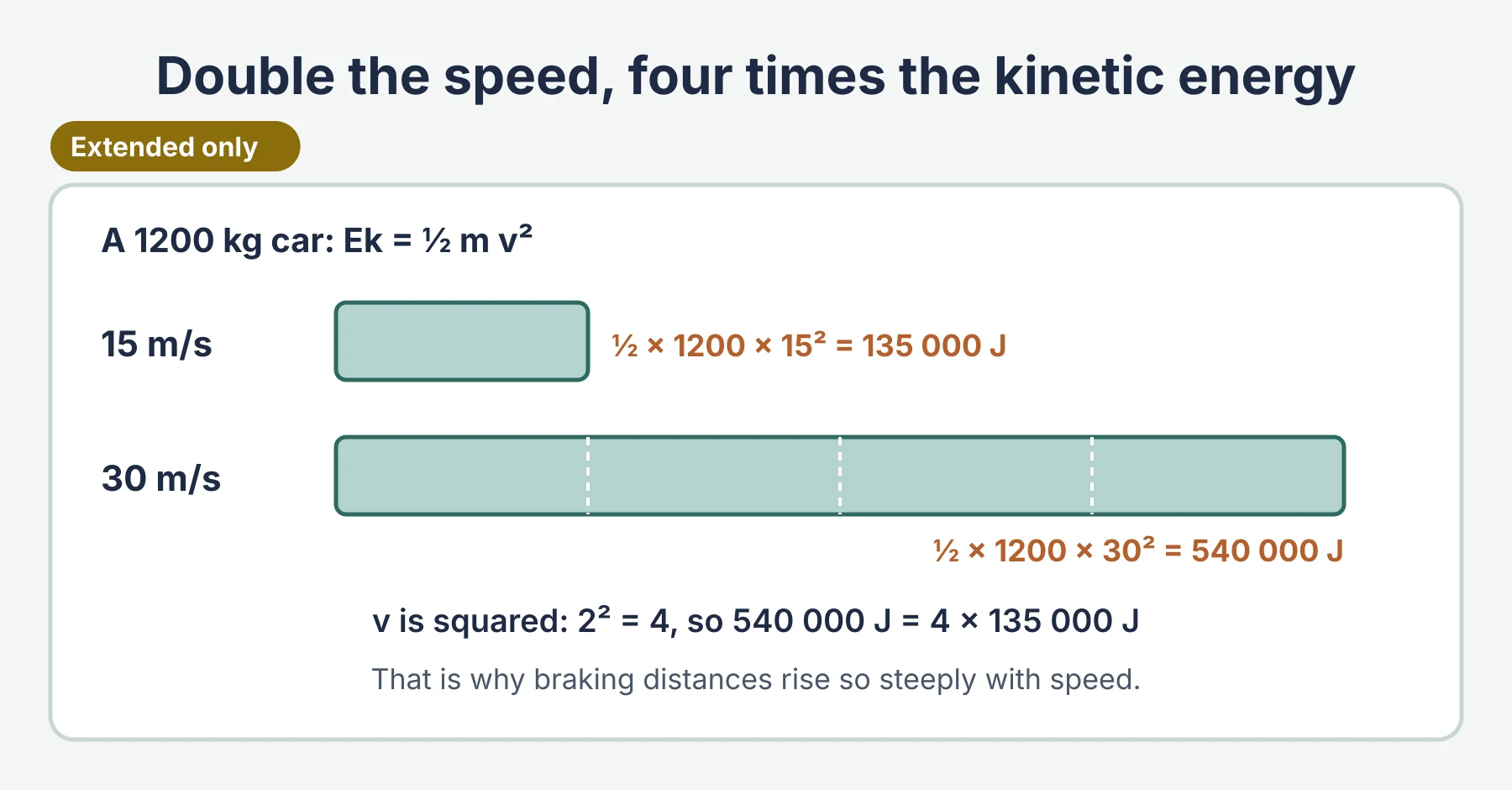
| Ek = ½ m v² | J (kg, m/s) | Extended only |
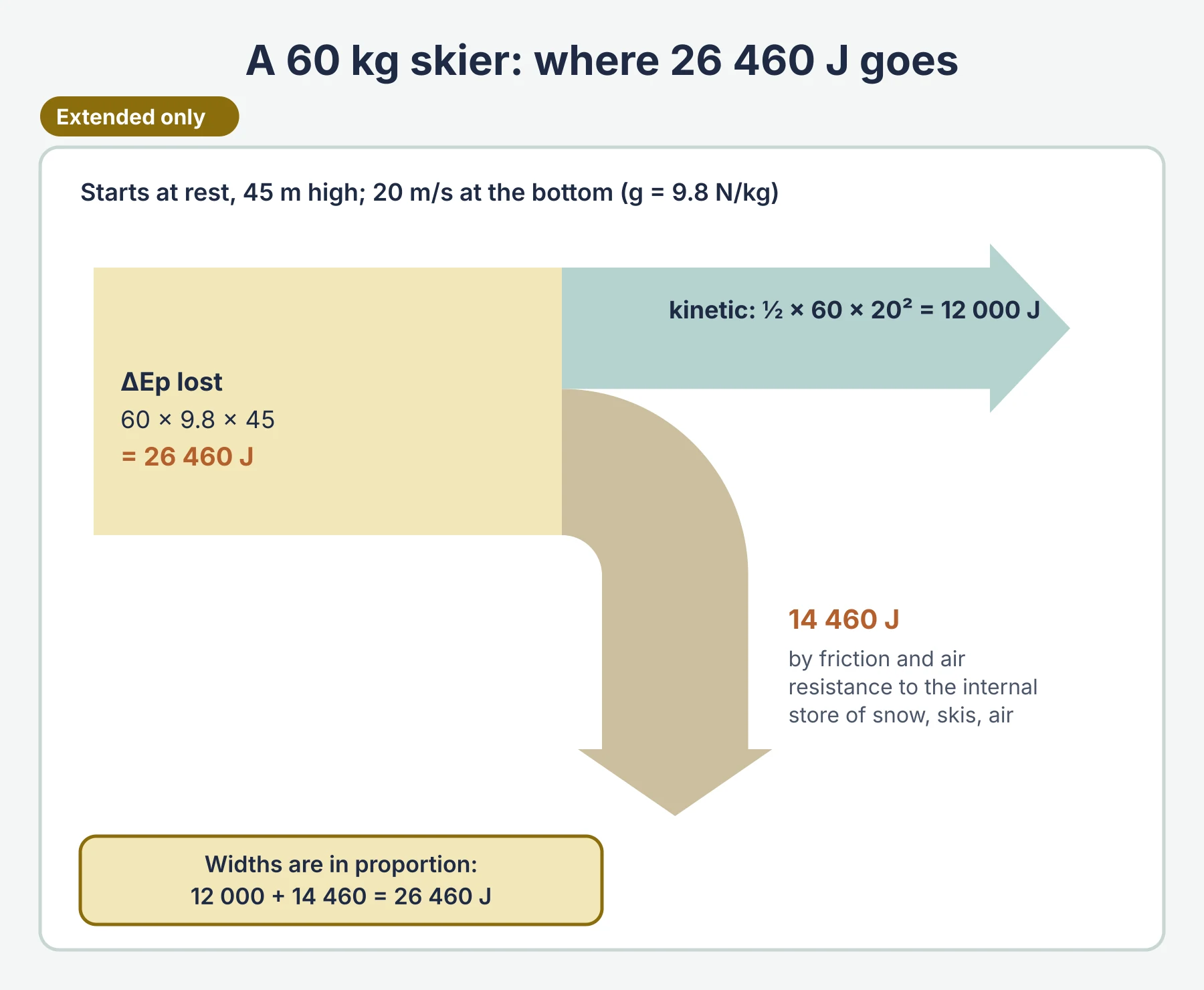
| ΔEp = m g Δh | J (kg, N/kg, m) | Extended only |
| efficiency = useful energy output ÷ total energy input (× 100%) | no unit, or % | Extended only |
| efficiency = useful power output ÷ total power input (× 100%) | no unit, or % | Extended only |
Useful conversions: 1 kJ = 1000 J; 1 MJ = 10⁶ J; 1 kW = 1000 W; minutes × 60 = s.
Energy (1.7.1)
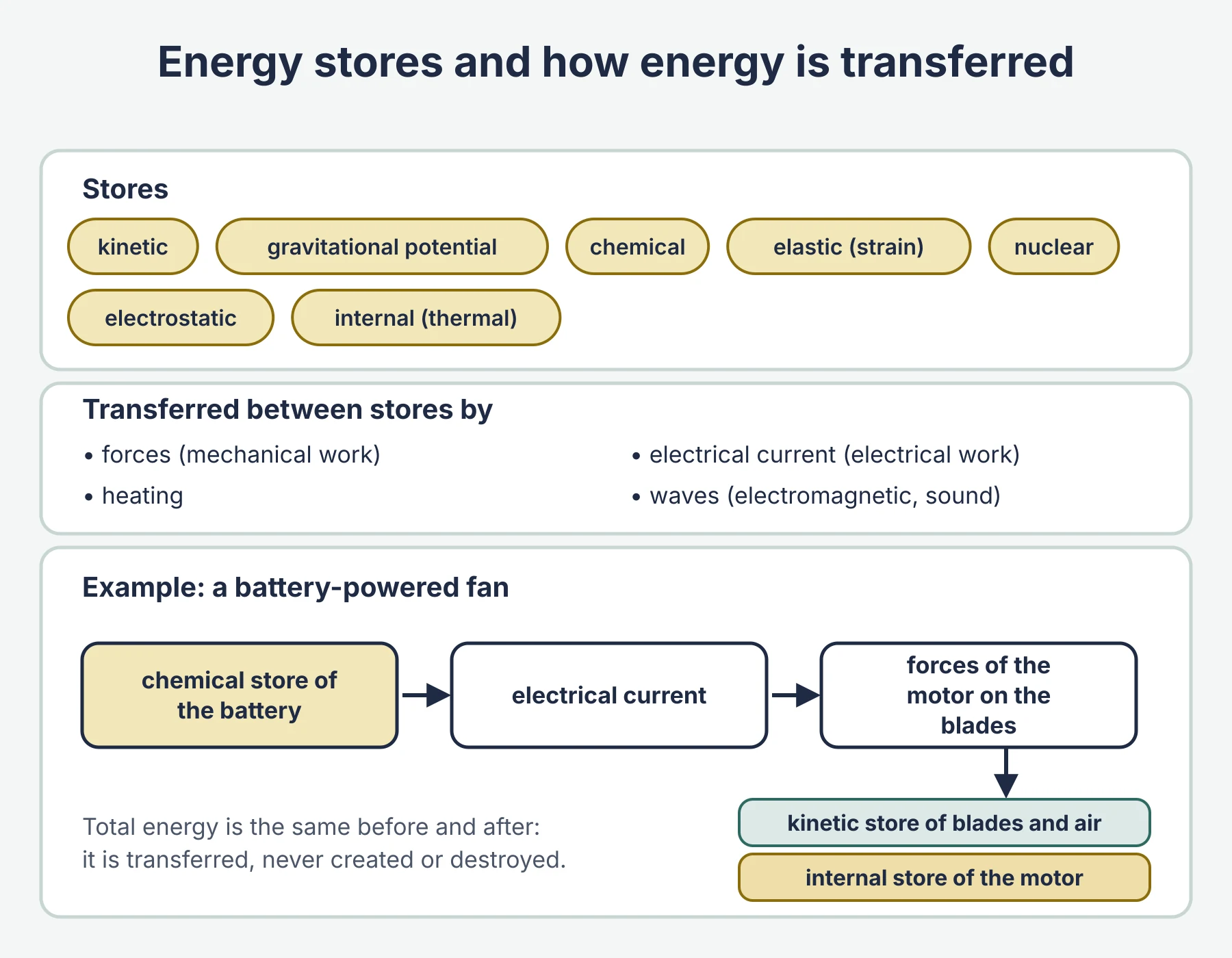
Seven stores: kinetic, gravitational potential, chemical, elastic (strain), nuclear, electrostatic, internal (thermal).
Four ways to transfer energy between stores:
- forces (mechanical work done);
- electrical currents (electrical work done);
- heating;
- waves: electromagnetic, sound and others.
Conservation of energy: energy is not created or destroyed; total energy out = total energy in. Wasted energy usually ends up in the internal store of the surroundings.
Flow diagrams (Core): boxes for stores, arrows for transfers.
(Extended only) Sankey diagrams: arrow widths in proportion to energy; useful output continues straight on, wasted energy branches off; widths out add up to width in. Multi-stage chains: apply conservation at each stage.
Quick energy facts (Extended only)
- Doubling speed → Ek × 4.
- Doubling mass → Ek × 2.
- Falling with no air resistance: mgΔh = ½mv², so v = √(2gΔh), whatever the mass.
Work (1.7.2)
- Mechanical or electrical work done = energy transferred.
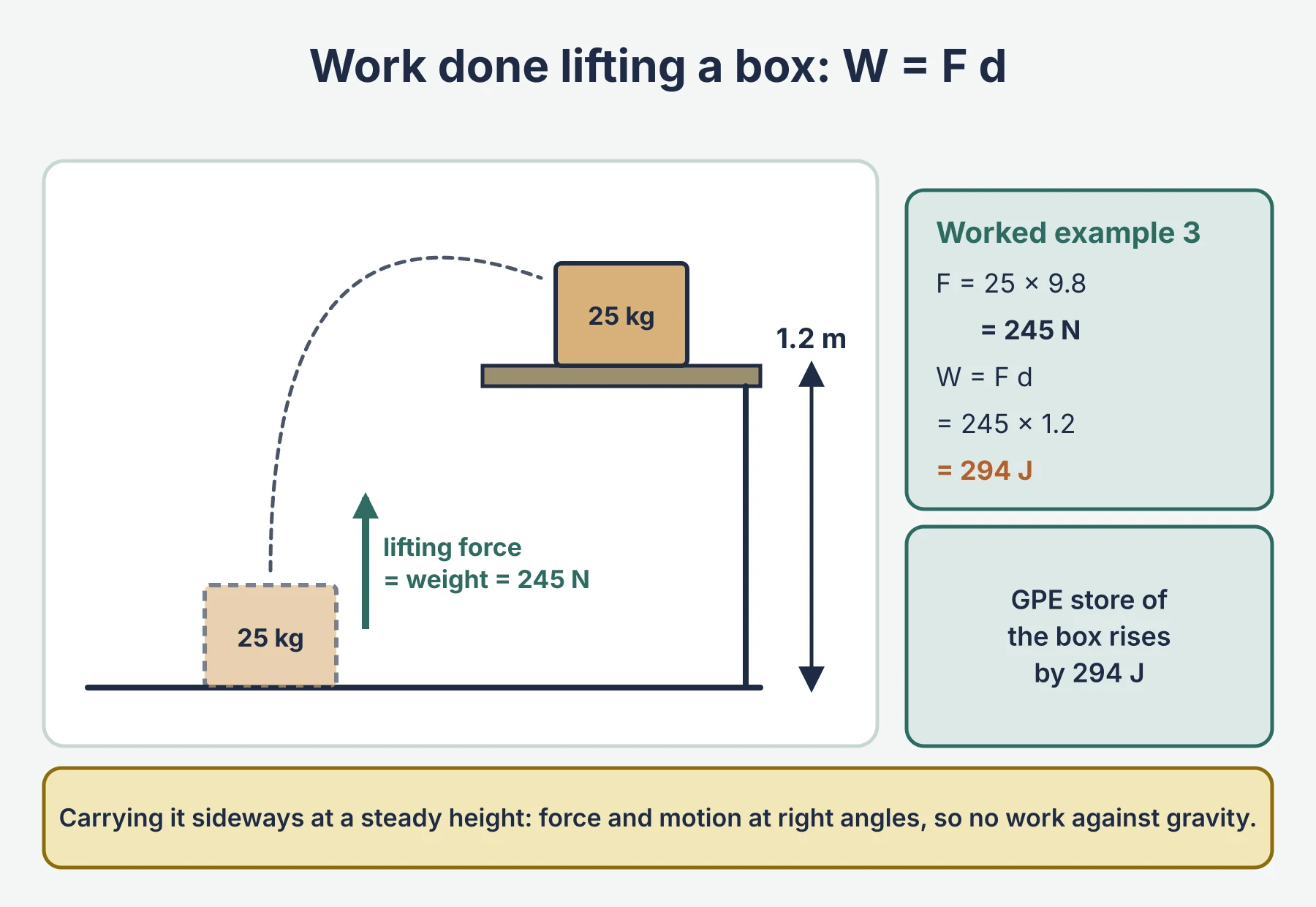
- W = Fd, with d the distance moved in the direction of the force.
- Lifting at steady speed: F = weight = mg, so W = mgΔh.
- A force at right angles to the motion does no work.
Energy resources (1.7.3)
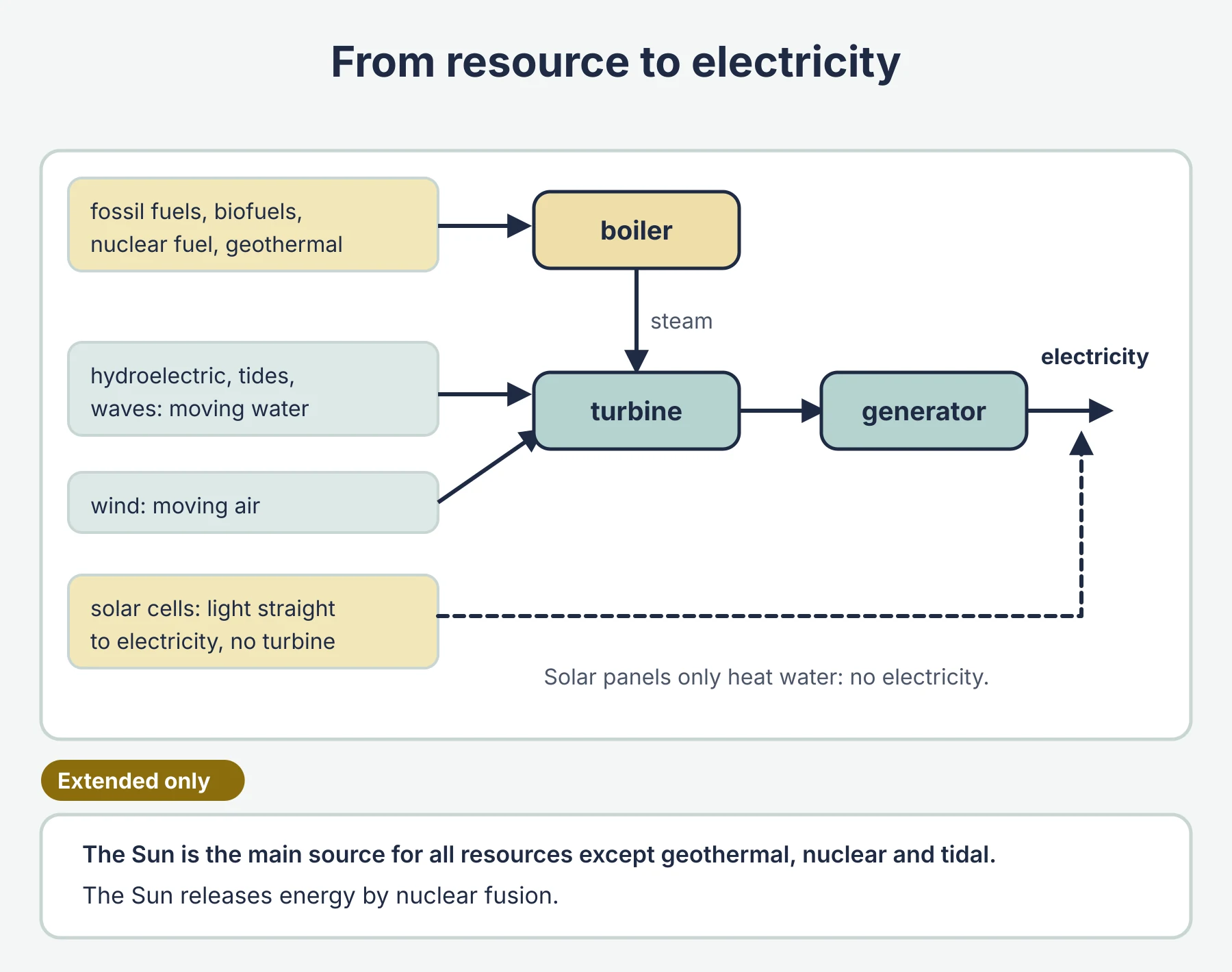
Turbine–generator chain
- Boiler → steam → turbine → generator: fossil fuels, biofuels, nuclear, geothermal.
- Water or air turns the turbine directly: hydroelectric, tides, waves, wind.
- No turbine: solar cells (light → electricity).
- Solar panels heat water; they generate no electricity.
Five comparison criteria: renewability, availability, reliability, scale, environmental impact.
| Resource | Renewable? | Reliable? | One big disadvantage |
|---|---|---|---|
| Fossil fuels | no | yes | carbon dioxide; will run out |
| Biofuels | yes | yes | large areas of land |
| Nuclear | no | yes | long-lived radioactive waste |
| Hydroelectric | yes | yes | floods valleys and habitats |
| Tidal | yes | predictable | few suitable sites |
| Wave | yes | no | small scale |
| Geothermal | yes | yes | few suitable places |
| Wind | yes | no | output depends on the weather |
| Solar cells | yes | no (none at night) | large area for large output |
Efficiency (Core): the fraction of input energy transferred usefully; always less than 100%.
Extended only
- The Sun is the main source of energy for all resources except geothermal, nuclear and tidal.
- The Sun releases energy by nuclear fusion.
- Research is being carried out into large-scale electricity generation from fusion.
Power (1.7.4)
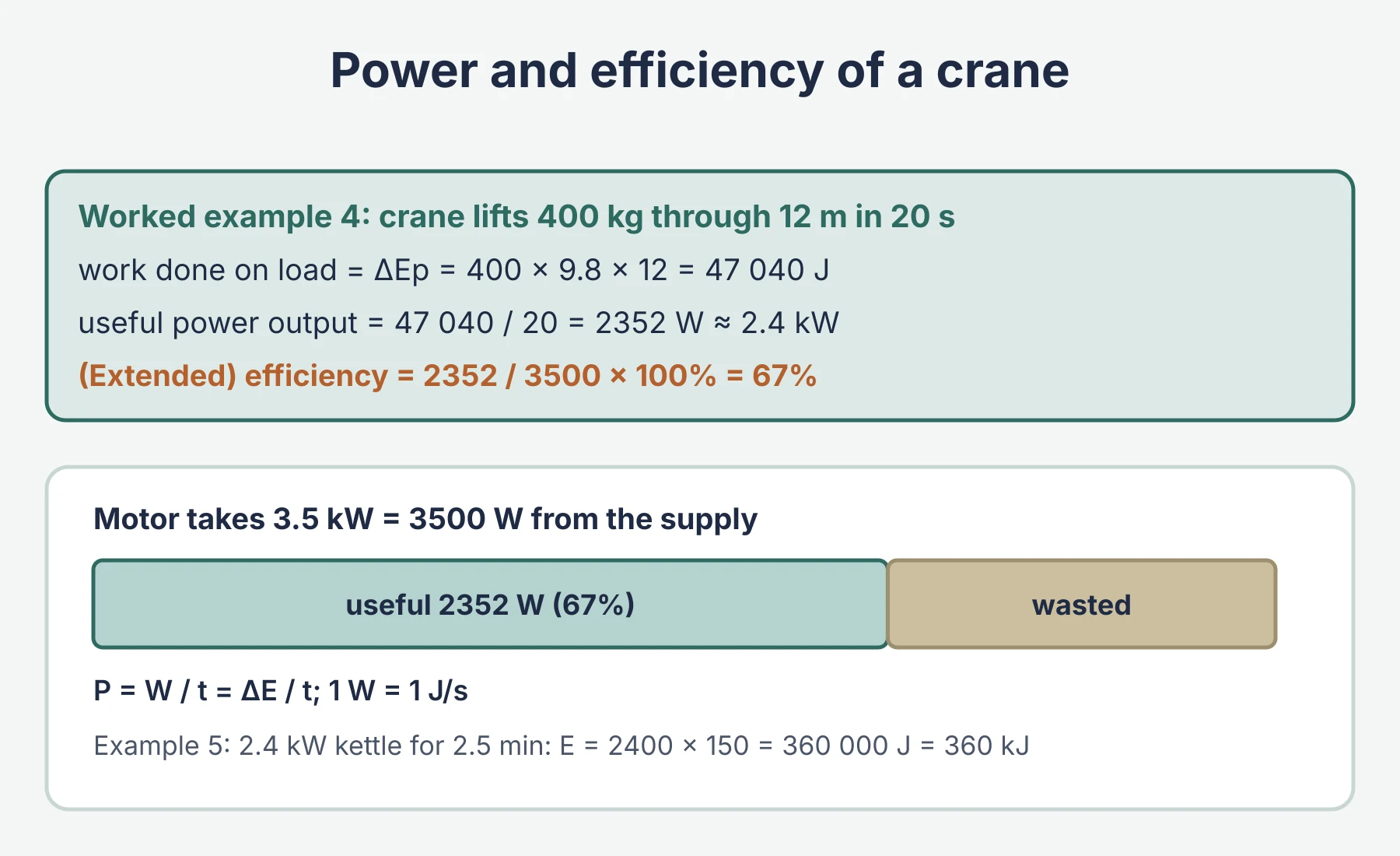
- Power: work done per unit time or energy transferred per unit time.
- 1 W = 1 J/s.
- Same job done faster → same work, more power.
Key terms
| Term | Meaning |
|---|---|
| Energy store | Way energy is held: kinetic, gravitational potential, chemical, elastic, nuclear, electrostatic, internal |
| Work done | Energy transferred by a force or an electrical current |
| Power | Work done (or energy transferred) per unit time |
| Renewable | Will not run out; replaced naturally |
| Turbine | Machine turned by steam, water or air that drives a generator |
| Efficiency | Useful output ÷ total input |
| Sankey diagram (Extended) | Energy diagram with arrow widths in proportion to energy |
Exam traps
- “Energy is lost”: say where it went (internal store of surroundings, by heating or sound).
- Using mass (kg) for force in W = Fd.
- Writing kinetic energy as ½mv (no square).
- Power from energy and minutes without converting to seconds.
- Mixing solar cells and solar panels.
- Advantages that are vague (“cheap”, “clean”) with no reason.
- (Extended) Efficiency over 100%: you divided the wrong way.
- (Extended) Listing tidal energy as coming from the Sun.
Quick self-test
- Name the store of energy in a stretched spring.
- State the principle of conservation of energy.
- A force of 80 N pushes a trolley 2.5 m. Find the work done.
- A 1500 W hairdryer runs for 4.0 minutes. Find the energy transferred.
- A motor does 6000 J of work in 30 s. Find its power.
- Name the three parts of a coal-fired power station that the energy passes through after the coal is burned.
- Give one advantage and one disadvantage of tidal energy.
- (Extended) Find the kinetic energy of a 0.20 kg ball moving at 15 m/s.
- (Extended) Find the gain in gravitational potential energy of a 50 kg climber who climbs 120 m.
- (Extended) A lamp takes 60 J of electrical energy and gives out 12 J as light. Find its efficiency.
- (Extended) Name the three energy resources that do not get their energy from the Sun.
- (Extended) A 2.0 kg stone is dropped from 20 m. Ignoring air resistance, find its speed just before it lands.
Answers
- Elastic (strain) store.
- Energy cannot be created or destroyed; it is transferred between stores, and the total stays the same.
- 80 × 2.5 = 200 J.
- 1500 × 240 = 360 000 J (360 kJ).
- 6000 ÷ 30 = 200 W.
- Boiler, turbine, generator.
- Advantage: renewable / predictable / no carbon dioxide in operation. Disadvantage: few suitable estuaries / affects habitats / output varies with the tides.
- ½ × 0.20 × 15² = 22.5 J.
- 50 × 9.8 × 120 = 58 800 J.
- 12 ÷ 60 × 100% = 20%.
- Geothermal, nuclear, tidal.
- v = √(2 × 9.8 × 20) = √392 = 19.8 m/s (20 m/s).
Where to go next
Try the practice questions on energy, work and power, then move on to the revision notes on pressure.
Related resources
-
Study guides
Cambridge IGCSE Physics (0625): Forces
Study guide to Cambridge IGCSE Physics 0625 section 1.5 Forces: extension, resultant force, friction, F = ma, circular motion, moments and stability.
Physics · Cambridge · IGCSE
Read guide -
Practice questions
Cambridge IGCSE Physics (0625): Forces – Practice Questions
Thirteen original Cambridge IGCSE Physics 0625 forces questions: springs, resultants, friction, F = ma, circular motion, moments and stability, with answers.
Physics · Cambridge · IGCSE
Try questions -
Revision notes
Cambridge IGCSE Physics (0625): Forces – Revision Notes
Revision notes for Cambridge IGCSE Physics 0625 section 1.5 Forces: extension, resultants, F = ma, circular motion, moments, centre of gravity and a self-test.
Physics · Cambridge · IGCSE
Revise topic
Related articles
Get free revision emails (optional)
Occasional emails with practice questions, worked explanations and links to free resources for the qualification and subjects you choose. No spam, and you can unsubscribe from any email. The free tools on this site never need an email.