
Revision Notes
Cambridge IGCSE Physics (0625): Pressure – Revision Notes
Revision notes for Cambridge IGCSE Physics 0625 section 1.8 Pressure: p = F/A, area conversions, everyday examples, liquid pressure, Δp = ρgΔh and a self-test.
- Subject
- Physics
- Level
- IGCSE
- Topic
- Motion, forces and energy
- Author
- Marlbridge Academic Team
- Updated
- Reviewed by
- Iftikhar Azeemi (what this means)
Aligned to Cambridge IGCSE Physics (0625), For examination in 2026, 2027 and 2028. Official specification .
Syllabus page (what it covers and how it is assessed): Cambridge IGCSE Physics.
Syllabus points this page covers, with Core and Extended
0625
- 1.8 Pressure · Core and Extended
"Core and Extended" means part of that syllabus point is Extended only. The page's own tier notes say which part.
Found an error? Report a correction.
Need help with this topic? Request a free trial class for IGCSE Physics (0625).
These notes condense section 1.8, Pressure, of the Cambridge IGCSE Physics 0625 syllabus for examination in 2026, 2027 and 2028. Supplement content, marked Extended only, is examined on Papers 2 and 4. Worked examples are in the study guide on pressure; the Motion, forces and energy revision notes cover the whole of Topic 1.
Definition and equations
- Pressure: force per unit area.
| Equation | Units | Tier |
|---|---|---|
| p = F / A | Pa (= N/m²), N, m² | Core |
| Δp = ρ g Δh | Pa, kg/m³, N/kg, m | Extended only |
Rearranged: F = pA; A = F/p; Δh = Δp/(ρg); ρ = Δp/(gΔh).
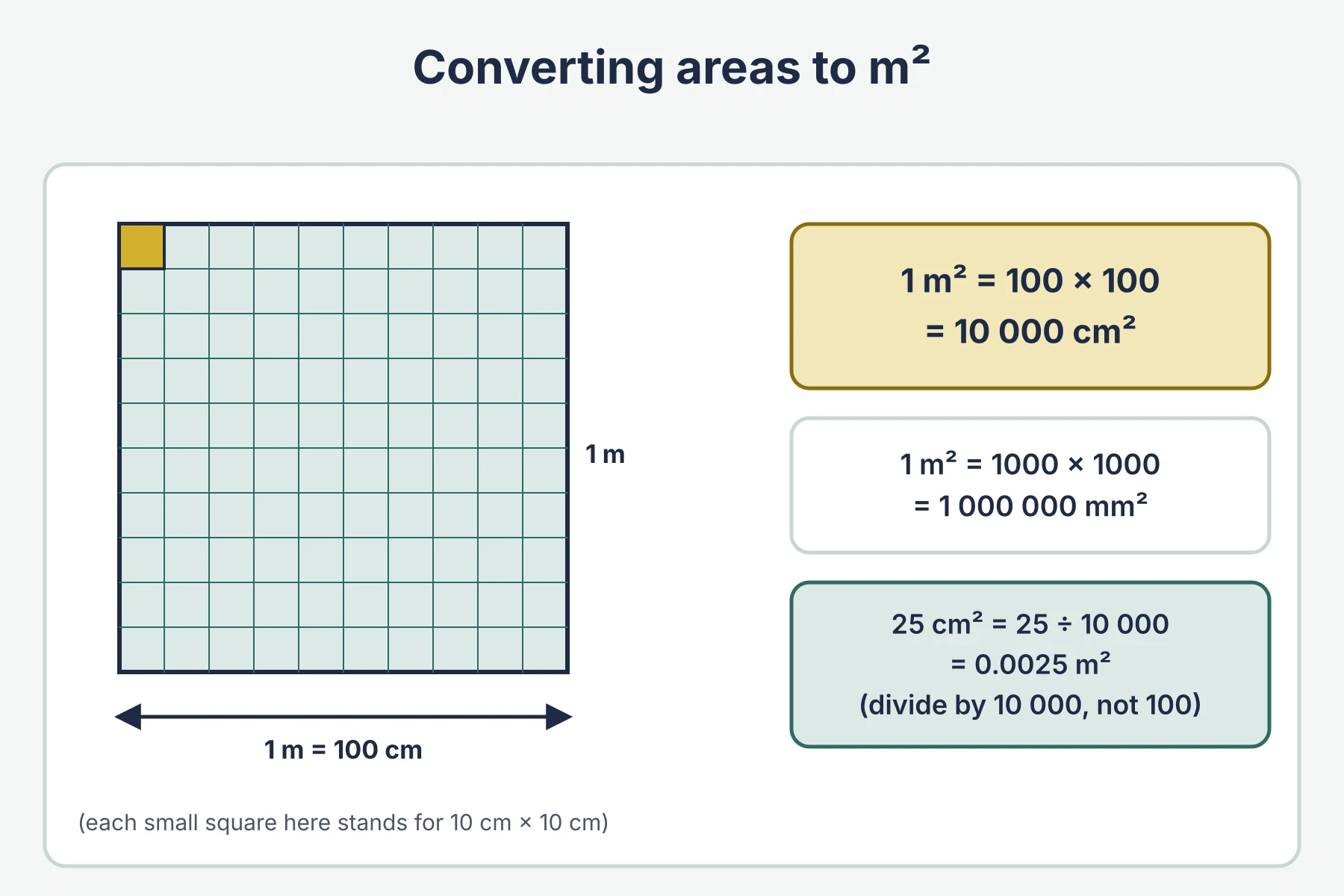
Area conversions
| From | To m² | Example |
|---|---|---|
| cm² | ÷ 10 000 | 40 cm² = 0.0040 m² |
| mm² | ÷ 1 000 000 | 2.0 mm² = 2.0 × 10⁻⁶ m² |
| cm × cm | convert each length to m first | 50 cm × 20 cm = 0.50 m × 0.20 m = 0.10 m² |
Prefixes: 1 kPa = 1000 Pa; 1 MPa = 10⁶ Pa.
Force, area and pressure (Core)
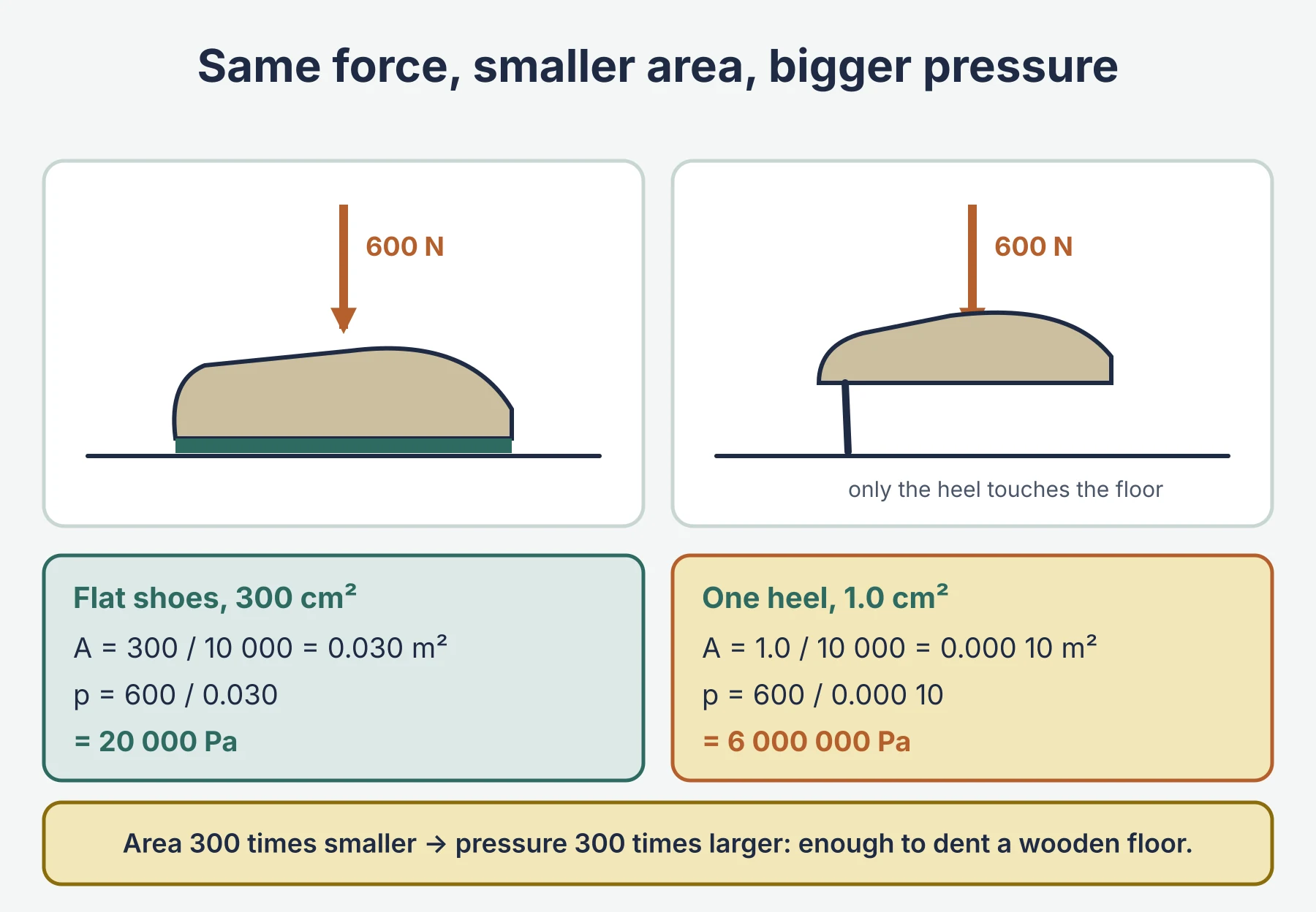
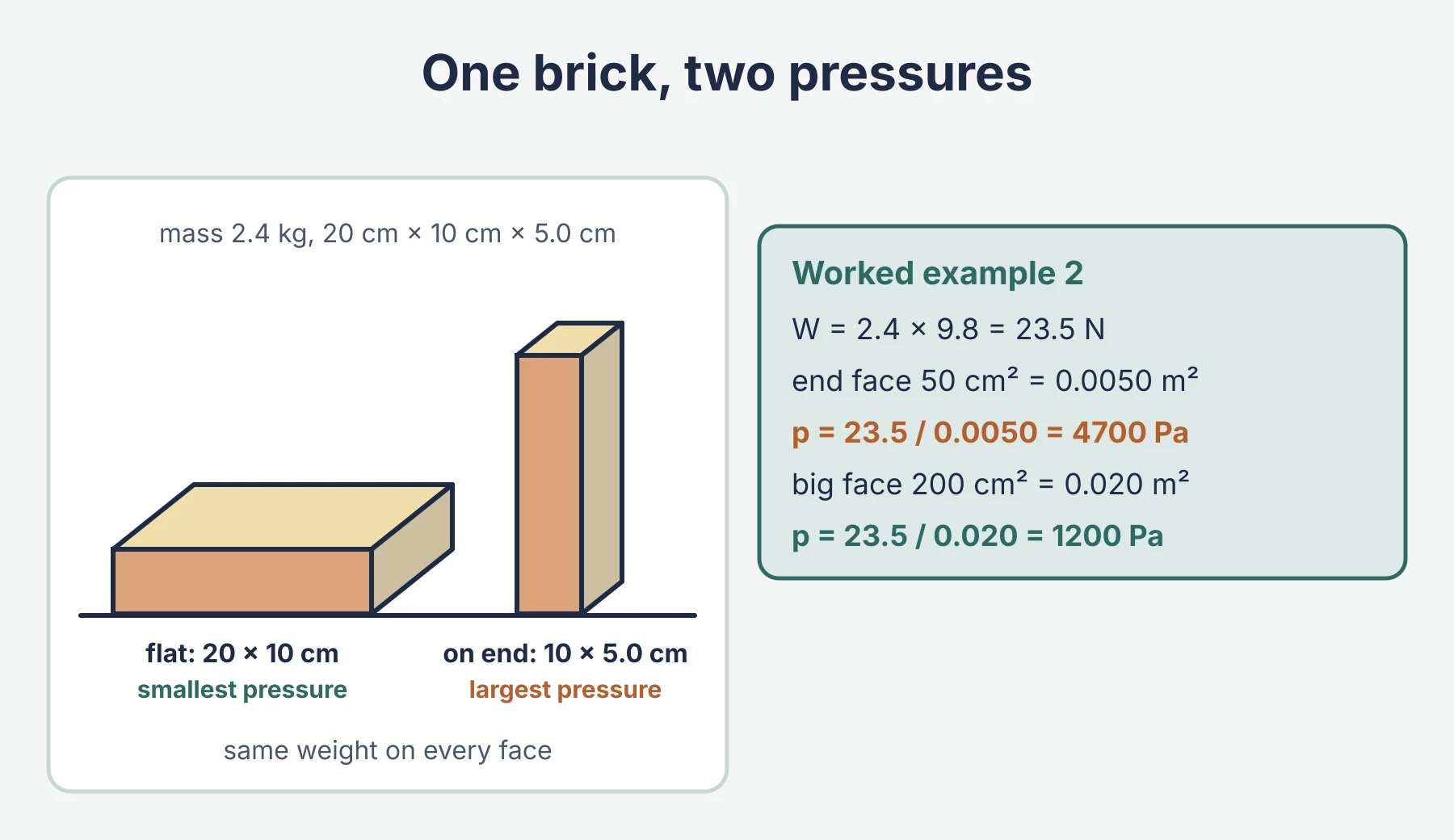
- Same area, larger force → larger pressure.
- Same force, smaller area → larger pressure.
- Same force, larger area → smaller pressure.
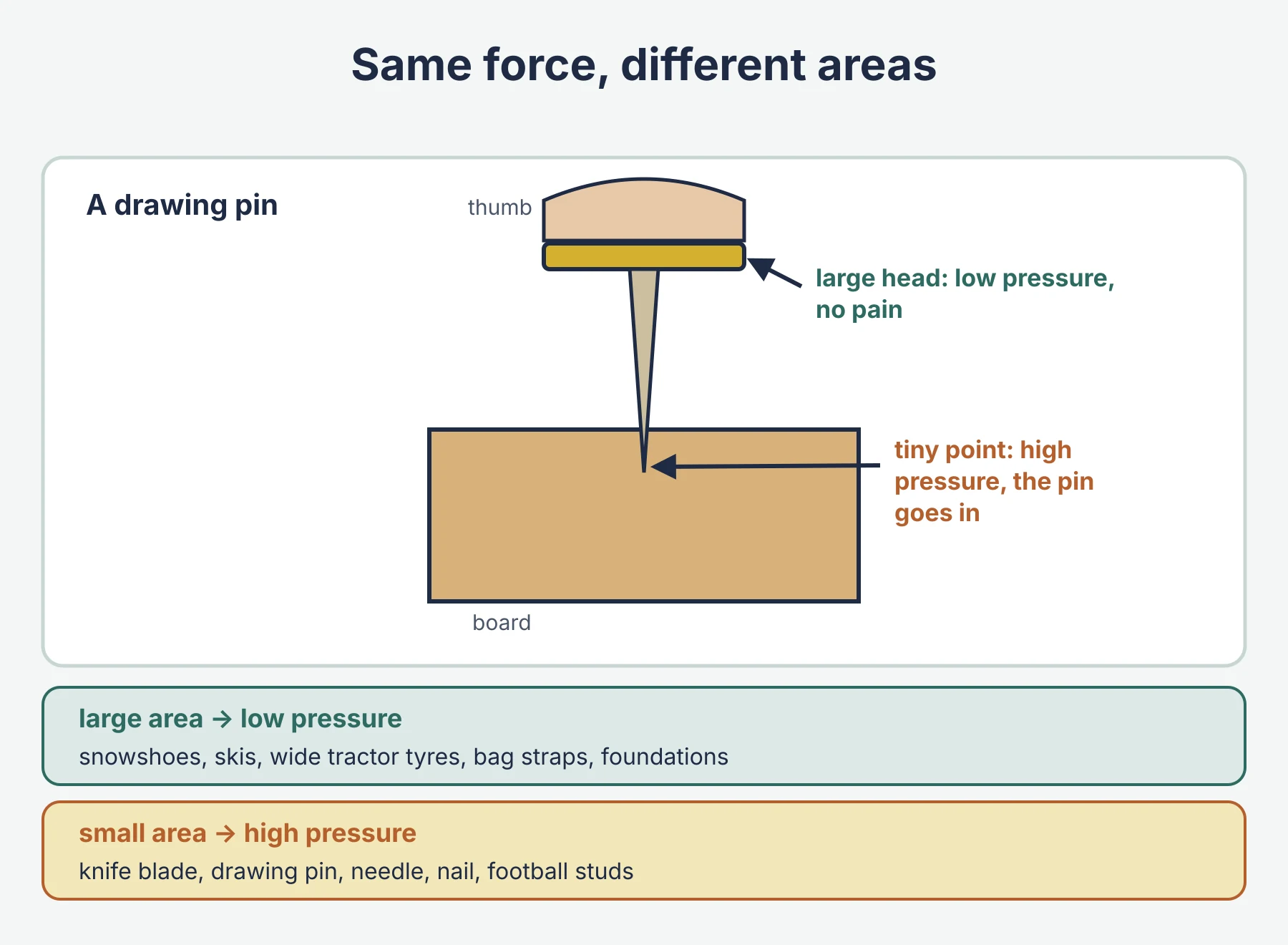
Low pressure wanted (large area): snowshoes, skis, tractor tyres, tank tracks, wide bag straps, building foundations, a camel’s wide feet on sand.
High pressure wanted (small area): knife blades, scissors, needles, nails, drawing-pin points, football studs, ice-skate blades.
Describing an example: “The [object] has a [large/small] area, so for the same force the pressure is [low/high], so it [does not sink / cuts easily].”
Pressure in liquids (Core)
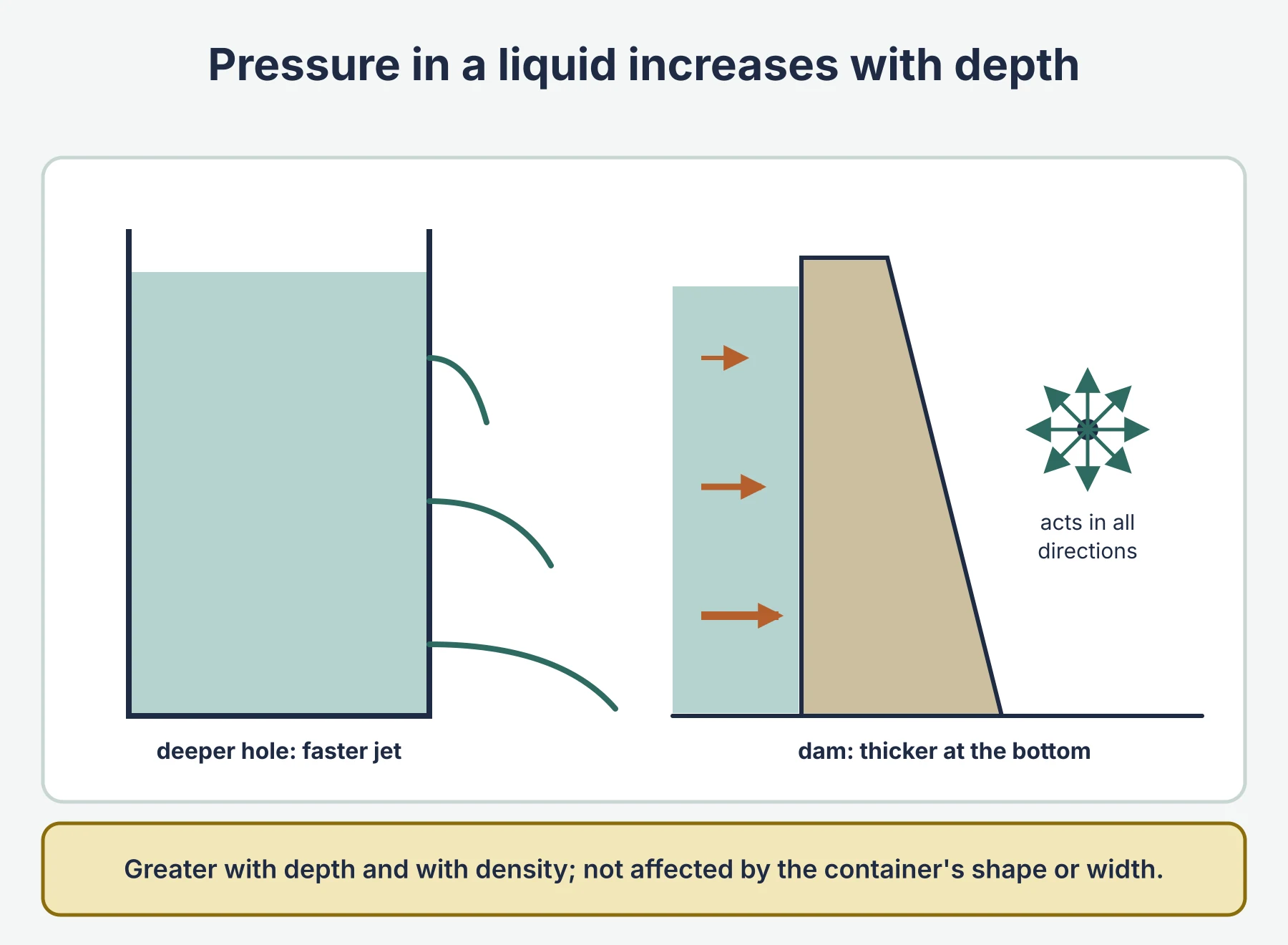
- Increases with depth.
- Increases with the liquid’s density.
- Same depth, same liquid → same pressure, whatever the container shape.
- Applications: dams thicker at the base; water spurts faster from lower holes; water towers placed high; ears hurt deeper underwater.
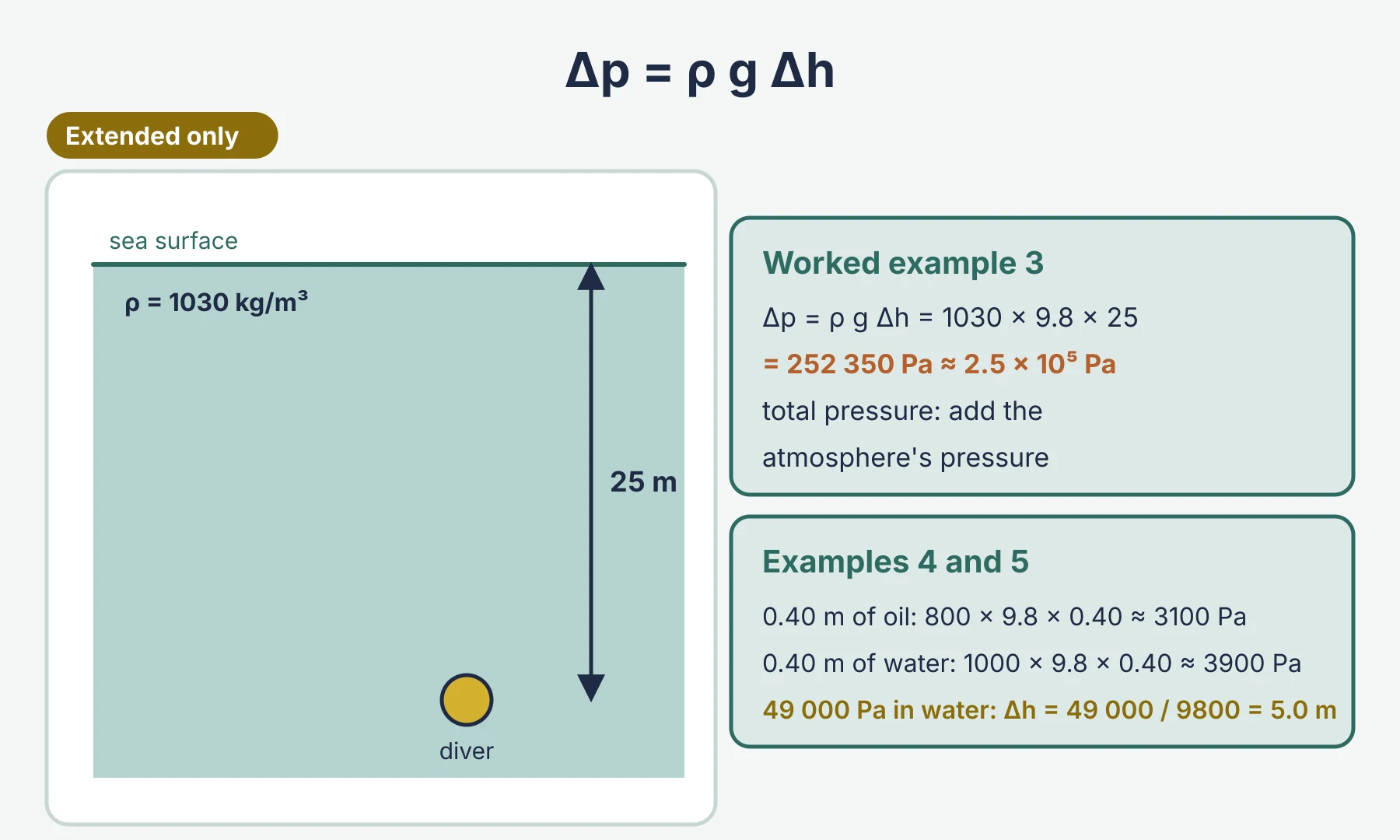
Δp = ρgΔh (Extended only)
- Δh = vertical depth below the surface (or vertical height difference between two points).
- Density must be in kg/m³ (1.0 g/cm³ = 1000 kg/m³).
- Gives the pressure due to the liquid only; total pressure = atmospheric pressure + ρgΔh if atmospheric pressure is given.
- Doubling depth doubles Δp; doubling density doubles Δp.
Method in steps
- Convert density to kg/m³ and depth to m.
- Substitute into Δp = ρgΔh.
- Add atmospheric pressure only if the question asks for the total and gives the value.
- Give the unit Pa (or kPa).
Worked reminder. Mercury has a density of 13.6 g/cm³ = 13 600 kg/m³. At 0.20 m below its surface: Δp = 13 600 × 9.8 × 0.20 = 26 656 Pa ≈ 27 kPa, over thirteen times the value at the same depth in water. Leaving the density as 13.6 would give 26.7 Pa, a thousand times too small.
Key terms
| Term | Meaning |
|---|---|
| Pressure | Force per unit area |
| Pascal (Pa) | Unit of pressure; 1 Pa = 1 N/m² |
| Area of contact | Area over which the force acts |
| Depth | Vertical distance below the surface of the liquid |
| Density | Mass per unit volume; needed for liquid pressure |
Exam traps
- cm² → m²: divide by 10 000, not 100.
- Using mass instead of weight as the force (multiply kg by g first).
- “A sharp knife needs less pressure”: it needs less force, because the small area gives a large pressure.
- Thinking a wider tank has a bigger pressure at the bottom at the same depth.
- (Extended) Measuring Δh from the bottom of the tank.
- (Extended) Using g/cm³ in Δp = ρgΔh.
- (Extended) Adding atmospheric pressure when the question asks only for the change in pressure.
Quick self-test
- Define pressure.
- A box of weight 240 N rests on an area of 0.60 m². Find the pressure.
- Convert 80 cm² into m².
- A force of 50 N acts on an area of 25 cm². Find the pressure in Pa.
- Explain why a camel’s wide feet help it walk on sand.
- Explain why a drawing pin goes into a board point first, not head first.
- State two factors that affect the pressure beneath the surface of a liquid.
- Why is a dam thicker at the bottom than at the top?
- (Extended) Find the pressure due to the water 12 m below the surface of a lake (ρ = 1000 kg/m³).
- (Extended) At what depth in oil of density 900 kg/m³ is the pressure due to the oil 18 000 Pa?
- (Extended) A liquid gives a pressure of 5880 Pa at a depth of 0.50 m. Find its density.
- (Extended) Atmospheric pressure is 1.0 × 10⁵ Pa. Find the total pressure 20 m below the surface of fresh water.
Answers
- Force per unit area.
- 240 ÷ 0.60 = 400 Pa.
- 80 ÷ 10 000 = 0.0080 m².
- 50 ÷ 0.0025 = 20 000 Pa.
- Large area → for the same weight, lower pressure → the camel does not sink so far into the sand.
- The point has a tiny area, so the same force gives a very high pressure on the board; the head’s large area keeps the pressure on the thumb low.
- Depth and density of the liquid.
- Water pressure increases with depth, so the force on the dam is greatest at the bottom.
- 1000 × 9.8 × 12 = 117 600 Pa (1.2 × 10⁵ Pa).
- 18 000 ÷ (900 × 9.8) = 2.0 m (2.04 m).
- 5880 ÷ (9.8 × 0.50) = 1200 kg/m³.
- 1000 × 9.8 × 20 = 196 000 Pa; total = 196 000 + 100 000 = 296 000 Pa (3.0 × 10⁵ Pa).
Where to go next
Try the practice questions on pressure, then move on to Topic 2 with the revision notes on the kinetic particle model of matter, where gas pressure is explained with particles.
Related resources
-
Study guides
IGCSE Physics: Motion, Forces and Energy (Cambridge 0625)
Cambridge IGCSE Physics 0625 Topic 1 study guide for 2026-2028: motion graphs, mass and weight, density, forces, momentum, energy, work, power and pressure.
Physics · Cambridge · IGCSE
Read guide -
Practice questions
IGCSE Physics: Motion, Forces and Energy (Extended) — Practice Questions (Cambridge 0625)
Original Cambridge IGCSE Physics 0625 Extended questions on vectors at right angles, impulse, momentum conservation, energy and liquid pressure, with answers.
Physics · Cambridge · IGCSE
Try questions -
Practice questions
IGCSE Physics: Motion, Forces and Energy — Practice Questions
Original exam-style practice questions with full worked answers on speed, forces, momentum, energy and pressure for Cambridge IGCSE Physics 0625.
Physics · Cambridge · IGCSE
Try questions
Related articles
Get free revision emails (optional)
Occasional emails with practice questions, worked explanations and links to free resources for the qualification and subjects you choose. No spam, and you can unsubscribe from any email. The free tools on this site never need an email.