
Study Guides
Cambridge IGCSE Physics (0625): Energy, work and power
Study guide to Cambridge IGCSE Physics 0625 section 1.7: energy stores and transfers, kinetic and potential energy, work, resources, efficiency and power.
- Subject
- Physics
- Level
- IGCSE
- Topic
- Motion, forces and energy
- Author
- Marlbridge Academic Team
- Updated
- Reviewed by
- Iftikhar Azeemi (what this means)
Aligned to Cambridge IGCSE Physics (0625), For examination in 2026, 2027 and 2028. Official specification .
Syllabus page (what it covers and how it is assessed): Cambridge IGCSE Physics.
Syllabus points this page covers, with Core and Extended
0625
- 1.7 Energy, work and power · Core and Extended
"Core and Extended" means part of that syllabus point is Extended only. The page's own tier notes say which part.
Found an error? Report a correction.
Need help with this topic? Request a free trial class for IGCSE Physics (0625).
This guide teaches section 1.7, Energy, work and power, of the Cambridge IGCSE Physics 0625 syllabus for examination in 2026, 2027 and 2028, in its four parts: 1.7.1 Energy, 1.7.2 Work, 1.7.3 Energy resources and 1.7.4 Power. Supplement content is examined only on Papers 2 and 4 and is labelled Extended only. The Motion, forces and energy study guide already gives the list of stores, a torch flow diagram, a power-station Sankey diagram and a full table of energy resources; this page concentrates on calculations, multi-stage energy chains and how to write a comparison of resources.
What the syllabus asks for
| Part | Core | Extended only |
|---|---|---|
| 1.7.1 Energy | Stores; transfers between stores; conservation of energy with simple flow diagrams | Ek = ½mv²; ΔEp = mgΔh; conservation in multi-stage examples and Sankey diagrams |
| 1.7.2 Work | Mechanical or electrical work done = energy transferred; W = Fd = ΔE | – |
| 1.7.3 Energy resources | How each resource gives useful energy or electricity (boiler, turbine, generator); advantages and disadvantages; efficiency as a qualitative idea | The Sun as the main source except geothermal, nuclear and tidal; fusion in the Sun; fusion research; efficiency equations |
| 1.7.4 Power | P = W/t and P = ΔE/t | – |
Stores, transfers and conservation (1.7.1)
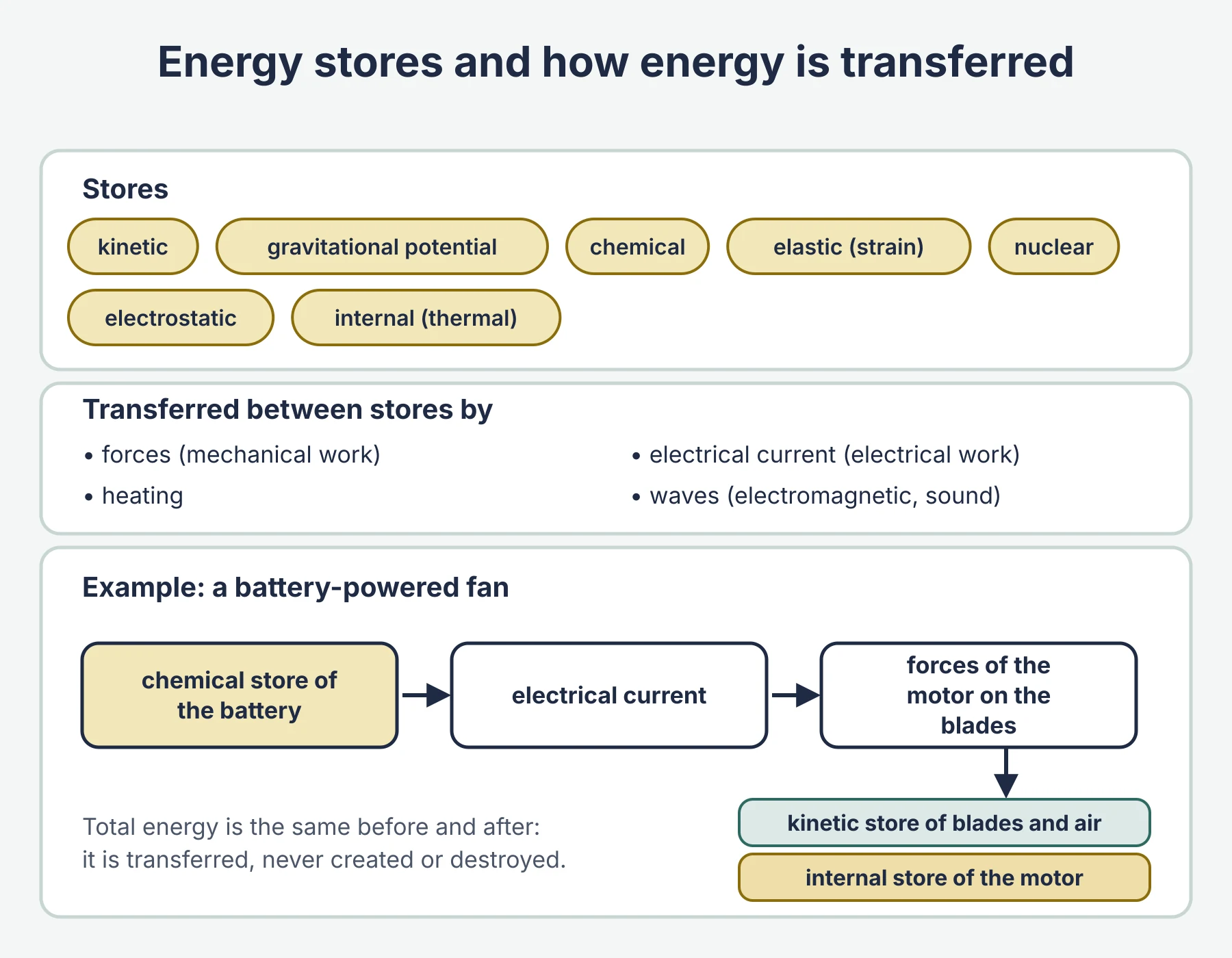
Energy can be stored as kinetic, gravitational potential, chemical, elastic (strain), nuclear, electrostatic and internal (thermal). It is transferred between stores by forces (mechanical work), by electrical currents (electrical work), by heating, and by waves (electromagnetic, sound and others).
Describe a transfer by naming the store it leaves, the way it is transferred and the store it goes to:
| Event | From store | Transferred by | To store(s) |
|---|---|---|---|
| a solar-powered calculator works | (the Sun’s nuclear store) | light (electromagnetic waves) to the solar cell, then electrical current | internal store of the circuit and surroundings; light from the display |
| a bungee jumper slows at the bottom | kinetic | the cord’s force (mechanical work) | elastic store of the cord |
| a battery-powered fan runs | chemical store of the battery | electrical current, then the motor’s forces on the blades | kinetic store of the blades and air; internal store of the motor |
| a guitar string is plucked | elastic | sound waves | internal store of the surroundings |
Conservation of energy: energy cannot be created or destroyed, only transferred between stores. The total is the same before and after; “lost” energy has usually gone, by heating or sound, into the internal store of the surroundings, where it is spread out and no longer useful.
Kinetic and gravitational potential energy (Extended only)
Ek  = ½ m v²         (J, kg, m/s)
ΔEp = m g Δh         (J, kg, N/kg, m)
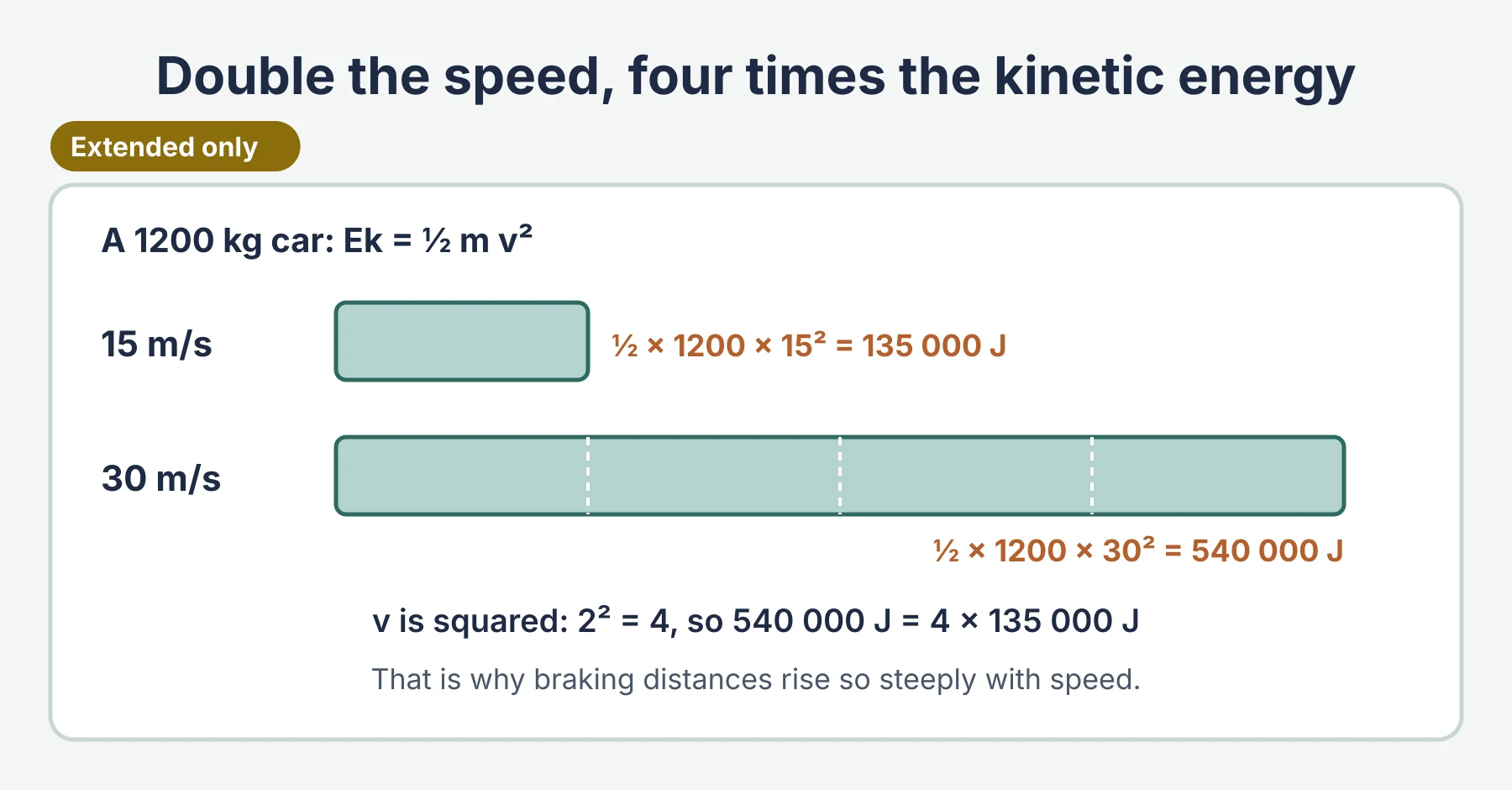
Worked example 1. A 1200 kg car moves at 15 m/s. Find its kinetic energy, and the kinetic energy at 30 m/s.
Ek = ½ × 1200 × 15² = 135 000 J
at 30 m/s: Ek = ½ × 1200 × 30² = 540 000 J  (four times as much)
Doubling the speed quadruples Ek because v is squared. That is why braking distances rise so steeply with speed.
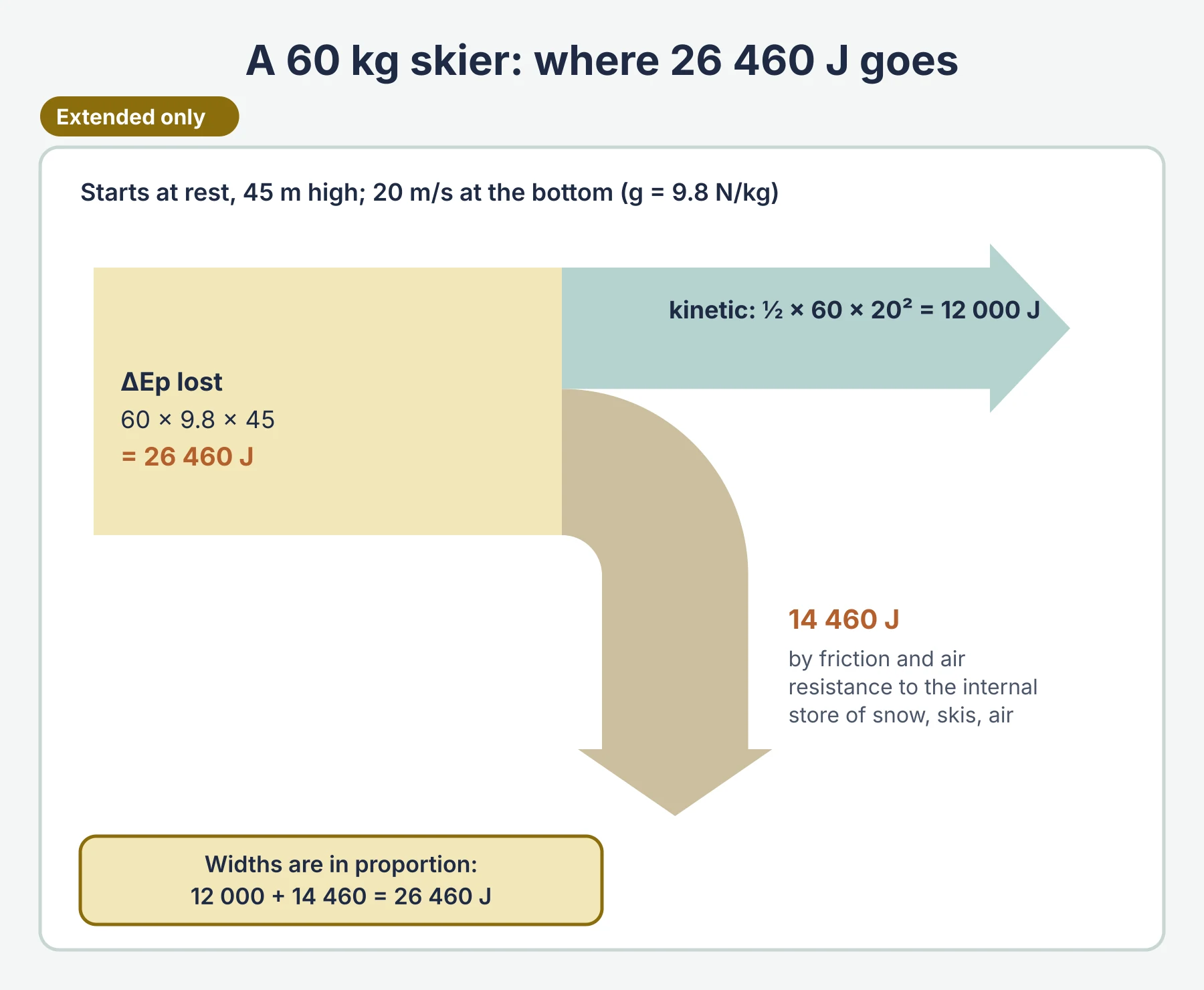
Worked example 2 (a multi-stage chain). A 60 kg skier starts from rest at the top of a slope 45 m high. At the bottom her speed is 20 m/s.
ΔEp lost  = 60 × 9.8 × 45 = 26 460 J
Ek gained = ½ × 60 × 20²  = 12 000 J
by conservation, the remaining 14 460 J was transferred by friction
and air resistance to the internal store of the snow, skis and air
In a Sankey diagram for this, the arrow starts 26 460 J wide; 12 000 J continues as the useful kinetic energy and 14 460 J branches off as wasted energy. Arrow widths must be in proportion to the energies, and the widths out must add up to the width in.
Ignoring friction, the skier’s speed would follow from mgΔh = ½mv²: v = √(2gΔh) = √(2 × 9.8 × 45) = 30 m/s. The mass cancels, so any skier would reach the same speed.
Work (1.7.2)
Mechanical or electrical work done is equal to the energy transferred.
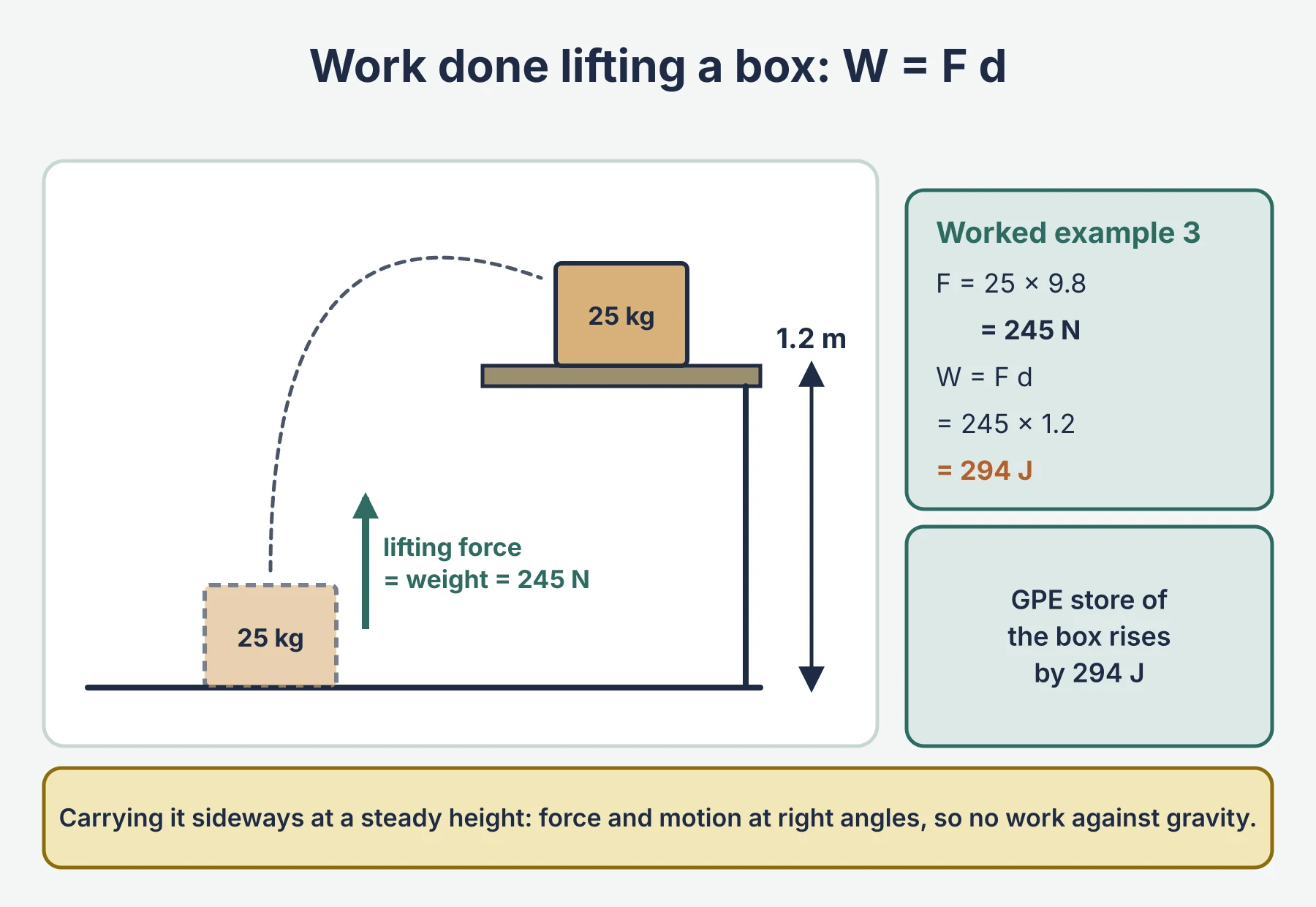
W = F d = ΔE W in J, F in N, d in m (distance moved in the direction of the force)Worked example 3. A worker lifts a 25 kg box steadily onto a shelf 1.2 m high (g = 9.8 N/kg).
force needed = weight = 25 × 9.8 = 245 N
W = F d = 245 × 1.2 = 294 J
the box's gravitational potential store increases by 294 J
If the force and the motion are at right angles, no work is done by that force: carrying the box horizontally at a steady height does no work against gravity.
Energy resources (1.7.3)
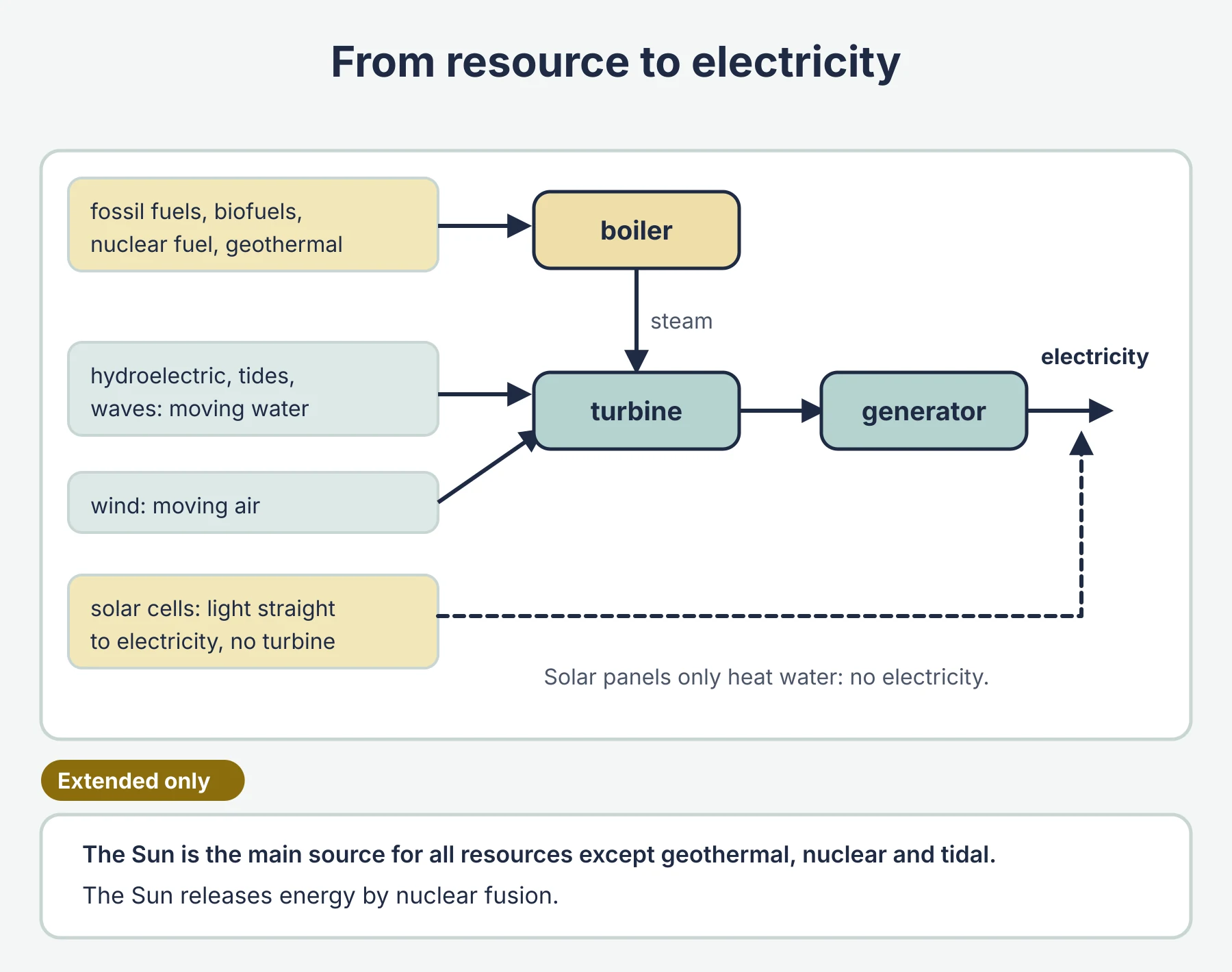
Most electricity is generated by spinning a turbine connected to a generator. The resources differ in what turns the turbine:
- Fossil fuels, biofuels, nuclear fuel, geothermal: energy heats water in a boiler (for geothermal, hot rocks heat the water underground) to make steam; steam drives the turbine.
- Hydroelectric, tides, waves: moving water turns the turbine directly.
- Wind: moving air turns the turbine blades.
- Solar cells: light is transferred straight to electrical energy, with no turbine or generator.
- Solar panels: infrared and other waves from the Sun heat water; they do not generate electricity.
Writing a comparison
The syllabus names five criteria: renewability, availability, reliability, scale and environmental impact. A strong answer uses the criterion words and compares directly:
Wind compared with gas for a country’s electricity. Wind is renewable; gas is not and will run out. Wind turbines release no carbon dioxide while operating, but gas releases carbon dioxide, contributing to climate change. Gas is reliable and can be supplied on demand, whereas wind output depends on the weather. A single gas power station supplies on a large scale; many wind turbines over a large area are needed for the same output.
Efficiency
Core (qualitative). Efficiency describes how much of the energy put in is transferred usefully. No device is 100% efficient; the wasted part usually ends up in the internal store of the surroundings.
Extended only.
efficiency = useful energy output / total energy input   (× 100%)
efficiency = useful power output  / total power input    (× 100%)
Where the energy comes from (Extended only)
Radiation from the Sun is the main source of energy for all our resources except geothermal, nuclear and tidal. The Sun releases its energy by nuclear fusion. Research is being carried out into using energy released by nuclear fusion to generate electricity on a large scale.
Power (1.7.4)
Power is the work done per unit time, and also the energy transferred per unit time:
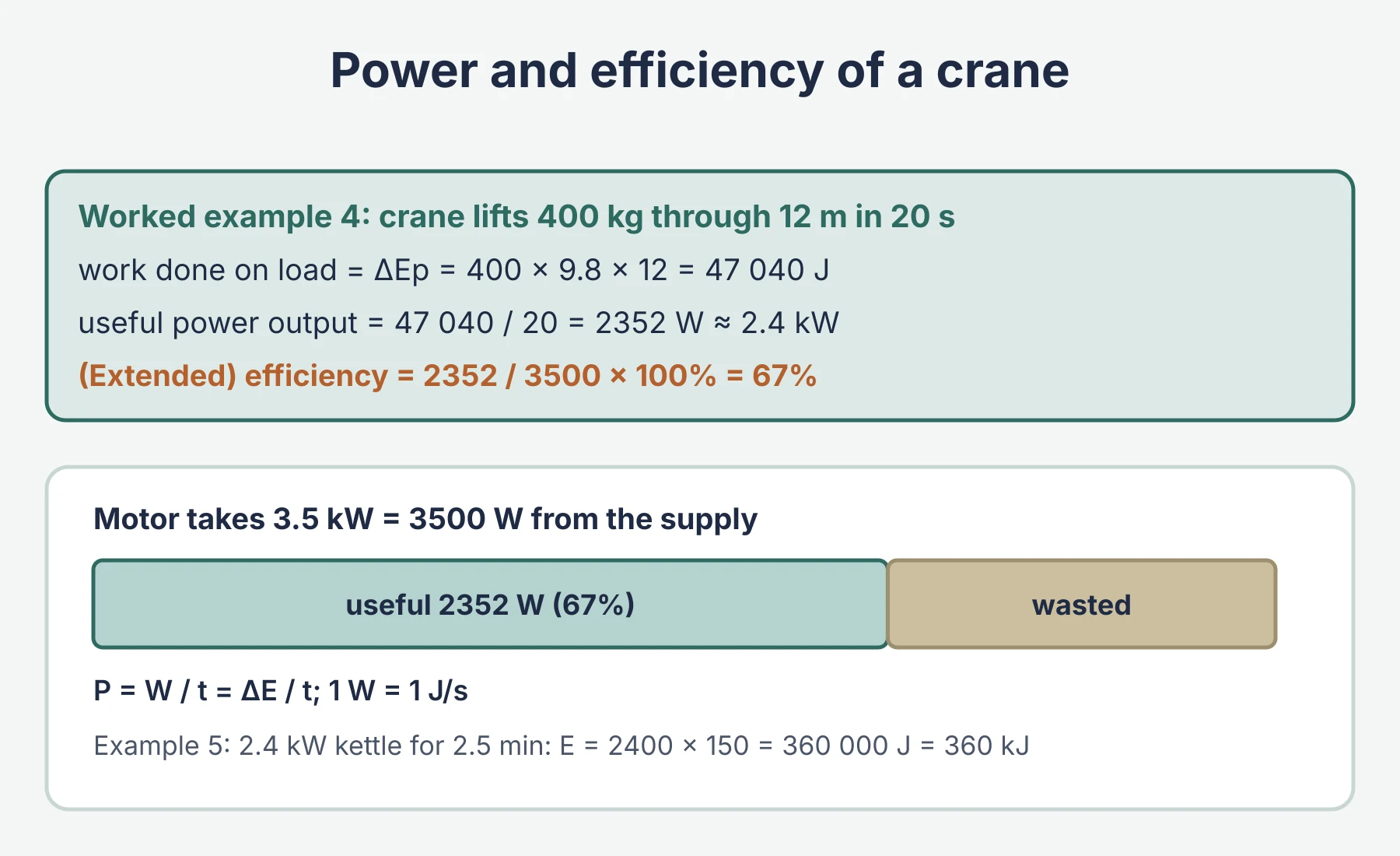
P = W / t P = ΔE / t P in watts (W), 1 W = 1 J/sWorked example 4. A crane lifts a 400 kg load through 12 m in 20 s. Its electric motor takes 3.5 kW from the supply.
work done on load = ΔEp = 400 × 9.8 × 12 = 47 040 J
useful power output = 47 040 / 20 = 2352 W  ≈ 2.4 kW
(Extended) efficiency = 2352 / 3500 × 100% = 67%
Worked example 5. A 2.4 kW kettle runs for 2.5 minutes. Energy transferred = P × t = 2400 × 150 = 360 000 J = 360 kJ.
Two people climbing the same stairs do the same work if they have the same weight; the one who climbs faster has the greater power.
Common mistakes
- Saying energy is “used up” or “lost” with no destination: say where it is transferred.
- Forgetting to square v in Ek, or squaring the whole of ½mv.
- Using mass instead of weight in W = Fd for a lifting problem.
- Leaving minutes or kW unconverted in P = ΔE/t.
- Calling solar panels and solar cells the same thing.
- Answering “advantages and disadvantages” with “it is good for the environment” without naming the effect (no carbon dioxide while operating, habitats flooded, and so on).
- (Extended) Giving an efficiency greater than 100%, or as a decimal when a percentage is asked for.
- (Extended) Including tidal energy as originating from the Sun.
Exam technique: command words
- State the stores or the principle: one clear phrase each.
- Describe an energy transfer: store → way it is transferred → store, for each stage.
- Calculate: equation, substitution with units converted, answer with a unit (J, W or %).
- Explain why a figure is less than expected: name the wasted energy and where it went.
- Discuss / compare resources: use the five criteria words and make each point comparative.
Test yourself with the revision notes on energy, work and power and the practice questions on energy, work and power. The forces that do work are in the study guide on forces, and kinetic energy in collisions in the study guide on momentum.
Related resources
-
Practice questions
Cambridge IGCSE Physics (0625): Energy, work and power – Practice Questions
Thirteen original Cambridge IGCSE Physics 0625 questions on energy stores, work, power, Ek, Ep, efficiency and energy resources, with mark-by-mark answers.
Physics · Cambridge · IGCSE
Try questions -
Revision notes
Cambridge IGCSE Physics (0625): Energy, work and power – Revision Notes
Revision notes for Cambridge IGCSE Physics 0625 section 1.7: stores, transfers, Ek, Ep, work, power, efficiency and energy resources, with a self-test.
Physics · Cambridge · IGCSE
Revise topic -
Study guides
Cambridge IGCSE Physics (0625): Forces
Study guide to Cambridge IGCSE Physics 0625 section 1.5 Forces: extension, resultant force, friction, F = ma, circular motion, moments and stability.
Physics · Cambridge · IGCSE
Read guide
Related articles
Get free revision emails (optional)
Occasional emails with practice questions, worked explanations and links to free resources for the qualification and subjects you choose. No spam, and you can unsubscribe from any email. The free tools on this site never need an email.