
Revision Notes
Cambridge IGCSE Physics (0625): Momentum – Revision Notes
Revision notes for Cambridge IGCSE Physics 0625 section 1.6 Momentum (Extended): p = mv, impulse, conservation, F = Δp/Δt, safety features and a self-test.
- Subject
- Physics
- Level
- IGCSE
- Topic
- Motion, forces and energy
- Author
- Marlbridge Academic Team
- Updated
- Reviewed by
- Iftikhar Azeemi (what this means)
Aligned to Cambridge IGCSE Physics (0625), For examination in 2026, 2027 and 2028. Official specification .
Syllabus page (what it covers and how it is assessed): Cambridge IGCSE Physics.
Syllabus points this page covers, with Core and Extended
0625
- 1.6 Momentum · Extended only
"Core and Extended" means part of that syllabus point is Extended only. The page's own tier notes say which part.
Found an error? Report a correction.
Need help with this topic? Request a free trial class for IGCSE Physics (0625).
These notes condense section 1.6, Momentum, of the Cambridge IGCSE Physics 0625 syllabus for examination in 2026, 2027 and 2028. All of section 1.6 is Supplement (Extended only) and is examined on Papers 2 and 4. Explanations and five worked examples are in the study guide on momentum; the Motion, forces and energy revision notes cover the rest of Topic 1.
Definitions
- Momentum: mass × velocity.
- Impulse: force × time for which the force acts.
- Resultant force: change in momentum per unit time.
- Principle of conservation of momentum: in a collision or explosion, the total momentum before equals the total momentum after (when no external resultant force acts).
Equations
| Equation | Units |
|---|---|
| p = m v | kg m/s |
| impulse = F Δt = Δ(m v) | N s (= kg m/s) |
| F = Δp / Δt | N |
Links:
- F = Δp/Δt is F = ma for constant mass.
- Impulse and change in momentum are the same quantity, so a question may give either.
- Unit check: N s = (kg m/s²) × s = kg m/s.
Signs and directions
- Momentum is a vector.
- Choose a positive direction; anything moving the other way is negative.
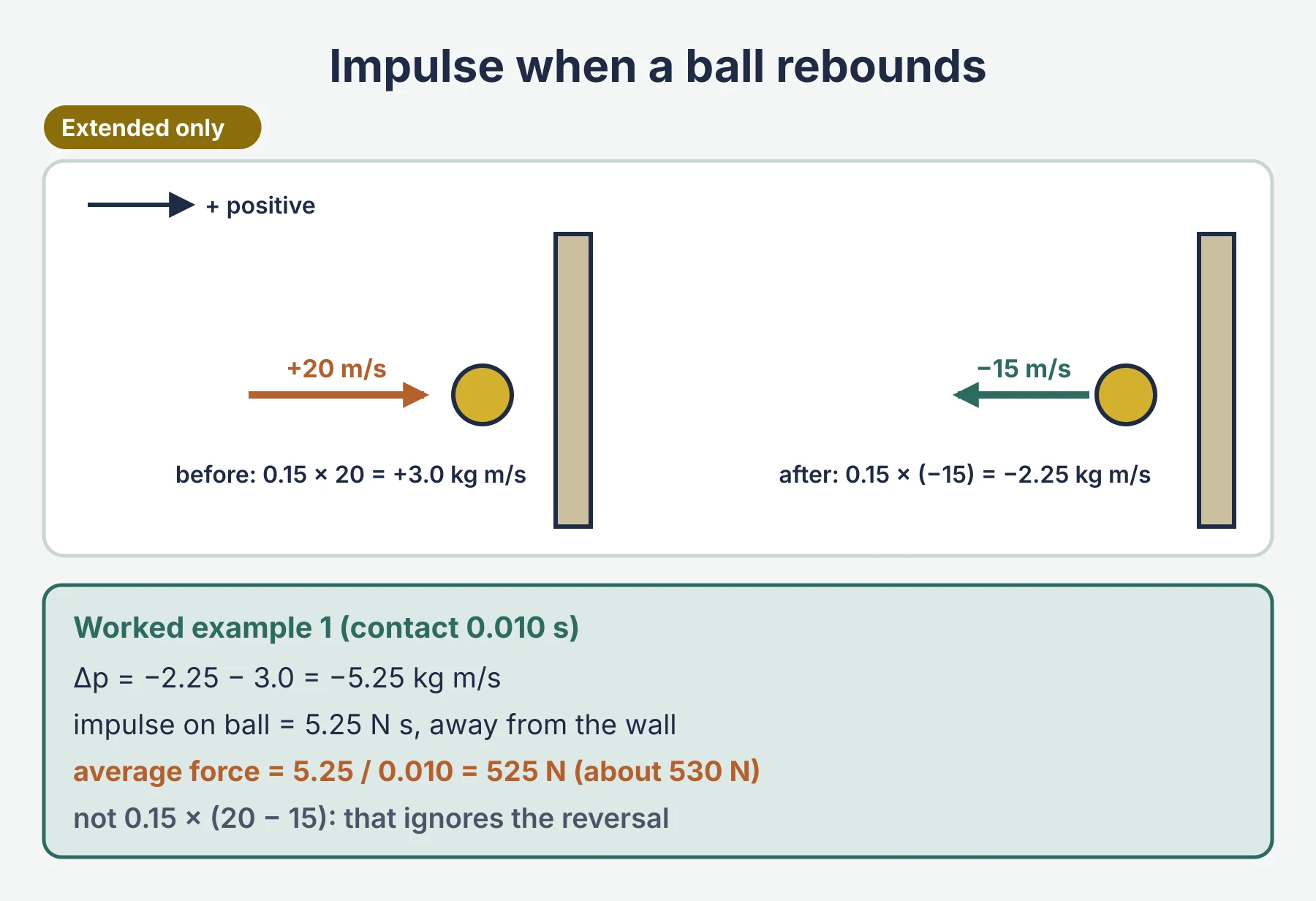
- Rebound: Δp = m(v − u) with v and u of opposite sign, so the change is the sum of the magnitudes.
- 0.20 kg ball, 10 m/s in, 8.0 m/s out: Δp = 0.20 × (−8.0 − 10) = −3.6 kg m/s; size 3.6 N s.
Conservation problems: three types
| Type | Before | After | Equation pattern |
|---|---|---|---|
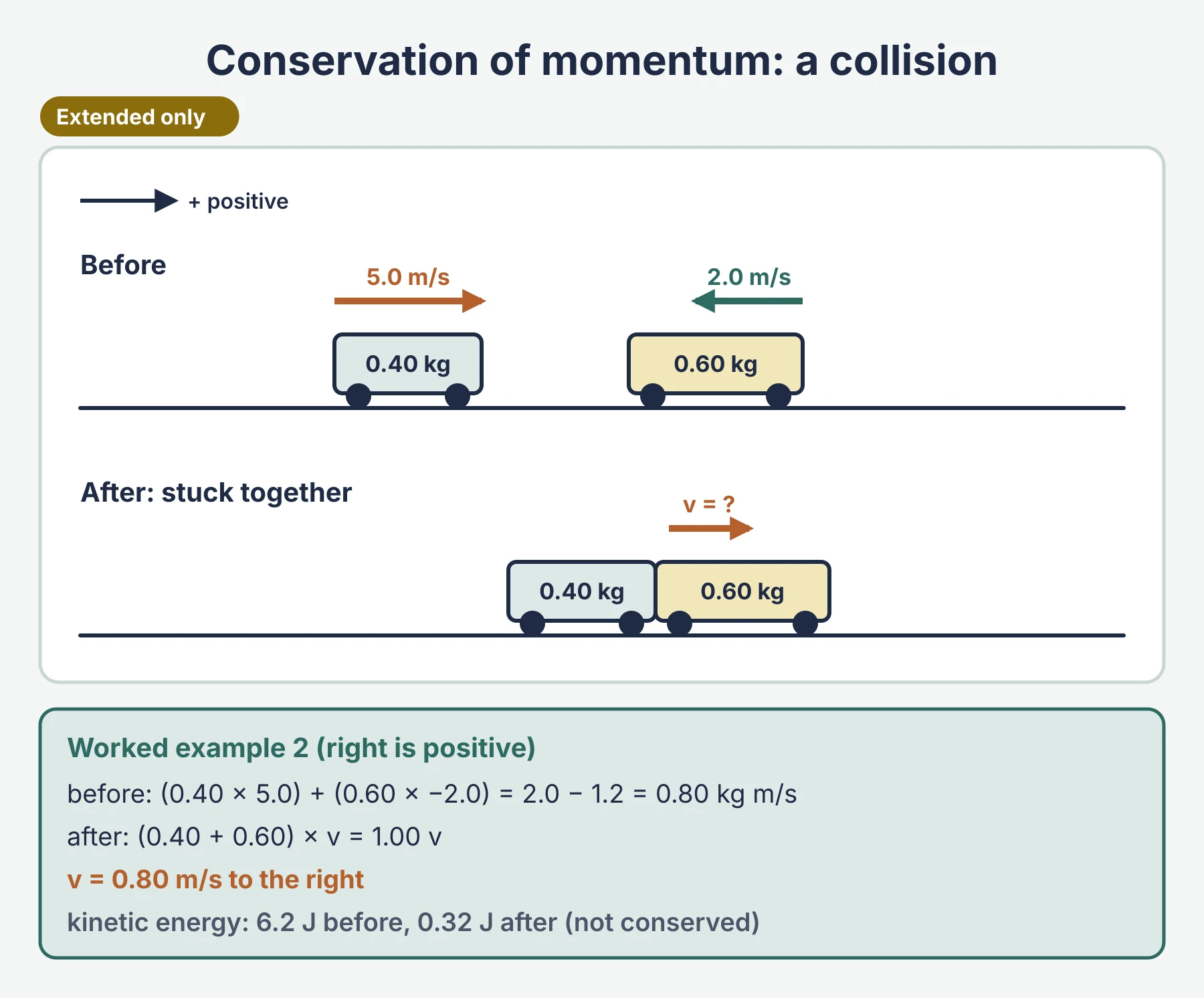
| Objects join | m₁u₁ + m₂u₂ | (m₁ + m₂)v | m₁u₁ + m₂u₂ = (m₁ + m₂)v |
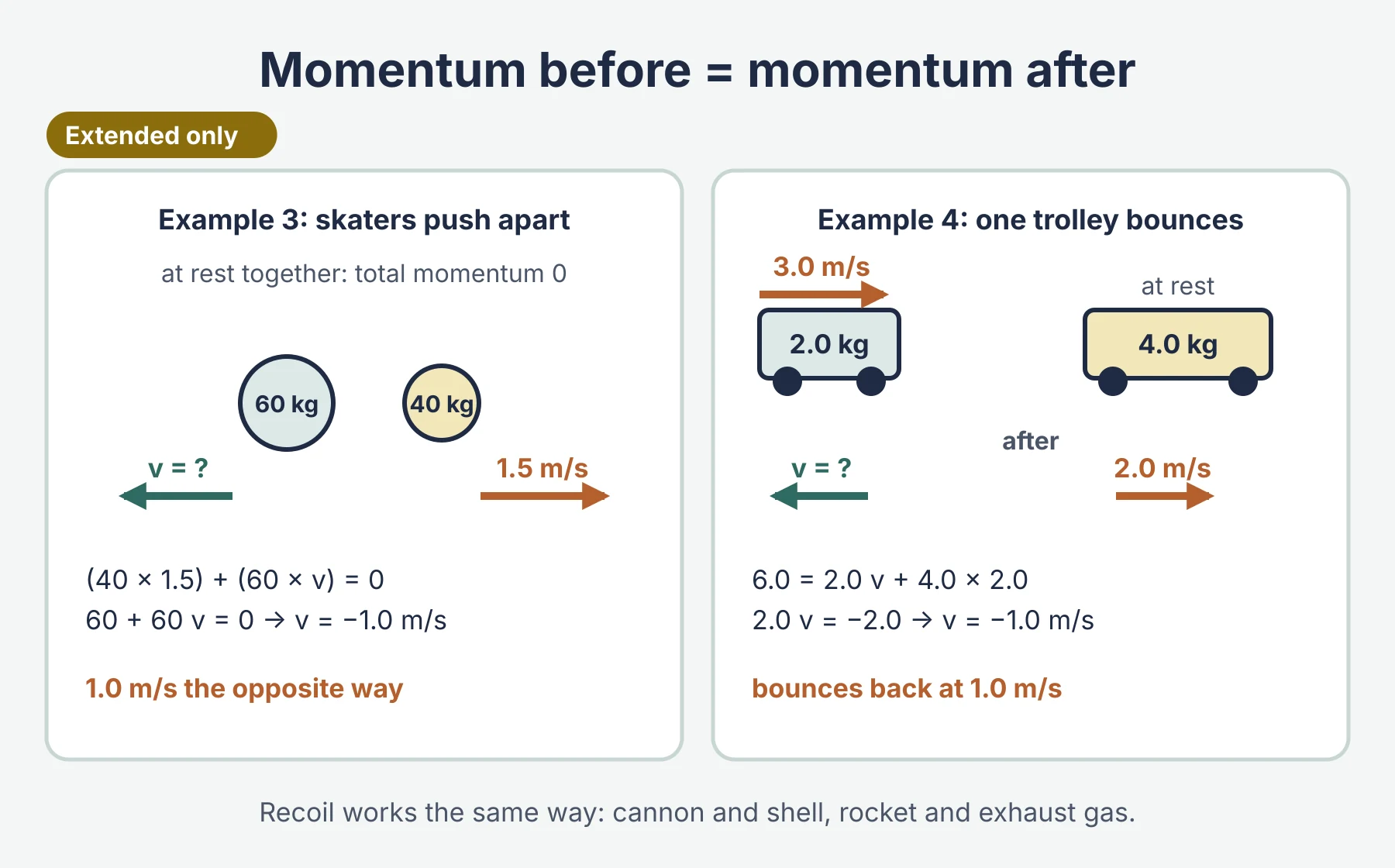
| Objects separate from rest (explosion, recoil) | 0 | m₁v₁ + m₂v₂ | m₁v₁ = −m₂v₂ |
| Objects bounce apart | m₁u₁ + m₂u₂ | m₁v₁ + m₂v₂ | solve for the one unknown |
Always finish with the direction of the velocity you found.
Worked check (objects join). A 0.50 kg trolley at 6.0 m/s hits a stationary 1.0 kg trolley and they stick: 0.50 × 6.0 = 1.5 v, so v = 2.0 m/s in the original direction. Sense check: the joined trolleys must move more slowly than the moving one did, because the same momentum is shared by a larger mass.
Worked check (recoil). A 40 kg boy steps forwards off a stationary 80 kg boat at 2.0 m/s: 0 = 40 × 2.0 + 80 v, so the boat moves at 1.0 m/s backwards.
Force and time: safety
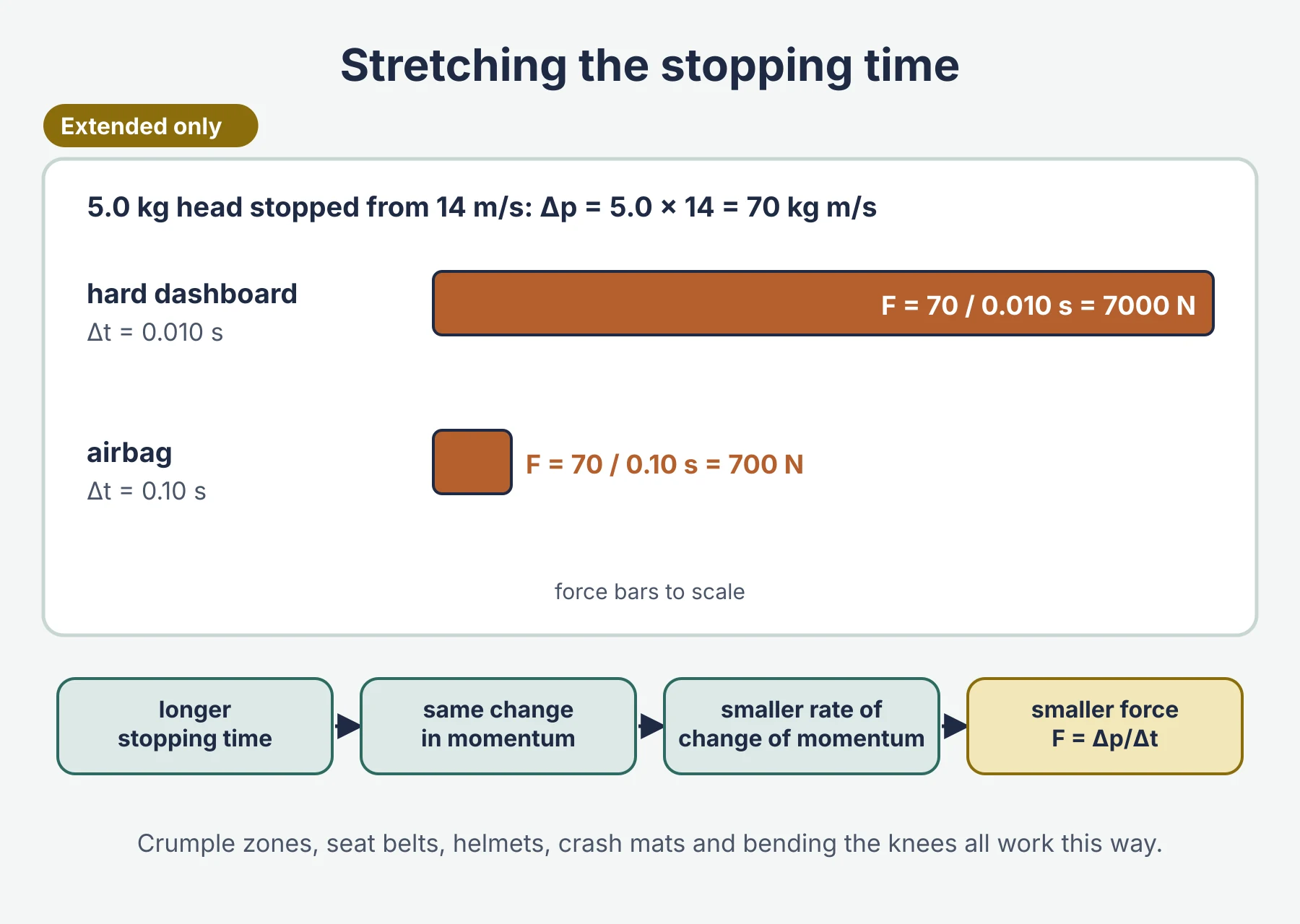
- For the same change in momentum, longer time → smaller force.
- Crumple zones, airbags, seat belts, helmets, crash mats, bending your knees: all increase Δt.
- A golfer or batter “following through” keeps the force acting for longer, so the ball gains more momentum (larger impulse).
Key terms
| Term | Meaning |
|---|---|
| Momentum | Mass × velocity; vector; kg m/s |
| Impulse | Force × time for which the force acts; equals change in momentum; N s |
| Conservation of momentum | Total momentum unchanged in a collision or explosion with no external resultant force |
| Recoil | Backward motion of one object when it pushes another forwards |
| Crumple zone | Part of a car designed to crush in a collision, increasing the stopping time |
| Rate of change of momentum | Δp/Δt; equal to the resultant force |
Exam traps
- Adding momenta of objects moving in opposite directions without signs.
- Treating a rebound as a smaller change than stopping. It is larger.
- Writing “the airbag absorbs the momentum” or “reduces the impulse”. The change in momentum is fixed; the time is longer, so the force is smaller.
- Forgetting the direction of a final velocity.
- Using the combined mass when objects bounce apart.
- Unit errors: momentum in kg/m s, impulse in N/s.
- Mixing grams and kilograms: 50 g is 0.050 kg.
Quick self-test
- Define momentum.
- Calculate the momentum of a 1500 kg car moving at 20 m/s.
- State the unit of impulse and show that it equals the unit of momentum.
- A 0.050 kg ball moving at 30 m/s is stopped. Find its change in momentum.
- A force of 120 N acts on a trolley for 0.25 s. Find the impulse.
- A 2.0 kg trolley at 4.0 m/s hits and sticks to a stationary 2.0 kg trolley. Find their speed.
- A 3.0 kg gun fires a 0.010 kg bullet at 300 m/s. Find the recoil speed of the gun.
- A 0.20 kg ball hits a wall at 10 m/s and rebounds at 8.0 m/s. Find the size of its change in momentum.
- If the ball in question 8 is in contact with the wall for 0.020 s, find the average force on it.
- Explain why a crash mat reduces the force on a gymnast who lands on it.
- State the condition for momentum to be conserved.
- A 1.0 kg trolley at 6.0 m/s hits a 2.0 kg trolley moving at 3.0 m/s in the opposite direction. They stick. Find the final velocity.
Answers
- Mass × velocity.
- 1500 × 20 = 30 000 kg m/s.
- N s; N s = kg m/s² × s = kg m/s.
- 0.050 × 30 = 1.5 kg m/s (opposite to the motion).
- 120 × 0.25 = 30 N s.
- 8.0 = 4.0 v, so v = 2.0 m/s.
- 0.010 × 300 = 3.0 kg m/s; gun: 3.0 ÷ 3.0 = 1.0 m/s backwards.
- 0.20 × (10 + 8.0) = 3.6 kg m/s.
- 3.6 ÷ 0.020 = 180 N.
- The gymnast’s change in momentum is the same, but the mat increases the stopping time, so the rate of change of momentum, and so the force, is smaller.
- No external resultant force acts on the objects.
- 6.0 − 6.0 = 0, so the trolleys stop (v = 0).
Where to go next
Work through the practice questions on momentum, then use the revision notes on energy, work and power for kinetic energy in collisions.
Related resources
-
Study guides
Cambridge IGCSE Physics (0625): Motion
Study guide to Cambridge IGCSE Physics 0625 section 1.2 Motion: speed, velocity, distance–time and speed–time graphs, acceleration and terminal velocity.
Physics · Cambridge · IGCSE
Read guide -
Practice questions
Cambridge IGCSE Physics (0625): Motion – Practice Questions
Twelve original Cambridge IGCSE Physics 0625 motion questions on speed, average speed, motion graphs, acceleration and terminal velocity, with full answers.
Physics · Cambridge · IGCSE
Try questions -
Revision notes
Cambridge IGCSE Physics (0625): Motion – Revision Notes
Revision notes for Cambridge IGCSE Physics 0625 section 1.2 Motion: speed equations, graph shapes, gradients, areas, acceleration, free fall and a self-test.
Physics · Cambridge · IGCSE
Revise topic
Related articles
Get free revision emails (optional)
Occasional emails with practice questions, worked explanations and links to free resources for the qualification and subjects you choose. No spam, and you can unsubscribe from any email. The free tools on this site never need an email.