
Revision Notes
Cambridge IGCSE Physics (0625): Forces – Revision Notes
Revision notes for Cambridge IGCSE Physics 0625 section 1.5 Forces: extension, resultants, F = ma, circular motion, moments, centre of gravity and a self-test.
- Subject
- Physics
- Level
- IGCSE
- Topic
- Motion, forces and energy
- Author
- Marlbridge Academic Team
- Updated
- Reviewed by
- Iftikhar Azeemi (what this means)
Aligned to Cambridge IGCSE Physics (0625), For examination in 2026, 2027 and 2028. Official specification .
Syllabus page (what it covers and how it is assessed): Cambridge IGCSE Physics.
Syllabus points this page covers, with Core and Extended
0625
- 1.5 Forces · Core and Extended
"Core and Extended" means part of that syllabus point is Extended only. The page's own tier notes say which part.
Found an error? Report a correction.
Need help with this topic? Request a free trial class for IGCSE Physics (0625).
These notes condense section 1.5, Forces (1.5.1 Effects of forces, 1.5.2 Turning effect of forces, 1.5.3 Centre of gravity), of the Cambridge IGCSE Physics 0625 syllabus for examination in 2026, 2027 and 2028. Supplement content, marked Extended only, is examined on Papers 2 and 4. Explanations and worked examples are in the study guide on forces; the Motion, forces and energy revision notes cover all of Topic 1.
Equations
| Equation | Units | Tier |
|---|---|---|
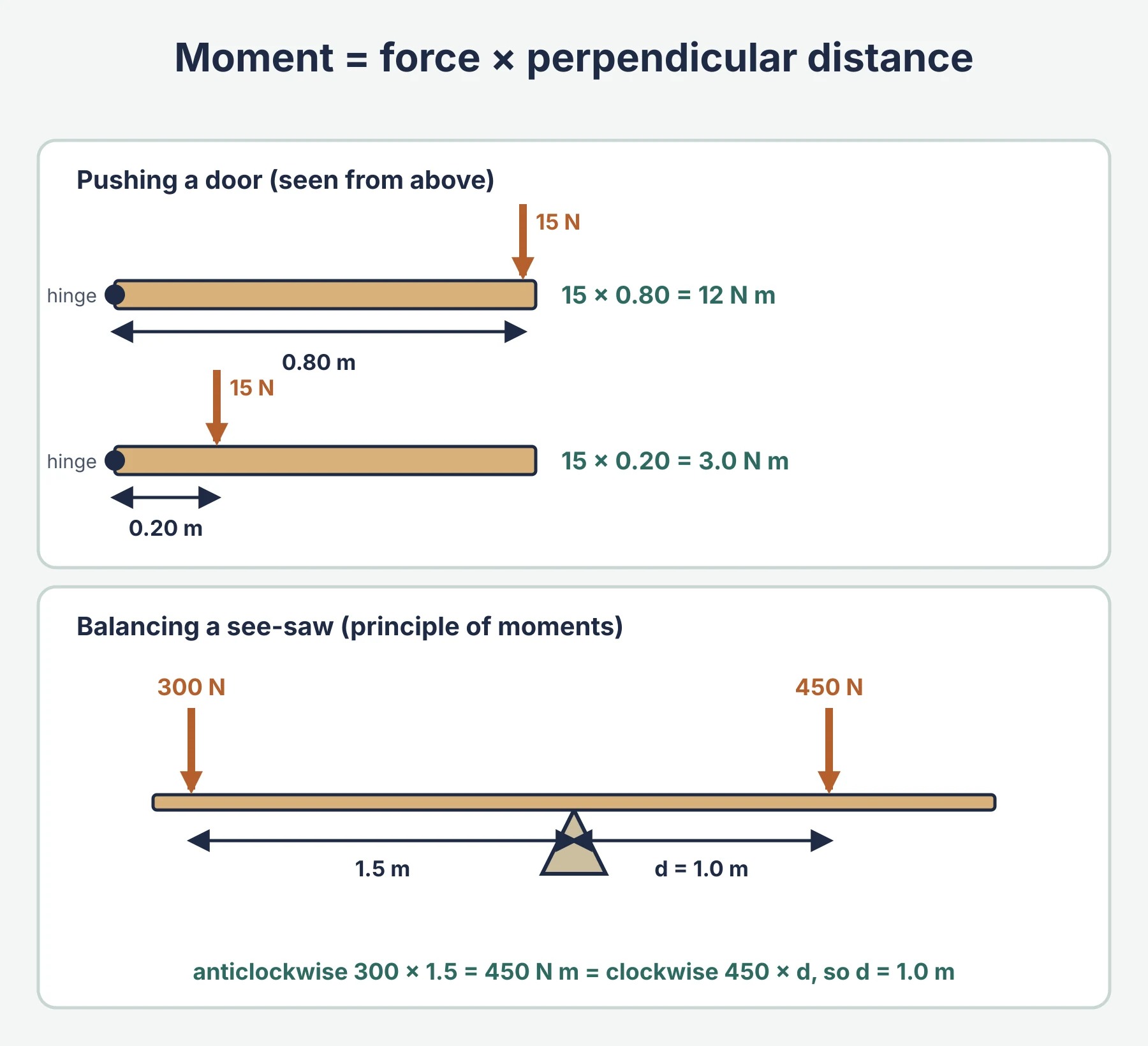
| moment = force × perpendicular distance from the pivot | N m | Core |
| k = F / x (spring constant) | N/m (or N/cm) | Extended only |
| F = m a (F is the resultant force) | N = kg × m/s² | Extended only |
Effects of forces (1.5.1)
- Forces can change the size and shape of an object.
- Extension = stretched length − original length.
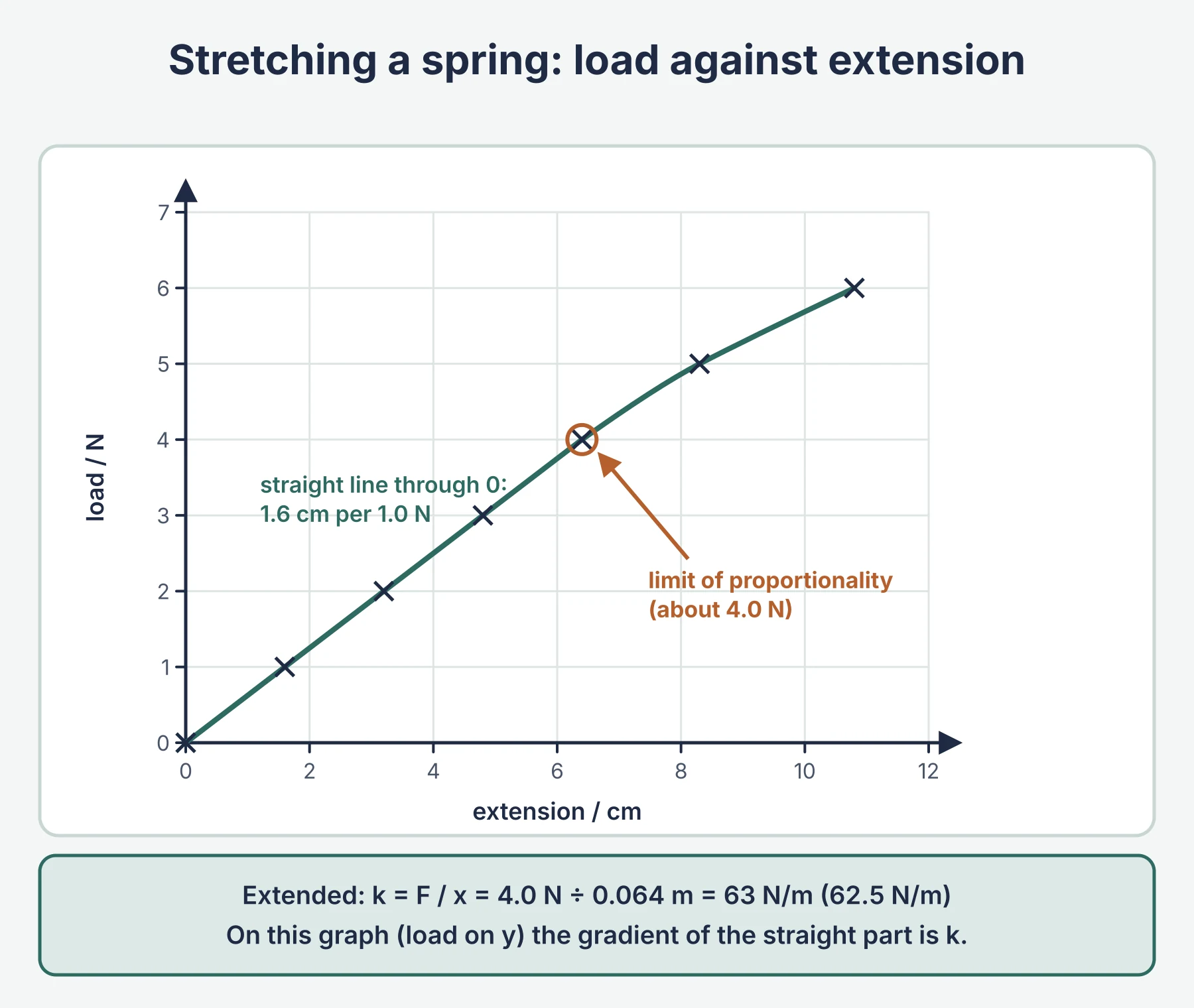
- Load–extension graph for a spring: straight line through the origin, then curves.
- (Extended) Limit of proportionality: the point beyond which extension is no longer proportional to load (the end of the straight part).
- (Extended) k = F/x applies only up to the limit of proportionality. Stiffer spring → larger k → steeper load–extension line.
Resultant along a line
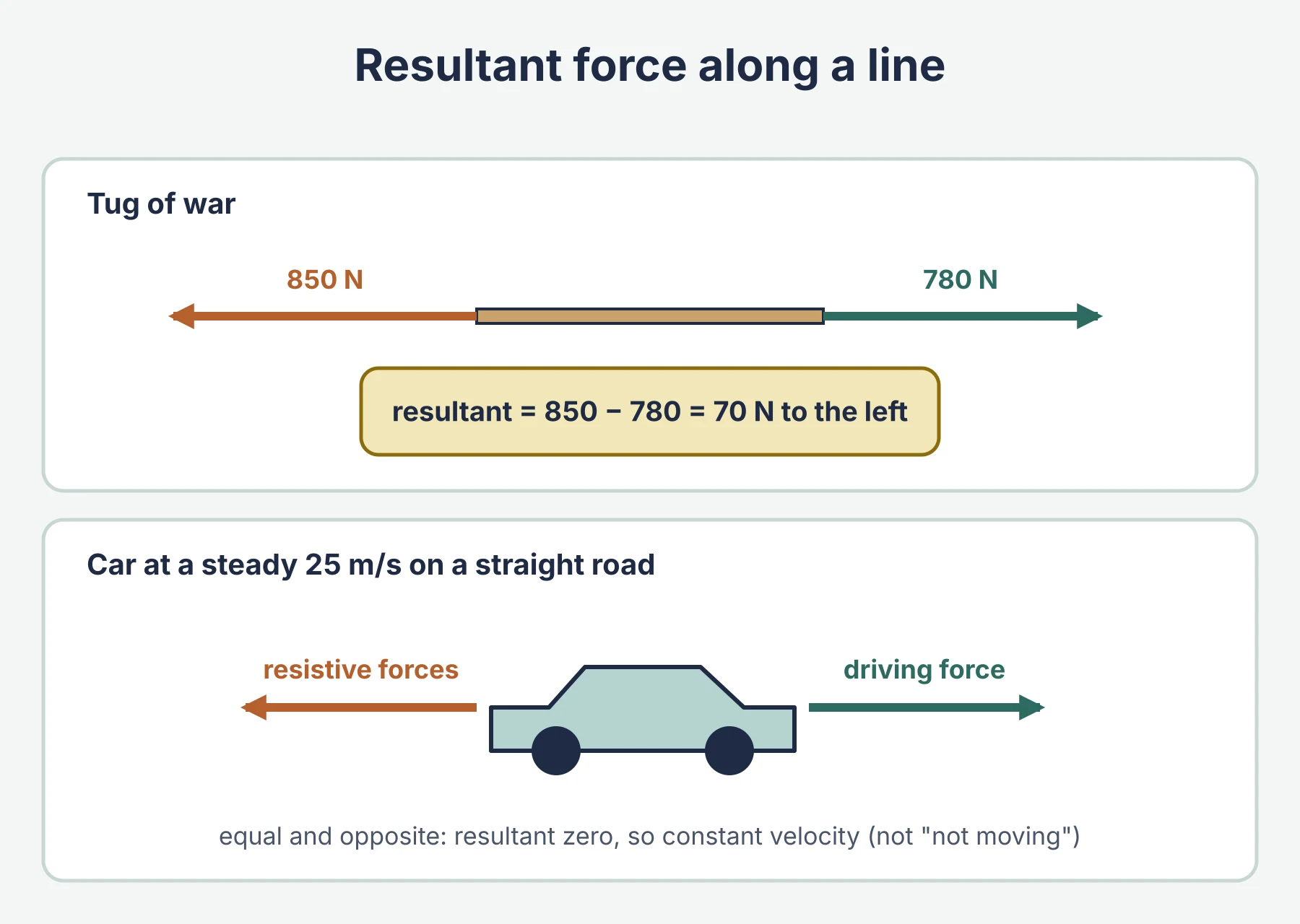
- Same direction: add. Opposite directions: subtract; resultant points the way of the larger force.
- Zero resultant → object stays at rest or keeps moving at constant speed in a straight line.
- A resultant force can change speed or direction (or both).
Friction and drag
- Solid friction: between two surfaces; may impede motion; produces heating.
- Drag: friction acting on an object moving through a liquid or a gas (air resistance).
F = ma (Extended only)
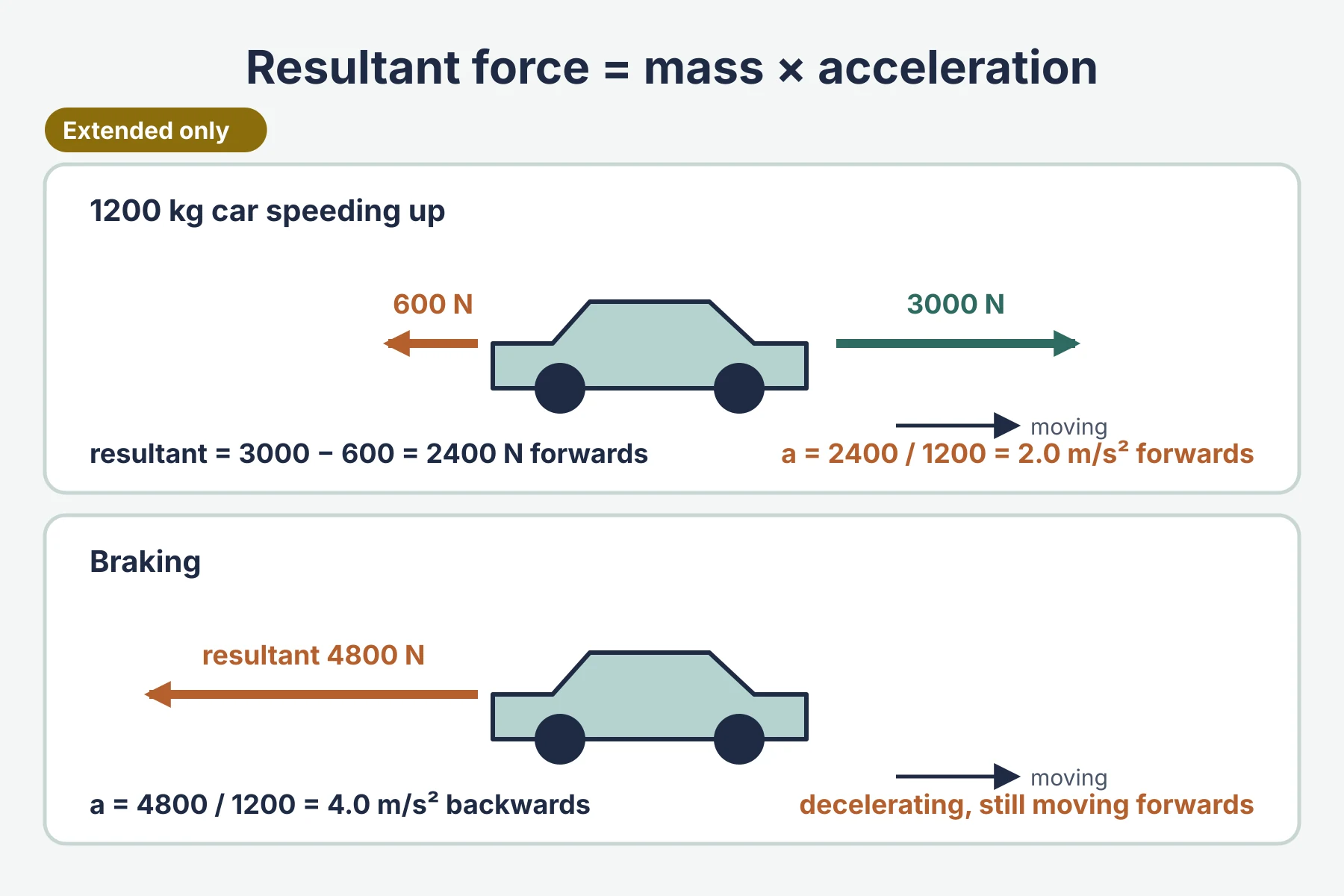
- Find the resultant force (with direction).
- a = F/m; acceleration is in the same direction as the resultant force.
- Resultant opposite to motion → deceleration.
Circular motion (Extended only)
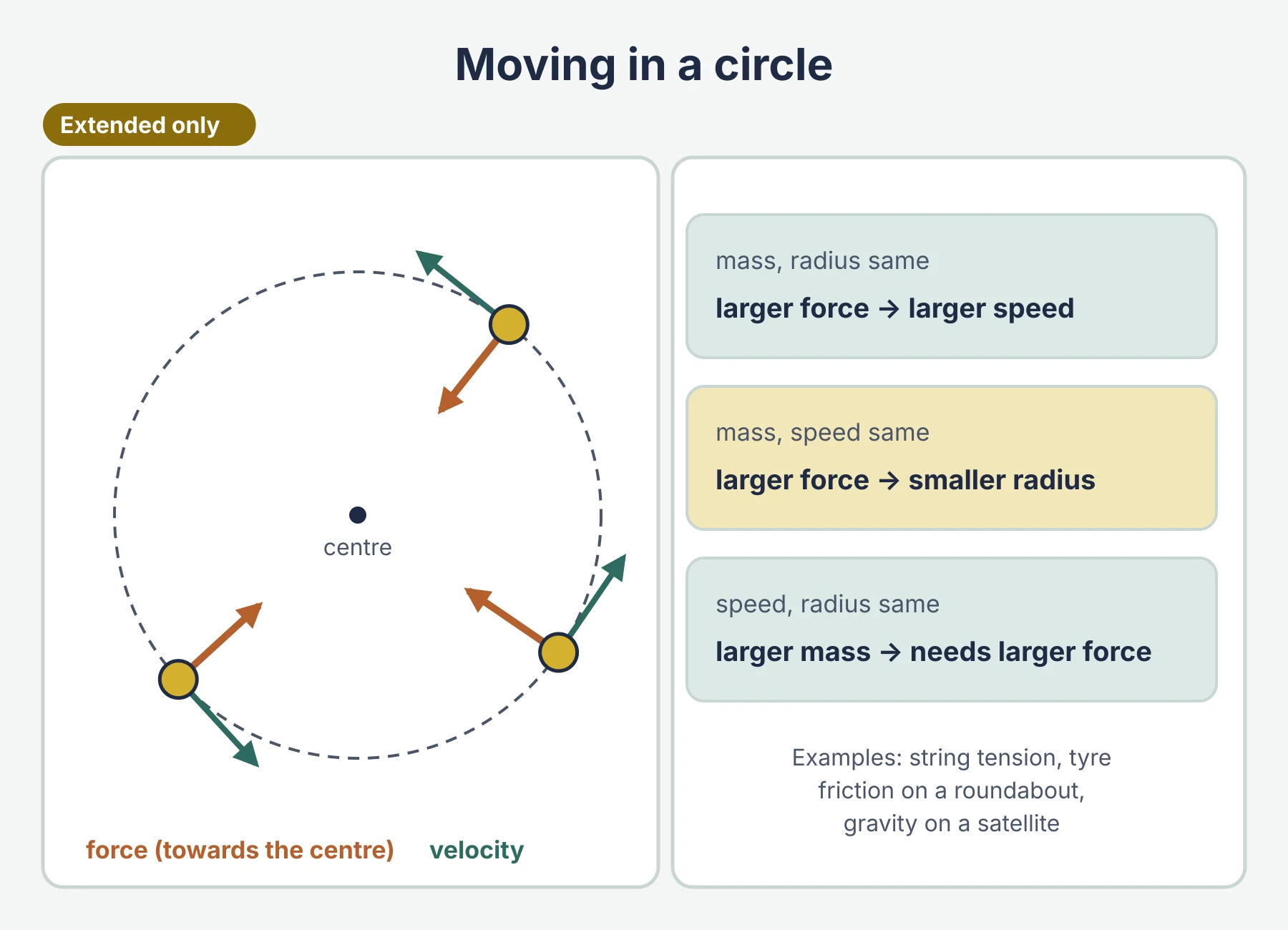
- Force acts perpendicular to the motion, towards the centre.
- Same m and r, larger force → larger speed.
- Same m and speed, larger force → smaller radius.
- Larger m → larger force needed for the same speed and radius.
Turning effect (1.5.2)
- Moment: measure of the turning effect of a force.
- Larger moment from a larger force or a larger perpendicular distance (long spanner, handle far from the hinge).
- Principle of moments: in equilibrium, total clockwise moment = total anticlockwise moment about the pivot.
- Equilibrium: no resultant force and no resultant moment.
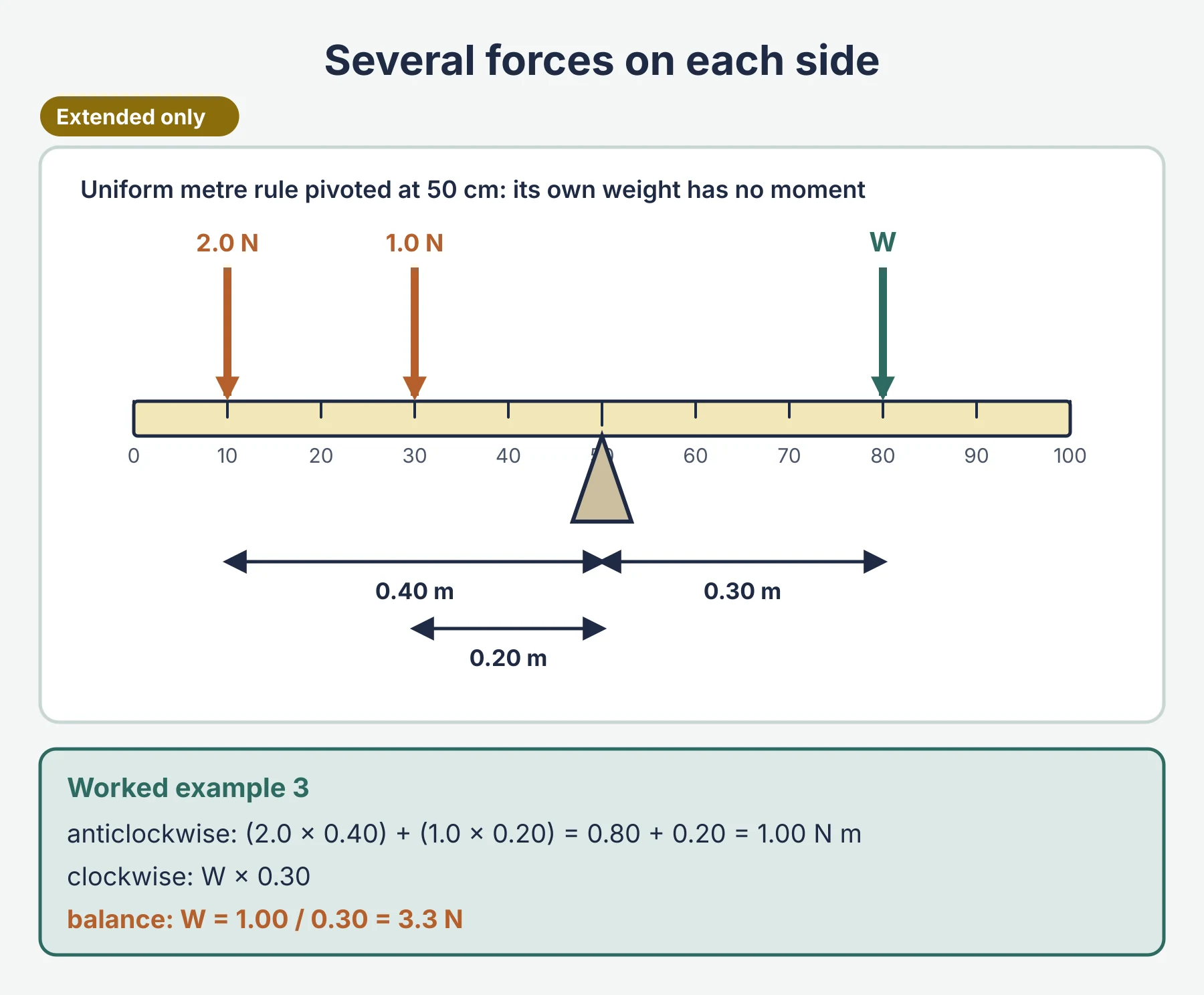
- (Extended) With several forces on one side, add their moments first.
- (Extended) Experiment: balance a metre rule on a pivot with weights each side; calculate the clockwise and anticlockwise totals; they are equal.
Method for moment calculations
- Mark the pivot; measure every distance from the pivot.
- Convert cm to m if you want N m.
- List clockwise and anticlockwise moments separately.
- Set the totals equal; solve.
- Include the beam’s weight at its centre of gravity if it is not over the pivot.
Centre of gravity (1.5.3)
- The point through which the whole weight of an object appears to act.
- Irregular lamina: hang from a pin with a plumb line; mark the line; repeat from another hole; the lines cross at the centre of gravity.
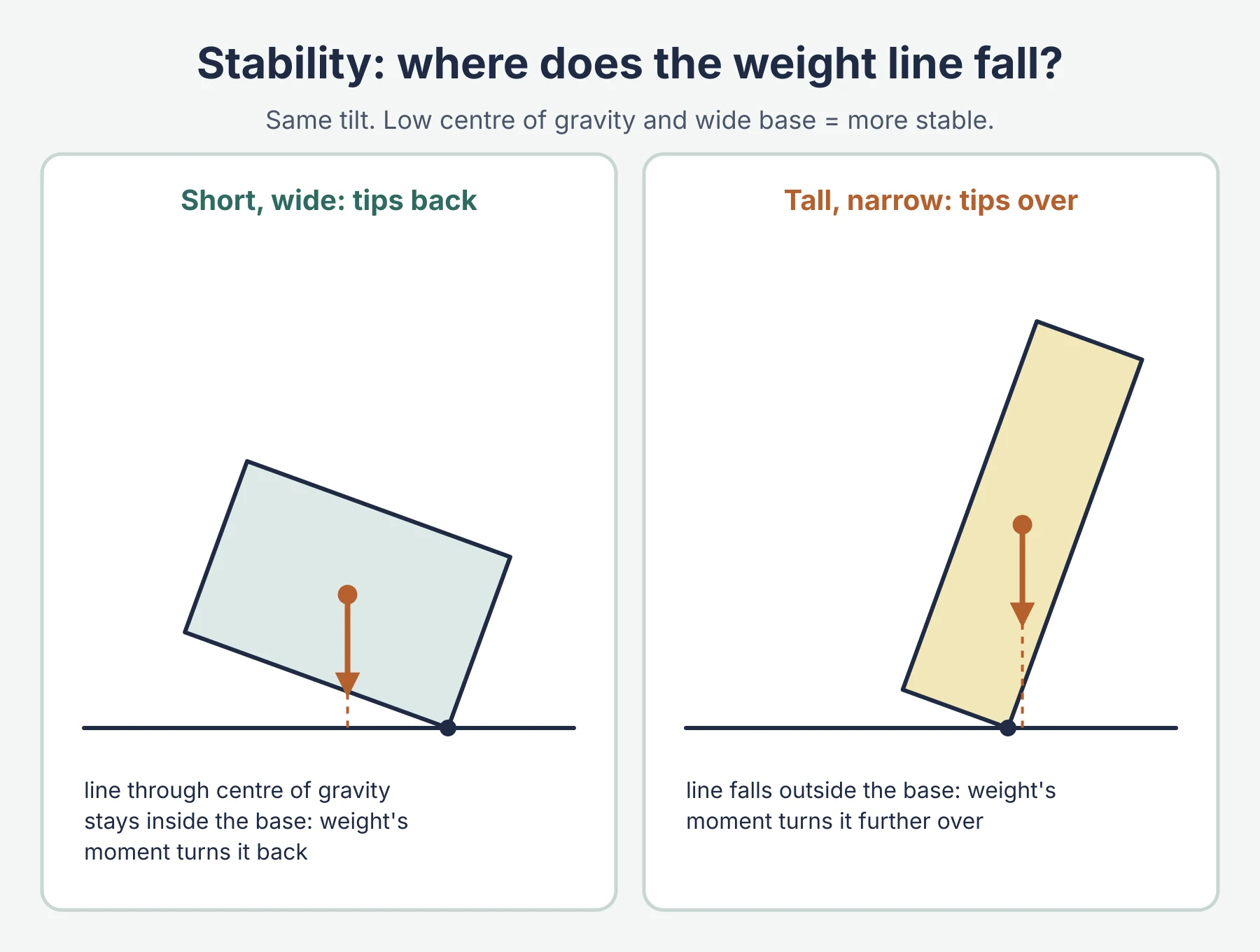
- Topples when the vertical line through the centre of gravity passes outside the base.
- More stable: lower centre of gravity, wider base.
Key terms
| Term | Meaning |
|---|---|
| Resultant force | Single force with the same effect as all the forces acting |
| Solid friction | Force between two surfaces that may impede motion and produce heating |
| Drag | Friction on an object moving through a liquid or gas |
| Spring constant (Extended) | Force per unit extension |
| Limit of proportionality (Extended) | Point beyond which extension is no longer proportional to load |
| Moment | Force × perpendicular distance from the pivot |
| Equilibrium | No resultant force and no resultant moment |
| Centre of gravity | Point where the whole weight appears to act |
Exam traps
- Plotting length instead of extension.
- “A moving object needs a force to keep it moving”: not if there is no friction.
- Giving a resultant force with no direction.
- Moments with distances from the end of the beam, not the pivot.
- Mixing cm and m in one moment equation.
- Stating only one condition for equilibrium.
- (Extended) Using the driving force, not the resultant, in F = ma.
- (Extended) Writing “elastic limit” for the limit of proportionality.
- (Extended) An outward force in circular motion; the force is towards the centre.
Quick self-test
- A spring’s length increases from 12.0 cm to 15.5 cm. Find its extension.
- Forces of 40 N east and 65 N west act on a box. Find the resultant.
- State what happens to an object moving at constant speed if the resultant force on it is zero.
- Name the force that opposes a cyclist moving through air.
- Find the moment of a 25 N force applied 0.40 m from a pivot, at right angles.
- A 200 N weight is 1.2 m left of a pivot. What force 0.80 m to the right balances it?
- State the two conditions for equilibrium.
- Give two ways to make a lamp more stable.
- (Extended) A 6.0 N load stretches a spring by 0.15 m. Find k.
- (Extended) A 0.50 kg trolley has a resultant force of 1.5 N. Find its acceleration.
- (Extended) A 2.0 N weight 30 cm left and a 3.0 N weight 10 cm left of a pivot balance a weight 40 cm right. Find it.
- (Extended) A ball whirled on a string in a horizontal circle is swung faster at the same radius. What happens to the tension needed?
Answers
- 15.5 − 12.0 = 3.5 cm.
- 65 − 40 = 25 N west.
- It continues at constant speed in a straight line.
- Air resistance (drag).
- 25 × 0.40 = 10 N m.
- 200 × 1.2 = F × 0.80, so F = 300 N.
- No resultant force and no resultant moment.
- Lower its centre of gravity (heavy base) and widen its base.
- k = 6.0 ÷ 0.15 = 40 N/m.
- a = 1.5 ÷ 0.50 = 3.0 m/s².
- (2.0 × 30) + (3.0 × 10) = 90 N cm = W × 40, so W = 2.25 N (2.3 N).
- It must increase: a larger speed at the same radius and mass needs a larger force towards the centre.
Where to go next
Try the practice questions on forces, then revise the revision notes on momentum (Extended) or the revision notes on energy, work and power.
Related resources
-
Study guides
Cambridge IGCSE Physics (0625): Mass and weight
Study guide to Cambridge IGCSE Physics 0625 section 1.3: mass, weight, gravitational field strength g = W/m, balances and weight as a field effect.
Physics · Cambridge · IGCSE
Read guide -
Practice questions
Cambridge IGCSE Physics (0625): Mass and weight – Practice Questions
Twelve original Cambridge IGCSE Physics 0625 questions on mass, weight, g = W/m, balances and gravitational fields, with mark-by-mark worked answers.
Physics · Cambridge · IGCSE
Try questions -
Revision notes
Cambridge IGCSE Physics (0625): Mass and weight – Revision Notes
Revision notes for Cambridge IGCSE Physics 0625 section 1.3: mass and weight definitions, g = W/m, balances, gravitational fields and a 12-question self-test.
Physics · Cambridge · IGCSE
Revise topic
Related articles
Get free revision emails (optional)
Occasional emails with practice questions, worked explanations and links to free resources for the qualification and subjects you choose. No spam, and you can unsubscribe from any email. The free tools on this site never need an email.