
Revision Notes
Cambridge IGCSE Physics (0625): Mass and weight – Revision Notes
Revision notes for Cambridge IGCSE Physics 0625 section 1.3: mass and weight definitions, g = W/m, balances, gravitational fields and a 12-question self-test.
- Subject
- Physics
- Level
- IGCSE
- Topic
- Motion, forces and energy
- Author
- Marlbridge Academic Team
- Updated
- Reviewed by
- Iftikhar Azeemi (what this means)
Aligned to Cambridge IGCSE Physics (0625), For examination in 2026, 2027 and 2028. Official specification .
Syllabus page (what it covers and how it is assessed): Cambridge IGCSE Physics.
Syllabus points this page covers, with Core and Extended
0625
- 1.3 Mass and weight · Core and Extended
"Core and Extended" means part of that syllabus point is Extended only. The page's own tier notes say which part.
Found an error? Report a correction.
Need help with this topic? Request a free trial class for IGCSE Physics (0625).
These notes condense section 1.3, Mass and weight, of the Cambridge IGCSE Physics 0625 syllabus for examination in 2026, 2027 and 2028. Supplement content, marked Extended only, is examined on Papers 2 and 4. Explanations and worked examples are in the study guide on mass and weight; the Motion, forces and energy revision notes cover the whole of Topic 1.
Definitions to learn word for word
- Mass: a measure of the quantity of matter in an object at rest relative to the observer.
- Weight: a gravitational force on an object that has mass.
- Gravitational field strength: force per unit mass.
- (Extended only) Weight is the effect of a gravitational field on a mass.
The equation
| Form | Use it to find |
|---|---|
| g = W / m | field strength from a weighing |
| W = m g | weight from mass |
| m = W / g | mass from a weight reading |
Units: W in newtons (N), m in kilograms (kg), g in N/kg.
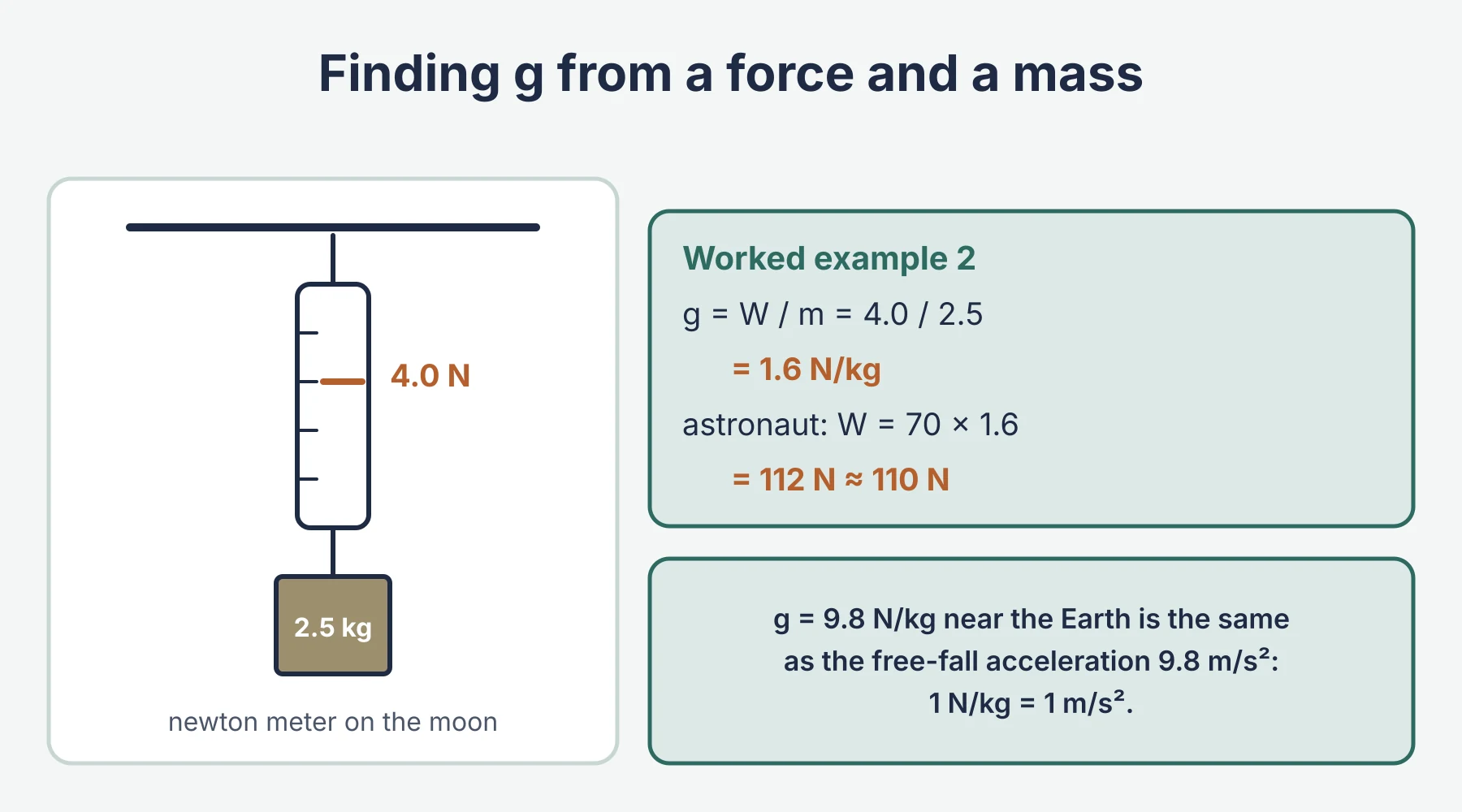
g is equivalent to the acceleration of free fall: 9.8 N/kg = 9.8 m/s² near the Earth, because 1 N/kg = 1 m/s².
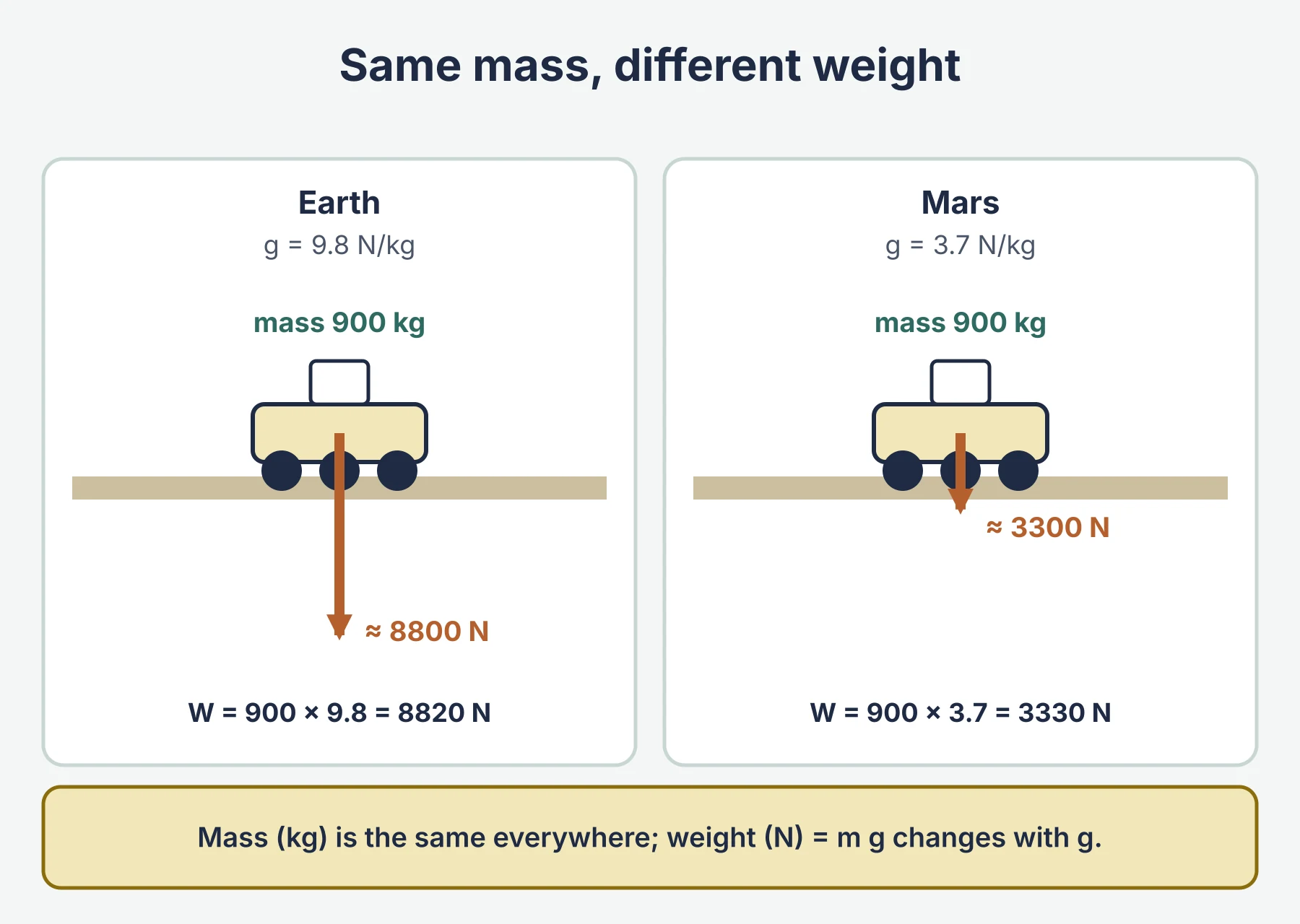
Mass versus weight
- Mass: kg, scalar, the same everywhere.
- Weight: N, vector (towards the centre of the planet), changes with g.
- A 60 kg student has a weight of 60 × 9.8 = 588 N on the Earth and 60 × 1.6 = 96 N on the Moon. Her mass is 60 kg in both places.
Typical field strengths
| Place | g / N/kg (approx.) | Weight of 1.0 kg |
|---|---|---|
| Earth’s surface | 9.8 | 9.8 N |
| Moon’s surface | 1.6 | 1.6 N |
| Mars’s surface | 3.7 | 3.7 N |
Questions give the value of g for anywhere other than the Earth; use the value given.
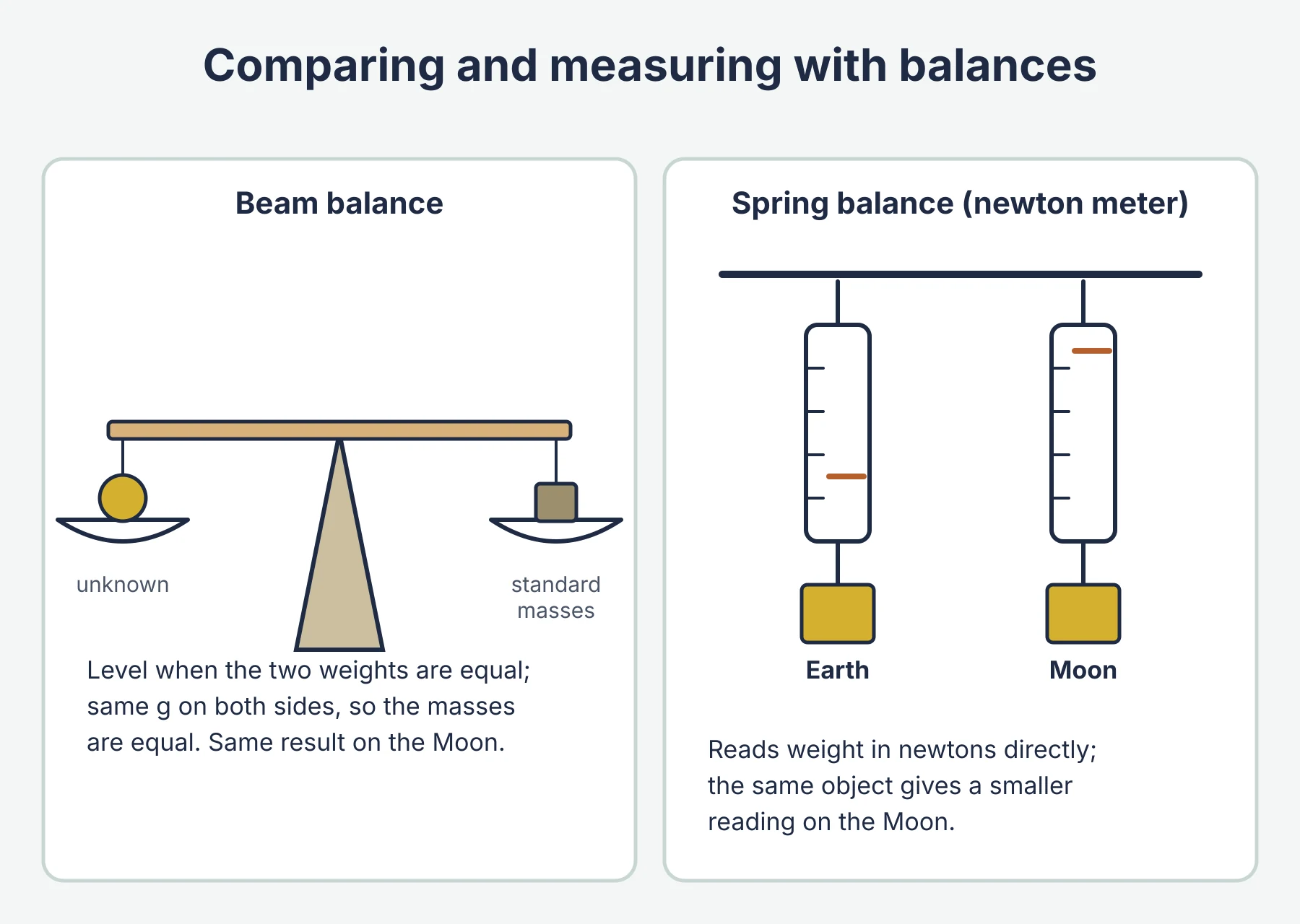
Balances
| Instrument | What it really responds to | Reading on the Moon for an object of mass 3.0 kg |
|---|---|---|
| Beam balance | compares two weights | balances against 3.0 kg of standard masses, as on Earth |
| Spring balance (newton meter) | stretch caused by the weight | 3.0 × 1.6 = 4.8 N (Earth: 29.4 N) |
| Electronic top-pan balance | force on the pan, shown as a mass using Earth’s g | about 0.49 kg (one sixth of the true mass) |
Why a beam balance still works on the Moon: both pans are in the same field, so equal weights still mean equal masses.
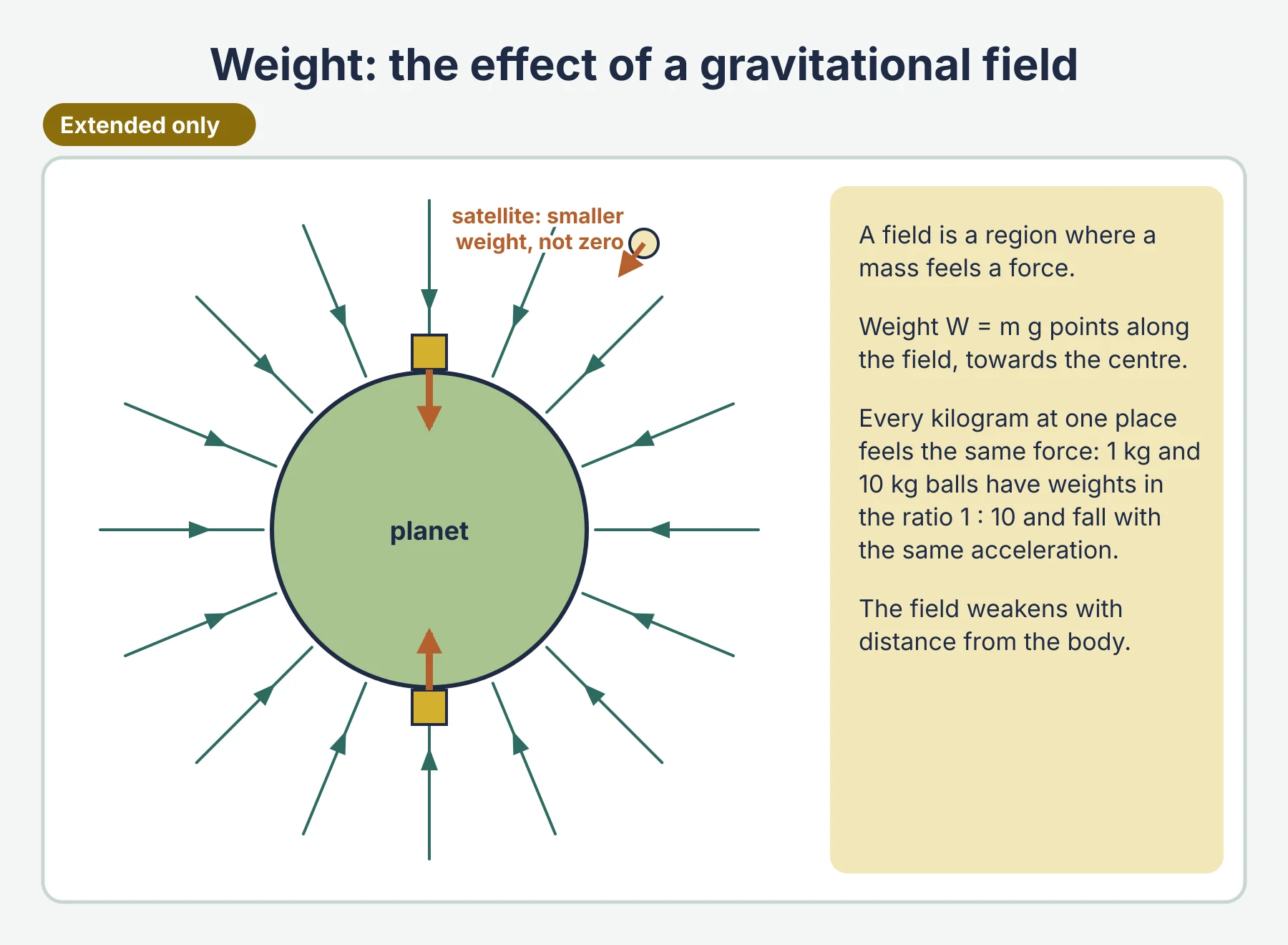
Gravitational fields (Extended only)
- A gravitational field is a region in which a mass experiences a force.
- Every mass at the same place feels the same force per kilogram, so all fall with the same acceleration (ignoring air resistance).
- g at a surface is larger for a body with more mass.
- g decreases with distance from the body; a spacecraft far from the Earth weighs less, but its mass is unchanged.
- Weight acts along the field direction, towards the centre of the body.
Finding g by experiment
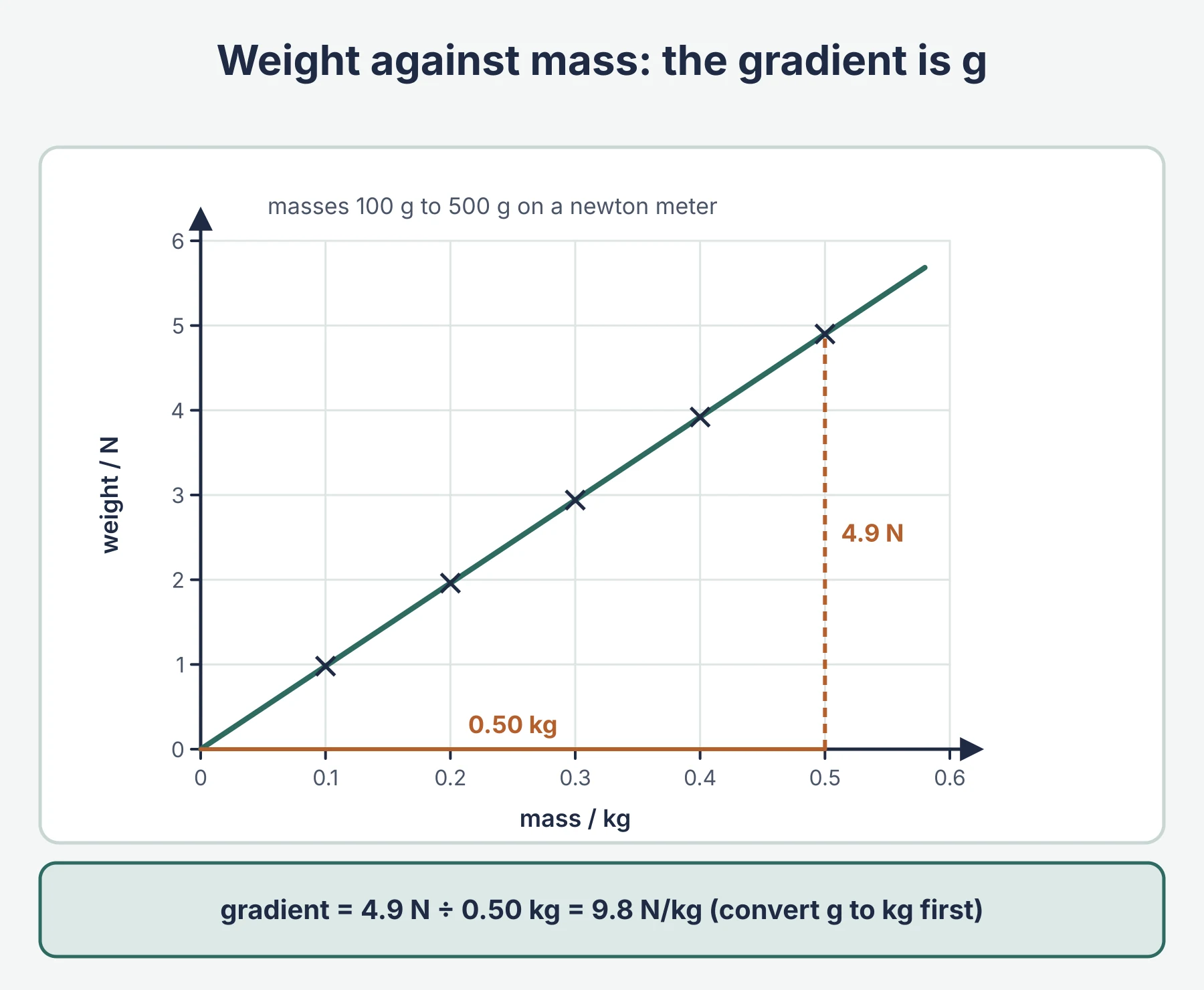
- Newton meter in a clamp; hang 100 g to 500 g in turn.
- Convert grams to kilograms; record each weight.
- Plot W (y-axis) against m (x-axis): straight line through the origin.
- Gradient = g.
Key terms
| Term | Meaning |
|---|---|
| Mass | Quantity of matter in an object; kg |
| Weight | Gravitational force on an object that has mass; N |
| Gravitational field strength | Force per unit mass; N/kg |
| Acceleration of free fall | Acceleration of an object falling with only its weight acting; m/s² |
| Newton meter | Spring balance calibrated in newtons |
| Beam balance | Balance that compares the weights on two pans |
| Gravitational field (Extended) | Region in which a mass experiences a force |
Exam traps
- Units swapped. “Weight = 50 kg” is wrong. Weight is in N.
- Grams. 450 g is 0.45 kg before using W = mg.
- “Gravity” for weight. Name the force: weight, or the gravitational force of the Earth on the object.
- Mass changing. Moving an object never changes its mass in this syllabus.
- Rearranging. m = W ÷ g, not W × g.
- Vague definitions. “Weight is how much something weighs” earns nothing.
- (Extended) “No gravity in space.” Fields weaken with distance but do not vanish.
- (Extended) Heavier falls faster. In the same field, all masses have the same acceleration of free fall.
Quick self-test
- State what is meant by mass.
- State what is meant by weight.
- Define gravitational field strength.
- Find the weight on the Earth of a 0.75 kg book (g = 9.8 N/kg).
- A box weighs 196 N on the Earth. Find its mass.
- A 5.0 kg mass weighs 18.5 N on a planet. Find g there.
- State the unit of g in two equivalent forms.
- Why does a beam balance give the same result on the Moon as on the Earth?
- A spring balance reads 2.94 N with an object on Earth. What does it read on the Moon (g = 1.6 N/kg)?
- A student says, “On the Moon my mass is less, so I can jump higher.” Correct the statement.
- (Extended) Describe weight in terms of a gravitational field.
- (Extended) Explain why a 1 kg and a 5 kg ball dropped together in a vacuum land together.
Answers
- A measure of the quantity of matter in an object (at rest relative to the observer).
- A gravitational force on an object that has mass.
- Force per unit mass.
- 0.75 × 9.8 = 7.35 N (7.4 N).
- 196 ÷ 9.8 = 20 kg.
- 18.5 ÷ 5.0 = 3.7 N/kg.
- N/kg and m/s².
- Both pans are in the same gravitational field, so when the weights balance, the masses are equal.
- Mass = 2.94 ÷ 9.8 = 0.30 kg; Moon weight = 0.30 × 1.6 = 0.48 N.
- Her mass is unchanged; her weight is smaller because g is smaller on the Moon.
- Weight is the effect of a gravitational field on a mass: the field exerts a force mg on any mass in it.
- The field exerts the same force per kilogram on each ball, so both have the same acceleration g.
Where to go next
Try the practice questions on mass and weight, then continue with the revision notes on density.
Related resources
-
Study guides
Cambridge IGCSE Physics (0625): Momentum
Study guide to Cambridge IGCSE Physics 0625 section 1.6 Momentum (Extended): p = mv, impulse, conservation of momentum in collisions and F = Δp/Δt.
Physics · Cambridge · IGCSE
Read guide -
Practice questions
Cambridge IGCSE Physics (0625): Momentum – Practice Questions
Twelve original Cambridge IGCSE Physics 0625 Extended momentum questions on p = mv, impulse, collisions, recoil, F = Δp/Δt and safety, with full answers.
Physics · Cambridge · IGCSE
Try questions -
Revision notes
Cambridge IGCSE Physics (0625): Momentum – Revision Notes
Revision notes for Cambridge IGCSE Physics 0625 section 1.6 Momentum (Extended): p = mv, impulse, conservation, F = Δp/Δt, safety features and a self-test.
Physics · Cambridge · IGCSE
Revise topic
Related articles
Get free revision emails (optional)
Occasional emails with practice questions, worked explanations and links to free resources for the qualification and subjects you choose. No spam, and you can unsubscribe from any email. The free tools on this site never need an email.