
Revision Notes
Cambridge IGCSE Physics (0625): Physical quantities and measurement techniques – Revision Notes
Revision notes for Cambridge IGCSE Physics 0625 section 1.1: measuring length, volume and time, measuring multiples, scalars, vectors and a self-test.
- Subject
- Physics
- Level
- IGCSE
- Topic
- Motion, forces and energy
- Author
- Marlbridge Academic Team
- Updated
- Reviewed by
- Iftikhar Azeemi (what this means)
Aligned to Cambridge IGCSE Physics (0625), For examination in 2026, 2027 and 2028. Official specification .
Syllabus page (what it covers and how it is assessed): Cambridge IGCSE Physics.
Syllabus points this page covers, with Core and Extended
0625
- 1.1 Physical quantities and measurement techniques · Core and Extended
"Core and Extended" means part of that syllabus point is Extended only. The page's own tier notes say which part.
Found an error? Report a correction.
Need help with this topic? Request a free trial class for IGCSE Physics (0625).
These notes condense section 1.1, Physical quantities and measurement techniques, of the Cambridge IGCSE Physics 0625 syllabus for examination in 2026, 2027 and 2028. Measuring length, volume and time is Core; scalars, vectors and resultants are Supplement, marked Extended only, and examined on Papers 2 and 4. Full explanations and worked examples are in the study guide on physical quantities and measurement techniques; the topic revision notes for Motion, forces and energy cover the rest of Topic 1.
Condensed recall
Length (Core)
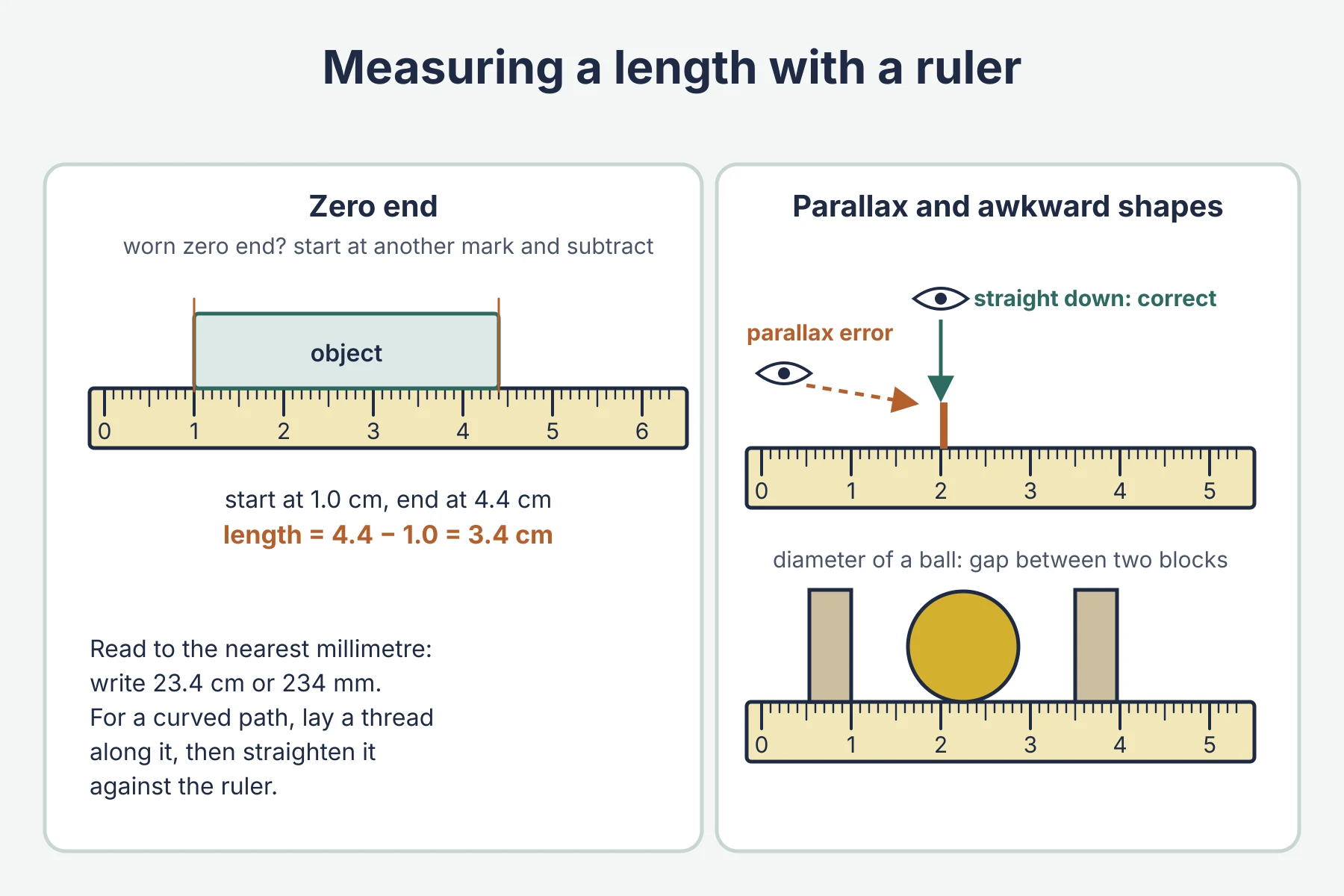
- Ruler or metre rule: reads to the nearest 1 mm.
- Measure from the 0 mark, or from another mark and subtract (worn ends).
- Eye directly above the mark, at right angles to the scale: avoids parallax.
- Diameter of a sphere or cylinder: trap it between two blocks set square to the ruler.
Volume (Core)
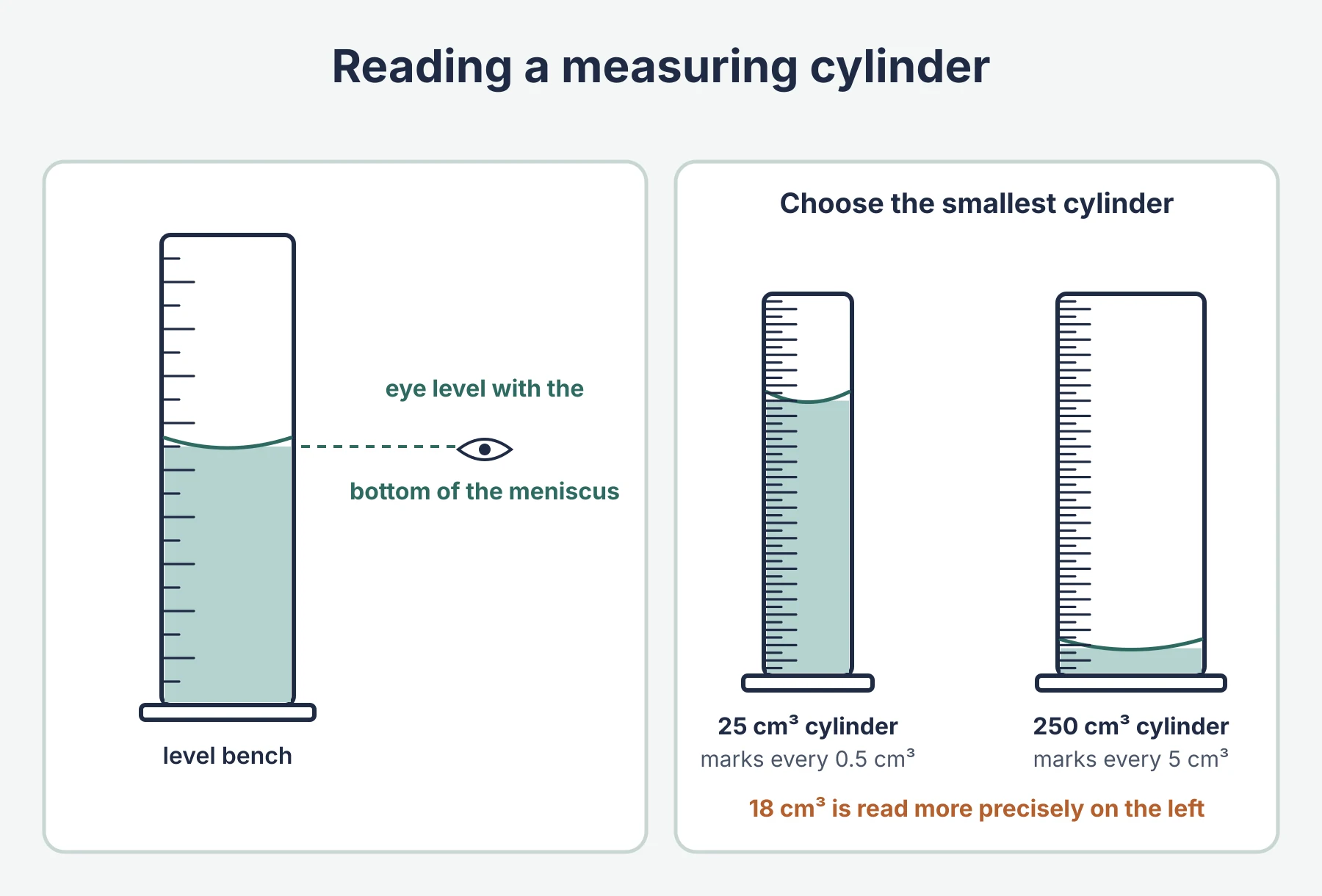
- Measuring cylinder on a level surface.
- Read the bottom of the meniscus, eye level with it.
- Use the smallest cylinder that holds the liquid: finer scale divisions.
- 1 cm³ = 1 ml; 1 litre = 1000 cm³; 1 m³ = 10⁶ cm³.
Time (Core)
- Clock or stopwatch for long intervals.
- Hand timing adds reaction time (a few tenths of a second) at the start and again at the stop.
- Short intervals: a digital timer started and stopped by light gates, with no reaction time.
Measuring multiples (Core)
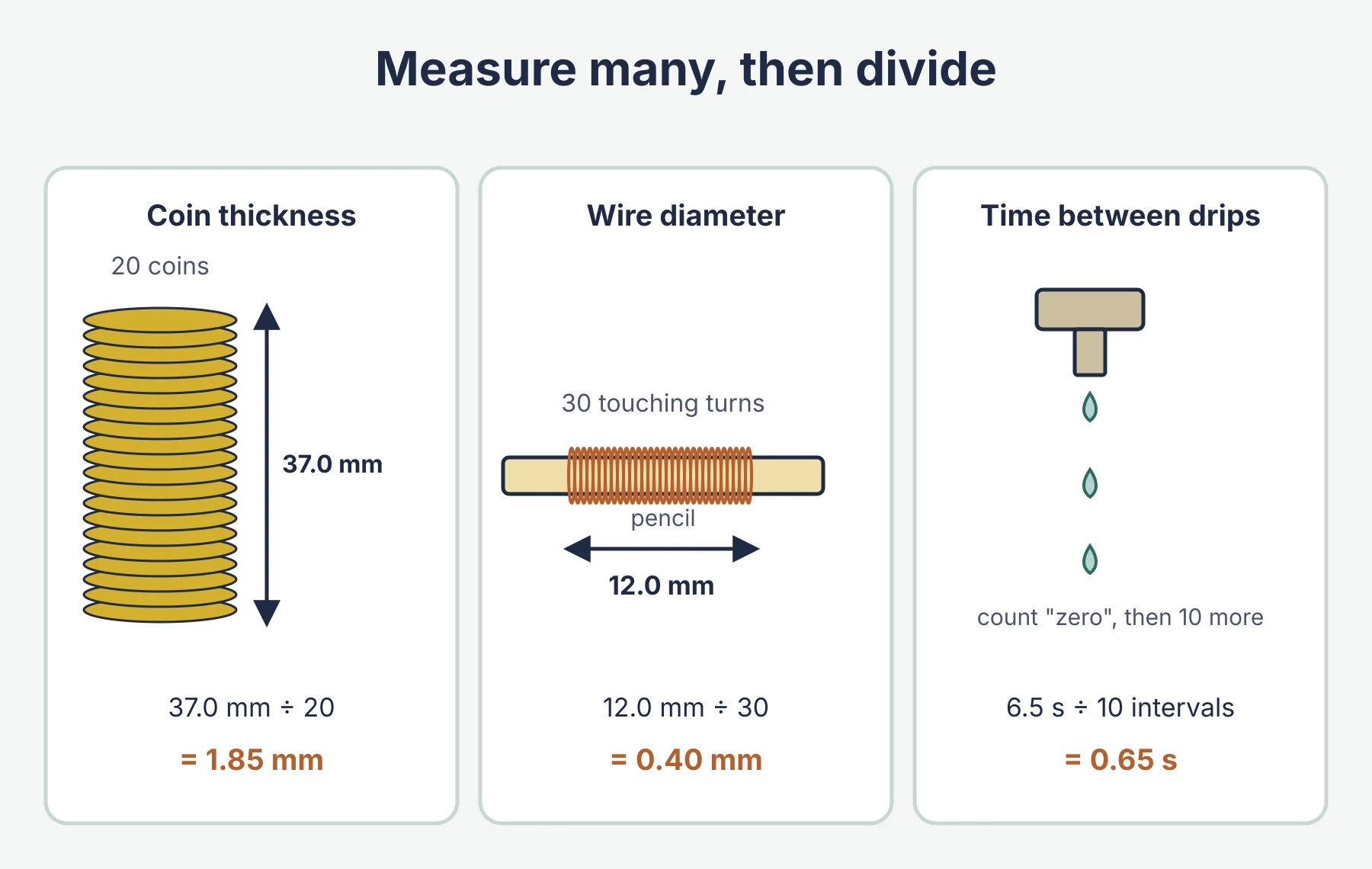
- Measure N items or events together, then divide by N.
- Works because the uncertainty of one ruler reading, or one reaction time, is shared across N.
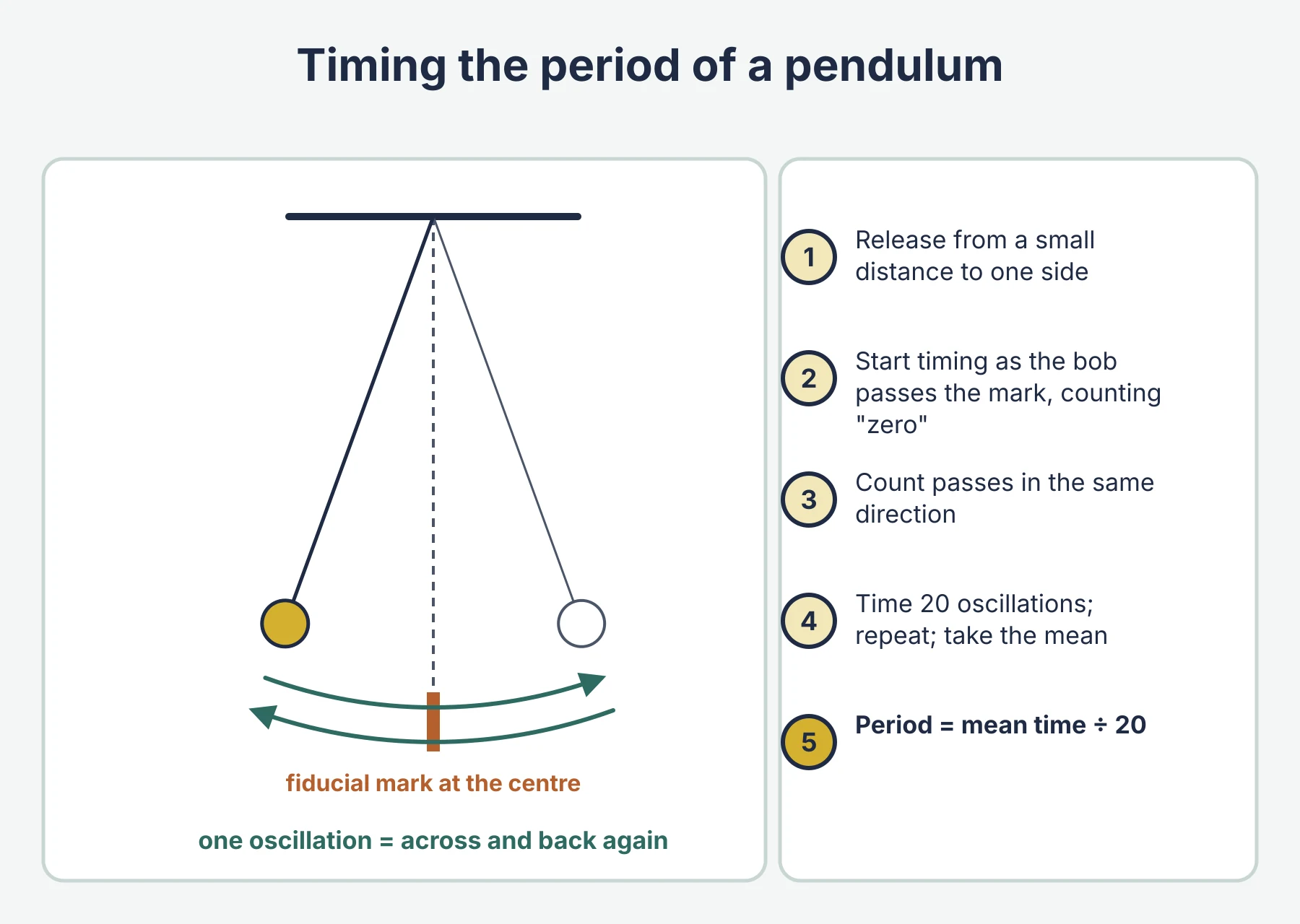
- Pendulum: time 20 complete oscillations; repeat; take the mean; divide by 20.
- Time from the centre of the swing (fastest point), using a fixed marker.
- One oscillation = from one extreme, to the other, and back.
Scalars and vectors (Extended only)
| Scalars (magnitude only) | Vectors (magnitude and direction) |
|---|---|
| distance | force |
| speed | weight |
| time | velocity |
| mass | acceleration |
| energy | momentum |
| temperature | electric field strength |
| gravitational field strength |
Mass and weight sit on opposite sides of this table; so do speed and velocity.
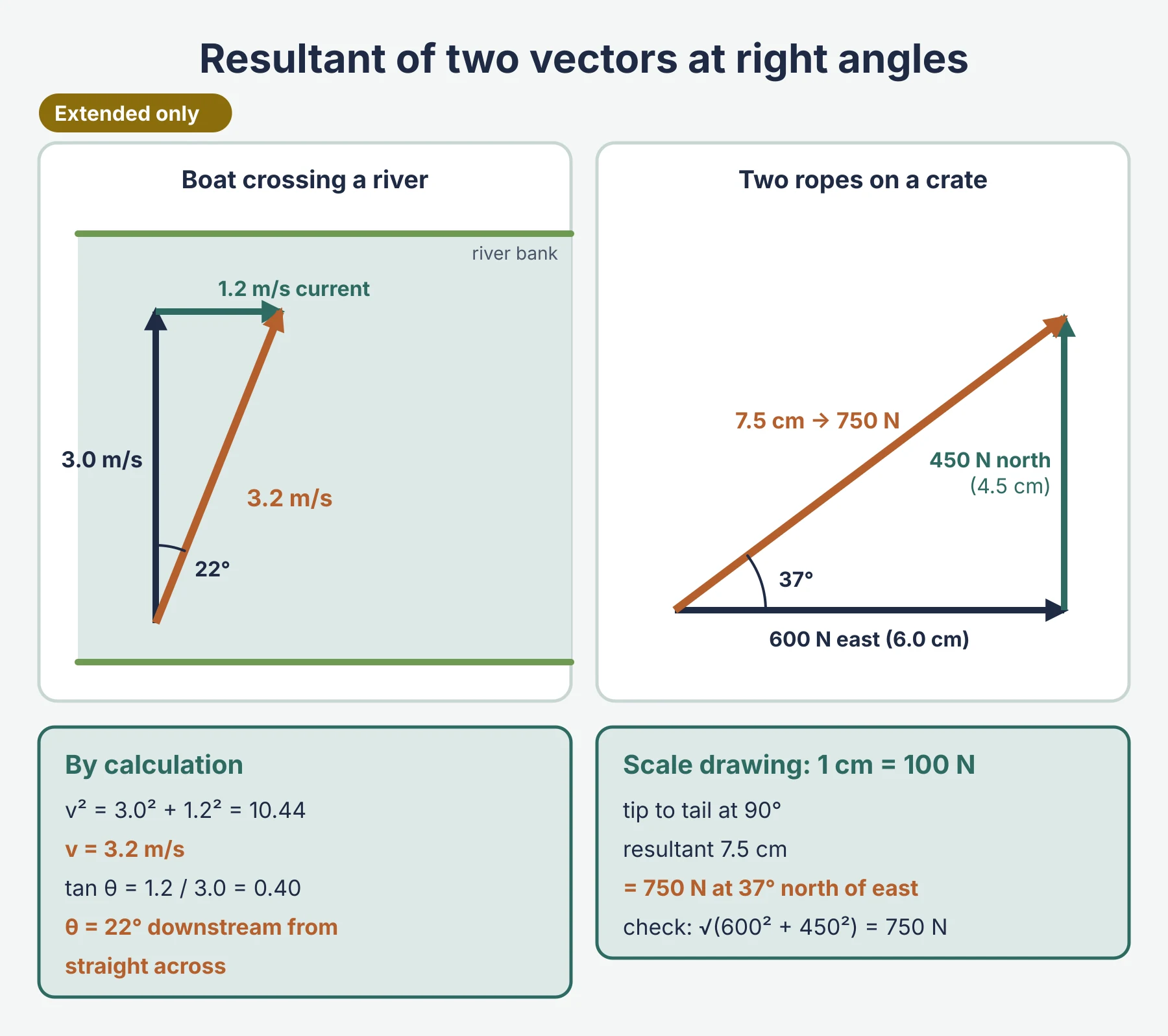
Resultant of two vectors at right angles (Extended only)
- Forces or velocities only.
- Magnitude: R = √(A² + B²).
- Direction: tan θ = B / A, θ measured from the direction of A.
- Scale drawing: tip-to-tail, 90° corner, join start to finish; measure length and angle.
- The resultant is always longer than either vector but shorter than their sum.
Key terms
| Term | Meaning |
|---|---|
| Parallax error | Reading error caused by viewing a scale from an angle rather than straight on |
| Meniscus | Curved liquid surface in a measuring cylinder; read the bottom of it for water |
| Reaction time | Delay between seeing an event and pressing the stopwatch button |
| Light gate | A beam of light and sensor that starts or stops a digital timer when the beam is broken |
| Period (of a pendulum) | Time for one complete oscillation |
| Oscillation | One complete movement there and back |
| Scalar | Quantity with magnitude only |
| Vector | Quantity with magnitude and direction |
| Resultant | Single vector with the same effect as two or more vectors acting together |
Exam traps
- Dividing by the wrong count. Twenty oscillations, divide by 20. Ten intervals between drips need eleven drips.
- Over-precise hand timing. A stopwatch display to 0.01 s does not make a hand-timed reading precise to 0.01 s.
- Wrong end of the meniscus. Read the bottom of the curve for water.
- Vague method answers. “Use a ruler” scores little. Name what you line up with zero and how you avoid parallax.
- (Extended) Arithmetic addition of perpendicular vectors. 5 N + 12 N at right angles is 13 N, not 17 N.
- (Extended) No direction. A resultant vector needs an angle and what it is measured from.
- (Extended) Weight as a scalar. Weight is a force, so it is a vector. Mass is the scalar.
- (Extended) Speed as a vector. Speed is a scalar; velocity is the vector.
- (Extended) Scale too small. Fill the space given; state the scale.
Quick self-test
- Give two precautions when reading the volume of water in a measuring cylinder.
- Why is a stopwatch operated by hand unsuitable for timing a ball falling through 20 cm?
- A stack of 50 sheets of card is 18.5 mm thick. Find the thickness of one sheet.
- A student times 20 oscillations of a pendulum: 31.2 s, 31.6 s and 31.4 s. Find the period.
- Why should timing of a pendulum start as the bob passes the centre of its swing?
- A wooden metre rule has a worn end. How should a student measure the length of a pencil?
- (Extended) Sort into scalars and vectors: momentum, temperature, acceleration, energy, weight, speed.
- (Extended) Define a vector quantity.
- (Extended) Forces of 8.0 N east and 6.0 N north act on a point. Find the size of the resultant.
- (Extended) For question 9, find the angle the resultant makes with the east direction.
- (Extended) A plane flies north at 240 m/s in a wind blowing east at 70 m/s. Find the size of its resultant velocity.
- (Extended) Two velocities at right angles are drawn to a scale of 1 cm : 2 m/s. The resultant line is 6.5 cm long. What speed does it represent?
Answers
- Place the cylinder on a level bench; read the bottom of the meniscus with the eye level with it.
- The fall lasts about 0.2 s, similar to human reaction time, so the reaction-time error is as large as the time itself; use light gates and a digital timer.
- 18.5 ÷ 50 = 0.37 mm.
- Mean = (31.2 + 31.6 + 31.4) ÷ 3 = 31.4 s; period = 31.4 ÷ 20 = 1.57 s.
- The bob moves fastest there, so the moment it passes the marker is easiest to judge.
- Line one end of the pencil up with a clear mark such as 10.0 cm, read the other end with the eye directly above it, and subtract 10.0 cm.
- Scalars: temperature, energy, speed. Vectors: momentum, acceleration, weight.
- A quantity with both magnitude and direction.
- √(8.0² + 6.0²) = √100 = 10 N.
- tan θ = 6.0 ÷ 8.0 = 0.75, θ = 37° north of east.
- √(240² + 70²) = √62 500 = 250 m/s.
- 6.5 × 2 = 13 m/s.
Where to go next
Try the practice questions on physical quantities and measurement techniques, then move on to the revision notes on motion, where velocity and acceleration use the vector ideas above.
Related resources
-
Study guides
Cambridge IGCSE Physics (0625): Pressure
Study guide to Cambridge IGCSE Physics 0625 section 1.8 Pressure: p = F/A, area conversions, everyday examples, pressure in liquids and Δp = ρgΔh.
Physics · Cambridge · IGCSE
Read guide -
Practice questions
Cambridge IGCSE Physics (0625): Pressure – Practice Questions
Twelve original Cambridge IGCSE Physics 0625 pressure questions on p = F/A, area conversions, everyday examples and liquid pressure Δp = ρgΔh, with answers.
Physics · Cambridge · IGCSE
Try questions -
Revision notes
Cambridge IGCSE Physics (0625): Pressure – Revision Notes
Revision notes for Cambridge IGCSE Physics 0625 section 1.8 Pressure: p = F/A, area conversions, everyday examples, liquid pressure, Δp = ρgΔh and a self-test.
Physics · Cambridge · IGCSE
Revise topic
Related articles
Get free revision emails (optional)
Occasional emails with practice questions, worked explanations and links to free resources for the qualification and subjects you choose. No spam, and you can unsubscribe from any email. The free tools on this site never need an email.