
Study Guides
Cambridge IGCSE Physics (0625): Physical quantities and measurement techniques
Study guide to Cambridge IGCSE Physics 0625 section 1.1: rulers, measuring cylinders, timers, measuring multiples, scalars, vectors and resultants.
- Subject
- Physics
- Level
- IGCSE
- Topic
- Motion, forces and energy
- Author
- Marlbridge Academic Team
- Updated
- Reviewed by
- Iftikhar Azeemi (what this means)
Aligned to Cambridge IGCSE Physics (0625), For examination in 2026, 2027 and 2028. Official specification .
Syllabus page (what it covers and how it is assessed): Cambridge IGCSE Physics.
Syllabus points this page covers, with Core and Extended
0625
- 1.1 Physical quantities and measurement techniques · Core and Extended
"Core and Extended" means part of that syllabus point is Extended only. The page's own tier notes say which part.
Found an error? Report a correction.
Need help with this topic? Request a free trial class for IGCSE Physics (0625).
This guide teaches section 1.1, Physical quantities and measurement techniques, of the Cambridge IGCSE Physics 0625 syllabus for examination in 2026, 2027 and 2028. Statements 1 to 3 (measuring lengths, volumes and times) are Core. Statements 4 to 7 (scalars, vectors and resultants) are Supplement, examined only on the Extended papers (Papers 2 and 4), and are labelled Extended only. The Motion, forces and energy study guide gives the overview of the whole topic; this page goes further into the measuring skills that every later practical question depends on.
What the syllabus asks for
| Statement | Tier | What you must be able to do |
|---|---|---|
| 1 | Core | Describe using rulers and measuring cylinders to find a length or a volume |
| 2 | Core | Describe how to measure a variety of time intervals with clocks and digital timers |
| 3 | Core | Find an average value for a small distance or a short time by measuring multiples, including the period of a pendulum |
| 4 | Extended only | Understand that a scalar has magnitude only and a vector has magnitude and direction |
| 5 | Extended only | Know that distance, speed, time, mass, energy and temperature are scalars |
| 6 | Extended only | Know that force, weight, velocity, acceleration, momentum, electric field strength and gravitational field strength are vectors |
| 7 | Extended only | Find, by calculation or graphically, the resultant of two vectors at right angles (forces or velocities only) |
Measuring a length with a ruler
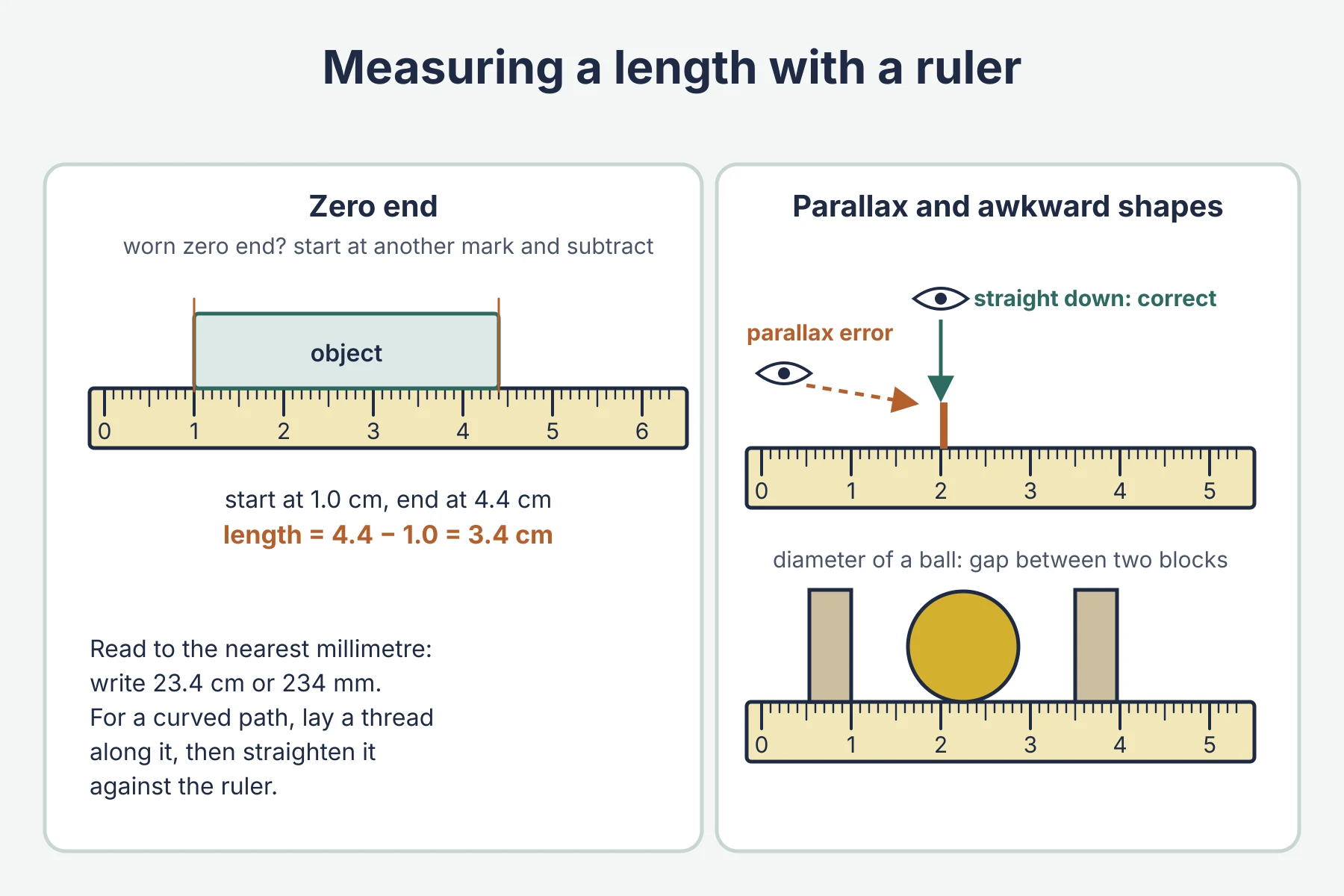
A metre rule or 30 cm ruler reads to the nearest millimetre, so record lengths such as 23.4 cm or 234 mm, not “23 cm and a bit”.
- Zero end. The end of a wooden rule is often worn. Line the object up with the 0 mark, or start at another mark (say 10.0 cm) and subtract.
- Parallax. Look straight down at the scale, at right angles to it. Viewing from one side shifts the reading. Rulers are thick, so place the scale edge against the object.
- Awkward objects. For the diameter of a ball, trap it between two wooden blocks held at right angles to the ruler and measure the gap between the blocks. For a curved path, lay a thread along it, mark the thread, then straighten it against the ruler.
Measuring a volume with a measuring cylinder
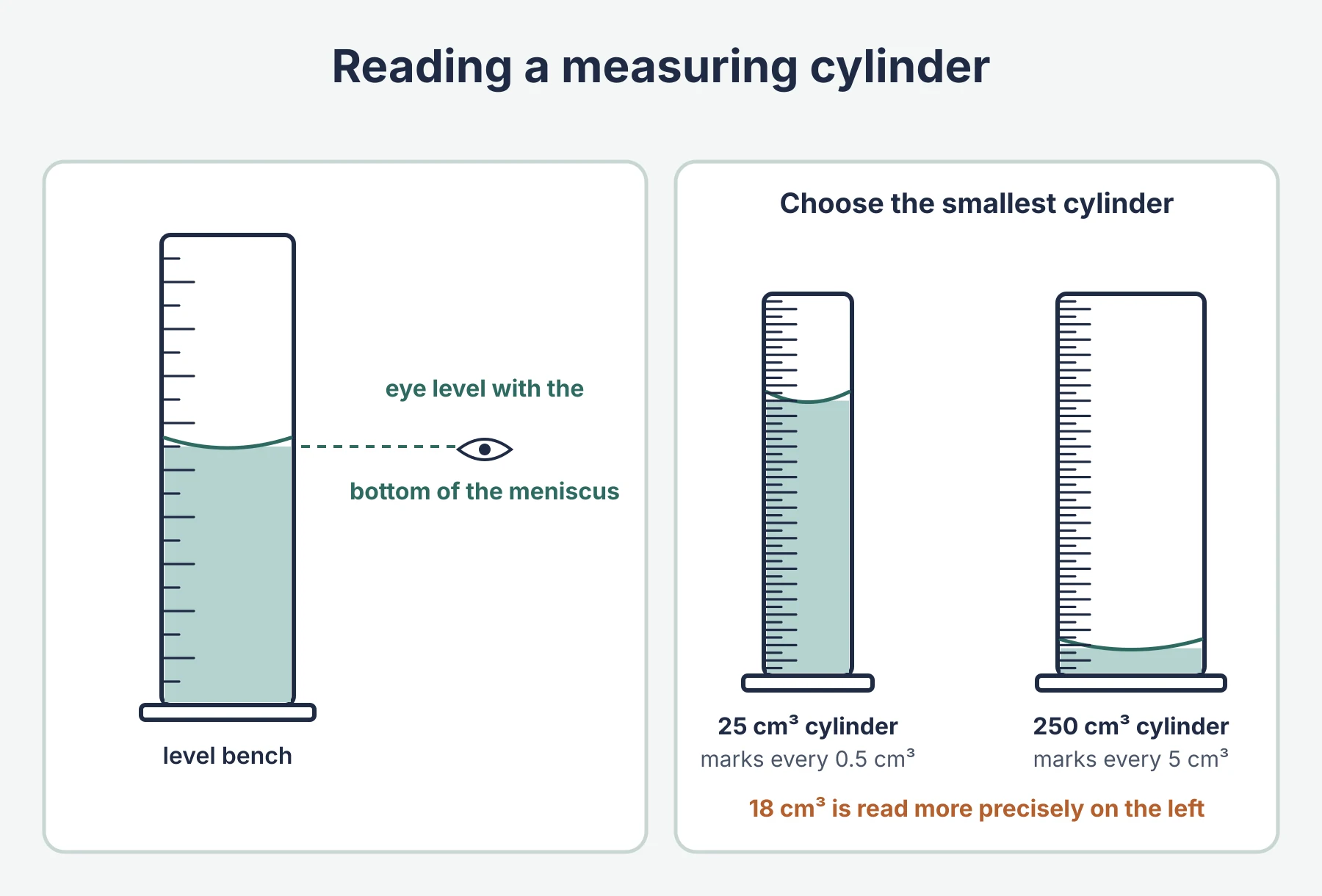
Stand the cylinder on a level bench. Water forms a curved surface, the meniscus; read the bottom of the curve with your eye level with it. Choose the smallest cylinder that holds the volume: a 25 cm³ cylinder marked every 0.5 cm³ gives a more precise reading of 18 cm³ than a 250 cm³ cylinder marked every 5 cm³. Volumes in this syllabus are usually in cm³ (1 cm³ = 1 ml); 1 m³ = 1 000 000 cm³.
Measuring time intervals
| Interval | Suitable instrument | Main limitation |
|---|---|---|
| minutes or hours (cooling a liquid) | clock or stopwatch | reading the clock at the right moment |
| several seconds (a trolley rolling down a long ramp) | stopwatch | human reaction time each time you start and stop |
| a fraction of a second (a ball passing through a gap) | digital timer triggered by light gates | none from reaction time; the gates must be placed accurately |
A stopwatch displays 0.01 s, but a person starting and stopping it adds a reaction time of a few tenths of a second, so a hand-timed reading is not as precise as the display suggests. A digital timer connected to light gates starts when an object breaks the first beam and stops when it breaks the second, removing reaction time entirely.
Measuring multiples
When one item is too small, or one event too quick, to measure well, measure many and divide. The uncertainty of the ruler or of your reaction time is then shared between all of them.
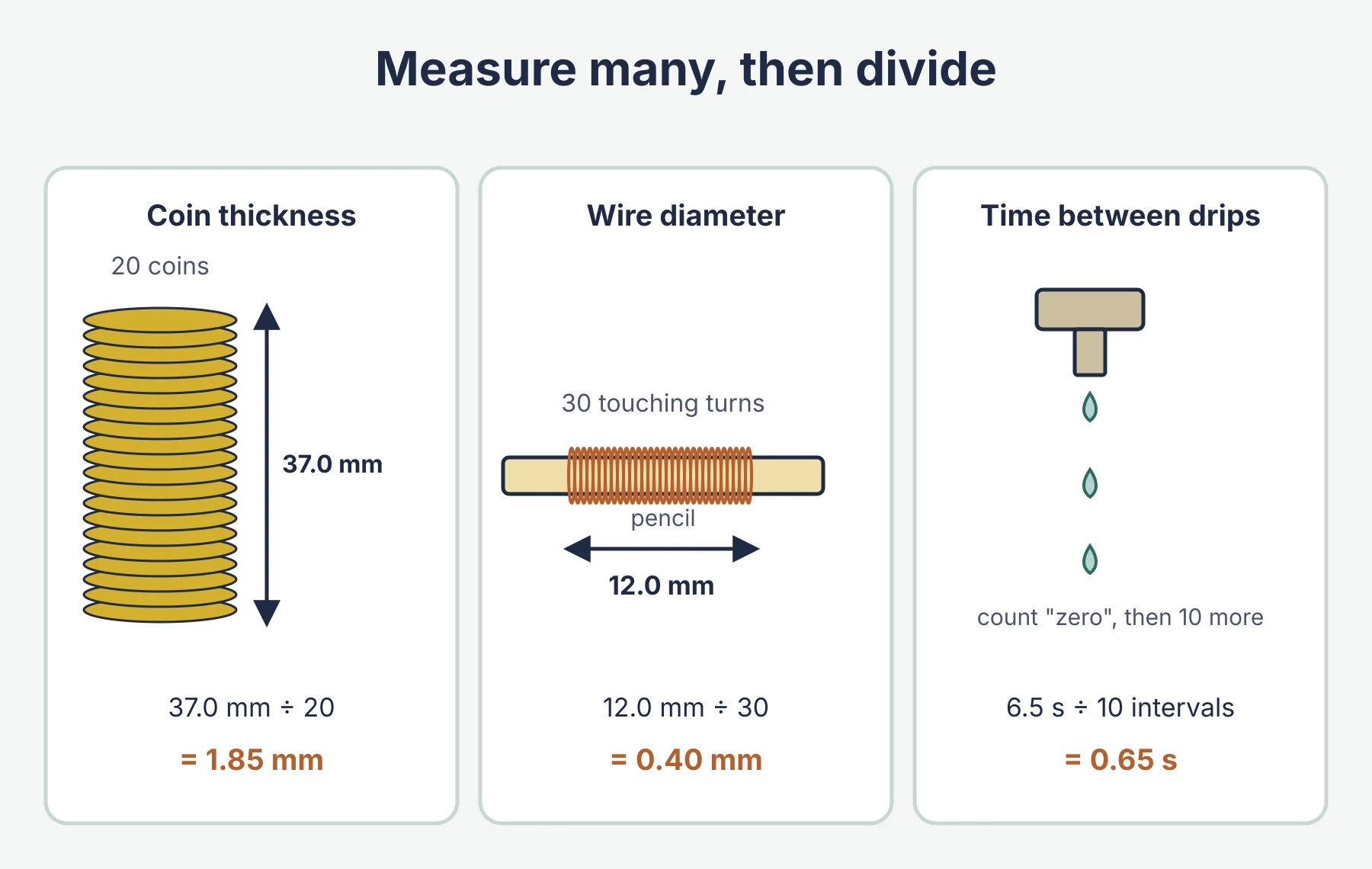
- Small distance. A stack of 20 identical coins is 37.0 mm tall, so one coin is 37.0 ÷ 20 = 1.85 mm thick. A ruler could not measure a single coin to that precision.
- Fine wire. Wind 30 tight, touching turns of wire round a pencil. If the coil is 12.0 mm long, the wire’s diameter is 12.0 ÷ 30 = 0.40 mm.
- Short time. Start a stopwatch at one drip from a tap, counting “zero”, and stop it at the tenth drip after that: 6.5 s for 10 intervals, so the mean time between drips is 0.65 s.
The period of a pendulum
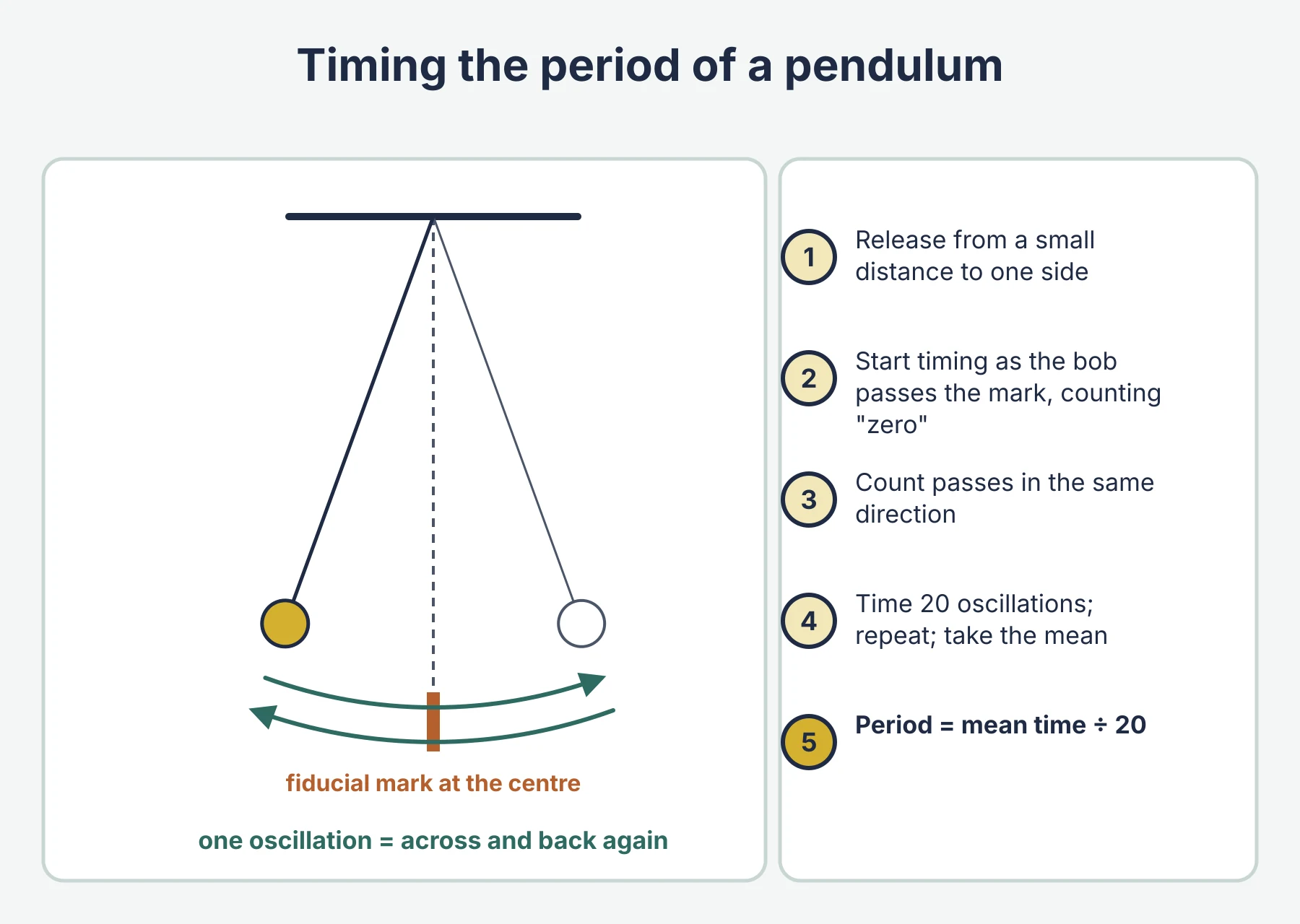
The period is the time for one complete oscillation: from one side, across to the other side, and back again. A single swing lasts about a second, comparable to your reaction time, so:
- Pull the bob a small distance to one side and release it.
- Use a fixed mark (a fiducial marker) behind the centre of the swing, where the bob moves fastest and its passing is easiest to judge.
- Start the stopwatch as the bob passes the mark, counting “zero”, and count each time it passes in the same direction.
- Time 20 oscillations, then repeat and take the mean.
- Divide the mean time by 20.
Scalars and vectors (Extended only)
A scalar has magnitude (size) only. A vector has magnitude and direction.
| Scalars | Vectors |
|---|---|
| distance, speed, time, mass, energy, temperature | force, weight, velocity, acceleration, momentum, electric field strength, gravitational field strength |
Pairs worth separating: speed is a scalar while velocity, speed in a given direction, is a vector; mass is a scalar while weight, a force, is a vector; gravitational field strength is a vector (it points towards the centre of the Earth) even though it is often quoted as just 9.8 N/kg. Two cars both travelling at 20 m/s, one north and one south, have the same speed but different velocities.
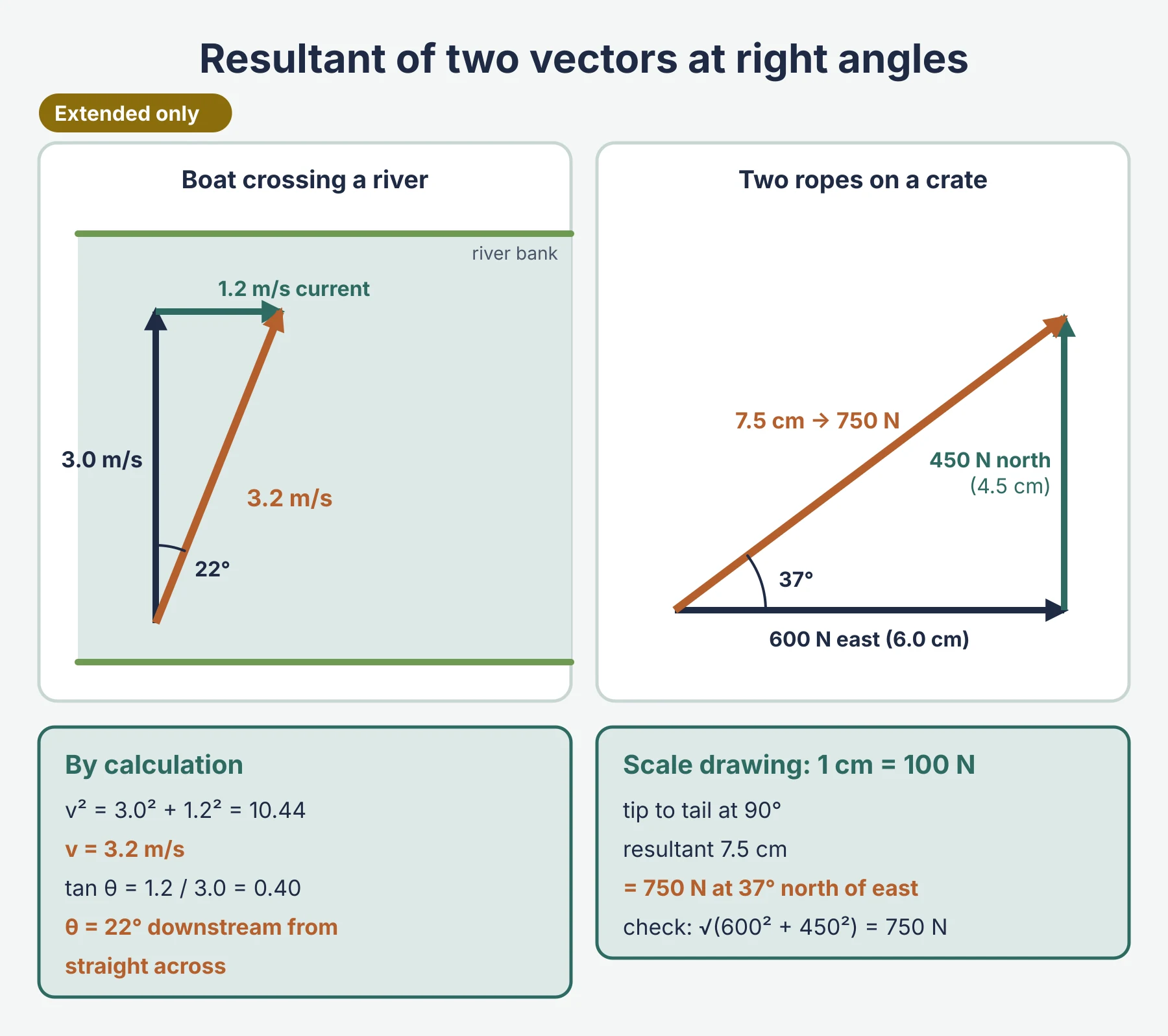
Resultant of two vectors at right angles
The resultant is the single vector with the same effect as the two together. For two forces or two velocities at right angles:
- By calculation: the magnitude comes from Pythagoras, R² = A² + B², and the direction from tan θ = opposite ÷ adjacent.
- Graphically: choose a scale, draw the first vector as an arrow, draw the second from its tip at 90°, and join the tail of the first to the tip of the second. Measure the length (convert with the scale) and the angle with a protractor.
Worked example 1 (by calculation). A boat heads straight across a river at 3.0 m/s relative to the water. The current flows downstream at 1.2 m/s. Find the boat’s resultant velocity.
magnitude:  v² = 3.0² + 1.2² = 9.00 + 1.44 = 10.44
            v  = 3.2 m/s
direction:  tan θ = 1.2 / 3.0 = 0.40,  θ = 22°
answer:     3.2 m/s at 22° downstream from the straight-across direction
The direction must say what the angle is measured from. “22°” alone is incomplete.
Worked example 2 (graphically). Two ropes pull a crate along the floor: 600 N due east and 450 N due north. Scale: 1 cm represents 100 N.
east arrow:   6.0 cm;  north arrow from its tip: 4.5 cm
resultant drawn from start to finish: 7.5 cm  →  7.5 × 100 = 750 N
angle measured from east: 37° (towards north)
check: √(600² + 450²) = 750 N;  tan θ = 450/600, θ = 37°
Choose a scale that makes the diagram large (at least 5 cm per side). A tiny drawing makes a 1 mm error in length, or a 1° error in angle, a large fraction of the answer.
Common mistakes
- Reading the top of the meniscus, or reading a measuring cylinder held in the hand at an angle.
- Counting a pendulum’s “one swing” as only from one side to the other; one oscillation is there and back.
- Dividing by the wrong number: measuring 20 oscillations but dividing by 10, or timing 10 drips from the first drip (only 9 intervals).
- Stating a timing to 0.01 s from a hand-operated stopwatch and claiming it is that precise.
- (Extended) Adding two perpendicular vectors as numbers: 600 N + 450 N is not 1050 N.
- (Extended) Giving the magnitude of a resultant without its direction, or giving an angle without a reference direction.
- (Extended) Listing weight as a scalar because it is “the same as mass”.
Exam technique: command words
- Describe (how to measure): give the instrument, what you do in order, and one precaution such as avoiding parallax or reading the bottom of the meniscus. Name units.
- Determine (an average value): show the reading for the multiple, the division, and the result with a unit.
- State (whether a quantity is a scalar or vector): one word is enough, but in an Extended “explain” add that a vector has direction.
- Calculate (a resultant): show Pythagoras with the numbers substituted, then the angle, and give both.
- Show that / scale-drawing questions: state your scale, draw neat arrows with arrowheads, and give the measured values.
Test yourself with the revision notes on physical quantities and measurement techniques, then work through the practice questions on physical quantities and measurement techniques. The measuring skills here are used straight away in the study guide on motion and the study guide on density.
Related resources
-
Practice questions
Cambridge IGCSE Physics (0625): Physical quantities and measurement techniques – Practice Questions
Twelve original Cambridge IGCSE Physics 0625 questions on measuring length, volume and time, multiples, scalars, vectors and resultants, with full answers.
Physics · Cambridge · IGCSE
Try questions -
Revision notes
Cambridge IGCSE Physics (0625): Physical quantities and measurement techniques – Revision Notes
Revision notes for Cambridge IGCSE Physics 0625 section 1.1: measuring length, volume and time, measuring multiples, scalars, vectors and a self-test.
Physics · Cambridge · IGCSE
Revise topic -
Study guides
Cambridge IGCSE Physics (0625): Pressure
Study guide to Cambridge IGCSE Physics 0625 section 1.8 Pressure: p = F/A, area conversions, everyday examples, pressure in liquids and Δp = ρgΔh.
Physics · Cambridge · IGCSE
Read guide
Related articles
Get free revision emails (optional)
Occasional emails with practice questions, worked explanations and links to free resources for the qualification and subjects you choose. No spam, and you can unsubscribe from any email. The free tools on this site never need an email.