
Revision Notes
Edexcel International A Level Law (YLA1): General Defences: Duress and Intoxication – Revision Notes
Condensed notes on duress of threats and circumstances and on voluntary and involuntary intoxication, with step-by-step tests, cases and a self-test (YLA1).
- Subject
- Law
- Level
- A LEVELS
- Topic
- Paper 2 – The Law in Action
- Author
- Marlbridge Academic Team
- Updated
- Reviewed by
- Aizaz Raoof Ali (what this means)
Aligned to Pearson Edexcel A Level Law (YLA1), Issue 4, November 2021. Official specification .
Syllabus page (what it covers and how it is assessed): Pearson Edexcel A Level Law.
Syllabus points this page covers
YLA1
- 2.2 The criminal offender
Found an error? Report a correction.
Need help with this topic? Request a free trial class for A Level Law (YLA1).
Condensed for the final weeks. These notes cover content areas 2.2.8, “Duress of threats and duress of circumstances”, and 2.2.9, “Voluntary and involuntary intoxication”. For the full explanation, use the duress and intoxication study guide; the whole criminal section is in the criminal offender revision notes.
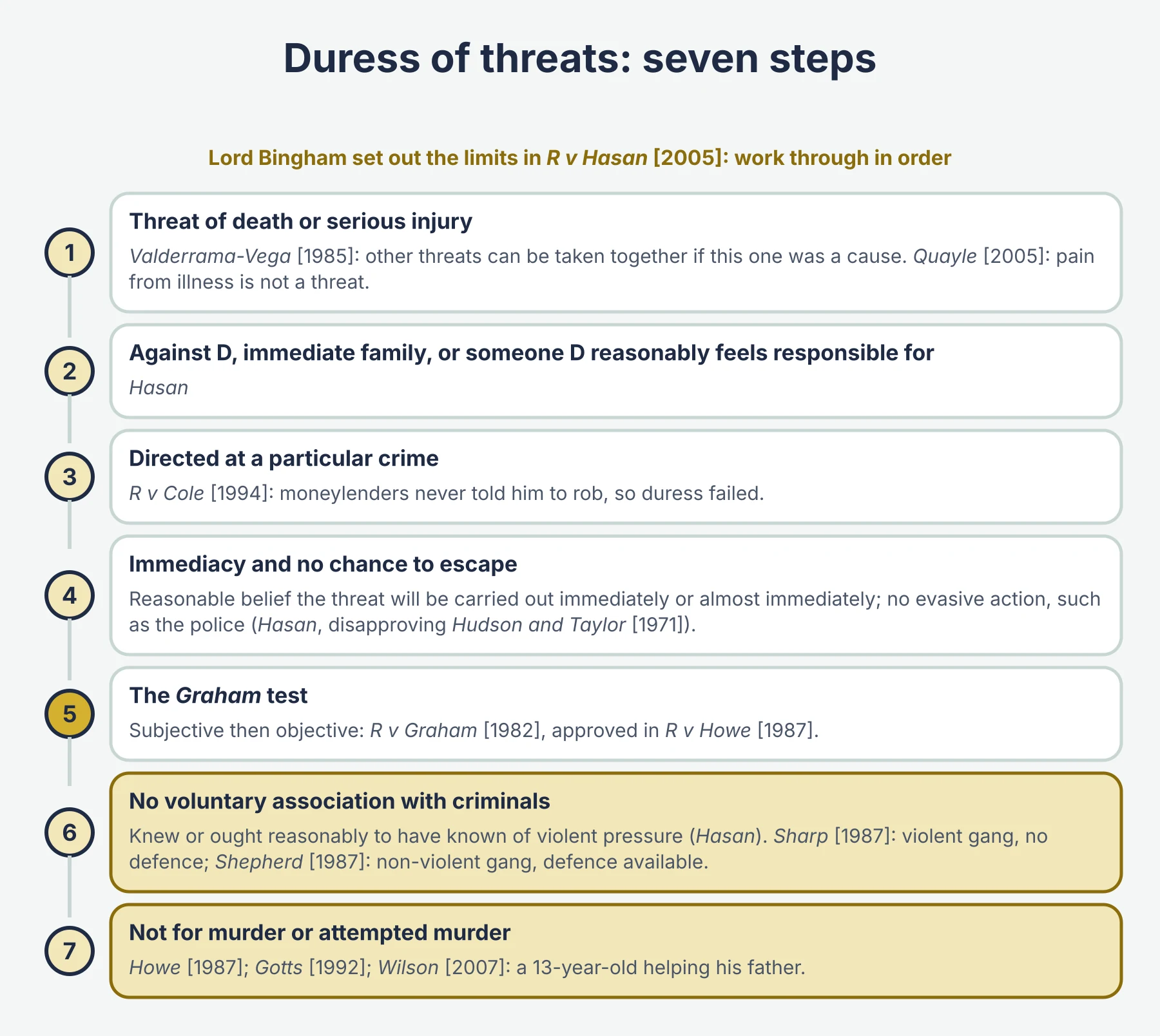
Duress: the seven-step test
| Step | Requirement | Case |
|---|---|---|
| 1 | Threat of death or serious injury (other pressures may be considered with it) | Valderrama-Vega [1985]; Quayle [2005] |
| 2 | Against D, D’s immediate family, or someone D reasonably feels responsible for | Hasan [2005] |
| 3 | Threat directed at a particular crime | Cole [1994] |
| 4 | Threat expected immediately or almost immediately; no reasonable chance to escape or go to the police | Hasan, disapproving Hudson and Taylor [1971] |
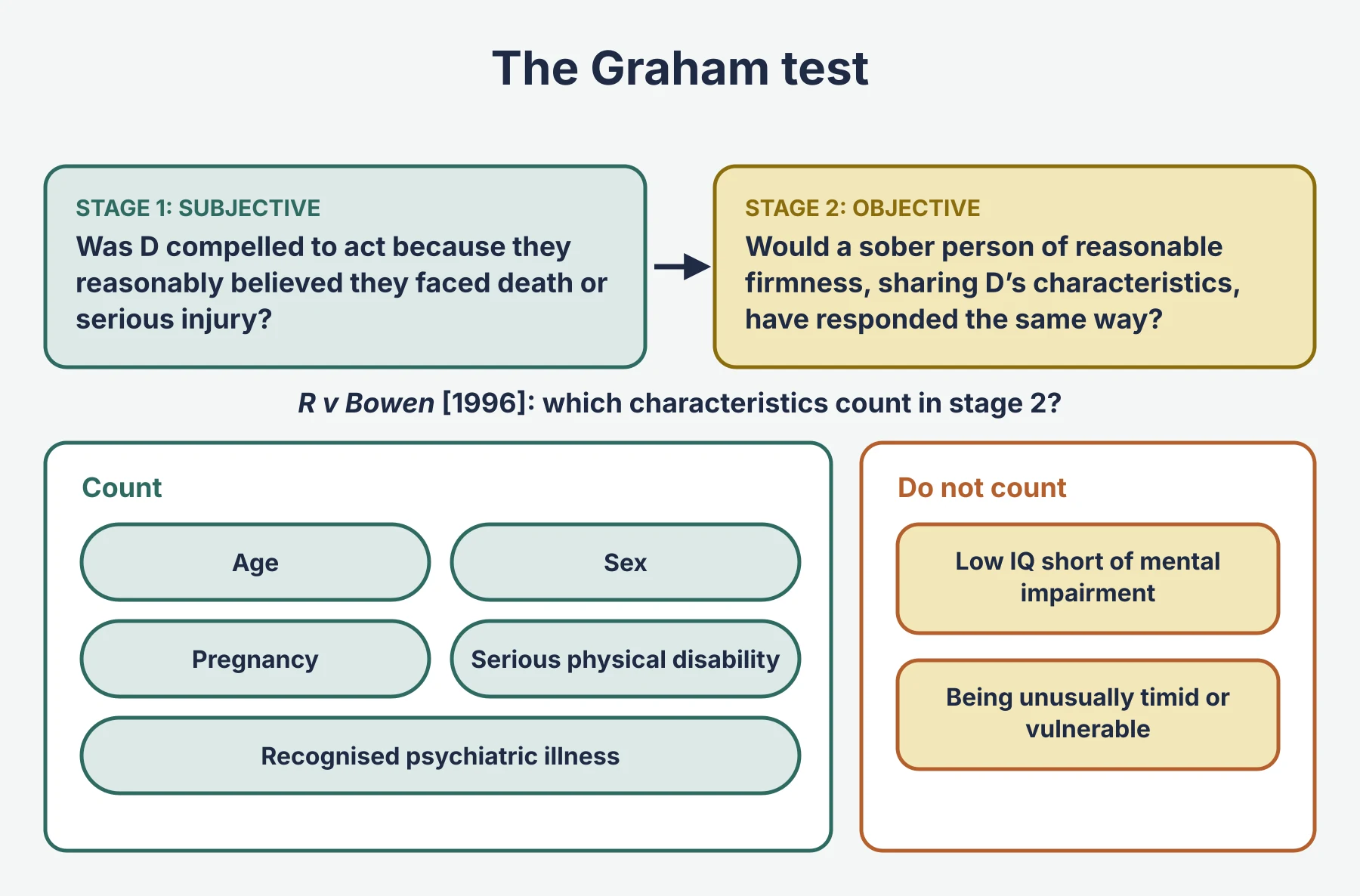
| 5a | Subjective: D reasonably believed the threat and was compelled | Graham [1982] |
| 5b | Objective: a sober person of reasonable firmness with D’s relevant characteristics would have done the same | Graham; Bowen [1996] |
| 6 | No voluntary association with people D knew or ought to have known might use violence | Sharp [1987]; Shepherd [1987]; Hasan |
| 7 | Not available for murder or attempted murder | Howe [1987]; Gotts [1992]; Wilson [2007] |
Bowen characteristics: age, sex, pregnancy, serious physical disability, recognised psychiatric illness. Not: low IQ short of mental impairment; being especially timid.
Duress of circumstances
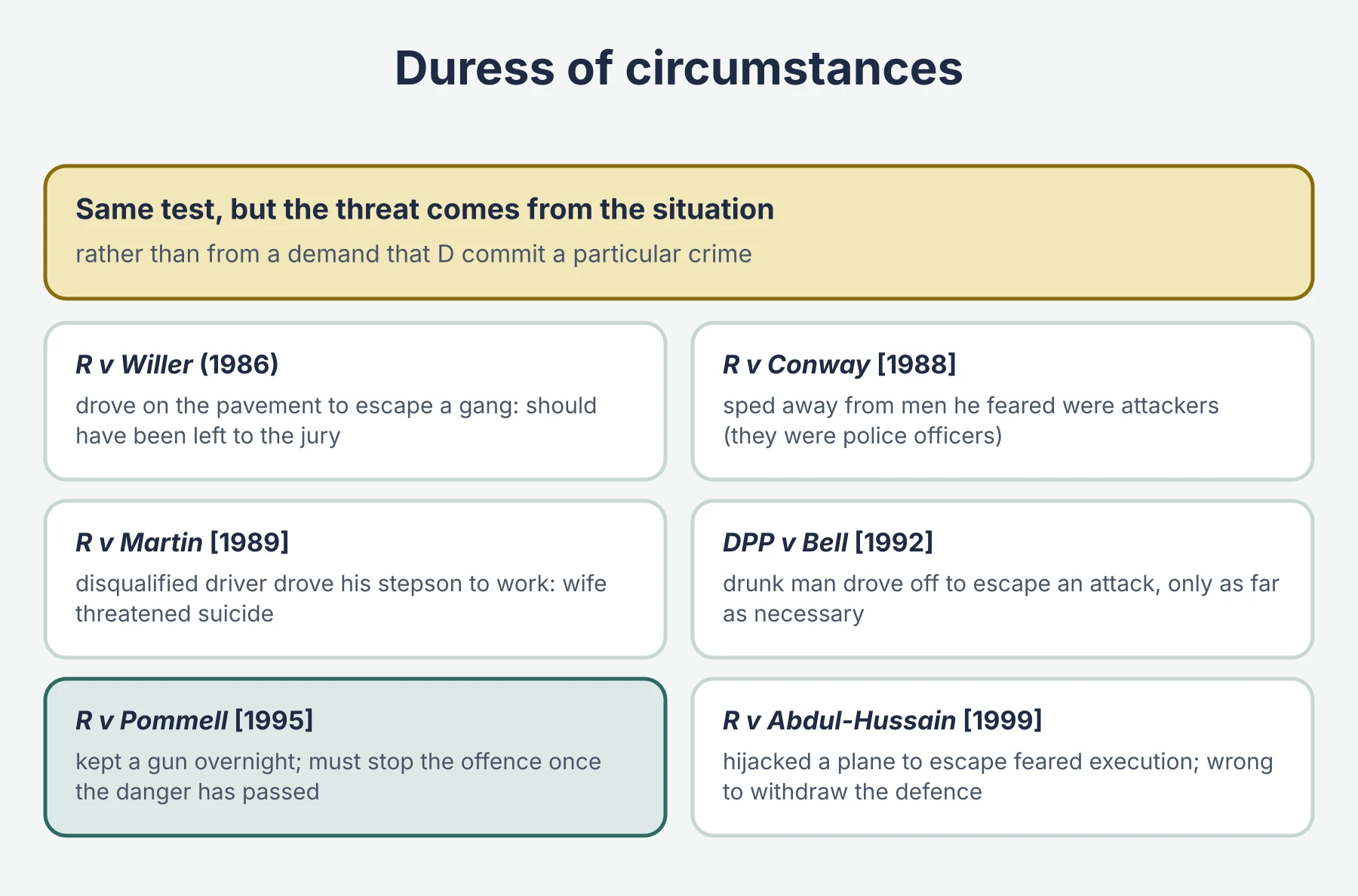
Same test; the threat arises from the situation.
- Willer (1986): drove on a pavement to escape a gang.
- Conway [1988]: sped away from men he feared were attackers.
- Martin [1989]: drove while disqualified because his wife threatened suicide.
- DPP v Bell [1992]: drove off drunk to escape attack; went no further than necessary.
- Pommell [1995]: must stop the offence once the danger has passed.
- Abdul-Hussain [1999]: hijacking to escape feared execution; defence should go to the jury.
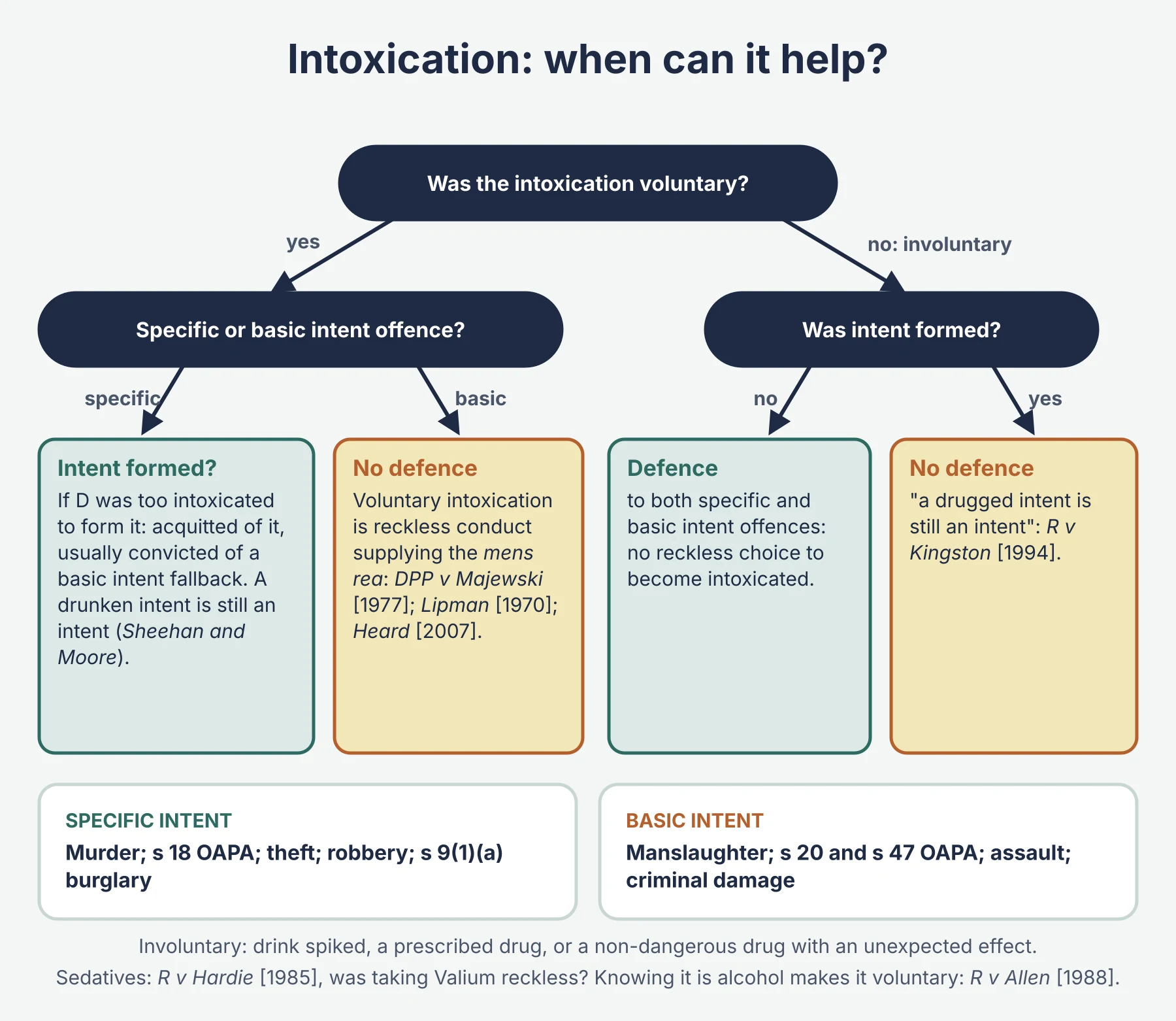
Intoxication: decision tree
Was the intoxication voluntary?
 YES -> Is the offence specific intent?
          YES -> Did D form the intent?  yes -> guilty (Sheehan and Moore)
                                         no  -> not guilty of it; usually
                                                guilty of a basic intent
                                                fallback
          NO (basic intent) -> no defence (Majewski; Lipman)
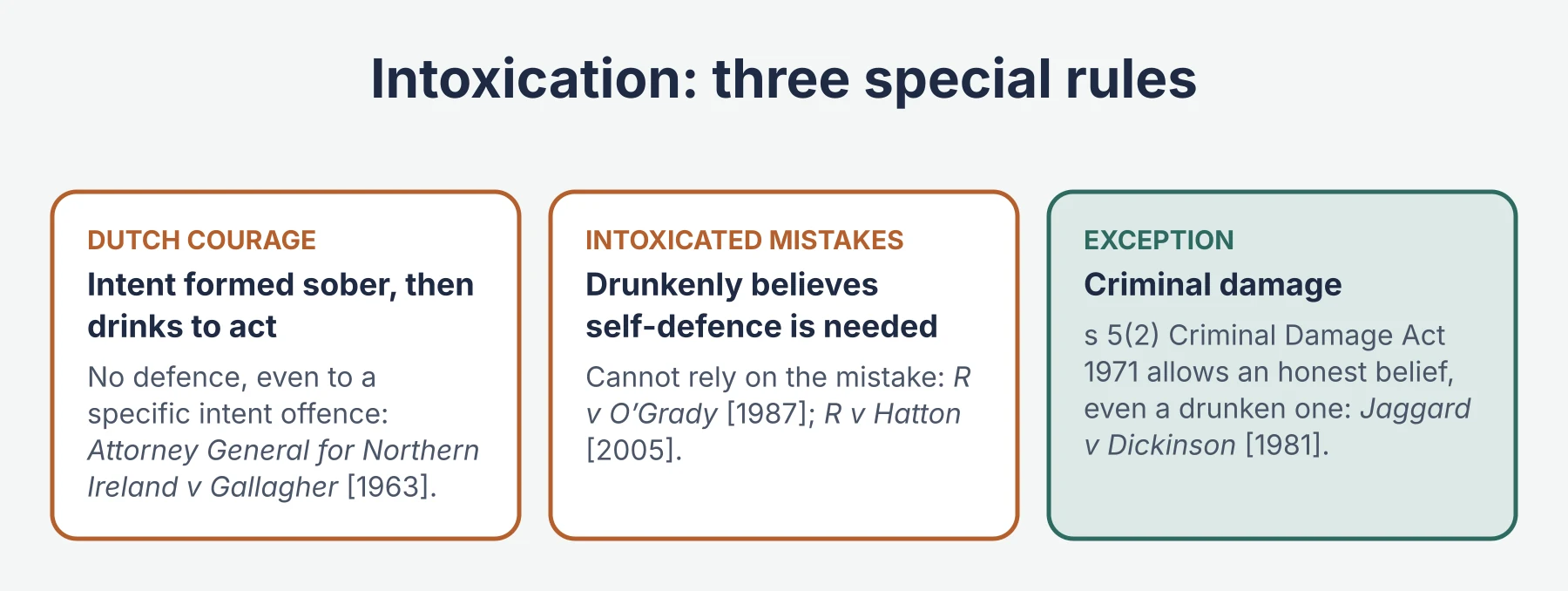
        Dutch courage? -> no defence at all (Gallagher)
 NO (spiked / prescribed / non-dangerous drug with unexpected effect)
     -> Did D form the mens rea?  yes -> guilty (Kingston)
                                  no  -> not guilty of any offence
                                         (Hardie)
Voluntary even if strength misjudged: Allen [1988]. Drunken mistakes: no self-defence based on a drunken mistake (O’Grady [1987]; Hatton [2005]); exception for lawful excuse in criminal damage (Jaggard v Dickinson [1981]).
Specific versus basic intent offences
| Specific intent | Basic intent |
|---|---|
| Murder | Manslaughter |
| s 18 OAPA 1861 | s 20 and s 47 OAPA 1861; assault and battery |
| Theft, robbery | Criminal damage (reckless) |
| s 9(1)(a) burglary with intent to steal | Sexual assault (Heard [2007]) |
Model evaluation paragraph
Excluding murder from duress, as in Howe*, reflects the view that an ordinary person should be prepared to sacrifice their own life rather than take an innocent one. However, the result can be harsh: in* Wilson a 13-year-old acting under his father’s threats had no defence, and the law relies on the mandatory life sentence being softened only at the stage of the minimum term. The voluntary association rule in Hasan is easier to justify, because a person who joins violent criminals has chosen the risk.
Key terms
| Term | Meaning |
|---|---|
| Duress of threats | A defence where D is threatened with death or serious injury to commit a crime |
| Duress of circumstances | The same defence where the danger comes from the situation |
| Voluntary association | Choosing to associate with people likely to use violent pressure |
| Specific intent | An offence whose mens rea is intention only |
| Basic intent | An offence whose mens rea can be satisfied by recklessness |
| Dutch courage | Drinking after forming an intent, to gain the nerve to act |
| Involuntary intoxication | Spiked drink, prescribed drug, or unexpected effect of a non-dangerous drug |
Exam traps
- Duress is never a defence to murder or attempted murder.
- Hasan requires an immediate or almost immediate threat; do not rely on Hudson and Taylor.
- Bowen excludes low IQ and timidity.
- Intoxication is no defence to basic intent offences if voluntary.
- A drugged or drunken intent is still an intent (Kingston; Sheehan and Moore).
Self-test
- What kind of threat is required for duress?
- Why did duress fail in R v Cole?
- What did Hasan say about immediacy?
- State both limbs of the Graham test.
- Which characteristics did Bowen say may be taken into account?
- Distinguish Sharp from Shepherd.
- Which cases exclude duress for murder and attempted murder?
- Give one example of duress of circumstances.
- What did Majewski decide?
- What did Sheehan and Moore decide?
- Why did the defence fail in Kingston?
- Can a defendant rely on a drunken mistaken belief in the need for self-defence?
Answers: 1. A threat of death or serious injury to D, D’s immediate family or someone D reasonably feels responsible for. 2. The moneylenders had not nominated robbery as the crime to be committed. 3. D must reasonably believe the threat will be carried out immediately or almost immediately, with no chance to take evasive action. 4. Was D compelled because he reasonably believed he faced death or serious injury; and would a sober person of reasonable firmness with D’s characteristics have done the same? 5. Age, sex, pregnancy, serious physical disability and recognised psychiatric illness. 6. In Sharp the defendant joined a violent robbery gang and could not use duress; in Shepherd the gang was a non-violent shoplifting gang, so violence was not foreseeable. 7. Howe (murder) and Gotts (attempted murder). 8. Any one: Willer; Conway; Martin; DPP v Bell; Pommell; Abdul-Hussain. 9. Voluntary intoxication is no defence to a basic intent offence. 10. A drunken intent is still an intent; intoxication helps only if D did not form the intent. 11. He had formed the intent, even though his drink had been drugged. 12. No (O’Grady; Hatton).
Test yourself further with the duress and intoxication practice questions.
Related resources
-
Study guides
Edexcel International A Level Law (YLA1): Misrepresentation and Mistake
Misrepresentation under the Misrepresentation Act 1967 with contributory negligence, and common, mutual and unilateral mistake, with cases (YLA1 2.1.4).
Law · Pearson Edexcel · A Level
Read guide -
Practice questions
Edexcel International A Level Law (YLA1): Misrepresentation and Mistake – Practice Questions
Original practice questions with full answers on misrepresentation, the Misrepresentation Act 1967, contributory negligence and mistake (YLA1 2.1.4).
Law · Pearson Edexcel · A Level
Try questions -
Revision notes
Edexcel International A Level Law (YLA1): Misrepresentation and Mistake – Revision Notes
Condensed notes on the elements, types, remedies and bars of misrepresentation, contributory negligence, and common, mutual and unilateral mistake (YLA1 2.1.4).
Law · Pearson Edexcel · A Level
Revise topic
Get free revision emails (optional)
Occasional emails with practice questions, worked explanations and links to free resources for the qualification and subjects you choose. No spam, and you can unsubscribe from any email. The free tools on this site never need an email.