
Revision Notes
Edexcel International A Level Law (YLA1): Misrepresentation and Mistake – Revision Notes
Condensed notes on the elements, types, remedies and bars of misrepresentation, contributory negligence, and common, mutual and unilateral mistake (YLA1 2.1.4).
- Subject
- Law
- Level
- A LEVELS
- Topic
- Paper 2 – The Law in Action
- Author
- Marlbridge Academic Team
- Updated
- Reviewed by
- Aizaz Raoof Ali (what this means)
Aligned to Pearson Edexcel A Level Law (YLA1), Issue 4, November 2021. Official specification .
Syllabus page (what it covers and how it is assessed): Pearson Edexcel A Level Law.
Syllabus points this page covers
YLA1
- 2.1 The market
Found an error? Report a correction.
Need help with this topic? Request a free trial class for A Level Law (YLA1).
Condensed for the final weeks. These notes cover two bullets of content area 2.1.4, “Validity of contracts”: “misrepresentation, including the Misrepresentation Act 1967 and the Law Reform (Contributory Negligence) Act 1945” and “mistake”. For the full explanation, use the misrepresentation and mistake study guide; the whole market section is in the market revision notes.
Misrepresentation checklist
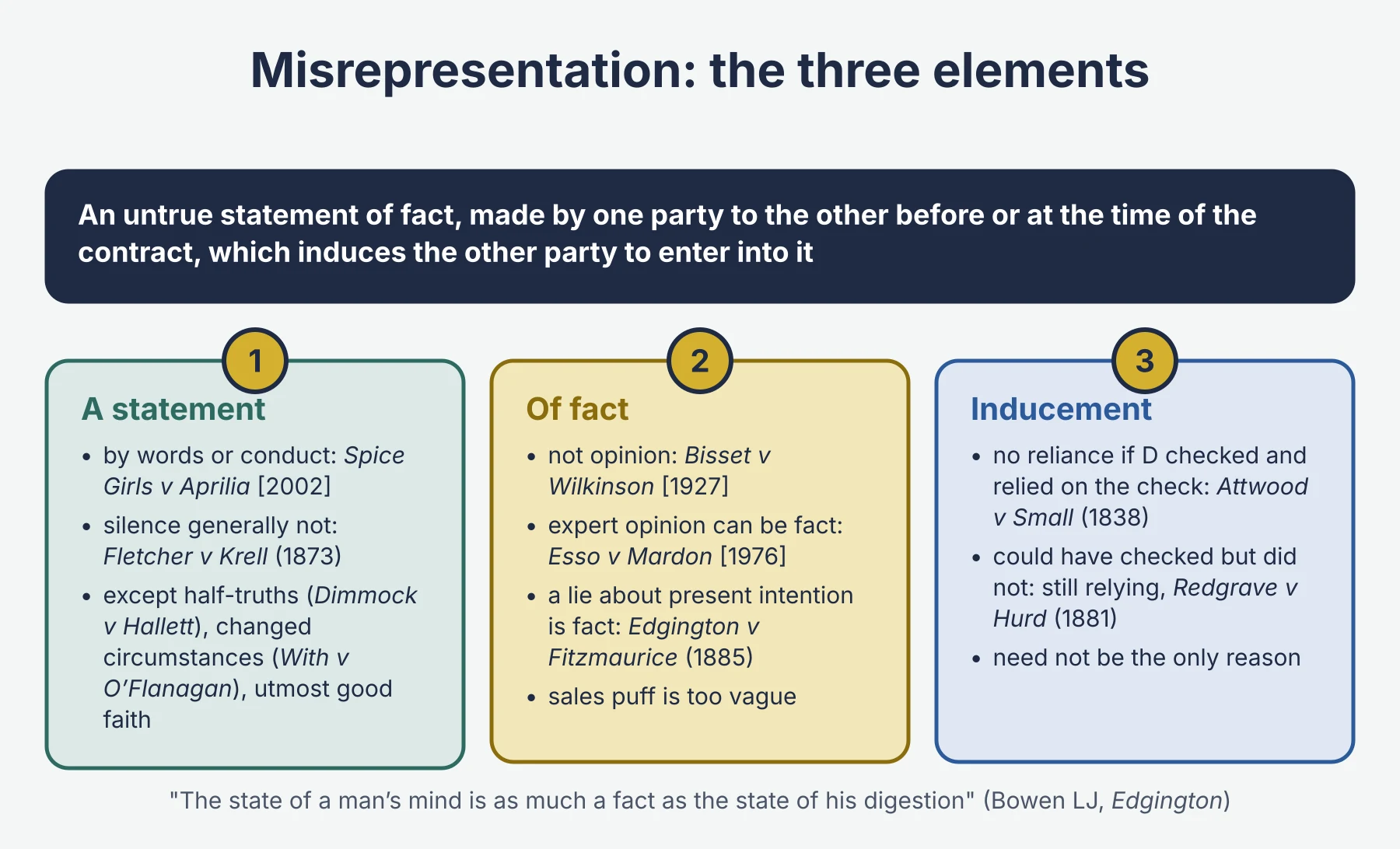
An untrue statement of fact → made by a party → before or at the contract → that induced the contract.
| Element | Rule | Case |
|---|---|---|
| Statement by conduct | Conduct can represent a fact | Spice Girls v Aprilia [2002] |
| Silence | Generally not a misrepresentation | Fletcher v Krell (1873) |
| Half-truth | Misleading partial statement | Dimmock v Hallett (1866) |
| Change of circumstances | Must correct a statement that becomes untrue | With v O’Flanagan [1936] |
| Opinion | Not fact, if honestly held without special knowledge | Bisset v Wilkinson [1927] |
| Expert opinion | Can be treated as fact | Esso v Mardon [1976] |
| Intention | A lie about present intention is a fact | Edgington v Fitzmaurice (1885) |
| No reliance | Relied on own investigation | Attwood v Small (1838) |
| Reliance despite chance to check | Still relied | Redgrave v Hurd (1881) |
Types and remedies
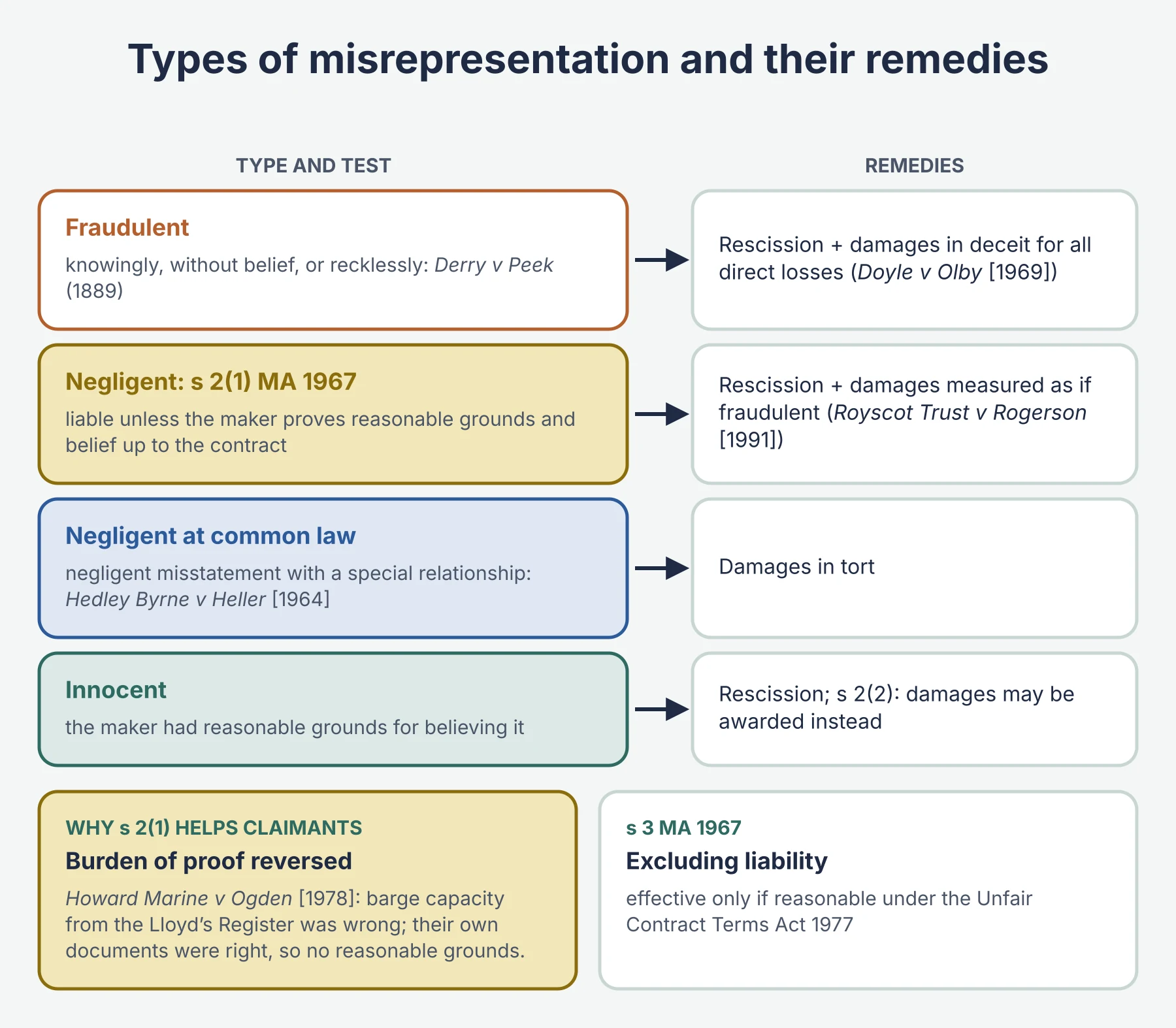
| Type | Key point | Remedy |
|---|---|---|
| Fraudulent | Knowingly, without belief, or recklessly (Derry v Peek (1889)) | Rescission + deceit damages for all direct loss (Doyle v Olby [1969]) |
| s 2(1) MA 1967 | Defendant must prove reasonable grounds for belief (Howard Marine v Ogden [1978]) | Rescission + damages as if fraud (Royscot v Rogerson [1991]) |
| Common law negligent misstatement | Special relationship (Hedley Byrne [1964]) | Damages |
| Innocent | Reasonable belief | Rescission, or damages in lieu under s 2(2) |
- s 3 MA 1967: exclusion of liability for misrepresentation must be reasonable (UCTA test).
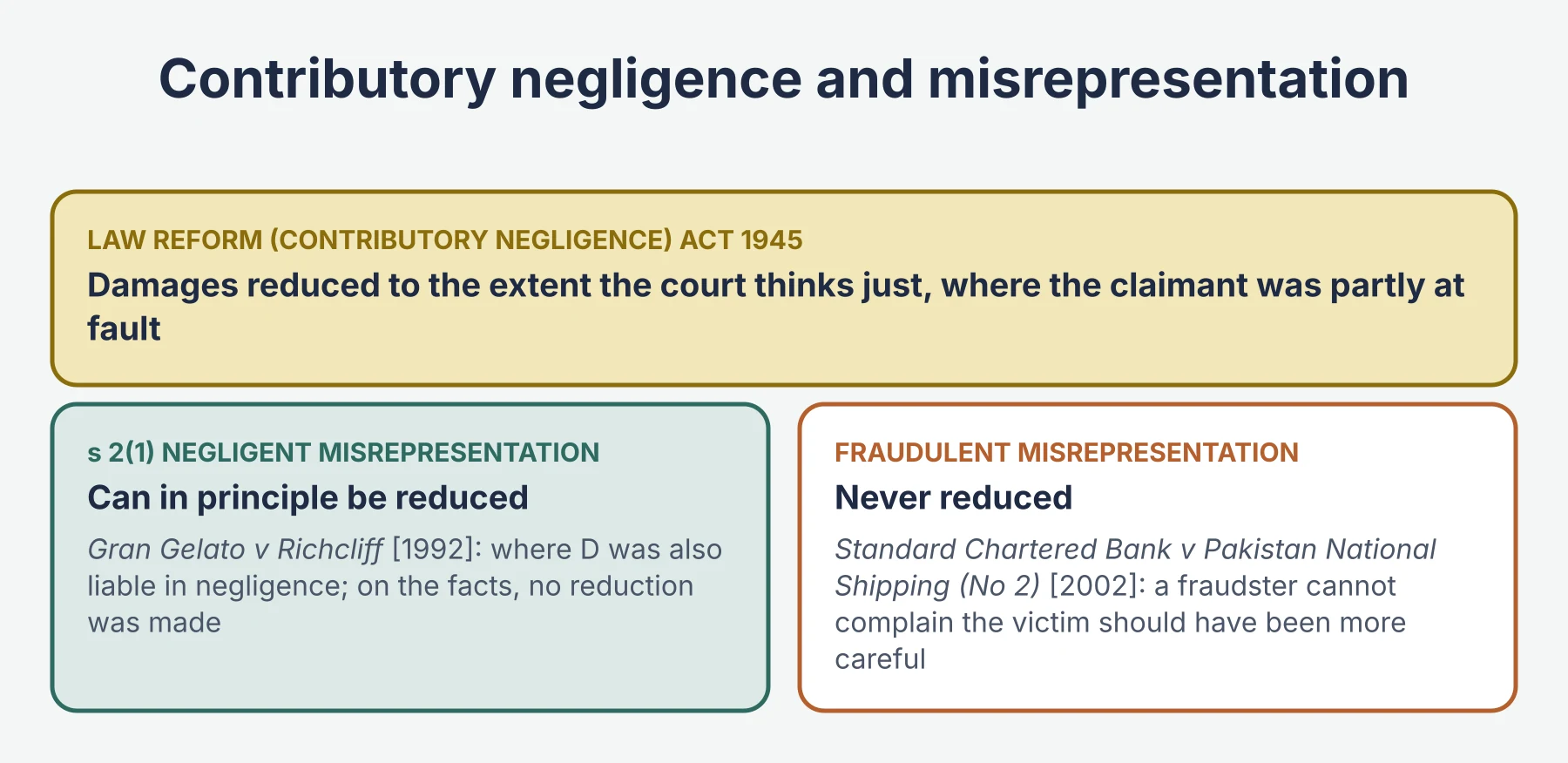
- 1945 Act: damages can be reduced for the claimant’s own fault in a s 2(1) claim (Gran Gelato v Richcliff [1992]); never in fraud (Standard Chartered v PNSC [2002]).
Bars to rescission
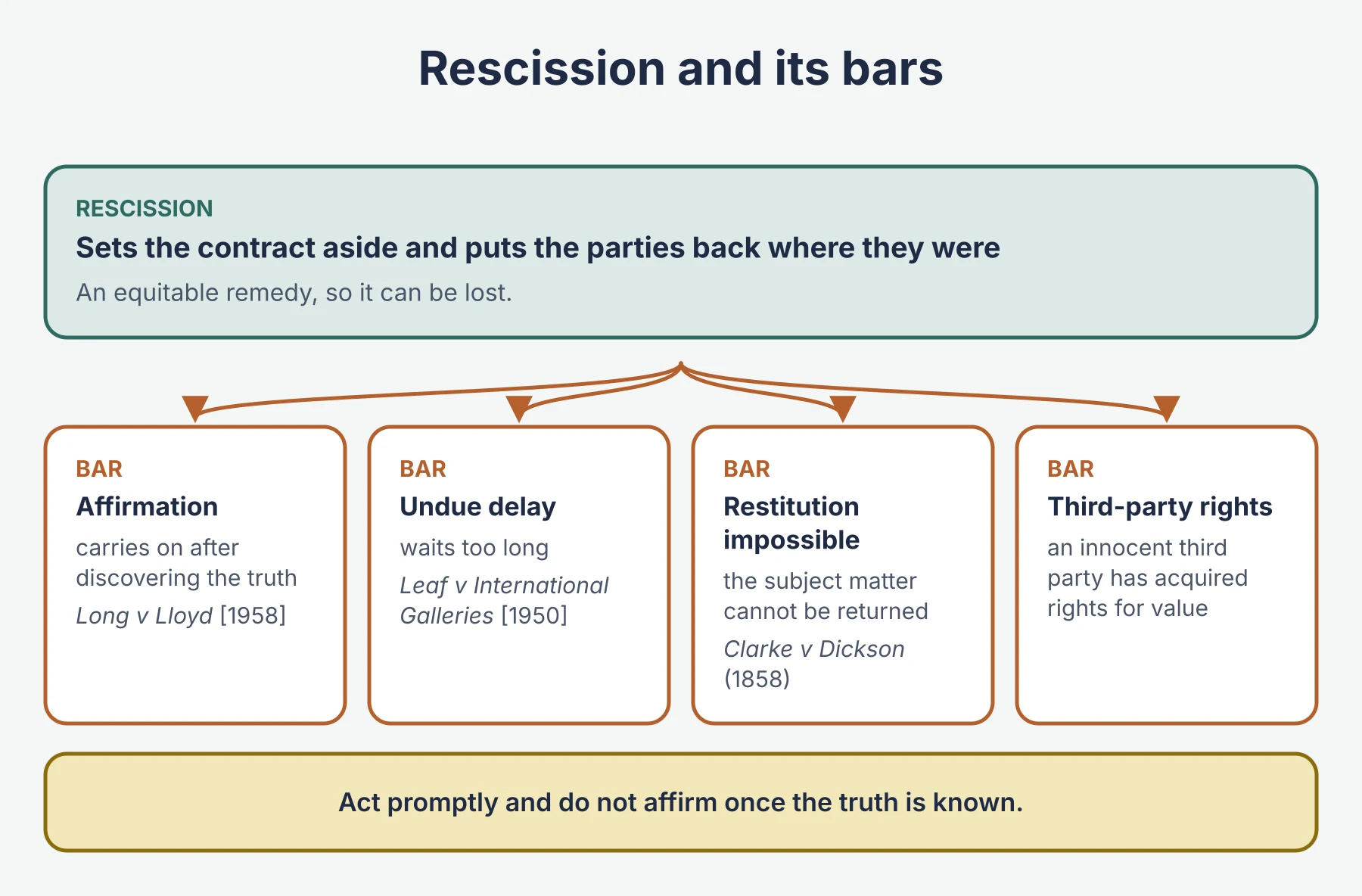
- Affirmation: Long v Lloyd [1958].
- Lapse of time: Leaf v International Galleries [1950].
- Restitution impossible: Clarke v Dickson (1858).
- Third-party rights acquired in good faith for value.
Mistake map
Common   (same mistake)  existence  -> void (Couturier v Hastie)
                         ownership  -> void (Cooper v Phibbs)
                         quality    -> valid (Bell v Lever Bros;
                                       Great Peace: only if performance
                                       essentially different)
Mutual   (cross-purposes)            -> void if no objective meaning
                                       (Raffles v Wichelhaus;
                                        Scriven v Hindley)
Unilateral (one mistaken, other knows)
          terms                      -> void (Hartog v Colin and Shields)
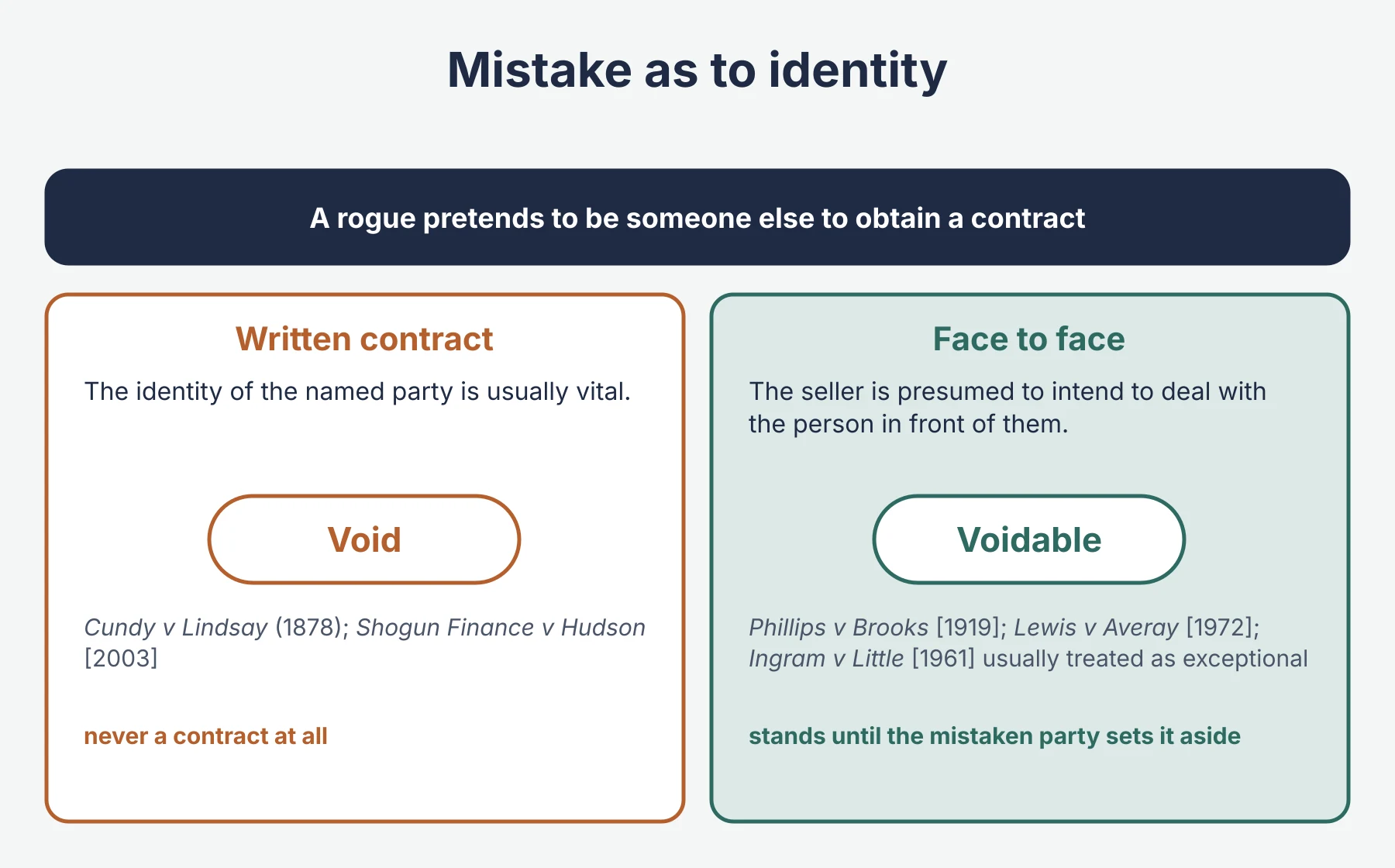
          identity, in writing       -> void (Cundy v Lindsay;
                                        Shogun Finance v Hudson)
          identity, face to face     -> voidable (Phillips v Brooks;
                                        Lewis v Averay; contrast
                                        Ingram v Little)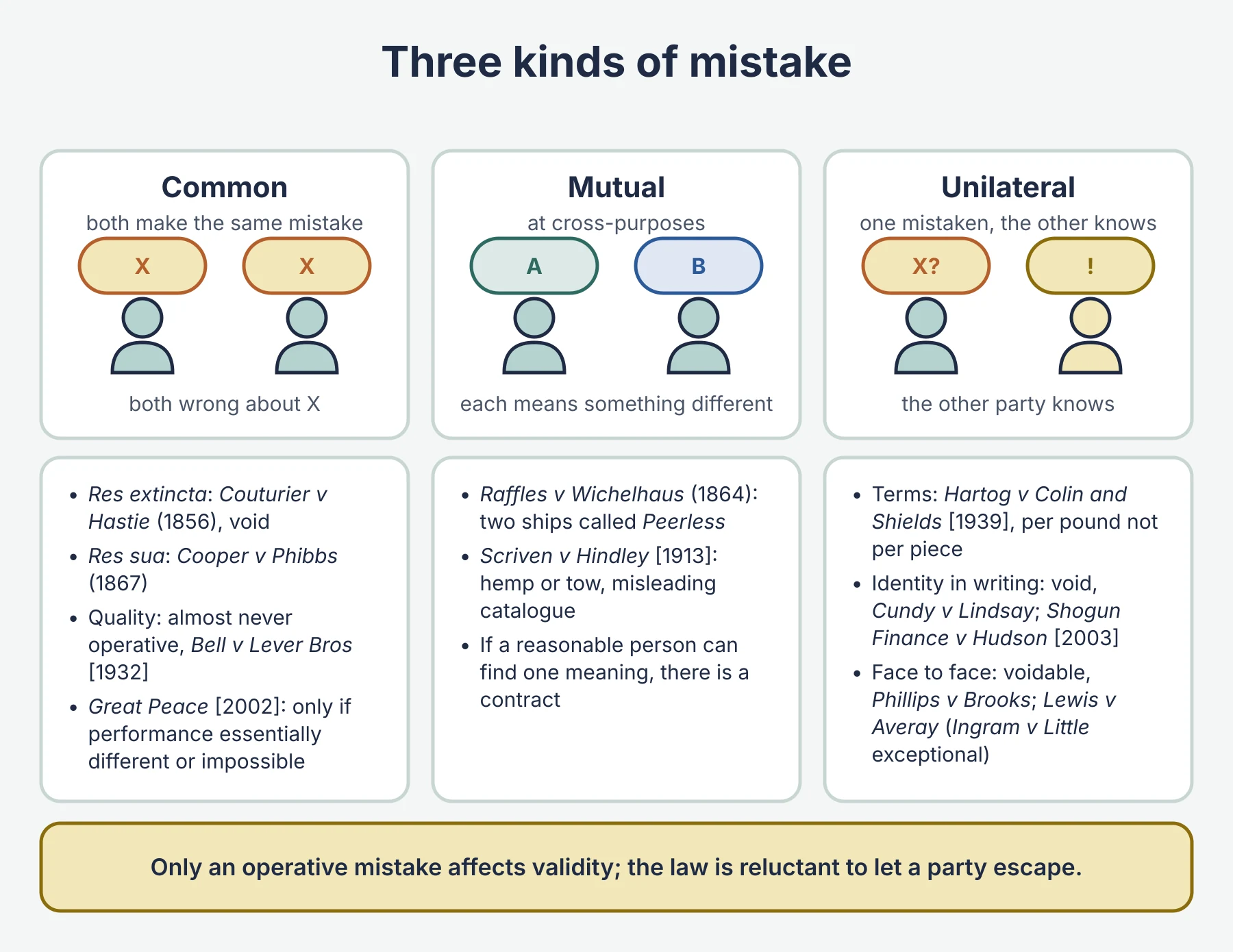
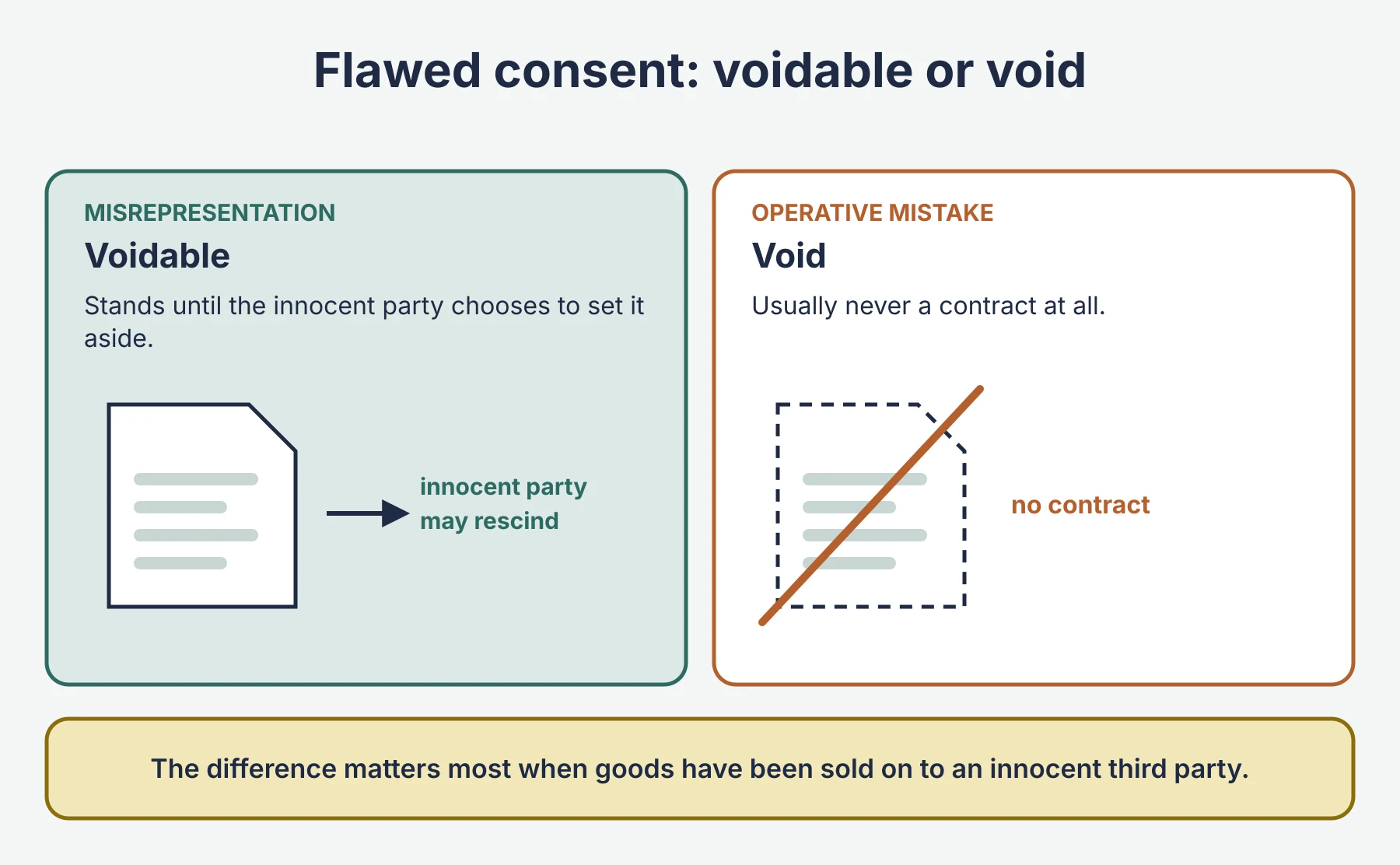
Void versus voidable
| Void | Voidable | |
|---|---|---|
| Effect | No contract from the start | Valid until rescinded |
| Typical cause | Operative mistake | Misrepresentation |
| Third party who bought in good faith | Gets no title | Keeps the goods if they bought before rescission |
Model evaluation paragraph
Section 2(1) of the Misrepresentation Act 1967 strongly favours the claimant: the defendant must disprove negligence, as the barge owners failed to do in Howard Marine*, and after* Royscot damages are assessed as if the defendant had been fraudulent. This may be harsh on a merely careless defendant, but the 1945 Act allows damages to be reduced where the claimant shared the fault (Gran Gelato), so the law can still apportion responsibility. Refusing that reduction in fraud (Standard Chartered) is justified because a dishonest party should bear the full consequences.
Key terms
| Term | Meaning |
|---|---|
| Misrepresentation | An untrue statement of fact inducing a contract |
| Voidable | Valid until the innocent party sets it aside |
| Void | Of no legal effect from the start |
| Rescission | Setting the contract aside and restoring the parties |
| Affirmation | Treating the contract as continuing after learning the truth |
| Deceit | The tort of fraudulent misrepresentation |
| Operative mistake | A mistake serious enough to affect validity |
| Res extincta | The subject matter no longer exists |
| Res sua | The buyer already owns the subject matter |
| Contributory negligence | The claimant’s own fault, reducing damages |
Exam traps
- Opinion versus fact: check the maker’s expertise.
- The s 2(1) burden lies on the defendant.
- No contributory negligence reduction for fraud.
- Mistake as to quality rarely makes a contract void.
- Face-to-face identity mistakes usually make the contract voidable, not void.
Self-test
- Define misrepresentation.
- Why was there no misrepresentation in Bisset v Wilkinson?
- What did Bowen LJ say in Edgington v Fitzmaurice?
- Give two exceptions to the rule that silence is not a misrepresentation.
- State the test for fraud in Derry v Peek.
- Who bears the burden of proof under s 2(1)?
- What did Royscot Trust v Rogerson decide?
- Can damages for fraudulent misrepresentation be reduced for contributory negligence?
- Name the four bars to rescission.
- What test for common mistake did Great Peace Shipping lay down?
- Why was there no contract in Raffles v Wichelhaus?
- Why is a face-to-face identity mistake usually only voidable?
Answers: 1. An untrue statement of fact made by one party to the other before or at the time of the contract, which induces the other to enter it. 2. It was an honest opinion by a seller with no special knowledge of sheep farming. 3. “The state of a man’s mind is as much a fact as the state of his digestion.” 4. Any two: half-truths; a change of circumstances; contracts of utmost good faith. 5. A false statement made knowingly, without belief in its truth, or recklessly, careless whether it is true or false. 6. The defendant, who must prove reasonable grounds for believing the statement. 7. Damages under s 2(1) are measured as if the misrepresentation were fraudulent. 8. No (Standard Chartered v PNSC). 9. Affirmation; lapse of time; restitution impossible; third-party rights. 10. The mistake must make performance essentially different from what was agreed, or impossible. 11. Each party meant a different ship called Peerless, and there was no way to decide which. 12. The seller is presumed to intend to deal with the person physically present, whatever name they give.
Test yourself further with the misrepresentation and mistake practice questions.
Related resources
-
Study guides
Edexcel International A Level Law (YLA1): The Criminal Offender
A deep dive into YLA1 section 2.2 The criminal offender: actus reus, mens rea, strict liability, property offences, duress, intoxication and sentencing.
Law · Pearson Edexcel · A Level
Read guide -
Practice questions
Edexcel International A Level Law (YLA1): The Criminal Offender – Practice Questions
Original practice questions on YLA1 section 2.2 The criminal offender: causation, mens rea, property offences, duress, intoxication and sentencing, with answers.
Law · Pearson Edexcel · A Level
Try questions -
Revision notes
Edexcel International A Level Law (YLA1): The Criminal Offender – Revision Notes
Condensed recall notes on YLA1 section 2.2: causation, omissions, intention, recklessness, strict liability, property offences, defences and sentencing.
Law · Pearson Edexcel · A Level
Revise topic
Get free revision emails (optional)
Occasional emails with practice questions, worked explanations and links to free resources for the qualification and subjects you choose. No spam, and you can unsubscribe from any email. The free tools on this site never need an email.