
Study Guides
Edexcel International A Level Law (YLA1): Discharge of Contract: Performance, Agreement, Breach and Frustration
How contracts end by performance, agreement, breach and frustration, with the Frustrated Contracts Act 1943, leading cases and a scenario (YLA1 2.1.4).
- Subject
- Law
- Level
- A LEVELS
- Topic
- Paper 2 – The Law in Action
- Author
- Marlbridge Academic Team
- Updated
- Reviewed by
- Aizaz Raoof Ali (what this means)
Aligned to Pearson Edexcel A Level Law (YLA1), Issue 4, November 2021. Official specification .
Syllabus page (what it covers and how it is assessed): Pearson Edexcel A Level Law.
Syllabus points this page covers
YLA1
- 2.1 The market
Found an error? Report a correction.
Need help with this topic? Request a free trial class for A Level Law (YLA1).
This guide covers the third bullet of content area 2.1.4 of Pearson Edexcel International Advanced Level Law, Issue 4, “Validity of contracts”: “discharge of contract – performance – agreement – breach – frustration, including the Law Reform (Frustrated Contracts) Act 1943”. The market study guide gives each method one bullet with a leading case. This page explains the exceptions to each rule, the different kinds of breach and the limits of frustration, and works through the 1943 Act, because scenario questions on Paper 2 turn on these details.
What “discharge” means
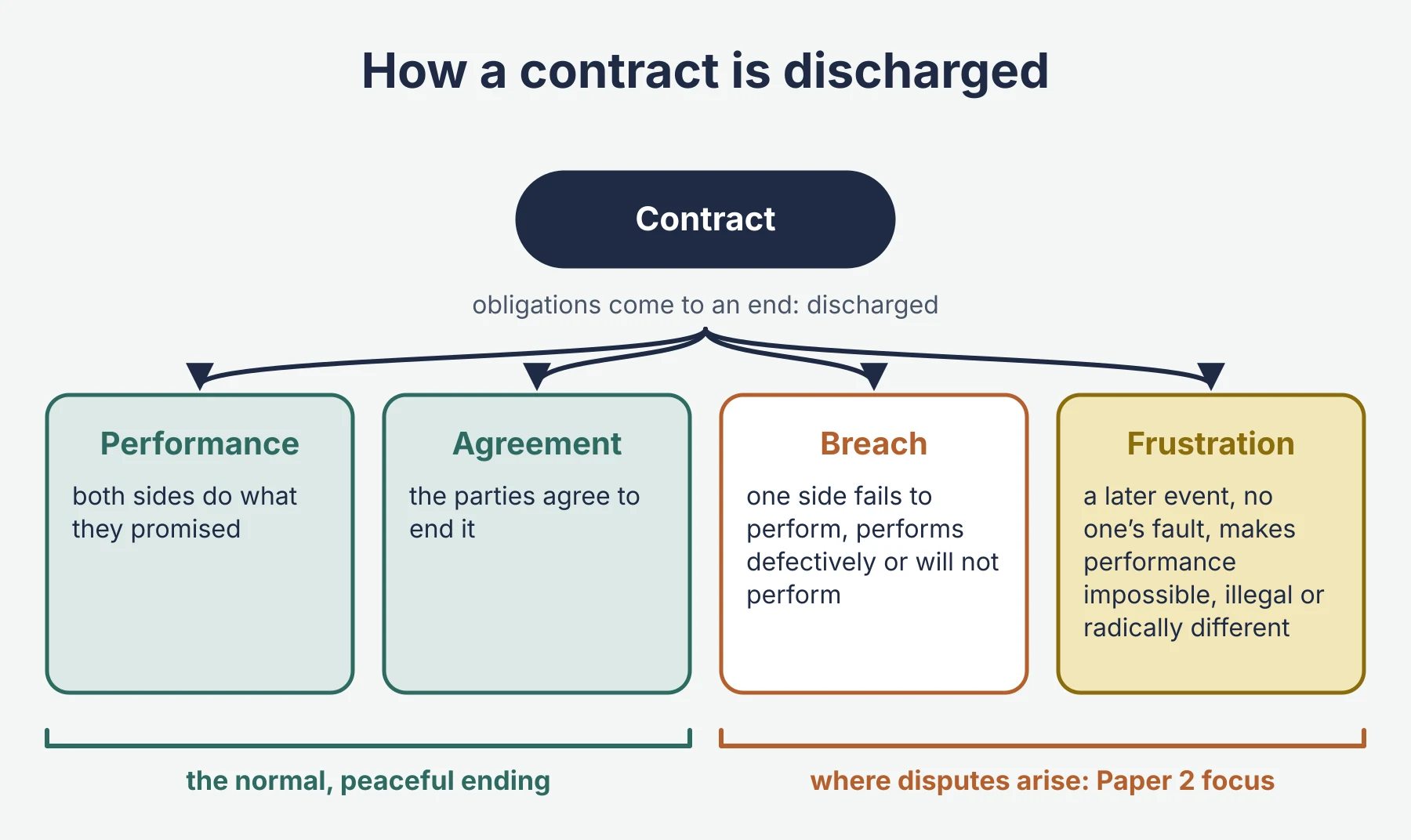
A contract is discharged when the parties’ obligations under it come to an end. Discharge by performance and agreement is the normal, peaceful ending. Discharge by breach or frustration is where disputes arise, and where Paper 2 questions concentrate.
Discharge by performance
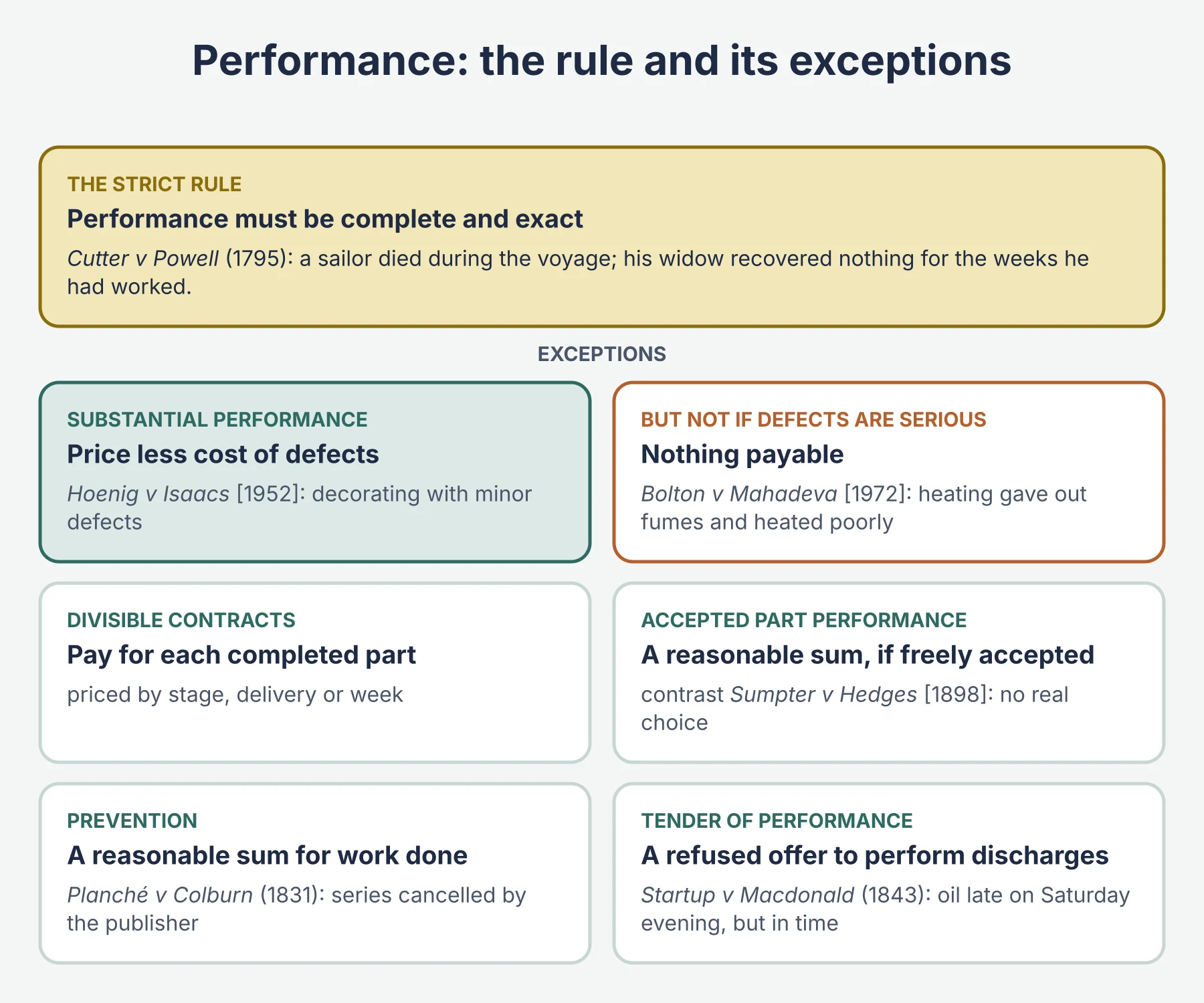
The strict rule. Performance must be complete and exact. In Cutter v Powell (1795) a sailor who died during a voyage had been promised a lump sum on arrival; his widow recovered nothing for the weeks he had worked.
The rule is harsh, so the courts have developed exceptions:
| Exception | Rule | Case |
|---|---|---|
| Substantial performance | If the work is substantially done, the price is payable less the cost of putting defects right | Hoenig v Isaacs [1952]: decorating with minor defects; price less the cost of repairs |
| …but not where defects are serious | No substantial performance | Bolton v Mahadeva [1972]: a central heating system that gave out fumes and heated poorly; nothing was payable |
| Divisible contracts | Payment is due for each completed part | Contracts priced by stage, delivery or week |
| Acceptance of partial performance | If the other party freely accepts the part performed, a reasonable sum is payable | Contrast Sumpter v Hedges [1898]: a landowner who finished half-built buildings himself had no real choice, so did not “accept” them |
| Prevention of performance | If one party prevents the other completing, the other can claim a reasonable sum for work done | Planché v Colburn (1831): a writer’s series was cancelled by the publisher |
| Tender of performance | An offer to perform that is refused discharges the party who offered | Startup v Macdonald (1843): oil delivered late on a Saturday evening but within the agreed time |
Discharge by agreement
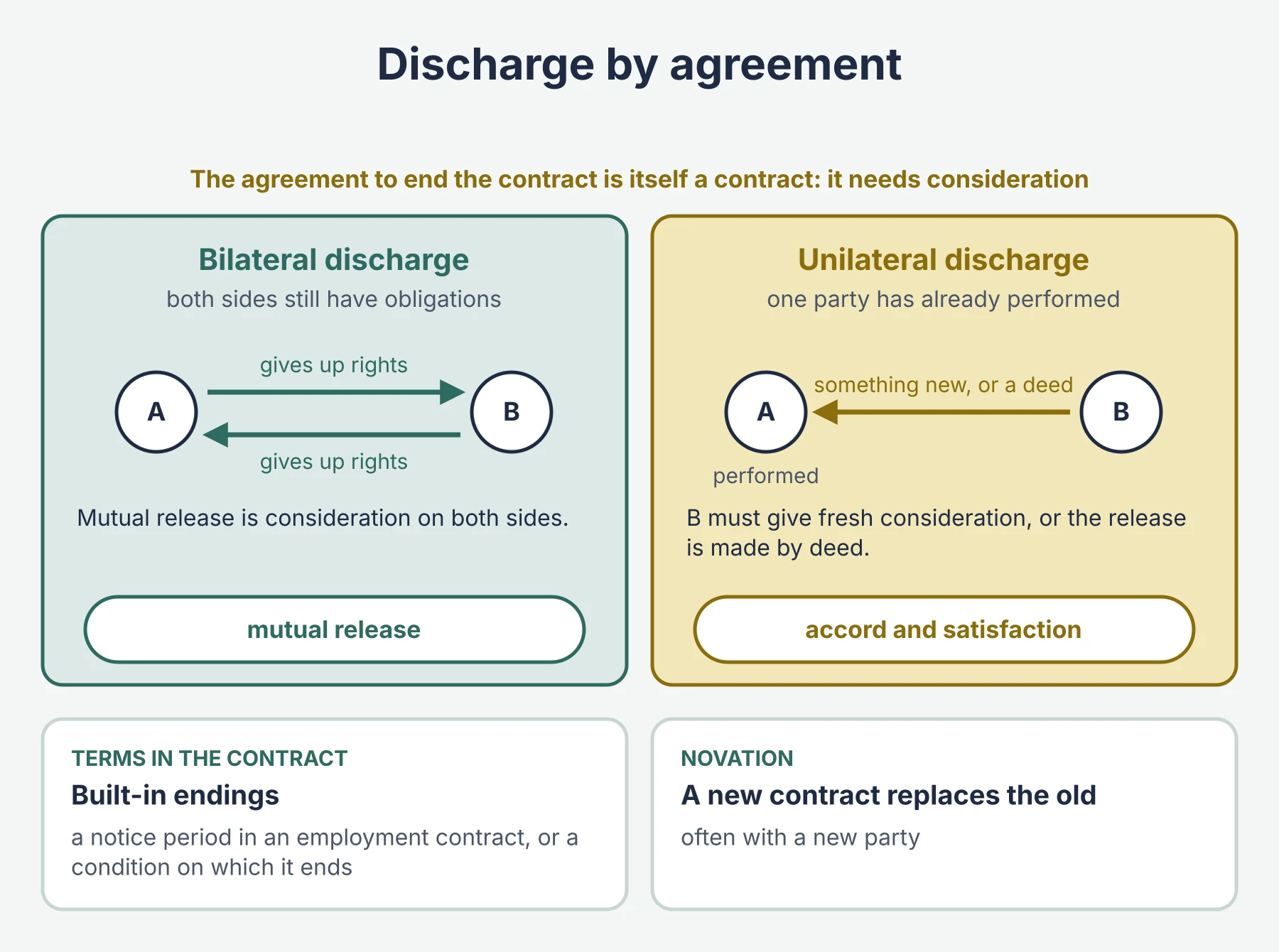
The parties made the contract, so they can end it, but the agreement to end it is itself a contract and needs consideration.
- Bilateral discharge: both parties still have obligations, so each gives up rights: mutual release is consideration on both sides.
- Unilateral discharge: one party has already performed, so the other must give something new, or the release must be made by deed. This is accord and satisfaction.
- Terms in the contract can provide for discharge, such as a notice period in an employment contract or a condition on which the contract ends.
- Novation: a new contract replaces the old one, often with a new party.
Discharge by breach
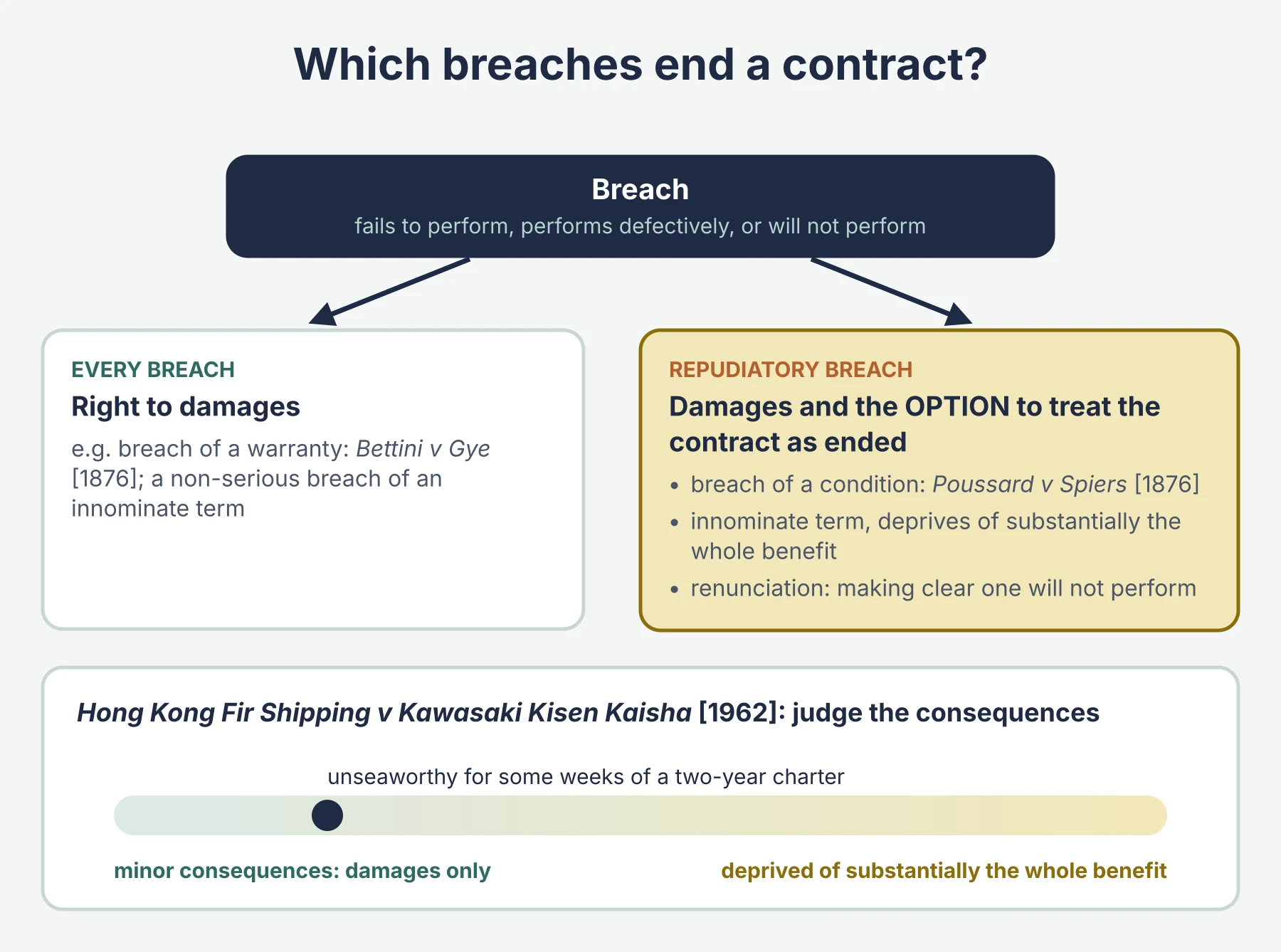
A breach occurs when a party fails to perform, performs defectively or shows that they will not perform. Every breach gives a right to damages, but only a repudiatory breach gives the innocent party the option to treat the contract as ended.
Repudiatory breaches:
- Breach of a condition (Poussard v Spiers [1876]), not of a warranty (Bettini v Gye [1876]).
- Breach of an innominate term whose consequences deprive the innocent party of substantially the whole benefit of the contract: Hong Kong Fir Shipping v Kawasaki Kisen Kaisha [1962], where a ship was unseaworthy for some weeks of a two-year charter; the breach was not serious enough to end the contract.
- Renunciation: making clear that one will not perform.
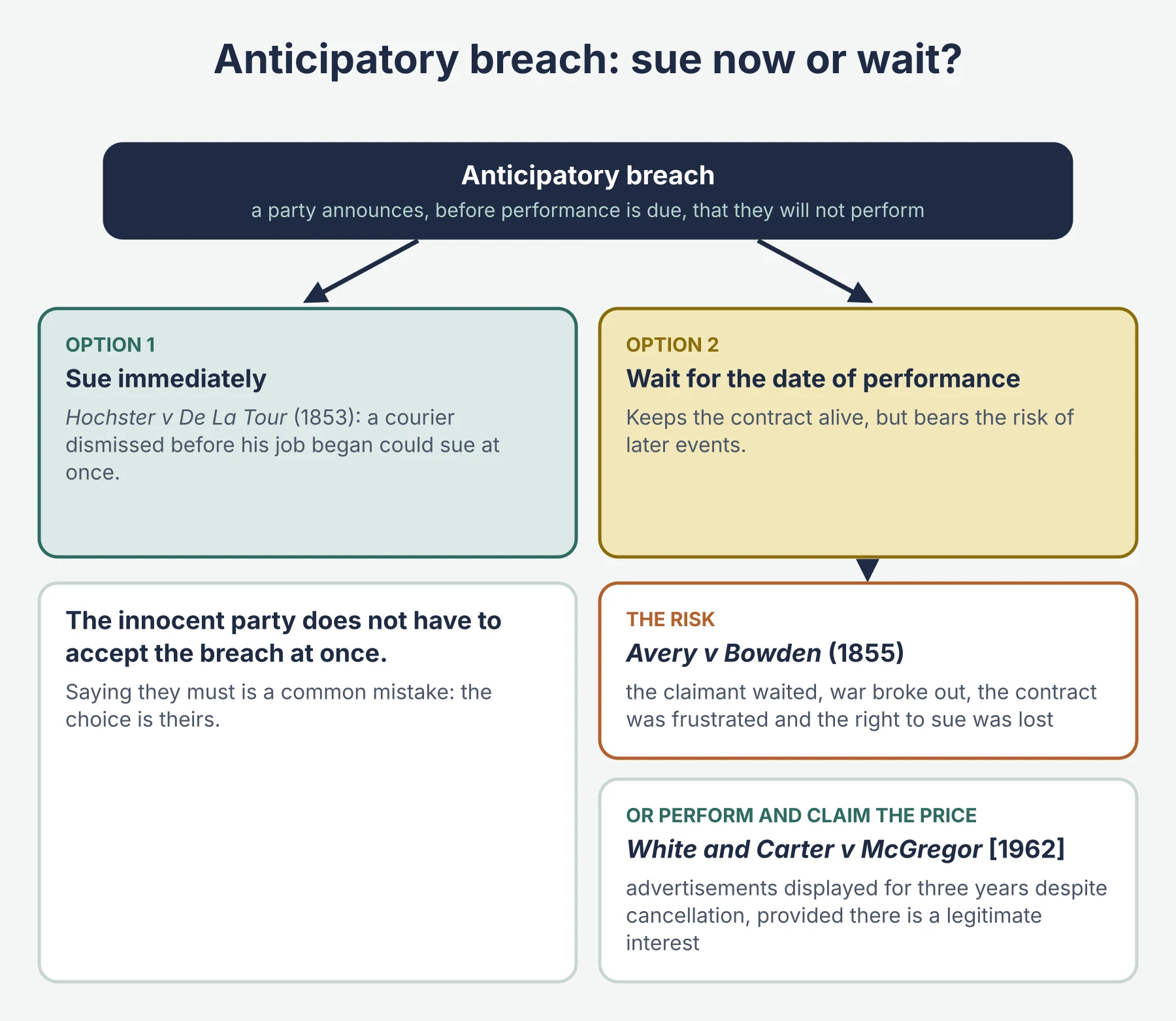
Anticipatory breach. A party announces before the time for performance that they will not perform.
- The innocent party may sue immediately: in Hochster v De La Tour (1853) a courier dismissed before his job began could sue at once.
- Or wait until the date for performance, keeping the contract alive, but then bears the risk of later events: in Avery v Bowden (1855) the claimant waited, war broke out, the contract was frustrated, and the right to sue was lost.
- A party who keeps the contract alive may in some cases perform and claim the price: White and Carter v McGregor [1962], where advertisements were displayed for three years despite cancellation, provided the innocent party has a legitimate interest in doing so.
Discharge by frustration
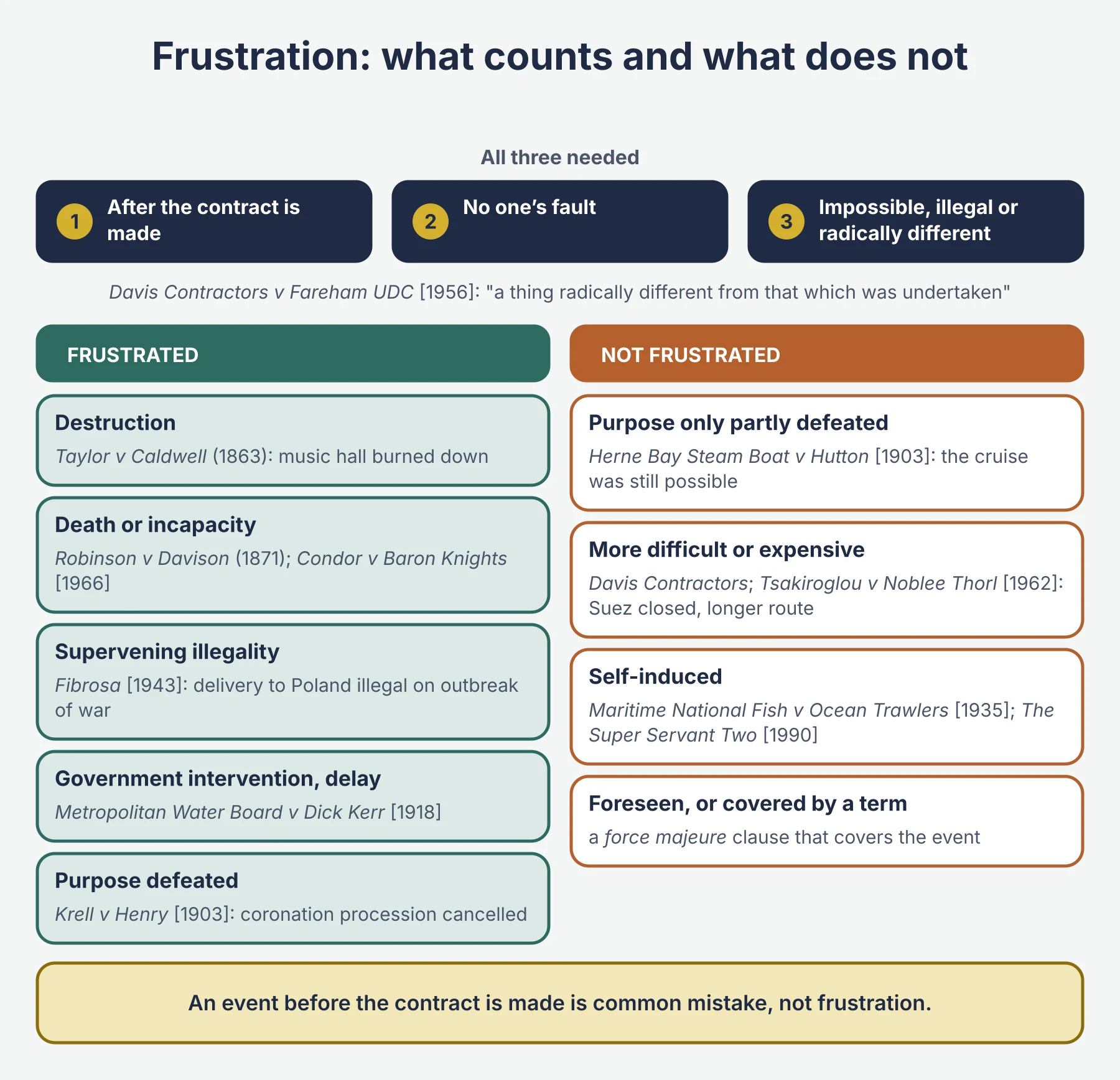
The doctrine. A contract is frustrated when, after it is made, an event occurs that is no one’s fault and makes performance impossible, illegal or radically different from what was agreed. In Davis Contractors v Fareham UDC [1956] Lord Radcliffe described it as a situation where performance would be “a thing radically different from that which was undertaken”.
Categories:
| Category | Case |
|---|---|
| Destruction of subject matter | Taylor v Caldwell (1863): music hall burned down before the concerts |
| Death or incapacity in a personal contract | Robinson v Davison (1871): a pianist too ill to perform; Condor v Baron Knights [1966]: a drummer whose illness meant he could not play the agreed seven nights a week |
| Supervening illegality | Fibrosa Spolka Akcyjna v Fairbairn Lawson [1943]: delivery to Poland became illegal on the outbreak of war |
| Government intervention or long delay | Metropolitan Water Board v Dick Kerr [1918]: building work stopped by wartime order |
| Purpose defeated | Krell v Henry [1903]: rooms hired to watch a coronation procession that was cancelled |
Limits: when a contract is not frustrated.
- Purpose only partly defeated: in Herne Bay Steam Boat v Hutton [1903] a boat hired to watch a naval review and cruise round the fleet could still be used for the cruise.
- More difficult or expensive: Davis Contractors (labour shortages); Tsakiroglou v Noblee Thorl [1962] (closure of the Suez Canal meant a longer route, not impossibility).
- Self-induced: in Maritime National Fish v Ocean Trawlers [1935] a company chose to use its fishing licences for other ships; in The Super Servant Two [1990] a carrier chose which contract to break when one of its vessels sank.
- Foreseen events that the contract should have provided for, or an express term (a force majeure clause) that covers the event.
The Law Reform (Frustrated Contracts) Act 1943
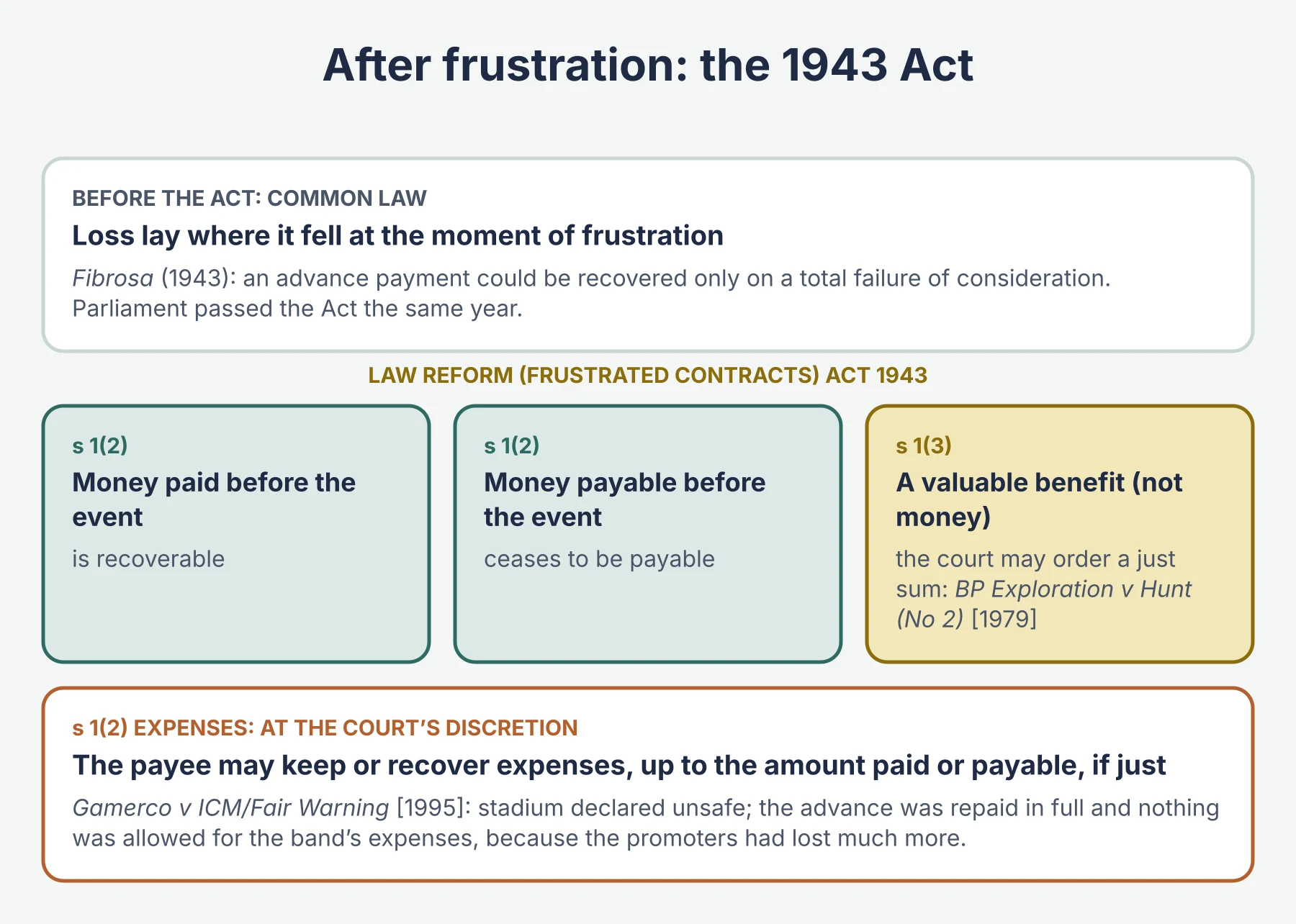
At common law, loss lay where it fell at the moment of frustration, which was unfair to a party who had paid in advance. Fibrosa (1943) allowed recovery of an advance payment only where there had been a total failure of consideration, and Parliament passed the Act the same year.
- s 1(2): money paid before the frustrating event is recoverable, and money payable before it ceases to be payable. The court may allow the payee to keep or recover expenses incurred in performing, up to the amount paid or payable, if it considers this just. In Gamerco v ICM/Fair Warning [1995] a concert was cancelled when the stadium was declared unsafe; the court ordered the advance to be repaid in full, allowing nothing for the band’s expenses, because the promoters had lost much more.
- s 1(3): where one party has obtained a valuable benefit (other than money) before the frustrating event, the court may order them to pay a just sum for it: BP Exploration v Hunt (No 2) [1979].
Worked example: a frustration scenario
Kemi books a band to play at her restaurant’s opening night and pays a £1,000 deposit, with £2,000 due on the night. A week before, the band’s lead singer is injured; the other members could play but Kemi booked them for her singing. The band has spent £300 on rehearsals.
Frustrated?  personal contract; incapacity of the key performer makes
             performance radically different (Robinson v Davison;
             Condor v Baron Knights). Not self-induced. Probably frustrated.
Effect       both discharged from future obligations.
1943 Act     s 1(2): the £1,000 deposit is recoverable; the £2,000 due
             on the night ceases to be payable.
Expenses     court may let the band keep up to £300 if just
             (compare Gamerco, where no deduction was allowed).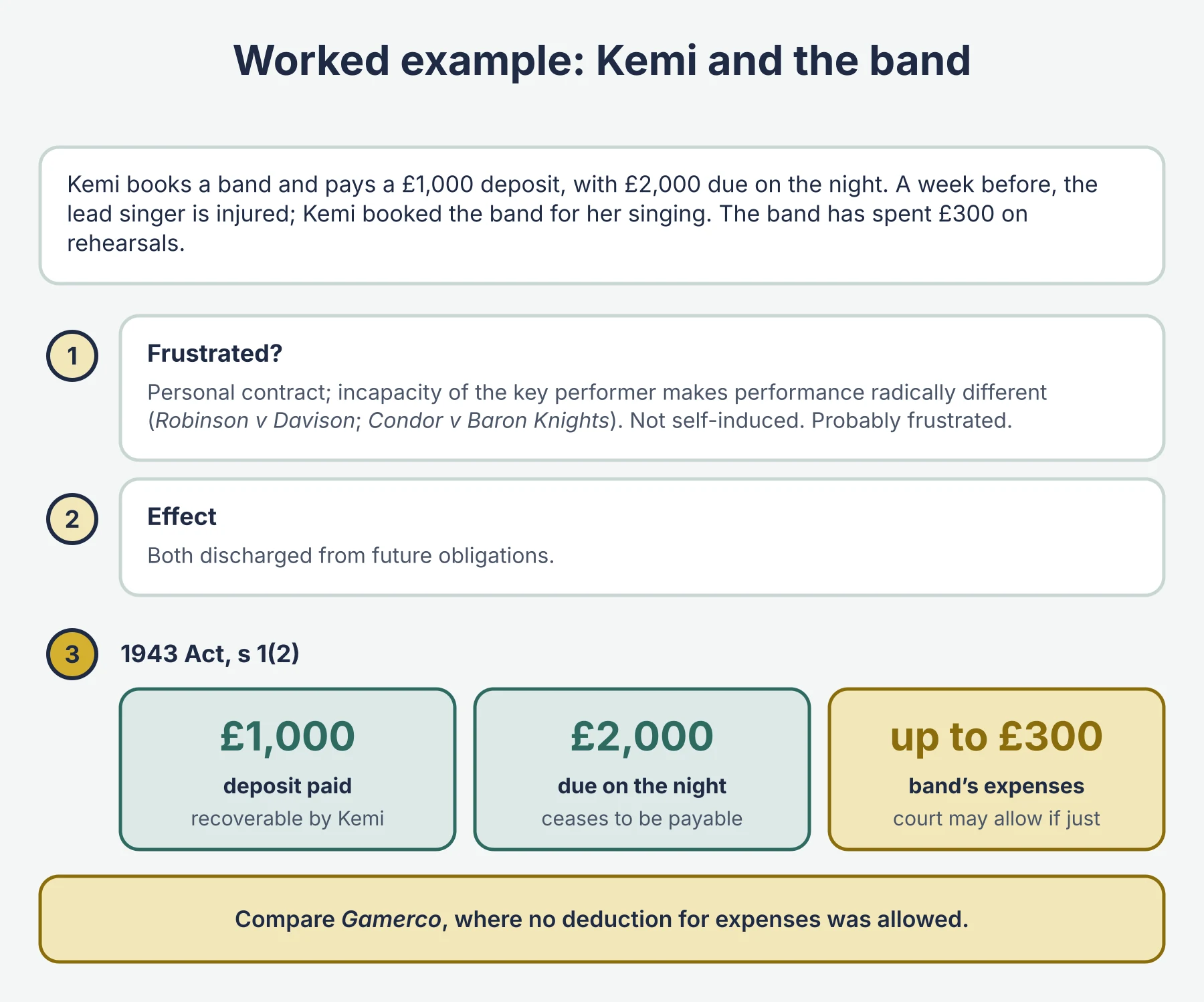
Common mistakes
- Saying a contract is frustrated because it became more expensive or difficult.
- Forgetting that frustration must happen after formation; an event before it is common mistake.
- Treating every breach as ending the contract; only repudiatory breach gives the option.
- Saying the innocent party must accept an anticipatory breach at once.
- Stating that the 1943 Act always lets the payee keep expenses; it is at the court’s discretion.
Exam technique
For each method of discharge, state the rule, the exception or limit, a case, and apply it to the facts. In an evaluate question on frustration, weigh certainty (the narrow doctrine in Davis and Tsakiroglou) against fairness (the 1943 Act’s flexible allocation of loss).
Condense with the discharge of contract revision notes and practise with the discharge of contract practice questions.
Related resources
-
Practice questions
Edexcel International A Level Law (YLA1): Discharge of Contract: Performance, Agreement, Breach and Frustration – Practice Questions
Original practice questions with full answers on discharge by performance, agreement, breach and frustration, and the 1943 Act (YLA1 content area 2.1.4).
Law · Pearson Edexcel · A Level
Try questions -
Revision notes
Edexcel International A Level Law (YLA1): Discharge of Contract: Performance, Agreement, Breach and Frustration – Revision Notes
Condensed notes on discharge by performance, agreement, breach and frustration, the 1943 Act, leading cases, traps and a self-test, for YLA1 content area 2.1.4.
Law · Pearson Edexcel · A Level
Revise topic -
Study guides
Edexcel International A Level Law (YLA1): General Defences: Duress and Intoxication
Duress of threats and of circumstances, and voluntary and involuntary intoxication, step by step with cases and a worked scenario, for YLA1 2.2.8 and 2.2.9.
Law · Pearson Edexcel · A Level
Read guide
Get free revision emails (optional)
Occasional emails with practice questions, worked explanations and links to free resources for the qualification and subjects you choose. No spam, and you can unsubscribe from any email. The free tools on this site never need an email.