
Study Guides
Edexcel International A Level Law (YLA1): General Defences: Duress and Intoxication
Duress of threats and of circumstances, and voluntary and involuntary intoxication, step by step with cases and a worked scenario, for YLA1 2.2.8 and 2.2.9.
- Subject
- Law
- Level
- A LEVELS
- Topic
- Paper 2 – The Law in Action
- Author
- Marlbridge Academic Team
- Updated
- Reviewed by
- Aizaz Raoof Ali (what this means)
Aligned to Pearson Edexcel A Level Law (YLA1), Issue 4, November 2021. Official specification .
Syllabus page (what it covers and how it is assessed): Pearson Edexcel A Level Law.
Syllabus points this page covers
YLA1
- 2.2 The criminal offender
Found an error? Report a correction.
Need help with this topic? Request a free trial class for A Level Law (YLA1).
This guide covers content areas 2.2.8 and 2.2.9 of Pearson Edexcel International Advanced Level Law, Issue 4, listed under “General defences”: “Duress of threats and duress of circumstances” and “Voluntary and involuntary intoxication”. The criminal offender study guide states the Graham test, the exclusion of murder and the Majewski rule in one paragraph each. This page builds each defence into a step-by-step test with the cases on every step, so that you can apply it to a scenario in Paper 2.
How general defences work
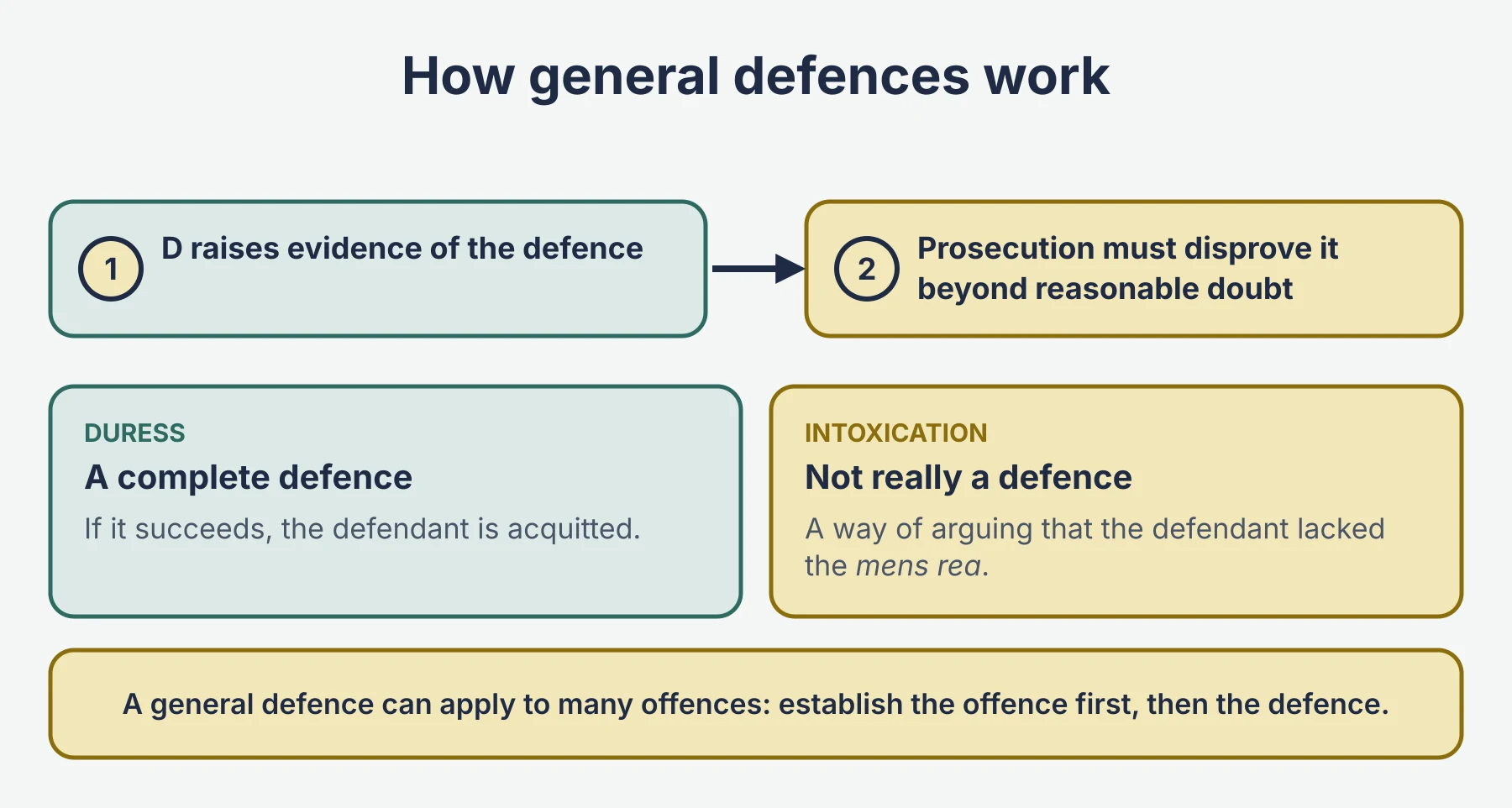
A general defence can apply to many offences. The defendant must raise evidence of it; the prosecution must then disprove it beyond reasonable doubt. Duress is a complete defence: if it succeeds, the defendant is acquitted. Intoxication is not really a defence at all: it is a way of arguing that the defendant lacked the mens rea.
Duress of threats
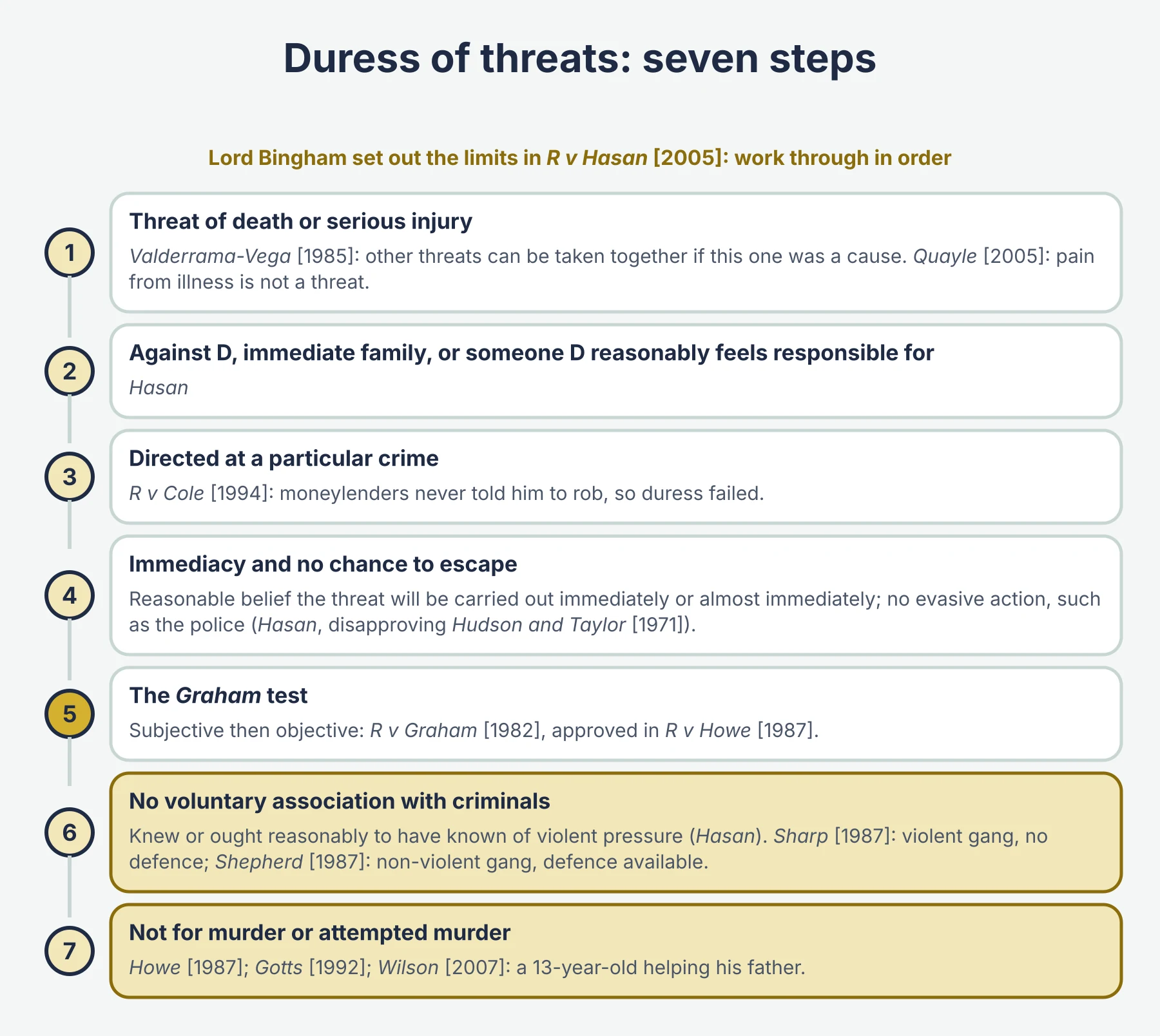
Duress applies where the defendant commits a crime because someone threatens them with death or serious injury unless they do so. Lord Bingham set out the limits in R v Hasan [2005]. Work through these steps in order:
1. A threat of death or serious injury.
- Threats to expose secrets or damage property are not enough. In R v Valderrama-Vega [1985] threats to reveal the defendant’s sexuality and financial pressure were present, but only the threat of death or serious injury counted; the jury may take the threats together provided that threat was one of the causes.
- R v Quayle [2005]: pain from illness is not a threat of death or serious injury, so taking cannabis to relieve it could not be excused.
2. Against the defendant, their immediate family, or someone for whom they reasonably feel responsible (Hasan).
3. The threat must be directed at the commission of a particular crime. In R v Cole [1994] moneylenders threatened the defendant, who robbed two building societies to repay them. They had not told him to commit robbery, so duress failed.
4. Immediacy and no chance to escape. The defendant must reasonably believe that the threat will be carried out immediately or almost immediately, and there must be no evasive action they could reasonably take, such as going to the police (Hasan). Hasan disapproved the more generous approach in R v Hudson and Taylor [1971], where two young witnesses lied in court after threats, even though the threatener was in the public gallery and could have been reported.
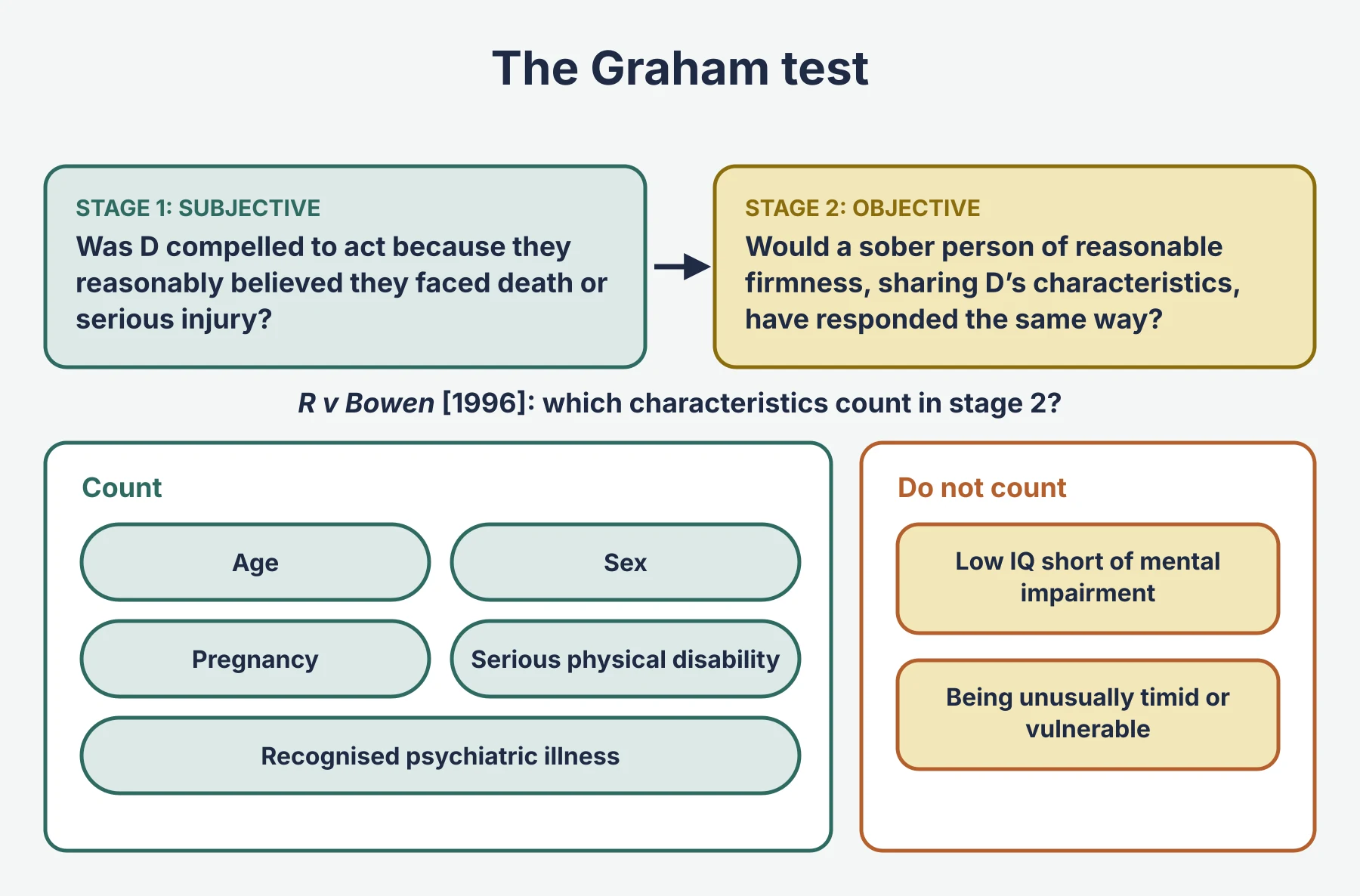
5. The Graham test (R v Graham [1982], approved in R v Howe [1987]):
- Subjective: was the defendant compelled to act as they did because they reasonably believed they faced death or serious injury?
- Objective: would a sober person of reasonable firmness, sharing the defendant’s characteristics, have responded in the same way?
Which characteristics count? In R v Bowen [1996] the Court of Appeal said relevant characteristics include age, sex, pregnancy, serious physical disability and recognised psychiatric illness, but not a low IQ that falls short of mental impairment, nor being unusually timid or vulnerable.
6. Not available after voluntarily associating with criminals. If the defendant voluntarily joined a criminal gang or associated with people they knew or ought reasonably to have known might pressure them with violence, duress is unavailable (Hasan). Earlier cases show the development: in R v Sharp [1987] a member of a violent robbery gang could not use duress; in R v Shepherd [1987] a member of a non-violent shoplifting gang could, because he could not have foreseen violence.
7. Not available for murder or attempted murder. R v Howe [1987] (murder, whether as principal or accessory); R v Gotts [1992] (attempted murder); and in R v Wilson [2007] a 13-year-old who helped his father kill his mother under threats could not rely on duress either.
Duress of circumstances
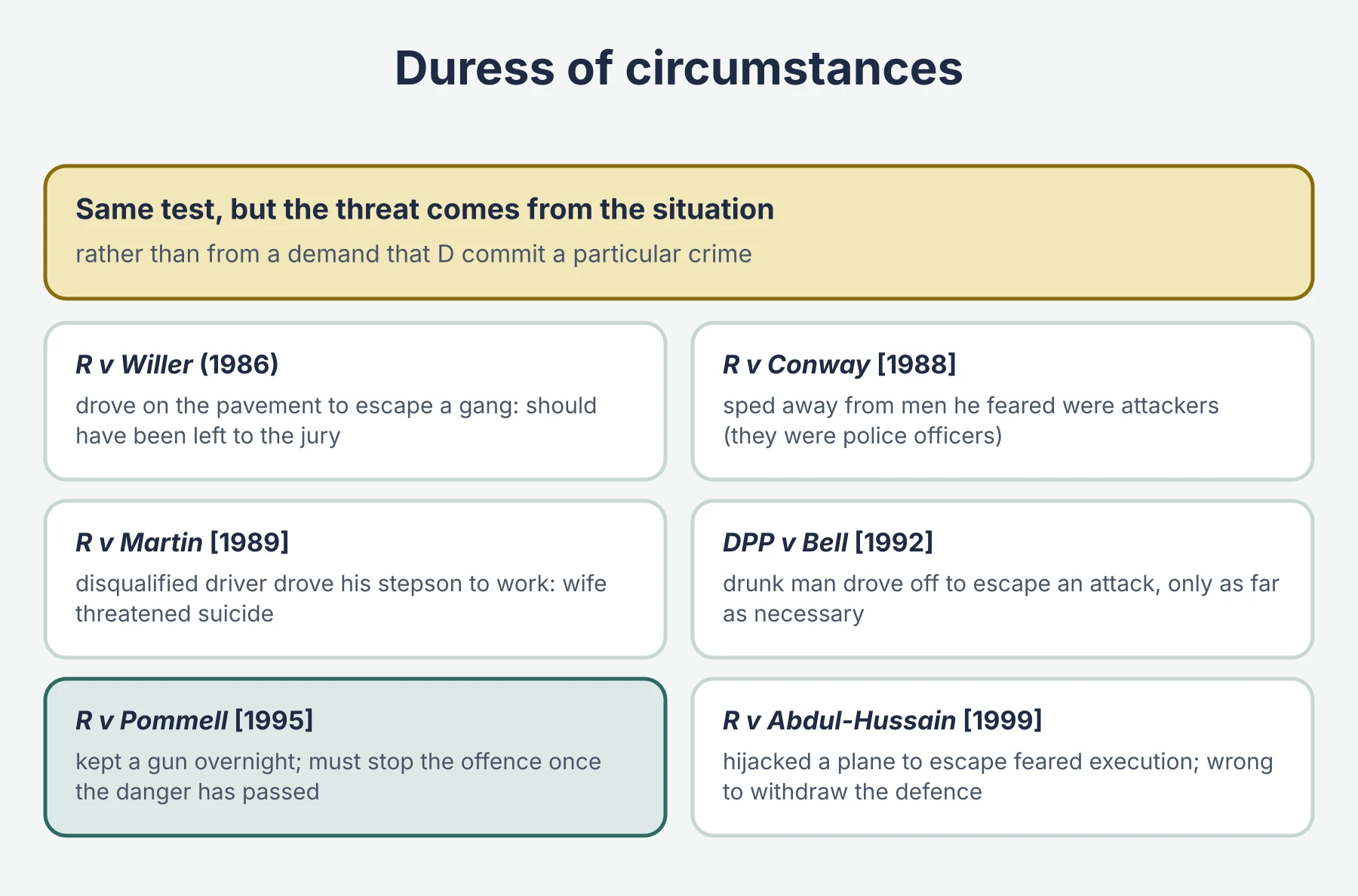
The same test applies where the threat comes from the situation rather than from a person’s demand that the defendant commit a particular crime.
- R v Willer (1986): a driver mounted the pavement to escape a gang threatening him; the defence should have been left to the jury.
- R v Conway [1988]: a driver sped away from two men in plain clothes he feared were attackers (they were police officers).
- R v Martin [1989]: a disqualified driver drove his stepson to work because his wife threatened suicide if he did not.
- DPP v Bell [1992]: a drunk man drove off to escape an attack; the defence was available because he drove only as far as necessary.
- R v Pommell [1995]: a man took a gun from someone intending to shoot another and kept it overnight; the court held the defence could be left to the jury, but the defendant must stop committing the offence as soon as the danger has passed.
- R v Abdul-Hussain [1999]: Iraqi men who hijacked a plane to escape feared execution; the trial judge was wrong to withdraw the defence.
Intoxication
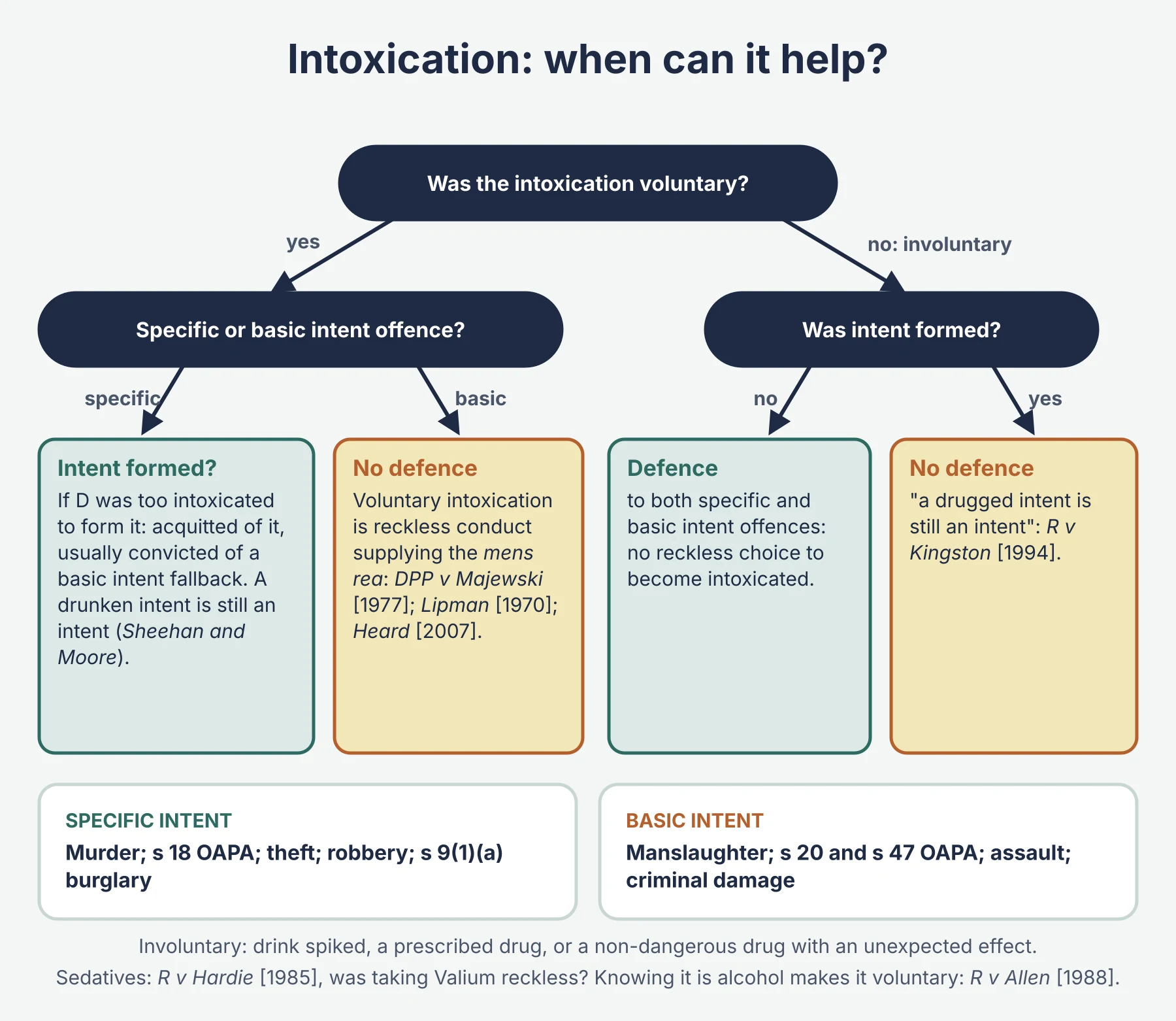
The key distinction: specific and basic intent
| Specific intent offences | Basic intent offences | |
|---|---|---|
| Examples | Murder; s 18 OAPA 1861; theft; robbery; s 9(1)(a) burglary with intent to steal | Manslaughter; s 20 and s 47 OAPA 1861; assault; criminal damage |
| Voluntary intoxication | Can be a defence if D was so intoxicated that they did not form the intent | No defence (DPP v Majewski [1977]) |
Specific intent. In R v Sheehan and Moore [1975] two drunk men poured petrol on a homeless man and set him alight. The question was whether, drunk or not, they had formed the intent. A drunken intent is still an intent. If D was too intoxicated to form it, they are acquitted of the specific intent offence but usually convicted of a basic intent fallback, such as manslaughter instead of murder.
Basic intent. In DPP v Majewski [1977] the House of Lords held that becoming voluntarily intoxicated is itself a reckless course of conduct, which supplies the mens rea for basic intent offences. In R v Lipman [1970] the defendant killed his girlfriend while hallucinating on LSD; he was guilty of manslaughter. In R v Heard [2007] the Court of Appeal treated sexual assault as a basic intent offence for this purpose.
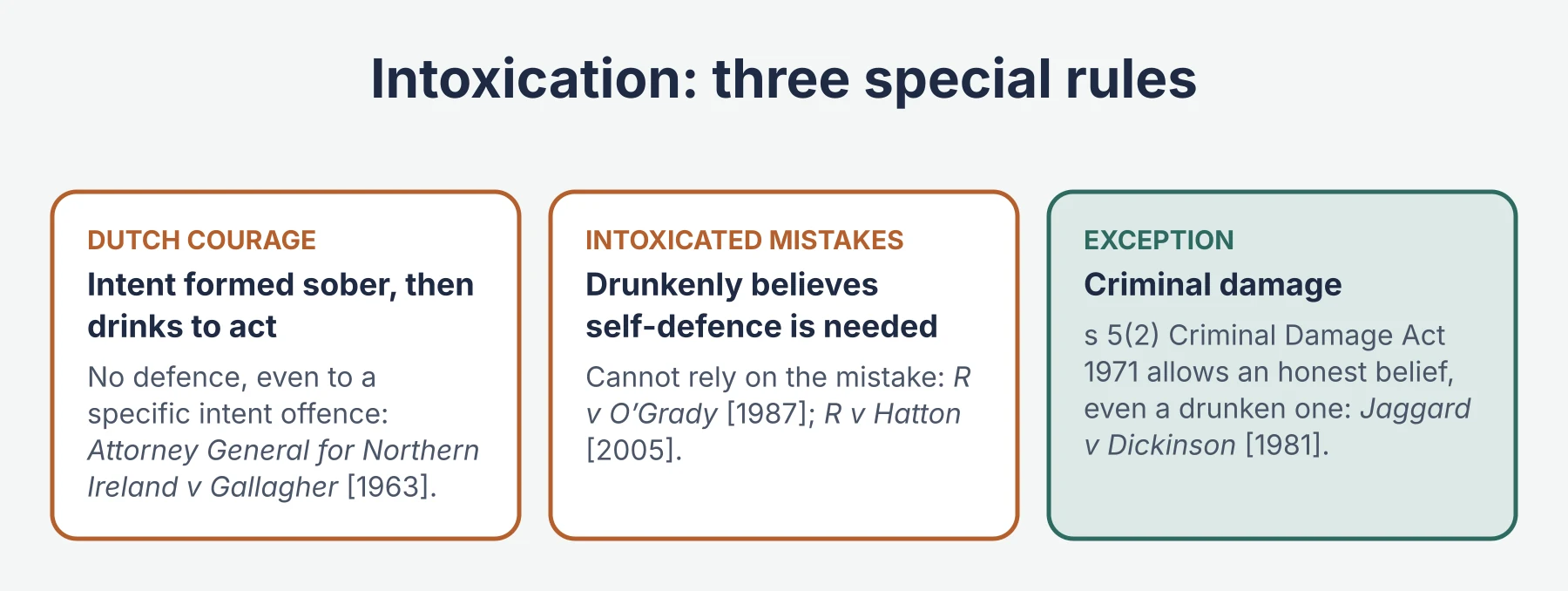
Dutch courage. If D forms the intent while sober and drinks to gain the courage to act, intoxication is no defence even to a specific intent offence (Attorney General for Northern Ireland v Gallagher [1963]).
Involuntary intoxication
Intoxication is involuntary where D’s drink is spiked, or where D takes a drug in accordance with a prescription or a non-dangerous drug that has an unexpected effect.
- No intent formed: D has a defence to both specific and basic intent offences, because there was no reckless choice to become intoxicated.
- Intent formed: no defence. In R v Kingston [1994] the defendant’s coffee was drugged and he sexually assaulted a boy; he had formed the intent, and “a drugged intent is still an intent”.
- Sedatives: in R v Hardie [1985] the defendant took Valium, generally a calming drug, and set fire to a wardrobe; the jury should have considered whether taking it was reckless.
- Knowing it is alcohol is enough to make it voluntary: in R v Allen [1988] a man who did not realise how strong the wine was had still chosen to drink alcohol, so his intoxication was voluntary.
Intoxicated mistakes
A defendant who, because of voluntary intoxication, mistakenly believes they need to defend themselves cannot rely on that mistake (R v O’Grady [1987]; R v Hatton [2005]). The exception is criminal damage, where s 5(2) of the Criminal Damage Act 1971 allows an honest belief, even a drunken one (Jaggard v Dickinson [1981]).
Worked example
Ravi owes money to a gang. They tell him to set fire to a rival’s shop that night or they will break his legs; they wait outside his flat. Before going, he drinks heavily “for courage”. At the shop he punches a passer-by he wrongly thinks is about to attack him.
Arson (criminal damage by fire)
  Duress   threat of serious injury; nominated crime (Cole satisfied);
           immediacy and no escape? The gang is outside: arguable.
  BUT      he owed money to a gang; if he knew or ought to have known
           they might use violence, voluntary association (Hasan) removes
           the defence.
  Drink    Dutch courage: no defence (Gallagher); in any case criminal
           damage is basic intent (Majewski).
Assault on the passer-by
  Mistake  drunken belief in the need for self-defence: not available
           (O'Grady; Hatton).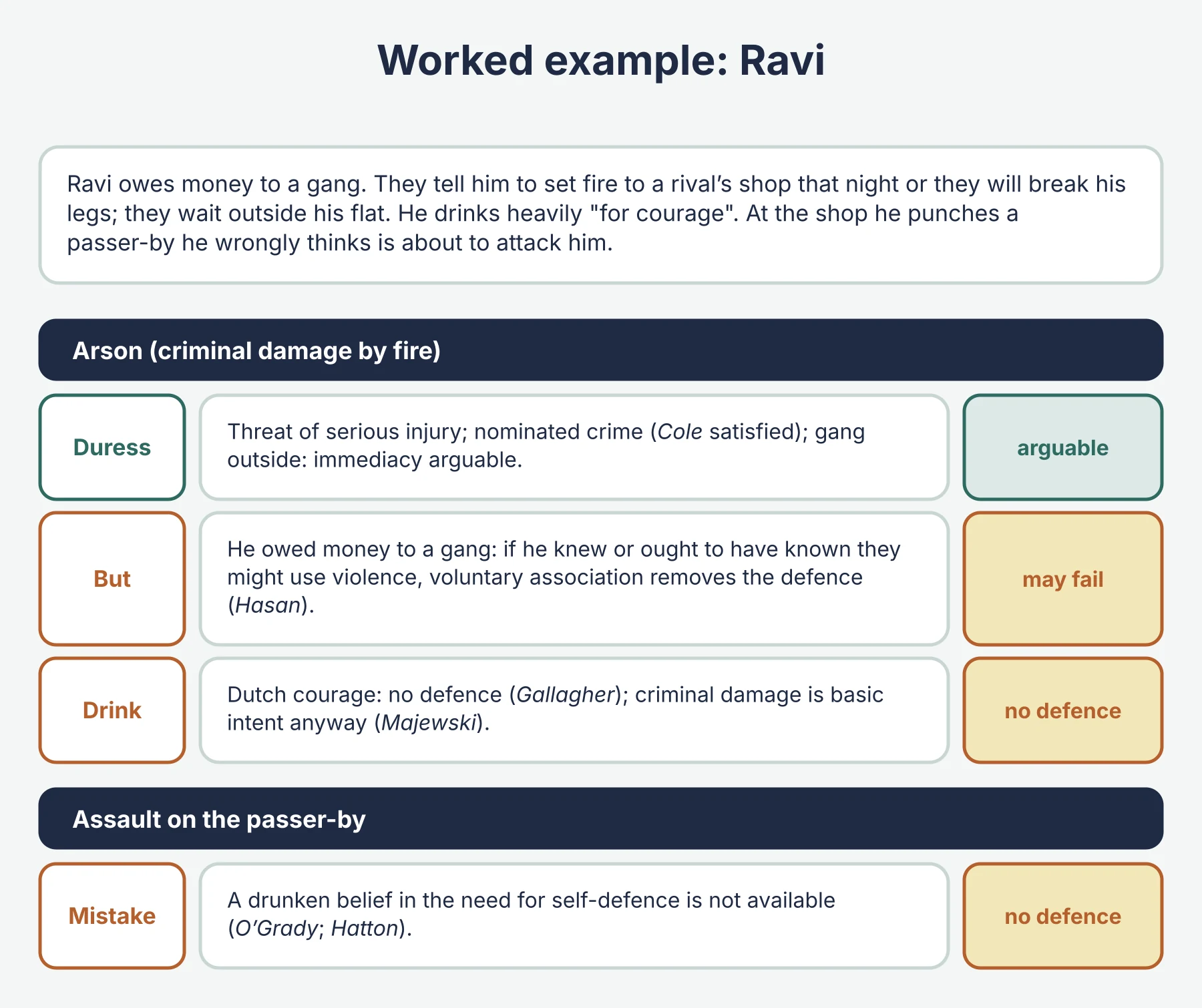
Common mistakes
- Allowing duress for murder or attempted murder.
- Skipping the immediacy and escape step, or applying the old Hudson and Taylor approach after Hasan.
- Using a characteristic Bowen excluded, such as low IQ, in the objective test.
- Treating intoxication as a defence to a basic intent offence.
- Saying involuntary intoxication is always a defence: not if intent was formed (Kingston).
Exam technique
In a scenario, take one defence at a time after establishing the offence: state each element, apply the facts, cite the case and conclude. For evaluate questions, discuss whether excluding murder from duress (Howe) and the Majewski rule are justified, weighing protection of the public against fairness to individual defendants.
Condense with the duress and intoxication revision notes and practise with the duress and intoxication practice questions.
Related resources
-
Practice questions
Edexcel International A Level Law (YLA1): General Defences: Duress and Intoxication – Practice Questions
Original practice questions with full answers on duress of threats, duress of circumstances, and voluntary and involuntary intoxication (YLA1 2.2.8 and 2.2.9).
Law · Pearson Edexcel · A Level
Try questions -
Revision notes
Edexcel International A Level Law (YLA1): General Defences: Duress and Intoxication – Revision Notes
Condensed notes on duress of threats and circumstances and on voluntary and involuntary intoxication, with step-by-step tests, cases and a self-test (YLA1).
Law · Pearson Edexcel · A Level
Revise topic -
Study guides
Edexcel International A Level Law (YLA1): Misrepresentation and Mistake
Misrepresentation under the Misrepresentation Act 1967 with contributory negligence, and common, mutual and unilateral mistake, with cases (YLA1 2.1.4).
Law · Pearson Edexcel · A Level
Read guide
Get free revision emails (optional)
Occasional emails with practice questions, worked explanations and links to free resources for the qualification and subjects you choose. No spam, and you can unsubscribe from any email. The free tools on this site never need an email.