
Study Guides
Edexcel International A Level Law (YLA1): Misrepresentation and Mistake
Misrepresentation under the Misrepresentation Act 1967 with contributory negligence, and common, mutual and unilateral mistake, with cases (YLA1 2.1.4).
- Subject
- Law
- Level
- A LEVELS
- Topic
- Paper 2 – The Law in Action
- Author
- Marlbridge Academic Team
- Updated
- Reviewed by
- Aizaz Raoof Ali (what this means)
Aligned to Pearson Edexcel A Level Law (YLA1), Issue 4, November 2021. Official specification .
Syllabus page (what it covers and how it is assessed): Pearson Edexcel A Level Law.
Syllabus points this page covers
YLA1
- 2.1 The market
Found an error? Report a correction.
Need help with this topic? Request a free trial class for A Level Law (YLA1).
This guide covers the first two bullets of content area 2.1.4 of Pearson Edexcel International Advanced Level Law, Issue 4, “Validity of contracts”: “misrepresentation, including the Misrepresentation Act 1967 and the Law Reform (Contributory Negligence) Act 1945” and “mistake”. The market study guide gives a short paragraph on each, naming the three types of misrepresentation and one case on mistake. This page builds the full test for misrepresentation element by element, sets out the remedies and the bars to rescission, and divides mistake into its three kinds. Discharge of contract, the third bullet of 2.1.4, has its own page.
What makes a contract invalid?
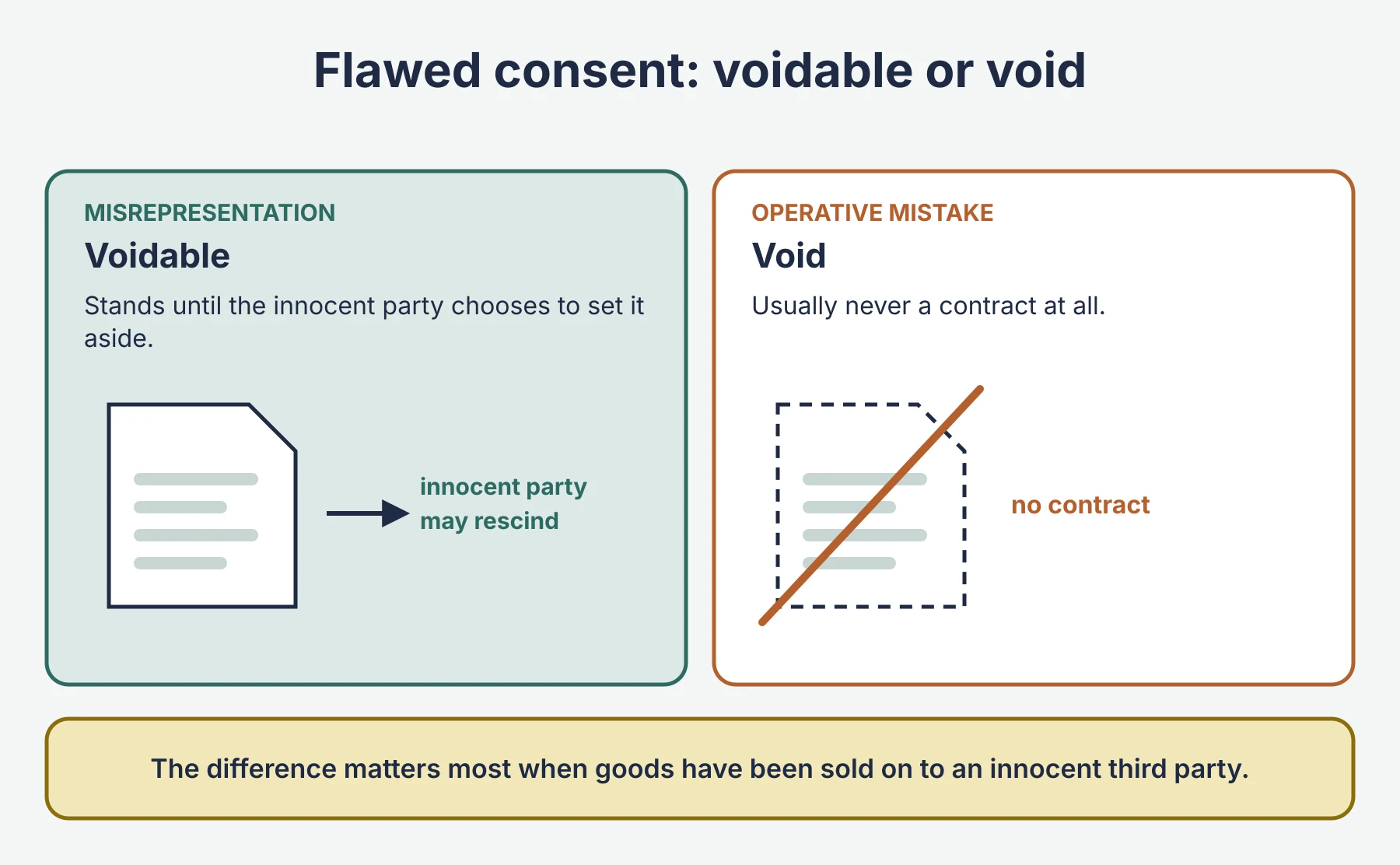
A contract that has been properly formed can still be challenged because one party’s consent was flawed. Misrepresentation makes a contract voidable: it stands until the innocent party chooses to set it aside. An operative mistake usually makes it void: it was never a contract at all. The difference matters most when goods have been sold on to an innocent third party.
Misrepresentation: the elements
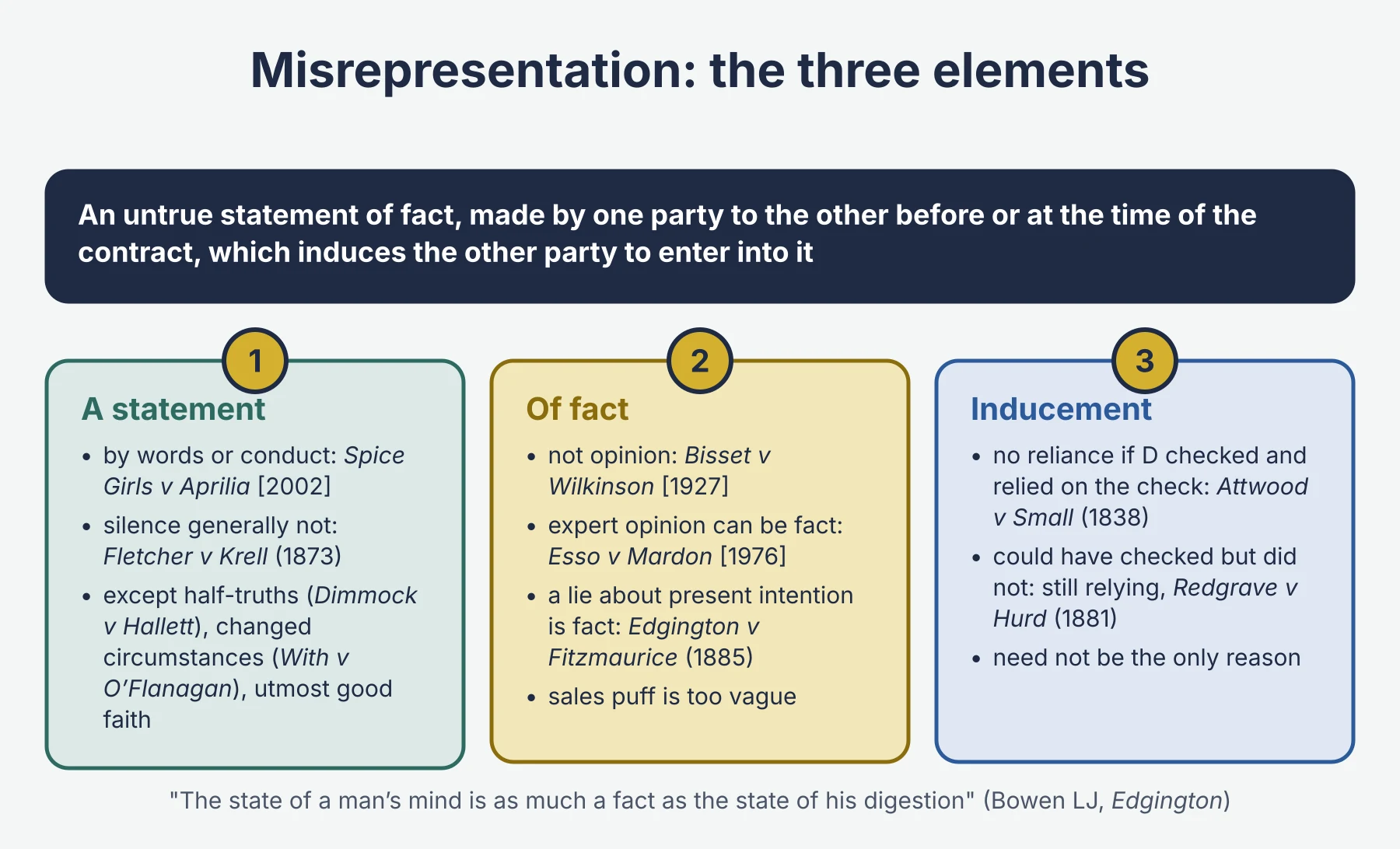
A misrepresentation is an untrue statement of fact, made by one party to the other before or at the time of the contract, which induces the other party to enter into it.
1. A statement
The statement may be by words or by conduct. In Spice Girls Ltd v Aprilia World Service [2002] the group took part in filming an advertisement while knowing one member intended to leave; this conduct represented that none of them knew of any such plan.
Silence is generally not a misrepresentation (Fletcher v Krell (1873)), but there are exceptions:
- Half-truths: in Dimmock v Hallett (1866) the seller said farms were let but not that the tenants had given notice to leave.
- Change of circumstances: in With v O’Flanagan [1936] a doctor’s practice was accurately described, but its income collapsed before the sale and the seller did not say so.
- Contracts of utmost good faith, such as insurance, where full disclosure is required.
2. Of fact, not opinion, intention or puff
- Opinion: in Bisset v Wilkinson [1927] a seller with no experience of sheep farming estimated the land could carry 2,000 sheep; this was an honest opinion, not fact.
- Expert opinion can be fact: in Esso Petroleum v Mardon [1976] Esso’s experienced staff gave a forecast of a petrol station’s sales, and Esso was liable because they had the expertise to make it.
- Statements of intention: generally not facts, but a lie about present intention is: in Edgington v Fitzmaurice (1885) directors said a loan would be used to improve the business when they meant to pay debts; Bowen LJ said “the state of a man’s mind is as much a fact as the state of his digestion”.
- Sales puff, such as “the best in town”, is too vague to be a statement of fact.
3. Inducement
The statement must have been relied on.
- No reliance if the claimant checked for themselves and relied on that check: Attwood v Small (1838), where buyers of a mine relied on their own surveyors.
- But a claimant who could have checked and did not is still relying: Redgrave v Hurd (1881).
- The statement need not be the only reason, provided it was a real inducement (Edgington v Fitzmaurice).
The three types and their remedies
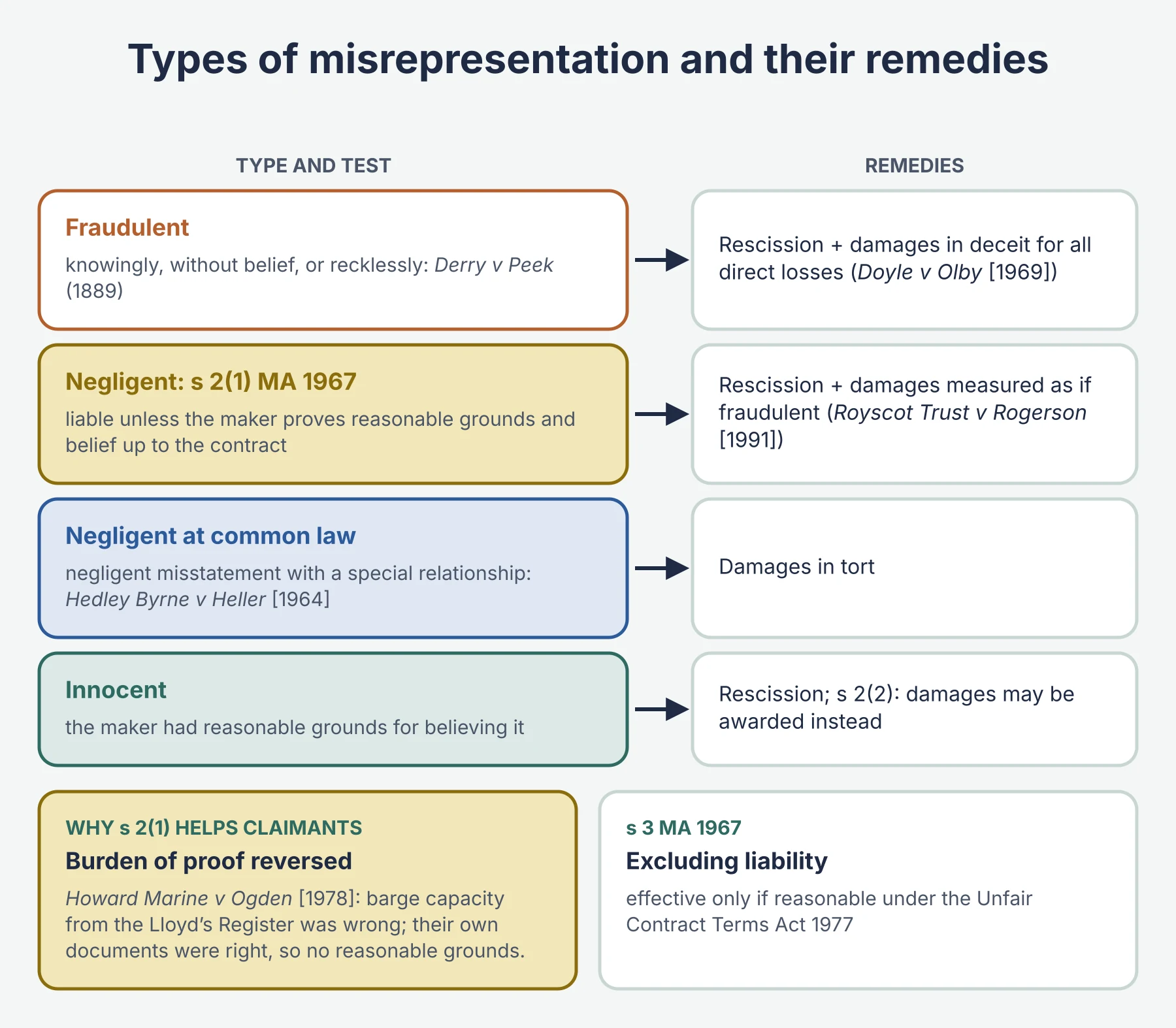
| Type | Test | Remedies |
|---|---|---|
| Fraudulent | Made knowingly, without belief in its truth, or recklessly, careless whether true or false (Derry v Peek (1889)) | Rescission and damages in the tort of deceit for all direct losses (Doyle v Olby [1969]) |
| Negligent: Misrepresentation Act 1967, s 2(1) | The maker is liable unless they prove they had reasonable grounds to believe, and did believe, the statement was true up to the time of the contract | Rescission and damages; measured as if fraudulent (Royscot Trust v Rogerson [1991]) |
| Negligent at common law | A negligent misstatement where there is a special relationship (Hedley Byrne v Heller [1964]) | Damages in tort |
| Innocent | The maker had reasonable grounds for believing it | Rescission; under s 2(2) the court may award damages instead of rescission |
Why s 2(1) is so useful to claimants: the burden of proof is reversed. In Howard Marine v Ogden [1978] the owners of barges stated their capacity from the Lloyd’s Register, which was wrong; their own documents gave the correct figure, so they could not prove reasonable grounds and were liable.
Exclusion clauses: under s 3 of the 1967 Act, a term excluding liability for misrepresentation is effective only if it satisfies the reasonableness test in the Unfair Contract Terms Act 1977.
The Law Reform (Contributory Negligence) Act 1945
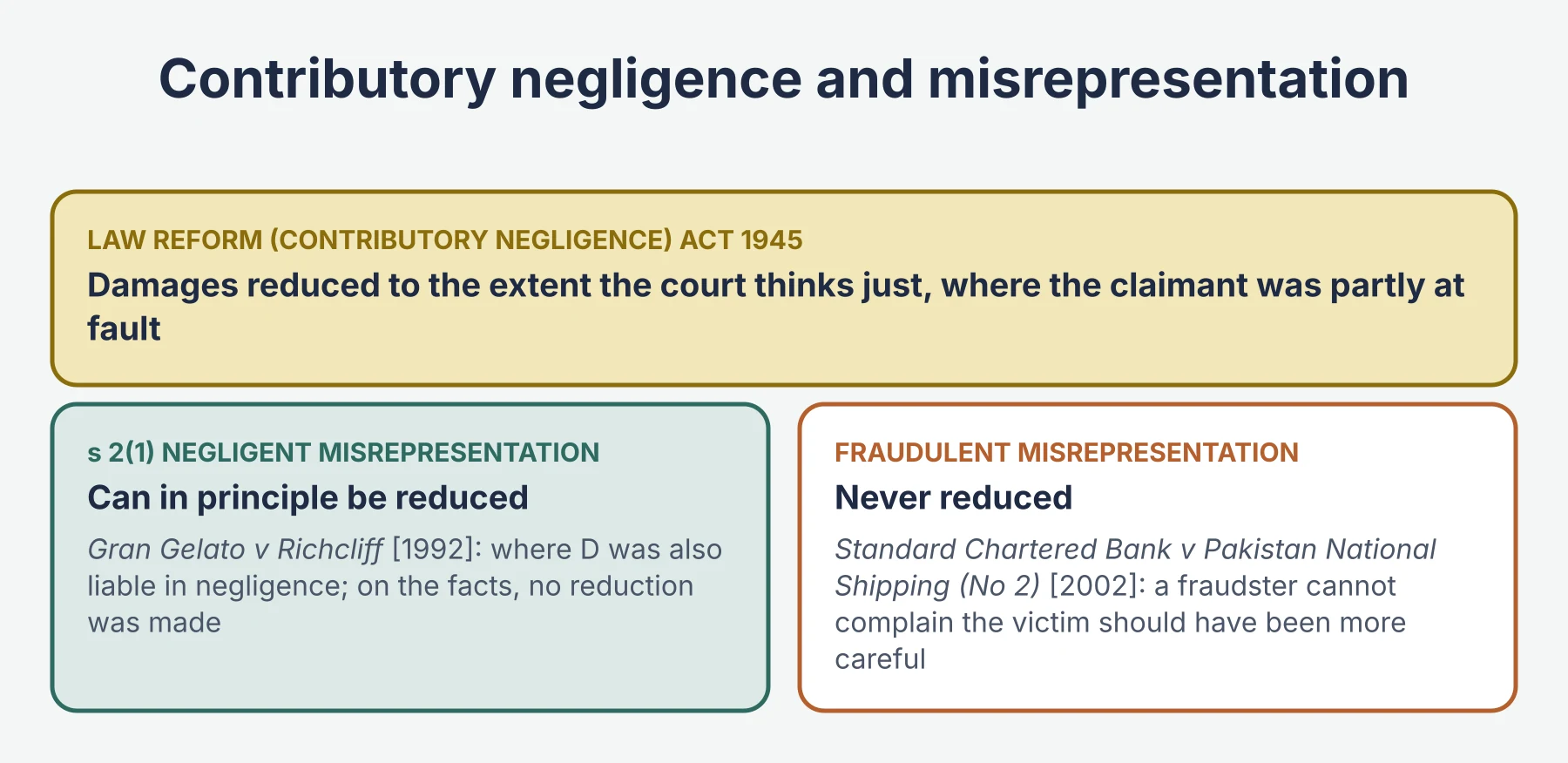
Under the 1945 Act, where a claimant suffers damage partly through their own fault, damages can be reduced to the extent the court thinks just. In Gran Gelato v Richcliff [1992] the court accepted that damages under s 2(1) could in principle be reduced for the claimant’s own carelessness where the defendant was also liable in negligence, although on the facts no reduction was made. Contributory negligence is not a defence to fraudulent misrepresentation (Standard Chartered Bank v Pakistan National Shipping Corporation (No 2) [2002]): a fraudster cannot complain that the victim should have been more careful.
Rescission and its bars
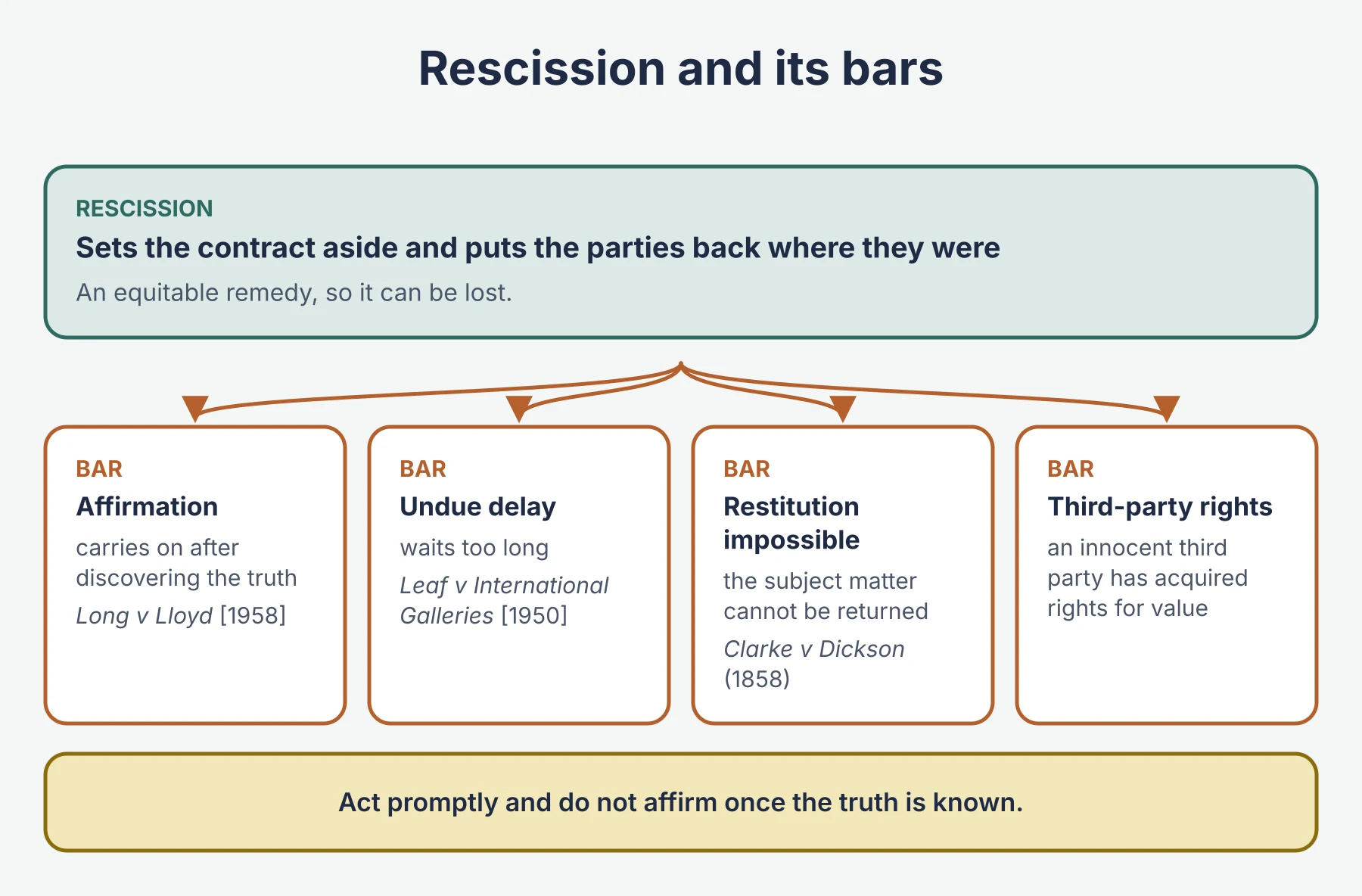
Rescission sets the contract aside and puts the parties back where they were. It is an equitable remedy and is lost if:
- the claimant affirms the contract after discovering the truth (Long v Lloyd [1958]);
- there is undue delay (Leaf v International Galleries [1950]);
- restitution is impossible, because the subject matter cannot be returned (Clarke v Dickson (1858));
- an innocent third party has acquired rights in the goods for value.
Mistake
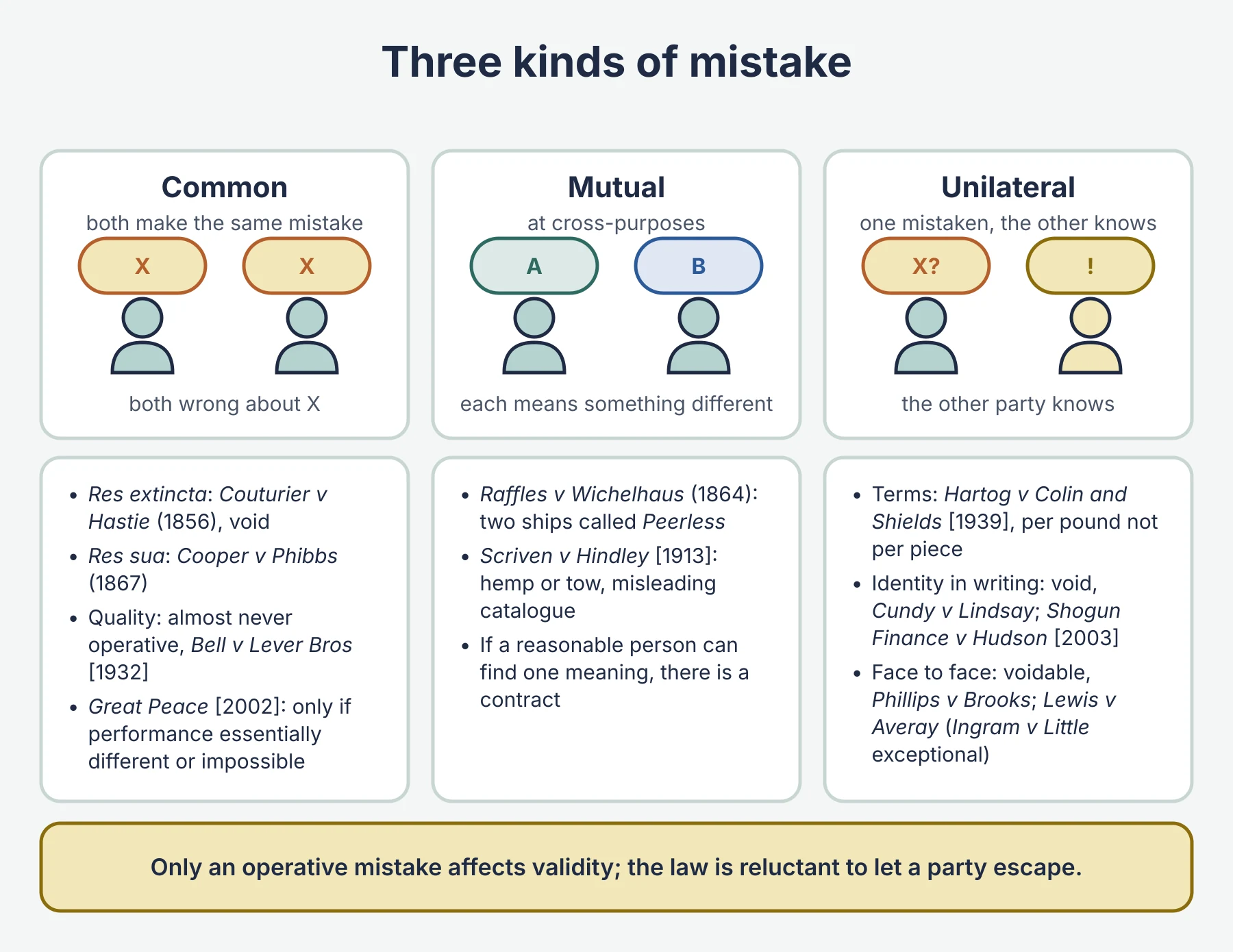
The law is reluctant to let a party escape a contract because they were mistaken. Only an operative mistake affects validity.
Common mistake: both parties make the same mistake
- Subject matter does not exist (res extincta): Couturier v Hastie (1856), a cargo of corn that had already been sold before the contract; the contract was void.
- Buyer already owns it (res sua): Cooper v Phibbs (1867).
- Quality: almost never operative. In Bell v Lever Bros [1932] a company paid compensation to directors it could have dismissed for nothing; the contract was valid. In Great Peace Shipping v Tsavliris Salvage [2002] the Court of Appeal held that a common mistake makes a contract void only if it makes performance essentially different or impossible, and that there is no separate equitable power to rescind for common mistake.
Mutual mistake: the parties are at cross-purposes
- Raffles v Wichelhaus (1864): cotton was to arrive on the ship Peerless; there were two ships of that name sailing at different times, and each party meant a different one. No contract.
- Scriven v Hindley [1913]: at an auction, a bidder thought he was bidding for hemp when the lot was tow; the auction catalogue was misleading, so the contract was void.
- The court asks how a reasonable person would understand the agreement; if it can identify one meaning, there is a contract.
Unilateral mistake: one party is mistaken and the other knows
- As to terms: in Hartog v Colin and Shields [1939] hare skins were offered at a price per pound rather than per piece; the buyer must have known it was a mistake, so the contract was void.
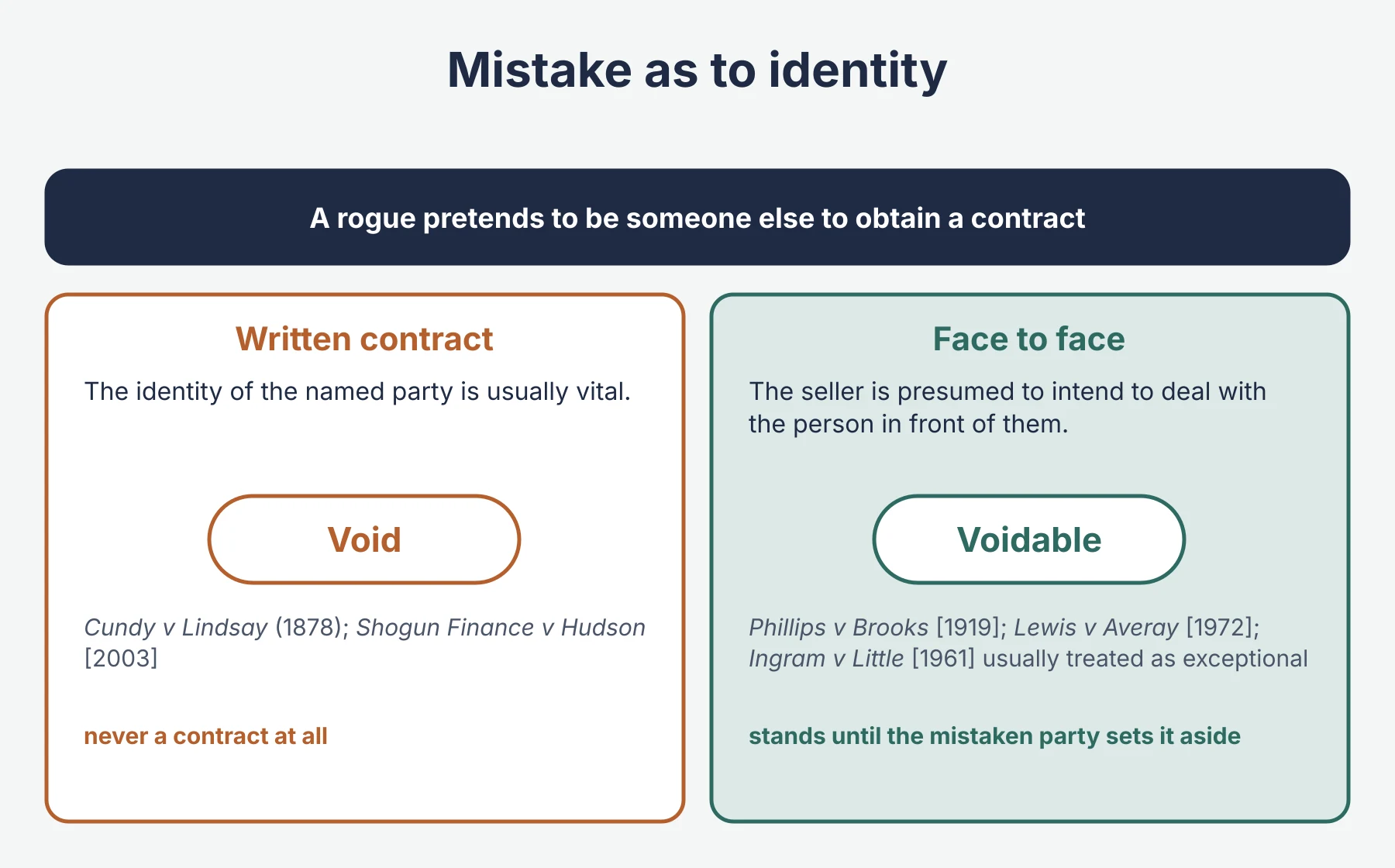
- As to identity:
- Written contracts: the identity of the named party is usually vital, so the contract is void. In Cundy v Lindsay (1878) a rogue signed letters to look like those of a respectable firm; in Shogun Finance v Hudson [2003] the House of Lords held a written hire-purchase agreement in a stolen identity void.
- Face to face: the seller is presumed to intend to deal with the person in front of them, so the contract is only voidable: Phillips v Brooks [1919]; Lewis v Averay [1972]. Ingram v Little [1961], where such a contract was held void, is usually treated as exceptional.
Worked example
Sana buys a café from Bilal. Bilal says, “It makes £800 a week.” That was true a year ago, but takings fell to £400 after a new road closed the street; Bilal knew. Sana did not check the accounts she was offered. Advise Sana.
Statement   "makes £800 a week": a statement of fact about current takings
Silence?    stated fact became untrue and was not corrected
            (With v O'Flanagan)
Inducement  she relied on it; failure to check does not matter
            (Redgrave v Hurd)
Type        Bilal knew the truth: fraudulent (Derry v Peek); or at least
            s 2(1), where he cannot prove reasonable belief
Remedy      rescission plus damages for all direct losses; if fraud,
            no reduction for her failure to check (Standard Chartered)
Bars        act promptly and do not affirm (Long v Lloyd)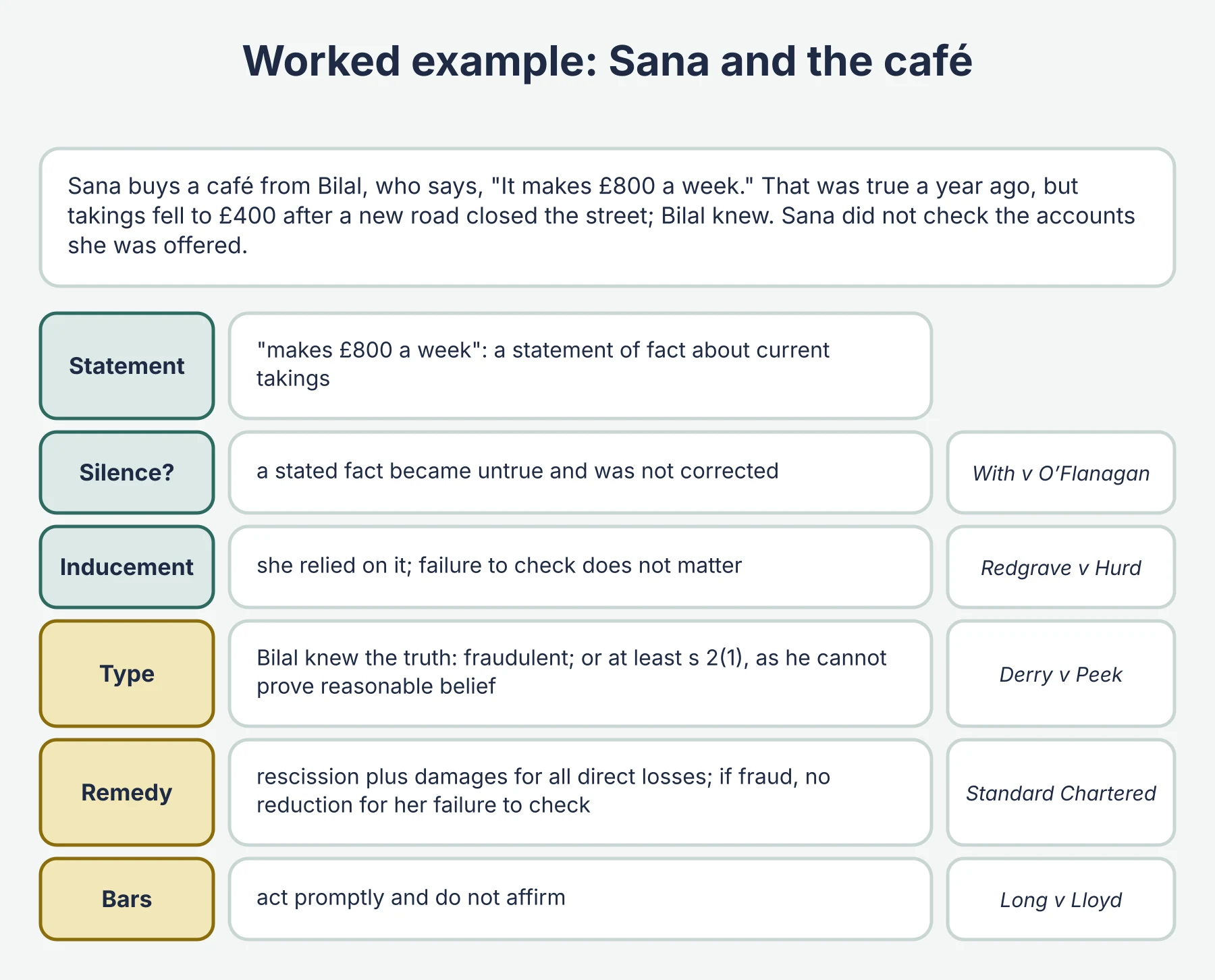
Common mistakes
- Treating an opinion as a statement of fact without asking about the maker’s expertise.
- Saying silence is always a misrepresentation, or never one.
- Forgetting the reversed burden of proof in s 2(1).
- Applying contributory negligence to fraud.
- Calling every mistake operative: most mistakes as to quality leave the contract valid.
- Mixing up face-to-face (voidable) and written (void) identity cases.
Exam technique
Paper 2 is built on scenarios. Use IRAC for each issue: identify the statement, test each element with a case, decide the type, then give the remedy and any bar. For evaluate questions, weigh how fairly the law balances the party who made the statement against the party who relied on it.
Condense with the misrepresentation and mistake revision notes and practise with the misrepresentation and mistake practice questions.
Related resources
-
Practice questions
Edexcel International A Level Law (YLA1): Misrepresentation and Mistake – Practice Questions
Original practice questions with full answers on misrepresentation, the Misrepresentation Act 1967, contributory negligence and mistake (YLA1 2.1.4).
Law · Pearson Edexcel · A Level
Try questions -
Revision notes
Edexcel International A Level Law (YLA1): Misrepresentation and Mistake – Revision Notes
Condensed notes on the elements, types, remedies and bars of misrepresentation, contributory negligence, and common, mutual and unilateral mistake (YLA1 2.1.4).
Law · Pearson Edexcel · A Level
Revise topic -
Study guides
Edexcel International A Level Law (YLA1): The Criminal Offender
A deep dive into YLA1 section 2.2 The criminal offender: actus reus, mens rea, strict liability, property offences, duress, intoxication and sentencing.
Law · Pearson Edexcel · A Level
Read guide
Get free revision emails (optional)
Occasional emails with practice questions, worked explanations and links to free resources for the qualification and subjects you choose. No spam, and you can unsubscribe from any email. The free tools on this site never need an email.