
Revision Notes
Edexcel International A Level Law (YLA1): Discharge of Contract: Performance, Agreement, Breach and Frustration – Revision Notes
Condensed notes on discharge by performance, agreement, breach and frustration, the 1943 Act, leading cases, traps and a self-test, for YLA1 content area 2.1.4.
- Subject
- Law
- Level
- A LEVELS
- Topic
- Paper 2 – The Law in Action
- Author
- Marlbridge Academic Team
- Updated
- Reviewed by
- Aizaz Raoof Ali (what this means)
Aligned to Pearson Edexcel A Level Law (YLA1), Issue 4, November 2021. Official specification .
Syllabus page (what it covers and how it is assessed): Pearson Edexcel A Level Law.
Syllabus points this page covers
YLA1
- 2.1 The market
Found an error? Report a correction.
Need help with this topic? Request a free trial class for A Level Law (YLA1).
Condensed for the final weeks. These notes cover the discharge bullet of content area 2.1.4: “discharge of contract – performance – agreement – breach – frustration, including the Law Reform (Frustrated Contracts) Act 1943”. For the full explanation, use the discharge of contract study guide; the whole market section is in the market revision notes.
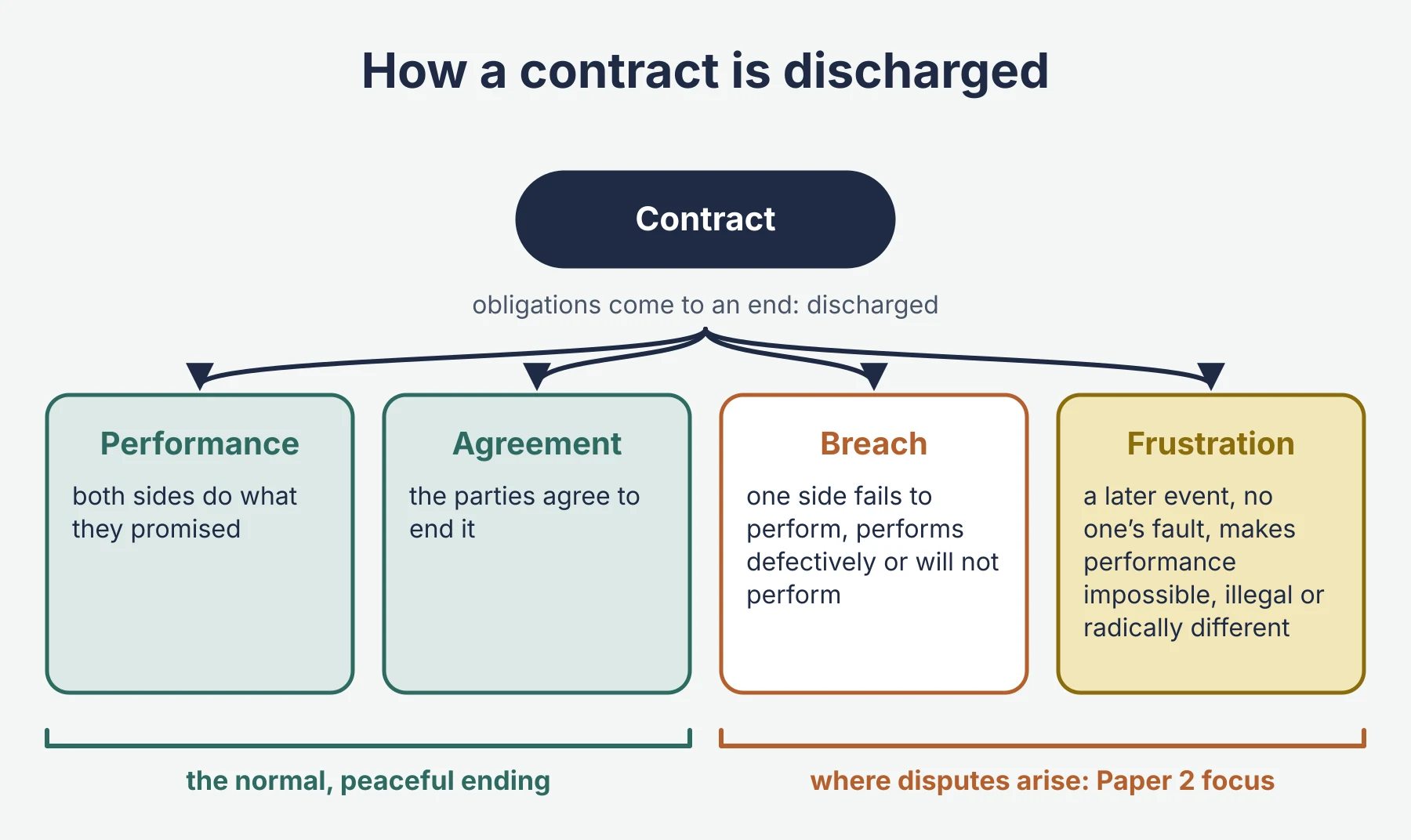
Four ways a contract ends
| Method | Core rule | Leading case |
|---|---|---|
| Performance | Must be complete and exact | Cutter v Powell (1795) |
| Agreement | Both agree to end it; needs consideration or a deed | Accord and satisfaction |
| Breach | Repudiatory breach gives the option to end the contract | Poussard v Spiers; Hong Kong Fir [1962] |
| Frustration | Later event, no one’s fault, makes performance impossible or radically different | Taylor v Caldwell (1863); Davis Contractors [1956] |
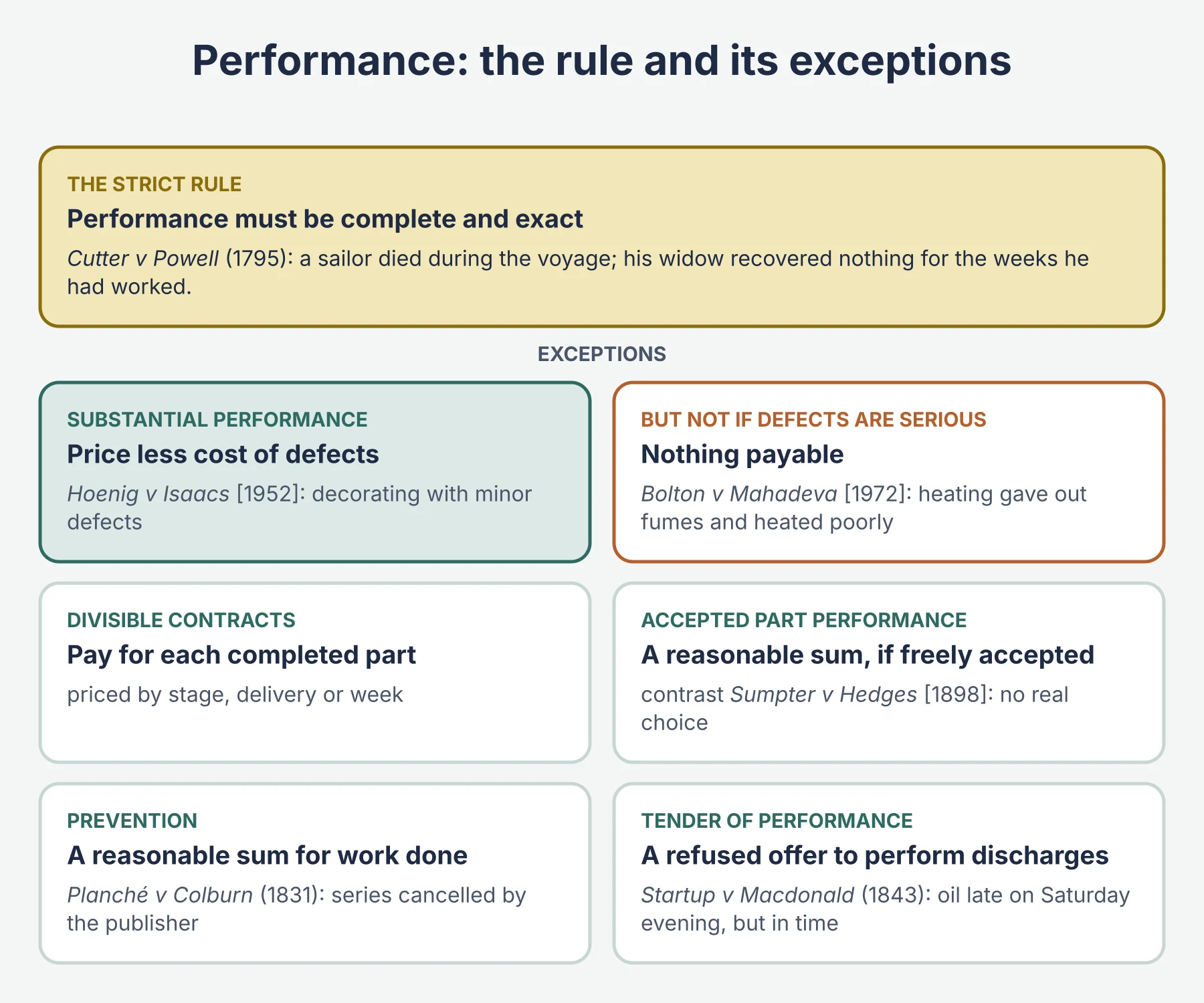
Performance: exceptions to the strict rule
- Substantial performance: price less cost of defects (Hoenig v Isaacs [1952]); not where defects are serious (Bolton v Mahadeva [1972]).
- Divisible contracts: pay for each completed part.
- Freely accepted partial performance: reasonable sum; but no free choice in Sumpter v Hedges [1898].
- Prevented performance: reasonable sum (Planché v Colburn (1831)).
- Tender of performance: refused tender discharges the tenderer (Startup v Macdonald (1843)).
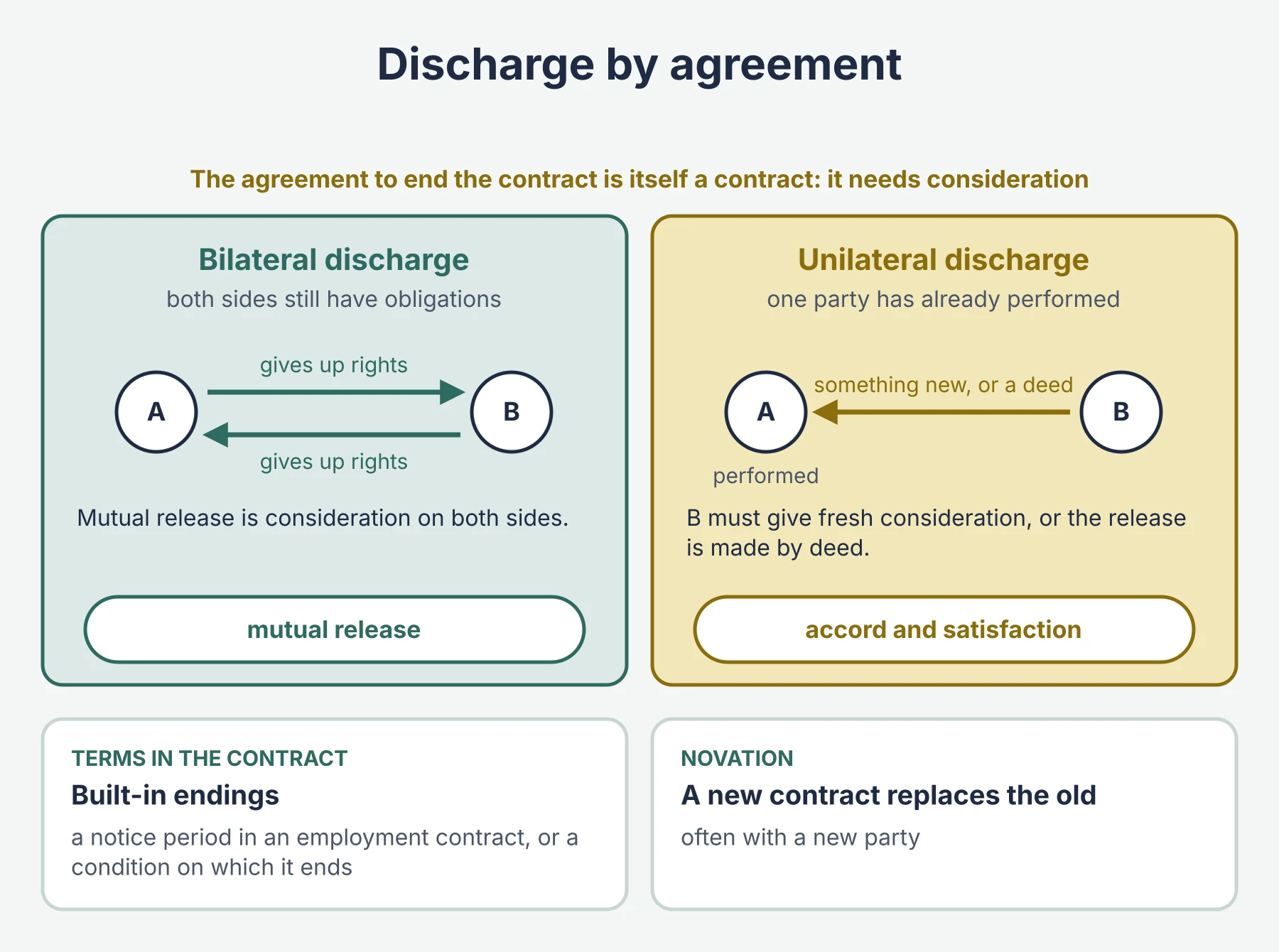
Agreement
- Bilateral: both still owe obligations; mutual release is consideration.
- Unilateral: one has performed; the other needs new consideration (accord and satisfaction) or a deed.
- Terms of the contract: notice periods, conditions.
- Novation: a new contract replaces the old.
Breach
Breach of warranty .............. damages only
Breach of condition ............. damages + option to end
Breach of innominate term ....... option to end only if the innocent party
                                  loses substantially the whole benefit
                                  (Hong Kong Fir)
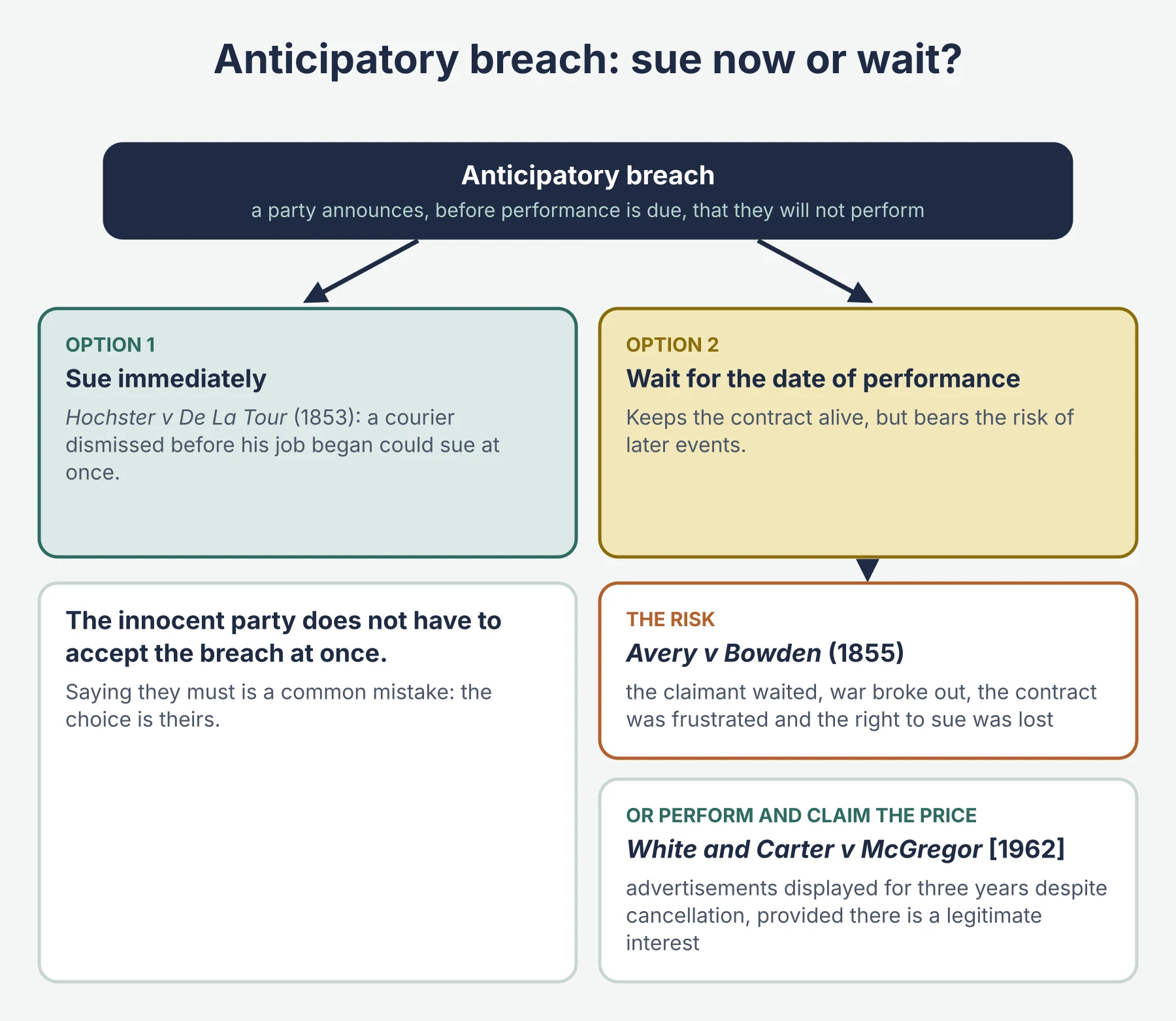
Anticipatory breach ............. sue now (Hochster v De La Tour)
                                  or wait, at your own risk (Avery v Bowden)
                                  or perform and claim the price if a
                                  legitimate interest (White and Carter)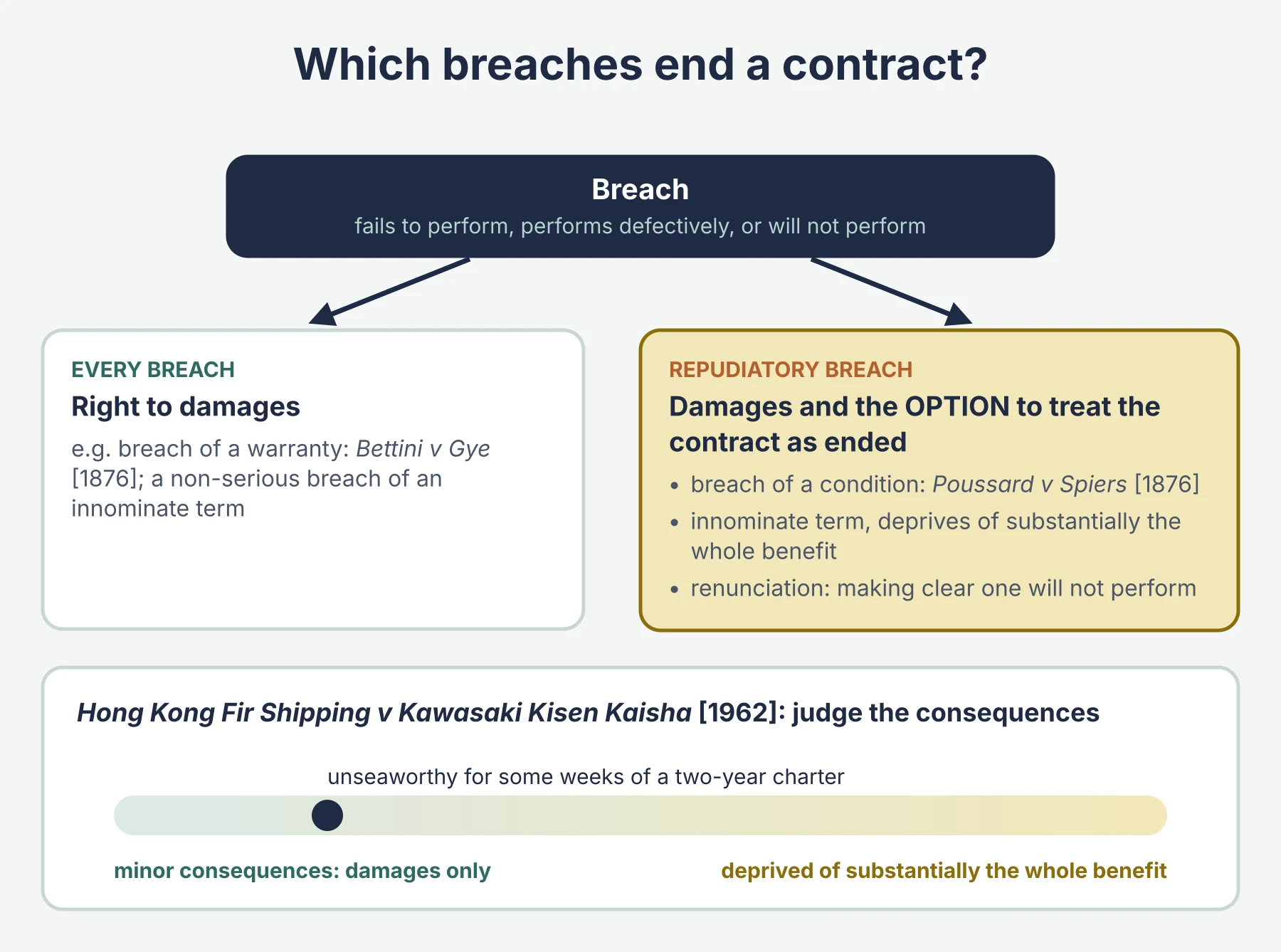
Frustration
Frustrating events
| Event | Case |
|---|---|
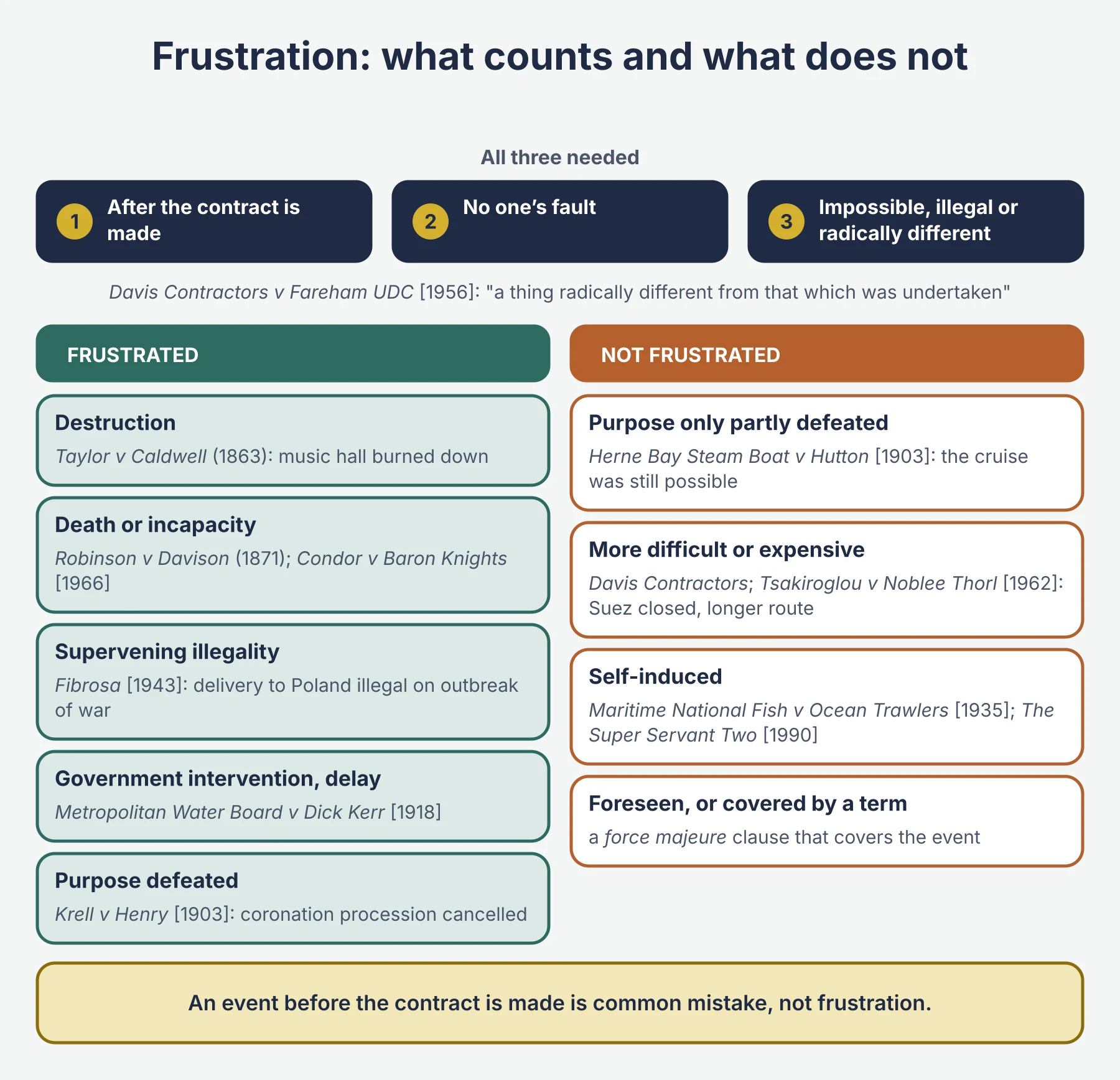
| Destruction | Taylor v Caldwell (1863) |
| Illness or death in a personal contract | Robinson v Davison (1871); Condor v Baron Knights [1966] |
| Supervening illegality | Fibrosa [1943] |
| Government intervention or long delay | Metropolitan Water Board v Dick Kerr [1918] |
| Main purpose defeated | Krell v Henry [1903] |
Not frustrated
| Reason | Case |
|---|---|
| Purpose only partly defeated | Herne Bay Steam Boat v Hutton [1903] |
| More expensive or difficult | Davis Contractors v Fareham UDC [1956]; Tsakiroglou v Noblee Thorl [1962] |
| Self-induced | Maritime National Fish v Ocean Trawlers [1935]; The Super Servant Two [1990] |
| Foreseen or covered by a force majeure clause | The contract allocates the risk |
The 1943 Act
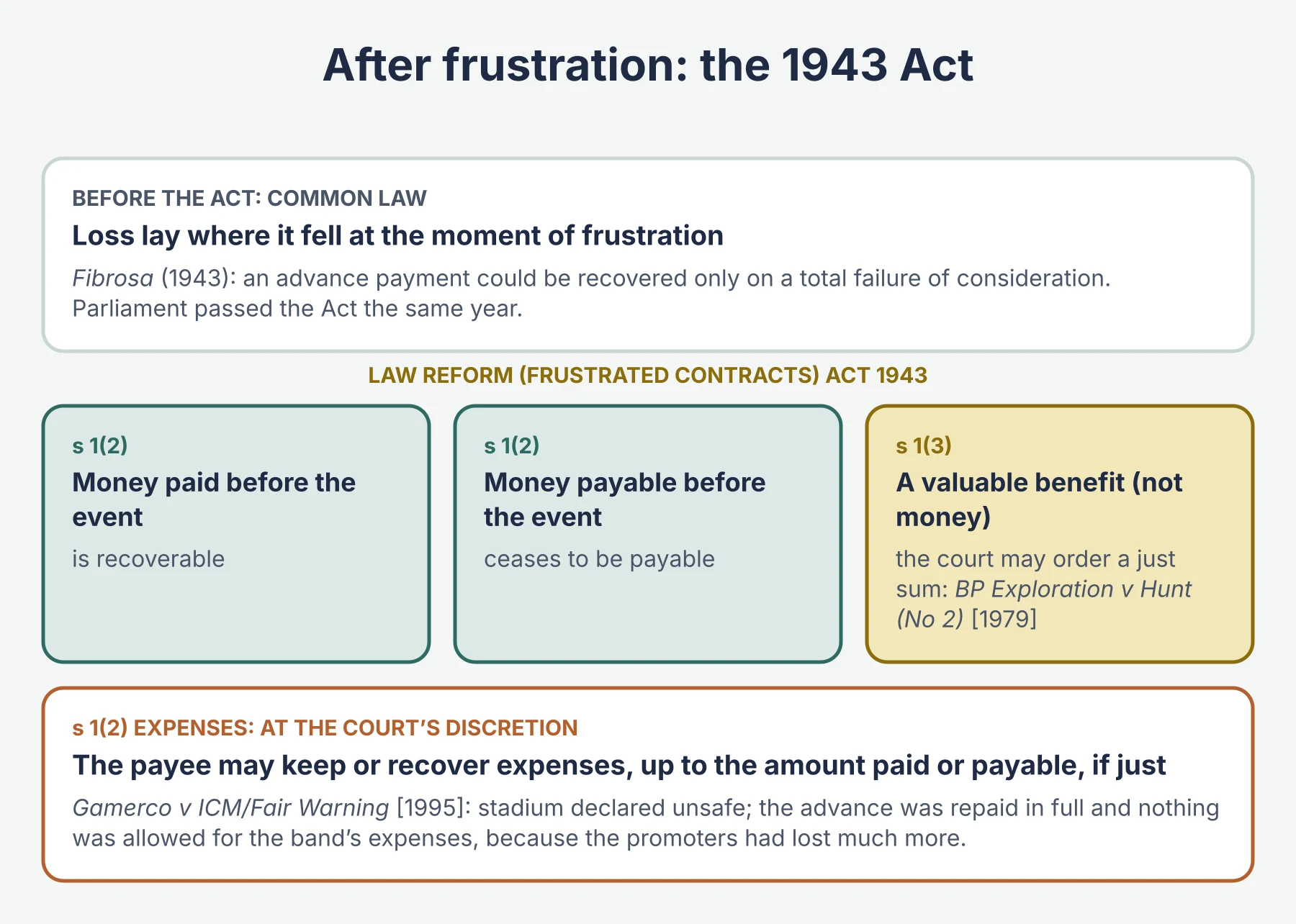
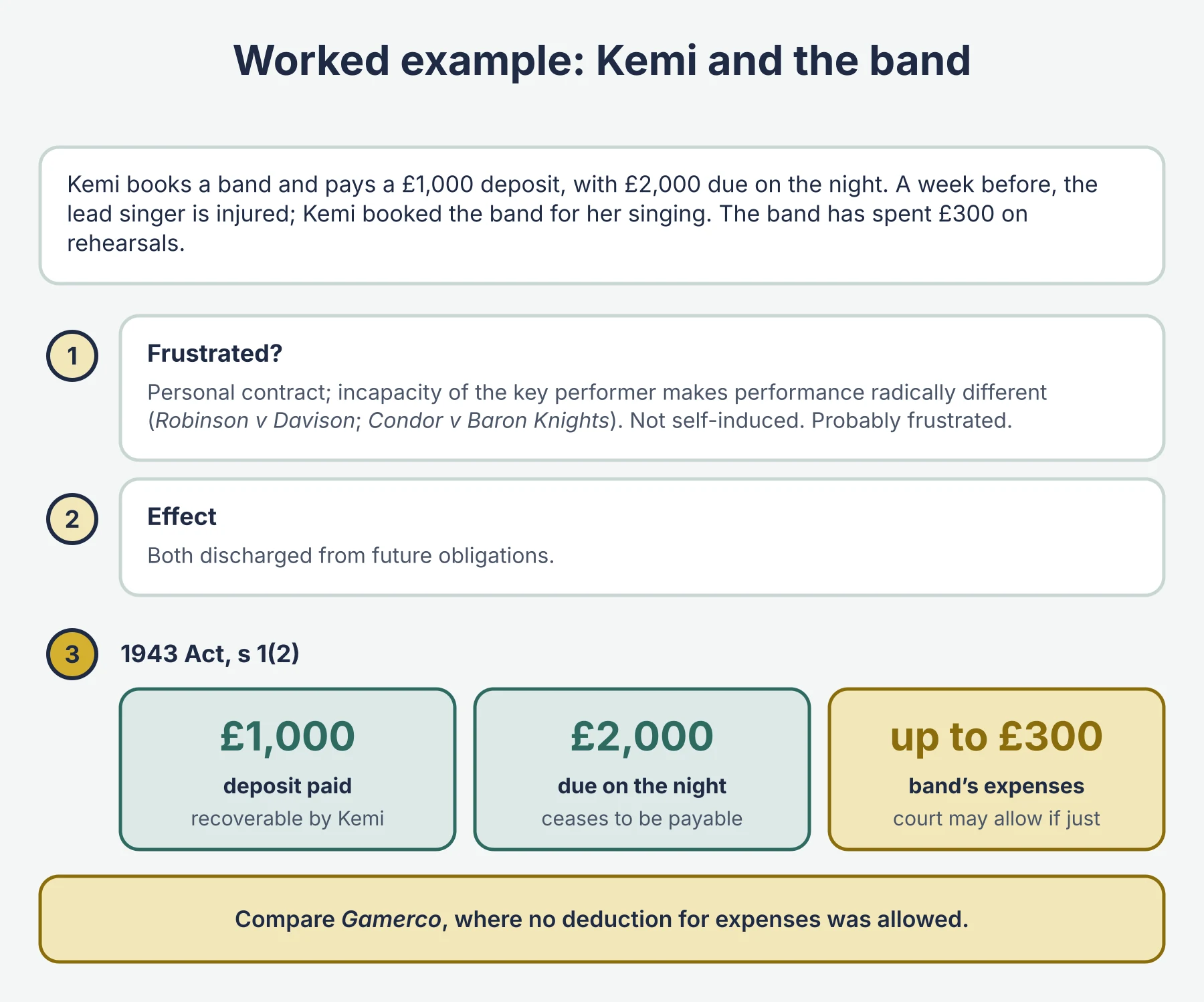
- s 1(2): money paid before frustration is recoverable; money payable ceases to be payable; the court may allow the payee to keep or recover expenses, up to the sum paid or payable (Gamerco v ICM [1995]: no deduction allowed).
- s 1(3): a party who received a valuable benefit other than money pays a just sum (BP Exploration v Hunt (No 2) [1979]).
- Background: Fibrosa allowed recovery only for total failure of consideration; the Act followed in the same year.
Model evaluation paragraph
The doctrine of frustration is deliberately narrow: Davis Contractors and Tsakiroglou show that increased cost or difficulty is not enough, which protects certainty and stops parties escaping bad bargains. The cost of that narrowness is that some parties remain bound in hardship, but the 1943 Act softens the effect of frustration where it does apply, by returning advance payments and giving the court discretion over expenses, as in Gamerco*. Together they balance certainty with fairness, though the broad discretion in s 1(2) makes outcomes hard to predict.*
Key terms
| Term | Meaning |
|---|---|
| Discharge | The ending of contractual obligations |
| Substantial performance | Performance complete except for minor defects |
| Divisible contract | Contract with separately payable parts |
| Accord and satisfaction | An agreement to release one party, supported by new consideration |
| Repudiatory breach | A breach serious enough to allow the innocent party to end the contract |
| Anticipatory breach | Announcing non-performance before it is due |
| Innominate term | A term whose breach is judged by its consequences |
| Frustration | Discharge by a later event that makes performance impossible or radically different |
| Self-induced frustration | An event caused by a party’s own choice; not frustration |
| Force majeure clause | A term allocating the risk of specified events |
Exam traps
- An event before the contract is common mistake, not frustration.
- More expensive ≠ frustrated.
- Only repudiatory breach gives the option to end the contract.
- The innocent party chooses whether to accept an anticipatory breach.
- The 1943 Act’s expenses rule is discretionary and capped at the sum paid or payable.
Self-test
- What was decided in Cutter v Powell?
- Distinguish Hoenig v Isaacs from Bolton v Mahadeva.
- Why did the builder in Sumpter v Hedges recover nothing for the unfinished buildings?
- What does Startup v Macdonald show?
- What is accord and satisfaction?
- What test did Hong Kong Fir set for innominate terms?
- What are the innocent party’s options after an anticipatory breach?
- Why did the claimant lose in Avery v Bowden?
- Why was Herne Bay Steam Boat v Hutton not frustrated, unlike Krell v Henry?
- Why was the contract not frustrated in Tsakiroglou?
- What does s 1(2) of the 1943 Act provide?
- What was decided about expenses in Gamerco v ICM?
Answers: 1. A sailor who died before completing a voyage earned nothing under a lump-sum contract; performance must be complete. 2. In Hoenig defects were minor, so substantial performance allowed the price less repair costs; in Bolton the heating system was seriously defective, so nothing was payable. 3. The landowner had no real choice but to accept the half-finished buildings on his land, so there was no free acceptance. 4. A valid tender of performance that is refused discharges the party who tendered. 5. An agreement to release a party from obligations (accord) supported by new consideration (satisfaction). 6. Whether the breach deprived the innocent party of substantially the whole benefit of the contract. 7. Sue immediately, or affirm and wait for the date of performance (and, with a legitimate interest, perform and claim the price). 8. He waited after the anticipatory breach, and war broke out and frustrated the contract before performance was due. 9. The boat could still be used to cruise round the fleet, so the purpose was not wholly defeated; in Krell the only purpose was to view the procession. 10. The closure of the Suez Canal made shipping longer and more expensive but not radically different. 11. Money paid before the frustrating event is recoverable, money payable ceases to be payable, and the court may allow expenses up to that sum. 12. The court allowed no deduction for the band’s expenses and ordered the full advance to be repaid.
Test yourself further with the discharge of contract practice questions.
Related resources
-
Study guides
Edexcel International A Level Law (YLA1): General Defences: Duress and Intoxication
Duress of threats and of circumstances, and voluntary and involuntary intoxication, step by step with cases and a worked scenario, for YLA1 2.2.8 and 2.2.9.
Law · Pearson Edexcel · A Level
Read guide -
Practice questions
Edexcel International A Level Law (YLA1): General Defences: Duress and Intoxication – Practice Questions
Original practice questions with full answers on duress of threats, duress of circumstances, and voluntary and involuntary intoxication (YLA1 2.2.8 and 2.2.9).
Law · Pearson Edexcel · A Level
Try questions -
Revision notes
Edexcel International A Level Law (YLA1): General Defences: Duress and Intoxication – Revision Notes
Condensed notes on duress of threats and circumstances and on voluntary and involuntary intoxication, with step-by-step tests, cases and a self-test (YLA1).
Law · Pearson Edexcel · A Level
Revise topic
Get free revision emails (optional)
Occasional emails with practice questions, worked explanations and links to free resources for the qualification and subjects you choose. No spam, and you can unsubscribe from any email. The free tools on this site never need an email.