
Revision Notes
Edexcel A Level Urdu (9UR0): Attitudes Towards Immigration – Revision Notes
9UR0 Theme 3.2 notes on attitudes towards immigration: reasons behind views, refugees, integration, a model paragraph and a self-test.
- Subject
- Urdu Language
- Level
- A LEVELS
- Topic
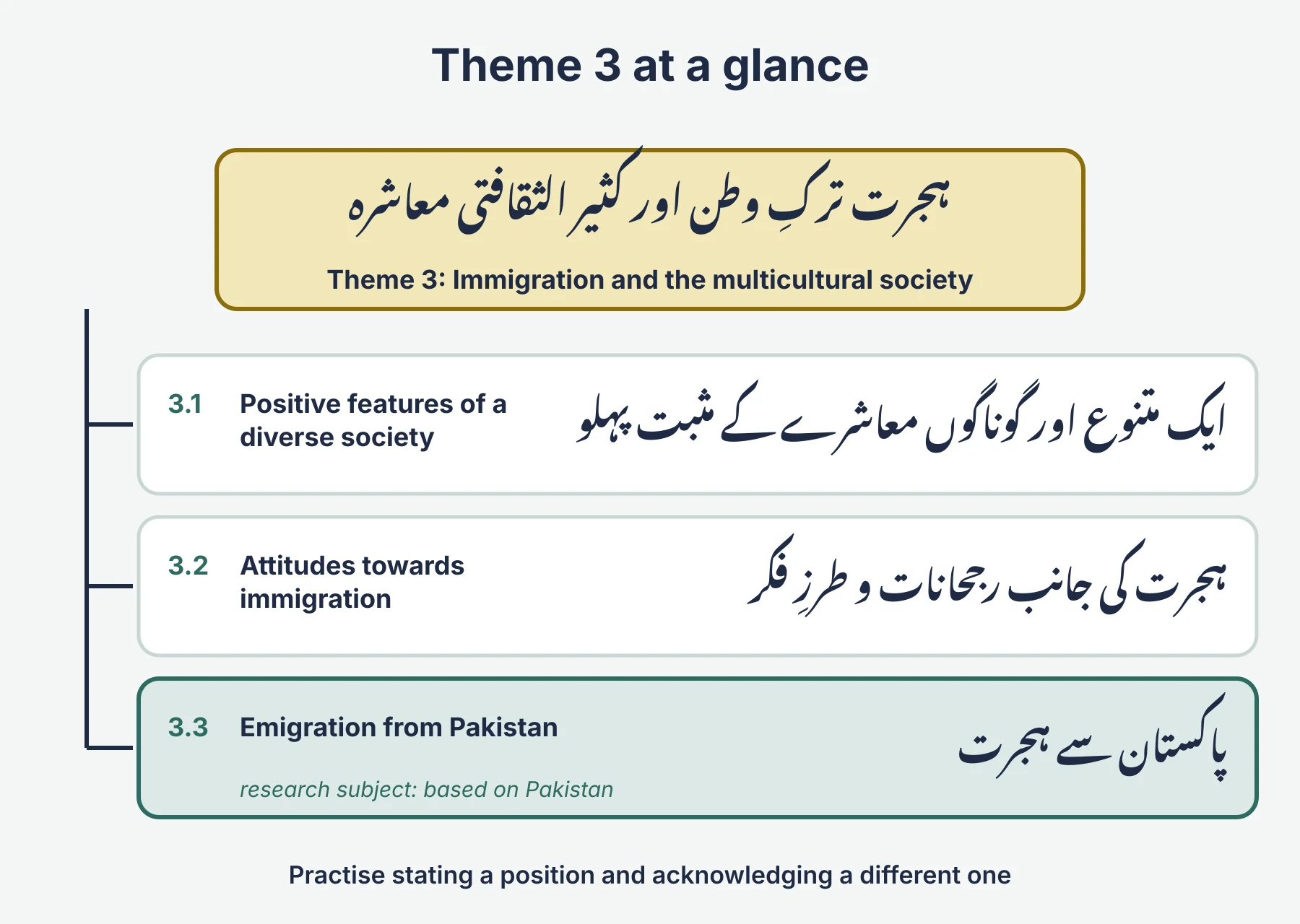
- Theme 3: Immigration and the multicultural society (ہجرت ترکِ وطن اور کثیر الثقافتی معاشرہ)
- Author
- Marlbridge Academic Team
- Updated
- Reviewed by
- Farheen Zehra (what this means)
Aligned to Pearson Edexcel A Level Urdu Language (9UR0), 2018. Official specification .
Syllabus page (what it covers and how it is assessed): Pearson Edexcel A Level Urdu Language.
Syllabus points this page covers
9UR0
- 3.2 ہجرت (ترکِ وطن) کی جانب رجحانات و طرزِ فکر
Found an error? Report a correction.
Need help with this topic? Request a free trial class for A Level Urdu Language (9UR0).
Revision notes for sub-theme 3.2 of Theme 3 in Pearson Edexcel A Level Urdu (9UR0): attitudes towards immigration (ہجرت (ترکِ وطن) کی جانب رجحانات و طرزِ فکر). For the wider theme, read the Theme 3 study guide.
Key ideas
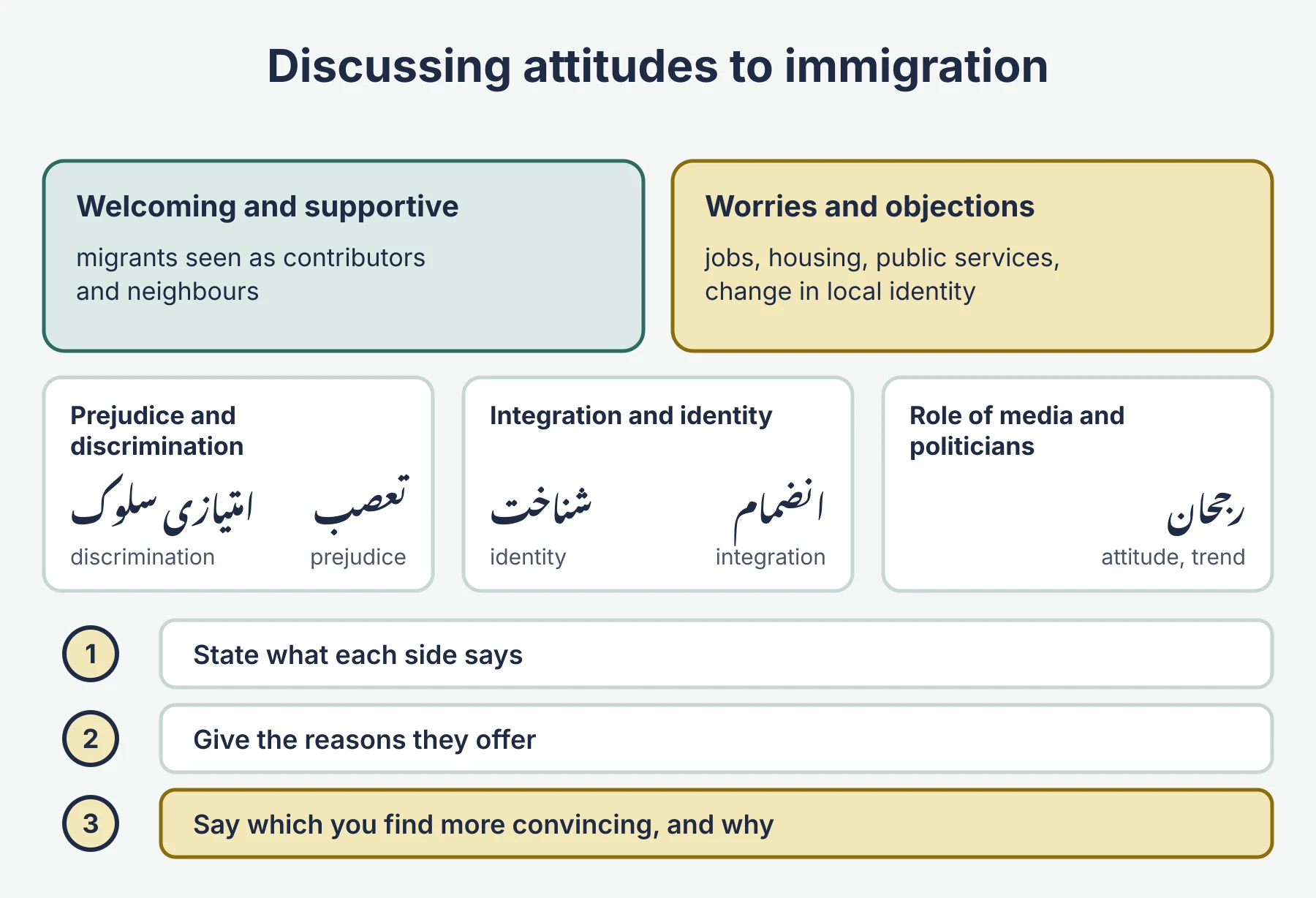
- Welcoming attitudes: migrants seen as contributors and neighbours.
- Worries and objections: jobs, housing, public services, change in local identity.
- Prejudice and discrimination: how stereotypes and unfair treatment affect lives, and what law, schools and communities can do.
- Integration and identity: whether newcomers keep their customs while taking part in wider society; how second and third generations see themselves.
- Media and politicians shape public attitudes.
Issues and perspectives
Why attitudes differ. People’s views of immigration depend on their own experience, their economic situation, what they see in the media and the language politicians use. Someone who works alongside migrants may see them as colleagues; someone competing for scarce housing may see them as rivals. A strong answer explains why people hold a view, rather than labelling them as simply good or bad.
Welcoming attitudes and their reasons.
- Humanitarian: people fleeing war or persecution deserve protection. Many writers in Urdu also refer to the tradition of hospitality (مہمان نوازی) and to the example of the Ansar of Madina, who welcomed the Muhajirin, as a model of generosity towards migrants.
- Economic: migrants fill jobs, pay taxes and start businesses.
- Cultural: newcomers bring variety and new ideas (see sub-theme 3.1).
Worries and objections and their reasons.
- Pressure on رہائش (housing), عوامی خدمات (public services) and jobs, especially where wages are low.
- Fear that local identity and customs will change too quickly.
- Concerns about security or about illegal entry.
Taking these concerns seriously is not the same as accepting prejudice. You can say that a concern deserves an answer while rejecting blame directed at a whole community.
Pakistan as a host country. Pakistan has hosted very large numbers of Afghan refugees (افغان پناہ گزین) since the Soviet invasion of Afghanistan in 1979. Attitudes have included generosity and shared religious and cultural ties, but also concern about economic pressure and security, and in recent years the government has pushed for many refugees without valid documents to return. This example lets you discuss attitudes to immigration from a Pakistani point of view; check details and dates against reliable sources.
Pakistanis as immigrants. Pakistani-heritage communities in Britain and elsewhere have experienced both welcome and prejudice (تعصب), including racism (نسل پرستی). The second and third generations (دوسری اور تیسری نسل) often describe a double identity: British and Pakistani, or Muslim and European. Debate continues about انضمام (integration): does it mean giving up one’s customs, or taking part fully in public life while keeping them?
The role of the media and politicians. Headlines that repeatedly link migrants to crime or burdens can harden attitudes (رویہ سخت ہونا); stories of contribution and personal experience can soften them. Politicians may calm fears with facts or stir them for votes. Ask who benefits from a particular way of describing migrants.
Vocabulary
| Urdu | Meaning |
|---|---|
| ہجرت | migration |
| تارکِ وطن | emigrant |
| مہاجر | migrant |
| تعصب | prejudice |
| امتیازی سلوک | discriminatory treatment |
| انضمام | integration |
| شناخت | identity |
| رجحان | attitude, trend |
| رویہ | attitude, behaviour (masculine) |
| پناہ گزین | refugee |
| مہمان نوازی | hospitality |
| خوش آمدید کہنا | to welcome |
| خدشہ / خدشات | concern / concerns |
| رہائش | housing, accommodation |
| عوامی خدمات | public services |
| نسل پرستی | racism |
| سماجی ہم آہنگی | social cohesion |
| غلط فہمی | misunderstanding |
| سرحد | border |
| دوسری نسل | second generation |
How to discuss attitudes
State what people on each side say, give the reasons they offer, then say which you find more convincing and why. You do not need to claim one view is the only reasonable one.
Useful sentences with grammar notes
- بعض لوگوں کو خدشہ ہے کہ نئے آنے والوں سے روزگار کے مواقع کم ہو جائیں گے۔ (Some people fear that newcomers will reduce job opportunities.) Dative construction لوگوں کو خدشہ ہے; the future verb agrees with مواقع (masculine plural): ہو جائیں گے.
- پاکستان نے کئی دہائیوں تک لاکھوں افغان پناہ گزینوں کی میزبانی کی ہے۔ (For several decades Pakistan has hosted vast numbers of Afghan refugees.) With نے, the verb agrees with the object میزبانی (feminine): کی ہے.
- تعصب کا مقابلہ تعلیم اور میل جول سے کیا جا سکتا ہے۔ (Prejudice can be countered through education and contact.) Passive with سکنا, agreeing with مقابلہ (masculine).
- دوسری نسل کے نوجوان اکثر خود کو دونوں ثقافتوں کا حصہ سمجھتے ہیں۔ (Young people of the second generation often see themselves as part of both cultures.) خود کو is the reflexive ‘themselves’.
- اگر میڈیا صرف منفی خبریں دکھائے تو لوگوں کا رویہ سخت ہو جاتا ہے۔ (If the media shows only negative news, people’s attitudes harden.) رویہ is masculine, so سخت ہو جاتا ہے; میڈیا takes a masculine subjunctive, دکھائے.
Model paragraph
ہجرت کے بارے میں لوگوں کے رویے ایک جیسے نہیں ہوتے۔ ایک طرف بہت سے لوگ نئے آنے والوں کو خوش آمدید کہتے ہیں، کیونکہ وہ انھیں محنتی ہمسائے اور معیشت میں حصہ ڈالنے والے شہری سمجھتے ہیں۔ دوسری طرف کچھ لوگوں کو رہائش، روزگار اور عوامی خدمات پر دباؤ کی فکر ہوتی ہے۔ ان خدشات کو نظر انداز کرنا درست نہیں، لیکن انھیں پوری برادری کے خلاف تعصب کا جواز بھی نہیں بنانا چاہیے۔ میرے خیال میں حکومت، اسکول اور میڈیا مل کر غلط فہمیاں دور کر سکتے ہیں، اور اس طرح سماجی ہم آہنگی مضبوط ہو سکتی ہے۔
Translation: People’s attitudes towards migration are not all the same. On the one hand, many people welcome newcomers because they regard them as hard-working neighbours and citizens who contribute to the economy. On the other hand, some people worry about pressure on housing, jobs and public services. It is not right to ignore these concerns, but they should not be made an excuse for prejudice against a whole community either. In my view the government, schools and the media can work together to remove misunderstandings, and in this way social cohesion can become stronger.
Why it works: both sides are given with reasons; the writer separates legitimate concern from prejudice; and the conclusion offers a practical response. In جواز بھی نہیں بنانا چاہیے the infinitive agrees with جواز (masculine).
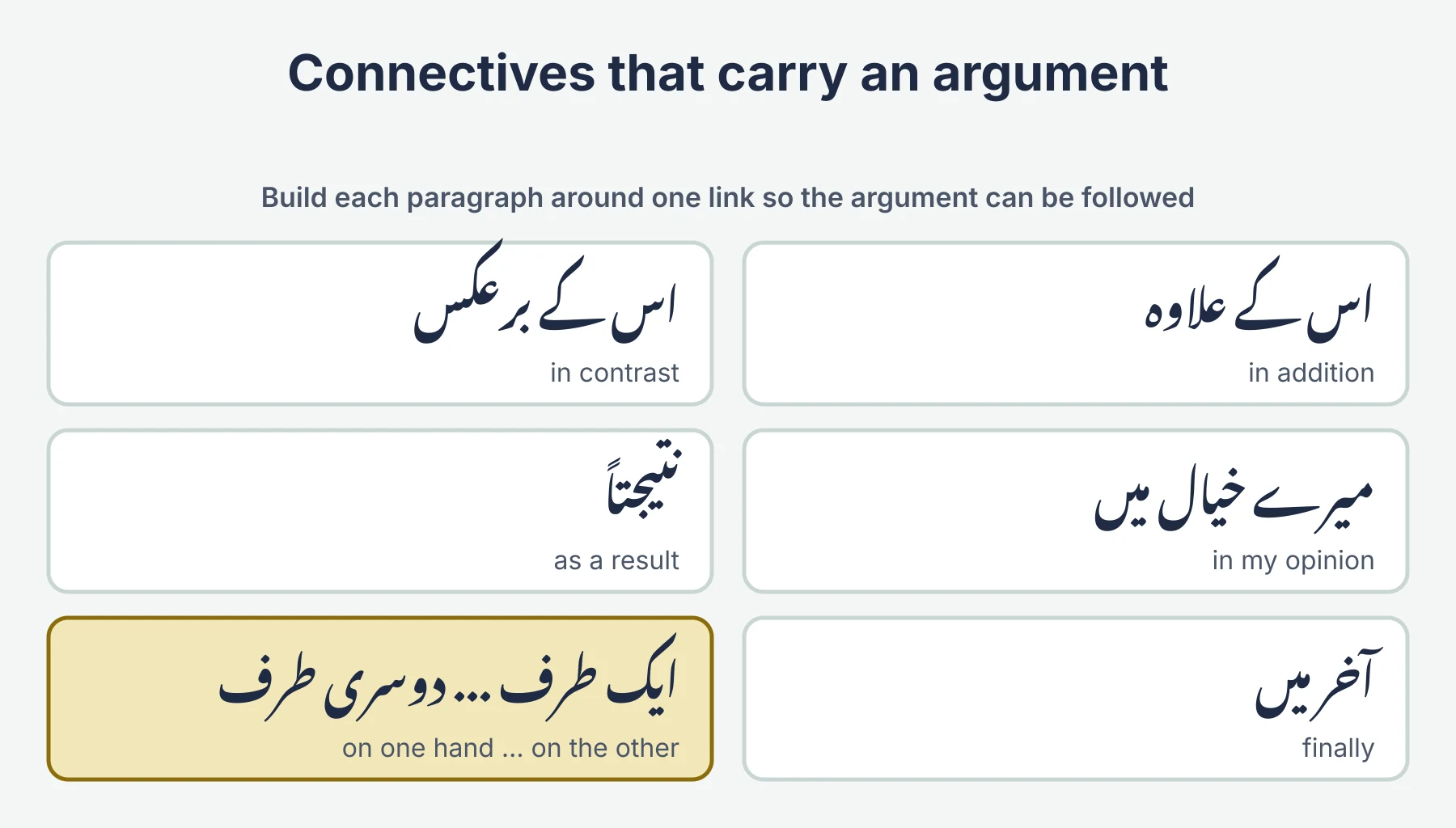
Connectives to reuse
| Urdu | Use |
|---|---|
| اس کے برعکس | in contrast |
| اس کے علاوہ | in addition |
| نتیجتاً | as a result |
| میرے خیال میں | in my opinion |
| ایک طرف … دوسری طرف | on one hand … on the other |
| آخر میں | finally |
Discussion and essay prompts
- «ہجرت کے بارے میں منفی رویوں کی سب سے بڑی وجہ میڈیا ہے۔» (The media is the main cause of negative attitudes towards immigration.) To what extent do you agree?
- Does integration require newcomers to give up their customs?
- How should a country balance generosity to refugees with the concerns of its own citizens? Use Pakistan’s experience as an example.
- «تعلیم تعصب کا بہترین علاج ہے۔» (Education is the best cure for prejudice.) Discuss.
Exam traps
- Confusing emigration (leaving) with immigration (arriving).
- Unsupported claims about whole groups.
- Disrespectful tone: write respectfully about different groups.
- Treating every worry as prejudice, or every welcome as naive; explain the reasons behind each view.
- Agreement errors with رویہ (masculine) and فکر (feminine): رویہ سخت ہو جاتا ہے, but فکر ہوتی ہے.
- Quoting refugee numbers from memory; describe the scale in words unless you have a source.
Self-test
- Give the Urdu for ‘prejudice’ and ‘integration’.
- Name two worries people sometimes express about immigration.
- What is the three-step way to discuss attitudes?
- What does شناخت mean?
- Which two groups can shape public attitudes, according to the guide?
- Give two reasons people offer for welcoming migrants.
- Since when has Pakistan hosted large numbers of Afghan refugees, and why?
- What does ‘double identity’ mean for second-generation migrants?
- Give the Urdu for ‘refugee’ and ‘hospitality’.
- In پاکستان نے … پناہ گزینوں کی میزبانی کی ہے, why is the verb کی ہے?
- Translate: ‘prejudice can be countered through education and contact’.
Answers: 1. تعصب and انضمام. 2. For example, jobs and housing. 3. State each side’s view, give their reasons, then say which you find more convincing and why. 4. Identity. 5. The media and politicians. 6. For example, humanitarian duty, economic contribution, or cultural variety. 7. Since the Soviet invasion of Afghanistan in 1979, when refugees fled the war. 8. Feeling part of two cultures at once, for example British and Pakistani. 9. پناہ گزین and مہمان نوازی. 10. With نے the verb agrees with the object میزبانی, which is feminine. 11. تعصب کا مقابلہ تعلیم اور میل جول سے کیا جا سکتا ہے۔
Related resources
-
Revision notes
Edexcel A Level Urdu (9UR0): Emigration from Pakistan – Revision Notes
9UR0 Theme 3.3 notes on emigration from Pakistan, the research subject: waves, remittances, brain drain, a model paragraph and a self-test.
Urdu Language · Pearson Edexcel · A Level
Revise topic -
Revision notes
Edexcel A Level Urdu (9UR0): Positive Features of a Diverse Society – Revision Notes
9UR0 Theme 3.1 notes on the positive features of a diverse society: perspectives, key terms, grammar notes, a model paragraph and a self-test.
Urdu Language · Pearson Edexcel · A Level
Revise topic -
Study guides
Edexcel A-Level Urdu: Theme 3, Immigration and the Multicultural Society (9UR0)
Diverse societies, attitudes towards immigration and emigration from Pakistan: ideas, vocabulary and model Urdu writing for Theme 3 of Pearson Edexcel GCE A-Level Urdu (9UR0).
Urdu Language · Pearson Edexcel · A Level
Read guide
Get free revision emails (optional)
Occasional emails with practice questions, worked explanations and links to free resources for the qualification and subjects you choose. No spam, and you can unsubscribe from any email. The free tools on this site never need an email.