
Revision Notes
Edexcel A Level Urdu (9UR0): Equal Access to Education in Pakistan – Revision Notes
9UR0 Theme 1.3 notes on equal access to education in Pakistan, the research subject: four gaps, measures, a model paragraph and a self-test.
- Subject
- Urdu Language
- Level
- A LEVELS
- Topic
- Theme 1: Evolving Pakistani society (پاکستانی معاشرے کا ارتقا)
- Author
- Marlbridge Academic Team
- Updated
- Reviewed by
- Farheen Zehra (what this means)
Aligned to Pearson Edexcel A Level Urdu Language (9UR0), 2018. Official specification .
Syllabus page (what it covers and how it is assessed): Pearson Edexcel A Level Urdu Language.
Syllabus points this page covers
9UR0
- 1.3 Equal access to education in Pakistan
Found an error? Report a correction.
Need help with this topic? Request a free trial class for A Level Urdu Language (9UR0).
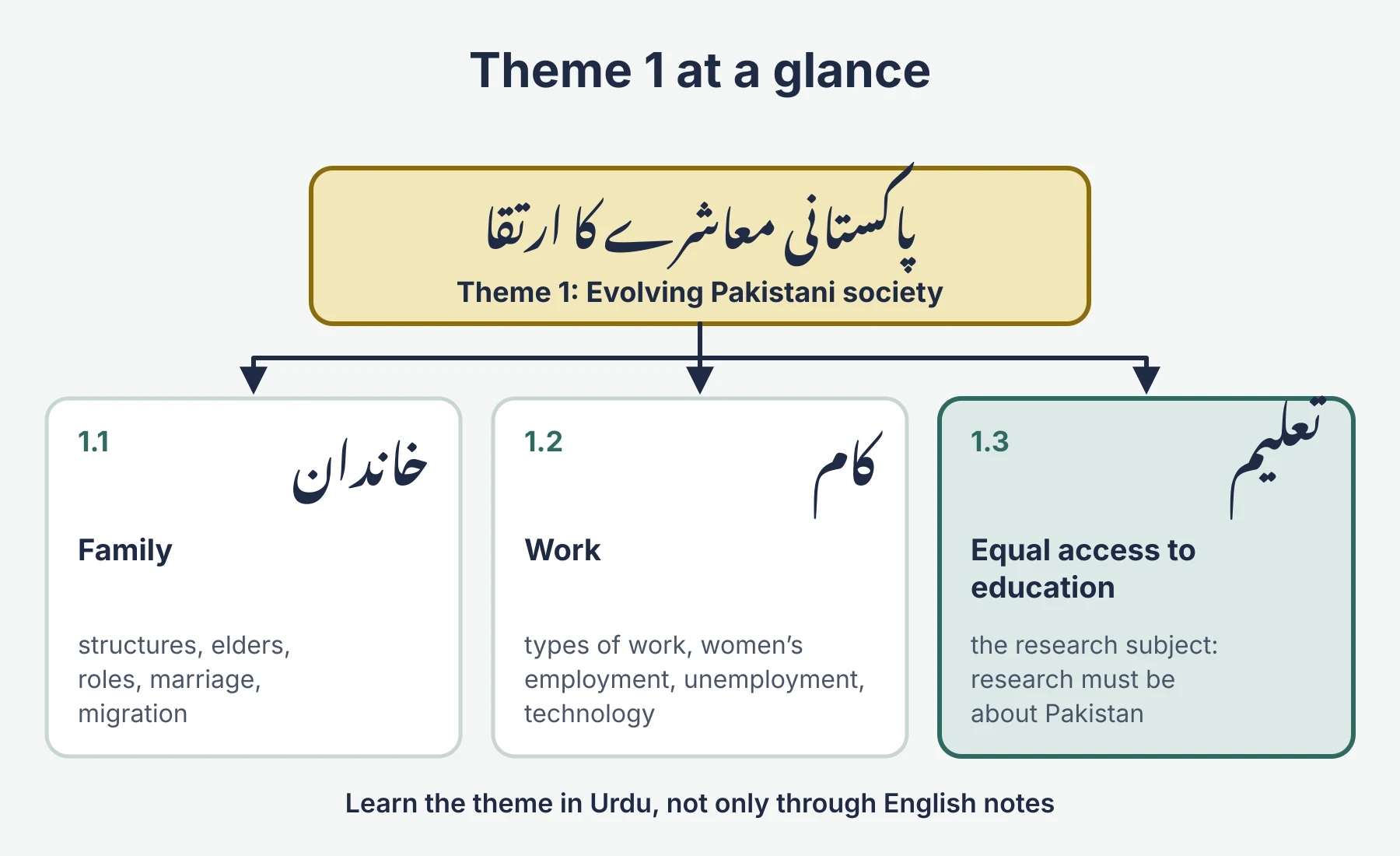
Revision notes for sub-theme 1.3 of Theme 1 in Pearson Edexcel A Level Urdu (9UR0): equal access to education in Pakistan (تعلیم), which is the research subject for this theme. For the wider theme, read the Theme 1 study guide.
Research rules
- Theme 1 research must be based on Pakistan and written up in Urdu.
- Keep a file of named sources, dates and figures you have checked yourself. Never quote a statistic you cannot trace.
- Compare at least two viewpoints on each point.
Points to investigate
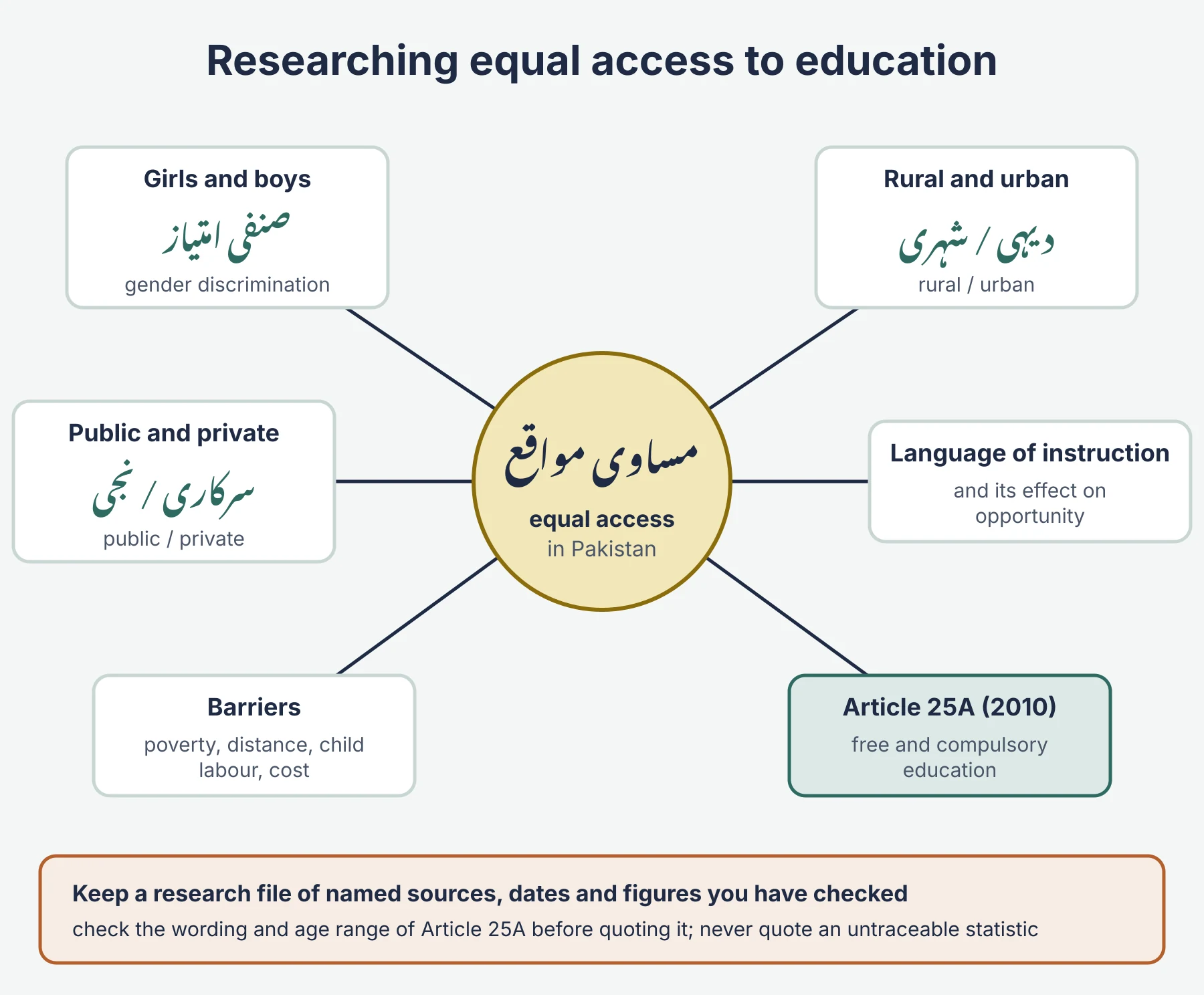
- Access for girls and boys, and for urban and rural children.
- Public (سرکاری) and private (نجی) schools: resources and quality.
- Language of instruction and its effect on opportunity.
- Constitutional commitment: Article 25A, added in 2010, provides for free and compulsory education for children in a stated age range. Check the wording and age range before you quote it.
- Barriers: poverty, distance, child labour and the cost of schooling.
Issues and perspectives
The key word is مساوی (equal). The question is not only whether schools exist, but whether every child has a fair chance of attending, staying and learning. Organise your research around four kinds of gap.
1. The gender gap. In many areas girls are less likely than boys to enrol and more likely to leave early. Reasons often given include distance to school and concerns about safety on the way, the lack of girls’ schools or female teachers, toilets and boundary walls, early marriage, household work, and family attitudes. Malala Yousafzai, from the Swat valley, campaigned for girls’ right to education, survived an attack by militants, and was awarded the Nobel Peace Prize in 2014; her story is widely used as a symbol of this issue, though you should also present wider evidence.
2. The urban–rural gap. Rural schools are more likely to lack teachers, buildings and materials, and children may have to walk long distances. Reports of teacher absence and of schools that exist on paper but do not function (often called گھوسٹ اسکول) are part of this debate; use reported cases from named sources.
3. The public–private gap. Private schools range from expensive elite schools to low-fee neighbourhood schools. Many families see them as better quality, but fees exclude the poorest. Critics speak of a طبقاتی نظامِ تعلیم (class-based education system), in which children of different classes study in different kinds of school, with different curricula and languages, and so grow up with unequal chances. دینی مدارس (religious seminaries) are a third strand: they often offer free education and board to poor children, and debates continue about their curriculum and the opportunities it opens.
4. Language of instruction. English-medium schooling is often linked to better jobs, while many children study in Urdu or a regional language. Some argue that children learn best in a language they understand; others argue that early English opens doors. The ذریعۂ تعلیم (medium of instruction) debate is closely tied to equality.
Responses to research. Possible measures include the constitutional right under Article 25A, stipends or cash support for girls’ attendance in some provinces, building and upgrading schools, non-formal and community schools, teacher training, and attempts at a common curriculum such as the یکساں قومی نصاب (Single National Curriculum). For each measure, note what it aims to do, the evidence about its effect, and at least one criticism.
Vocabulary
| Urdu | Meaning |
|---|---|
| تعلیم | education (feminine) |
| خواندگی | literacy |
| اسکول | school |
| استاد، معلم | teacher |
| مساوی مواقع | equal opportunities |
| صنفی امتیاز | gender discrimination |
| دیہی / شہری | rural / urban |
| نصاب | curriculum |
| رسائی | access |
| داخلہ | enrolment, admission |
| اسکول سے باہر بچے | out-of-school children |
| تعلیمِ نسواں | women’s and girls’ education |
| ذریعۂ تعلیم | medium of instruction |
| اساتذہ | teachers (plural) |
| سہولیات | facilities |
| معیارِ تعلیم | standard of education |
| مفت اور لازمی تعلیم | free and compulsory education |
| بنیادی حق | fundamental right |
| آئین | constitution |
| وظیفہ | stipend, scholarship |
| دینی مدرسہ | religious seminary |
| طبقاتی نظامِ تعلیم | class-based education system |
| بچوں سے مشقت | child labour |
Useful sentences with grammar notes
- آئین کے آرٹیکل 25 اے کے تحت ریاست بچوں کو مفت اور لازمی تعلیم فراہم کرنے کی پابند ہے۔ (Under Article 25-A of the constitution, the state is obliged to provide children with free and compulsory education.) کے تحت (under) introduces a law; کی پابند agrees with the feminine ریاست.
- دیہی علاقوں میں لڑکیوں کے اسکول اکثر گھر سے بہت دور ہوتے ہیں۔ (In rural areas, girls’ schools are often very far from home.) Masculine plural agreement with اسکول.
- غربت کی وجہ سے بہت سے بچوں کو کم عمری میں کام کرنا پڑتا ہے۔ (Because of poverty, many children have to work at a young age.) Obligation with کو + infinitive + پڑنا.
- سرکاری اور نجی اسکولوں کے معیار میں نمایاں فرق پایا جاتا ہے۔ (A marked difference is found in the standard of government and private schools.) Passive agreeing with فرق (masculine).
- اگر لڑکیوں کو تعلیم دی جائے تو پورا خاندان فائدہ اٹھاتا ہے۔ (If girls are given an education, the whole family benefits.) Passive subjunctive agreeing with تعلیم (feminine): دی جائے.
Model paragraph
پاکستان میں تعلیم تک مساوی رسائی اب بھی ایک بڑا چیلنج ہے۔ میری تحقیق کے مطابق شہری اور دیہی علاقوں کے بچوں کو ملنے والی سہولیات میں نمایاں فرق ہے، اور دیہات میں لڑکیوں کو فاصلے، حفاظت اور خاندانی رویوں کی وجہ سے زیادہ مشکلات کا سامنا ہے۔ اس کے علاوہ سرکاری اور نجی اسکولوں کے معیار میں فرق ایک طبقاتی نظامِ تعلیم کو جنم دیتا ہے۔ دیے گئے متن میں بھی اس بات کی نشاندہی کی گئی ہے کہ صرف اسکول کھولنا کافی نہیں؛ اساتذہ کی تربیت اور معیاری نصاب بھی ضروری ہیں۔ میرے خیال میں آئین میں دیا گیا مفت اور لازمی تعلیم کا حق اسی وقت پورا ہو سکتا ہے جب حکومت غریب خاندانوں کی مالی مدد بھی کرے۔
Translation: Equal access to education is still a major challenge in Pakistan. According to my research, there is a marked difference between the facilities available to children in urban and rural areas, and in the villages girls face greater difficulties because of distance, safety and family attitudes. In addition, the difference in standard between government and private schools gives rise to a class-based education system. The given text also points out that simply opening schools is not enough; teacher training and a good-quality curriculum are also necessary. In my view, the right to free and compulsory education given in the constitution can only be fulfilled when the government also gives financial help to poor families.
Why it works: research and source text are clearly marked (میری تحقیق کے مطابق, دیے گئے متن میں); three gaps are named; and the conclusion links a measure to a condition for its success.
Using research in an answer
Section C of Paper 1 rewards knowledge and understanding of society and culture through your research (AO4, 20 marks), response to the unseen Urdu text (AO2, 10 marks) and accuracy and range of language (AO3, 10 marks). Use both your research and the source text, and make clear which is which. See the Paper 1 study guide.
Discussion and essay prompts
- «پاکستان میں تعلیم کا سب سے بڑا مسئلہ اسکولوں کی کمی نہیں بلکہ معیار کی کمی ہے۔» (Pakistan’s biggest education problem is not a shortage of schools but a lack of quality.) Discuss.
- «لڑکیوں کی تعلیم پورے معاشرے کی ترقی کی کنجی ہے۔» (Girls’ education is the key to the progress of the whole of society.) To what extent do you agree?
- Should all children in Pakistan study the same curriculum in the same language?
- Can private schools help achieve equal access, or do they deepen inequality?
Exam traps
- Research that is not about Pakistan.
- Unsupported statistics and sweeping claims.
- Quoting Article 25A without checking its wording.
- Mixing research and source text so the examiner cannot tell them apart.
- Describing only problems; the sub-theme is about access, so discuss what is being done and how well it works.
- Treating تعلیم as masculine: it is feminine (تعلیم دی جاتی ہے).
Self-test
- Which country must Theme 1 research cover?
- Give the Urdu for ‘literacy’ and ‘curriculum’.
- Name two barriers to equal access to education.
- What did Article 25A add, and what must you do before quoting it?
- How are the 40 marks of Paper 1 Section C split?
- Name the four kinds of gap suggested for organising your research.
- What does طبقاتی نظامِ تعلیم mean?
- Why is Malala Yousafzai often mentioned in this sub-theme, and what award did she receive in 2014?
- Give the Urdu for ‘access’, ‘enrolment’ and ‘medium of instruction’.
- In اگر لڑکیوں کو تعلیم دی جائے, why is the verb دی جائے?
- Name two measures intended to widen access.
- Translate: ‘education is a fundamental right’.
Answers: 1. Pakistan. 2. خواندگی and نصاب. 3. For example, poverty and distance, or unequal access for girls. 4. It was added in 2010 and provides for free and compulsory education for children in a stated age range; check the wording and age range first. 5. AO4 research 20, AO2 unseen text 10, AO3 language 10. 6. Gender, urban–rural, public–private, and language of instruction. 7. A class-based education system, in which children of different classes attend different kinds of school with unequal chances. 8. She campaigned for girls’ right to education and survived an attack by militants; the Nobel Peace Prize. 9. رسائی, داخلہ and ذریعۂ تعلیم. 10. It is a passive subjunctive agreeing with تعلیم, which is feminine. 11. For example, stipends for girls, new and upgraded schools, non-formal schools, teacher training or a common curriculum. 12. تعلیم ایک بنیادی حق ہے۔
Related resources
-
Revision notes
Edexcel A Level Urdu (9UR0): Family (خاندان) – Revision Notes
9UR0 Theme 1.1 notes on family (خاندان): joint and separate households, elders, marriage, migration, a model paragraph and a self-test.
Urdu Language · Pearson Edexcel · A Level
Revise topic -
Study guides
Edexcel A-Level Urdu: Theme 1, Evolving Pakistani Society (9UR0)
Family, work and equal access to education in Pakistan: vocabulary, ideas and model Urdu writing for Theme 1 of Pearson Edexcel GCE A-Level Urdu (9UR0).
Urdu Language · Pearson Edexcel · A Level
Read guide -
Revision notes
Edexcel A Level Urdu (9UR0): Work (کام) – Revision Notes
9UR0 Theme 1.2 notes on work (کام): informal work, unemployment, women's employment, technology, a model paragraph and a self-test.
Urdu Language · Pearson Edexcel · A Level
Revise topic
Get free revision emails (optional)
Occasional emails with practice questions, worked explanations and links to free resources for the qualification and subjects you choose. No spam, and you can unsubscribe from any email. The free tools on this site never need an email.