
Revision Notes
Edexcel A Level Urdu (9UR0): Family (خاندان) – Revision Notes
9UR0 Theme 1.1 notes on family (خاندان): joint and separate households, elders, marriage, migration, a model paragraph and a self-test.
- Subject
- Urdu Language
- Level
- A LEVELS
- Topic
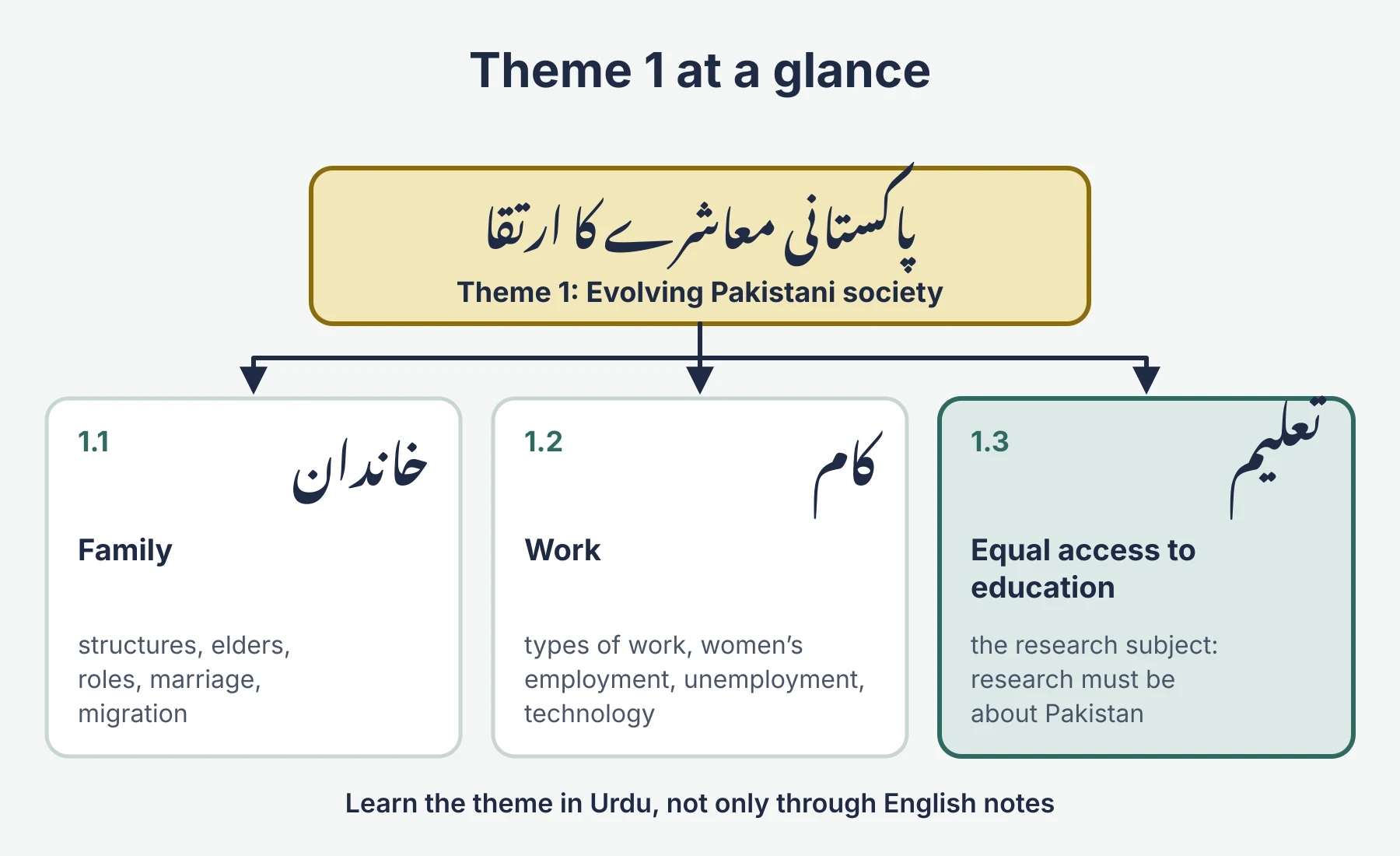
- Theme 1: Evolving Pakistani society (پاکستانی معاشرے کا ارتقا)
- Author
- Marlbridge Academic Team
- Updated
- Reviewed by
- Farheen Zehra (what this means)
Aligned to Pearson Edexcel A Level Urdu Language (9UR0), 2018. Official specification .
Syllabus page (what it covers and how it is assessed): Pearson Edexcel A Level Urdu Language.
Syllabus points this page covers
9UR0
- 1.1 خاندان
Found an error? Report a correction.
Need help with this topic? Request a free trial class for A Level Urdu Language (9UR0).
Revision notes for sub-theme 1.1 of Theme 1 in Pearson Edexcel A Level Urdu (9UR0): family (خاندان). For the wider theme, read the Theme 1 study guide.
Key ideas
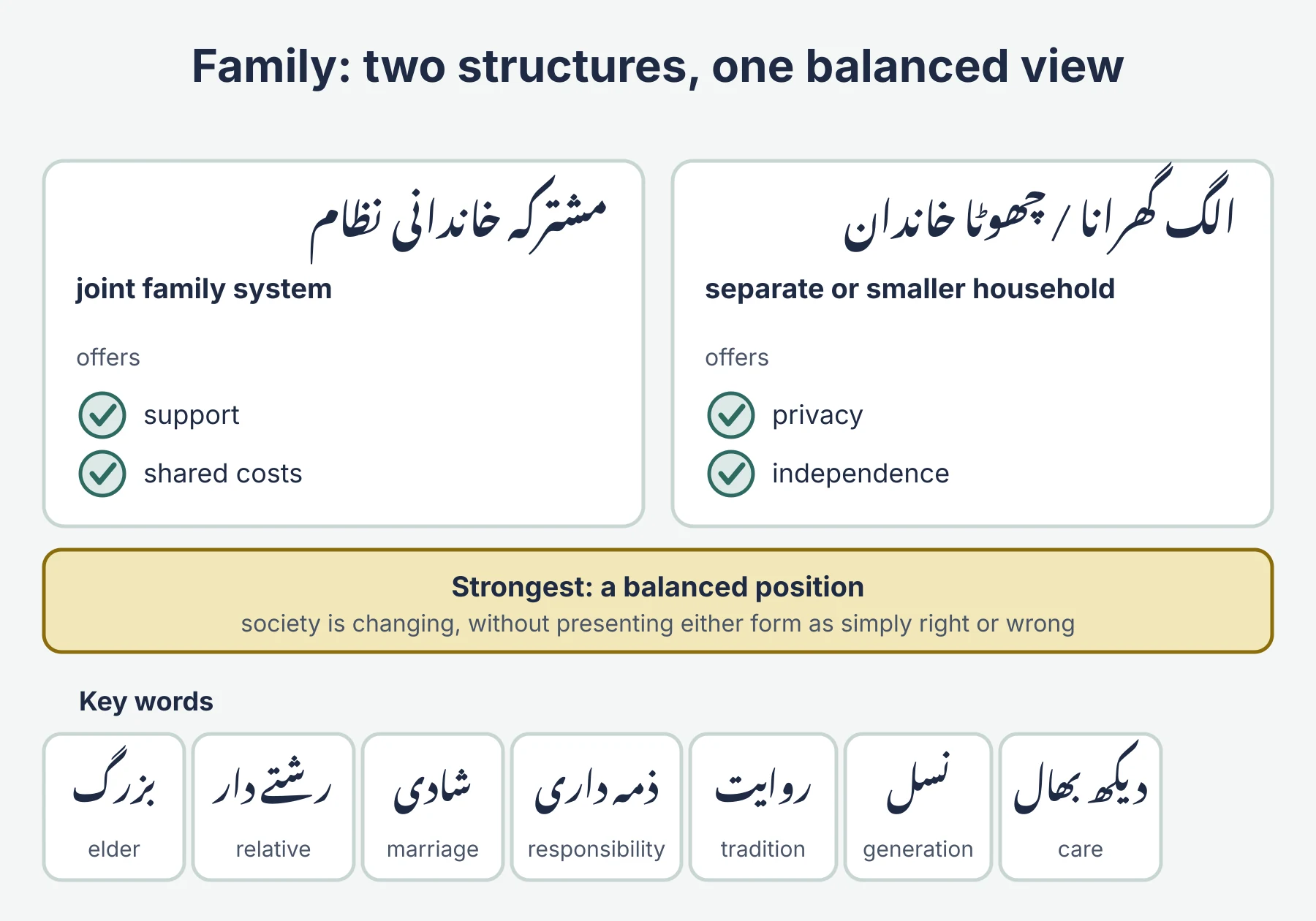
- مشترکہ خاندانی نظام = the joint family system (several generations or related households living and sharing responsibilities).
- الگ گھرانا / چھوٹا خاندان = a separate or smaller household.
- Also be ready to discuss: the role of elders and who cares for them, changing roles of parents and children, marriage customs and expectations, and the effect of migration from villages to cities and of work abroad.
Issues and perspectives
The joint family and why it is changing. In a traditional joint family, grandparents, their sons, the sons’ wives and children may share one house, one kitchen and one budget, with the eldest man or woman often taking the main decisions. This system offers shared costs, childcare from grandparents, company and care in old age, and a sense of belonging. Several pressures are changing it: moving to cities for work (شہروں کی طرف نقل مکانی), smaller flats, more women in paid work, higher education, work abroad, and a growing wish among couples for privacy (نجی زندگی) and independence (خود مختاری). Many families now live in a mixed pattern: a separate household close to the parents, with frequent visits and shared responsibilities.
Elders and their care. Respect for elders (بزرگوں کا احترام) is a strong value, and caring for parents in old age (بڑھاپا) is widely seen as the children’s duty. When children move away, elderly parents may be left alone; the appearance of old people’s homes (اولڈ ہوم) in cities is debated, with some seeing them as a practical solution and others as a sign that family duty is weakening. The film Baaghban dramatises this question.
Changing roles of parents and children. Parents often still guide decisions about study, career and marriage, but young people increasingly expect to be consulted. The نسلوں کا فرق (generation gap) shows in attitudes to technology, careers, dress and freedom. Women’s roles are also changing: more women study and work, which can bring greater independence but also the double burden of paid work and housework.
Marriage customs and expectations. Marriages arranged by the family, with the couple’s consent, remain common, alongside پسند کی شادی (marriage of one’s own choice). Debates include the role of the couple’s consent, marriage within the extended family, the pressure of expensive weddings, and جہیز (dowry), which many regard as a social evil (سماجی برائی) that burdens poorer families with daughters.
Migration and the family. When a parent works in the Gulf or a family settles abroad, money sent home can improve living standards, but separation affects relationships and children’s upbringing. Second-generation families abroad may hold different expectations from relatives in Pakistan, which links this sub-theme to Theme 3.
A balanced position. Avoid claiming that the joint family is always better or that it is simply outdated. Most strong answers argue that the form of the family is changing, while its core values (support, respect, care) can survive in new forms.
Vocabulary
| Urdu | Meaning |
|---|---|
| خاندان | family |
| بزرگ | elder |
| رشتے دار | relative |
| شادی | marriage |
| ذمہ داری | responsibility |
| روایت | tradition |
| نسل | generation (feminine) |
| دیکھ بھال | care (feminine) |
| مشترکہ خاندان | joint family |
| والدین | parents |
| اولاد | children, offspring |
| دادا دادی | paternal grandparents |
| نانا نانی | maternal grandparents |
| ساس / بہو | mother-in-law / daughter-in-law |
| بڑھاپا | old age |
| سہارا | support |
| نجی زندگی | private life, privacy |
| خود مختاری | independence |
| نسلوں کا فرق | generation gap |
| پسند کی شادی | marriage of one’s own choice |
| جہیز | dowry |
| سماجی برائی | social evil |
| نقل مکانی | moving home, migration |
| احترام | respect |
Building a balanced argument
| Joint family | Smaller household |
|---|---|
| Support and shared costs | Privacy and independence |
| Easier care of elders | Couples make their own decisions |
| Grandparents help raise children | Fewer household disputes |
| Strong sense of belonging | Easier to move for work |
The strongest position is usually balanced: society is changing, and neither form is simply right or wrong. Give a benefit, a cost and a reasoned opinion.
Grammar to control
- Perfective sentences with نے: the verb agrees with the object, not the subject (جوڑوں نے الگ گھر بنا لیے ہیں).
- Contrast frame: پہلے … لیکن اب.
- Feminine agreement: مشکل ہو گئی ہے agrees with دیکھ بھال.
Useful sentences with grammar notes
- مشترکہ خاندان میں دادا دادی بچوں کی تربیت میں اہم کردار ادا کرتے ہیں۔ (In a joint family, grandparents play an important part in bringing up the children.) A mixed-gender pair takes masculine plural: ادا کرتے ہیں.
- بڑھاپے میں والدین کو اولاد کے سہارے کی ضرورت ہوتی ہے۔ (In old age, parents need their children’s support.) Dative construction with ضرورت ہونا; the verb agrees with ضرورت (feminine): ہوتی ہے. بڑھاپا becomes بڑھاپے after میں.
- بہت سے لوگ جہیز کو ایک سماجی برائی سمجھتے ہیں۔ (Many people regard dowry as a social evil.) X کو Y سمجھنا means ‘to regard X as Y’.
- اگر میاں بیوی دونوں ملازمت کریں تو بچوں کی دیکھ بھال کا مسئلہ پیدا ہوتا ہے۔ (If both husband and wife work, the problem of childcare arises.) Subjunctive کریں in the condition; مسئلہ is masculine, so پیدا ہوتا ہے.
- نئی نسل اپنی شادی کے فیصلے میں زیادہ رائے دینا چاہتی ہے۔ (The new generation wants more say in decisions about its own marriage.) نسل is feminine, so چاہتی ہے.
Model paragraph
خاندان پاکستانی معاشرے کی بنیاد سمجھا جاتا ہے، لیکن اس کی شکل بدل رہی ہے۔ مشترکہ خاندان میں بچوں کو دادا دادی کی محبت اور تجربہ ملتا ہے، اور مشکل وقت میں سب ایک دوسرے کا سہارا بنتے ہیں۔ دوسری طرف ایک ہی گھر میں کئی خاندانوں کے رہنے سے نجی زندگی کم ہو جاتی ہے اور بعض اوقات ساس بہو کے جھگڑے بھی جنم لیتے ہیں۔ شادی کے معاملے میں بھی نئی نسل اب زیادہ رائے دینا چاہتی ہے۔ میرے خیال میں کوئی ایک نظام سب کے لیے بہترین نہیں؛ اصل بات یہ ہے کہ خاندان کے افراد ایک دوسرے کی عزت کریں اور بزرگوں کو تنہا نہ چھوڑیں۔
Translation: The family is regarded as the foundation of Pakistani society, but its form is changing. In a joint family, children receive the love and experience of their grandparents, and in hard times everyone becomes a support for one another. On the other hand, when several families live in one house, privacy is reduced, and sometimes quarrels between mother-in-law and daughter-in-law arise. In matters of marriage, too, the new generation now wants more of a say. In my view no single system is best for everyone; what really matters is that family members respect one another and do not leave their elders alone.
Why it works: a statement of change, a benefit, a cost introduced with دوسری طرف, a second area of change (marriage), and a conclusion that moves beyond ‘joint versus separate’ to shared values. Note نہ چھوڑیں (not نہیں) in the subjunctive clause.
Connectives to reuse
| Urdu | Use |
|---|---|
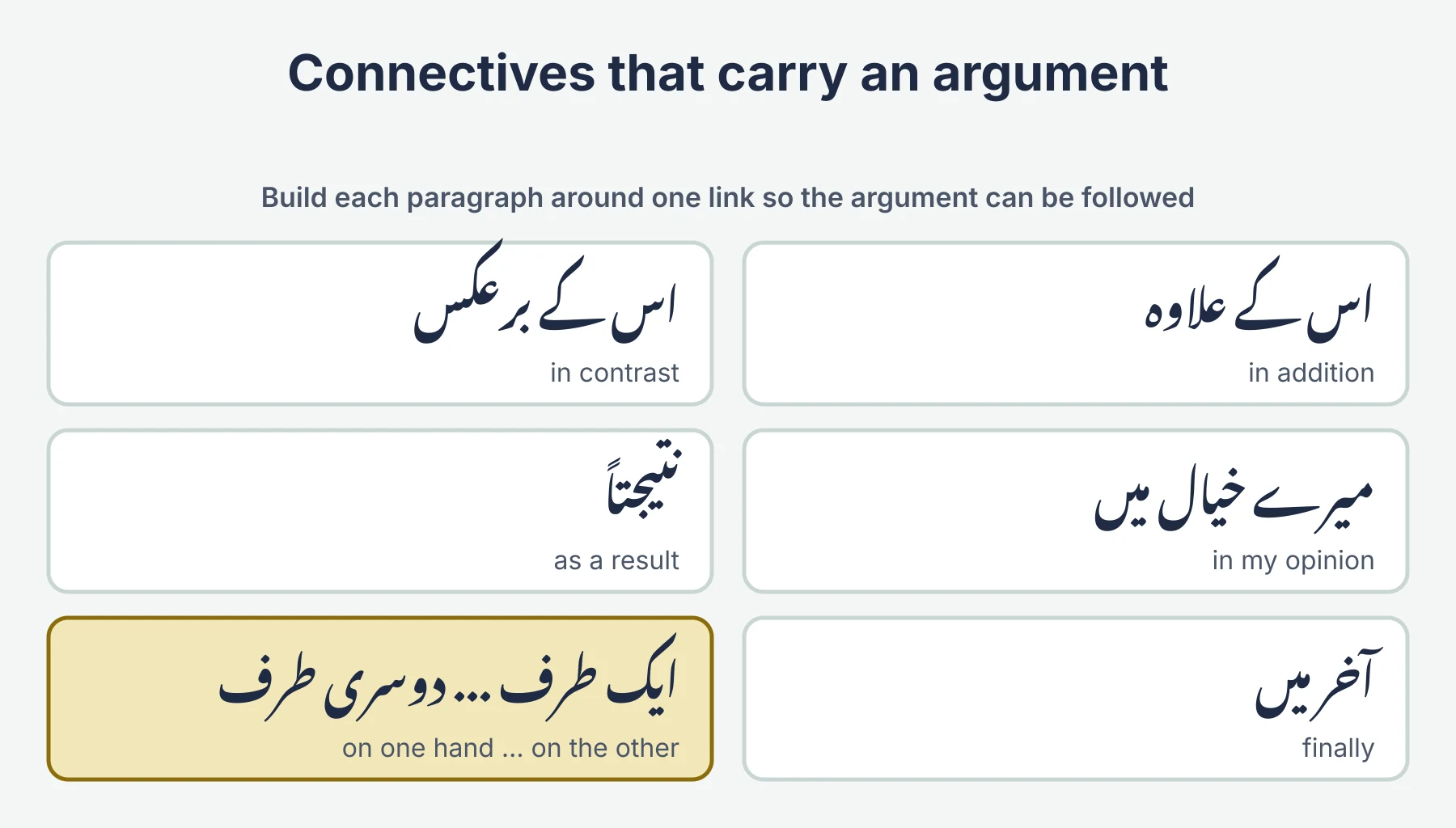
| اس کے برعکس | in contrast |
| اس کے علاوہ | in addition |
| نتیجتاً | as a result |
| میرے خیال میں | in my opinion |
| ایک طرف … دوسری طرف | on one hand … on the other |
| آخر میں | finally |
Discussion and essay prompts
- «مشترکہ خاندانی نظام آج کے دور کی ضروریات پوری نہیں کر سکتا۔» (The joint family system cannot meet the needs of today’s world.) To what extent do you agree?
- «بزرگوں کی دیکھ بھال صرف اولاد کی ذمہ داری ہے۔» (Caring for elders is the responsibility of children alone.) Discuss the role of the state as well.
- How far should young people decide about their own marriage?
- How has migration, within Pakistan and abroad, changed family life?
Exam traps
- Dropping نے or making the verb agree with the wrong noun.
- English word order instead of verb-final Urdu.
- A one-sided argument with no reasons.
- Treating نسل and دیکھ بھال as masculine; both are feminine.
- Using نہیں instead of نہ in subjunctive and conditional clauses (تنہا نہ چھوڑیں).
- Writing in generalities (‘all families are…’); show that patterns differ between city and village and between families.
Self-test
- What does مشترکہ خاندانی نظام mean?
- Give the Urdu for ‘elder’ and ‘generation’.
- Why is the verb plural in جوڑوں نے الگ گھر بنا لیے ہیں?
- Name one benefit and one cost of smaller households.
- Which connective introduces a contrast between past and present?
- Name three pressures that are changing the joint family.
- What is the debate about old people’s homes?
- Give the Urdu for ‘dowry’ and ‘marriage of one’s own choice’.
- In بڑھاپے میں والدین کو اولاد کے سہارے کی ضرورت ہوتی ہے, why is the verb ہوتی?
- Why does دادا دادی take a masculine plural verb?
- Translate: ‘the new generation wants more say in decisions about its own marriage’.
- Which prescribed film deals most directly with the care of elderly parents?
Answers: 1. The joint family system, in which several generations or related households live and share responsibilities together. 2. بزرگ and نسل. 3. With نے the verb agrees with the object گھر, masculine plural here. 4. For example, privacy and independence (benefit); caring for elders becomes harder (cost). 5. پہلے … لیکن اب. 6. For example, moving to cities for work, smaller homes, women’s paid work, higher education, work abroad and the wish for privacy. 7. Some see them as a practical solution; others see them as a sign that family duty is weakening. 8. جہیز and پسند کی شادی. 9. It agrees with ضرورت, which is feminine. 10. A pair of mixed gender takes masculine plural agreement. 11. نئی نسل اپنی شادی کے فیصلے میں زیادہ رائے دینا چاہتی ہے۔ 12. باغبان (Baaghban).
Related resources
-
Study guides
Edexcel A-Level Urdu: Theme 1, Evolving Pakistani Society (9UR0)
Family, work and equal access to education in Pakistan: vocabulary, ideas and model Urdu writing for Theme 1 of Pearson Edexcel GCE A-Level Urdu (9UR0).
Urdu Language · Pearson Edexcel · A Level
Read guide -
Revision notes
Edexcel A Level Urdu (9UR0): Work (کام) – Revision Notes
9UR0 Theme 1.2 notes on work (کام): informal work, unemployment, women's employment, technology, a model paragraph and a self-test.
Urdu Language · Pearson Edexcel · A Level
Revise topic -
Study guides
Edexcel A Level Urdu (9UR0): Work (کام)
9UR0 sub-theme 1.2 study guide on work: changing professions, women in the workplace and workers' rights, with a translation into Urdu walk-through.
Urdu Language · Pearson Edexcel · A Level
Read guide
Get free revision emails (optional)
Occasional emails with practice questions, worked explanations and links to free resources for the qualification and subjects you choose. No spam, and you can unsubscribe from any email. The free tools on this site never need an email.