
Revision Notes
Edexcel A Level Urdu (9UR0): Baaghban (باغبان) – Revision Notes
9UR0 notes on the prescribed film Baaghban (باغبان), Ravi Chopra (2003): themes, film technique, a model paragraph and a self-test.
- Subject
- Urdu Language
- Level
- A LEVELS
- Topic
- Prescribed literary texts and films
- Author
- Marlbridge Academic Team
- Updated
- Reviewed by
- Farheen Zehra (what this means)
Aligned to Pearson Edexcel A Level Urdu Language (9UR0), 2018. Official specification .
Syllabus page (what it covers and how it is assessed): Pearson Edexcel A Level Urdu Language.
Syllabus points this page covers
9UR0
- 5.5 باغبان — روی چوپڑہ (2003)
Found an error? Report a correction.
Need help with this topic? Request a free trial class for A Level Urdu Language (9UR0).
Revision notes for 5.5 in the prescribed literary texts and films of Pearson Edexcel A Level Urdu (9UR0), Paper 2. For the full explanation of the paper, read the Translation into Urdu and Written Response to Works study guide and the Paper 2 revision notes.
The work
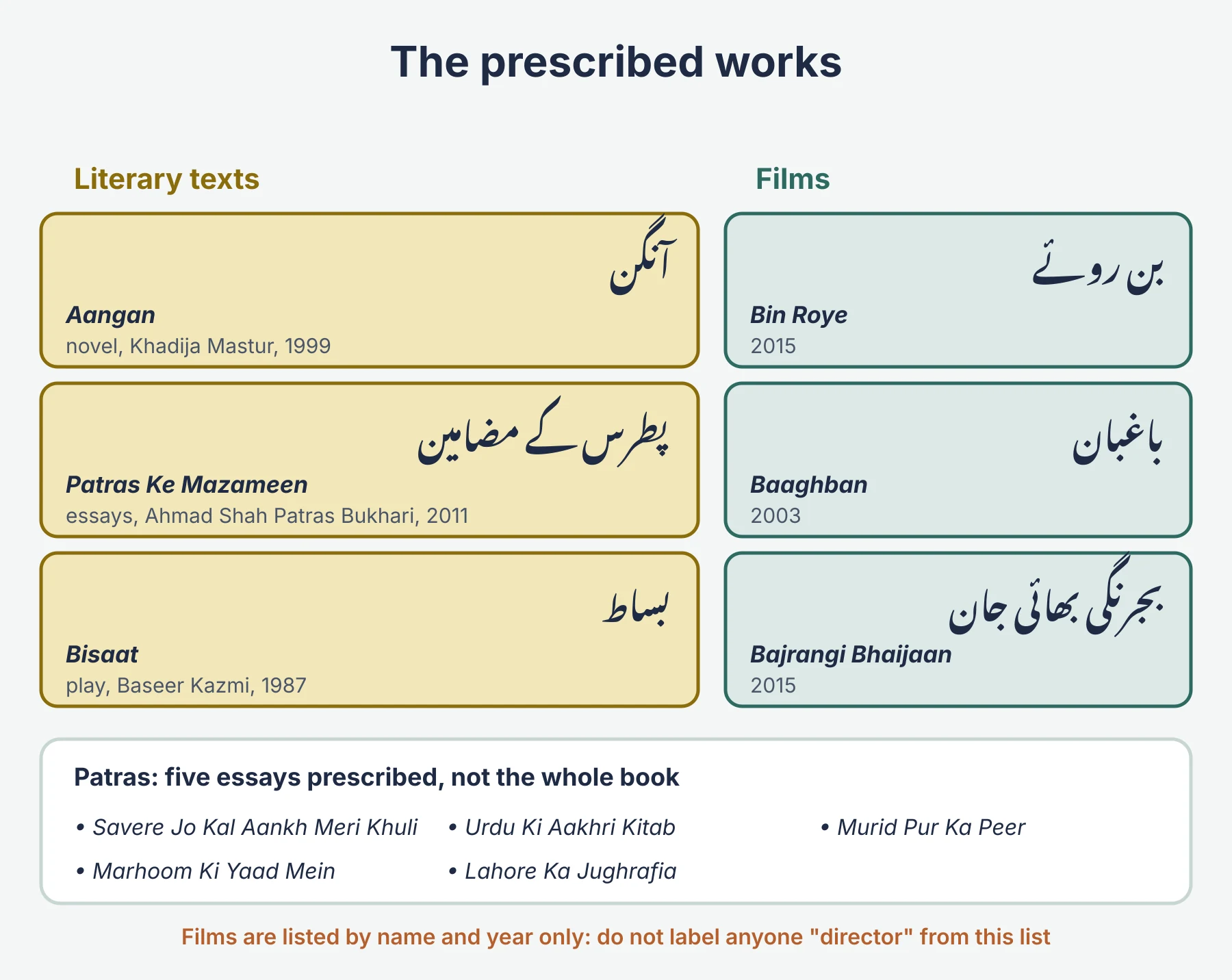
- Title: باغبان (Baaghban)
- Name given in the specification: روی چوپڑہ (Ravi Chopra)
- Year: 2003
- Form: a prescribed film in Appendix 1.
The specification gives each film as a name and a year only, with no role label, so do not write a name in as ‘director’ on the strength of the list alone.
What the film is about
Baaghban is a Hindi-language family drama. Its central couple, راج (Raj) and پوجا (Pooja) Malhotra, played by Amitabh Bachchan and Hema Malini, have devoted their lives to bringing up four sons. When Raj retires, the couple hope their children will support them in old age. Instead, the sons treat them as a burden and arrange for the parents to live apart, each with a different son. The separation, the couple’s loyalty to each other, and the contrast between the sons and آلوک (Alok), a young man the couple had cared for as a boy and who treats them with real devotion, drive the story. Raj turns his experience into a book, and its success allows him to speak publicly about the duty of children towards their parents.
Use this outline only for orientation. In the exam you need your own specific references to scenes and moments, gathered from watching the film closely.
The title
باغبان means ‘gardener’. The image suggests parents as gardeners who plant, water and protect their children as a gardener tends trees, expecting that the trees will one day give shade and fruit. Ask whether the film shows this expectation as fair, and what happens when it is disappointed.
Key themes and issues
- Duty to parents and elders: the film’s central question is what children owe to parents who sacrificed for them. Link this directly to Theme 1, sub-theme 1.1, family.
- Joint family and changing values: the sons’ attitudes reflect a shift towards independence, money and personal comfort; the film tends to present this shift critically.
- Marriage as companionship: Raj and Pooja’s relationship, tested by separation, is presented as an ideal of lifelong partnership.
- Gratitude and ingratitude: the contrast between the sons and Alok suggests that loyalty is shown through actions, not only through blood ties.
- Old age and independence: Raj’s financial dependence after retirement raises the question of how elderly people can keep their dignity.
Form and technique
- Melodrama (جذباتیت): strong emotions, clear moral contrasts and music are used to move the audience. You may evaluate this: does it make the message powerful, or one-sided?
- Songs (گانے): as in much Indian cinema, songs express feelings that dialogue does not, and mark key moments of joy or separation.
- Contrast and parallel scenes: scenes of the parents apart, and of the sons’ comfortable lives, are set against each other to guide the audience’s sympathy.
- Final speech: the film ends with a public statement of its message. Consider whether this direct approach strengthens or weakens the film.
- Acting and casting: two very well-known stars in the parents’ roles give the story weight and draw the audience’s sympathy.
How it is examined
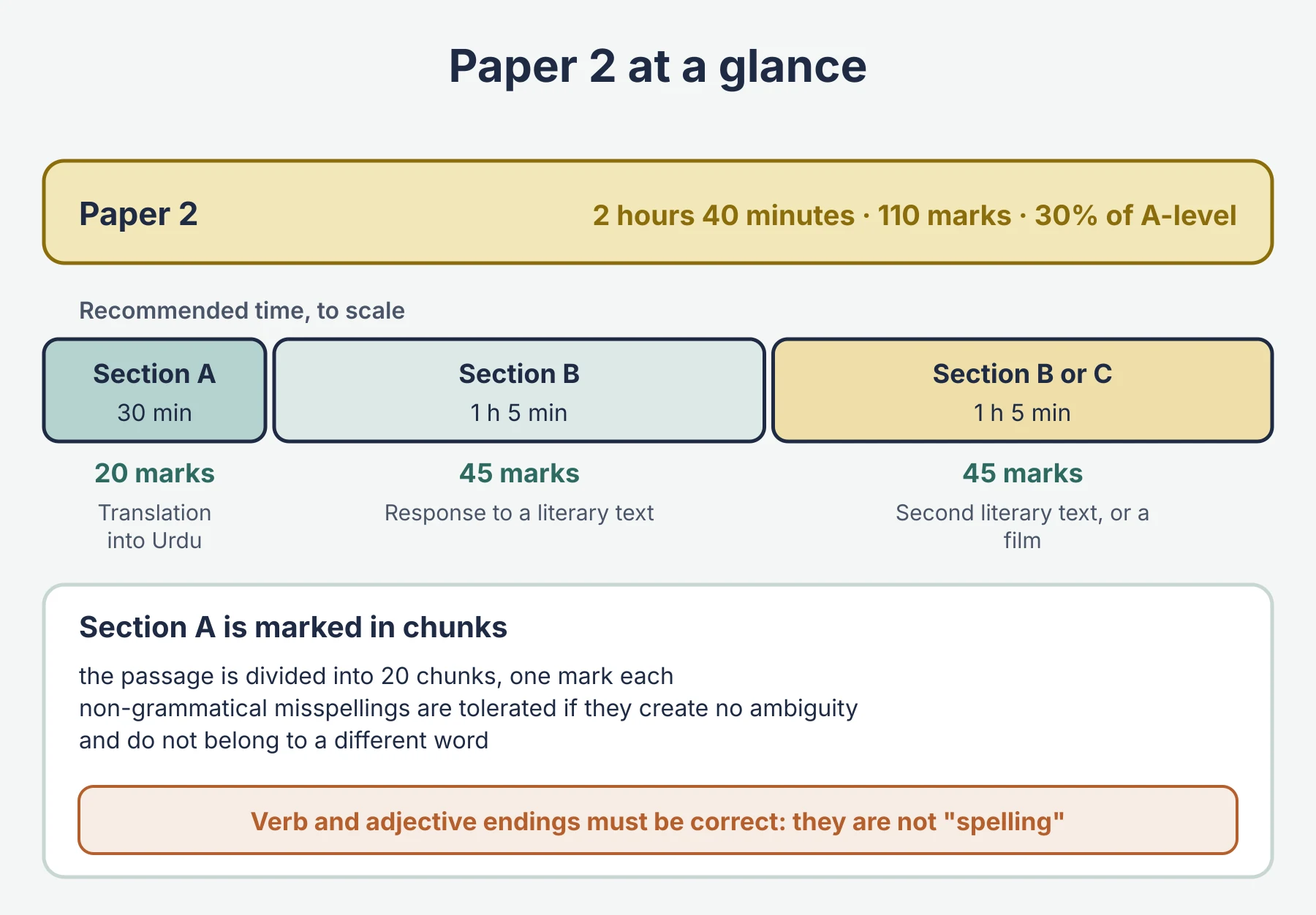
- Paper 2 is 2 hours 40 minutes, 110 marks, 30% of the A Level.
- Section C (film) is worth 45 marks and about 1 hour 5 minutes; you choose from two questions.
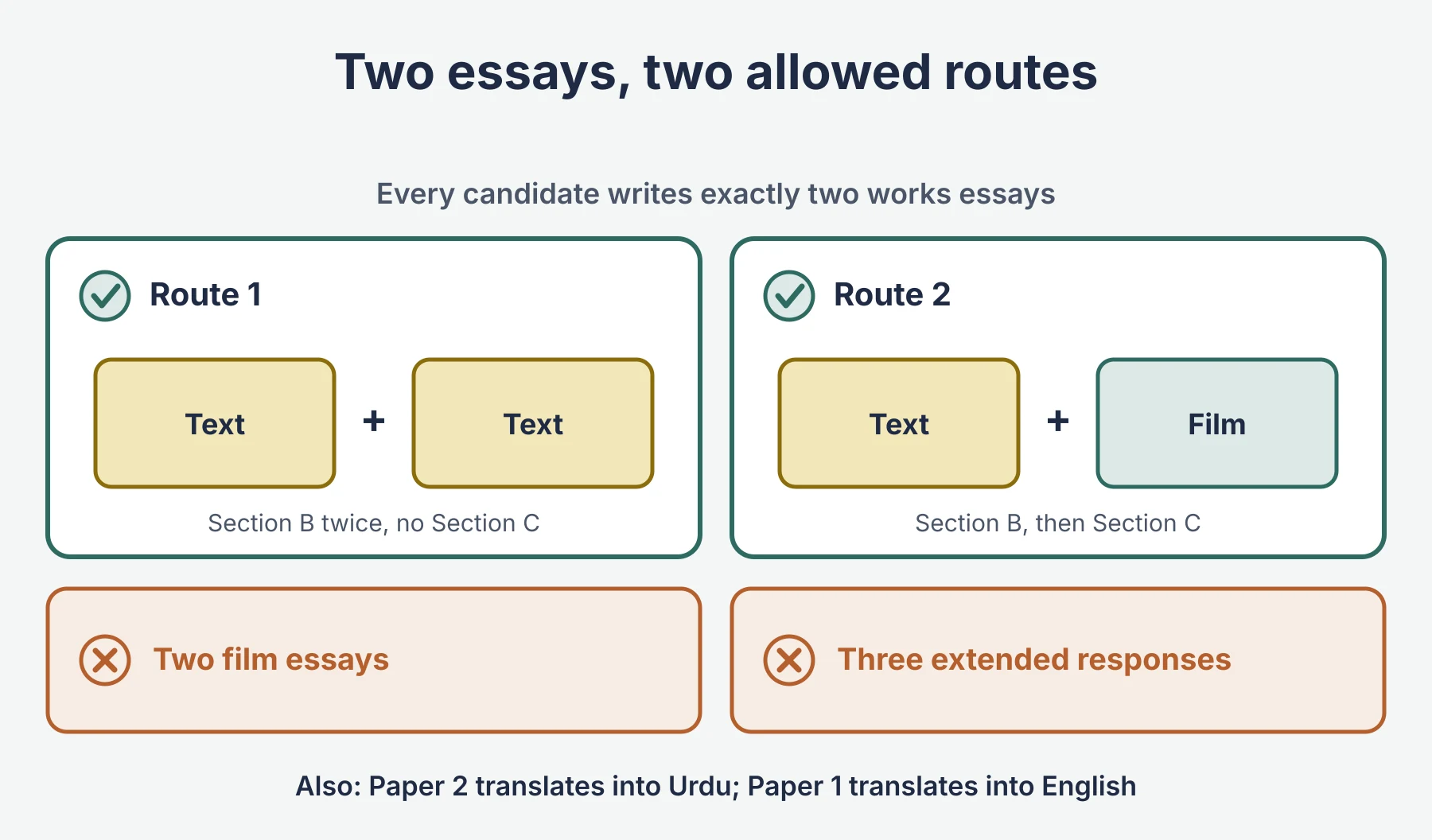
- You write exactly two extended responses: two literary texts, or one literary text and one film. Two films is never allowed.
- Marking criteria: critical and analytical response with cultural or social insight (AO4), range of grammatical structures and vocabulary (AO3), and accuracy of language (AO3). There are no AO1 or AO2 marks on Paper 2.
Approach and skills
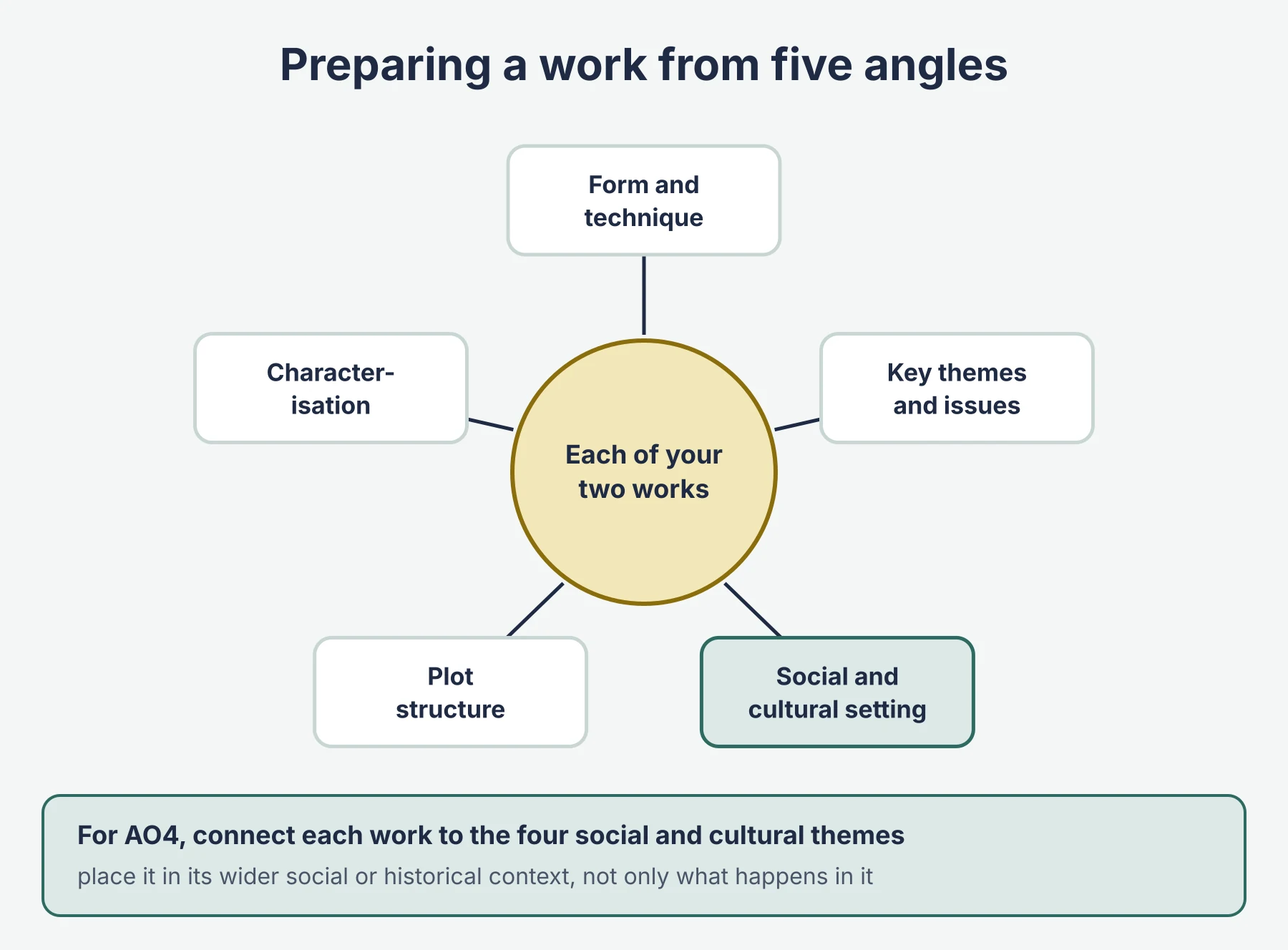
- Prepare against five angles: form and technique, key themes and issues, characterisation, plot structure, social and cultural setting.
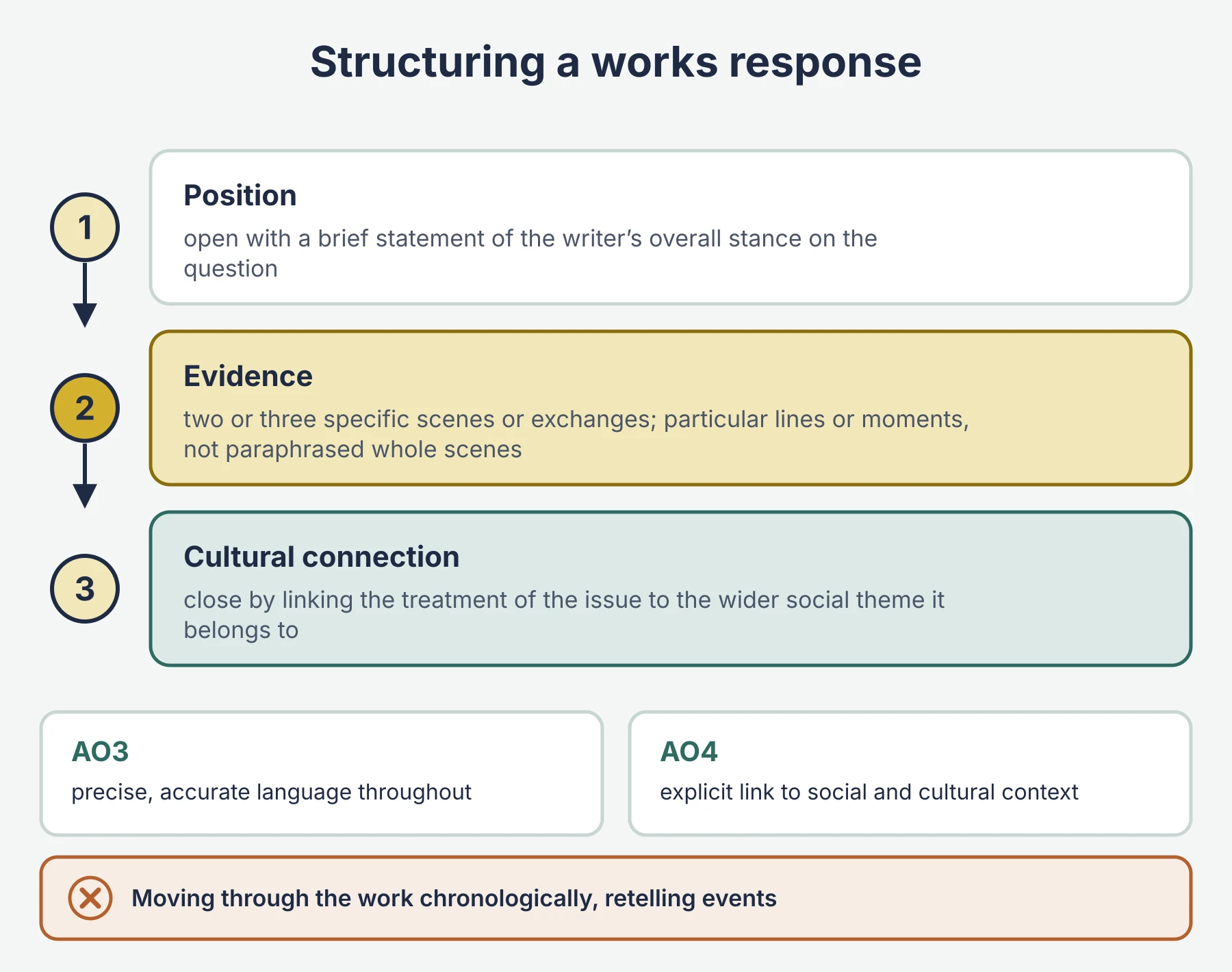
- Structure each answer as position, evidence, cultural connection: state your stance, support it with two or three specific points (not a retelling), then link the writer’s or film’s treatment of an issue to a broader social or cultural theme.
- Write in controlled Urdu with correct agreement, tense and spelling, and plan before you write.
- Use your own prepared references from the work; this page does not replace studying it.
Vocabulary for writing about the film
| Urdu | Meaning |
|---|---|
| فلم | film |
| منظر / مناظر | scene / scenes |
| اداکاری | acting |
| مکالمے | dialogue, lines |
| گانا / نغمہ | song |
| موسیقی | music |
| عکس بندی | cinematography, filming |
| کہانی | story |
| پیغام | message |
| جذباتیت | sentimentality, melodrama |
| والدین | parents |
| اولاد | children, offspring |
| بڑھاپا | old age |
| ریٹائرمنٹ | retirement |
| سہارا | support |
| احسان فراموشی | ingratitude |
| قربانی | sacrifice |
| پرورش | upbringing |
| وفاداری | loyalty |
Useful sentences with grammar notes
- فلم میں والدین اور اولاد کے رشتے کو مرکزی موضوع بنایا گیا ہے۔ (The film makes the relationship between parents and children its central theme.) Passive with کو, so masculine singular: بنایا گیا ہے.
- بیٹے اپنے بوڑھے والدین کو بوجھ سمجھنے لگتے ہیں۔ (The sons begin to regard their elderly parents as a burden.) سمجھنے لگنا means ‘to begin to regard’.
- راج اور پوجا کو مجبوراً الگ الگ گھروں میں رہنا پڑتا ہے۔ (Raj and Pooja are forced to live in separate houses.) Obligation with کو + infinitive + پڑنا.
- فلم کا اختتام کچھ زیادہ جذباتی ہے، مگر اس کا پیغام واضح ہے۔ (The film’s ending is rather too emotional, but its message is clear.) A balanced evaluation in one sentence.
Model paragraph
Task: how does the film present the relationship between parents and children?
فلم “باغبان” میں والدین اور اولاد کے رشتے کو مرکزی موضوع بنایا گیا ہے۔ راج اور پوجا ساری زندگی اپنے بیٹوں کی پرورش اور تعلیم کے لیے قربانیاں دیتے ہیں، لیکن ریٹائرمنٹ کے بعد جب انھیں سہارے کی ضرورت ہوتی ہے تو بیٹے انھیں بوجھ سمجھنے لگتے ہیں اور دونوں کو الگ الگ گھروں میں رہنا پڑتا ہے۔ فلم کا عنوان بھی معنی خیز ہے، کیونکہ باغبان کی طرح والدین بچوں کو پروان چڑھاتے ہیں مگر بدلے میں ہمیشہ پھل نہیں پاتے۔ میرے خیال میں یہ فلم برصغیر کے خاندانی نظام میں آنے والی تبدیلیوں پر ایک سوال اٹھاتی ہے: کیا جدید زندگی میں بزرگوں کی عزت اور دیکھ بھال کی روایت کمزور ہو رہی ہے؟
Translation: In the film Baaghban, the relationship between parents and children is the central theme. Raj and Pooja make sacrifices all their lives for their sons’ upbringing and education, but after retirement, when they need support, the sons begin to see them as a burden and the two have to live in separate houses. The film’s title is also meaningful, because like a gardener, parents raise their children but do not always receive fruit in return. In my view the film raises a question about the changes taking place in the family system of the subcontinent: is the tradition of respecting and caring for elders becoming weaker in modern life?
Why it works: a clear position, evidence from the story, analysis of the title, and a cultural connection to the joint family system. In a real answer, add one or two specific scenes and comment on a technique such as music or contrast.
Essay prompts to prepare
- «فلم “باغبان” میں بزرگوں کے ساتھ سلوک کی عکاسی کا تنقیدی جائزہ لیجیے۔» (Critically evaluate the portrayal of the treatment of elders in Baaghban.)
- «“باغبان” کا پیغام آج کے معاشرے کے لیے پہلے سے زیادہ اہم ہے۔» (The message of Baaghban matters more to today’s society than ever.) To what extent do you agree?
- How does the film use the character of Alok to develop its themes?
- Is the film’s emotional style a strength or a weakness?
Exam traps
- Retelling the story without connecting it to a theme weakens the AO4 mark.
- Attempting three responses, or choosing two films.
- Running over time on the first response and squeezing the second.
- Calling Ravi Chopra the director on the strength of the specification list alone.
- Analysing only the story and never the film techniques (music, contrast, acting, the final speech).
- Writing that all young people are ungrateful; the film itself offers Alok as a counter-example.
Self-test
- Which name and year does the specification give for باغبان?
- What must a film answer show for AO4?
- Which section covers films?
- What structure helps link AO3 and AO4?
- Why avoid retelling the plot?
- Who are the central couple, and what happens to them after retirement?
- What does the title mean, and what does the image suggest?
- What role does Alok play in developing the film’s themes?
- Name two film techniques you could analyse.
- Which Theme 1 sub-theme links most closely to the film?
- Give the Urdu for ‘upbringing’, ‘ingratitude’ and ‘old age’.
- In راج اور پوجا کو … رہنا پڑتا ہے, what does رہنا پڑتا ہے express?
Answers: 1. روی چوپڑہ, 2003. 2. A critical and analytical response with cultural or social insight. 3. Section C. 4. Position, evidence, cultural connection. 5. It does not connect the film to a theme and weakens the AO4 mark. 6. Raj and Pooja Malhotra; their sons treat them as a burden and they are made to live apart in different sons’ homes. 7. ‘Gardener’; parents tend their children like a gardener tends trees, hoping for shade and fruit in return. 8. He shows real devotion, in contrast to the sons, suggesting loyalty is proved by actions, not only by blood ties. 9. For example, songs and music, contrasting scenes, acting, and the final speech. 10. Sub-theme 1.1, family. 11. پرورش, احسان فراموشی and بڑھاپا. 12. Obligation: they are forced to live (have to live).
Related resources
-
Revision notes
Edexcel A Level Urdu (9UR0): Bajrangi Bhaijaan (بجرنگی بھائی جان) – Revision Notes
9UR0 notes on the prescribed film Bajrangi Bhaijaan (بجرنگی بھائی جان), Kabir Khan (2015): themes, technique, a model paragraph and a self-test.
Urdu Language · Pearson Edexcel · A Level
Revise topic -
Revision notes
Edexcel A Level Urdu (9UR0): Bin Roye (بن روئے) – Revision Notes
9UR0 notes on the prescribed film Bin Roye (بن روئے), Momina Duraid (2015): themes, film technique, a model paragraph and a self-test.
Urdu Language · Pearson Edexcel · A Level
Revise topic -
Revision notes
Edexcel A Level Urdu (9UR0): Bisaat (بساط) – Revision Notes
9UR0 notes on the prescribed play Bisaat (بساط) by Baseer Kazmi (1987): the title, reading a play, an essay frame and a self-test.
Urdu Language · Pearson Edexcel · A Level
Revise topic
Get free revision emails (optional)
Occasional emails with practice questions, worked explanations and links to free resources for the qualification and subjects you choose. No spam, and you can unsubscribe from any email. The free tools on this site never need an email.