
Revision Notes
Edexcel International A Level Accounting: Capital and revenue expenditure and depreciation (YAC11) – Revision Notes
Condensed revision notes on capital and revenue expenditure and non-current asset depreciation, outcomes 1.1.11 to 1.1.20 of Edexcel IAL Accounting.
- Subject
- Accounting
- Level
- AS LEVEL
- Topic
- Principles of accounting and double entry bookkeeping
- Author
- Marlbridge Academic Team
- Updated
- Reviewed by
- Javaid Iqbal Sabri (what this means)
Aligned to Pearson Edexcel A Level Accounting (YAC11), 2015-onwards. Official specification .
Syllabus page (what it covers and how it is assessed): Pearson Edexcel A Level Accounting.
Syllabus points this page covers
YAC11 (AS Level)
- 1.1.11-1.1.12 Capital expenditure and revenue expenditure
- 1.1.13-1.1.20 Non-current asset depreciation
Found an error? Report a correction.
Need help with this topic? Request a free trial class for A Level Accounting (YAC11).
These notes condense outcomes 1.1.11 to 1.1.20 of the Pearson Edexcel International Advanced Subsidiary/Advanced Level in Accounting (XAC11/YAC11) specification, Issue 2, September 2018, Unit 1 topic 1.1. Full explanations are in the study guide, and the practice questions test the same content. For the wider topic see Principles and double entry bookkeeping. The course hub is Edexcel A-Level Accounting, and the printable list is the checklist. The free diagnostics show which parts to revise first. Businesses and figures are invented, and amounts are in dollars.
Capital and revenue expenditure (1.1.11 and 1.1.12)
| Capital expenditure | Revenue expenditure | |
|---|---|---|
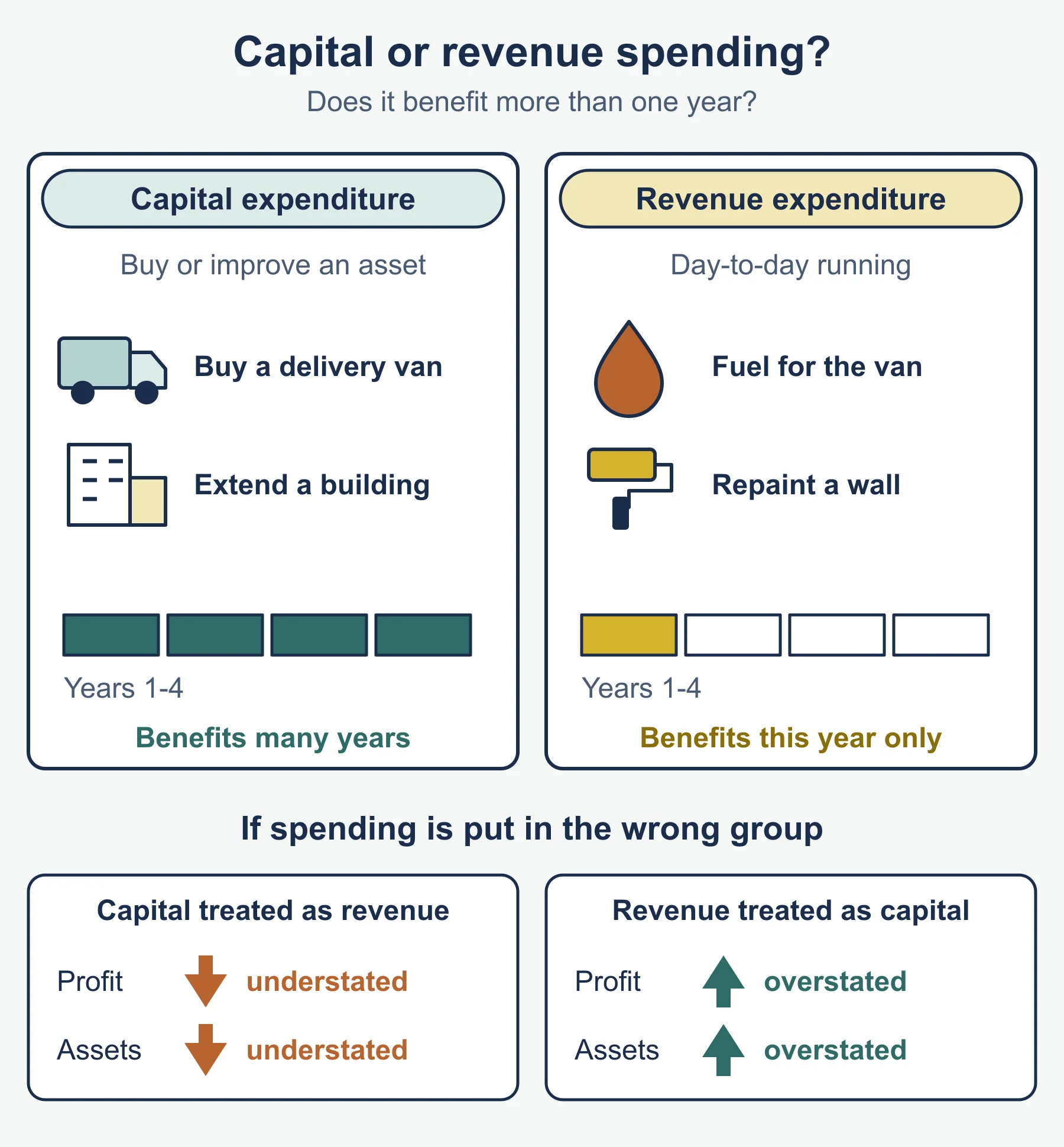
| Purpose | Acquire or improve a non-current asset | Run the business or maintain an asset |
| Where it goes | Statement of financial position, then depreciation | Statement of profit or loss, in full |
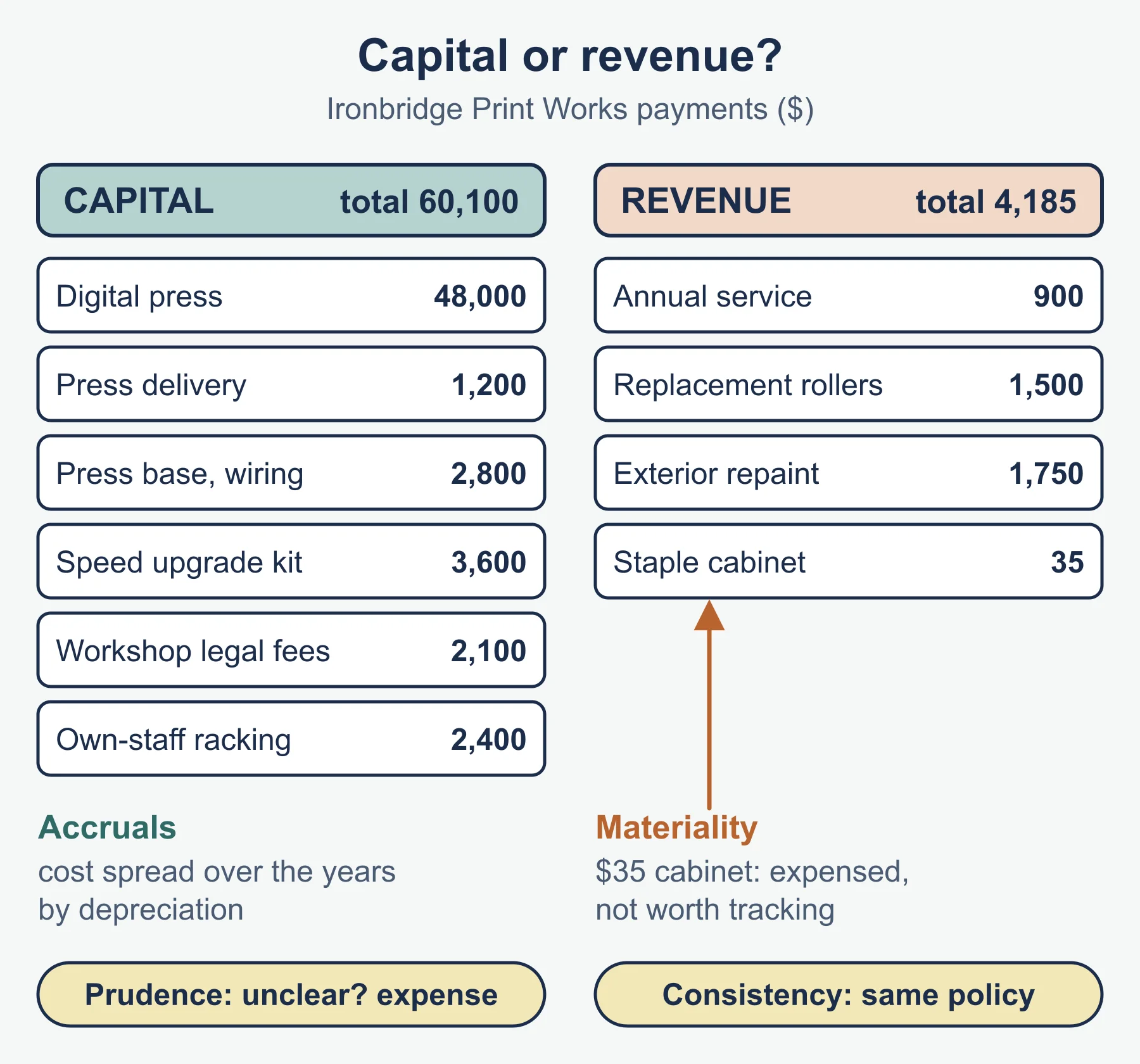
| Examples | Purchase price, delivery, installation, an upgrade that adds capacity | Repairs, servicing, fuel, repainting |
Concepts to name: accruals (spread a multi-year benefit), prudence (do not overstate profit or assets), materiality (trivial items are expensed), consistency (same policy each year).
Misclassification effects
- Capital spending treated as an expense: profit understated, non-current assets understated.
- Revenue spending treated as capital: profit overstated, non-current assets overstated.
Split a mixed invoice into its capital and revenue parts.
Causes and reasons (1.1.13 and 1.1.14)
| Causes | Reasons for charging |
|---|---|
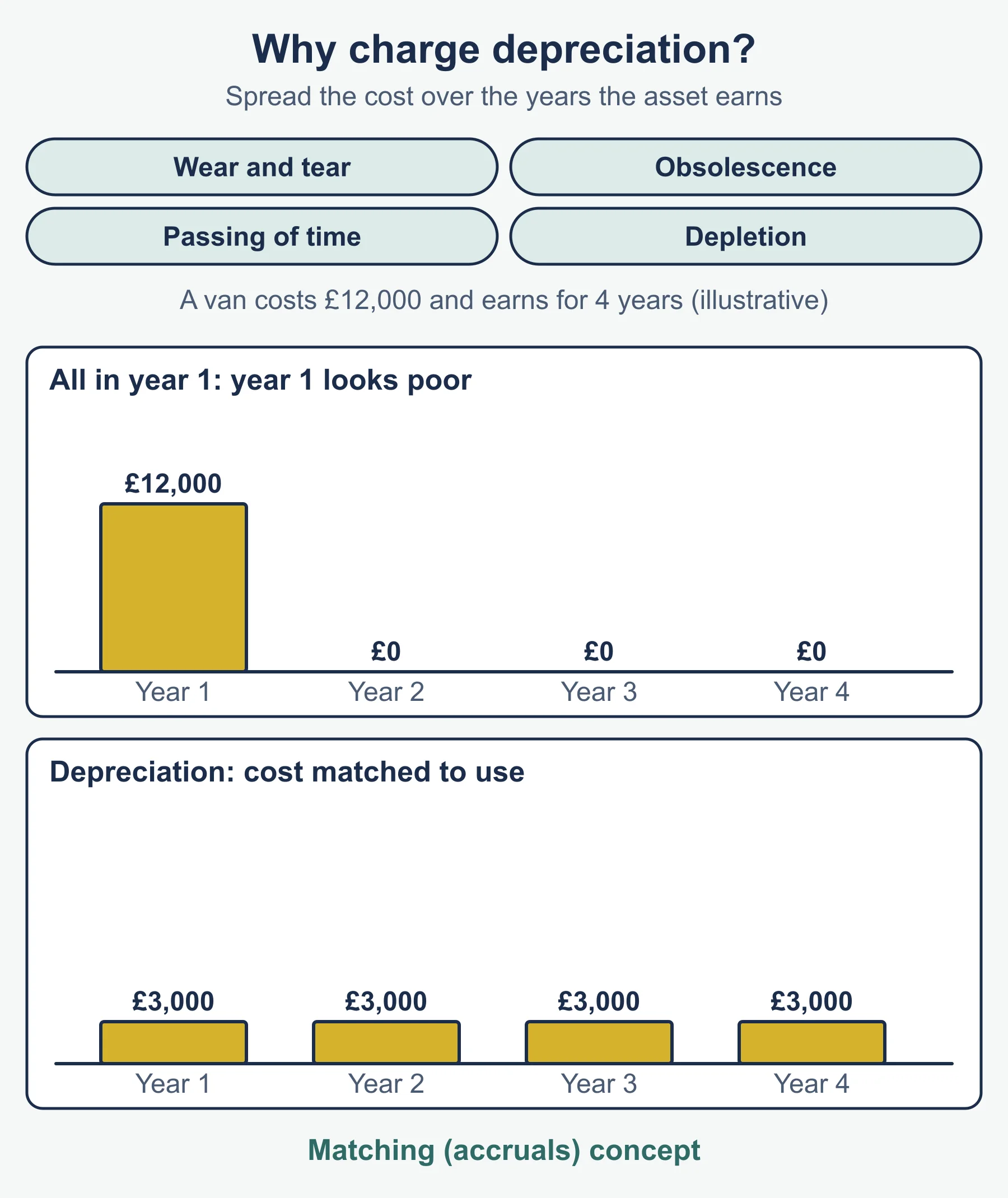
| Wear and tear | Match cost to the revenue it earns (accruals) |
| Obsolescence | Fairer profit each year |
| Passage of time (leases, patents) | Realistic carrying value |
| Depletion | Prudence: assets not overstated |
| Inadequacy |
Depreciation is not cash, not a replacement fund, and carrying value is not market value.
Methods (1.1.15)
| Method | Charge | Notes |
|---|---|---|
| Straight line | (cost − residual value) ÷ life, or a percentage of cost | Equal each year; part years by months |
| Reducing balance | Rate × carrying value at start of year | Ignores residual value in the calculation; falls each year |
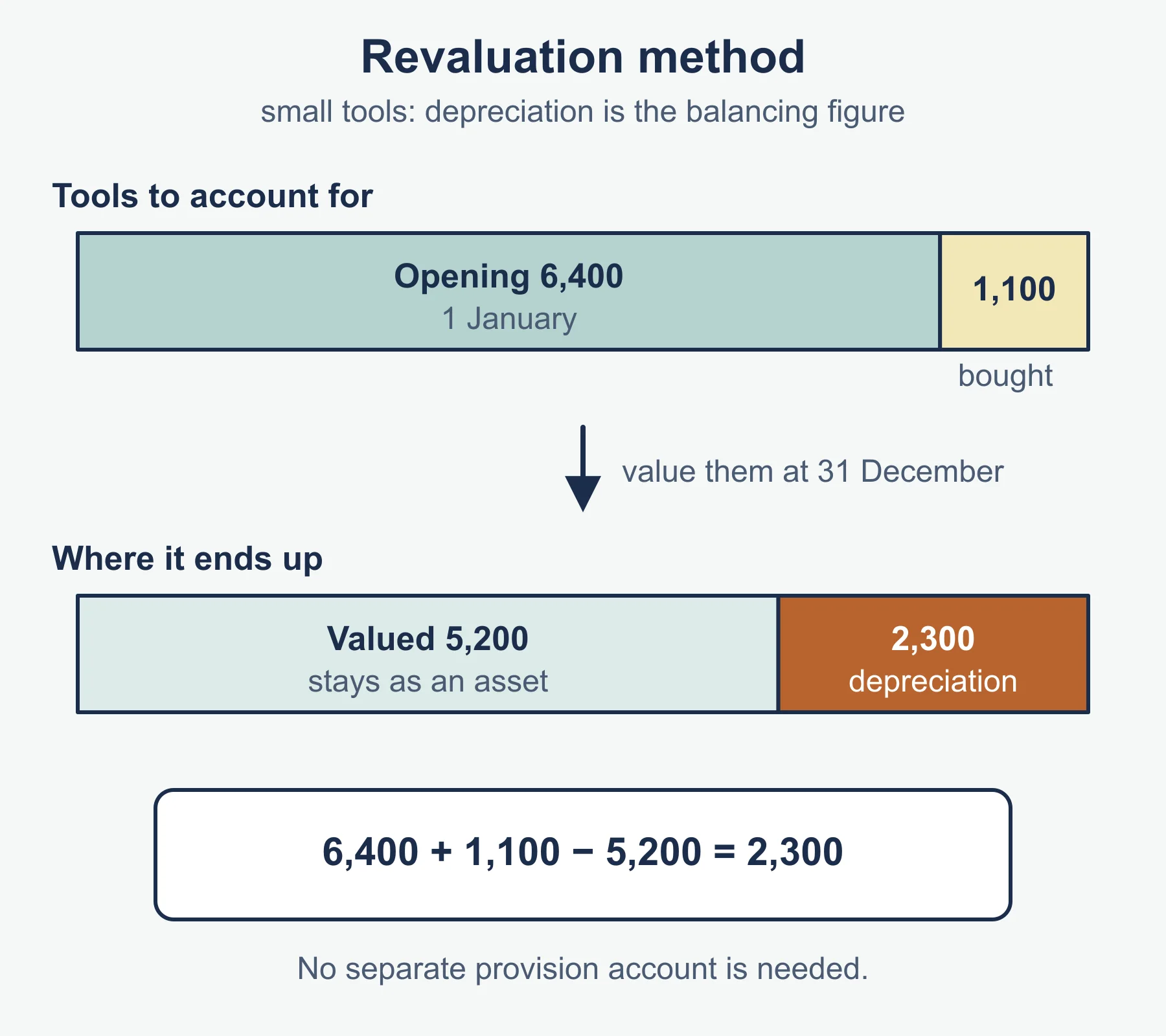
| Revaluation | Opening valuation + additions − closing valuation | For small items such as tools |
Worked reminder: Sandbourne Laundry
A washing line costs 36,000 and is expected to last 6 years, after which it is worth 3,000.
- Straight line: (36,000 − 3,000) ÷ 6 = 5,500 a year.
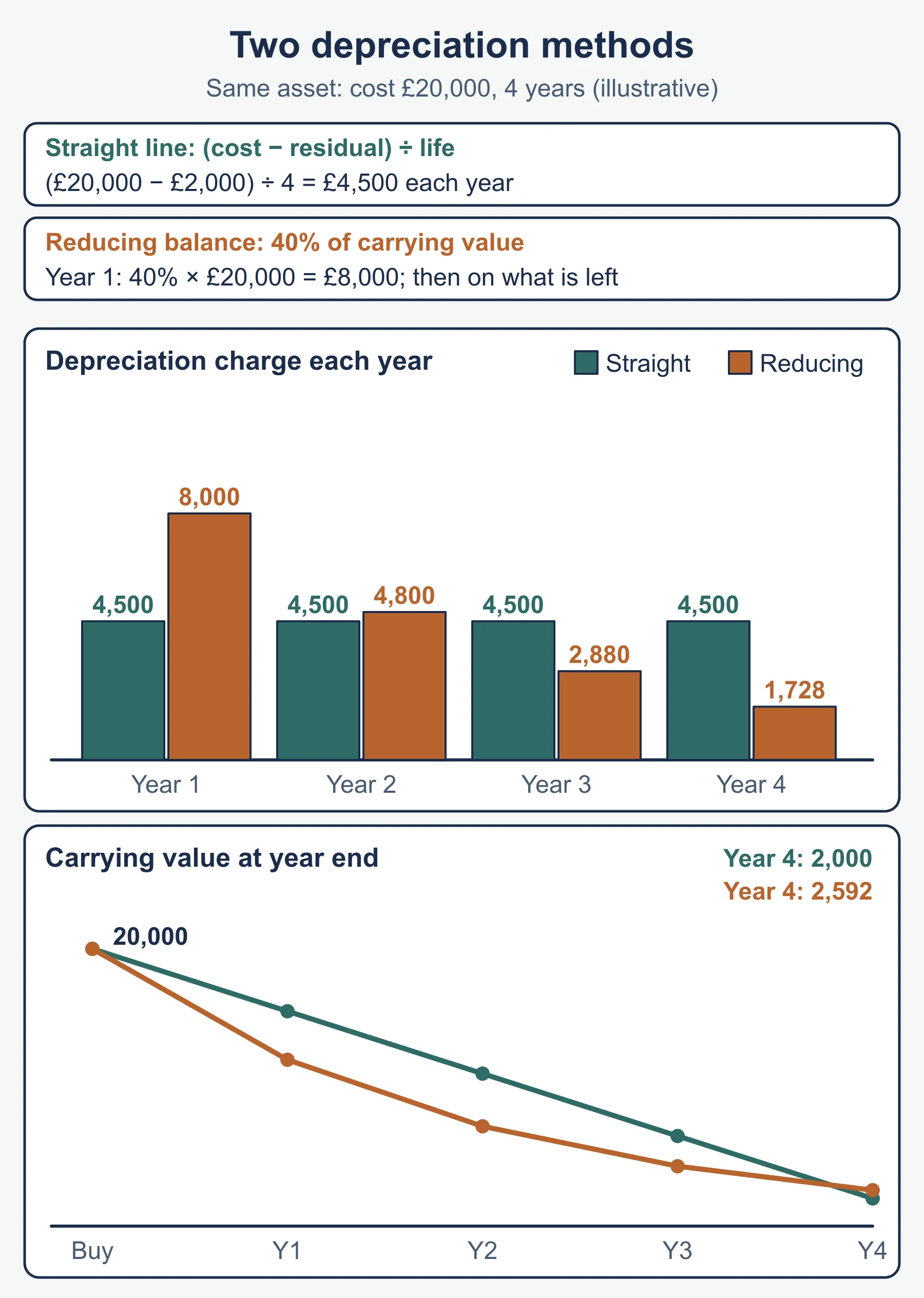
- Reducing balance at 20%: year 1 is 7,200 (carrying value 28,800), year 2 is 5,760 (23,040), year 3 is 4,608 (18,432).
- Part year: a van costing 18,000 bought on 1 October, at 15% of cost, with a 31 December year end, gives 18,000 × 15% × 3/12 = 675.
- Revaluation: fixtures valued at 8,500 at the start, 900 bought, valued at 7,300 at the end, give 8,500 + 900 − 7,300 = 2,100.
Effect on profit (1.1.17 and 1.1.18)
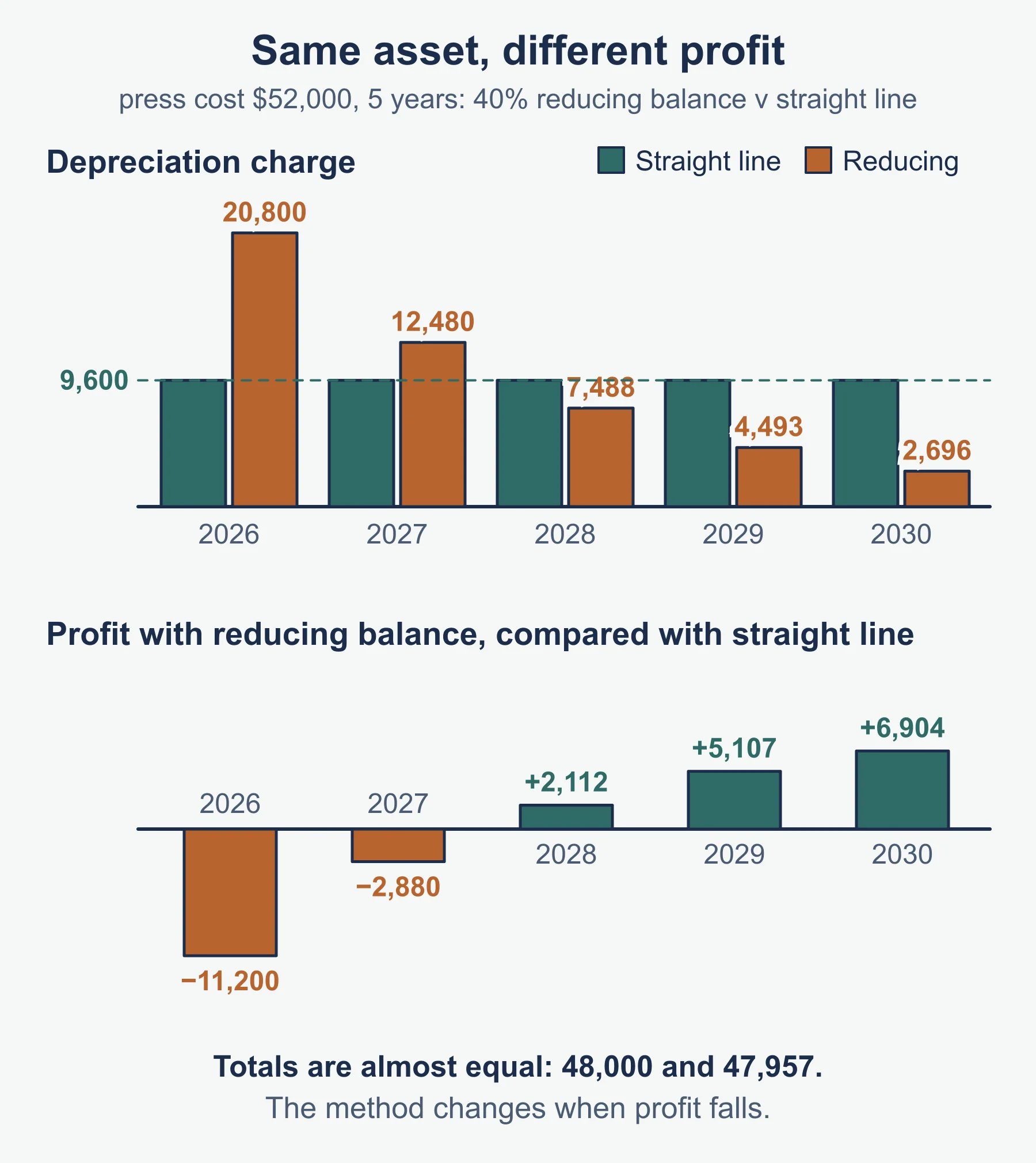
- Reducing balance gives a higher charge early on (here 7,200 against 5,500, so profit is 1,700 lower in year 1) and a lower charge later.
- Straight line gives a flat charge.
- Cash is unaffected by any of this.
- Over the whole life the methods move the timing of profit, not (broadly) the total.
Change of method, steps
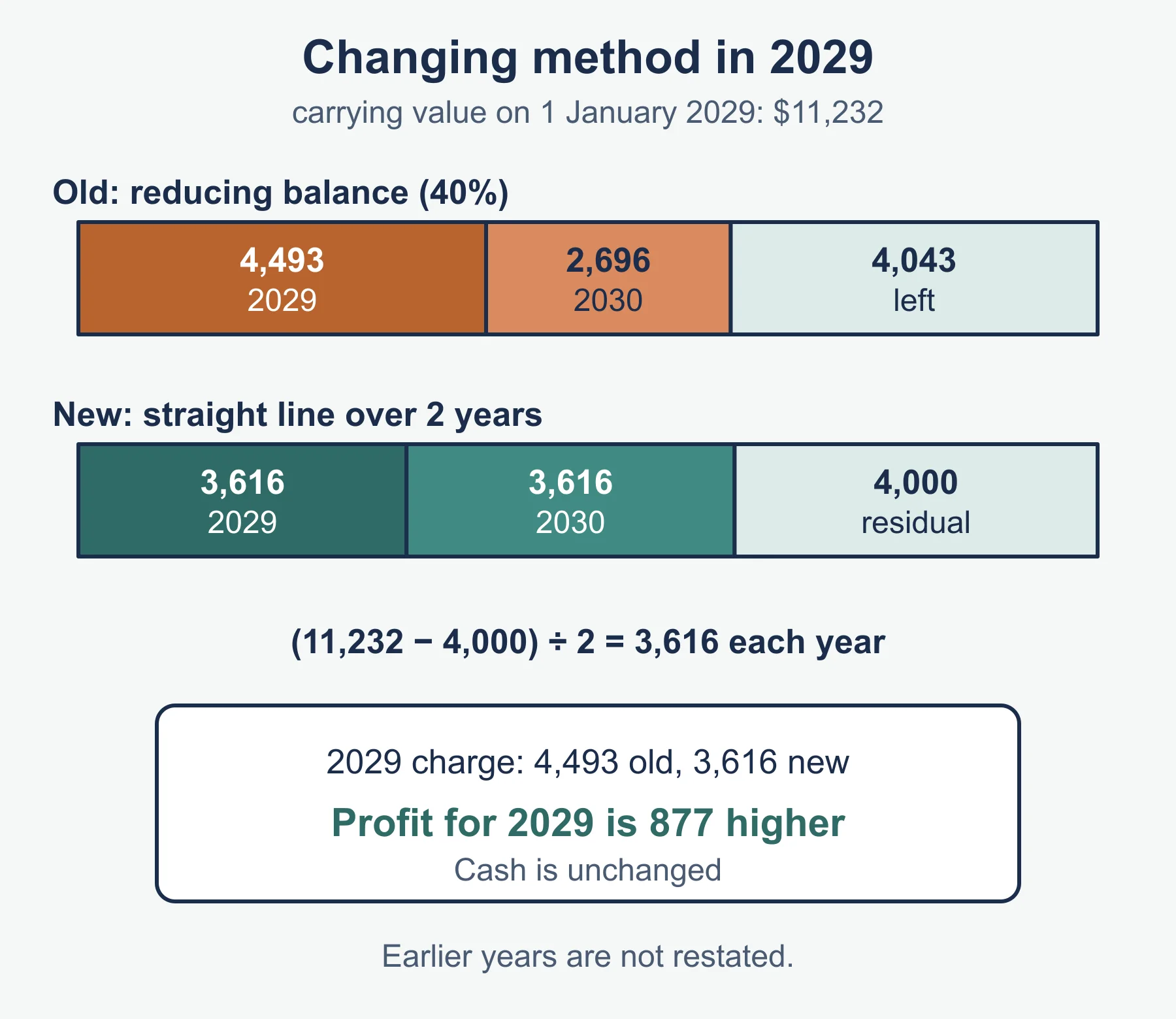
- Find the carrying value at the date of change.
- Apply the new method to that carrying value, over the remaining life if the new method is straight line.
- Leave earlier years’ profits as they were, unless the question says otherwise.
- Compare the new charge with the old one and state the effect on profit.
Example: Sandbourne used straight line for two years, so carrying value is 36,000 − 11,000 = 25,000. It then switches to reducing balance at 20%. The charge is 5,000, which is 500 less than 5,500, so profit is 500 higher in that year.
Ledger accounts (1.1.16)
| Account | Debit | Credit |
|---|---|---|
| Non-current asset (cost) | Purchases, at cost | Disposals, at cost |
| Provision for depreciation | Disposals, provision removed | Opening balance, then the yearly charge |
| Depreciation expense | Yearly charge | Transfer to the statement of profit or loss |
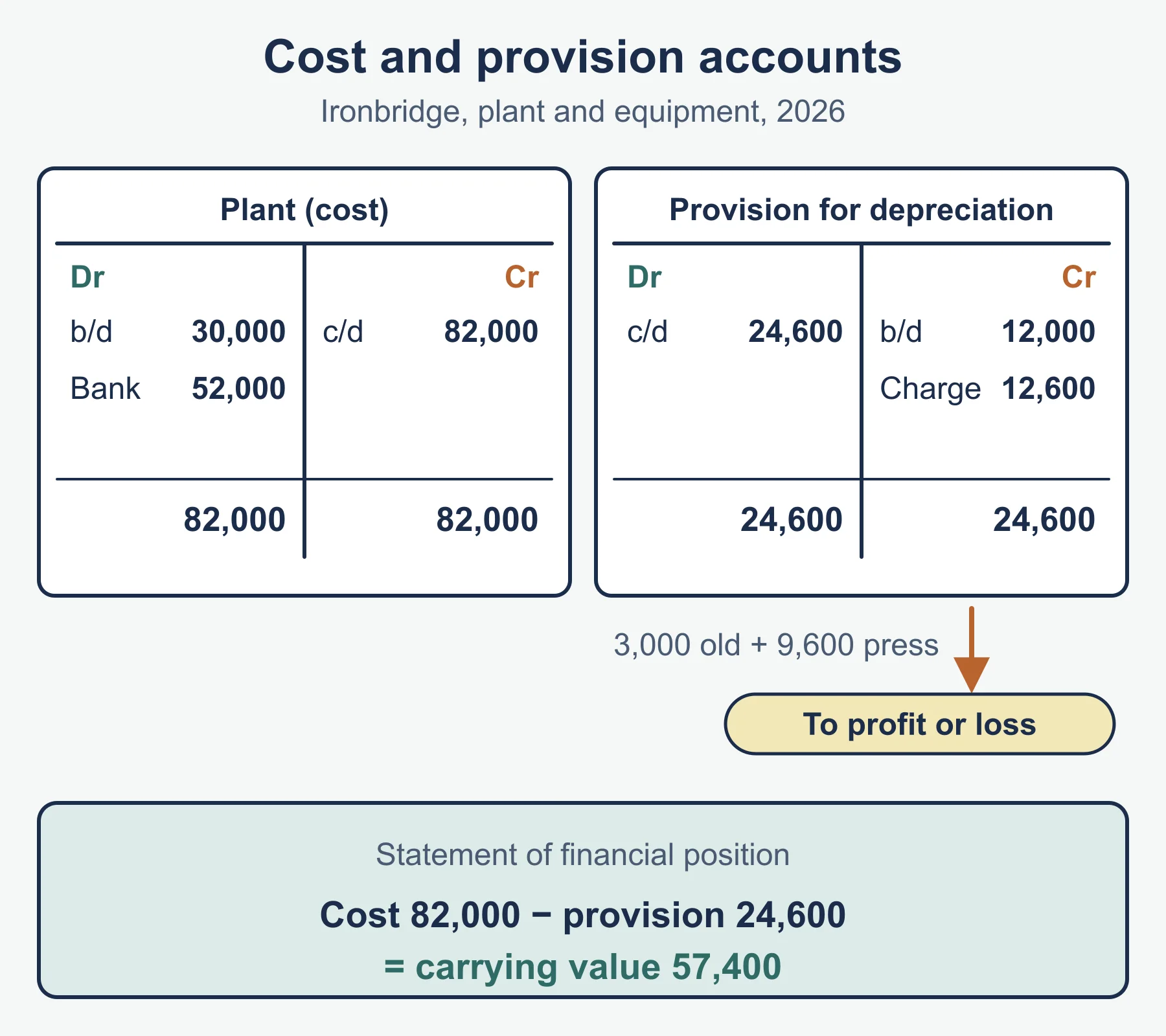
At the year end: debit depreciation expense and credit the provision, then transfer the expense to the statement of profit or loss. For revaluation assets, debit additions and credit depreciation and the closing valuation on the asset account itself.
Disposals (1.1.19)
Steps
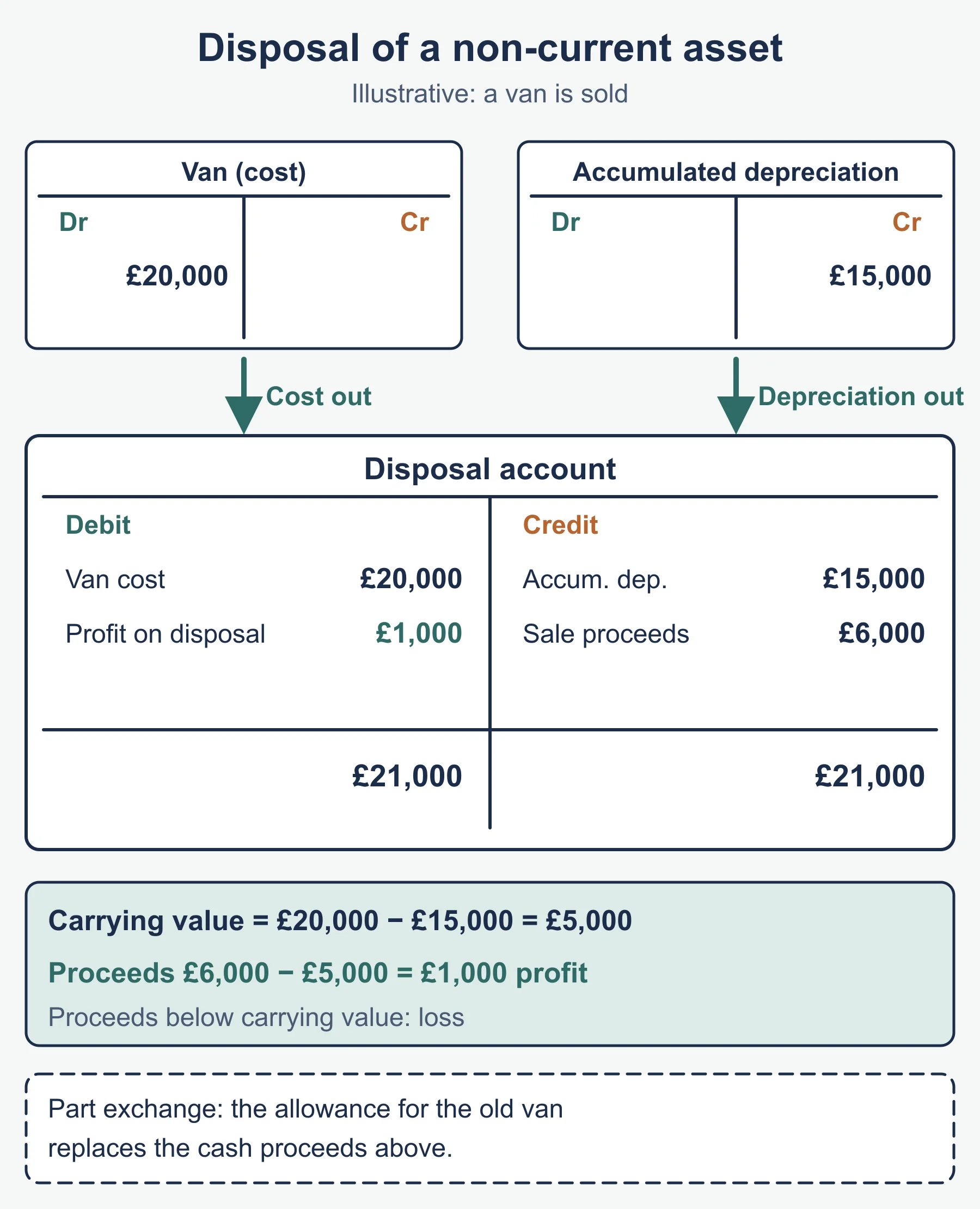
- Debit the disposals account with the asset at cost.
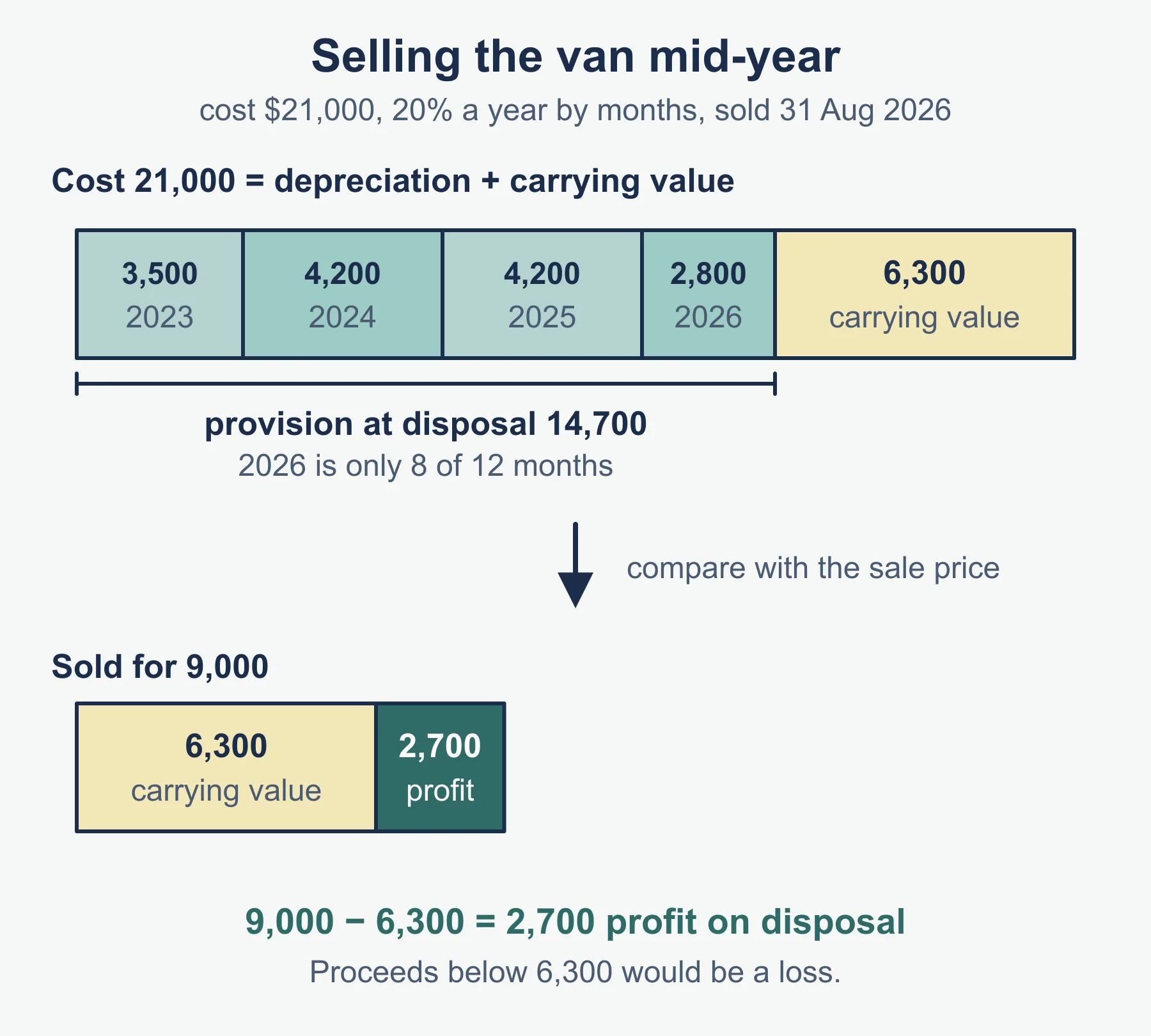
- Credit the disposals account with the provision for depreciation to the date of disposal, including the part-year charge.
- Credit the disposals account with the proceeds, or the part-exchange allowance.
- The balancing figure is a profit (credit side) or a loss (debit side). Transfer it to the statement of profit or loss.
Check: profit or loss = proceeds − carrying value at disposal.
Worked reminder: part-exchange
Sandbourne trades in a van that cost 16,000, with accumulated depreciation of 9,600. The dealer gives an allowance of 5,000 against a new van priced at 22,000.
| Dr | Cr | ||
|---|---|---|---|
| Van (cost) | 16,000 | Provision for depreciation | 9,600 |
| New van account (allowance) | 5,000 | ||
| Loss on disposal | 1,400 | ||
| 16,000 | 16,000 |
Carrying value is 6,400, the allowance is 5,000, so the loss is 1,400. The new van is recorded at its full price of 22,000, and the balance of 17,000 is paid.
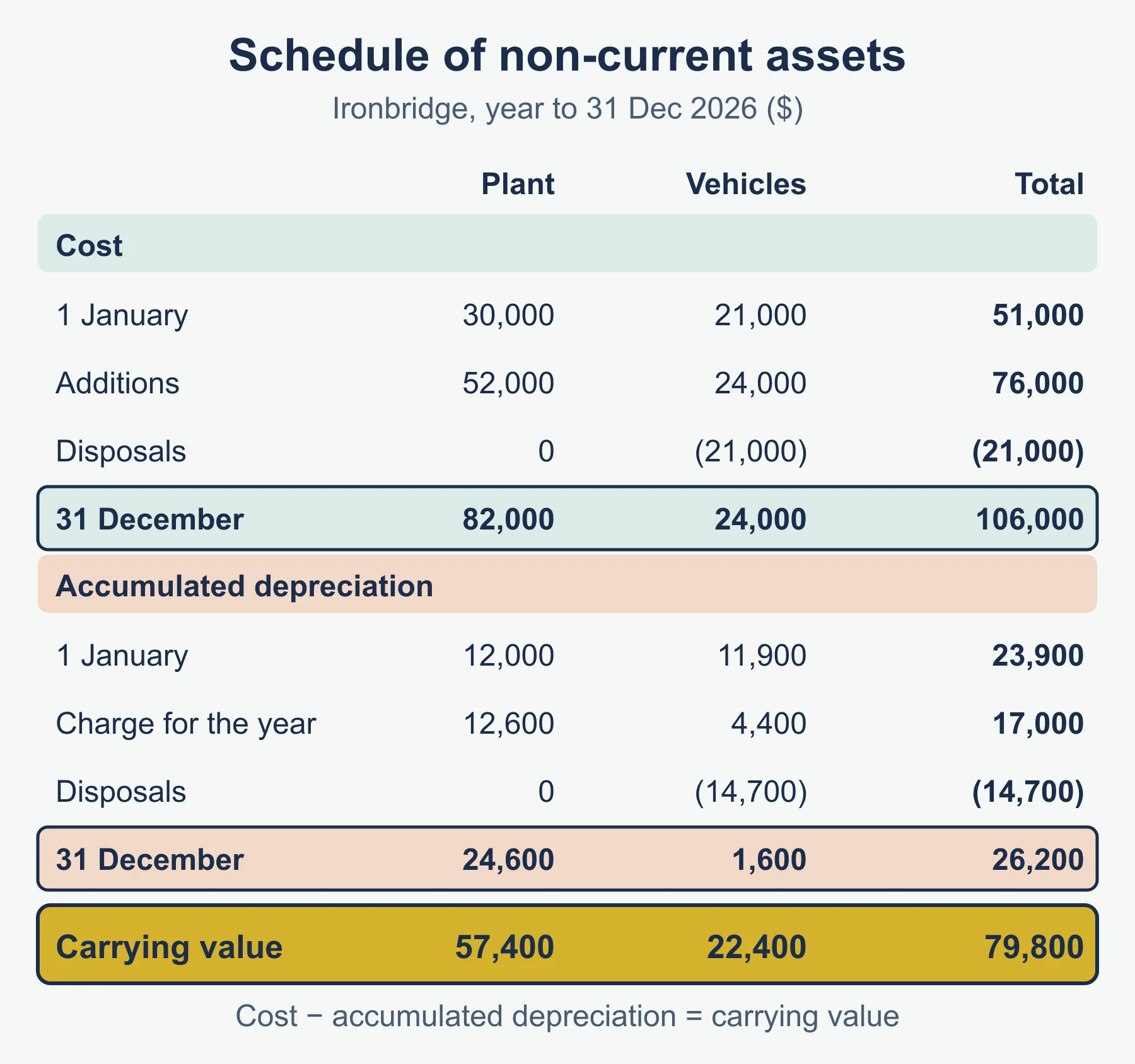
Schedule of non-current assets (1.1.20)
| Column heading | Rows |
|---|---|
| One column per class, plus a total | Cost: opening, additions, disposals, closing |
| Accumulated depreciation: opening, charge, disposals, closing | |
| Carrying value: closing (and opening for comparison) |
Disposals are deducted at cost in the cost section and at accumulated depreciation to the date of sale in the depreciation section. Closing carrying value = closing cost − closing accumulated depreciation, and it must agree with the statement of financial position.
Must-know distinctions
- Capital versus revenue: an upgrade that adds capacity is capital, whereas a repair that restores the original condition is revenue.
- Depreciation versus carrying value: the charge is a yearly expense, whereas the carrying value is the cost less all depreciation to date.
- Provision versus expense: the expense account is cleared to the statement of profit or loss each year, whereas the provision builds up until the asset is disposed of.
- Profit on disposal versus profit from trading: a gain or loss on disposal arises only because depreciation estimates differed from the sale price.
- Straight line versus reducing balance: one uses cost less residual value, the other uses carrying value and a rate.
Quick self-test
- State two causes of depreciation.
- An asset costs 24,000, has a residual value of 2,400 and lasts 6 years. What is the straight line charge?
- The same asset is depreciated at 25% reducing balance. What is the charge in year 2?
- Tools were valued at 3,200 at the start of the year, 600 of tools were bought and they are valued at 2,500 at the end. What is the depreciation?
- Equipment cost 40,000 and has accumulated depreciation of 26,000 at disposal. It is sold for 11,000. State the profit or loss.
- Is the cost of installing a new machine capital or revenue expenditure?
- Which concept justifies expensing a cheap stapler?
- A 5,000 capital item is charged as an expense in error. What is the effect on profit, ignoring depreciation?
- Why is profit lower in early years under reducing balance than straight line?
- An asset costing 10,000 is depreciated at 20% reducing balance. What is the carrying value after two years?
Answers
- Any two of wear and tear, obsolescence, passage of time, depletion, inadequacy.
- (24,000 − 2,400) ÷ 6 = 3,600.
- Year 1 is 6,000, carrying value 18,000, so year 2 is 4,500.
- 3,200 + 600 − 2,500 = 1,300.
- Carrying value 14,000, proceeds 11,000, so a loss of 3,000.
- Capital, because it is a cost of getting the asset ready for use.
- Materiality.
- Profit is understated by 5,000.
- The charge is a percentage of a larger carrying value early on, so the early charge is higher.
- 10,000 × 0.8 × 0.8 = 6,400.
Where marks are usually lost
- Writing “capital” or “revenue” with no reason when the question asks for justification.
- Including residual value in reducing balance.
- Giving the effect on profit but not the effect on the asset, or the reverse.
- Using the full year for an asset bought or sold part way through, when the question gives dates.
- Leaving depreciation for the year of sale out of the provision transferred.
- Putting a profit on disposal on the debit side, or a loss on the credit side.
- Using market value as the carrying value.
- Treating depreciation as cash set aside.
- Failing to compare old and new charges after a change of method.
Frequently asked questions
Which Edexcel YAC11 outcomes cover capital and revenue expenditure and depreciation? Outcomes 1.1.11 to 1.1.20 in Unit 1 of Pearson Edexcel International A Level Accounting cover capital and revenue expenditure, the causes and methods of depreciation, ledger accounts, disposals and the schedule of non-current assets.
Is residual value used in reducing balance depreciation? No. The reducing balance percentage is applied to the carrying value at the start of each year; residual value is not deducted first. Including it is a common mistake.
Is the carrying value of an asset its market value? No. Depreciation allocates cost rather than measuring market value, so the carrying value, cost less accumulated depreciation, is not what the asset would sell for.
How is depreciation handled for an asset bought or sold part way through the year? Where the question gives dates, charge depreciation only for the months of ownership, and include the year of sale’s depreciation in the provision transferred on disposal.
Official syllabus
Pearson Edexcel International Advanced Subsidiary/Advanced Level in Accounting (XAC11/YAC11), Specification, Issue 2, September 2018, Unit 1 topic 1.1, outcomes 1.1.11 to 1.1.20.
Get free revision emails (optional)
Occasional emails with practice questions, worked explanations and links to free resources for the qualification and subjects you choose. No spam, and you can unsubscribe from any email. The free tools on this site never need an email.
Related resources
-
Study guides
Edexcel International A Level Accounting: The double entry system (YAC11)
Study guide to the double entry system for Edexcel International A-Level Accounting: ledgers, books of prime entry, adjustments, allowances and ICT.
Accounting · Pearson Edexcel · AS Level
Read guide -
Practice questions
Edexcel International A Level Accounting: The double entry system (YAC11) – Practice Questions
Eleven original practice questions with worked answers on the double entry system for Edexcel International A-Level Accounting (YAC11).
Accounting · Pearson Edexcel · AS Level
Try questions -
Revision notes
Edexcel International A Level Accounting: The double entry system (YAC11) – Revision Notes
Condensed recall notes on the double entry system for Edexcel International A-Level Accounting: rules, prime entry, adjustments and allowances.
Accounting · Pearson Edexcel · AS Level
Revise topic
Related articles
-
teaching
A Level tuition in Dubai: Cambridge or Pearson Edexcel International A Level?
Schools in Dubai and Abu Dhabi teach either Cambridge International AS & A Level or Pearson Edexcel International A Level. How the two are structured, why it matters for tuition, and how online classes from Lahore work.
9 October 2026
-
curriculum guides
Choosing subjects at IGCSE and A Level
How subject choices at 14 and 16 affect university options later, and how to keep pathways open without overloading a timetable.
28 July 2026
Studying this with a teacher
Working through Accounting AS LEVEL?
This page is free and stays free. If you would rather be taught it, Marlbridge runs Accounting classes one-to-one and in small groups of up to 15, online in your own time zone. The first trial class is free. WhatsApp replies within an hour (8am–11pm Pakistan time, every day); email the same day.
Pearson Edexcel Accounting teachers at Marlbridge

