
Revision Notes
Edexcel International A Level Accounting: The double entry system (YAC11) – Revision Notes
Condensed recall notes on the double entry system for Edexcel International A-Level Accounting: rules, prime entry, adjustments and allowances.
- Subject
- Accounting
- Level
- AS LEVEL
- Topic
- Principles of accounting and double entry bookkeeping
- Author
- Marlbridge Academic Team
- Updated
- Reviewed by
- Javaid Iqbal Sabri (what this means)
Aligned to Pearson Edexcel A Level Accounting (YAC11), 2015-onwards. Official specification .
Syllabus page (what it covers and how it is assessed): Pearson Edexcel A Level Accounting.
Syllabus points this page covers
YAC11 (AS Level)
- 1.1.3-1.1.7 Double entry system
Found an error? Report a correction.
Need help with this topic? Request a free trial class for A Level Accounting (YAC11).
These revision notes condense content points 1.1.3 to 1.1.7 of Unit 1 in the Pearson Edexcel International Advanced Subsidiary/Advanced Level in Accounting (XAC11/YAC11) specification, Issue 2, September 2018: the double entry system. Full explanations and longer worked examples are in the study guide. Test yourself with the practice questions. The businesses are invented and amounts are in dollars.
Course hub: Edexcel A-Level Accounting. Checklist: Edexcel accounting checklist. Check where you stand with a free diagnostic. Related Topic 1 notes: principles revision notes.
1.1.3 Books of account: the rules
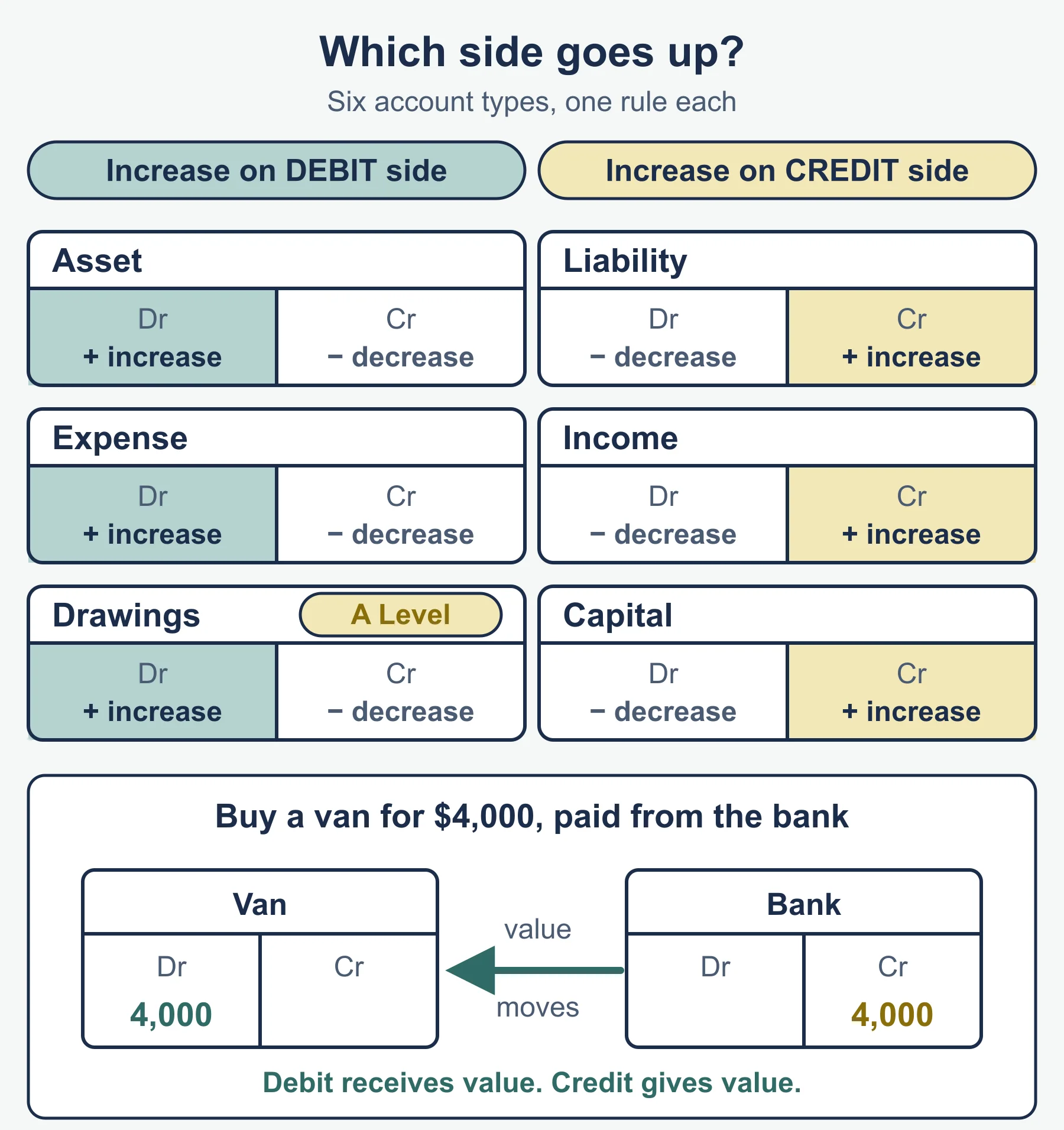
Each transaction has a dual effect: one account is debited and another credited, for equal values.
| Account type | Debit | Credit |
|---|---|---|
| Assets | Increase | Decrease |
| Expenses and drawings | Increase | Decrease |
| Liabilities | Decrease | Increase |
| Capital | Decrease | Increase |
| Revenue and other income | Decrease | Increase |
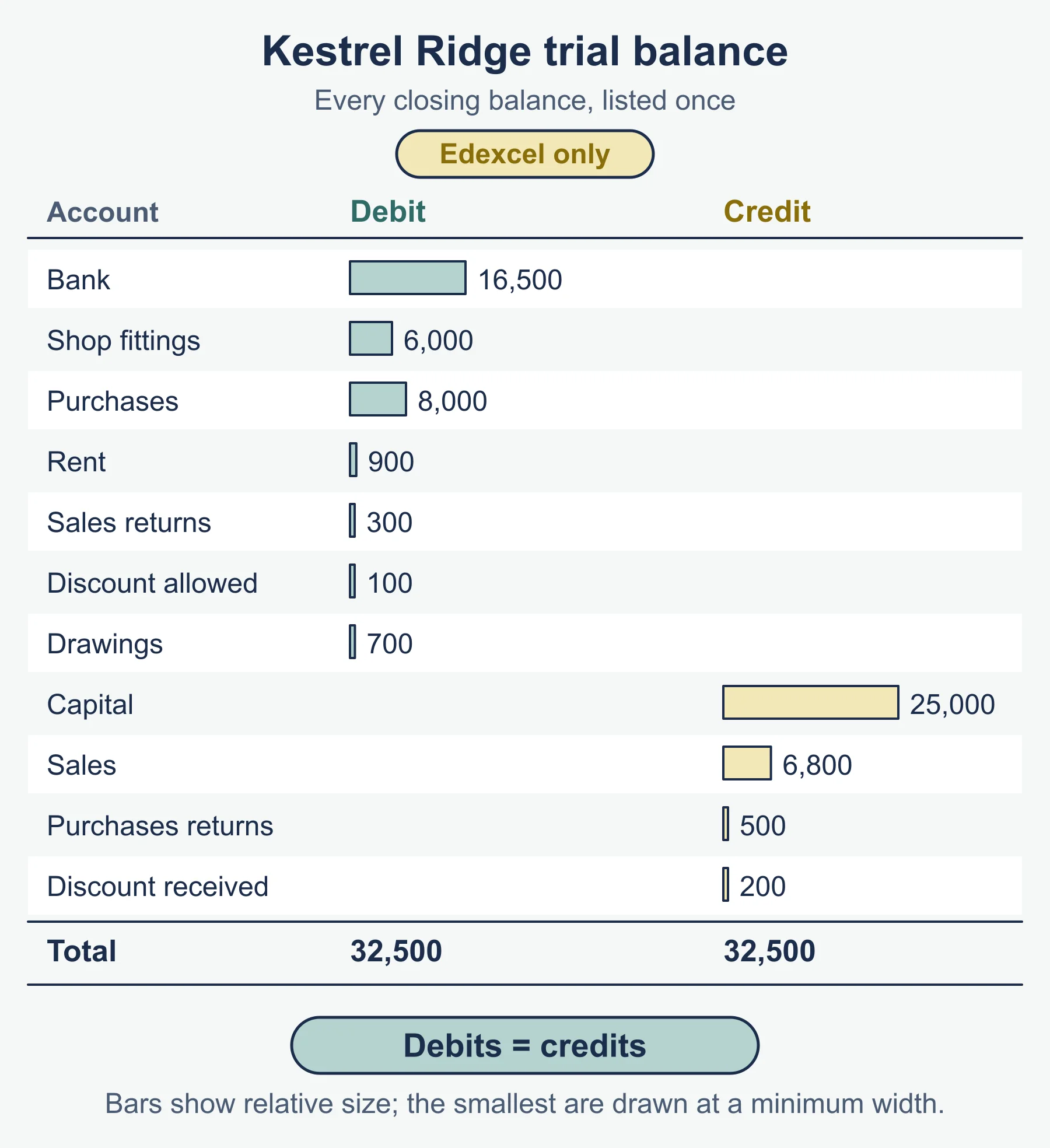
Ledgers: sales ledger (customers), purchases ledger (suppliers), general ledger (nominal and real accounts). Check by trial balance: total debit balances equal total credit balances.
Method for any transaction
- Name the two accounts affected.
- Decide whether each increases or decreases.
- Use the table to choose debit or credit.
- Check that the debit and credit amounts are equal.
Common entries to recall
| Transaction | Debit | Credit |
|---|---|---|
| Owner takes goods for own use | Drawings | Purchases |
| Credit purchase | Purchases | Supplier |
| Return to supplier | Supplier | Purchases returns |
| Credit sale | Customer | Revenue (Sales) |
| Return from customer | Sales returns | Customer |
| Cheque from customer | Bank | Customer |
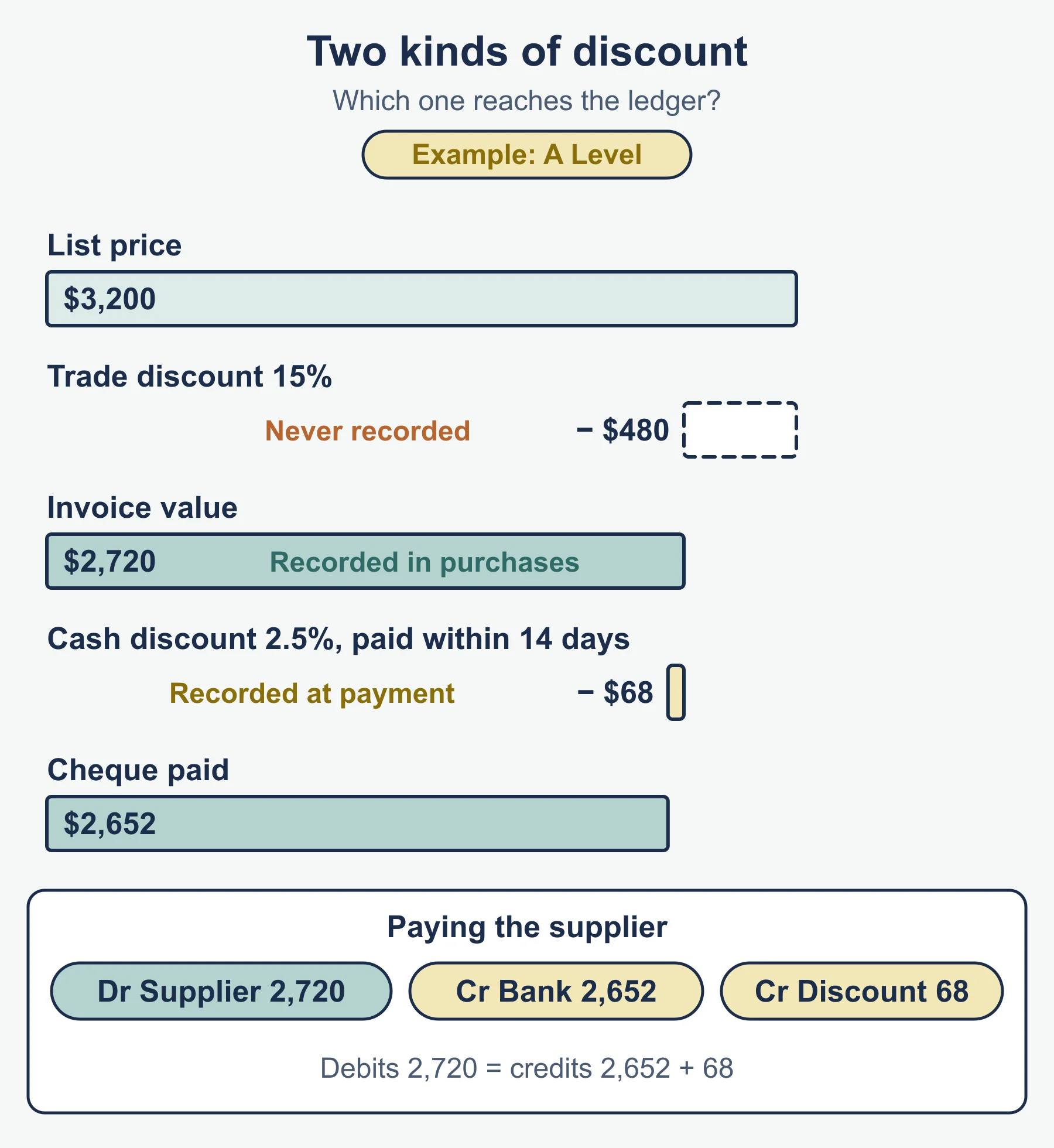
| Discount allowed to customer | Discount allowed | Customer |
| Discount received from supplier | Supplier | Discount received |
| Loan received | Bank | Loan |
1.1.4 Books of prime entry
| Book | What goes in | Posted as |
|---|---|---|
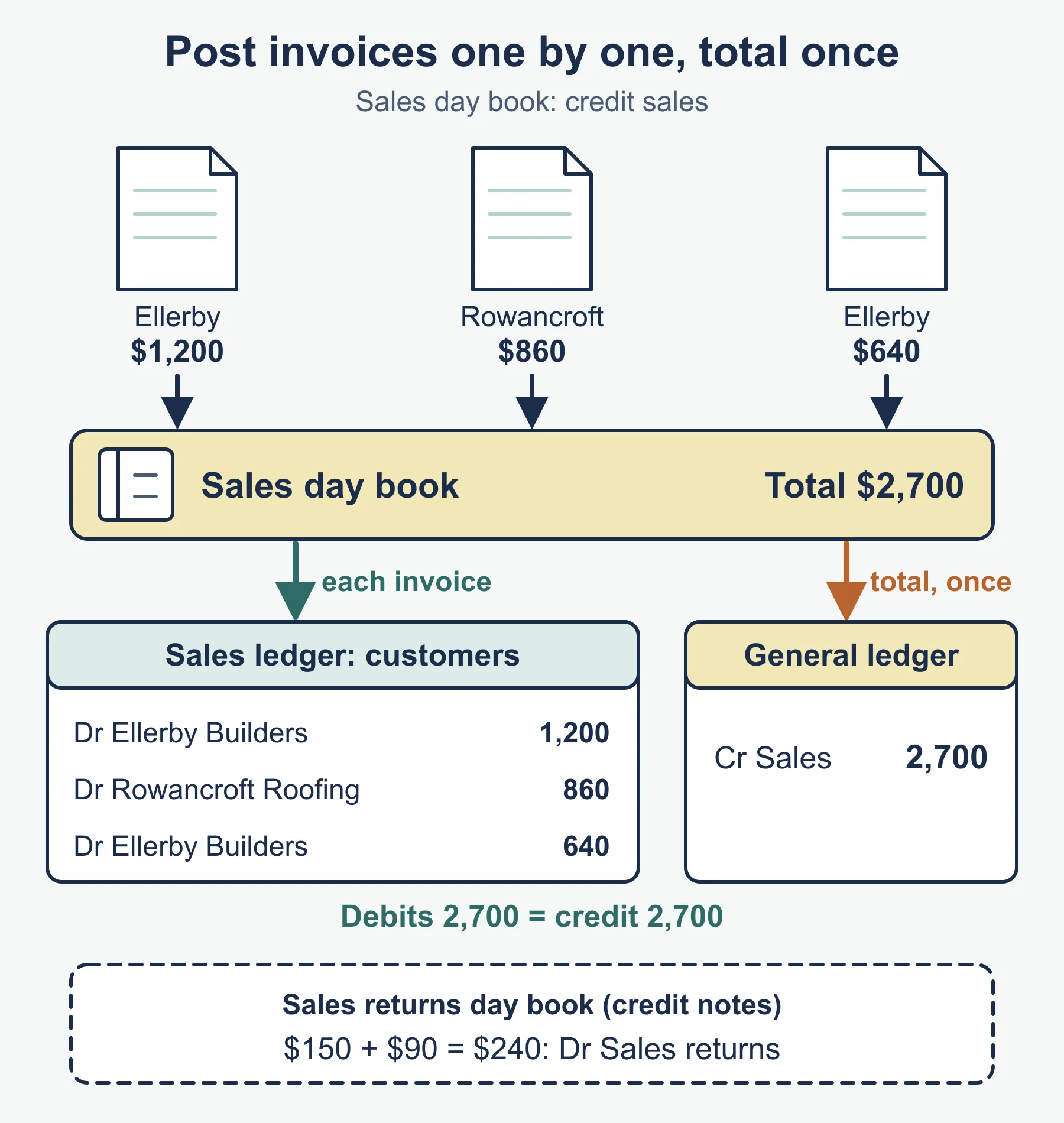
| Sales day book | Credit sales invoices | Debit customers, credit Sales |
| Purchases day book | Credit purchase invoices | Debit Purchases, credit suppliers |
| Sales returns day book | Credit notes issued | Debit Sales returns, credit customers |
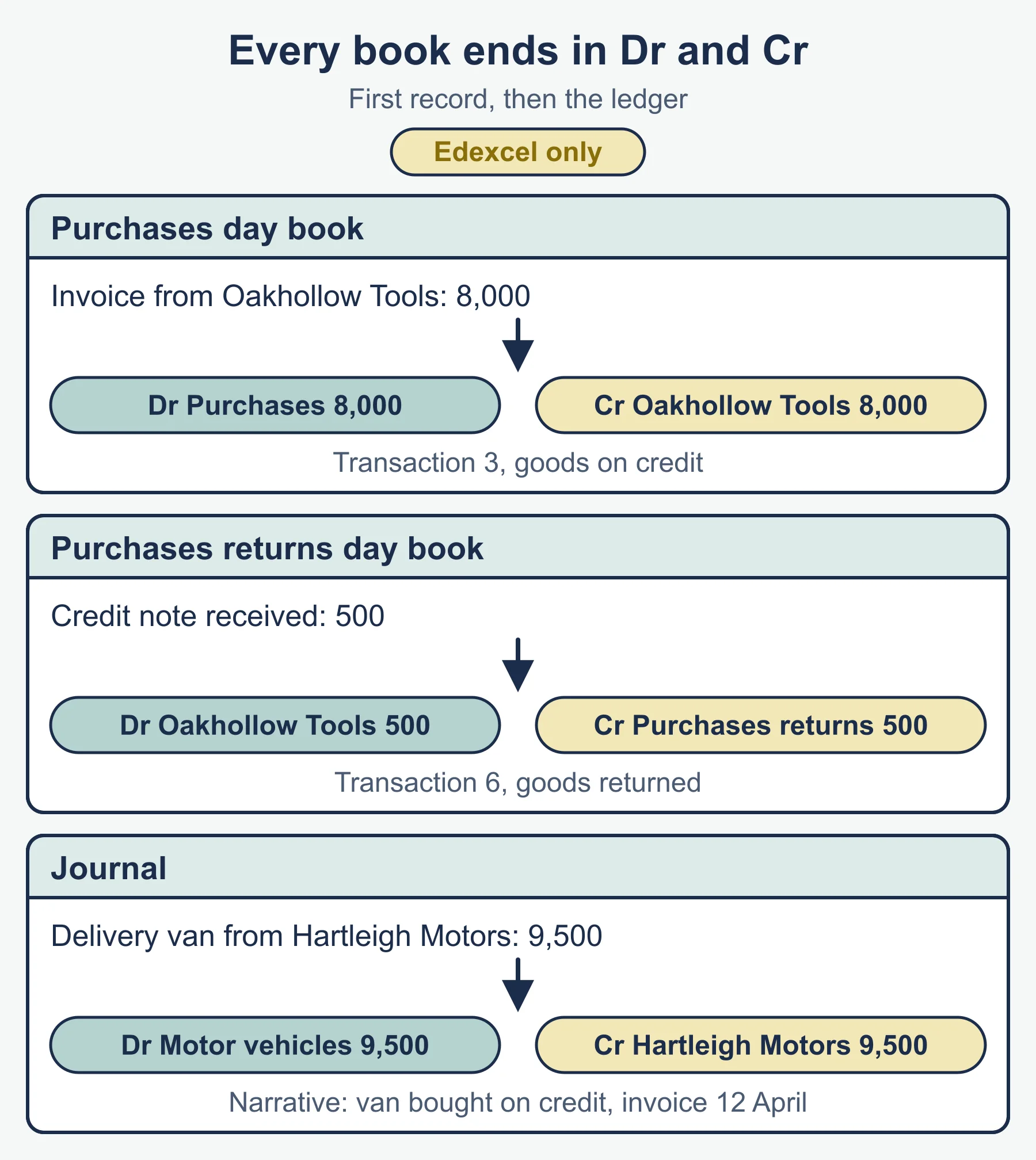
| Purchases returns day book | Credit notes received | Debit suppliers, credit Purchases returns |
| Cash book | Cash and bank receipts and payments, discounts | Opposite side posted to ledgers |
| Petty cash book | Small payments from a float | Analysis totals debited to expenses |
| Journal | Items with no other book (non-current assets on credit, write-offs, opening entries) | Debit, credit, narrative |
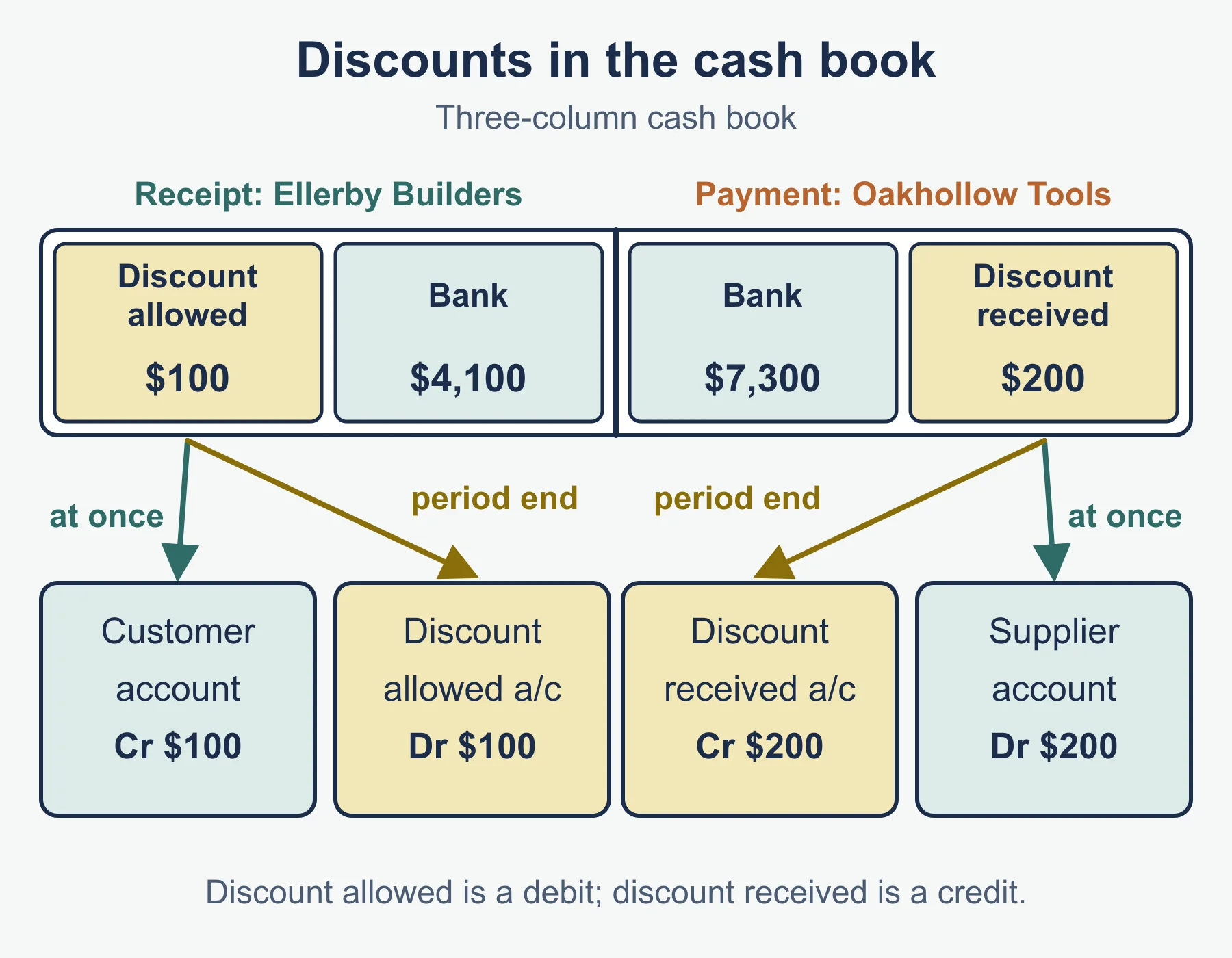
Cash book discounts. Discount allowed column (debit side) total goes to the debit of Discount allowed. Discount received column (credit side) total goes to the credit of Discount received. Individual discounts are posted to the personal accounts.
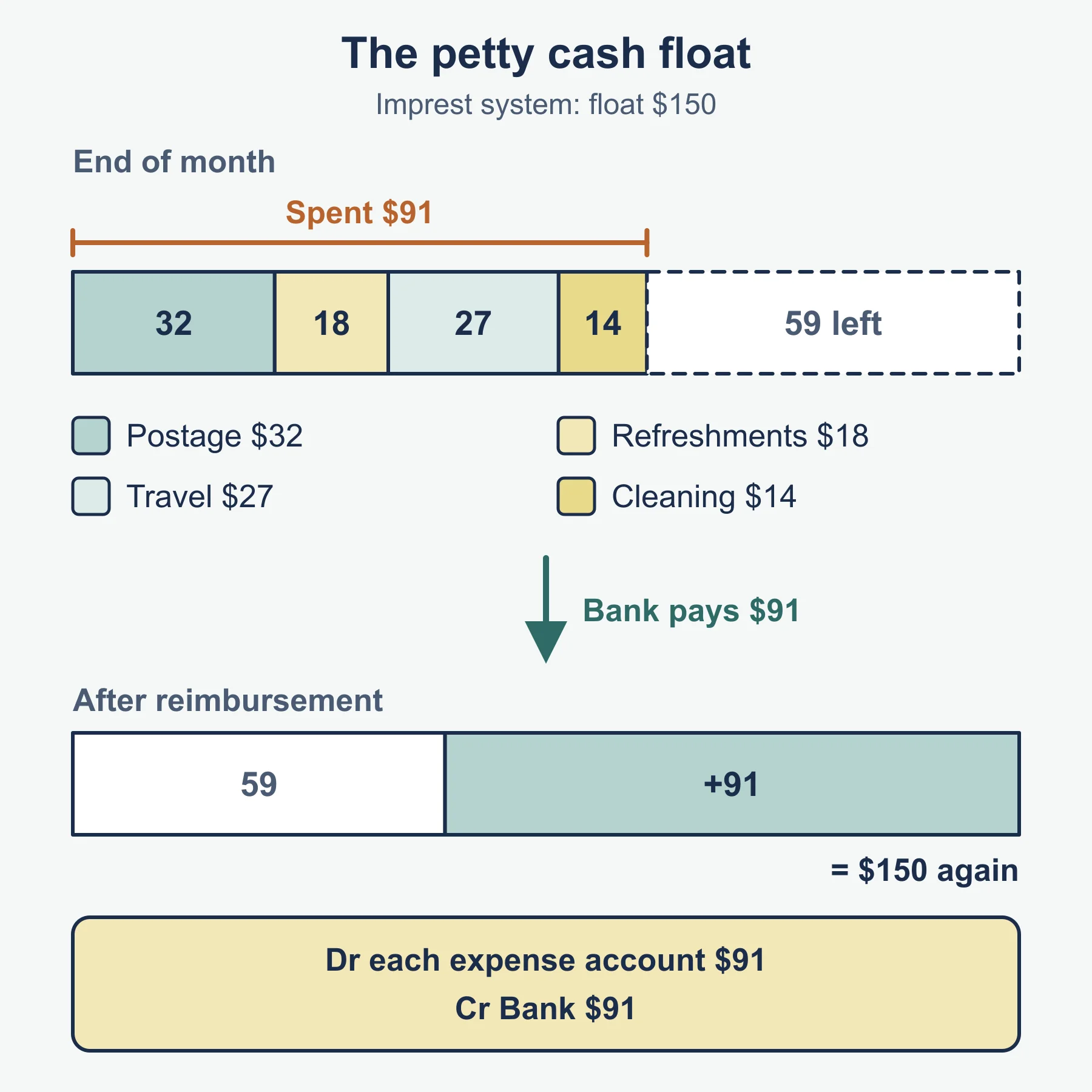
Imprest petty cash. Reimbursement equals the amount spent, restoring the float. Reimbursement is credited to Bank.
Worked reminder. Strathmoor Fabrics holds a petty cash float of 120. Payments are 24, 31, 19 and 12, a total of 86. The reimbursement is 86 and the float is back to 120.
1.1.5 End of period transfers and adjustments
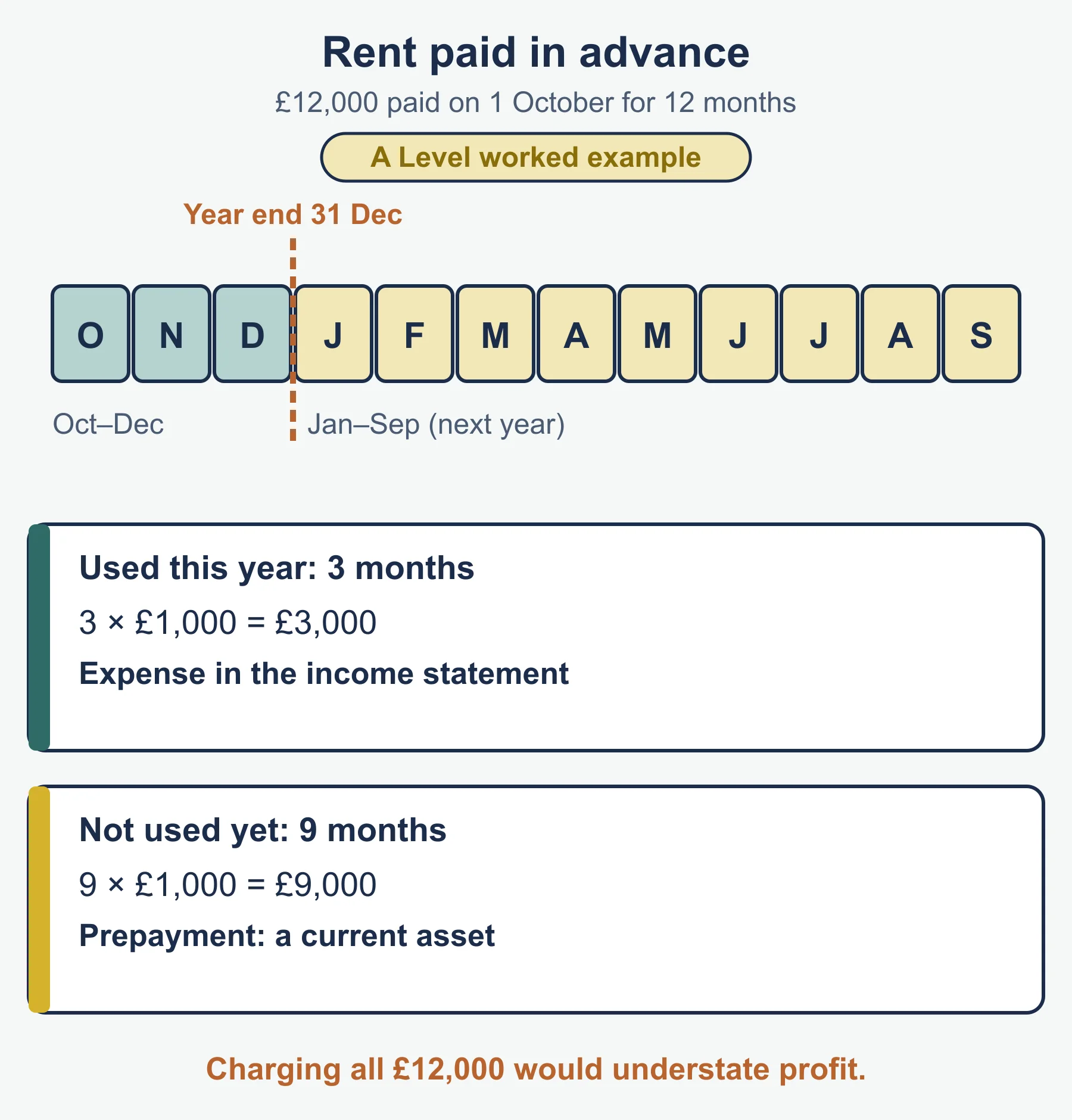
Adjustments put income and expenses into the correct period. Transfers move the final totals to the statement of profit or loss.
| Item | Charge to statement of profit or loss | Statement of financial position |
|---|---|---|
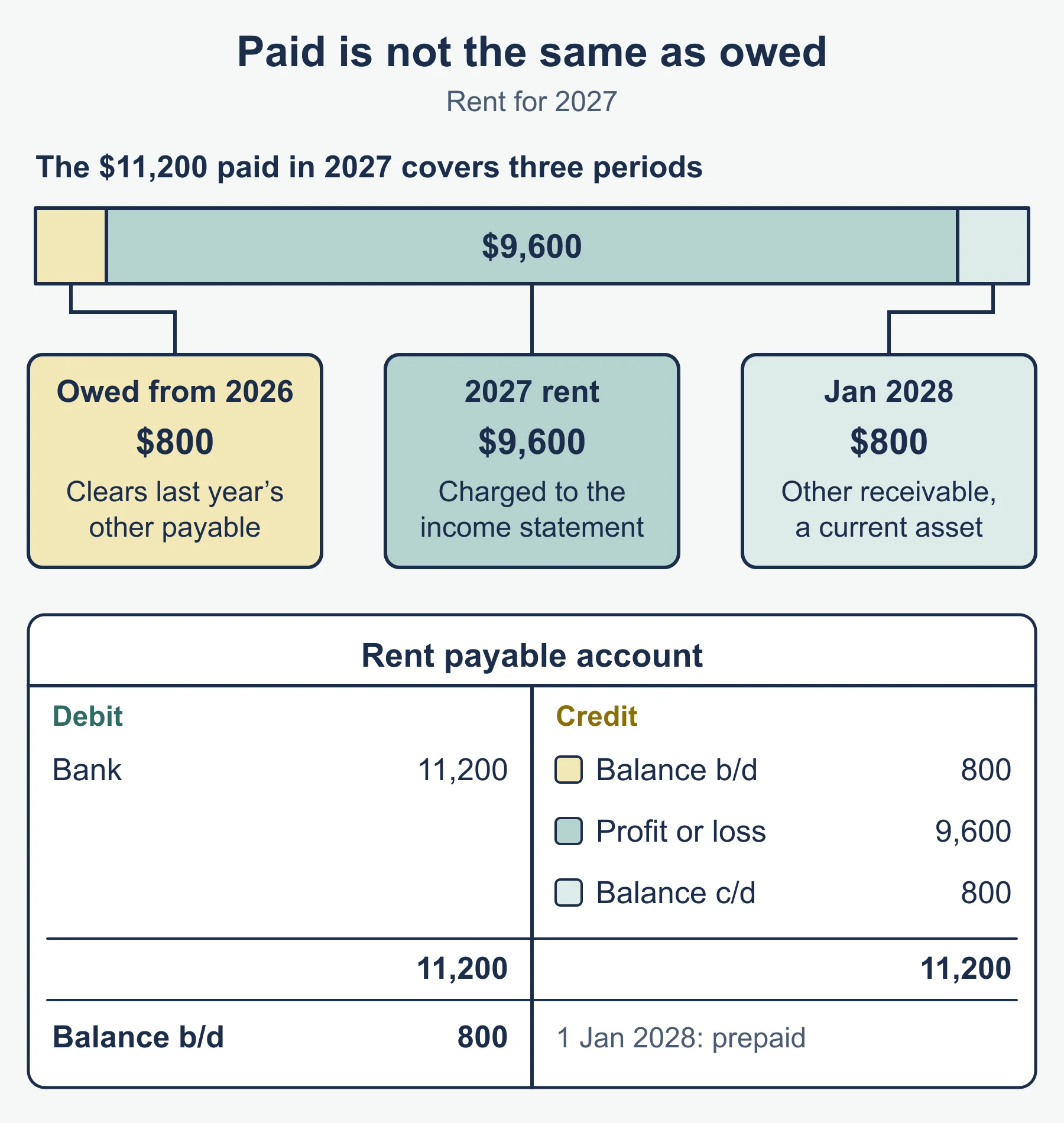
| Expense | Paid + closing accrual − opening accrual | Accrual: other payable |
| Expense | Paid + opening prepayment − closing prepayment | Prepayment: other receivable |
| Income | Received + closing accrued − opening accrued | Accrued income: other receivable |
| Income | Received + opening in advance − closing in advance | Income in advance: other payable |
| Irrecoverable debt | Debit expense, credit customer | Lowers trade receivables |
| Depreciation | Debit expense, credit provision for depreciation | Lowers carrying value |
| Drawings | Not an expense: closed to capital | Reduces capital |
Worked reminder. Electricity paid is 1,380, with 210 owing at the start and 340 owing at the end. The charge is 1,380 + 340 − 210 = 1,510. Insurance paid is 960, with 120 prepaid at the start and 270 prepaid at the end. The charge is 960 + 120 − 270 = 810.
Cost of sales
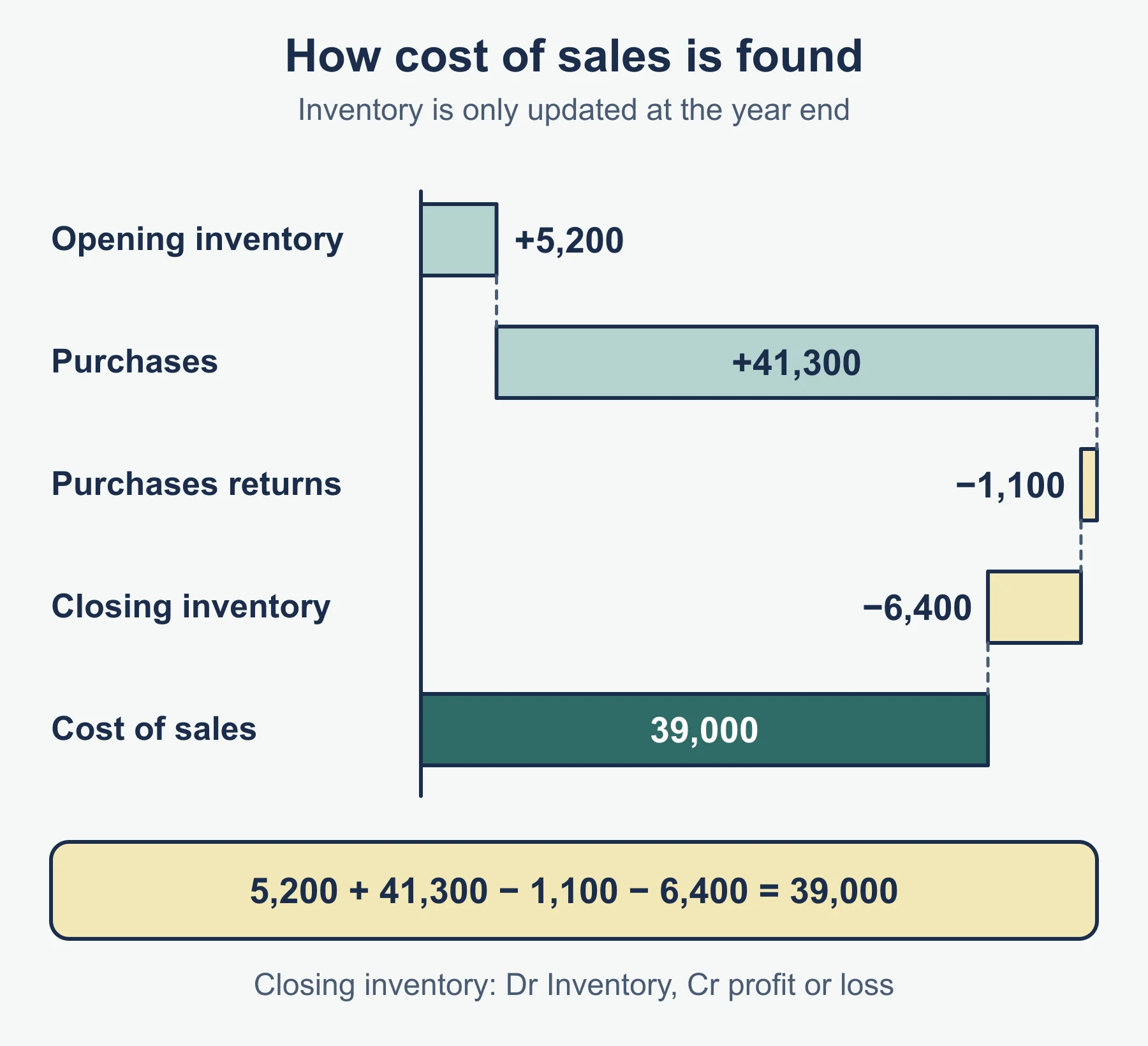
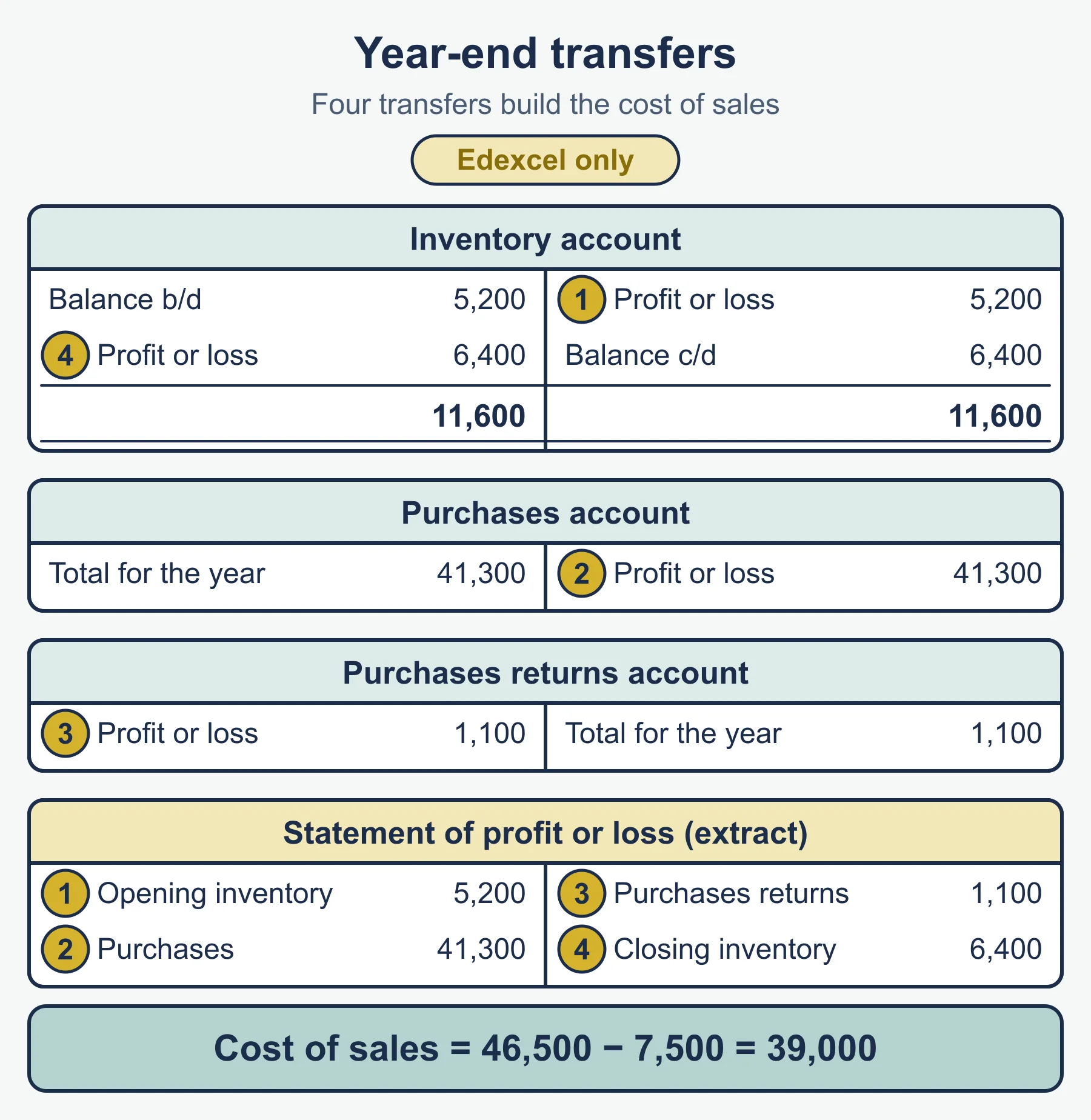
Cost of sales = opening inventory + purchases − purchases returns − closing inventory.
Strathmoor Fabrics has opening inventory 3,800, purchases 27,600, purchases returns 900 and closing inventory 4,300. Cost of sales is 3,800 + 27,600 − 900 − 4,300 = 26,200.
Transfers in the ledger: opening inventory is credited to Inventory and debited to the statement of profit or loss; closing inventory is debited to Inventory and credited to the statement of profit or loss. Closing balances are carried down and brought down as opening balances.
1.1.6 Allowance for irrecoverable debts
Method in steps
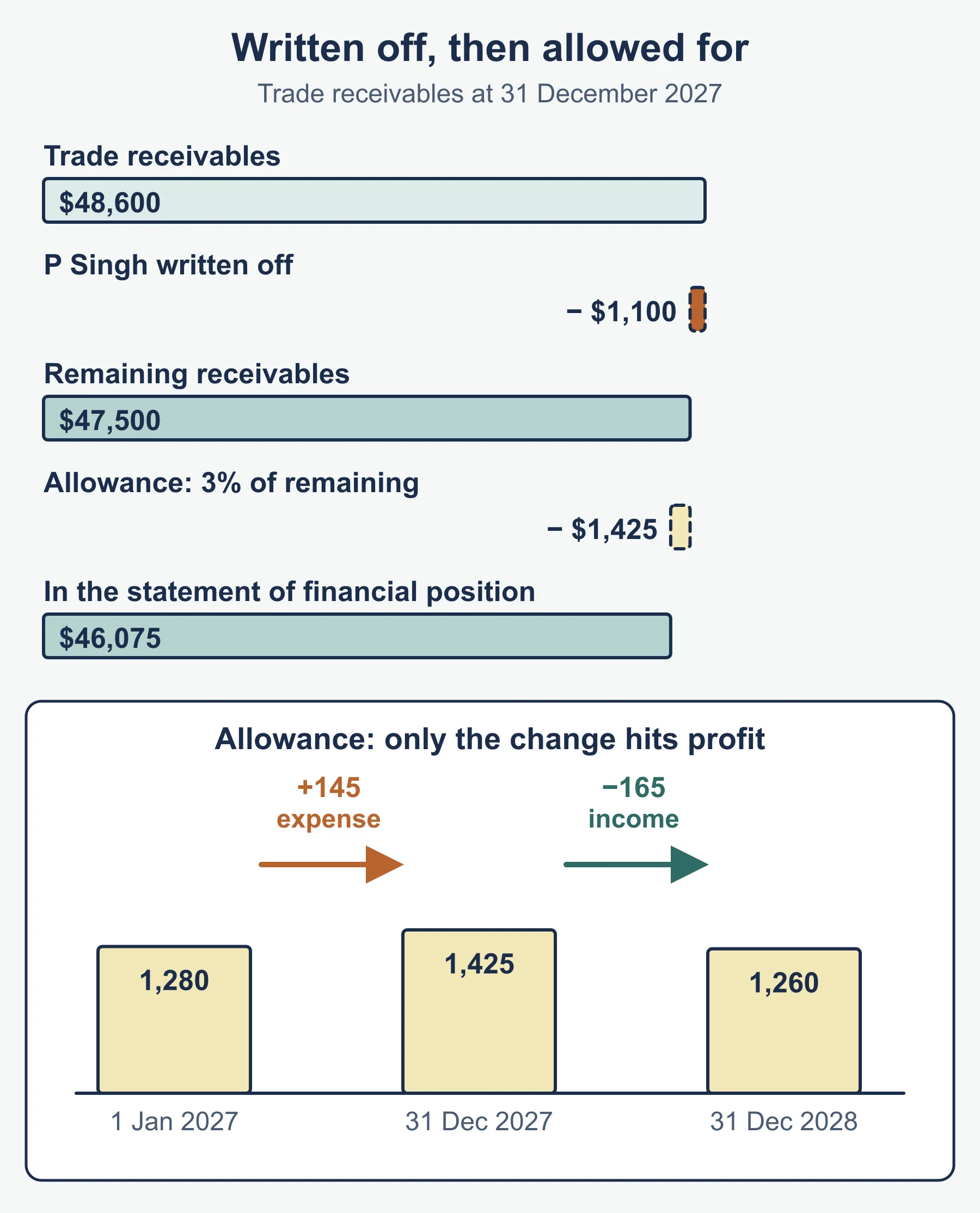
- Write off known irrecoverable debts first.
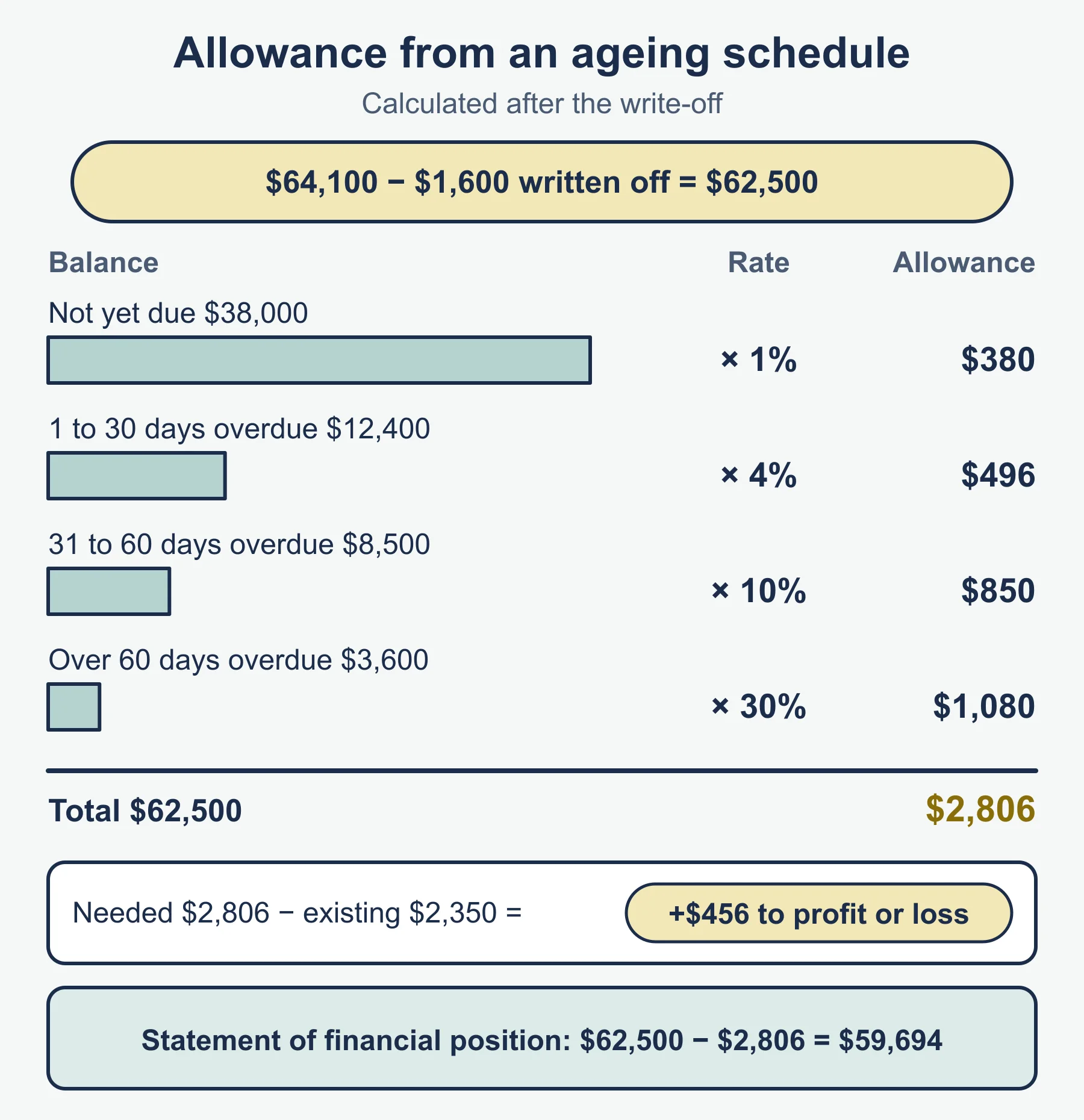
- Take the remaining trade receivables. Apply one rate, or rates to each age band in a schedule.
- Compare the new allowance with the existing allowance.
- Put only the difference through the statement of profit or loss.
- Deduct the new allowance from trade receivables in the statement of financial position.
| Situation | Allowance account | Statement of profit or loss |
|---|---|---|
| New allowance greater than old | Credit the increase | Expense: debit the increase |
| New allowance less than old | Debit the decrease | Income: credit the decrease |
Worked reminder (single rate). Trade receivables after write-off are 36,000 and the allowance is 4%, giving 1,440. The existing allowance is 1,260, so the increase is 180.
Worked reminder (schedule).
| Band | Balance | Rate | Allowance |
|---|---|---|---|
| Current | 21,000 | 2% | 420 |
| Overdue up to 60 days | 9,000 | 8% | 720 |
| Overdue over 60 days | 4,000 | 25% | 1,000 |
| Total | 34,000 | 2,140 |
Distinction. An irrecoverable debt is certain and written off to an expense account. An allowance is an estimate, held as a deduction from trade receivables, and justified by prudence. A debt recovered after write-off is credited to Irrecoverable debts recovered.
1.1.7 ICT in the double entry system
The specification says no specific applications or software packages are examined, so write about ICT generally.
- Recording: one entry posts to every affected account, and day books feed the ledgers.
- Reconciliations: control accounts and the trial balance can be produced from the ledgers on demand.
- Financial statements: produced quickly from the ledger data and re-run after adjustments.
- Benefits: speed, fewer arithmetical slips, easy retrieval, up-to-date figures.
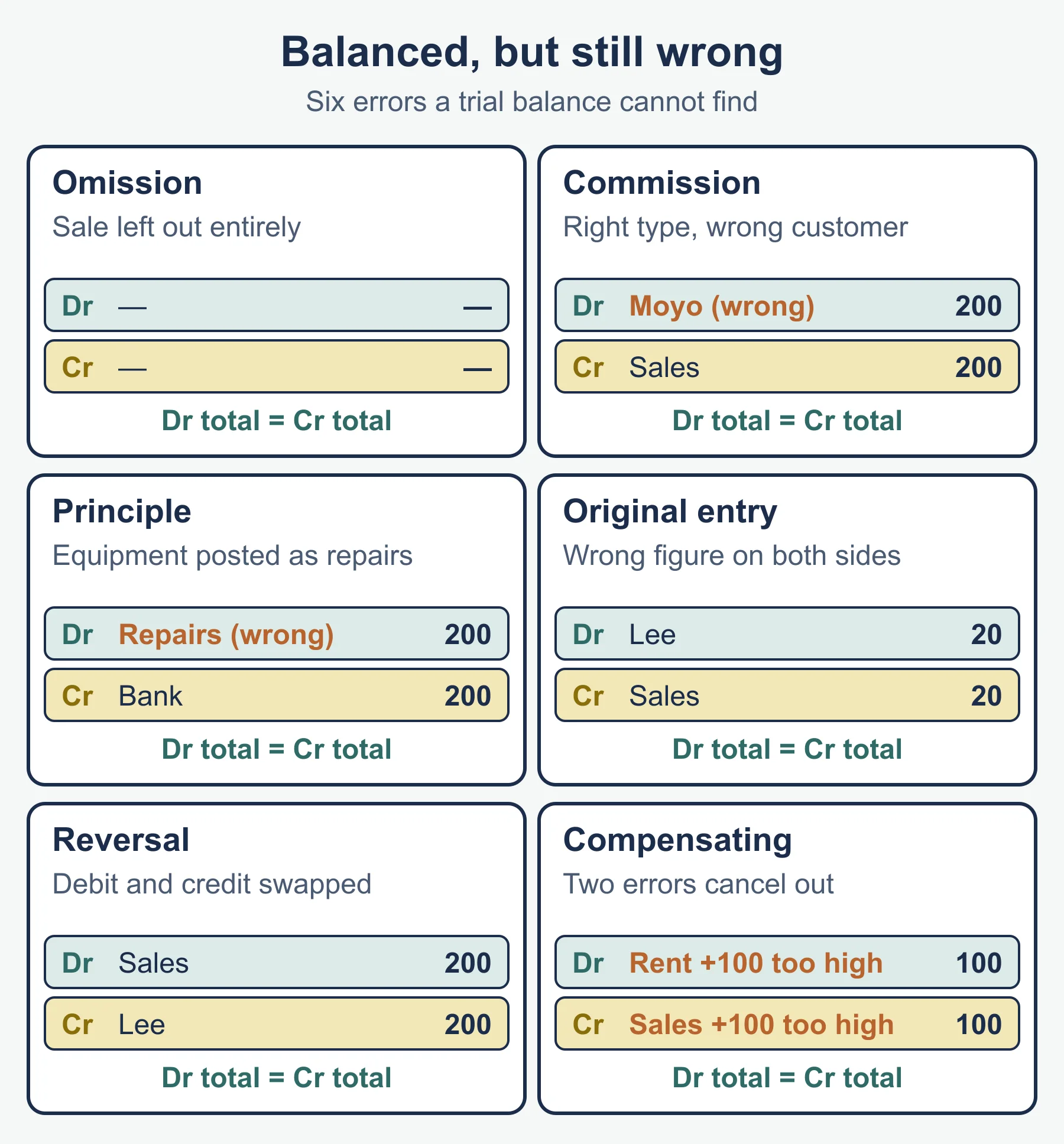
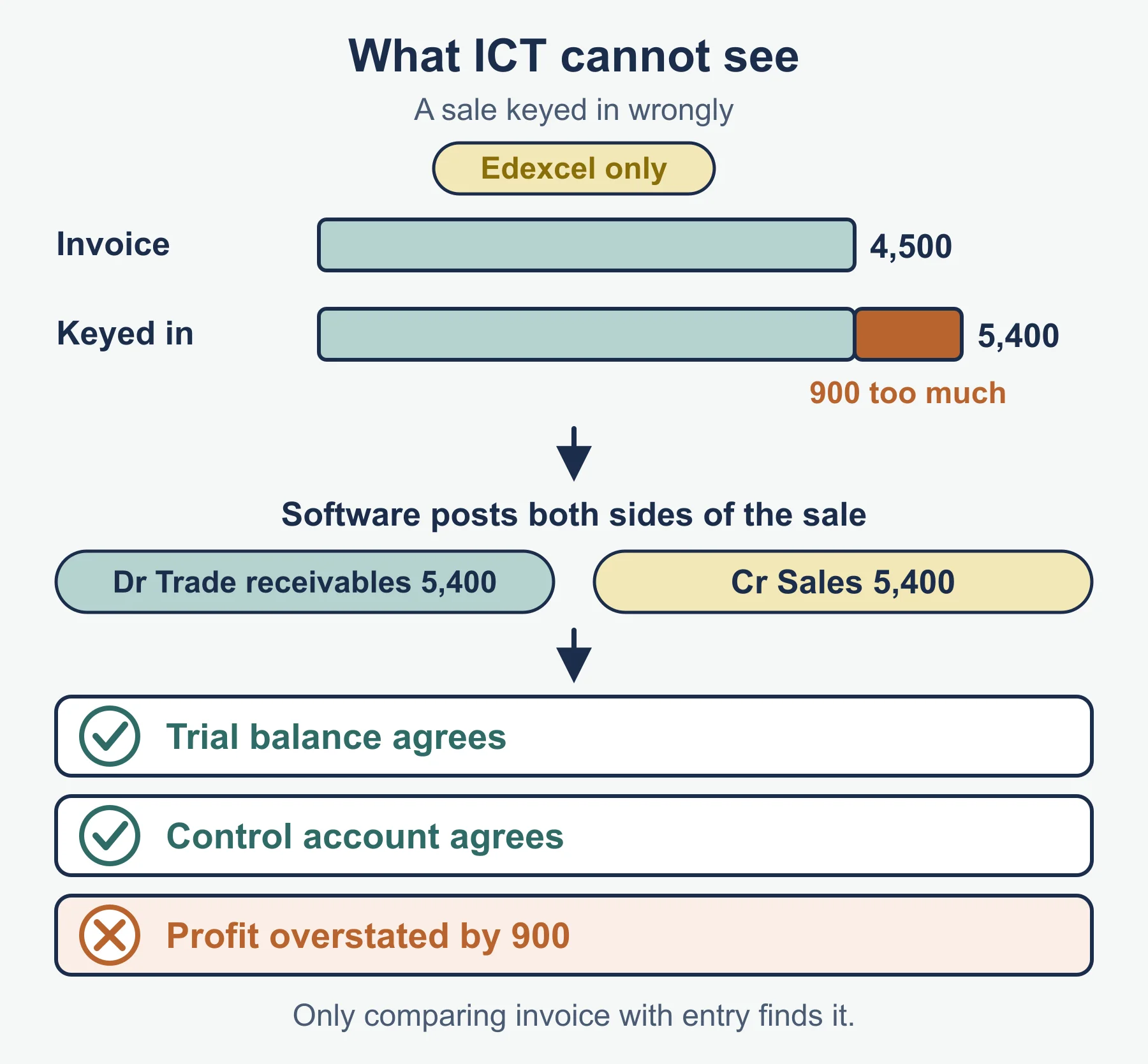
- Limits: incorrect input still gives incorrect output, errors of principle and compensating errors remain hidden, costs and training, data security, backup and fraud risks.
Worked reminder. A figure of 1,650 is keyed as 1,560. The software debits and credits 1,560, so the trial balance agrees. The error is 90, which is divisible by 9, a typical sign of transposed digits.
Must-know distinctions
- Book of prime entry versus ledger: the first records, the second classifies and balances.
- Accrual versus prepayment: owed versus paid early.
- Irrecoverable debt versus allowance: certain versus estimated.
- Drawings versus expense: capital reduction versus profit reduction.
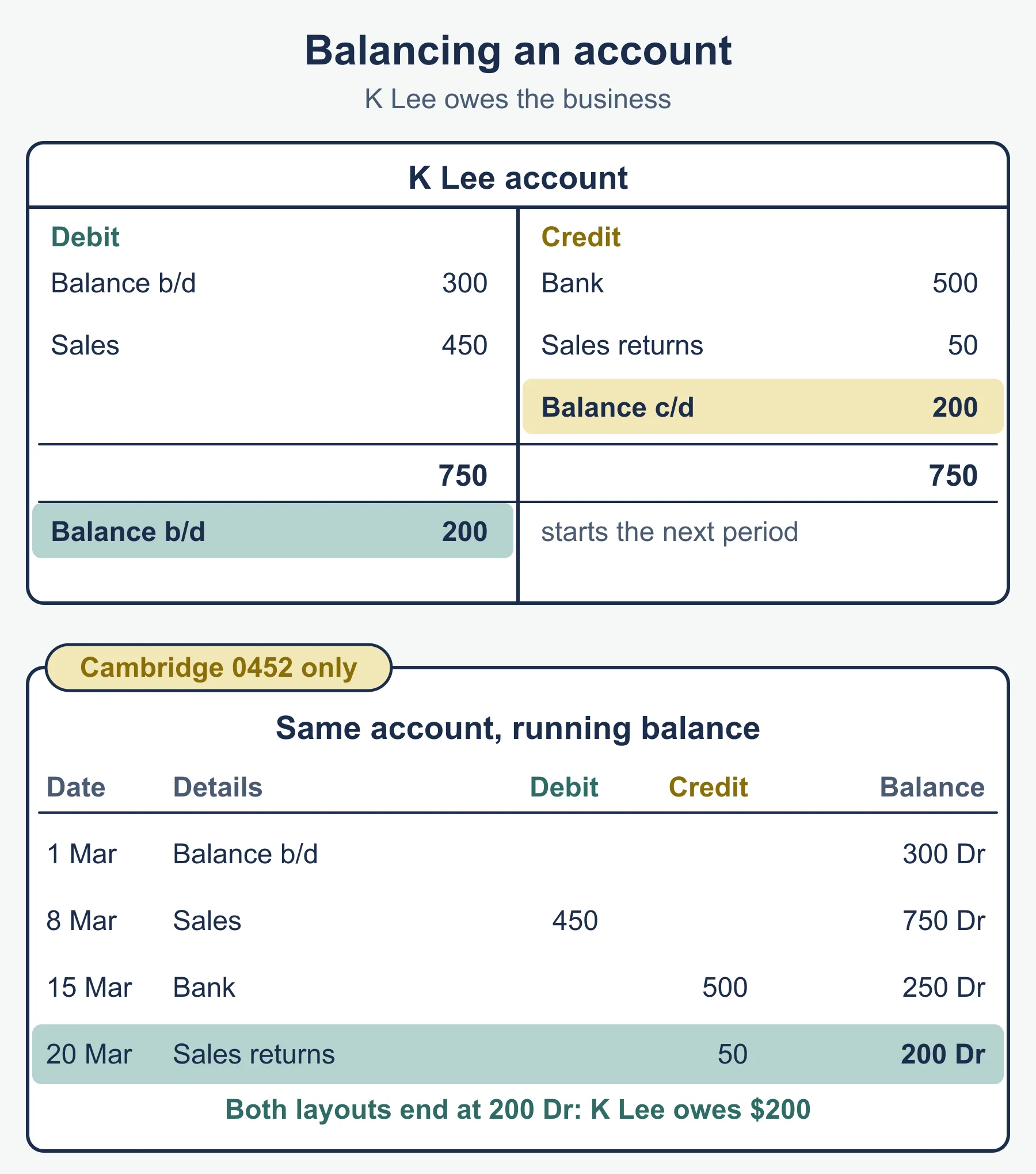
- Balance c/d versus b/d: the closing figure carried down becomes the opening figure brought down on the other side.
Quick self-test
- Name the accounts debited and credited when the owner takes goods for own use.
- Electricity paid is 1,380, owing at the start is 210 and owing at the end is 340. What is the charge?
- Insurance paid is 960, prepaid at the start is 120 and prepaid at the end is 270. What is the charge?
- Opening inventory is 3,800, purchases 27,600, purchases returns 900 and closing inventory 4,300. Find cost of sales.
- Receivables after write-off are 36,000, the allowance is 4% and the existing allowance is 1,260. What goes through the statement of profit or loss, and is it an expense or income?
- The allowance falls from 1,440 to 1,210. What is the entry?
- A petty cash float is 120 and 86 has been spent. State the reimbursement and the credit entry.
- In which book of prime entry is a credit note from a supplier first recorded?
- Why can a trial balance still agree after a keying error in accounting software?
- State two benefits and two limits of ICT in recording transactions.
Answers
- Debit Drawings, credit Purchases.
- 1,510.
-
- 26,200.
- 1,440 − 1,260 = 180, an expense (debit statement of profit or loss, credit allowance).
- The decrease is 230. Debit Allowance for irrecoverable debts 230 and credit the statement of profit or loss 230, increasing profit.
- 86, credited to Bank (and debited to the expense accounts).
- The purchases returns day book.
- The software posts the wrong amount to both sides equally, so debits still equal credits.
- Benefits: speed, fewer arithmetical errors. Limits: input errors still produce wrong output, cost and security risks.
Where marks are usually lost
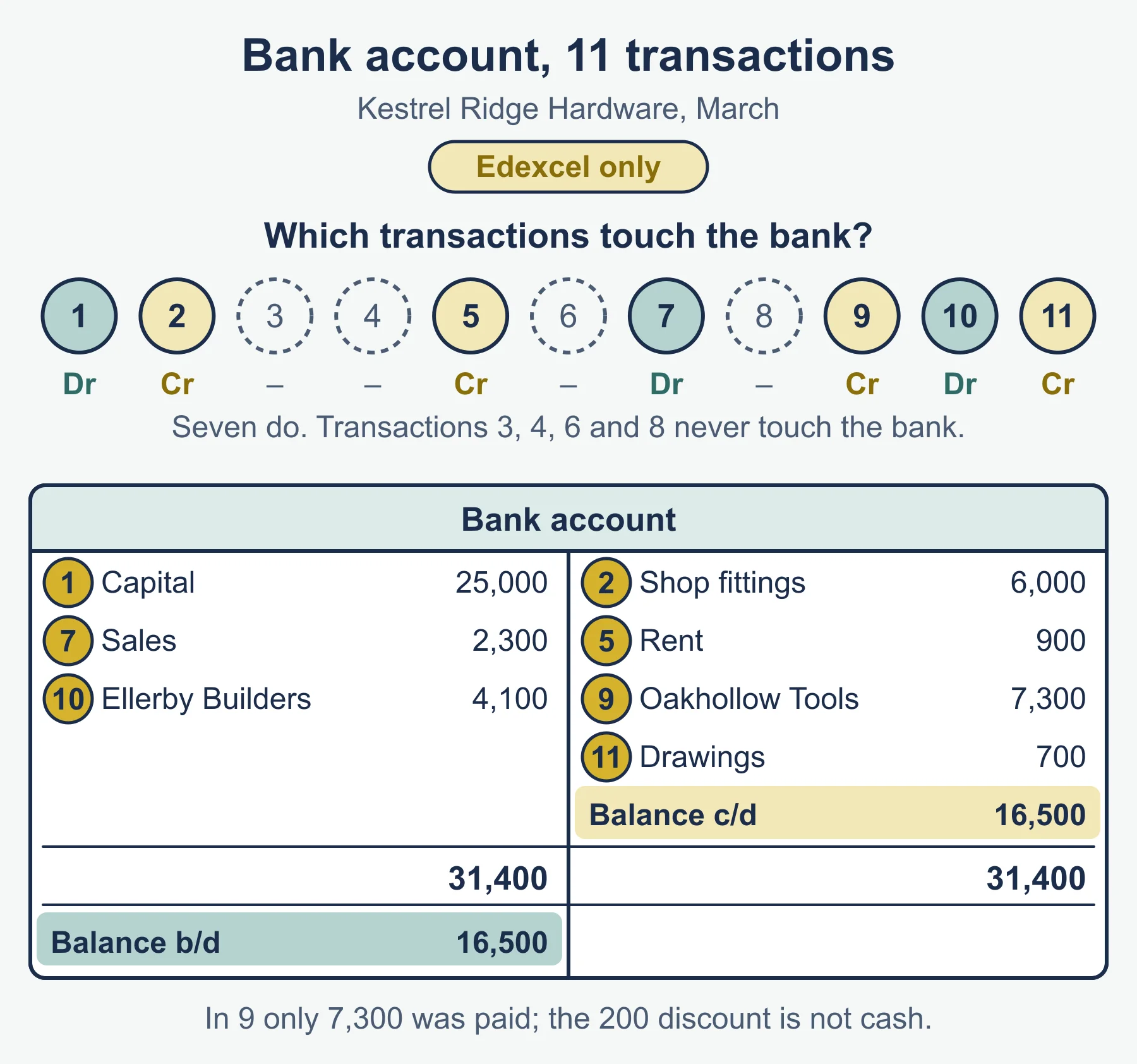
- Reversing debit and credit on a fall in an asset, such as a bank payment.
- Treating drawings as an expense of the business.
- Ignoring the opening accrual or prepayment when finding the charge.
- Putting the whole allowance, not the change, through the statement of profit or loss.
- Calculating the allowance before the irrecoverable debt is written off.
- Posting the cash book discount columns to the wrong side.
- Writing “ICT is faster” without saying what is faster or what still needs human checking.
- Leaving out the narrative on a journal entry or the account names beside the amounts.
Frequently asked questions
What is a book of prime entry? A book of prime entry gives each transaction its first written record before it is posted to the ledger. Examples are the sales and purchases day books, the returns day books, the cash book, the petty cash book and the journal.
What is the difference between an irrecoverable debt and an allowance for irrecoverable debts? An irrecoverable debt is a trade receivable that will not be paid and is written off. An allowance for irrecoverable debts is an estimate of debts that may not be paid, held in its own account and deducted from trade receivables in the statement of financial position.
What does a journal entry need to show? A journal entry shows the account debited, the account credited, the amount and a narrative explaining the transaction. It is used for items such as buying a non-current asset on credit, writing off an irrecoverable debt and opening entries.
How is cost of sales calculated at the year end? Cost of sales is opening inventory plus purchases, less purchases returns, less closing inventory. Inventory is not updated during the year, so it needs a year-end transfer.
Does a payment from the bank debit or credit the bank account? A payment reduces an asset, so it is credited to the bank account, while a receipt is debited. Reversing debit and credit on a fall in an asset is a common error.
Official syllabus
Pearson Edexcel International Advanced Subsidiary/Advanced Level in Accounting (XAC11/YAC11), Specification, Issue 2, September 2018, Unit 1, topic 1.1 content points 1.1.3 to 1.1.7.
Get free revision emails (optional)
Occasional emails with practice questions, worked explanations and links to free resources for the qualification and subjects you choose. No spam, and you can unsubscribe from any email. The free tools on this site never need an email.
Related resources
-
Study guides
Edexcel International A Level Accounting: Role and purpose of accounting, and concepts and conventions (YAC11)
Study guide to Edexcel IAL Accounting 1.1.1-1.1.2 and 1.1.8-1.1.10: why accounting exists, who uses it, nine concepts and conventions, and IAS.
Accounting · Pearson Edexcel · AS Level
Read guide -
Practice questions
Edexcel International A Level Accounting: Role and purpose, concepts and conventions (YAC11) – Practice Questions
Original practice questions with worked answers on the role of accounting, accounting concepts and conventions and IAS for Edexcel IAL Accounting.
Accounting · Pearson Edexcel · AS Level
Try questions -
Revision notes
Edexcel International A Level Accounting: Role and purpose, concepts and conventions (YAC11) – Revision Notes
Condensed recall notes for Edexcel IAL Accounting 1.1.1-1.1.2 and 1.1.8-1.1.10: role of accounting, nine concepts, IAS terms and a self-test.
Accounting · Pearson Edexcel · AS Level
Revise topic
Related articles
-
teaching
A Level tuition in Dubai: Cambridge or Pearson Edexcel International A Level?
Schools in Dubai and Abu Dhabi teach either Cambridge International AS & A Level or Pearson Edexcel International A Level. How the two are structured, why it matters for tuition, and how online classes from Lahore work.
9 October 2026
-
curriculum guides
Choosing subjects at IGCSE and A Level
How subject choices at 14 and 16 affect university options later, and how to keep pathways open without overloading a timetable.
28 July 2026
Studying this with a teacher
Working through Accounting AS LEVEL?
This page is free and stays free. If you would rather be taught it, Marlbridge runs Accounting classes one-to-one and in small groups of up to 15, online in your own time zone. The first trial class is free. WhatsApp replies within an hour (8am–11pm Pakistan time, every day); email the same day.
Pearson Edexcel Accounting teachers at Marlbridge

