
Study Guides
Edexcel International A Level Accounting: Capital and revenue expenditure and non-current asset depreciation (YAC11)
Study guide to capital and revenue expenditure and non-current asset depreciation, outcomes 1.1.11 to 1.1.20 of Edexcel International A Level Accounting.
- Subject
- Accounting
- Level
- AS LEVEL
- Topic
- Principles of accounting and double entry bookkeeping
- Author
- Marlbridge Academic Team
- Updated
- Reviewed by
- Javaid Iqbal Sabri (what this means)
Aligned to Pearson Edexcel A Level Accounting (YAC11), 2015-onwards. Official specification .
Syllabus page (what it covers and how it is assessed): Pearson Edexcel A Level Accounting.
Syllabus points this page covers
YAC11 (AS Level)
- 1.1.11-1.1.12 Capital expenditure and revenue expenditure
- 1.1.13-1.1.20 Non-current asset depreciation
Found an error? Report a correction.
Need help with this topic? Request a free trial class for A Level Accounting (YAC11).
This guide covers outcomes 1.1.11 to 1.1.20 of the Pearson Edexcel International Advanced Subsidiary/Advanced Level in Accounting (XAC11/YAC11) specification, Issue 2, September 2018. They sit in Unit 1, topic 1.1, which is the International AS unit. The businesses and figures are invented, and all amounts are in dollars. The wider overview is Principles and double entry bookkeeping; this guide goes deeper on its last two headings. For quick recall use the revision notes, then try the practice questions. The course hub is Edexcel A-Level Accounting, the printable list is the checklist, and the free diagnostics show where to start.
What the specification lists
| Outcome | What you must be able to do |
|---|---|
| 1.1.11 | Distinguish capital expenditure from revenue expenditure |
| 1.1.12 | Apply the correct treatment of each, with reference to relevant accounting concepts |
| 1.1.13 | Explain the causes of depreciation |
| 1.1.14 | Explain the reasons for charging depreciation |
| 1.1.15 | Calculate depreciation by reducing balance, straight line and revaluation methods |
| 1.1.16 | Write up non-current asset and provision for depreciation ledger accounts |
| 1.1.17 | Show the effect on profit of different depreciation methods |
| 1.1.18 | Show the effect on profit of a change of method |
| 1.1.19 | Prepare disposal accounts |
| 1.1.20 | Prepare a schedule of non-current assets |
The specification says calculators may be used in Unit 1.
Capital and revenue expenditure (1.1.11 and 1.1.12)
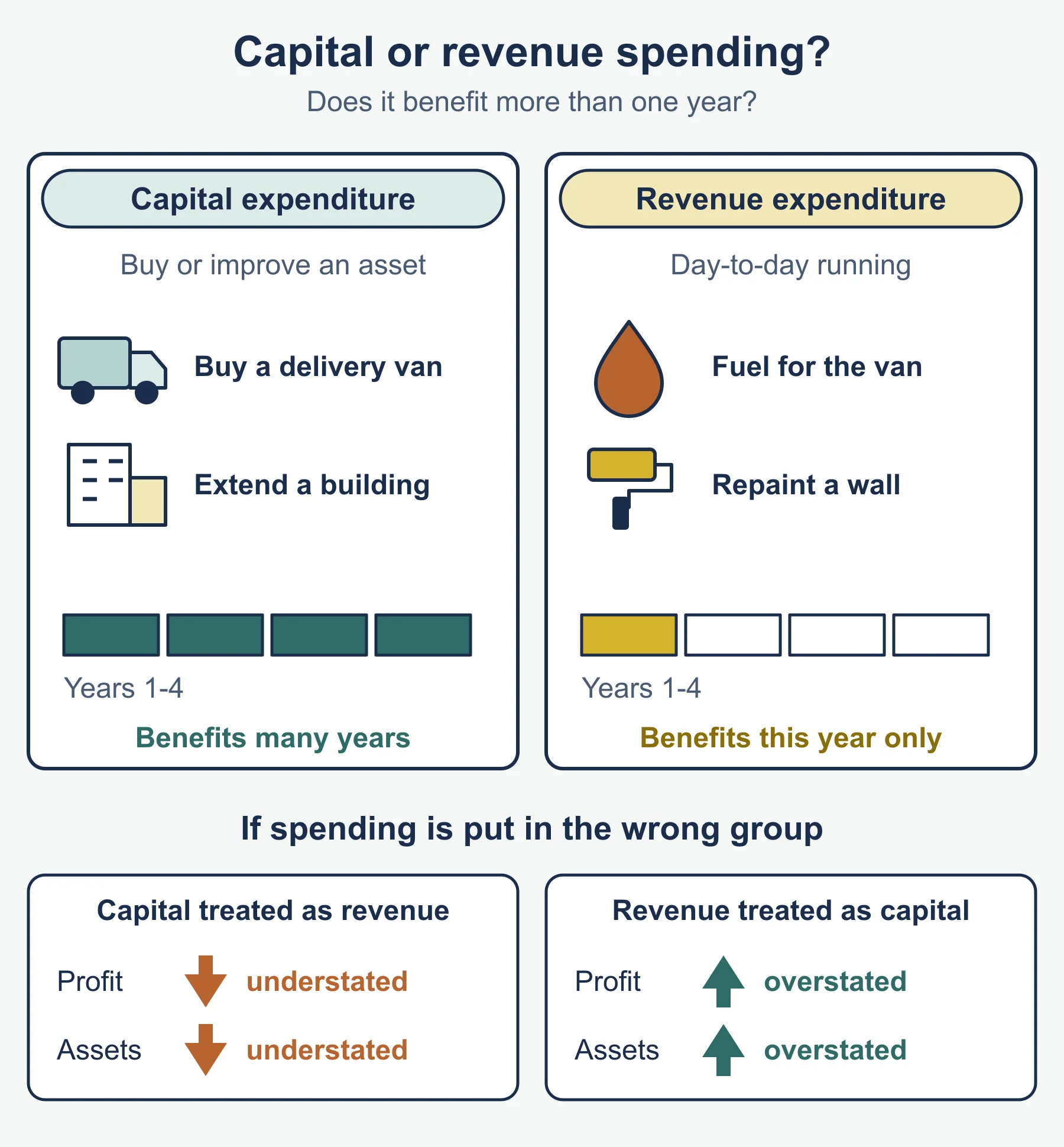
Capital expenditure buys, or improves the earning capacity of, a non-current asset. It is recorded in the statement of financial position at cost and then written off over the asset’s life through depreciation. Revenue expenditure keeps the business running and the asset in its present condition. It is charged in full to the statement of profit or loss for the year.
The test is purpose, not size. Does the spending bring an asset into use or add to what it can do? Or does it only maintain or run something the business already has?
Concepts behind the treatment
- Accruals: a cost that benefits several years is spread over those years through depreciation, so each year’s profit carries its fair share.
- Prudence: when it is unclear whether spending creates an asset, profit and assets are not overstated, so the cost leans towards expense.
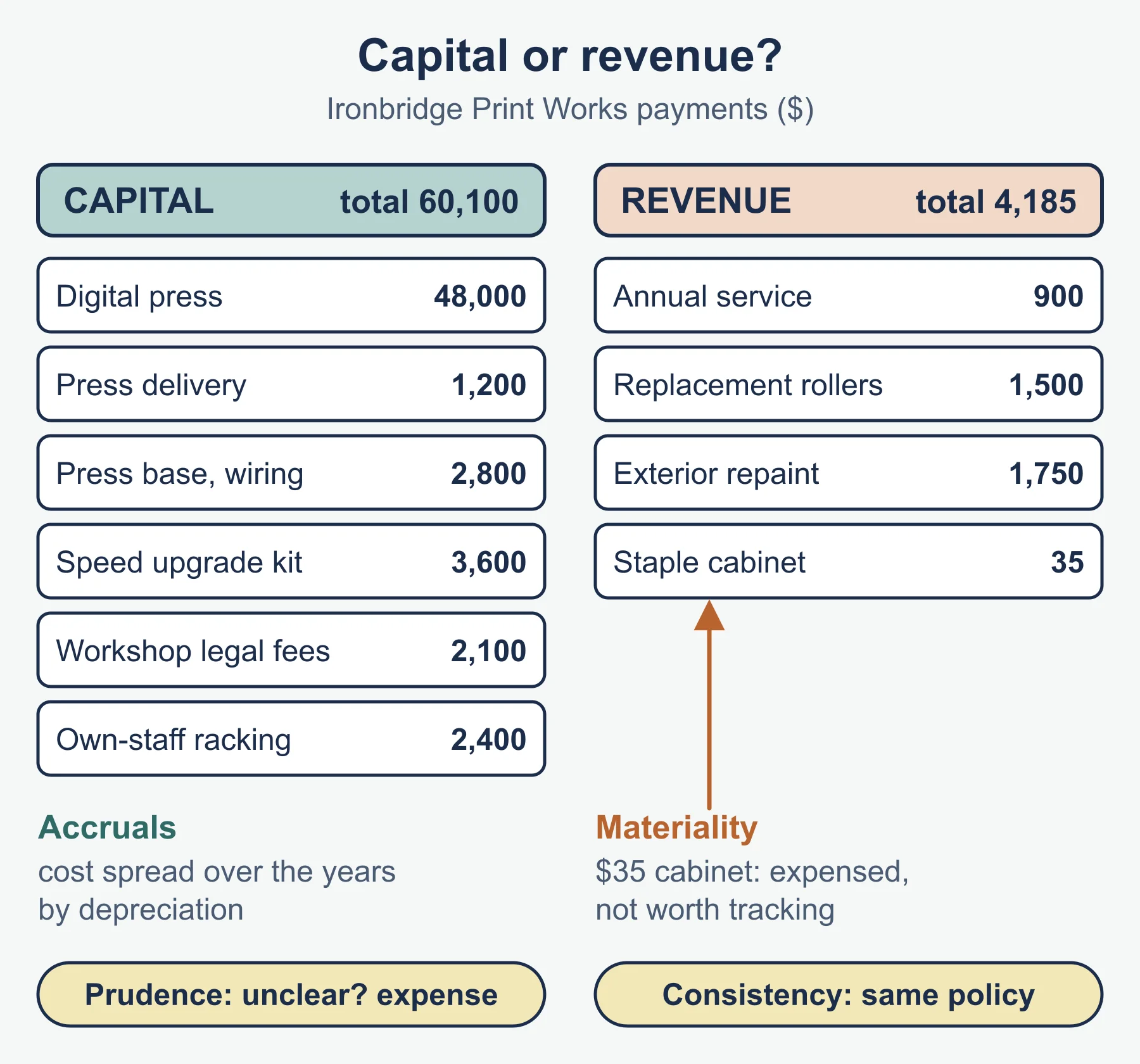
- Materiality: a trivial item, such as a cheap stapler, is treated as an expense even though it lasts for years, because tracking it would cost more than the information is worth.
- Consistency: the same policy is applied from year to year.
Worked example: Ironbridge Print Works
Ironbridge Print Works made these payments during 2026.
| Item | Amount | Treatment | Reason |
|---|---|---|---|
| New digital press | 48,000 | Capital | Asset acquired |
| Delivery of the press | 1,200 | Capital | Cost of bringing it to its location |
| Concrete base and wiring for the press | 2,800 | Capital | Cost of making it ready for use |
| Upgrade kit raising press speed by 40% | 3,600 | Capital | Increases earning capacity |
| Conveyancing fees on buying the workshop | 2,100 | Capital | Part of the cost of the property |
| Wages of own staff who built storage racking | 2,400 | Capital | Labour used to create an asset |
| Annual service of the old machine | 900 | Revenue | Maintains existing condition |
| Replacement rollers on the old machine | 1,500 | Revenue | Repair, not improvement |
| Repainting the workshop exterior | 1,750 | Revenue | Maintenance |
| Staple cabinet | 35 | Revenue | Not material |
Capital items total 60,100 and revenue items total 4,185. Suppose the press costs (52,000 in total) were wrongly charged as expenses. Profit for the year would be understated by 52,000, and non-current assets would be understated by the same amount. If the repainting were wrongly capitalised, profit and non-current assets would be overstated by 1,750. Questions often ask for this effect, so state both the profit and the asset.
Where one invoice mixes a repair and an upgrade, split it and treat each part separately.
Depreciation: causes and reasons (1.1.13 and 1.1.14)
Depreciation spreads the cost of a non-current asset, less any expected residual value, over its useful life. It is not a cash payment and it does not build up a fund to replace the asset.
Typical causes:
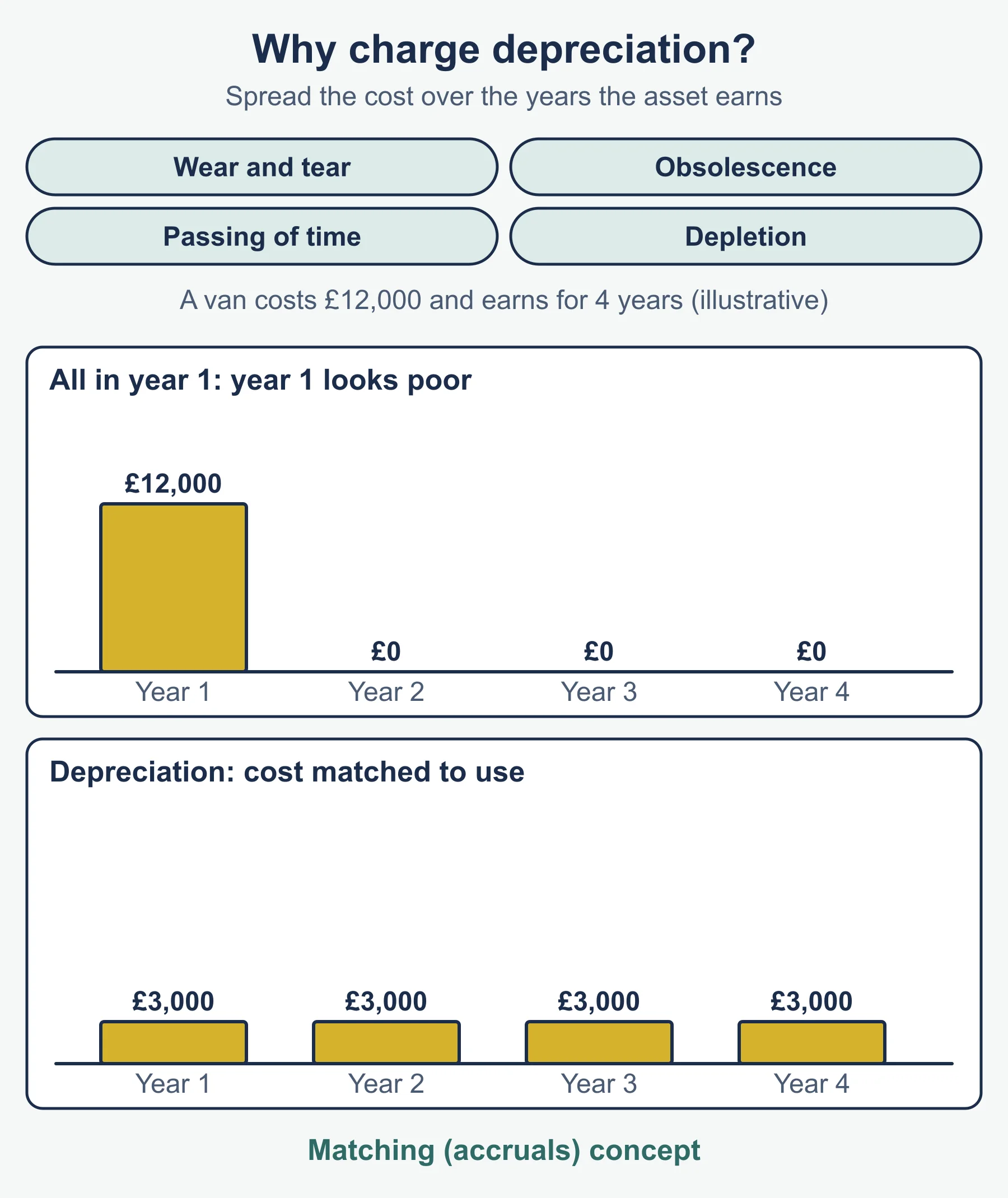
- Wear and tear from use and the passing of time.
- Obsolescence: new technology or changed demand makes the asset out of date before it wears out.
- Passage of time for assets with a fixed term, such as a lease.
- Depletion of assets that are used up, such as a quarry.
- Inadequacy: the business outgrows the asset.
Reasons for charging it:
- To apply accruals, matching the cost of the asset against the revenue it helps to earn.
- To report a profit that is fairer, since a purchase charged only in year 1 would make that year’s profit too low and later years’ too high.
- To show non-current assets at a more realistic carrying value, which is cost less accumulated depreciation.
- To apply prudence, so assets are not overstated.
The carrying value is not the market value, because depreciation allocates cost rather than measuring resale price.
Methods of depreciation (1.1.15)
Straight line
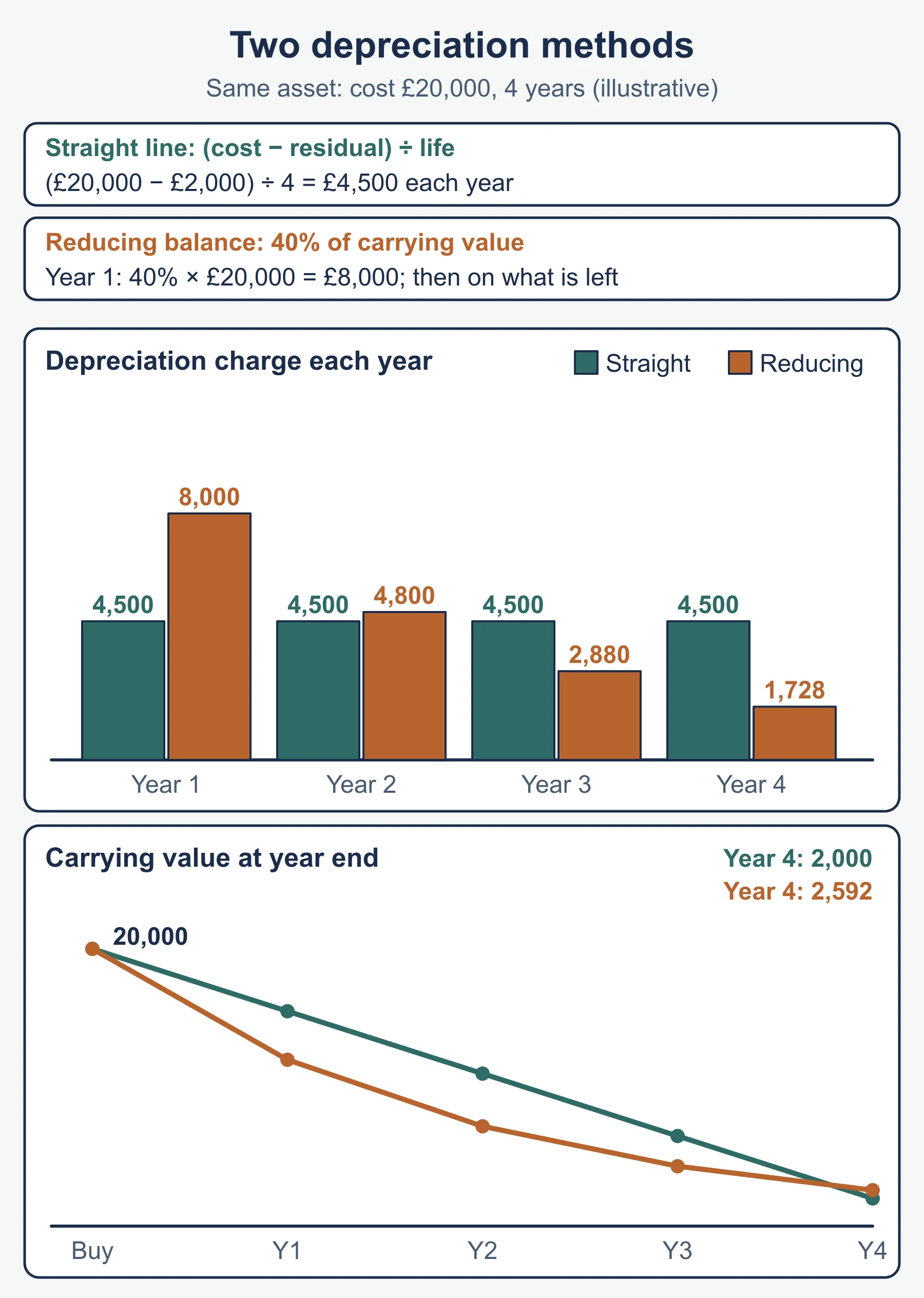
Annual charge = (cost − residual value) ÷ useful life. Many questions give a percentage of cost instead. For a part year, charge in proportion to the months of ownership unless the question states another policy.
Reducing balance
A fixed percentage is applied to the carrying value at the start of each year, so the charge is highest early on and residual value is not used in the calculation. Round each year’s charge to the nearest dollar unless the question says otherwise.
Revaluation
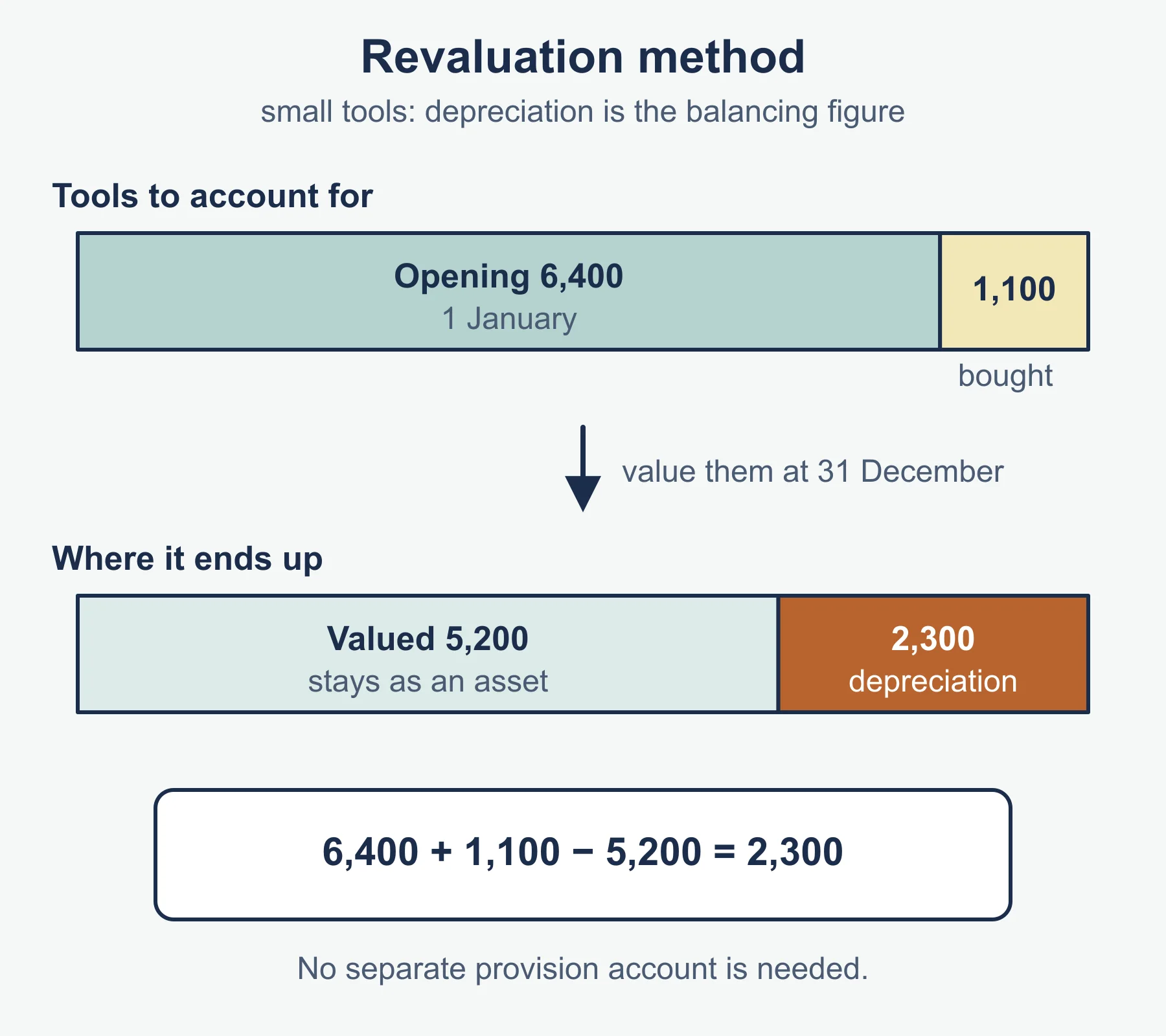
Used for small items such as tools, where tracking each one is impractical. The asset is valued at the year end. Depreciation = opening valuation + additions − closing valuation.
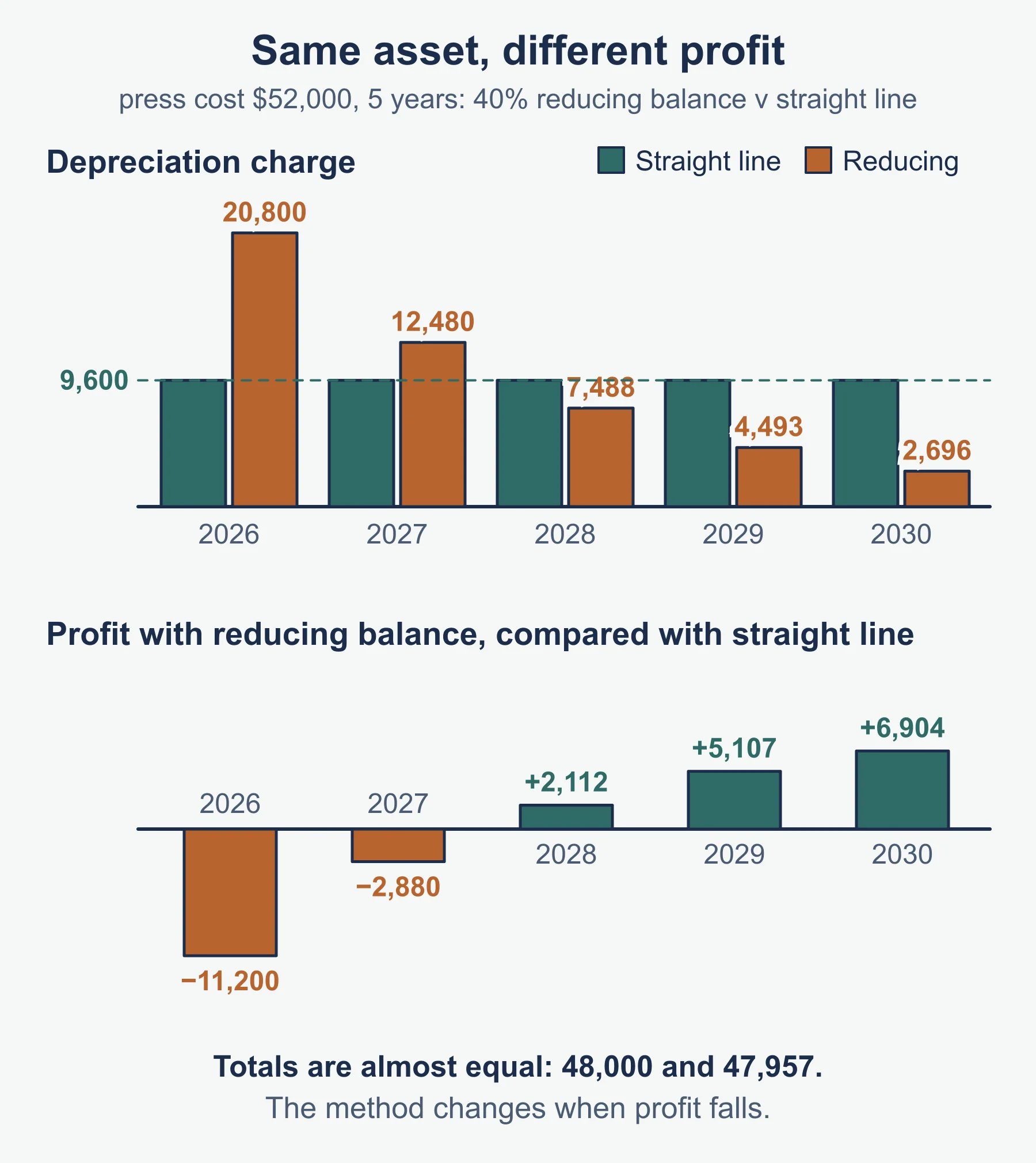
Ironbridge buys a printing press on 1 January 2026 for a total of 52,000. Residual value is 4,000 and the life is 5 years.
| Year | Straight line charge | Reducing balance 40% charge | Reducing balance carrying value |
|---|---|---|---|
| 2026 | 9,600 | 20,800 | 31,200 |
| 2027 | 9,600 | 12,480 | 18,720 |
| 2028 | 9,600 | 7,488 | 11,232 |
| 2029 | 9,600 | 4,493 | 6,739 |
| 2030 | 9,600 | 2,696 | 4,043 |
| Total | 48,000 | 47,957 |
The 40% rate brings the carrying value close to the 4,000 residual value rather than exactly onto it, which is normal when the rate is rounded.
Ironbridge also keeps small tools on a revaluation basis. They were valued at 6,400 at 1 January 2026, 1,100 of tools were bought in the year, and they are valued at 5,200 at 31 December. Depreciation is 6,400 + 1,100 − 5,200 = 2,300.
Effect on profit of the method (1.1.17)
Using the table above, reducing balance lowers profit in 2026 by 11,200 compared with straight line (20,800 − 9,600), and by 2,880 in 2027. In 2028, 2029 and 2030 it raises profit by 2,112, 5,107 and 6,904. Total depreciation over the life is almost the same, so the methods change when profit appears, not (broadly) how much. Reducing balance suits assets that lose usefulness fastest early on; straight line suits assets used evenly. Say which fits the asset described.
A higher depreciation charge never changes cash. It lowers profit for the year and the carrying value of the asset only.
Change of method (1.1.18)
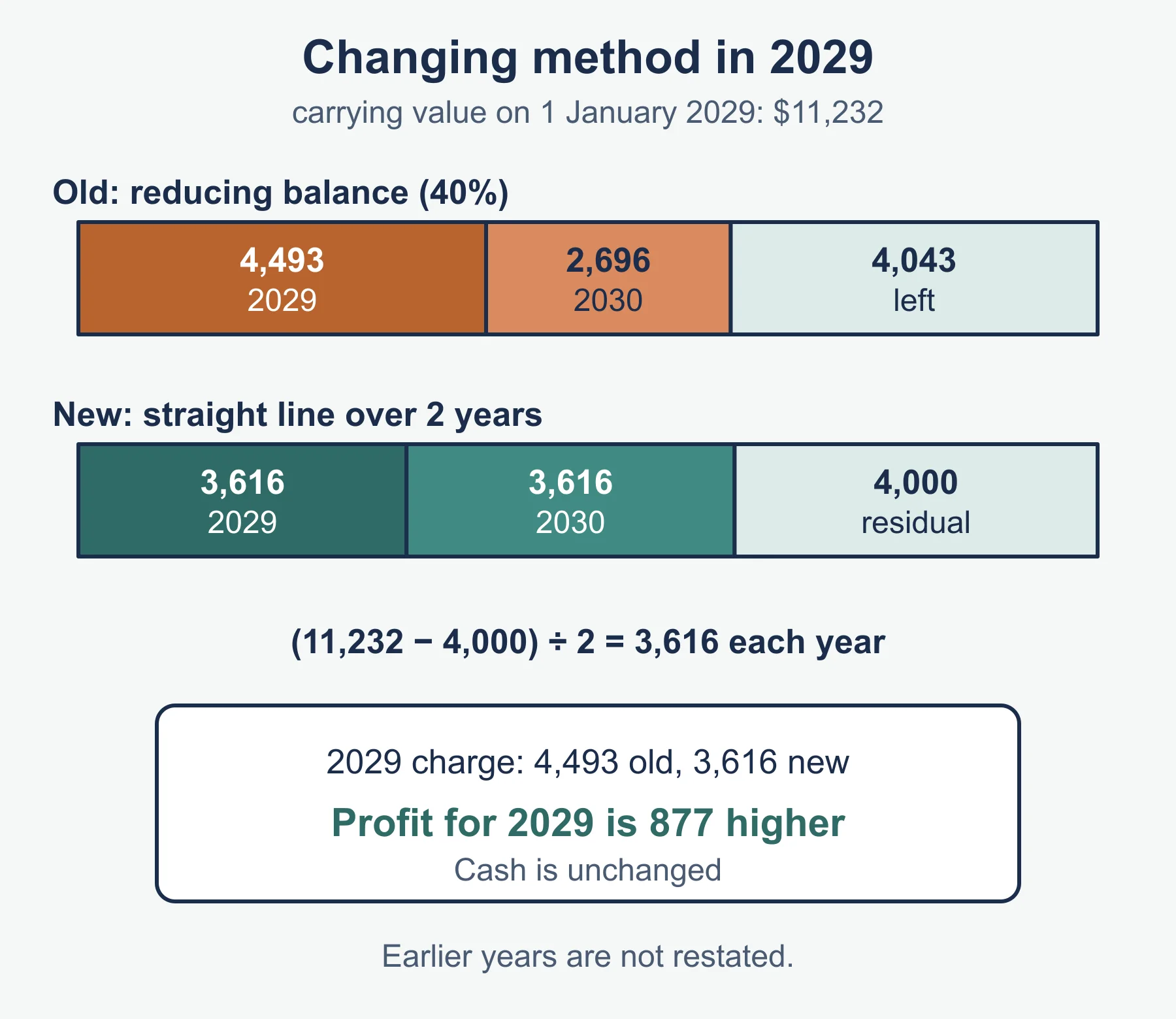
Suppose Ironbridge had used reducing balance at 40% and decided at the start of 2029 to move to straight line over the 2 years remaining, keeping the 4,000 residual value.
- Carrying value at 1 January 2029: 11,232.
- New annual charge: (11,232 − 4,000) ÷ 2 = 3,616.
- Charge under the old method would have been 4,493, so profit for 2029 is 877 higher.
The usual approach in questions is to apply the new method to the carrying value from the date of change, without altering earlier years’ profits, unless the question says otherwise. A change in method departs from consistency, so give the reason and the effect on profit.
Ledger accounts (1.1.16)
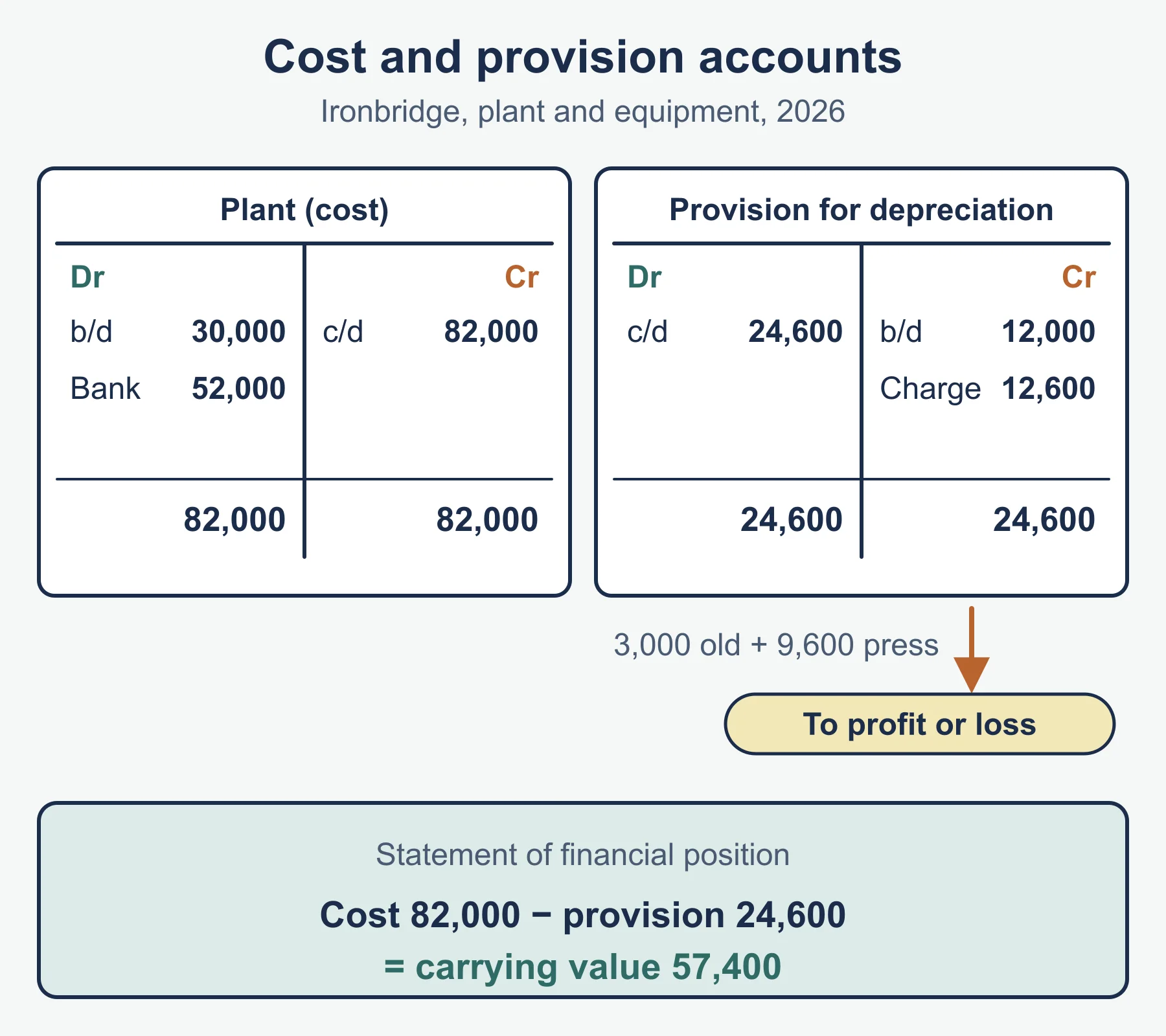
Ironbridge depreciates plant and equipment on a straight line basis. Its old machine cost 30,000, has been owned for four years, and is depreciated at 10% of cost per year with no residual value, so its provision stood at 12,000 on 1 January 2026. The press is added to the plant account on that date.
Plant and equipment (cost)
| 2026 | Dr | 2026 | Cr | ||
|---|---|---|---|---|---|
| 1 Jan | Balance b/d | 30,000 | 31 Dec | Balance c/d | 82,000 |
| 1 Jan | Bank | 52,000 | |||
| 82,000 | 82,000 |
Provision for depreciation: plant and equipment
| 2026 | Dr | 2026 | Cr | ||
|---|---|---|---|---|---|
| 31 Dec | Balance c/d | 24,600 | 1 Jan | Balance b/d | 12,000 |
| 31 Dec | Depreciation expense | 12,600 | |||
| 24,600 | 24,600 |
The charge is 3,000 for the old machine plus 9,600 for the press, which is 12,600. It is debited to the depreciation expense account and then transferred to the statement of profit or loss. The statement of financial position shows plant at cost 82,000 less provision 24,600, giving a carrying value of 57,400.
For a revaluation asset the entries are simpler. Ironbridge’s tools account shows opening balance 6,400, bank 1,100 on the debit side, and depreciation 2,300 and closing valuation 5,200 on the credit side. There is no separate provision account.
Disposal of a non-current asset (1.1.19)
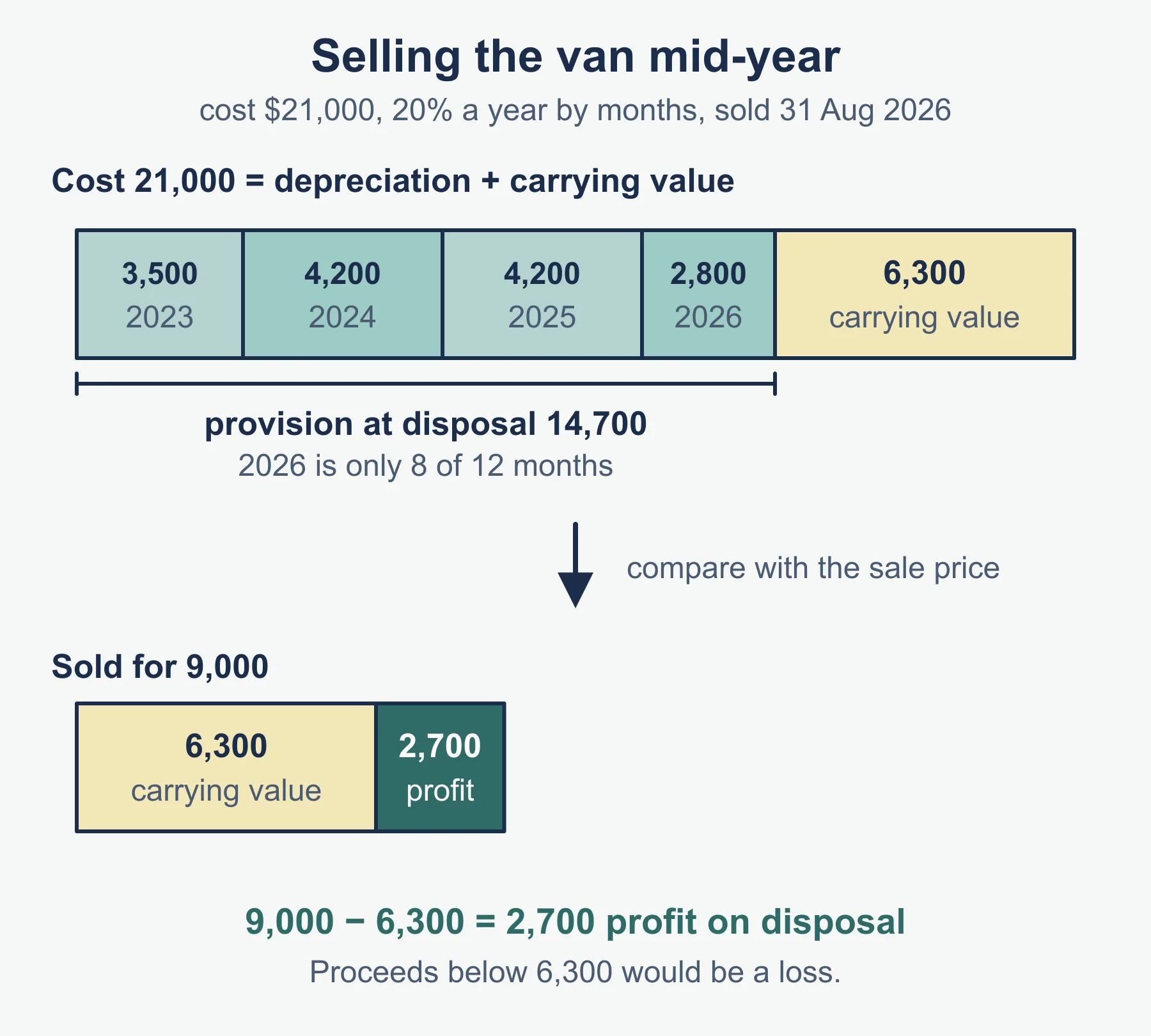
Ironbridge sold a van on 31 August 2026 for 9,000. The van cost 21,000 on 1 March 2023, and is depreciated at 20% of cost per year, by months, with no residual value.
- Depreciation to 31 December 2023: 21,000 × 20% × 10/12 = 3,500.
- 2024 and 2025: 4,200 each, so the provision at 31 December 2025 is 11,900.
- 2026 to the date of sale: 21,000 × 20% × 8/12 = 2,800, so the provision at disposal is 14,700.
- Carrying value at disposal: 21,000 − 14,700 = 6,300.
- Profit on disposal: 9,000 − 6,300 = 2,700.
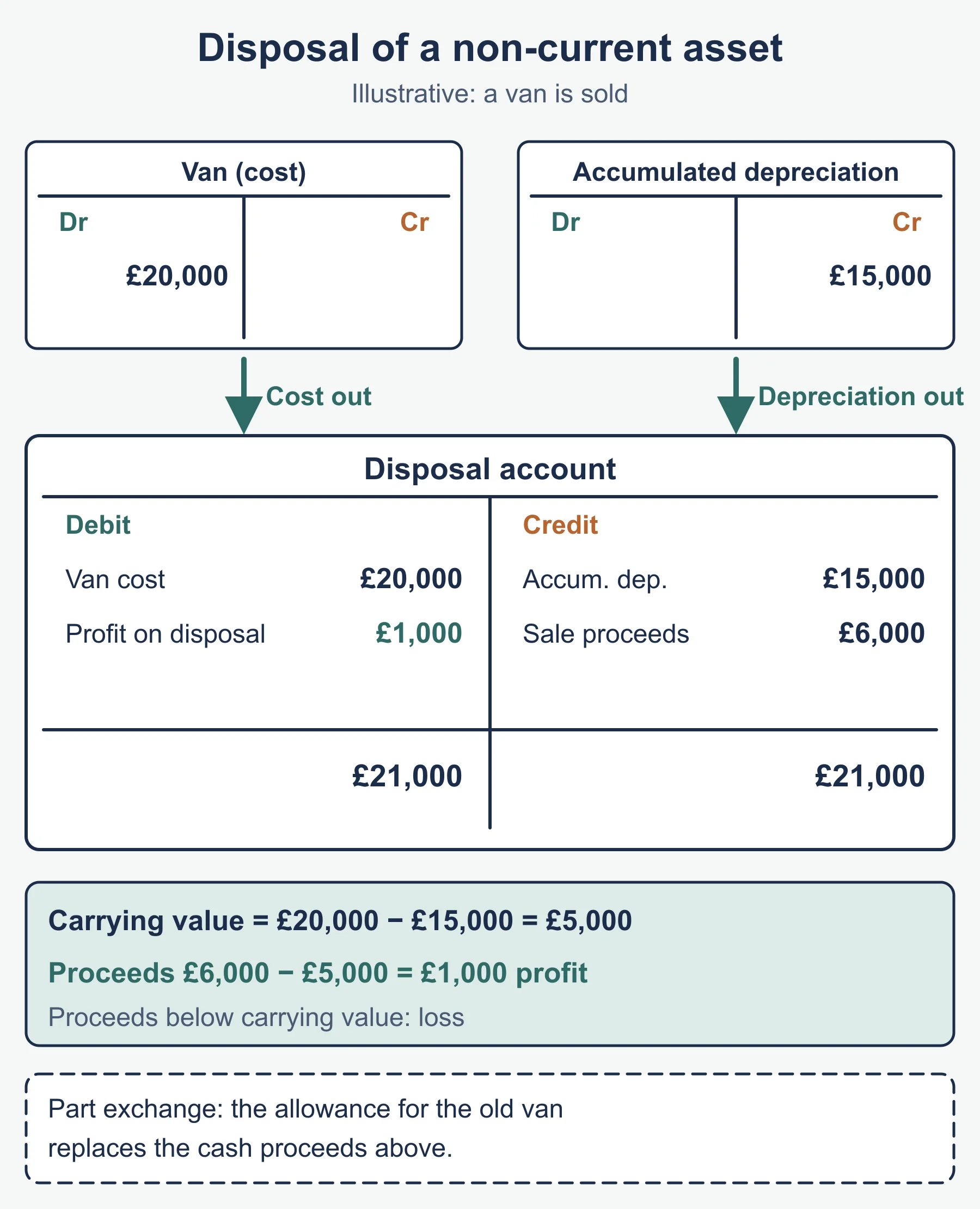
Disposals account: van
| Dr | Cr | ||
|---|---|---|---|
| Van (cost) | 21,000 | Provision for depreciation | 14,700 |
| Profit on disposal (to statement of profit or loss) | 2,700 | Bank | 9,000 |
| 23,700 | 23,700 |
If the proceeds had been below the carrying value, the balancing figure would be a loss on disposal, which is a debit in the statement of profit or loss. The depreciation for the months before the sale is still a charge for the year. The cost and provision accounts are cleared by the same entries.
Schedule of non-current assets (1.1.20)
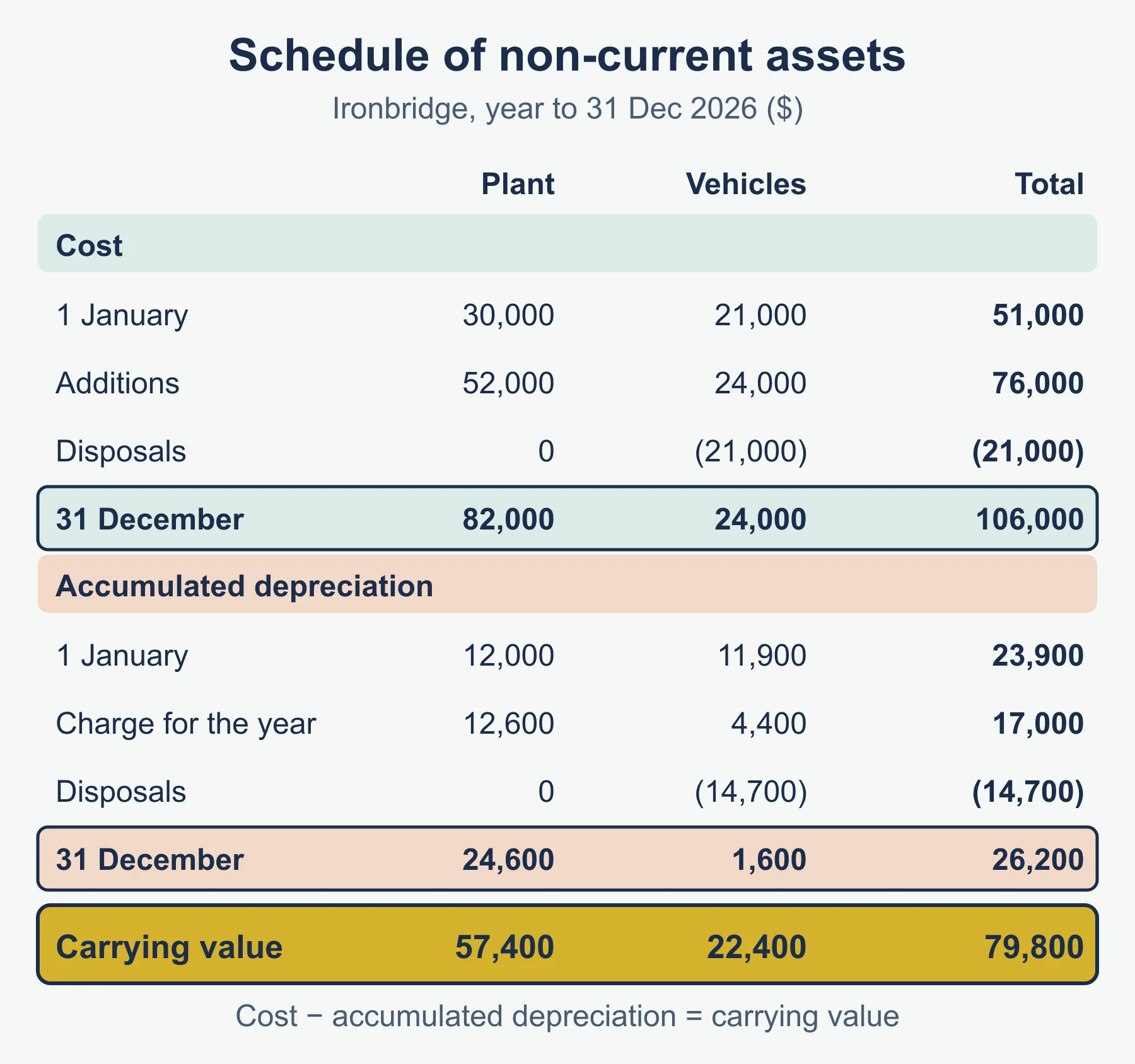
The schedule summarises cost, accumulated depreciation and carrying value by class. Ironbridge bought a new van for 24,000 on 1 September 2026 at the same 20% rate, so it carries 4 months of depreciation: 1,600.
| 2026 | Plant and equipment | Vehicles | Total |
|---|---|---|---|
| Cost | |||
| 1 January | 30,000 | 21,000 | 51,000 |
| Additions | 52,000 | 24,000 | 76,000 |
| Disposals | 0 | (21,000) | (21,000) |
| 31 December | 82,000 | 24,000 | 106,000 |
| Accumulated depreciation | |||
| 1 January | 12,000 | 11,900 | 23,900 |
| Charge for the year | 12,600 | 4,400 | 17,000 |
| Disposals | 0 | (14,700) | (14,700) |
| 31 December | 24,600 | 1,600 | 26,200 |
| Carrying value 31 December 2026 | 57,400 | 22,400 | 79,800 |
| Carrying value 1 January 2026 | 18,000 | 9,100 | 27,100 |
The vehicles charge of 4,400 is 2,800 on the van sold plus 1,600 on the new van.
Common errors
- Capitalising repairs, or expensing delivery and installation costs of a new asset.
- Using residual value in a reducing balance calculation.
- Forgetting to remove the disposed asset’s depreciation for earlier years from the provision.
- Charging a full year on a part-year asset, or none on an asset sold in the year.
- Saying depreciation provides cash for replacement.
Frequently asked questions
How do you decide if spending is capital or revenue expenditure? The test is purpose, not size. Spending that brings an asset into use or improves its earning capacity is capital expenditure; spending that maintains it or keeps the business running is revenue expenditure.
What are the causes of depreciation? Causes include wear and tear from use, obsolescence, the passage of time for fixed-term assets such as a lease, depletion of assets such as a quarry, and inadequacy when the business outgrows the asset.
What is the revaluation method of depreciation? The revaluation method is used for small items such as tools, where tracking each one is impractical. Depreciation = opening valuation + additions − closing valuation.
How is a change of depreciation method handled? The usual approach is to apply the new method to the carrying value from the date of the change, then compare the new charge with the old one to show the effect on profit.
Does depreciation affect cash? No. A higher depreciation charge lowers profit for the year and the carrying value of the asset, but it never changes cash.
Official syllabus
Pearson Edexcel International Advanced Subsidiary/Advanced Level in Accounting (XAC11/YAC11), Specification, Issue 2, September 2018, Unit 1 topic 1.1, outcomes 1.1.11 to 1.1.20.
Get free revision emails (optional)
Occasional emails with practice questions, worked explanations and links to free resources for the qualification and subjects you choose. No spam, and you can unsubscribe from any email. The free tools on this site never need an email.
Related resources
-
Practice questions
Edexcel International A Level Accounting: Capital and revenue expenditure and depreciation (YAC11) – Practice Questions
Original practice questions with worked answers on capital and revenue expenditure and non-current asset depreciation for Edexcel IAL Accounting.
Accounting · Pearson Edexcel · AS Level
Try questions -
Revision notes
Edexcel International A Level Accounting: Capital and revenue expenditure and depreciation (YAC11) – Revision Notes
Condensed revision notes on capital and revenue expenditure and non-current asset depreciation, outcomes 1.1.11 to 1.1.20 of Edexcel IAL Accounting.
Accounting · Pearson Edexcel · AS Level
Revise topic -
Study guides
Edexcel International A Level Accounting: The double entry system (YAC11)
Study guide to the double entry system for Edexcel International A-Level Accounting: ledgers, books of prime entry, adjustments, allowances and ICT.
Accounting · Pearson Edexcel · AS Level
Read guide
Related articles
-
teaching
A Level tuition in Dubai: Cambridge or Pearson Edexcel International A Level?
Schools in Dubai and Abu Dhabi teach either Cambridge International AS & A Level or Pearson Edexcel International A Level. How the two are structured, why it matters for tuition, and how online classes from Lahore work.
9 October 2026
-
curriculum guides
Choosing subjects at IGCSE and A Level
How subject choices at 14 and 16 affect university options later, and how to keep pathways open without overloading a timetable.
28 July 2026
Studying this with a teacher
Working through Accounting AS LEVEL?
This page is free and stays free. If you would rather be taught it, Marlbridge runs Accounting classes one-to-one and in small groups of up to 15, online in your own time zone. The first trial class is free. WhatsApp replies within an hour (8am–11pm Pakistan time, every day); email the same day.
Pearson Edexcel Accounting teachers at Marlbridge

