
Study Guides
Edexcel International A Level Accounting: The double entry system (YAC11)
Study guide to the double entry system for Edexcel International A-Level Accounting: ledgers, books of prime entry, adjustments, allowances and ICT.
- Subject
- Accounting
- Level
- AS LEVEL
- Topic
- Principles of accounting and double entry bookkeeping
- Author
- Marlbridge Academic Team
- Updated
- Reviewed by
- Javaid Iqbal Sabri (what this means)
Aligned to Pearson Edexcel A Level Accounting (YAC11), 2015-onwards. Official specification .
Syllabus page (what it covers and how it is assessed): Pearson Edexcel A Level Accounting.
Syllabus points this page covers
YAC11 (AS Level)
- 1.1.3-1.1.7 Double entry system
Found an error? Report a correction.
Need help with this topic? Request a free trial class for A Level Accounting (YAC11).
This guide teaches the double entry system, content points 1.1.3 to 1.1.7 of Unit 1, in the Pearson Edexcel International Advanced Subsidiary/Advanced Level in Accounting (XAC11/YAC11) specification, Issue 2, September 2018. Unit 1 topics are International AS. All businesses and figures are invented, and every amount is in dollars.
Course hub: Edexcel A-Level Accounting. Printable checklist: Edexcel accounting checklist. Check your level with a free diagnostic. Companion pages: revision notes and practice questions. Related: the Topic 1 study guide and the control accounts guide.
What this guide covers
| Point | You must be able to |
|---|---|
| 1.1.3 | Record transactions in the books of account |
| 1.1.4 | Record transactions in the books of prime entry |
| 1.1.5 | Make end of period transfers and adjustments |
| 1.1.6 | Keep ledger accounts for an allowance for irrecoverable debts, including calculating it from a schedule of trade receivables |
| 1.1.7 | Describe the use of ICT in recording transactions and preparing reconciliations (control accounts, trial balance) and financial statements |
The specification says you will not be examined on specific applications or software packages. Point 1.1.7 is about what ICT does for the accounting system, not any product.
1.1.3 Recording transactions in the books of account
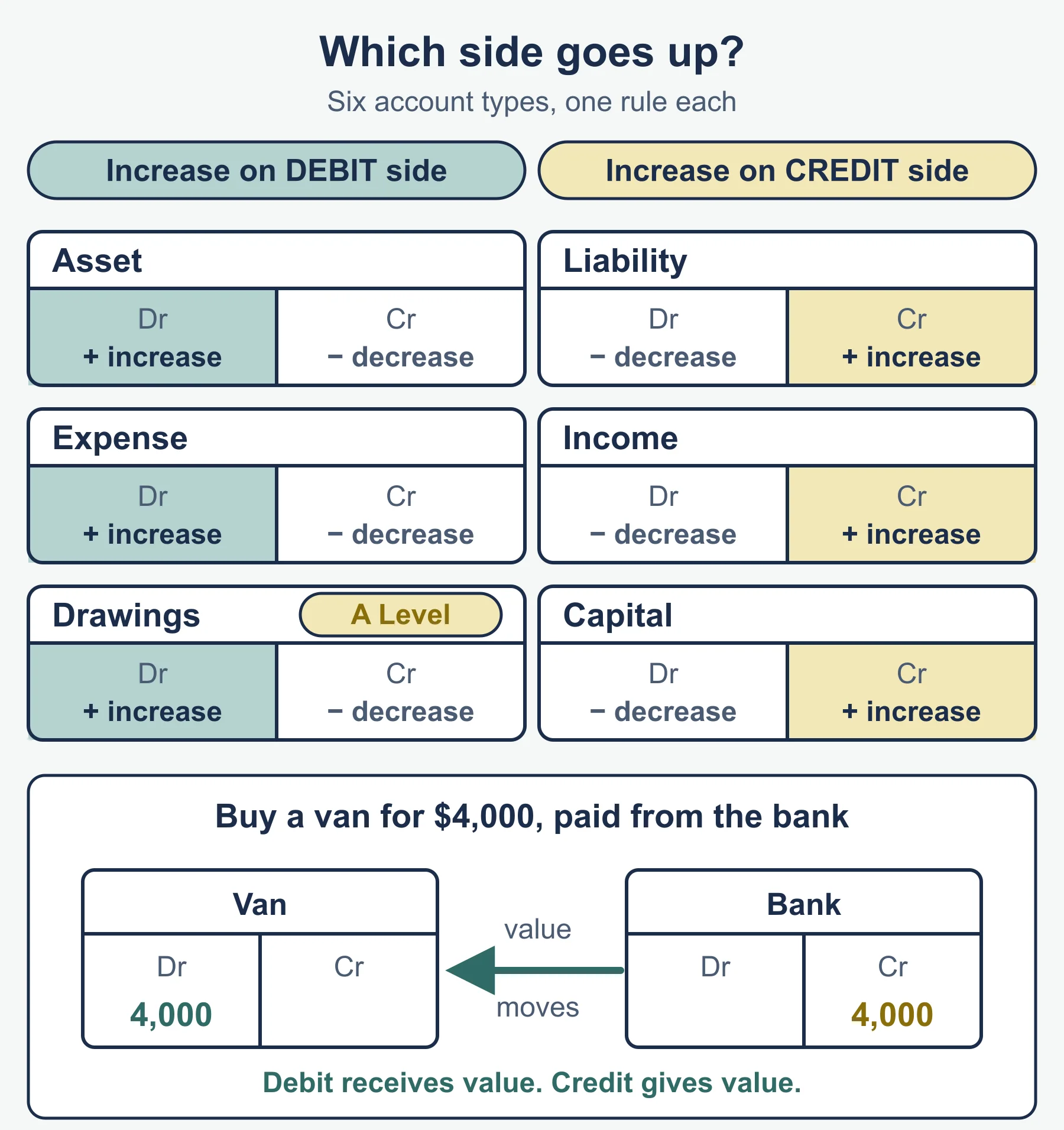
Every transaction has two effects, so it is recorded twice: once as a debit in one account and once as a credit of the same amount in another. Total debits always equal total credits.
| Type of account | Increase | Decrease |
|---|---|---|
| Assets (bank, inventory, non-current assets, trade receivables) | Debit | Credit |
| Expenses and drawings | Debit | Credit |
| Liabilities (trade payables, loans) | Credit | Debit |
| Capital | Credit | Debit |
| Revenue and other income | Credit | Debit |
The books of account are the ledgers. The sales ledger holds a personal account for each credit customer, the purchases ledger one for each supplier, and the general ledger holds the nominal accounts (expenses, revenue, drawings, capital) and the real accounts (assets such as shop fittings).
Worked example: a month of transactions
Kestrel Ridge Hardware starts trading on 1 March. For each transaction, decide what increases or decreases, then apply the table above.
| No. | Transaction | Debit | Credit | Amount |
|---|---|---|---|---|
| 1 | Owner pays capital into the bank | Bank | Capital | 25,000 |
| 2 | Buys shop fittings, paying by bank | Shop fittings | Bank | 6,000 |
| 3 | Buys goods on credit from Oakhollow Tools | Purchases | Oakhollow Tools | 8,000 |
| 4 | Sells goods on credit to Ellerby Builders | Ellerby Builders | Sales | 4,500 |
| 5 | Pays rent by bank | Rent | Bank | 900 |
| 6 | Returns goods to Oakhollow Tools | Oakhollow Tools | Purchases returns | 500 |
| 7 | Cash sales banked | Bank | Sales | 2,300 |
| 8 | Ellerby Builders return goods | Sales returns | Ellerby Builders | 300 |
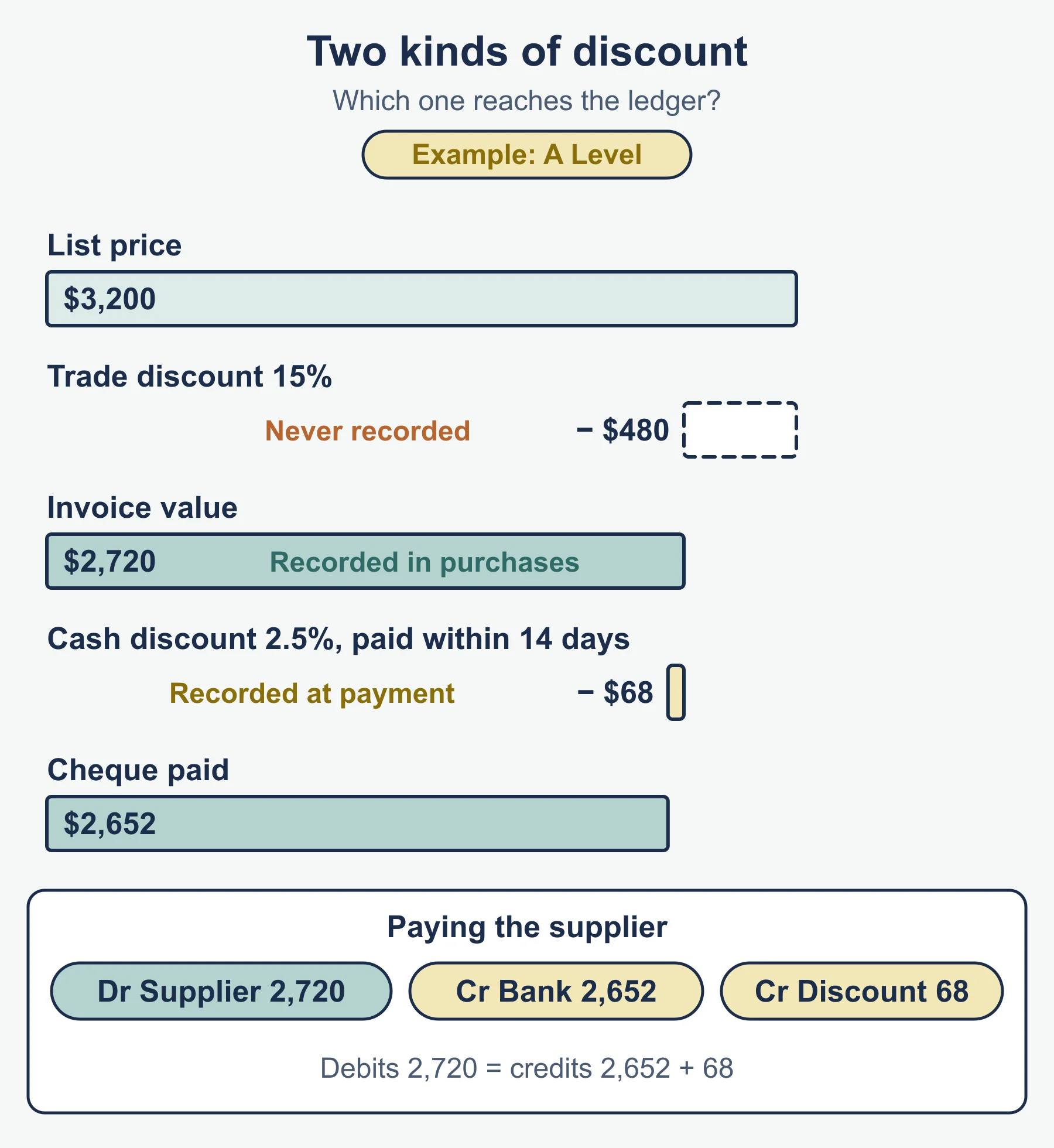
| 9 | Pays Oakhollow Tools 7,300 in full settlement of 7,500 | Oakhollow Tools | Bank 7,300; Discount received 200 | 7,500 |
| 10 | Ellerby Builders pay 4,100 in full settlement of 4,200 | Bank 4,100; Discount allowed 100 | Ellerby Builders | 4,200 |
| 11 | Owner draws money for personal use | Drawings | Bank | 700 |
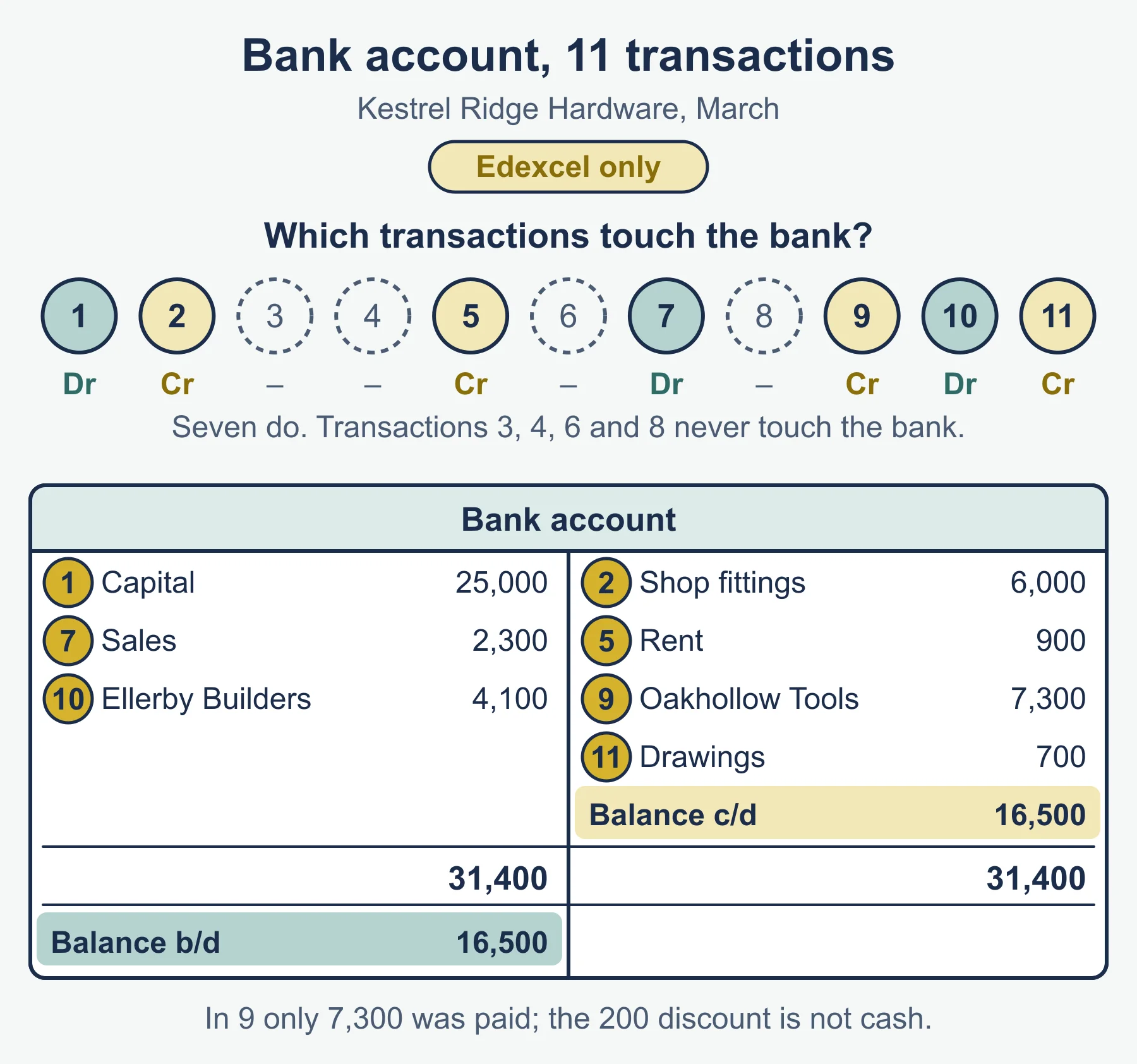
The bank account then looks like this.
| Bank account | |||
|---|---|---|---|
| Capital | 25,000 | Shop fittings | 6,000 |
| Sales | 2,300 | Rent | 900 |
| Ellerby Builders | 4,100 | Oakhollow Tools | 7,300 |
| Drawings | 700 | ||
| Balance c/d | 16,500 | ||
| 31,400 | 31,400 |
The balance b/d of 16,500 is a debit. Both personal accounts close to nil: Oakhollow Tools owed 8,000, less 500 returned, less 7,300 paid, less 200 discount; Ellerby Builders owed 4,500, less 300 returned, less 4,100 paid, less 100 discount.
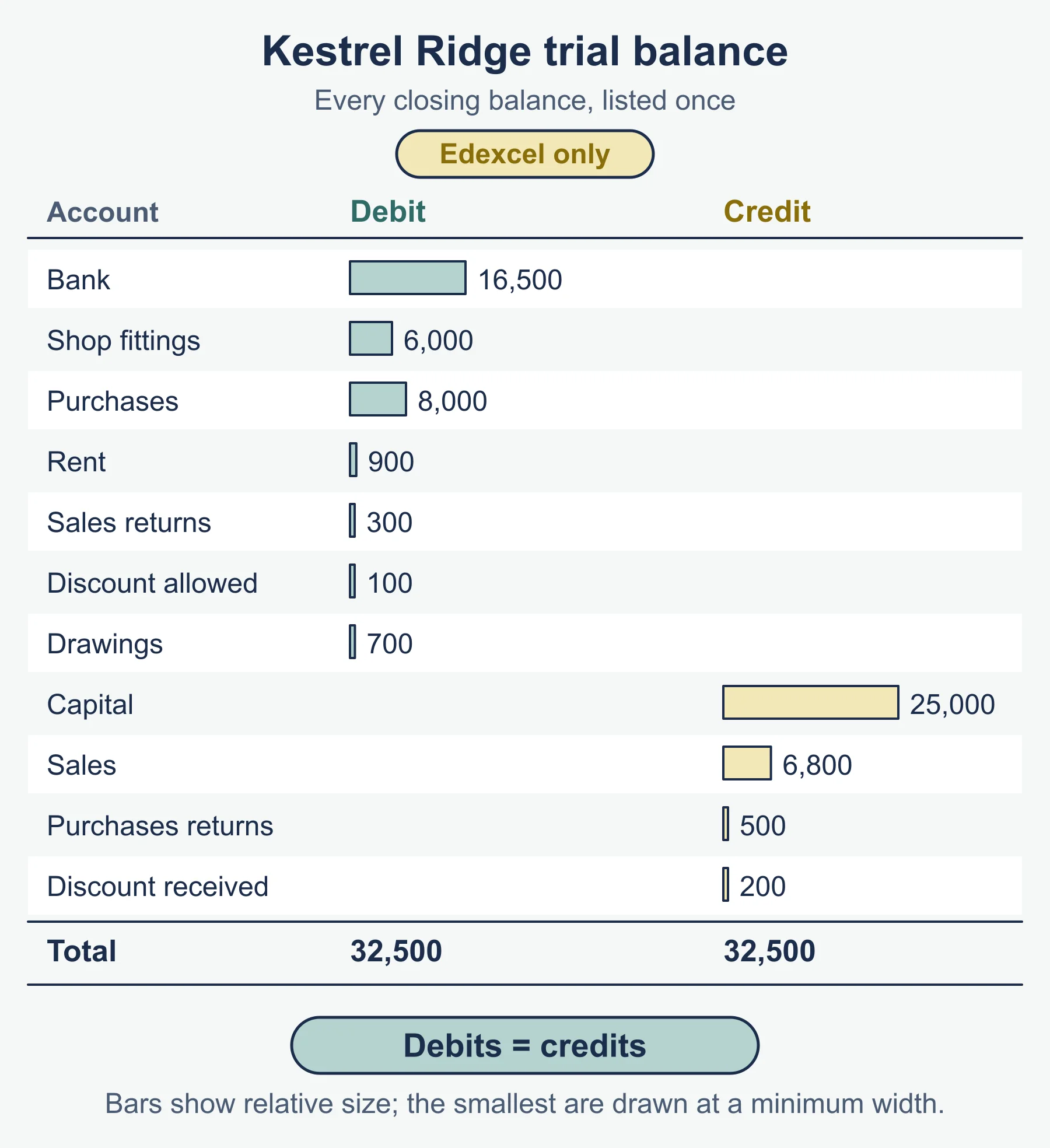
The trial balance lists every closing balance and checks that the totals agree.
| Account | Debit | Credit |
|---|---|---|
| Bank | 16,500 | |
| Shop fittings | 6,000 | |
| Purchases | 8,000 | |
| Rent | 900 | |
| Sales returns | 300 | |
| Discount allowed | 100 | |
| Drawings | 700 | |
| Capital | 25,000 | |
| Sales | 6,800 | |
| Purchases returns | 500 | |
| Discount received | 200 | |
| Total | 32,500 | 32,500 |
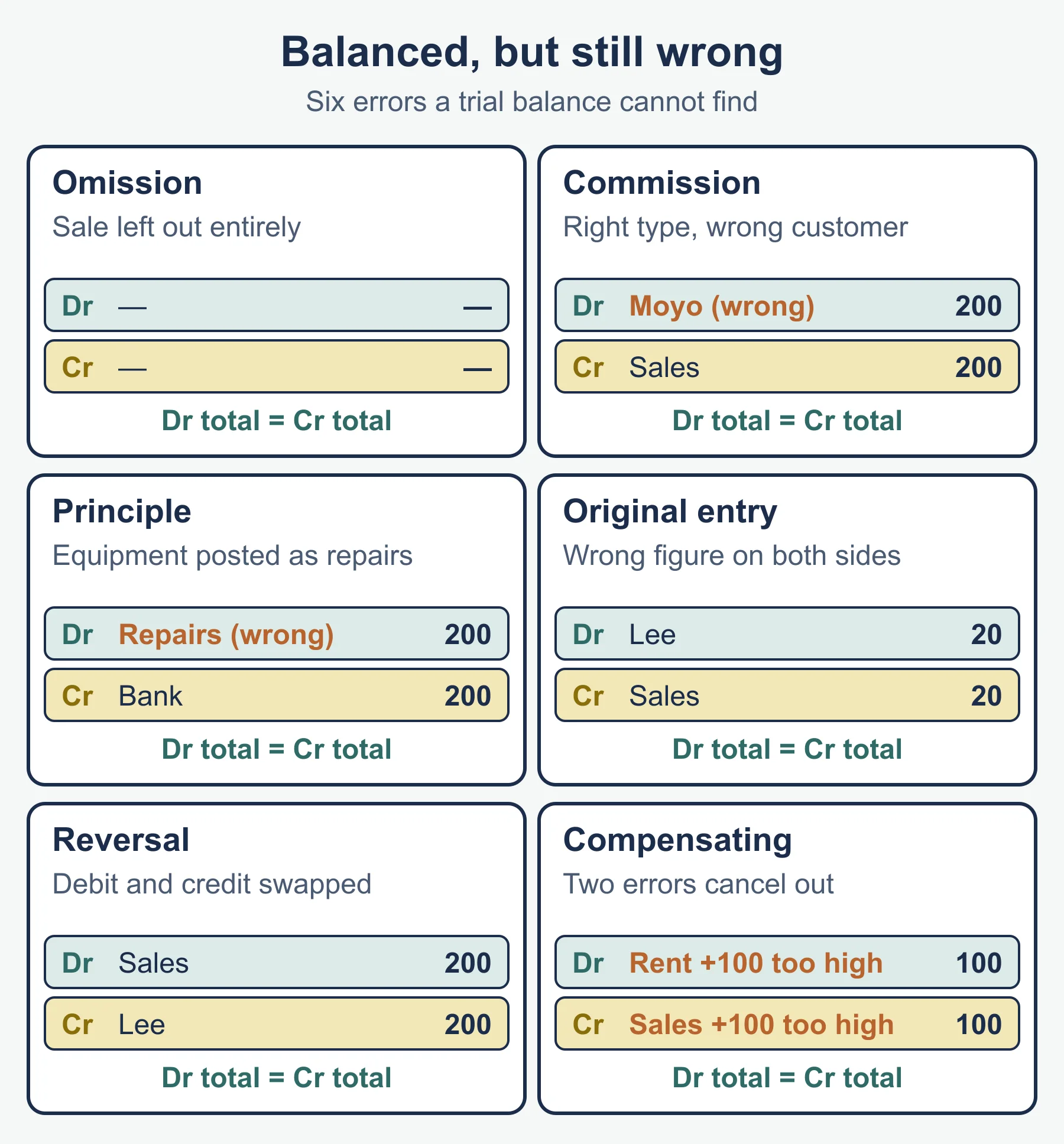
Agreement shows debits equal credits. It does not prove every entry is correct, because some errors leave both sides equal.
1.1.4 Books of prime entry
A book of prime entry gives each transaction its first written record, ahead of any ledger posting. Grouping similar items lets ledger postings be made from totals.
| Book | Records | Postings |
|---|---|---|
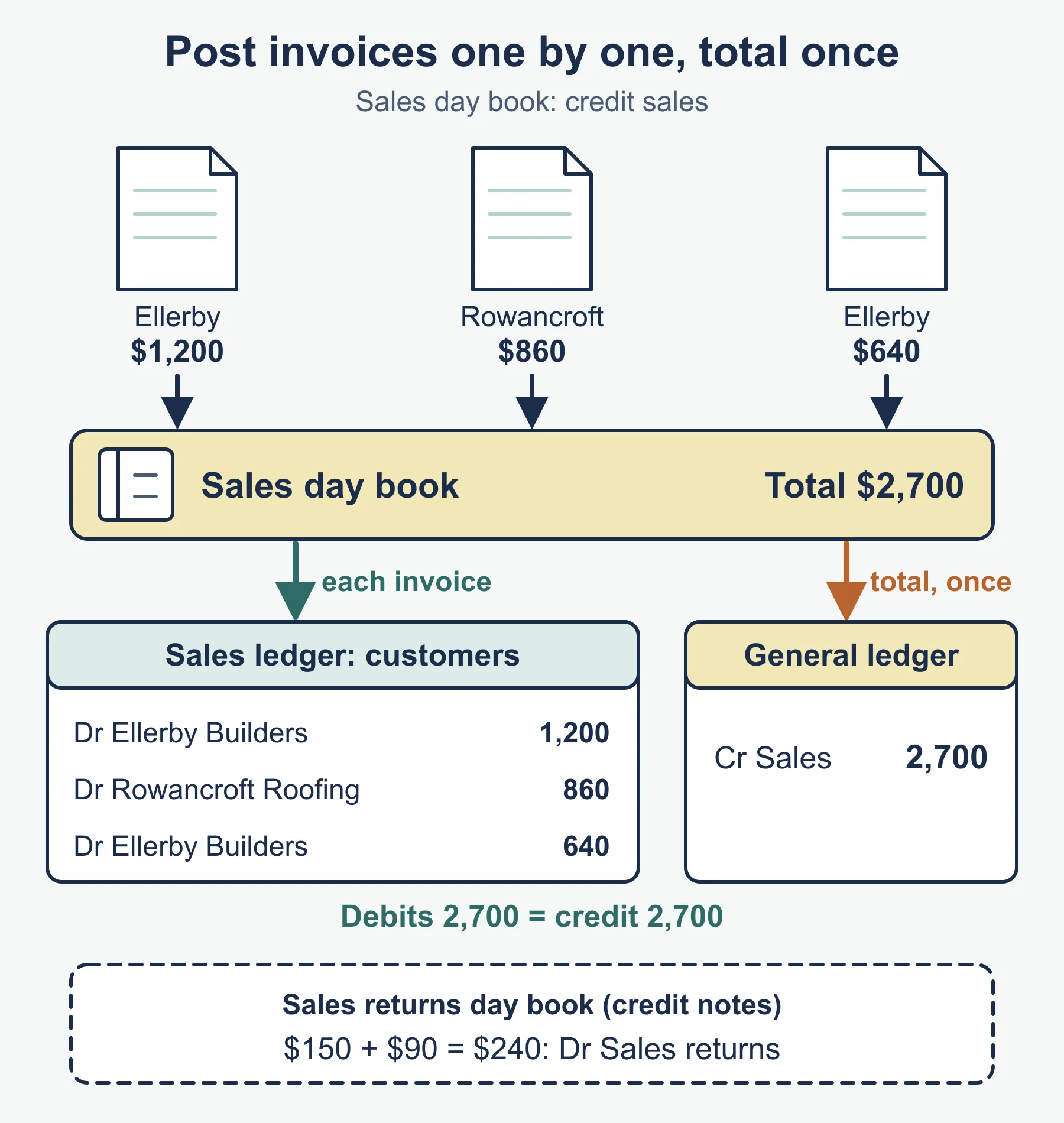
| Sales day book | Credit sales invoices | Each invoice to the customer’s account (debit); total to Sales (credit) |
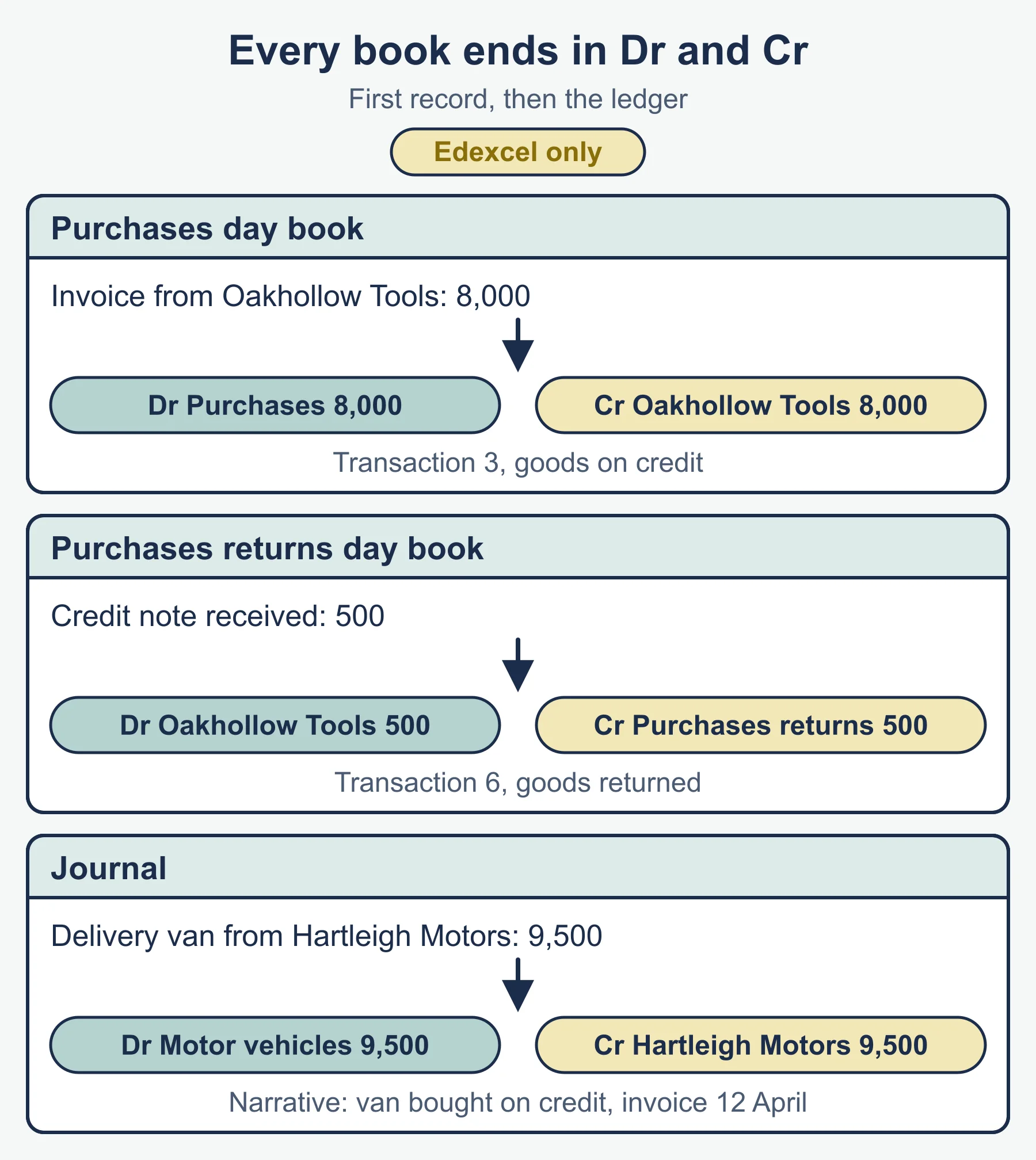
| Purchases day book | Credit purchase invoices | Each invoice to the supplier’s account (credit); total to Purchases (debit) |
| Sales returns day book | Credit notes issued | Each to the customer (credit); total to Sales returns (debit) |
| Purchases returns day book | Credit notes received | Each to the supplier (debit); total to Purchases returns (credit) |
| Cash book | Receipts and payments by bank and cash, plus discounts | See below |
| Petty cash book | Small payments from a float | See below |
| Journal | Anything that has no other book | Debit and credit named, with a narrative |
Sales day book
Kestrel Ridge Hardware’s April invoices are 1,200 to Ellerby Builders, 860 to Rowancroft Roofing and 640 to Ellerby Builders. The total is 2,700, debited as three amounts to the personal accounts and credited once to Sales. Credit notes of 150 and 90 in the sales returns day book total 240, debited to Sales returns.
Cash book
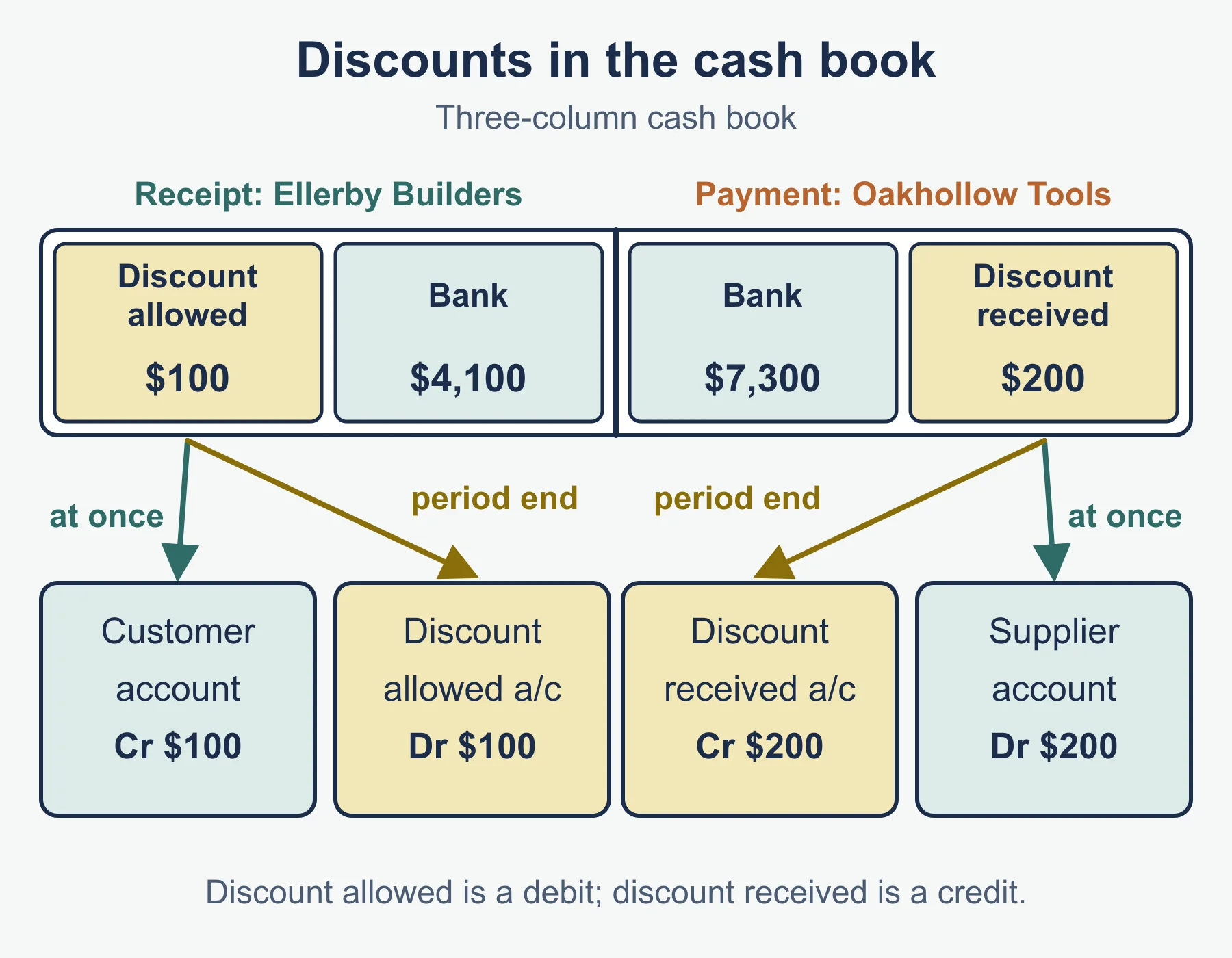
The cash book does two jobs: it is a first record of cash and bank items and also the cash and bank ledger account. In a three-column cash book, columns for discount allowed (left) and discount received (right) sit beside the cash and bank columns. The individual discounts are posted to the personal accounts straight away. At the end of the period, the left column total is debited to Discount allowed and the right column total credited to Discount received. In transactions 9 and 10 above, the 200 and 100 would appear in those columns.
Petty cash book
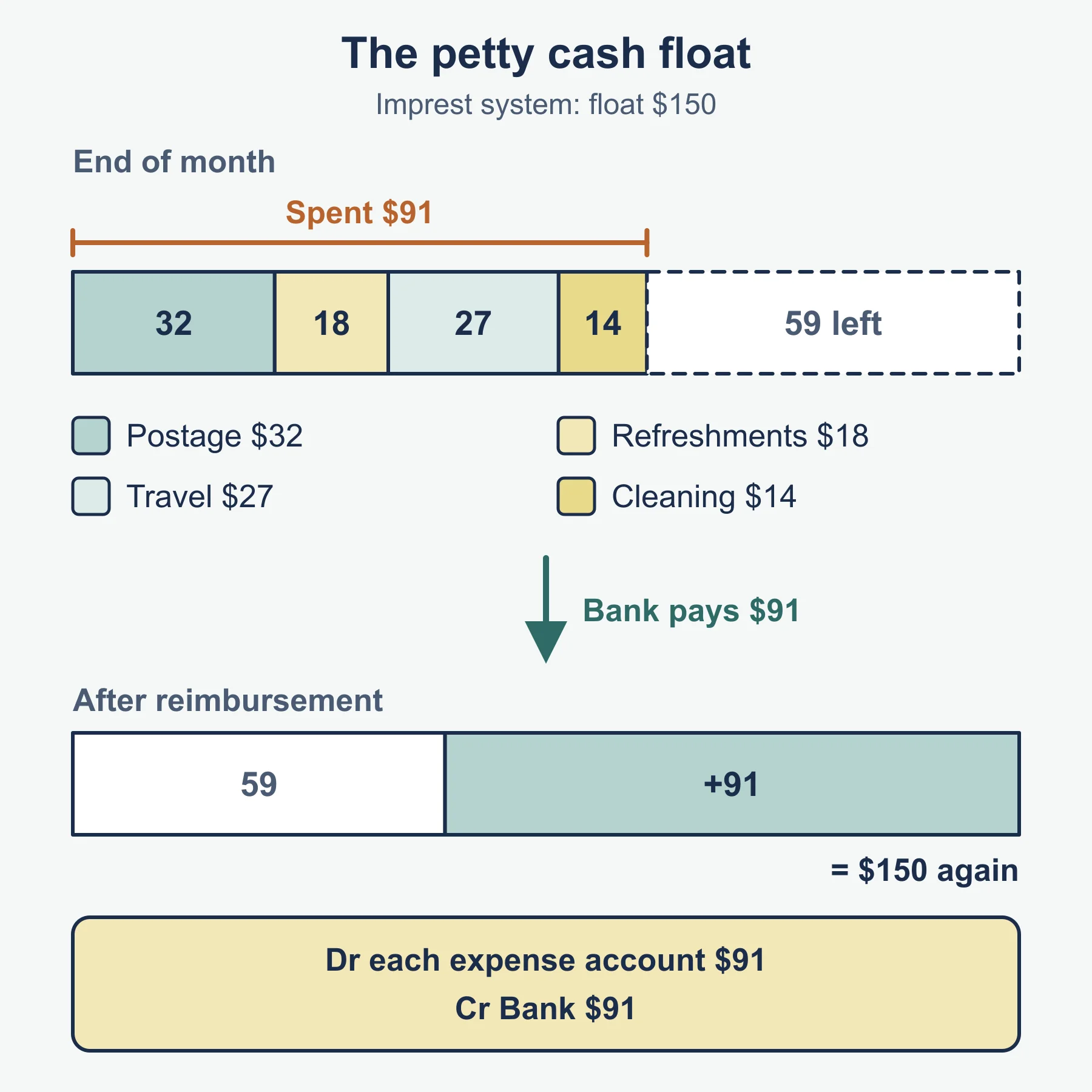
Under the imprest system, a float of 150 is set. A month’s payments are postage 32, refreshments 18, travel 27 and cleaning 14, totalling 91. Each total goes in an analysis column and is debited to its expense account. The reimbursement of 91 restores the float to 150, so the bank is credited 91. The box holds 59 before reimbursement.
Journal
The journal records items such as buying a non-current asset on credit, writing off an irrecoverable debt and opening entries. Each entry shows the accounts debited and credited, the amount and a narrative.
| Entry | Debit | Credit |
|---|---|---|
| Delivery van bought on credit from Hartleigh Motors | Motor vehicles 9,500 | Hartleigh Motors 9,500 |
Narrative: purchase of a delivery van on credit, invoice dated 12 April.
1.1.5 End of period transfers and adjustments
At the year end the ledgers need two kinds of work. Adjustments put each expense and income item into the right period (accruals and prepayments, depreciation, irrecoverable debts and inventory). Transfers then move the final figures to the statement of profit or loss, leaving the statement of financial position balances to be brought down.
Accruals and prepayments
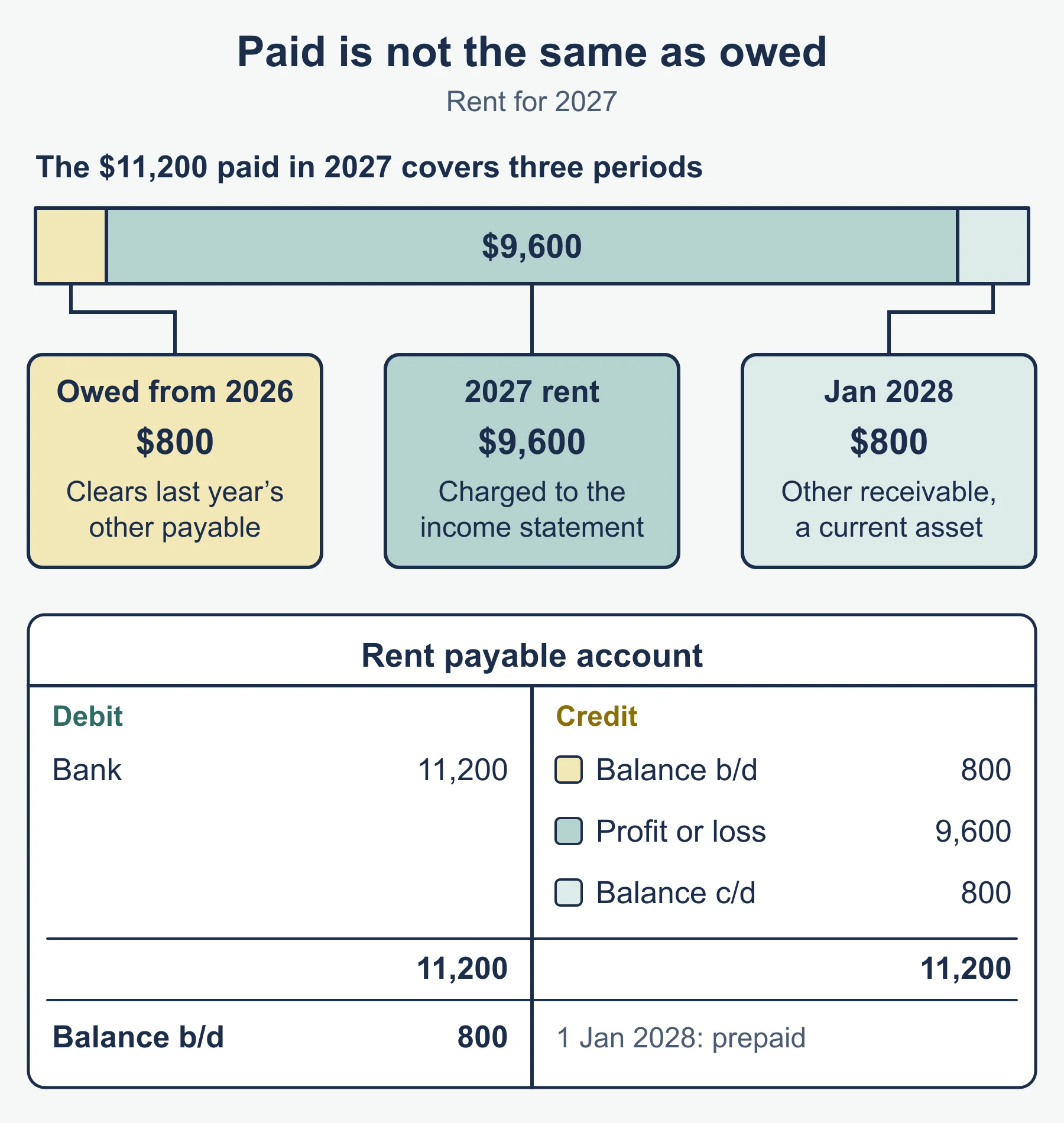
Kestrel Ridge Hardware pays rent of 9,600 in the year. At the start of the year 800 was owed (an other payable) and at the end 1,000 is owed.
| Rent account | |||
|---|---|---|---|
| Bank | 9,600 | Balance b/d (owed at start) | 800 |
| Balance c/d (owed at end) | 1,000 | Statement of profit or loss | 9,800 |
| 10,600 | 10,600 |
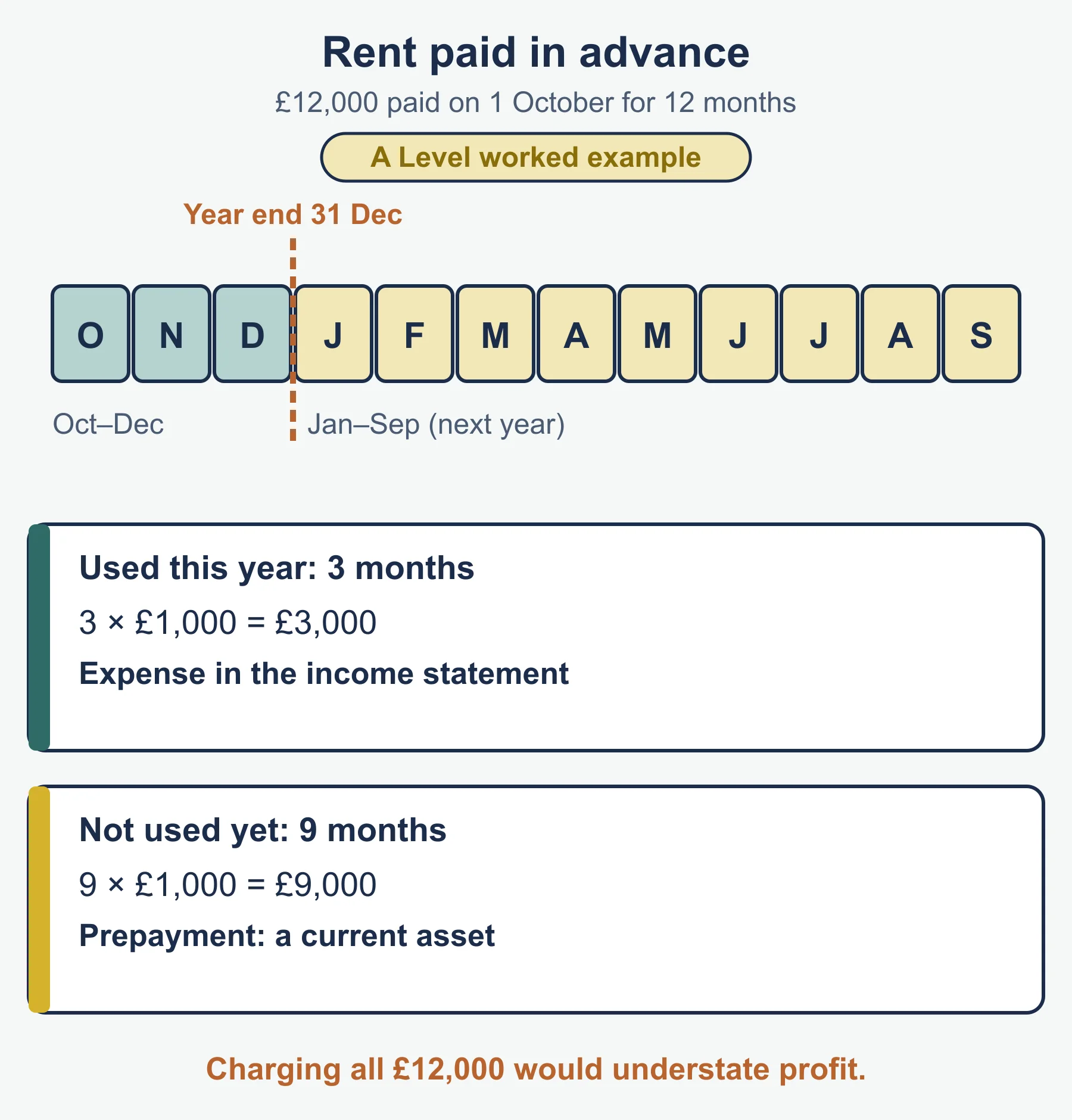
The charge is 9,600 + 1,000 − 800 = 9,800. On insurance, 400 was prepaid at the start. On 1 October 2,880 was paid for twelve months. Three months (720) have been used, so 2,160 is prepaid (an other receivable). The charge is 400 + 2,880 − 2,160 = 1,120. Income works the same way: commission received of 3,300, with 500 accrued at the start and 700 at the end, gives income of 3,300 − 500 + 700 = 3,500.
Other adjustments and transfers
Irrecoverable debts written off are debited to an expense account. A depreciation charge is debited to the depreciation expense account and credited to the provision for depreciation account; this guide does not teach the methods. Drawings are not an expense: the drawings account is closed to capital, so profit is unaffected.
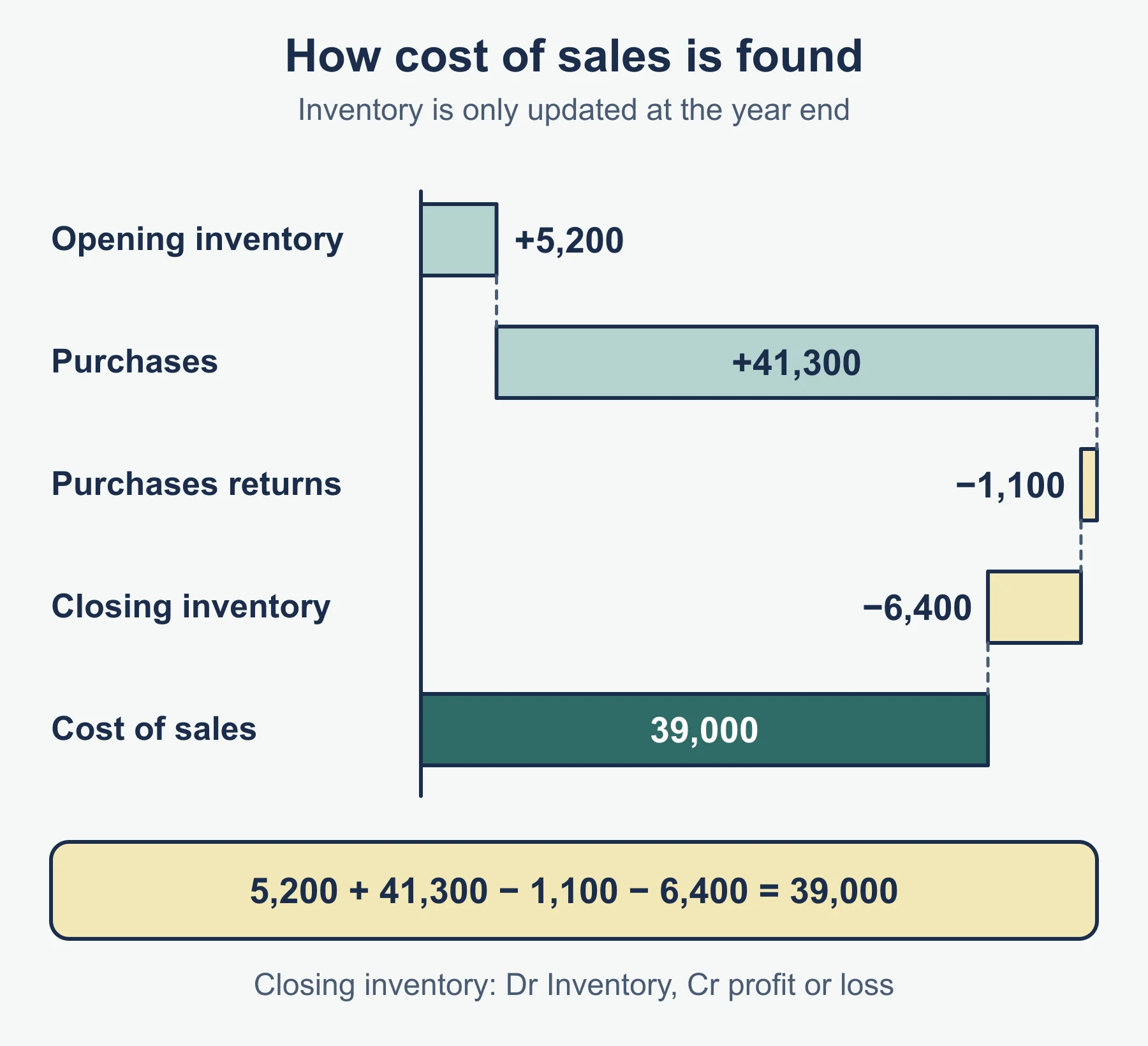
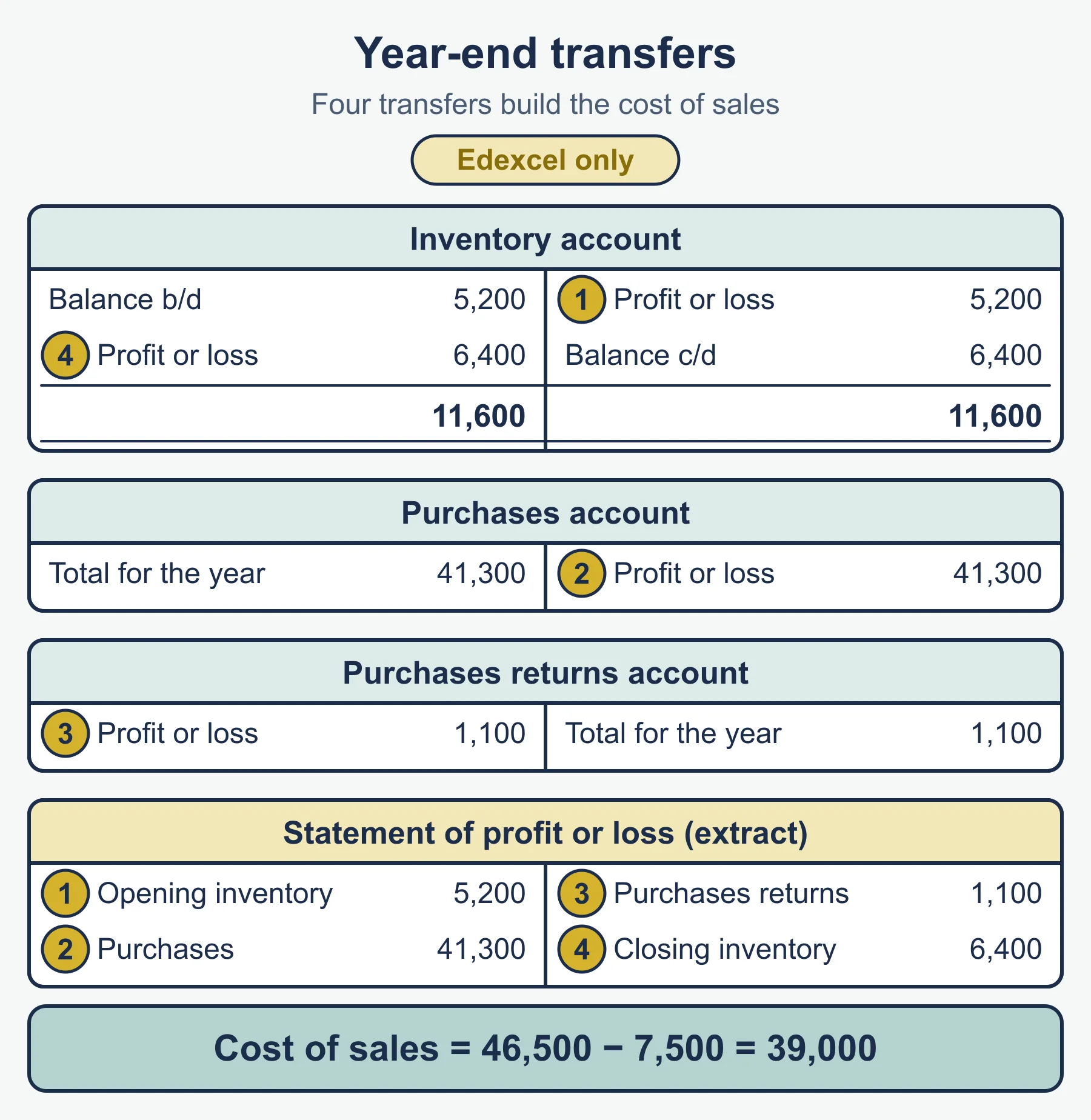
Inventory is not updated during the year, so it needs a transfer. Opening inventory is 5,200, purchases 41,300, purchases returns 1,100 and closing inventory 6,400, giving cost of sales:
5,200 + 41,300 − 1,100 − 6,400 = 39,000.
| Transfer | Debit | Credit |
|---|---|---|
| Opening inventory to cost of sales | Statement of profit or loss 5,200 | Inventory 5,200 |
| Purchases | Statement of profit or loss 41,300 | Purchases 41,300 |
| Purchases returns | Purchases returns 1,100 | Statement of profit or loss 1,100 |
| Closing inventory | Inventory 6,400 | Statement of profit or loss 6,400 |
Revenue and expense accounts are cleared the same way, and the profit for the year is then transferred to capital.
1.1.6 Allowance for irrecoverable debts
An irrecoverable debt is a trade receivable that will not be paid. It is written off: debit Irrecoverable debts, credit the customer. An allowance for irrecoverable debts is different. It is an estimate of debts that may not be paid, held in its own account and deducted from trade receivables. It reflects prudence, because profit and assets should not be overstated.
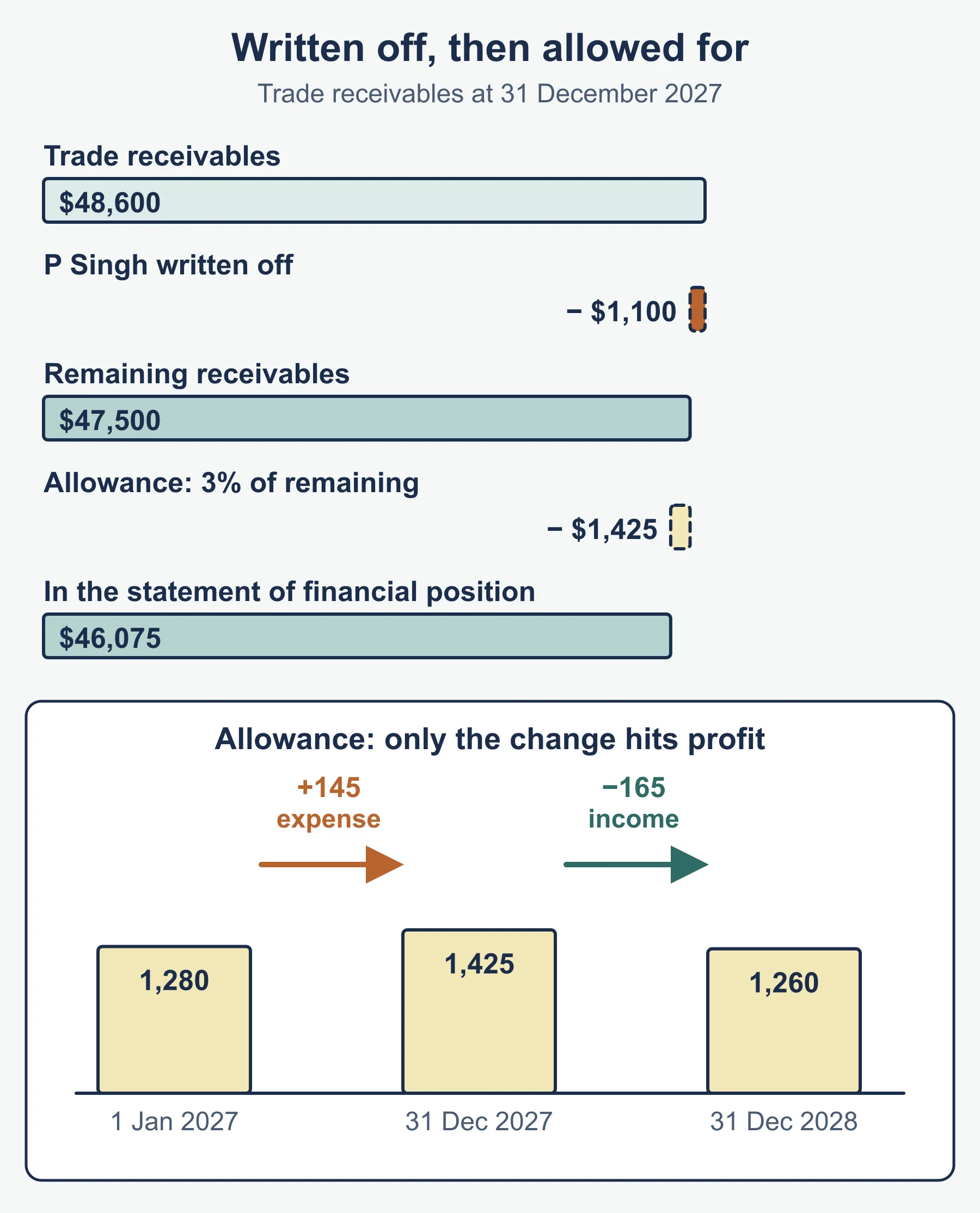
The allowance is calculated after writing off irrecoverable debts. Only the change in the allowance goes through the statement of profit or loss.
Worked example: calculating from a schedule
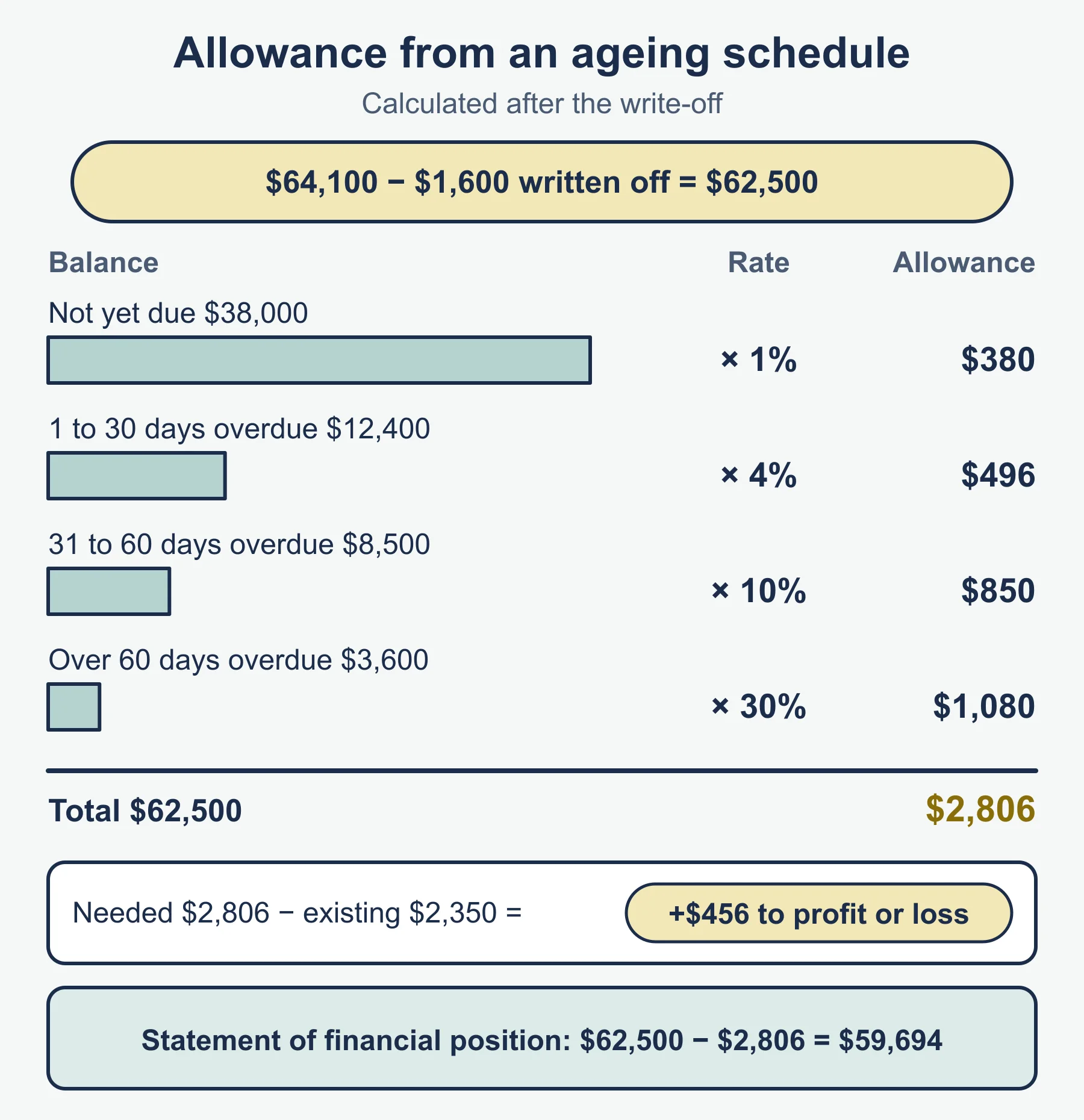
Before any write-off, Kestrel Ridge Hardware’s trade receivables are 64,100. A debt of 1,600 is written off, leaving 62,500, analysed by age.
| Age of debt | Balance | Rate | Allowance |
|---|---|---|---|
| Not yet due | 38,000 | 1% | 380 |
| 1 to 30 days overdue | 12,400 | 4% | 496 |
| 31 to 60 days overdue | 8,500 | 10% | 850 |
| Over 60 days overdue | 3,600 | 30% | 1,080 |
| Total | 62,500 | 2,806 |
The existing allowance is 2,350, so the increase is 456.
| Allowance for irrecoverable debts | |||
|---|---|---|---|
| Balance c/d | 2,806 | Balance b/d | 2,350 |
| Statement of profit or loss (increase) | 456 | ||
| 2,806 | 2,806 |
The statement of financial position shows trade receivables of 62,500 less the allowance of 2,806, a net figure of 59,694. The statement of profit or loss is charged with the irrecoverable debts written off (1,600) and the increase (456).
If the next year’s schedule produced an allowance of 2,540, the allowance account would be debited with the decrease of 266 and the statement of profit or loss credited with 266, which increases profit. If a debt previously written off is later paid, debit Bank and credit Irrecoverable debts recovered.
1.1.7 ICT in the double entry system
Accounting software posts a transaction to every account it affects from a single entry, completing the double entry automatically. A trial balance, a trade receivables ledger control account and draft financial statements can all be produced from the same data.
| Benefit | Limitation |
|---|---|
| Faster recording and reporting | Wrong data in gives wrong figures out |
| No arithmetic slips in posting or totalling | Cost, training and backup arrangements |
| Control accounts and trial balances generated from the ledgers | Access and fraud risks need passwords and review |
| Statements can be re-run after an adjustment | Some errors are still invisible |
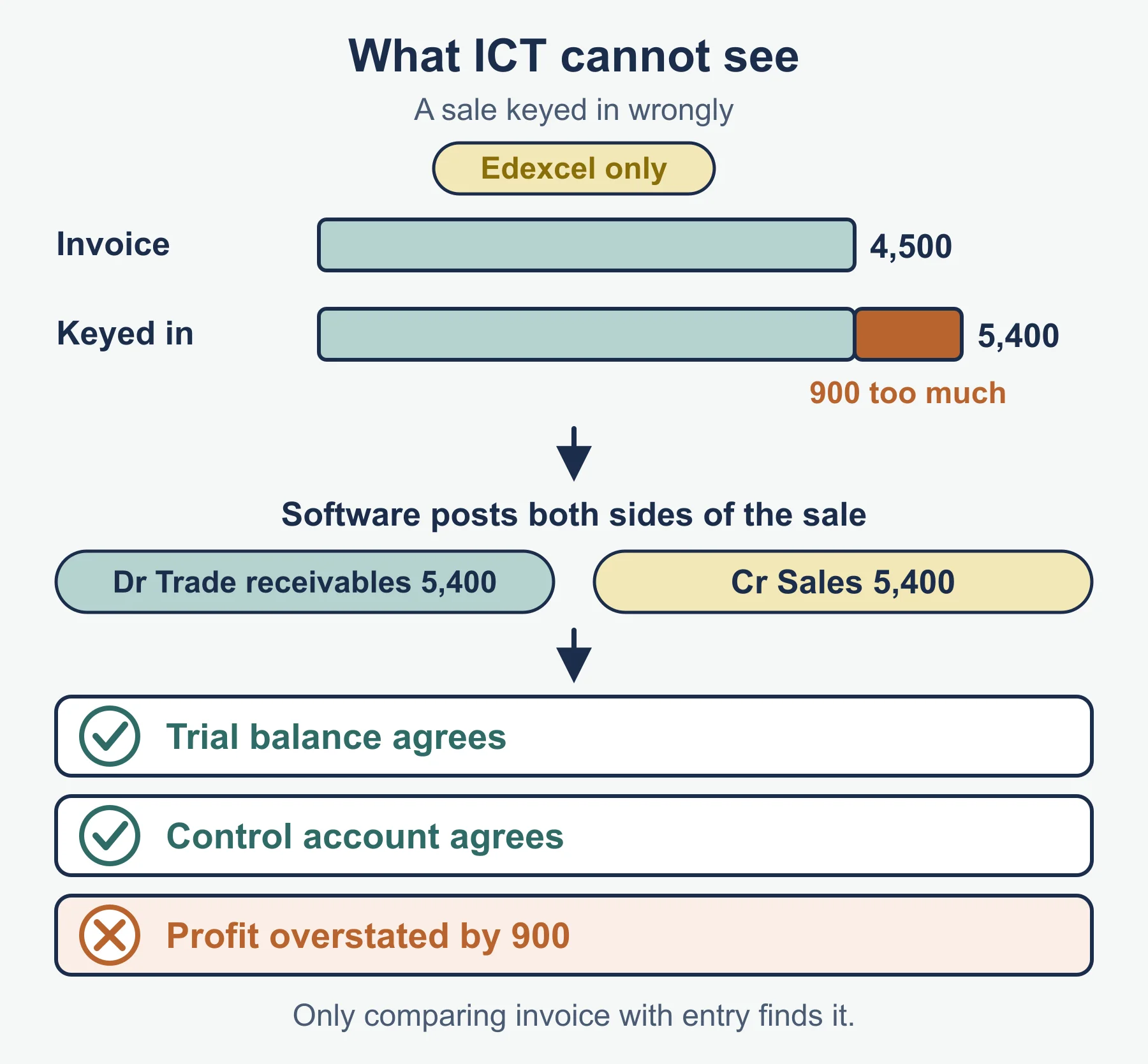
Worked example: what ICT cannot see
A clerk keys a sale of 4,500 as 5,400. The package debits trade receivables 5,400 and credits Sales 5,400. The trial balance agrees, and the control account agrees with the personal ledger, but profit is overstated by 900. Only comparing the invoice with the entry finds it.
Common errors
- Debiting an asset when it falls: a payment credits Bank, a receipt debits it.
- Treating drawings as an expense, which wrongly reduces profit.
- Posting discounts to the wrong side: Discount allowed is a debit, Discount received a credit.
- Calculating the allowance before writing off the irrecoverable debt.
- Charging the whole allowance to the statement of profit or loss each year rather than the change.
- Believing a balanced trial balance proves the records are free of error.
Frequently asked questions
What is the double entry system in Edexcel IAL Accounting? Every transaction has two effects, so it is recorded twice: once as a debit in one account and once as a credit of the same amount in another. Total debits therefore always equal total credits.
What is the difference between the sales ledger, purchases ledger and general ledger? The sales ledger holds a personal account for each credit customer and the purchases ledger one for each supplier. The general ledger holds the nominal accounts, such as expenses, revenue, drawings and capital, and the real accounts for assets.
How does the imprest system work for petty cash? A fixed float is set, payments are recorded in analysis columns and each column total is debited to its expense account. At the end of the period the amount spent is reimbursed from the bank, restoring the float to its original level.
Are drawings an expense of the business? No. Drawings are not an expense, so they do not reduce profit; the drawings account is closed to the capital account. Treating drawings as an expense is a common error.
Does a balanced trial balance prove the accounts are correct? No. Agreement shows that total debits equal total credits, but some errors leave both sides equal. For example, a sale keyed as 5,400 instead of 4,500 is posted to both sides, so only comparing the invoice with the entry finds it.
Official syllabus
Pearson Edexcel International Advanced Subsidiary/Advanced Level in Accounting (XAC11/YAC11), Specification, Issue 2, September 2018, Unit 1, topic 1.1 content points 1.1.3 to 1.1.7.
Get free revision emails (optional)
Occasional emails with practice questions, worked explanations and links to free resources for the qualification and subjects you choose. No spam, and you can unsubscribe from any email. The free tools on this site never need an email.
Related resources
-
Practice questions
Edexcel International A Level Accounting: The double entry system (YAC11) – Practice Questions
Eleven original practice questions with worked answers on the double entry system for Edexcel International A-Level Accounting (YAC11).
Accounting · Pearson Edexcel · AS Level
Try questions -
Revision notes
Edexcel International A Level Accounting: The double entry system (YAC11) – Revision Notes
Condensed recall notes on the double entry system for Edexcel International A-Level Accounting: rules, prime entry, adjustments and allowances.
Accounting · Pearson Edexcel · AS Level
Revise topic -
Study guides
Edexcel International A Level Accounting: Role and purpose of accounting, and concepts and conventions (YAC11)
Study guide to Edexcel IAL Accounting 1.1.1-1.1.2 and 1.1.8-1.1.10: why accounting exists, who uses it, nine concepts and conventions, and IAS.
Accounting · Pearson Edexcel · AS Level
Read guide
Related articles
-
teaching
A Level tuition in Dubai: Cambridge or Pearson Edexcel International A Level?
Schools in Dubai and Abu Dhabi teach either Cambridge International AS & A Level or Pearson Edexcel International A Level. How the two are structured, why it matters for tuition, and how online classes from Lahore work.
9 October 2026
-
curriculum guides
Choosing subjects at IGCSE and A Level
How subject choices at 14 and 16 affect university options later, and how to keep pathways open without overloading a timetable.
28 July 2026
Studying this with a teacher
Working through Accounting AS LEVEL?
This page is free and stays free. If you would rather be taught it, Marlbridge runs Accounting classes one-to-one and in small groups of up to 15, online in your own time zone. The first trial class is free. WhatsApp replies within an hour (8am–11pm Pakistan time, every day); email the same day.
Pearson Edexcel Accounting teachers at Marlbridge

