
Revision Notes
IB DP Business Management: International marketing (HL only) – Revision Notes
Condensed revision notes for IB DP Business Management 4.6 (HL only): international opportunities, threats, adaptation, key calculations and a self-test.
- Subject
- Business
- Level
- IB
- Topic
- Unit 4: Marketing
- Author
- Marlbridge Academic Team
- Updated
- Reviewed by
- Salman Ahmad (what this means)
Aligned to International Baccalaureate IB Diploma Programme Business (DP Business Management), First assessment 2024. Official specification .
Syllabus page (what it covers and how it is assessed): IB Diploma Programme Business.
Syllabus points this page covers
DP Business Management
- 4.6 International marketing (HL only)
Found an error? Report a correction.
Need help with this topic? Request a free trial class for IB Diploma Programme Business (DP Business Management).
These notes condense section 4.6, International marketing (HL only), of the IB Business management guide (first assessment 2024). For full explanations and worked examples, read the study guide first. Then test yourself with the practice questions.
Other pages: the IB DP Business Management hub, the syllabus checklist, the Unit 4 revision notes, the Unit 4 study guide, the multinational companies guide and the free diagnostics. All businesses and figures here are invented.
The one content point
| Guide wording | Depth in the guide | Label |
|---|---|---|
| The opportunities and threats posed by entering and operating internationally | AO3 | HL only |
AO3 means synthesis and evaluation. The guide defines “evaluate” as weighing up strengths and limitations, and “recommend” as presenting an advisable course of action with reasons. Expect to judge, not only list.
The guide’s assessment outline says paper 1 excludes HL extension topics, while HL paper 2 and paper 3 include them.
Key terms
| Term | Short meaning (standard textbook form) |
|---|---|
| Entering | The decision to go abroad, and by what route |
| Operating | Running the marketing mix and supply chain in the foreign market over time |
| Opportunity | A possible benefit that a foreign market offers |
| Threat | A possible cost or harm that foreign trading adds |
| Tariff | A tax on imported goods |
| Exchange rate | How much of one currency is needed to obtain a unit of another |
| Standardization | Using the same marketing mix in every market |
| Adaptation | Changing parts of the mix to suit each market |
Opportunities at a glance
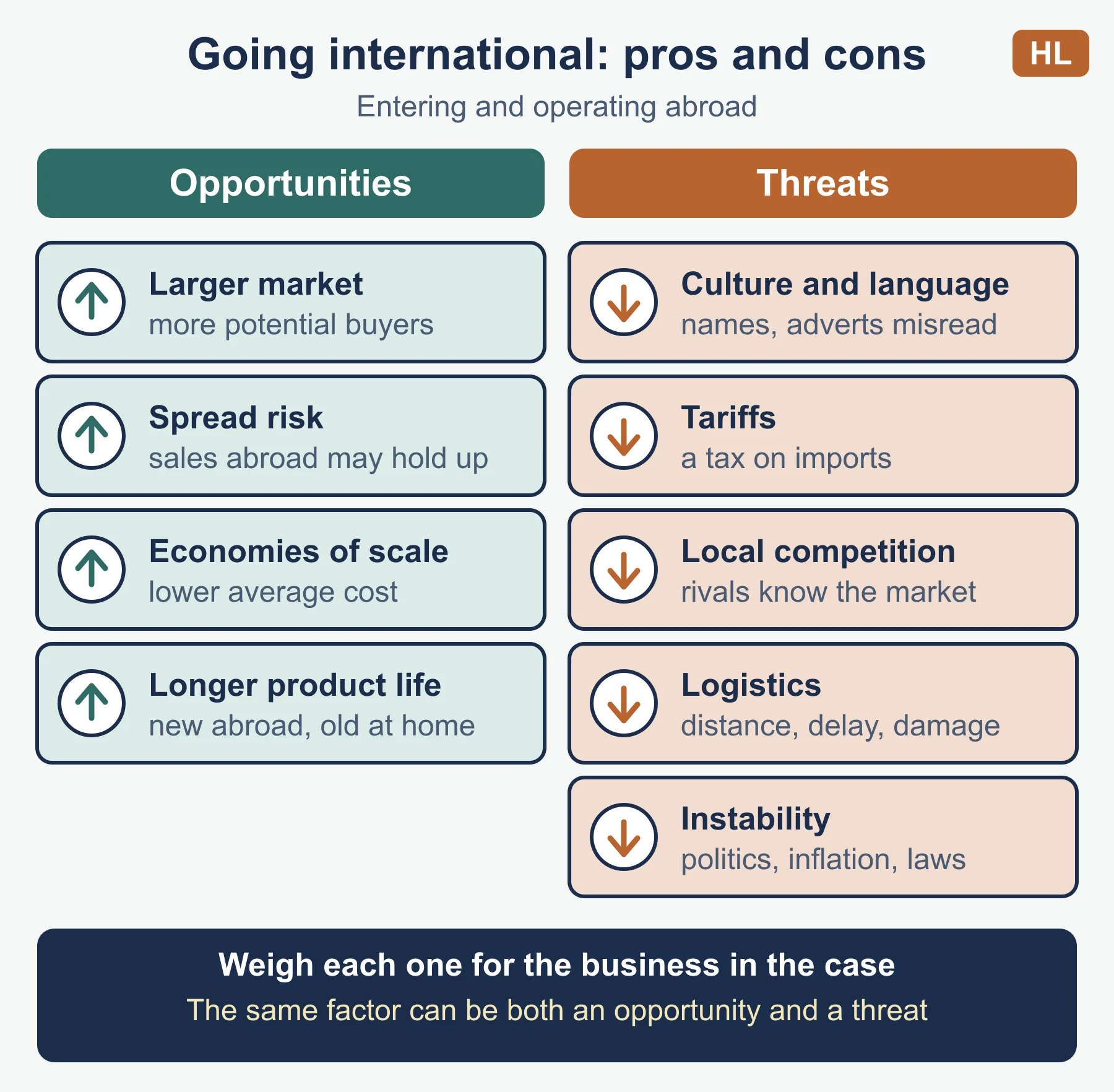
- Bigger customer base without a new product.
- Risk spread across economies, so one weak market hurts less.
- Economies of scale as output rises.
- Lower costs for labour, materials or premises.
- Longer product life when the product is mature at home but new abroad.
- Brand strength and prestige.
- New ideas from new customers, rivals and suppliers.
- Helpful exchange rate moves.
Threats at a glance
- Culture and language: names, colors, humour and customs can mislead.
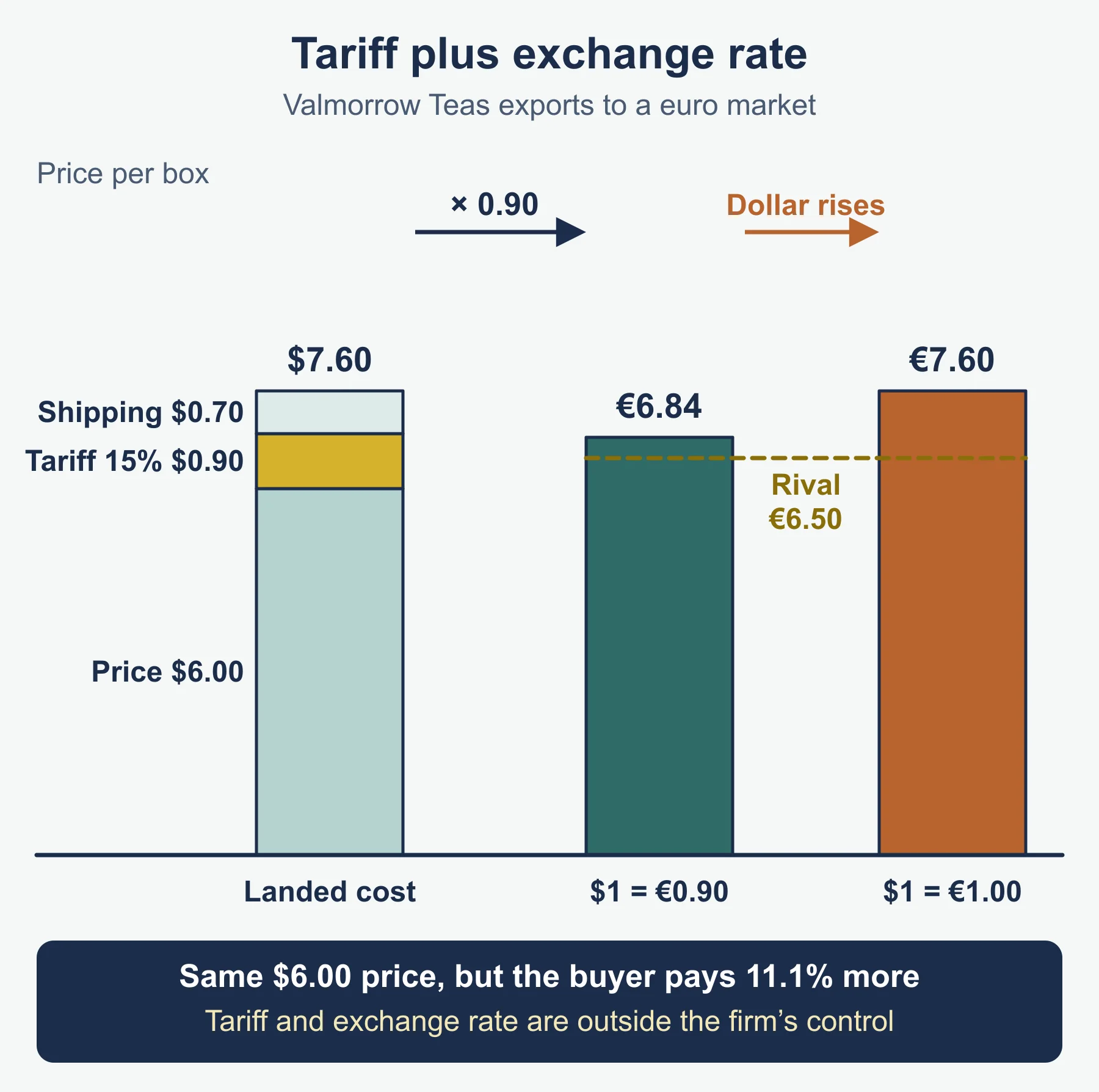
- Exchange rate movements.
- Tariffs and other trade barriers.
- Legal and regulatory differences (describe in general terms; use the case).
- Strong local competitors.
- Logistics: distance, delay, damage and cost.
- Political or economic instability.
- Higher set-up and marketing costs.
- Ethical and reputation risk, linked to CSR in section 1.3.
- Loss of control when using partners or distributors.
Same factor, two sides
| Factor | Opportunity | Threat |
|---|---|---|
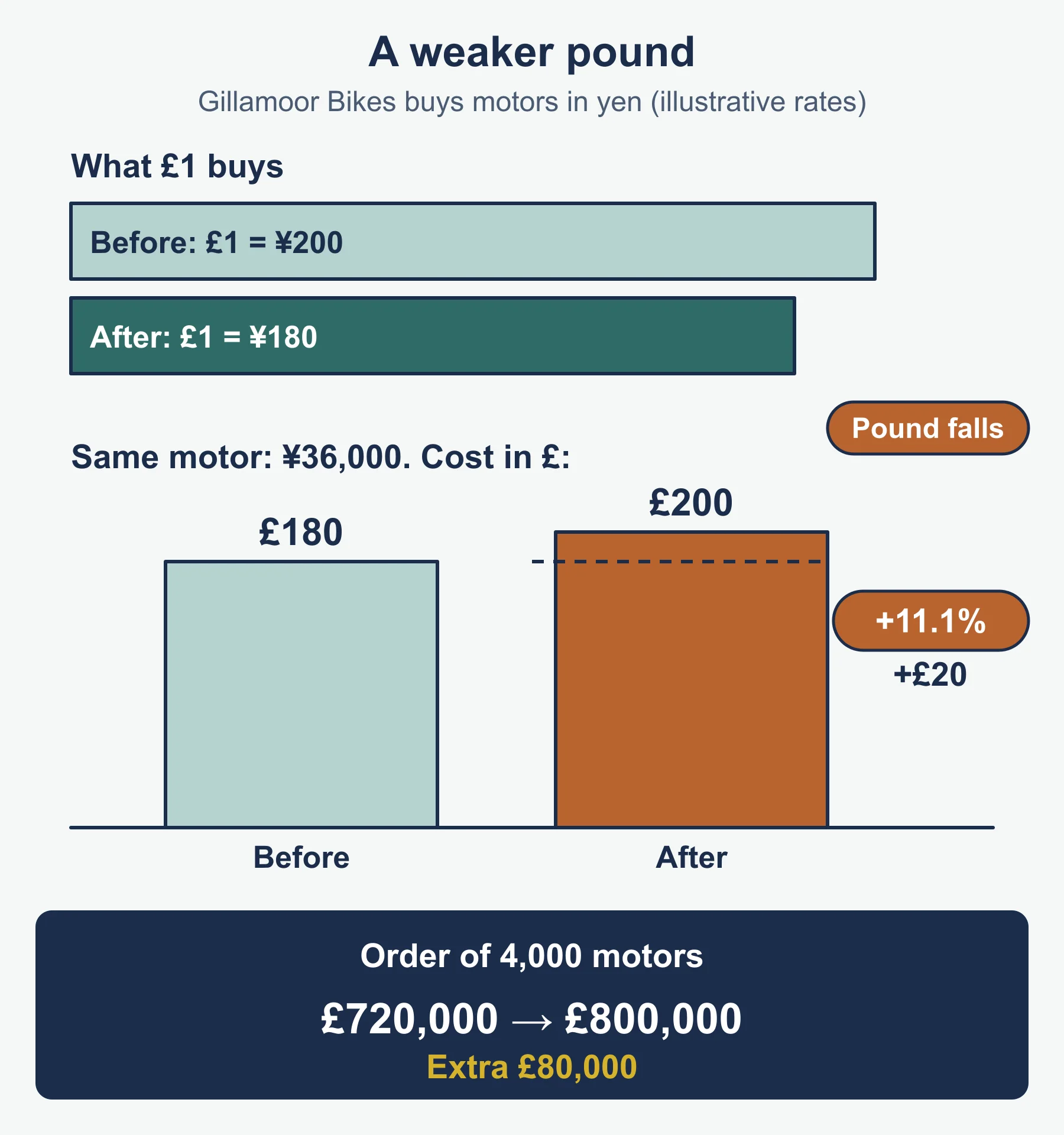
| Weaker home currency | Exports look cheaper abroad; foreign revenue converts to more | Imported inputs cost more |
| Stronger home currency | Imported inputs cost less | Exports look dearer abroad; foreign revenue converts to less |
| Large population | Many potential buyers | Many rivals may already serve them |
| Local partner | Knowledge and contacts | Less control, shared profit |
| Low-cost production site | Lower unit cost | Possible ethical criticism; longer supply lines |
| Adapting the mix | Better fit | Higher cost, mixed brand image |
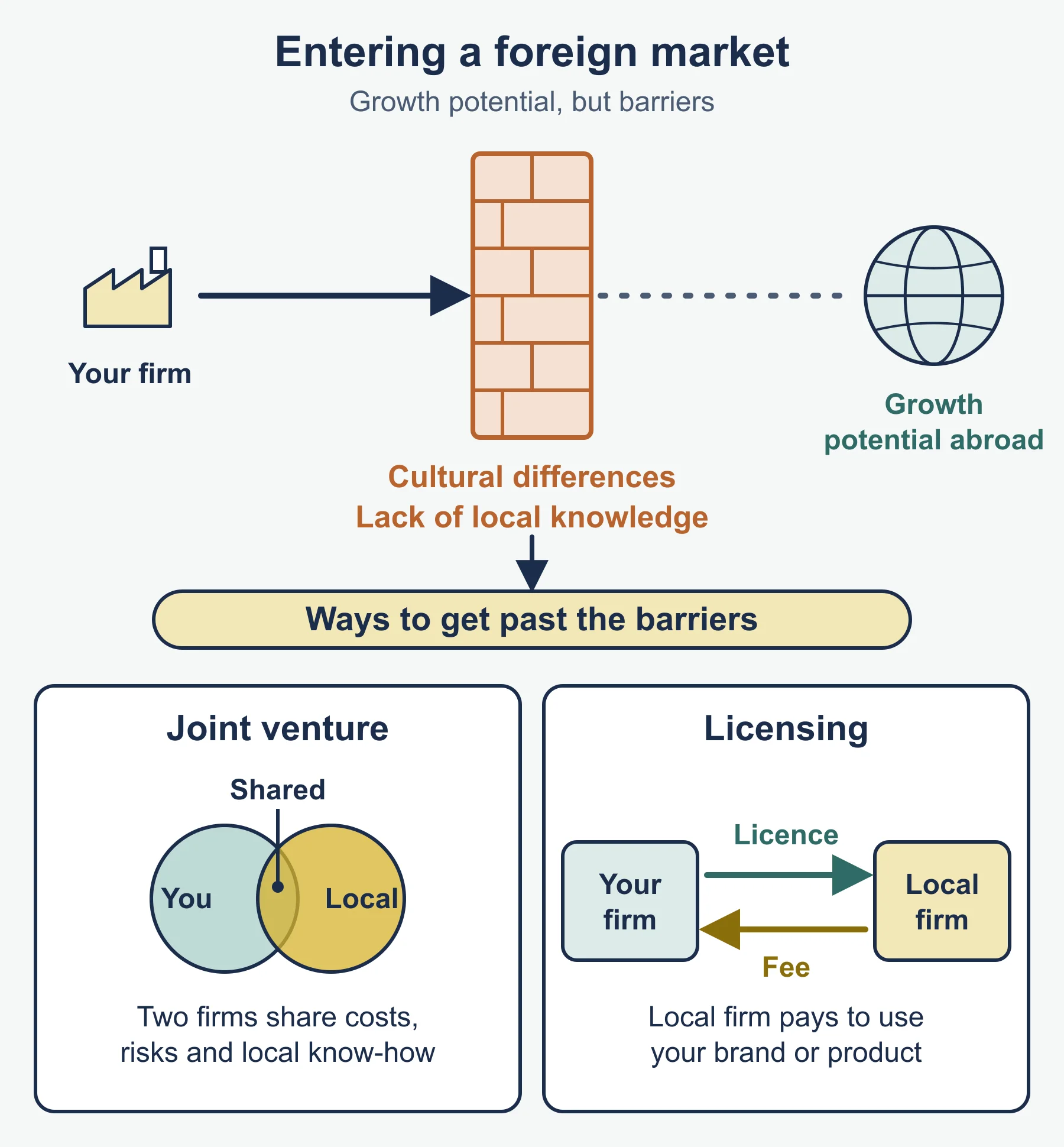
Routes abroad (background, not a guide list)
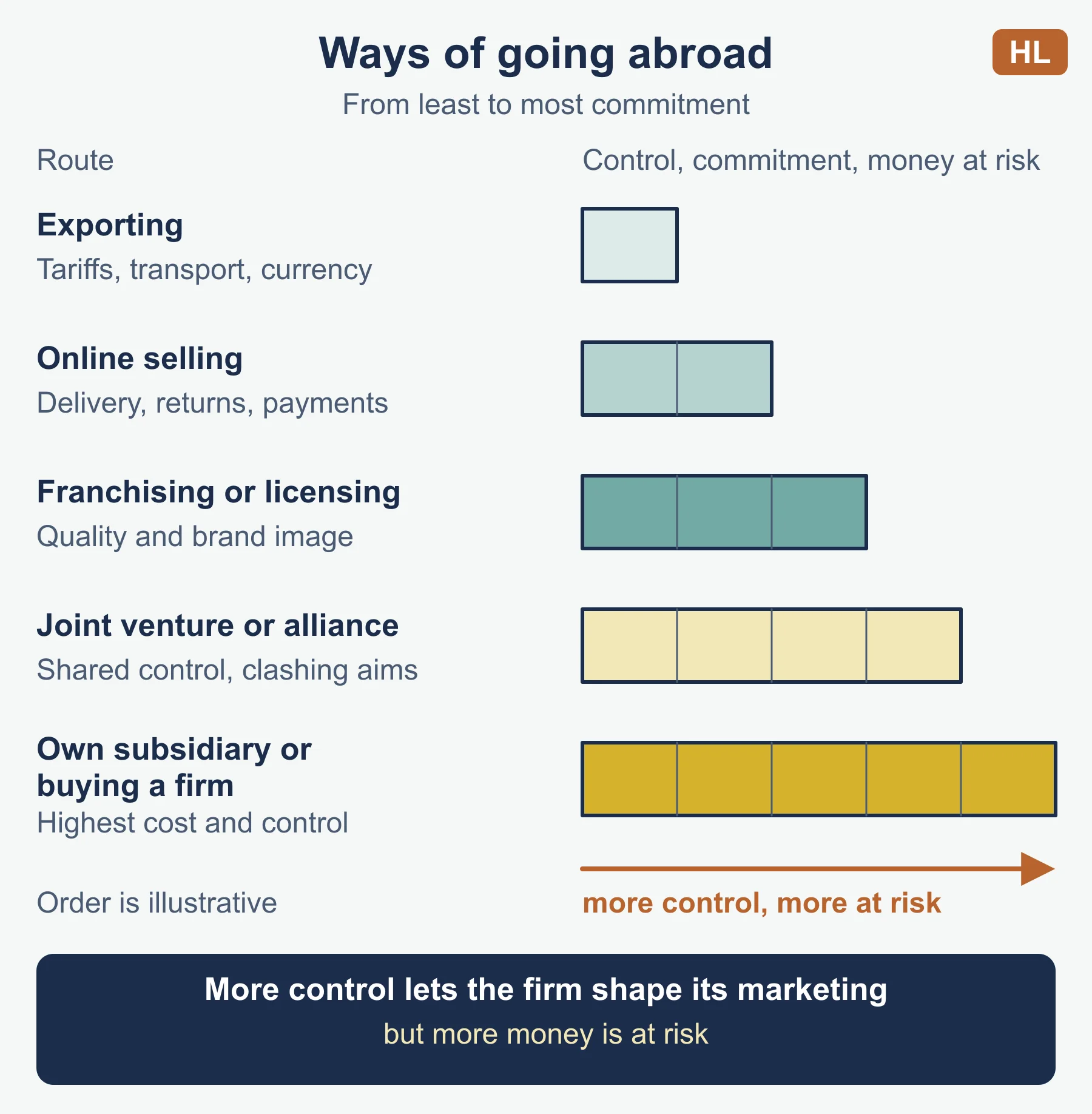
Exporting; online selling; franchising or licensing; joint venture or alliance; own subsidiary or acquisition. More control usually means more commitment and more money at risk. Sections 1.5 and 1.6 of the guide cover joint ventures, strategic alliances, franchising and multinational companies.
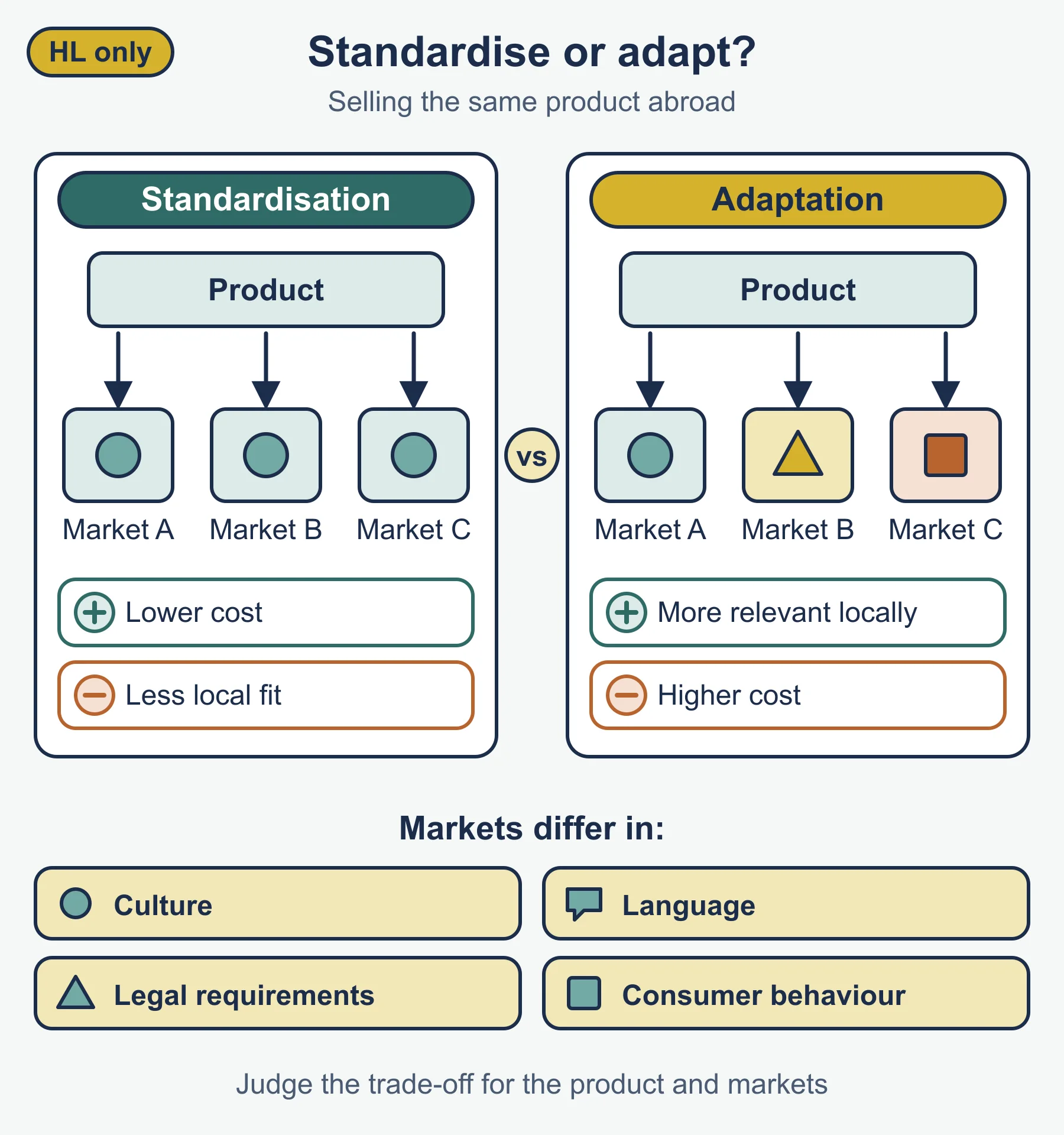
Standardize or adapt?
| Standardization | Adaptation |
|---|---|
| Lower cost | Better local fit |
| One global image | Can reduce legal and cultural mistakes |
| Easier to manage | More cost and management |
| Risk of poor local fit | Brand image may become mixed |
Many firms adapt only some of the seven Ps. A typical split: adapt promotion and price, keep the brand name and core design. Say which Ps matter most in the case and why.
Calculation reminders
These are standard working forms.
| Item | Method |
|---|---|
| Tariff | Tariff rate x value of the imported item |
| Landed cost | Price + tariff + shipping and handling |
| Foreign price | Landed cost x exchange rate (foreign currency per unit of home currency) |
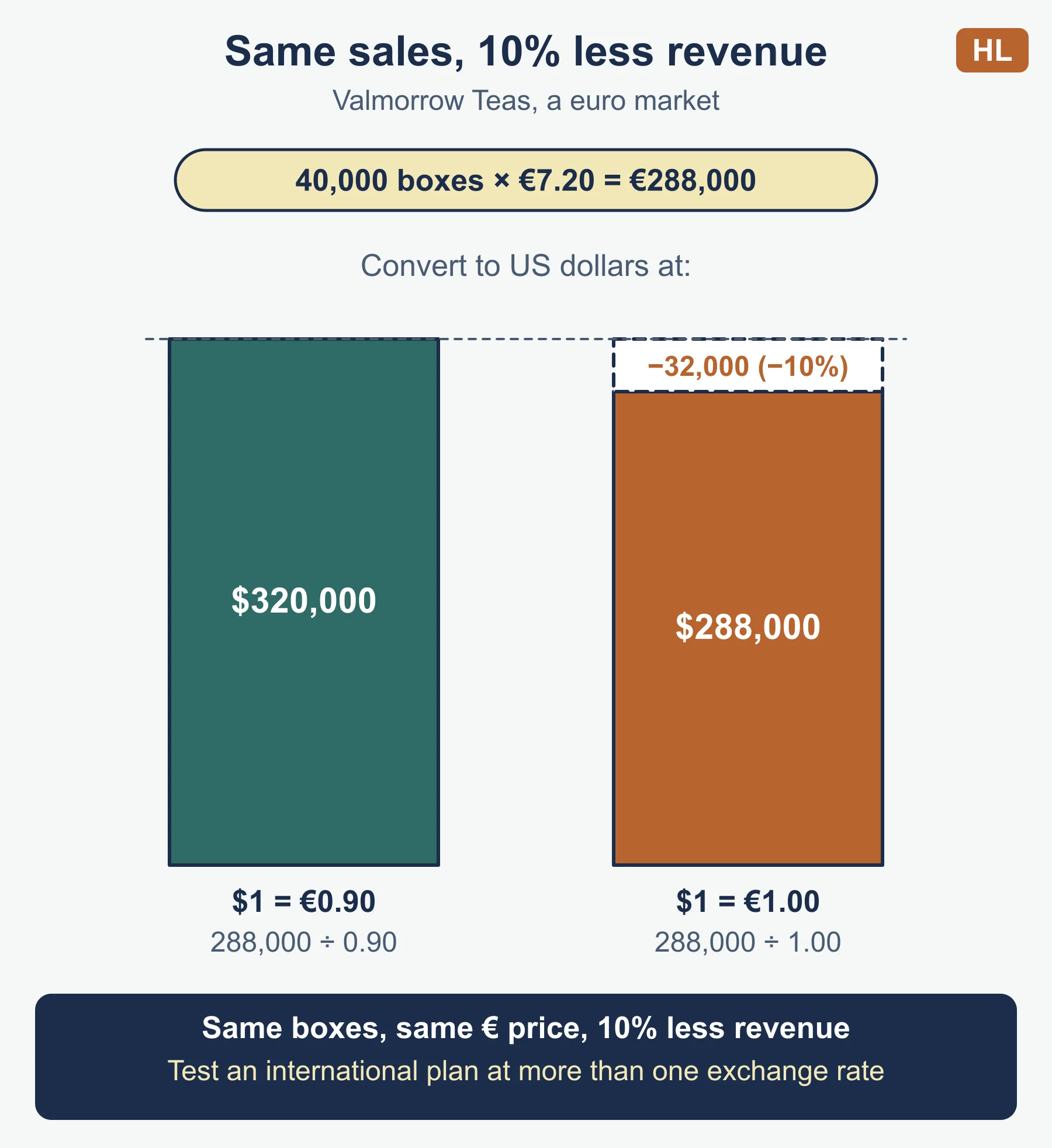
| Converting revenue back home | Foreign revenue / exchange rate |
| Percentage change | (new - old) / old x 100 |
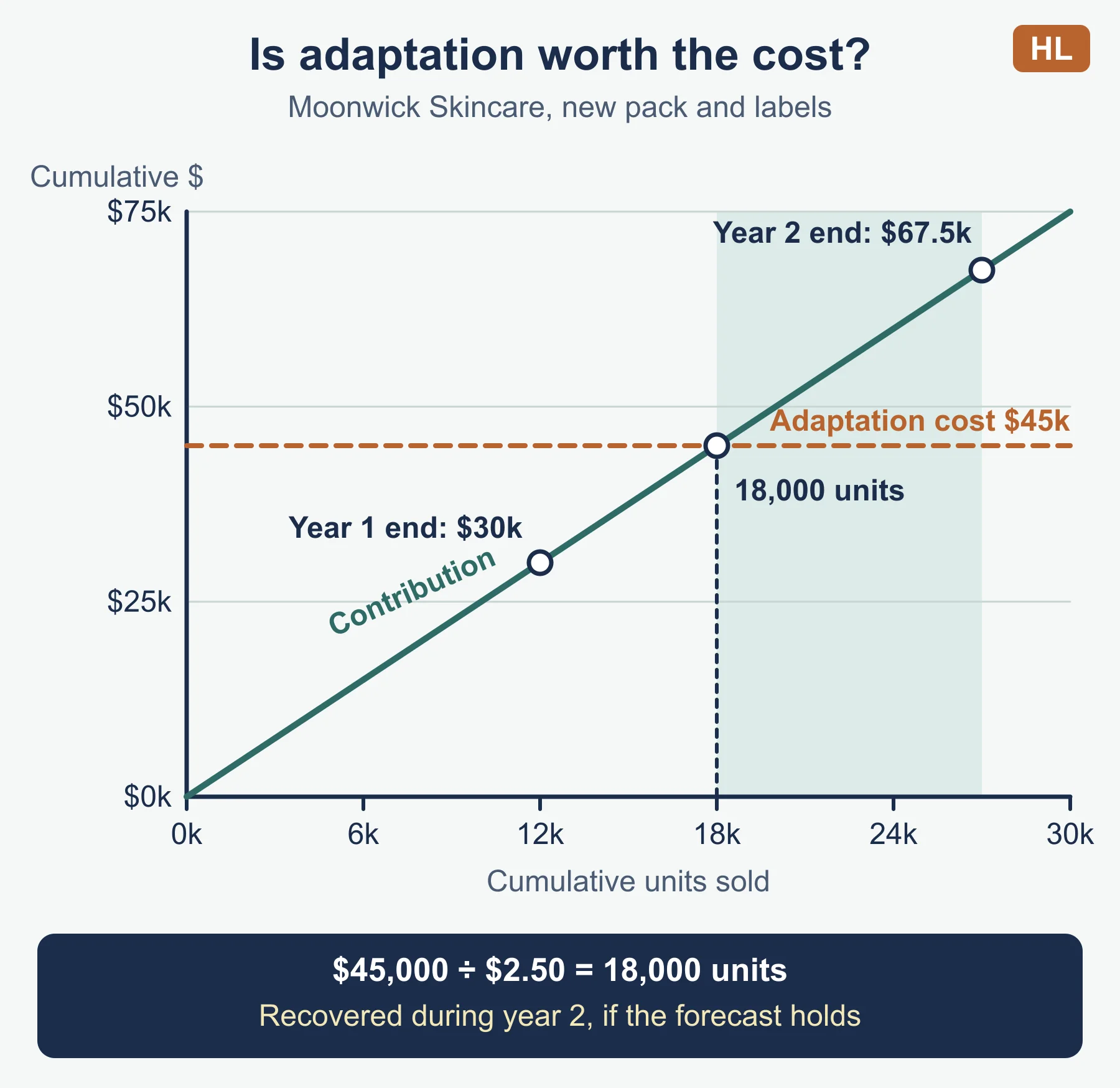
| Units to recover an adaptation cost | One-off cost / contribution per unit |
Method in steps: price in a foreign market
- Work out the tariff on the price the firm charges.
- Add the tariff and shipping to get the landed cost in home currency.
- Multiply by the exchange rate to get the price in the foreign currency.
- Compare with local rivals’ prices.
- State what the firm could do: cut margin, absorb the tariff, adapt the product, or choose a different route.
Small worked reminder
Gallowby Bakery sells a hamper at USD 20.00. The target country charges a 10% tariff and shipping is USD 3.00 a hamper.
- Tariff = 10% x 20.00 = USD 2.00.
- Landed cost = 20.00 + 2.00 + 3.00 = USD 25.00.
If the exchange rate is USD 1 = EUR 0.90, the euro price is 25.00 multiplied by 0.90, which gives EUR 22.50.
Small worked reminder: currency effect
Gallowby earns EUR 36,000 in a year. At USD 1 = EUR 0.90 this is 36,000 / 0.90 = USD 40,000. If the rate becomes USD 1 = EUR 0.80, it is 36,000 / 0.80 = USD 45,000. That is a rise of 12.5%, which helps Gallowby. The direction is reversed if the dollar strengthens.
Must-know distinctions
- Tariff and quota. A tariff is a tax on imports. A quota limits the quantity.
- Entering and operating. Entry decisions look at the route and set-up costs. Operating decisions look at running costs, rivals, currency and customer response over time.
- Standardize and adapt. The question is rarely all or nothing.
- Host country view and business view. Section 1.6 asks about the impact of multinationals on host countries. Section 4.6 asks about the opportunities and threats for the business.
- Contribution and profit. Contribution per unit covers fixed costs first. Only the part above the break-even level is profit.
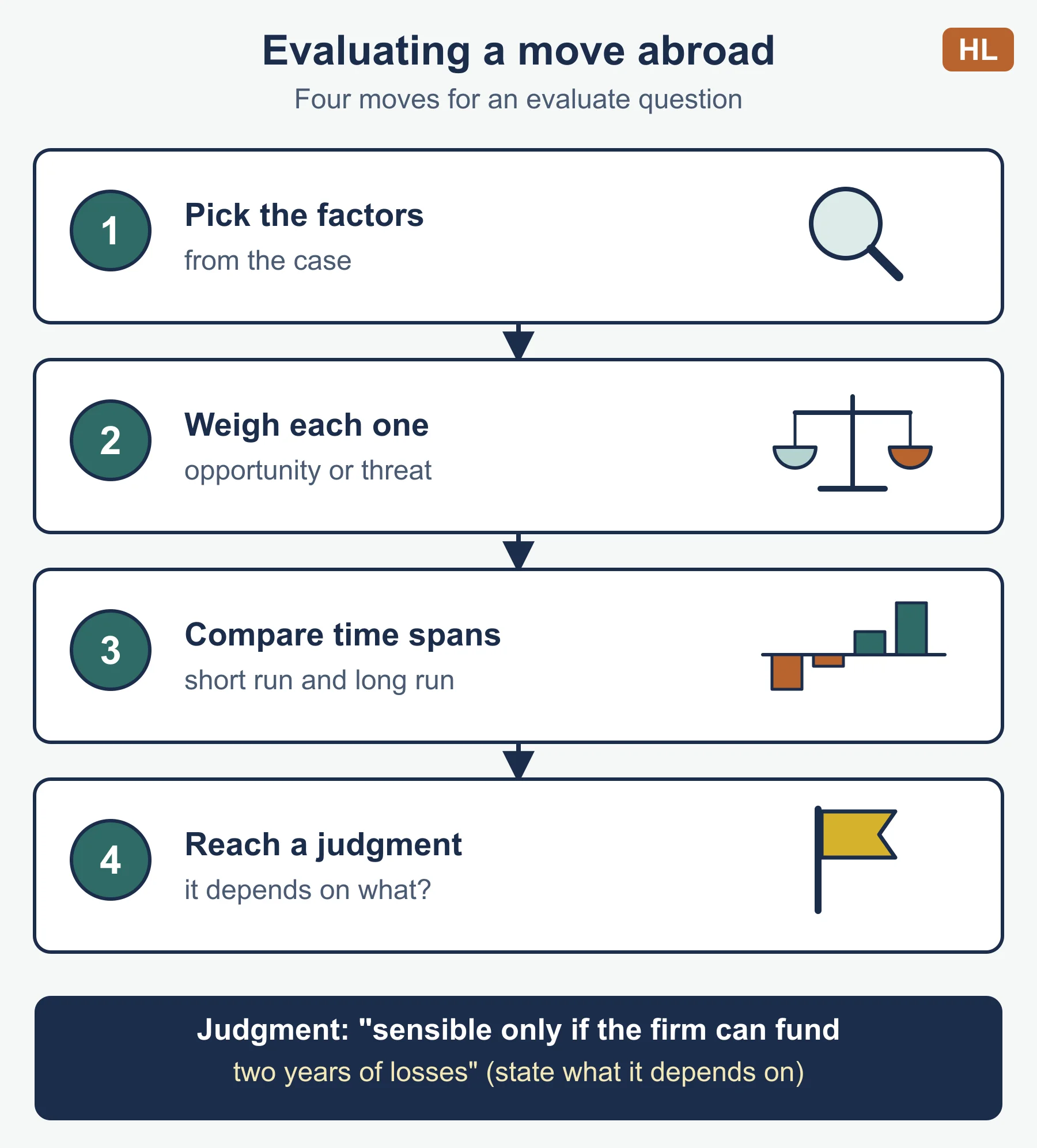
Evaluation checklist for AO3 answers
For “evaluate”, “discuss”, “justify” or “recommend” on an international move, check that you have:
- Opportunities and threats, each tied to the case.
- A figure or fact from the case for at least one point on each side.
- A short-run and long-run comparison.
- A criterion, such as profit, risk, brand image or cash.
- A judgment that says what the decision depends on.
Quick self-test
- State whether 4.6 is examined at SL, and give the depth label the guide gives it.
- State two opportunities of operating internationally.
- State two threats of operating internationally.
- Define a tariff.
- A hamper costs USD 20.00. The tariff is 10% and shipping is USD 3.00. Calculate the landed cost.
- A firm earns EUR 36,000. The exchange rate moves from USD 1 = EUR 0.90 to USD 1 = EUR 0.80. Calculate the percentage change in the dollar value of the revenue.
- Adapting a pack costs USD 14,000 once. Contribution is USD 4.00 a unit. Calculate the units needed to recover the cost.
- A firm earns USD 120,000 at home, USD 80,000 in market A and USD 40,000 in market B. Calculate the share of revenue from abroad.
- Distinguish standardization from adaptation.
- Explain why a weaker home currency can be both an opportunity and a threat.
- A foreign price rises from EUR 4.50 to EUR 5.40. Calculate the percentage rise.
- State which HL paper or papers include 4.6, according to the guide’s assessment outline.
Answers
- Not examined at SL: the section is HL only. Depth label: AO3.
- For example a larger customer base and spreading risk.
- For example exchange rate movements and cultural differences.
- A tax on imported goods.
- 20.00 + 2.00 + 3.00 = USD 25.00.
- At 0.90: USD 40,000. At 0.80: USD 45,000. Change = 5,000 / 40,000 x 100 = 12.5% rise.
- 14,000 / 4.00 = 3,500 units.
- Abroad = 80,000 + 40,000 = 120,000 out of 240,000 total = 50%.
- Standardization uses the same marketing mix everywhere; adaptation changes parts of it to suit each market.
- It makes exports cheaper abroad and raises foreign revenue when converted back, but raises the cost of imported inputs.
- (5.40 - 4.50) / 4.50 x 100 = 20%.
- Paper 2 and paper 3 include HL extension topics; paper 1 excludes them.
Where marks are usually lost
- Writing a generic list of pros and cons with no link to the case business.
- Assuming a bigger market always means more profit.
- Treating a currency move as always good or always bad, with no direction stated.
- Leaving out shipping or the tariff in a landed-price calculation.
- Mixing up which way an exchange rate is quoted before converting.
- Confusing a tariff with a quota.
- Naming specific laws the case does not mention.
- Recommending adaptation or standardization with no reason tied to cost or fit.
- Ending an evaluation without a judgment or without saying what the decision depends on.
Frequently asked questions
What is the difference between a tariff and a quota? A tariff is a tax on imported goods, which raises the final price or cuts the exporter’s margin. A quota limits the quantity of a good that can be imported.
How does a weaker home currency affect a business that trades internationally? A weaker home currency makes exports cheaper for buyers abroad and raises foreign revenue when it is converted back, which is an opportunity. It also raises the cost of imported inputs, which is a threat.
What is the difference between standardization and adaptation? Standardization uses the same marketing mix in every country, which keeps costs low and builds one global image. Adaptation changes parts of the mix to suit each market, improving local fit at a higher cost; many firms adapt only some of the seven Ps.
What depth of answer does section 4.6 require? The single content point in 4.6 is tagged AO3, so questions can ask you to evaluate, discuss, justify or recommend. You need opportunities and threats tied to the case, a criterion such as profit or risk, and a judgement that says what the decision depends on.
Official syllabus
IB Diploma Programme Business management guide (first assessment 2024), International Baccalaureate Organization, Unit 4, section 4.6 International marketing (HL only).
Get free revision emails (optional)
Occasional emails with practice questions, worked explanations and links to free resources for the qualification and subjects you choose. No spam, and you can unsubscribe from any email. The free tools on this site never need an email.
Related resources
-
Study guides
IB DP Business Management: Introduction to marketing and Marketing planning
Study guide to IB DP Business Management 4.1 and 4.2: orientation, market share and growth, segmentation, targeting, positioning and USPs.
Business · International Baccalaureate · IB
Read guide -
Practice questions
IB DP Business Management: Introduction to marketing and Marketing planning – Practice Questions
Original IB DP Business Management practice questions with worked answers on 4.1 and 4.2: share, growth, segmentation, positioning and USPs.
Business · International Baccalaureate · IB
Try questions -
Revision notes
IB DP Business Management: Introduction to marketing and Marketing planning – Revision Notes
Condensed IB DP Business Management revision notes for 4.1 and 4.2: share and growth formulas, STP, niche versus mass, USP and differentiation.
Business · International Baccalaureate · IB
Revise topic
Related articles
-
teaching
A Level tuition in Dubai: Cambridge or Pearson Edexcel International A Level?
Schools in Dubai and Abu Dhabi teach either Cambridge International AS & A Level or Pearson Edexcel International A Level. How the two are structured, why it matters for tuition, and how online classes from Lahore work.
9 October 2026
-
curriculum guides
Choosing subjects at IGCSE and A Level
How subject choices at 14 and 16 affect university options later, and how to keep pathways open without overloading a timetable.
28 July 2026
Studying this with a teacher
Working through Business IB?
This page is free and stays free. If you would rather be taught it, Marlbridge runs Business classes one-to-one, online in your own time zone. The first trial class is free. WhatsApp replies within an hour (8am–11pm Pakistan time, every day); email the same day.
IB Business teachers at Marlbridge

