
Study Guides
IB DP Geography: Unit 6: Global risks and resilience – Study Guide
Geopolitical, economic and environmental risks, and local and global resilience, as studied in the Higher Level extension of IB Diploma Programme Geography.
- Subject
- Geography
- Level
- IB
- Topic
- Unit 6: Global risks and resilience
- Author
- Marlbridge Academic Team
- Updated
- Reviewed by
- Azam Siddique (what this means)
Aligned to International Baccalaureate IB Diploma Programme Geography (DP Geography), First assessments 2019. Official specification .
Syllabus page (what it covers and how it is assessed): IB Diploma Programme Geography.
Syllabus points this page covers
DP Geography
- 13.1 Geopolitical and economic risks
- 13.2 Environmental risks
- 13.3 Local and global resilience
This page covers all 3 subtopics recorded here in topic 13, Unit 6: Global risks and resilience.
This guide covers Unit 6, Global risks and resilience, the final unit of the Higher Level extension of IB Diploma Programme Geography (first assessments 2019). The more tightly places are connected, the more easily a shock in one place can travel to others. This unit asks what the main categories of global risk are, why some people and places are more exposed than others, and how communities and international bodies build the capacity to cope, adapt and recover.
Where this fits in the course
Unit 4 described the networks and flows that connect places, and Unit 5 evaluated their effect on development and culture. Unit 6 turns to the downside and the response: the same interconnection that spreads investment and ideas also spreads financial crises, conflict, pollution and disease. Use ideas you already hold from earlier units, such as interdependence, inequality and power, to explain why risk is unevenly distributed and why response requires cooperation across scales.
13.1 Geopolitical and economic risks
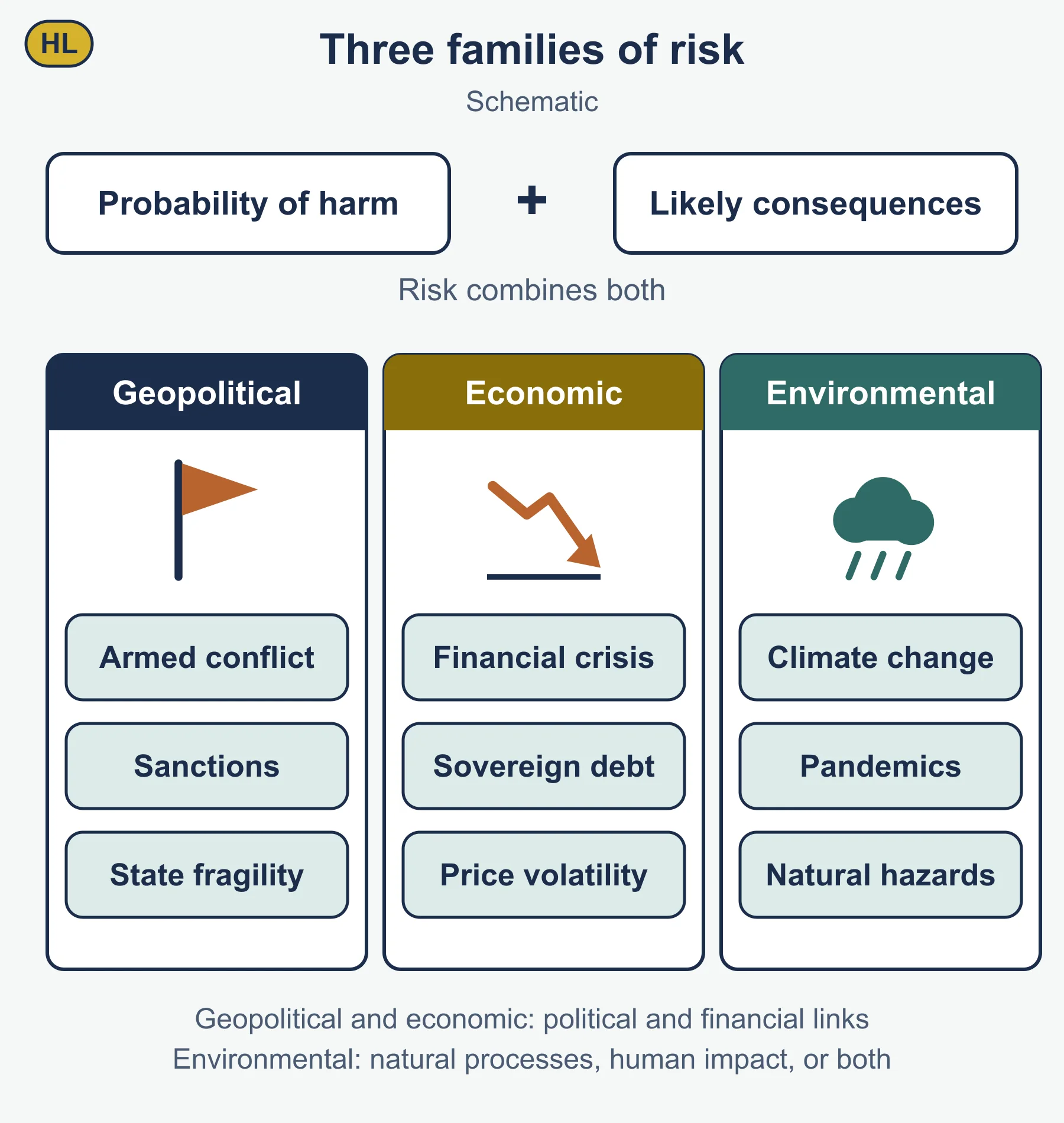
A risk is the probability of a harmful event combined with its likely consequences. Geopolitical and economic risks arise from political and financial relationships rather than from physical processes.
- Geopolitical risks include armed conflict, terrorism, tension over borders and resources, state fragility, sanctions and the weakening of international cooperation. Conflict can displace populations, disrupt trade routes and damage food and energy security.
- Economic risks include financial crises, sovereign debt problems, volatile commodity prices, unemployment and trade disputes. The global financial crisis that began in 2007 to 2008 is a standard example of a shock that spread through connected financial systems.
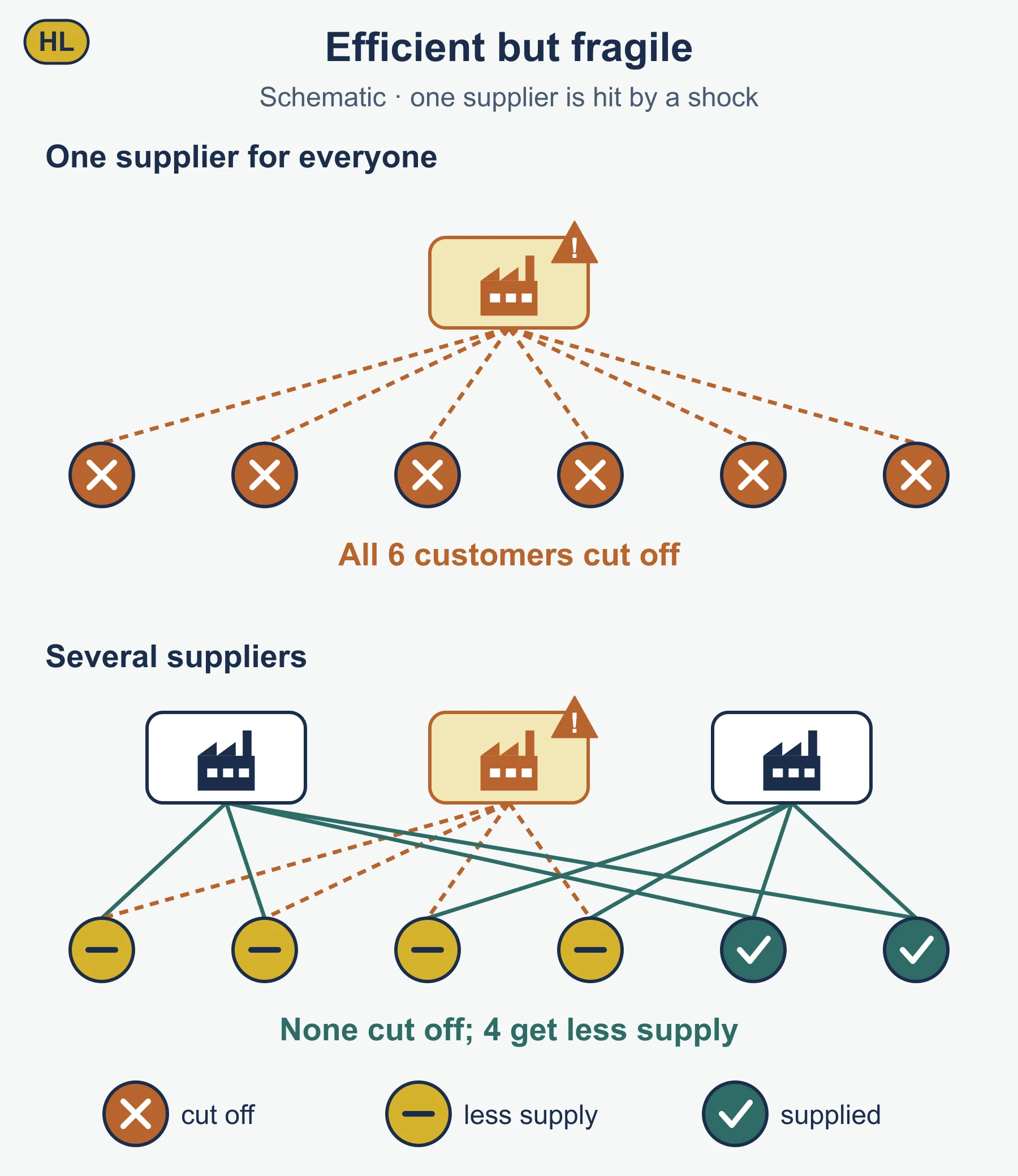
- Interdependence is the transmission mechanism: heavy reliance on a single supplier, market or route makes a system efficient but fragile.
- Unequal exposure: states with weak institutions, narrow export bases or heavy debt tend to be more vulnerable and less able to recover.
For each risk you should be able to identify the source, the groups affected, the scale at which it operates, and the responses available, from diplomacy and peacekeeping to financial regulation and debt relief.
13.2 Environmental risks
Environmental risks are those that arise from natural processes, human impact on the environment, or the interaction of the two.
- Climate change: rising temperatures, changing rainfall patterns, sea level rise and more intense extreme events, with consequences for water, food, health and settlement.
- Biodiversity loss and ecosystem decline: habitat loss, overexploitation and pollution weaken the services ecosystems provide.
- Pollution and resource pressure: air, water and plastic pollution, soil degradation and water scarcity.
- Disease and pandemics: spread along travel and trade networks, with impacts that depend on health systems and living conditions.
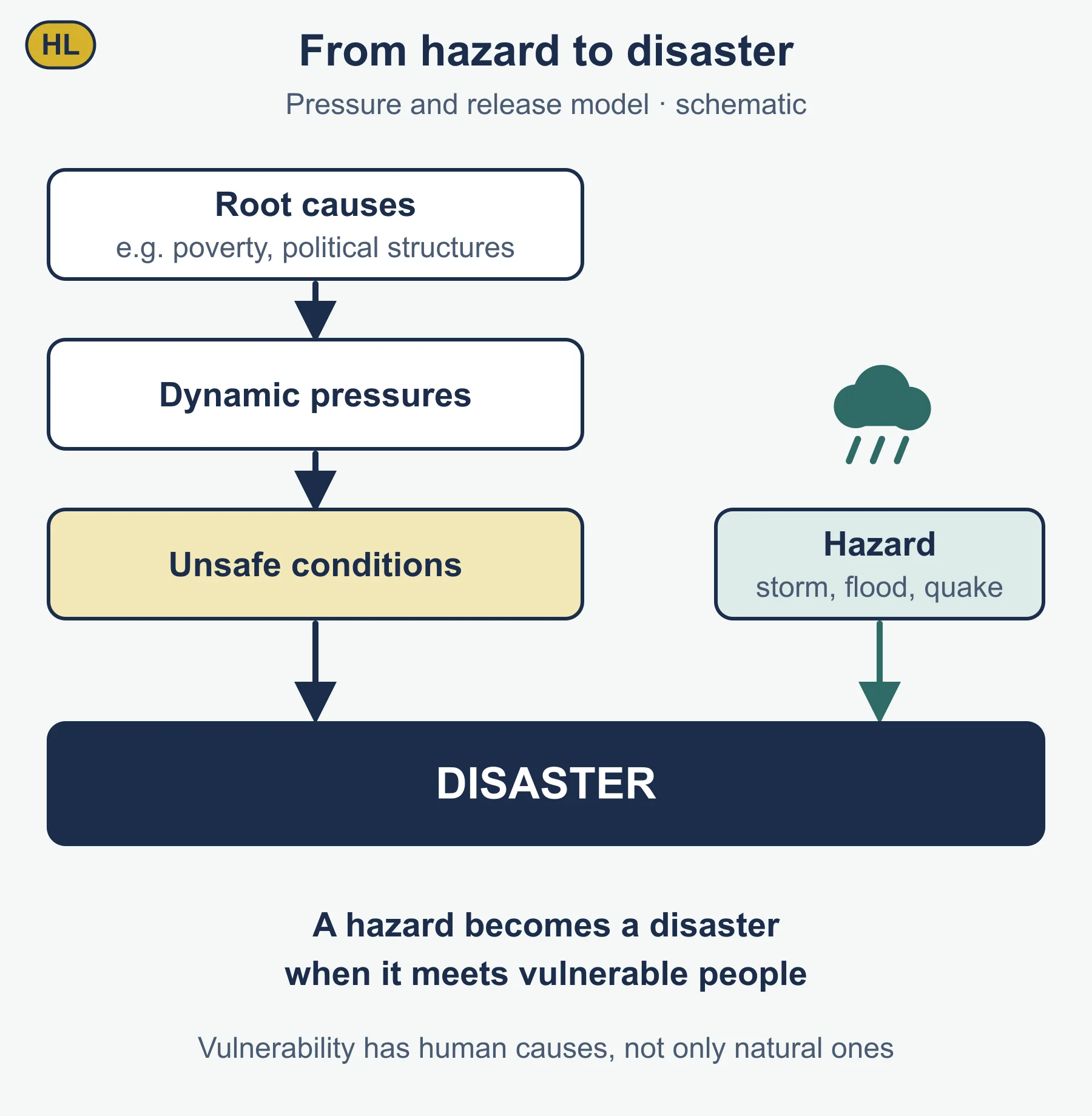
- Natural hazards: earthquakes, storms, floods and droughts become disasters when they meet vulnerable populations.
A useful model is the idea that disaster risk depends on hazard, exposure and vulnerability, reduced by capacity to cope. The pressure and release model, associated with Blaikie and colleagues, explains vulnerability as the result of root causes, such as poverty and political structures, that become dynamic pressures and unsafe conditions. Environmental risks are often transboundary, so one country’s actions can create risks for another, which is why they link naturally to global governance.
13.3 Local and global resilience
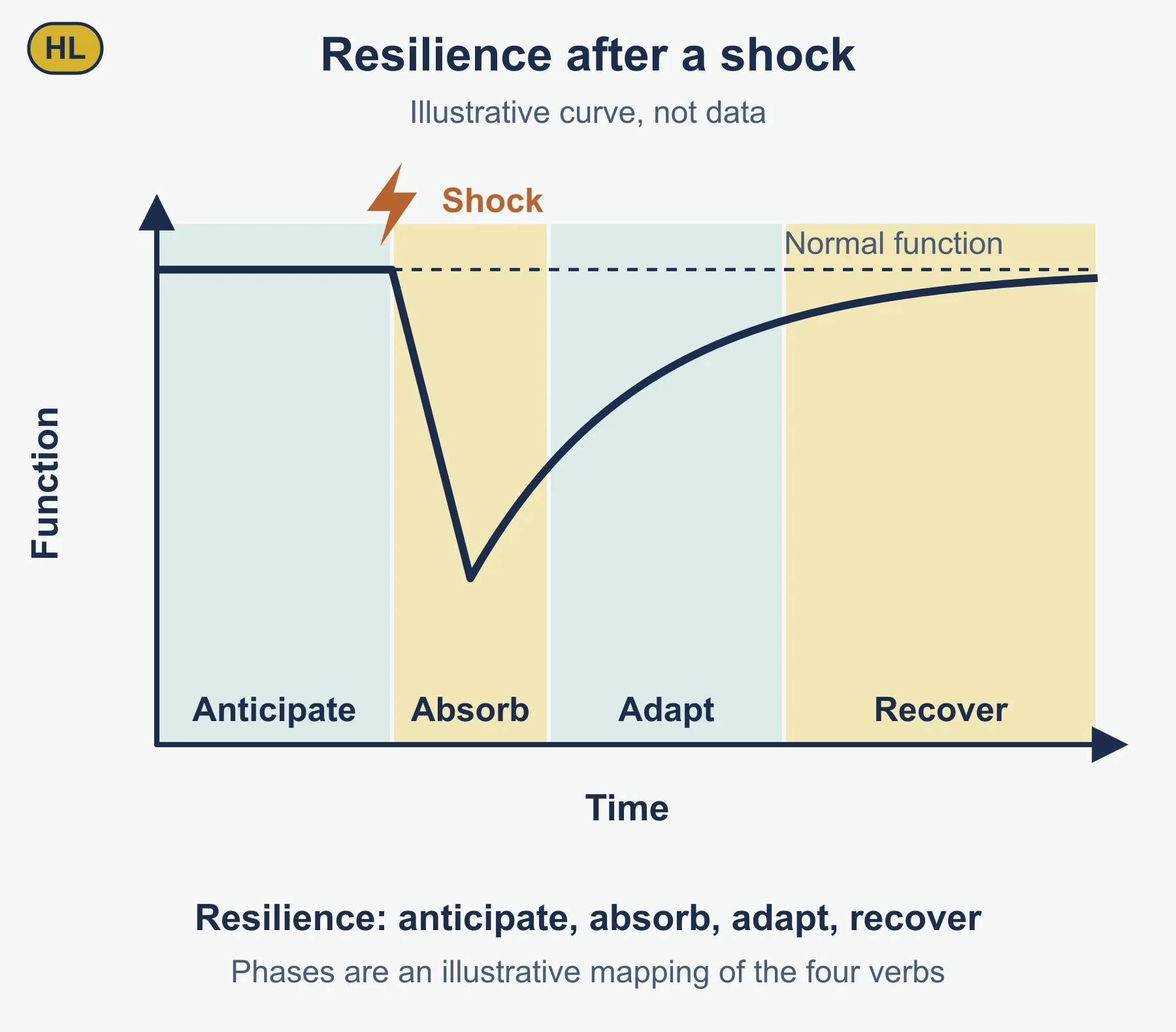
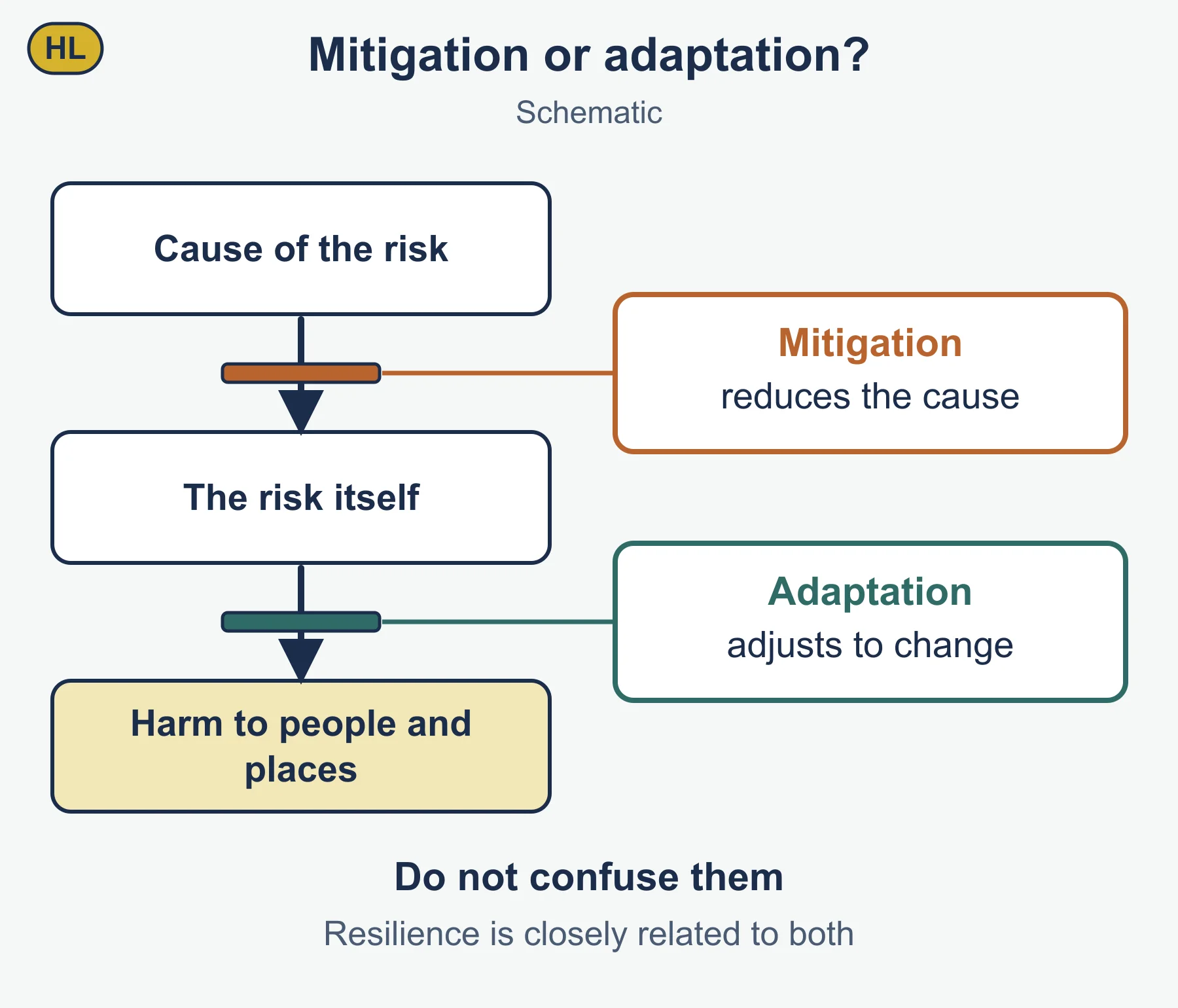
Resilience is the capacity of a person, community or system to anticipate, absorb, adapt to and recover from shocks. It is closely related to adaptation (adjusting to expected change) and mitigation (reducing the cause of the risk).
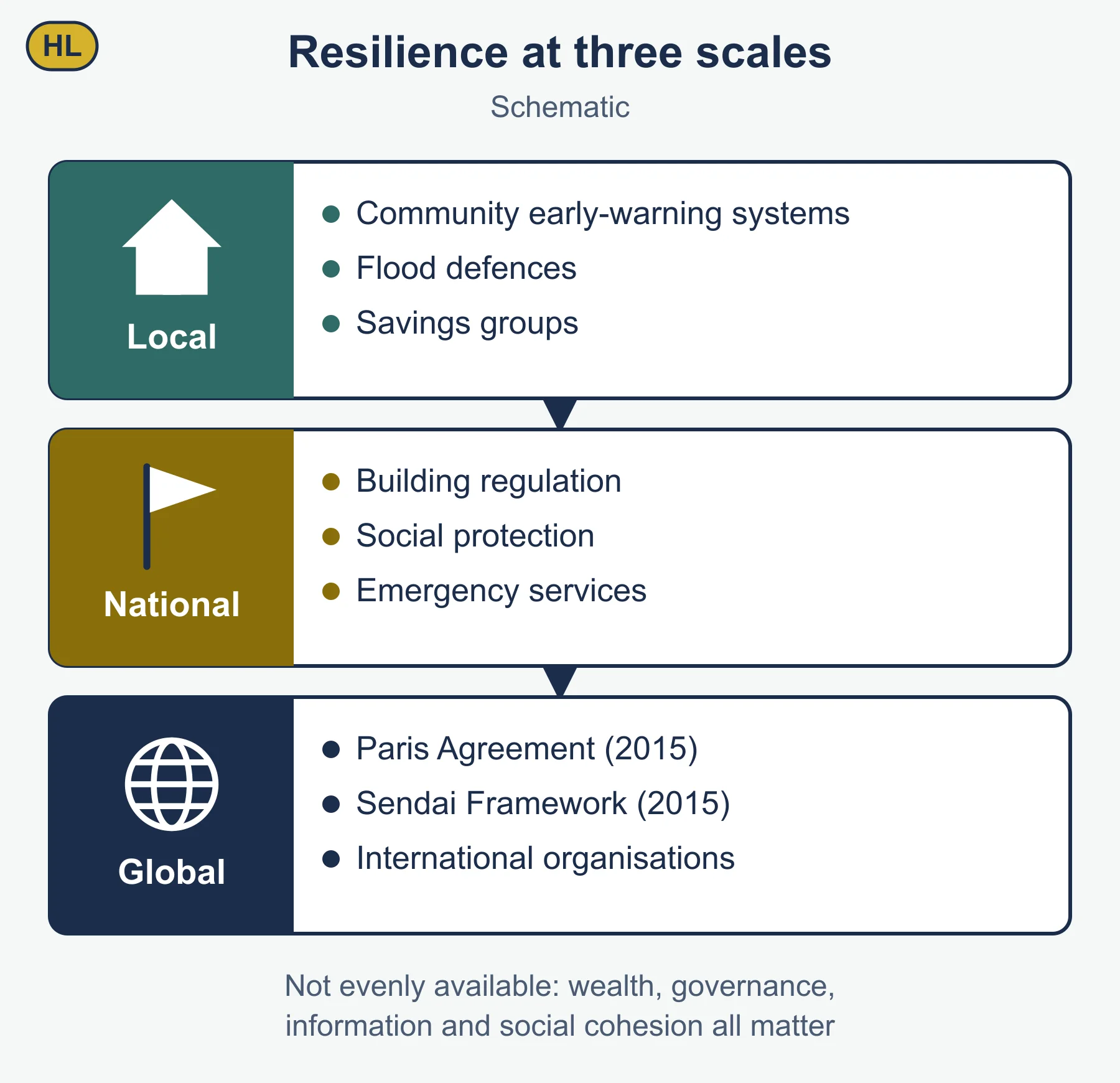
Responses operate at different scales.
- Local: community early-warning systems, flood defences and building standards, diversified livelihoods, savings groups, local knowledge and social networks.
- National: planning and building regulation, social protection, emergency services, investment in infrastructure and institutions.
- Global: agreements and frameworks, such as the Paris Agreement on climate change and the Sendai Framework for Disaster Risk Reduction, both adopted in 2015, and the work of international organisations and financial institutions.
Resilience is not evenly available. Wealth, governance, information and social cohesion all affect it. A judgement-based answer weighs who pays for resilience, whether measures reduce the underlying cause or only the symptoms, and whether short-term protection can create long-term vulnerability. Top-down measures can be well funded but poorly matched to local needs, while community-based measures may fit well but lack resources.
Worked example: comparing risk using a scoring heuristic
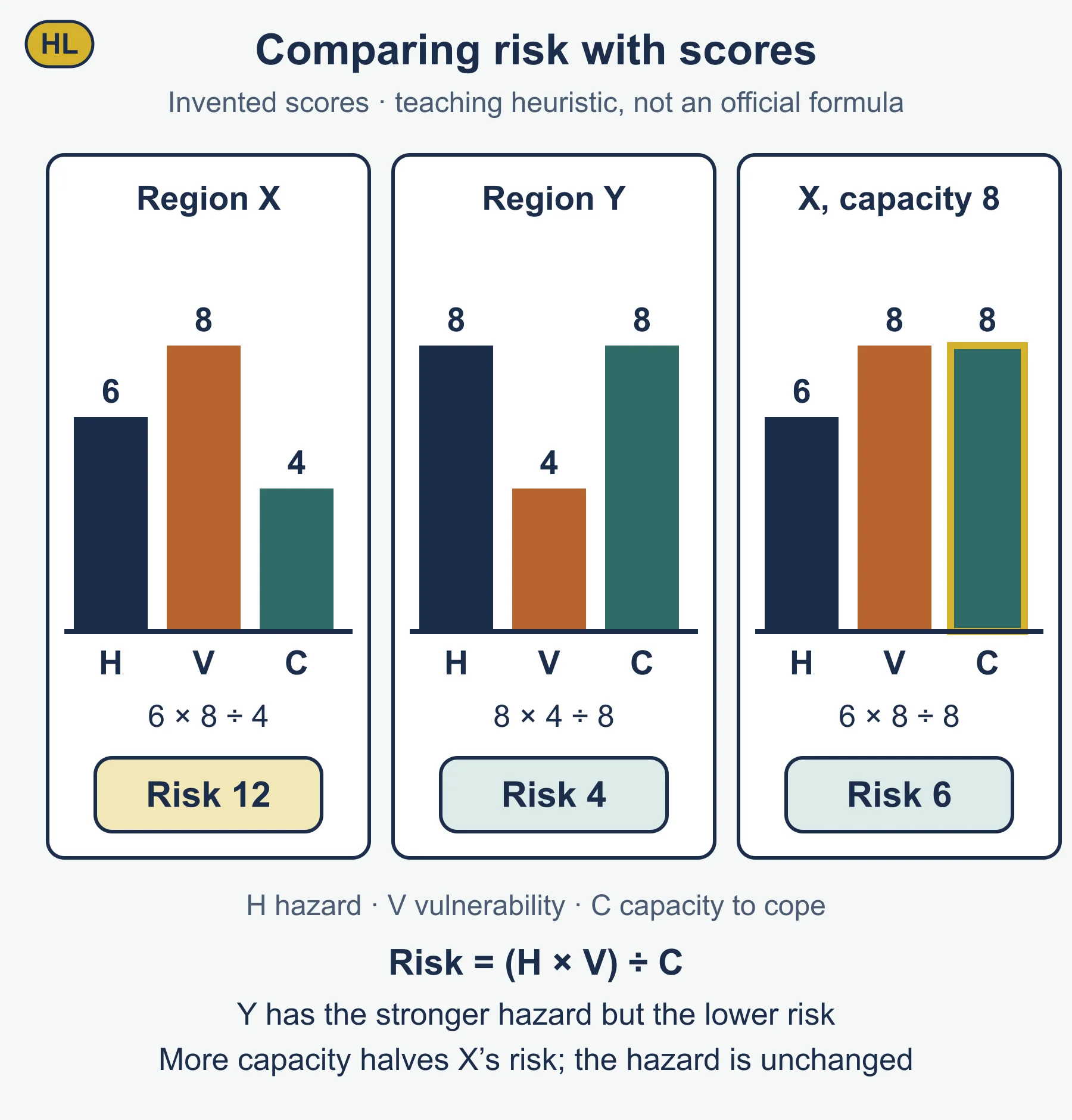
Disaster-risk thinking is often summarised as risk rising with hazard and vulnerability and falling with capacity to cope. This is a teaching heuristic, not an official formula, but it helps structure comparison. Score each factor from 1 (low) to 10 (high). The regions and scores are invented.
Risk score = (hazard x vulnerability) / capacity to cope.
- Region X: hazard 6, vulnerability 8, capacity 4. Risk = (6 x 8) / 4 = 48 / 4 = 12.
- Region Y: hazard 8, vulnerability 4, capacity 8. Risk = (8 x 4) / 8 = 32 / 8 = 4.
Region Y faces the stronger hazard but has a much lower risk score because it is less vulnerable and has greater capacity. If Region X raised its capacity from 4 to 8 through better warning systems and infrastructure, its score would fall to 48 / 8 = 6, halving its risk without changing the hazard at all. The lesson to write up is that disasters are not determined by hazard alone, and that investment in resilience can reduce risk even where the hazard cannot be changed. Then evaluate the method: the scores are subjective, the factors interact, and a single number hides how risk varies within a region.
Common mistakes
- Treating a disaster as only a natural event. Explain the human factors that turn a hazard into a disaster.
- Confusing mitigation with adaptation.
- Writing about resilience as purely local. Show how national and global actors enable or limit it.
- Listing risks without linking them to interdependence and unequal exposure.
- Naming agreements or events without being sure of their detail. Use only what you can state accurately.
Exam technique
Pay close attention to the command term. Examine asks for careful consideration of how and why; discuss needs balanced views and a conclusion; evaluate asks for a judgement of strengths and limitations; to what extent needs a stated position. Use at least one developed, accurate example per point, state the scale you are discussing, and finish by answering the exact question rather than summarising the topic.
Check your understanding
- Define resilience. Answer: The capacity to anticipate, absorb, adapt to and recover from shocks.
- Distinguish between adaptation and mitigation. Answer: Adaptation adjusts to change or risk; mitigation reduces the cause of the risk.
- Give two examples of economic risk. Answer: For example, a financial crisis and sovereign debt problems or commodity price volatility.
- Using (hazard x vulnerability) / capacity, find the risk score for hazard 5, vulnerability 6, capacity 3. Answer: (5 x 6) / 3 = 30 / 3 = 10.
- Why can a strong hazard lead to a low-impact outcome? Answer: Low vulnerability and high capacity to cope reduce the harm.
- Name two global frameworks or agreements related to environmental risk and the year they were adopted. Answer: The Paris Agreement and the Sendai Framework, both 2015.
- Why is interdependence both a strength and a risk? Answer: It improves efficiency and growth but transmits shocks between connected places.
Get free revision emails (optional)
Occasional emails with practice questions, worked explanations and links to free resources for the qualification and subjects you choose. No spam, and you can unsubscribe from any email. The free tools on this site never need an email.
Related resources
-
Study guides
IB DP Geography: Unit 5: Human development and diversity – Study Guide
Development opportunities, changing identities and cultures, and local responses to global interactions in the Higher Level extension of IB Diploma Programme Geography.
Geography · International Baccalaureate · IB
Read guide -
Study guides
IB DP Geography: Option E: Leisure, tourism and sport – Study Guide
A study guide to the Leisure, tourism and sport option in IB DP Geography: leisure patterns, tourism and sport at different scales, and sustainable management.
Geography · International Baccalaureate · IB
Read guide -
Study guides
IB DP Geography: Option B: Oceans and coastal margins – Study Guide
A study guide to the Oceans and coastal margins option in IB DP Geography: ocean circulation, coastal processes, coastal management and future ocean governance.
Geography · International Baccalaureate · IB
Read guide
Related articles
-
teaching
A Level tuition in Dubai: Cambridge or Pearson Edexcel International A Level?
Schools in Dubai and Abu Dhabi teach either Cambridge International AS & A Level or Pearson Edexcel International A Level. How the two are structured, why it matters for tuition, and how online classes from Lahore work.
9 October 2026
-
curriculum guides
Choosing subjects at IGCSE and A Level
How subject choices at 14 and 16 affect university options later, and how to keep pathways open without overloading a timetable.
28 July 2026
Studying this with a teacher
Working through Geography IB?
This page is free and stays free. Marlbridge is not offering Geography classes at the moment, so there is no tuition to book for it. The free study resources stay open to everyone.