
Revision Notes
IGCSE Accounting: Clubs and societies (Cambridge 0452) – Revision Notes
Condensed revision notes on club and society accounts for Cambridge IGCSE Accounting 0452 (2027-2029), with formulas, method steps and a short self-test.
- Subject
- Accounting
- Level
- IGCSE, O LEVELS
- Topic
- Preparation of financial statements
- Author
- Marlbridge Academic Team
- Updated
- Reviewed by
- Javaid Iqbal Sabri (what this means)
Aligned to Cambridge IGCSE O Level Accounting (0452, 7707), 2027-2029. Official specification (IGCSE) ; Official specification (O Level) .
Syllabus page (what it covers and how it is assessed): Cambridge IGCSE Accounting; Cambridge O Level Accounting.
Syllabus points this page covers
0452
- 5.5 Clubs and societies
7707
- 5.5 Clubs and societies
Found an error? Report a correction.
Want a teacher for this? Marlbridge teaches Accounting online. Request a free trial class.
Syllabus edition note. This resource follows the Cambridge IGCSE Accounting 0452 syllabus (and Cambridge O Level Accounting 7707, which has the same subject content for the same series) for exams in 2027, 2028 and 2029 (version 1), first examined in the March 2027 series in India and the June 2027 series elsewhere. If you sit 0452 in November 2026, you sit the 2026 syllabus (version 2), which differs: Paper 1 has 35 multiple-choice marks in 1 hour 15 minutes, not 40 marks in 1 hour 30 minutes; Topic 7 is “Accounting principles and policies”, without 7.2 Ethical considerations or 7.3 Technology and sustainability; 4.4 is “Irrecoverable debts and provision for doubtful debts”; income statements are named instead of statements of profit or loss; three-column running balance accounts are not required; Clubs and societies is 5.4 and Manufacturing accounts 5.5; and 6.3 is “Inter-firm comparison”. For this topic, the 2026 syllabus covers only trading and service businesses in 5.1 and limits drawings adjustments to goods taken by the owner for own use; for limited companies it excludes cumulative and non-cumulative preference shares, rights issues, share premium and capital redemption reserve but requires the difference between redeemable and non-redeemable preference shares (the 2027-2029 syllabus lists none of these); and for incomplete records it does not ask why businesses keep them or what their advantages are. If you sit in November 2026, work from the 2026 syllabus on the Cambridge International website.
These revision notes cover syllabus section 5.5 Clubs and societies in Cambridge IGCSE Accounting 0452, for exams in 2027, 2028 and 2029 (version 1). They are part of Topic 5, Preparation of financial statements, and the syllabus does not split 5.5 into tiers. For full explanations and a complete set of statements, read the study guide. Then test yourself with the practice questions. The wider topic is in the Topic 5 revision notes and the Topic 5 practice questions. The course hub is Cambridge IGCSE Accounting, the printable checklist tracks progress, and the free diagnostics show gaps.
Key terms
| Term | Meaning |
|---|---|
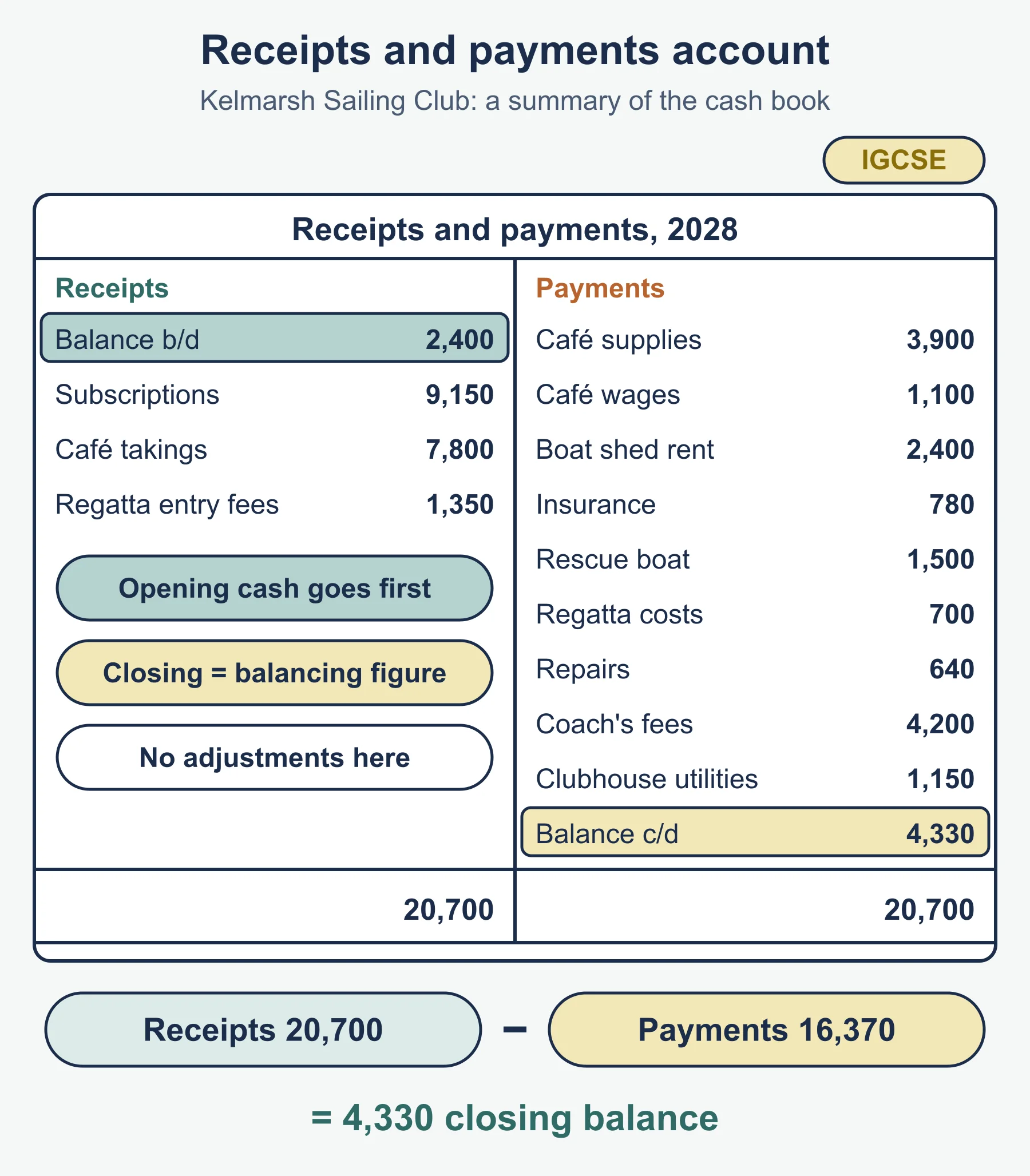
| Receipts and payments account | Summary of the cash book: all cash and bank receipts and payments, opening balance to closing balance |
| Income and expenditure account | The club’s equivalent of a statement of profit or loss; revenue items for the year only, adjusted for amounts owing and prepaid |
| Surplus / deficit | Income greater than expenditure / expenditure greater than income |
| Revenue-generating activity | Something the club runs to raise money, such as refreshments or an event; its net result goes to the income and expenditure account |
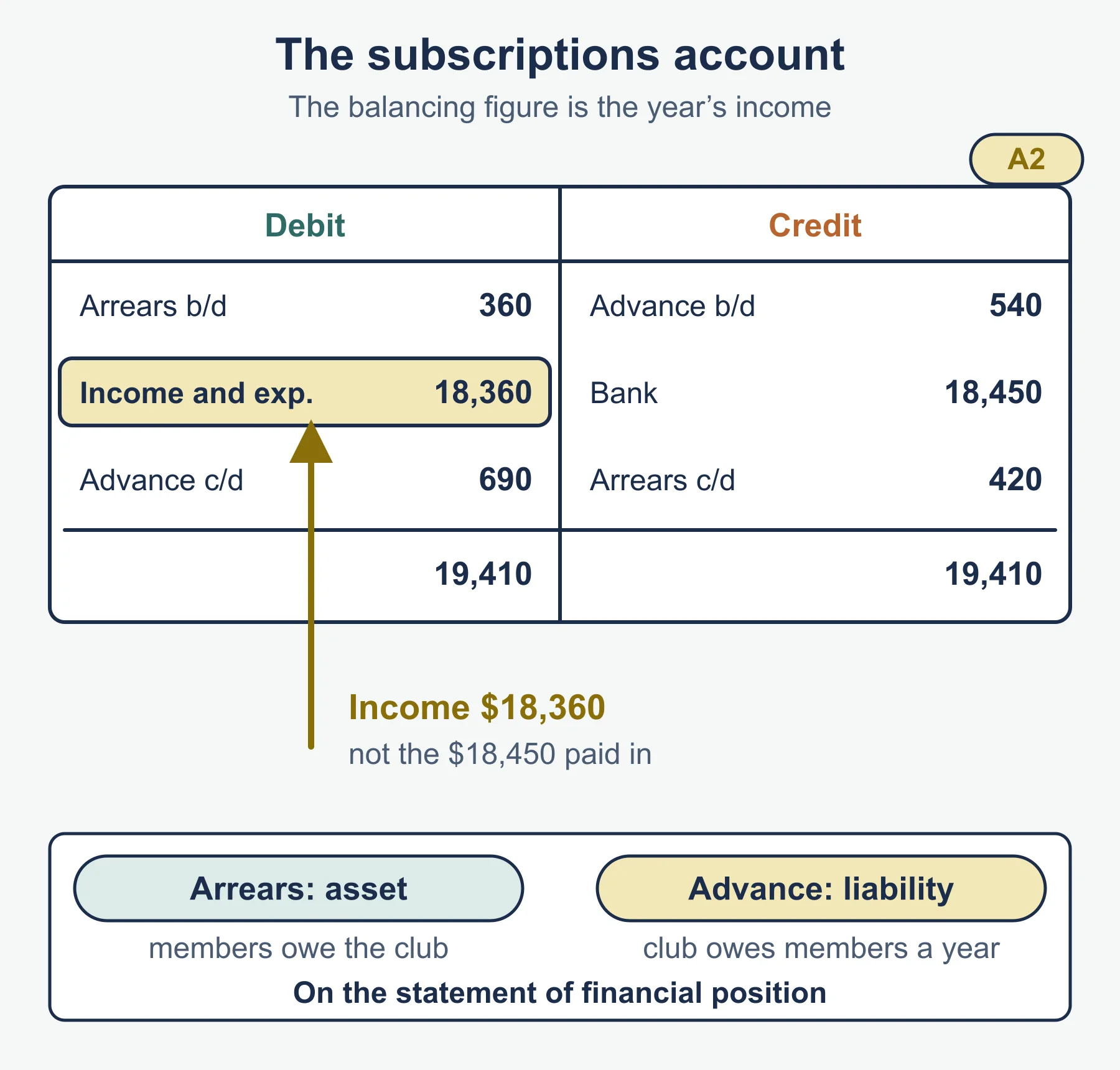
| Subscriptions in arrears | Owed by members; an other receivable |
| Subscriptions in advance | Paid for a later period; an other payable |
| Accumulated fund | The club’s capital: total assets less total liabilities |
Formulas
| Item | Formula |
|---|---|
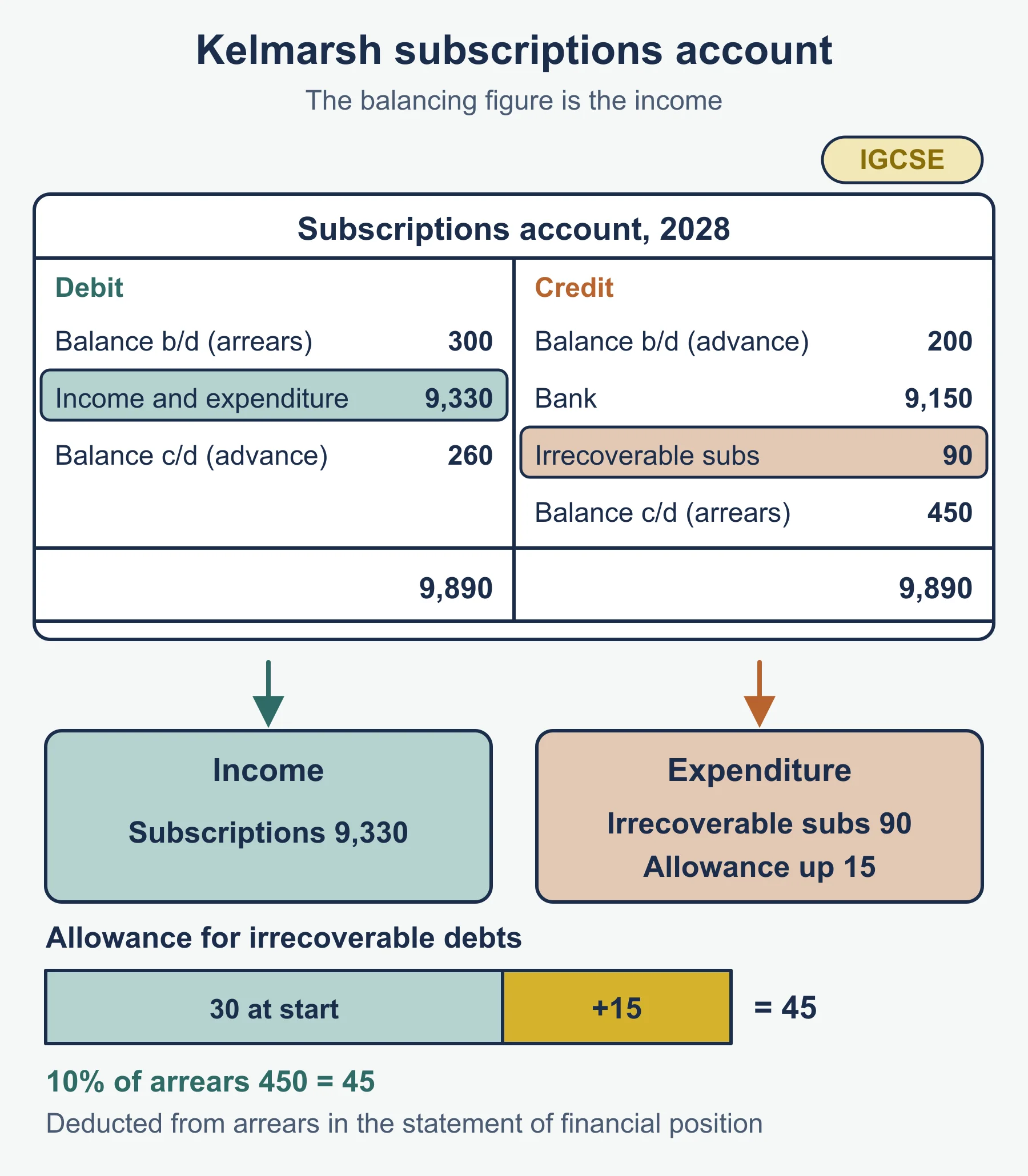
| Subscription income | cash received - opening arrears + closing arrears + irrecoverable subscriptions written off + opening advance - closing advance |
| Purchases for an activity | cash paid + closing trade payables - opening trade payables |
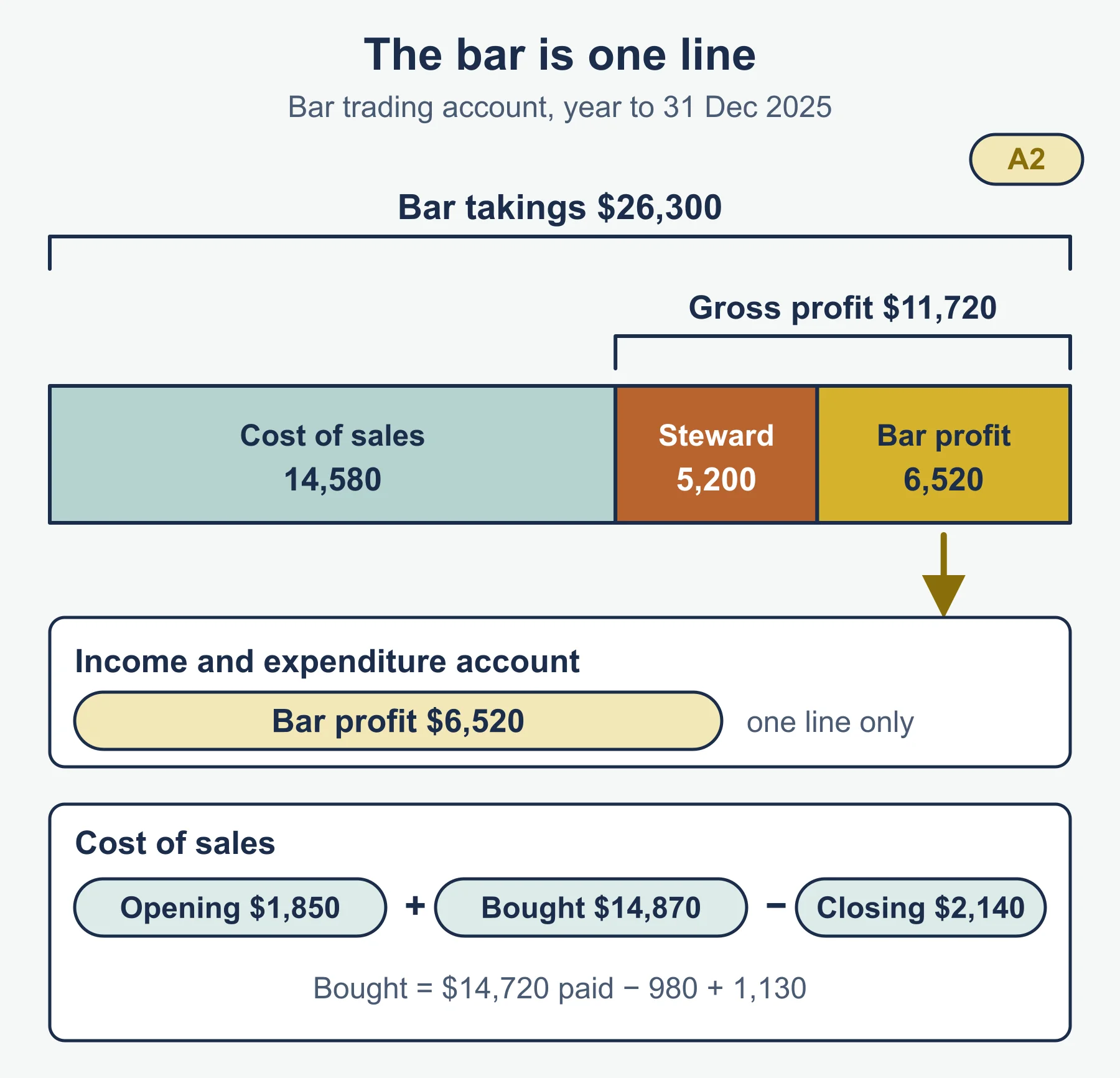
| Cost of sales | opening inventory + purchases - closing inventory |
| Profit on an activity | sales (or takings) - cost of sales - direct expenses |
| Opening accumulated fund | opening total assets - opening total liabilities |
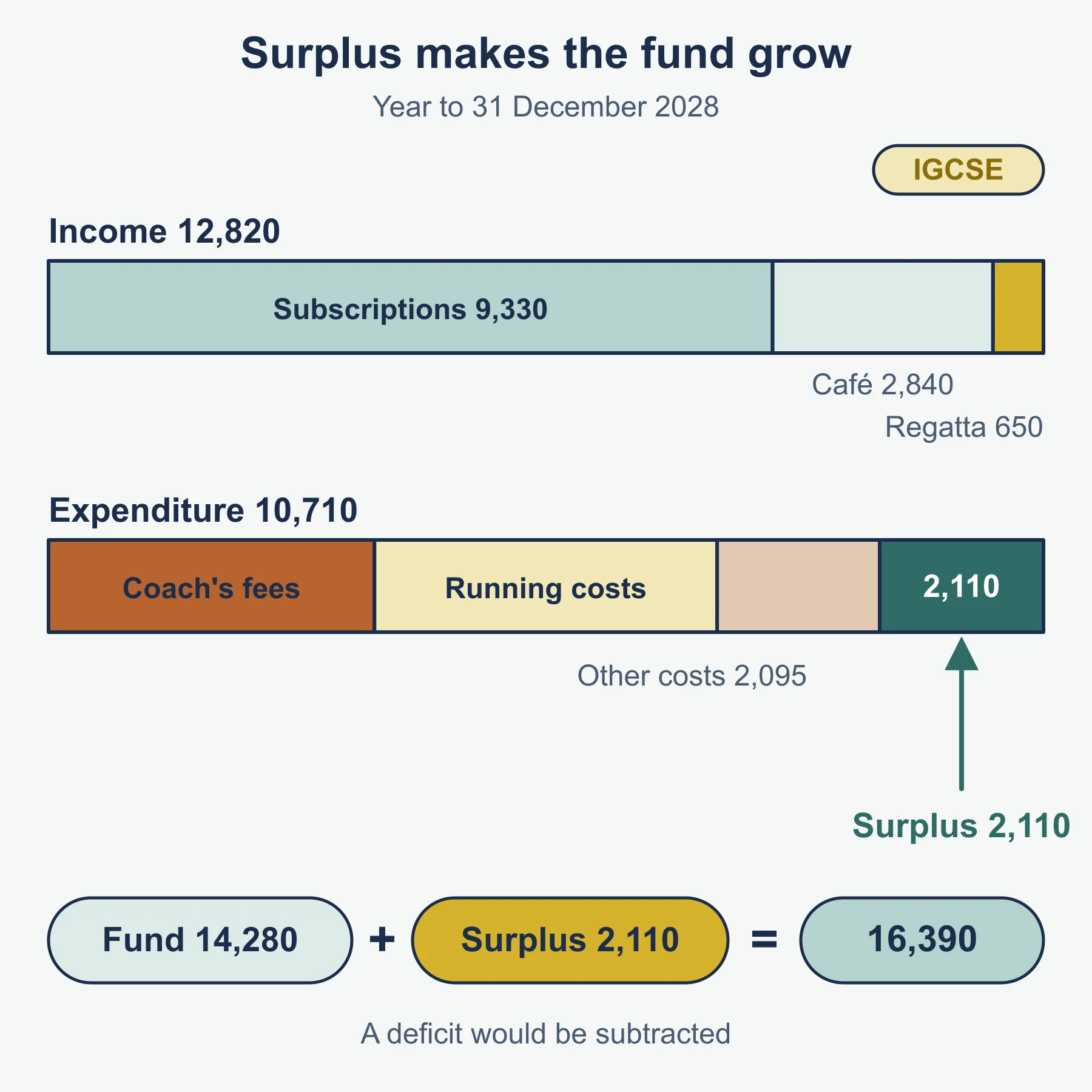
| Closing accumulated fund | opening accumulated fund + surplus (or - deficit) |
| Straight-line depreciation | (cost - residual value) divided by expected life |
| Reducing-balance depreciation | percentage x net book value |
| Depreciation by revaluation | opening valuation + additions - closing valuation |
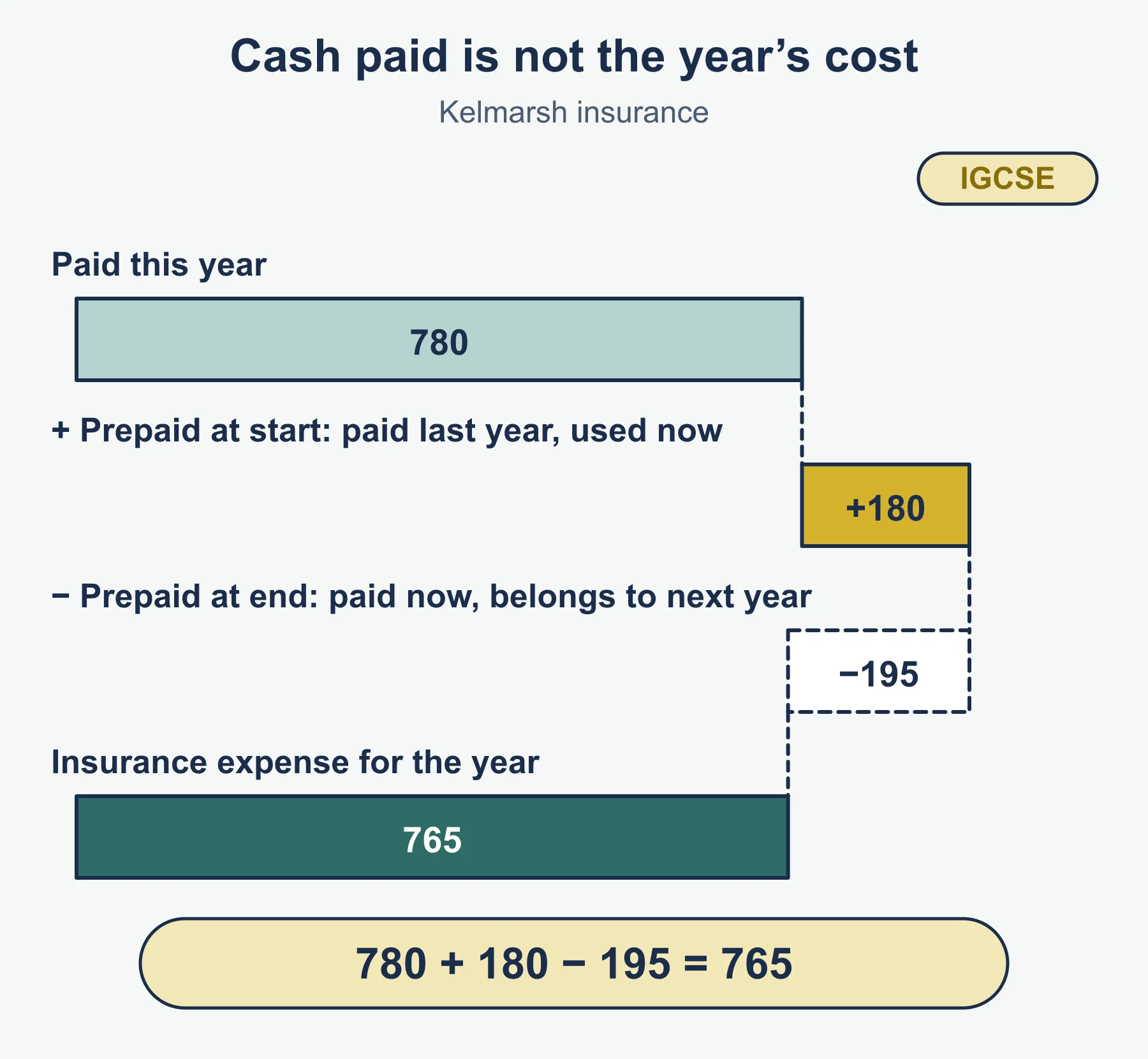
| Expense after prepayment | cash paid + opening prepaid - closing prepaid |
| Expense after accrual | cash paid + closing owing - opening owing |
Method in steps
- Prepare the receipts and payments account if the question gives cash book information. Do not adjust it.
- Work out opening assets and liabilities, and the opening accumulated fund.
- Prepare the subscriptions account and find the income.
- Prepare an account for each revenue-generating activity and carry the net result across.
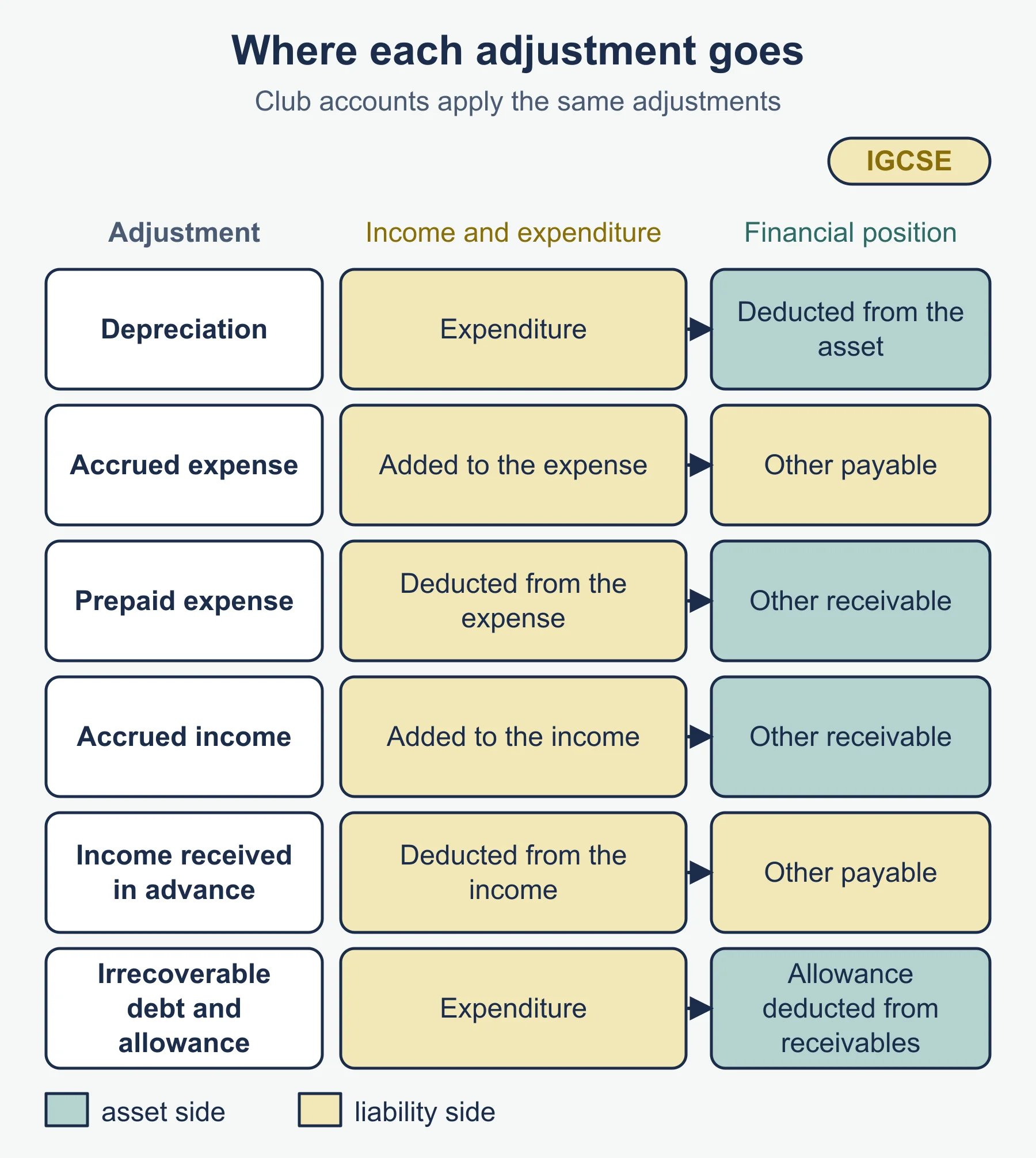
- Adjust each remaining expense for accruals and prepayments, and calculate depreciation. Leave out capital items.
- Prepare the income and expenditure account and find the surplus or deficit.
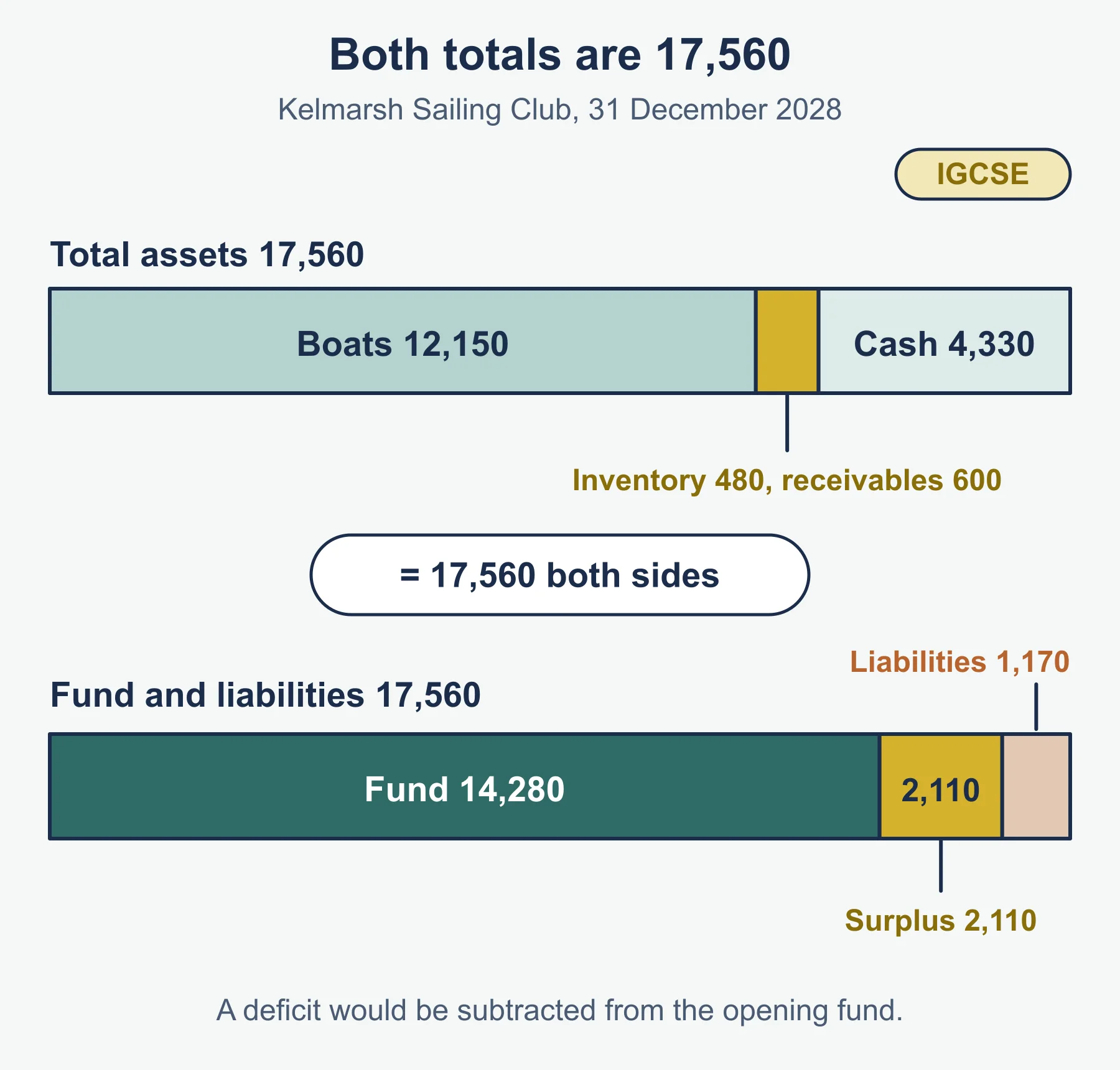
- Prepare the statement of financial position, adding the surplus to (or subtracting the deficit from) the opening accumulated fund, and check that both totals agree.
Worked reminder: Marren Archery Club
The club’s year ends on 31 December 2028. Members paid 5,400 in cash. Arrears were 150 at the start and 210 at the end. Advance payments were 90 at the start and 120 at the end. No debts were written off.
Subscription income = 5,400 - 150 + 210 + 90 - 120 = 5,430The club’s kiosk took 2,600 in sales. It paid 1,500 for supplies. Trade payables for supplies were 200 at the start and 240 at the end. Inventory was 120 at the start and 180 at the end. The kiosk assistant was paid 300.
Purchases      = 1,500 + 240 - 200        = 1,540
Cost of sales  = 120 + 1,540 - 180        = 1,480
Gross profit   = 2,600 - 1,480            = 1,120
Profit on kiosk = 1,120 - 300             =   820
At 1 January the club had range equipment of 8,000, kiosk inventory of 120, arrears of 150 and a bank balance of 1,300. It owed 90 of subscriptions paid in advance and 200 to trade payables.
Assets 8,000 + 120 + 150 + 1,300 = 9,570
Liabilities 90 + 200             =   290
Accumulated fund                 = 9,280
Must-know distinctions
| Compare | Key difference |
|---|---|
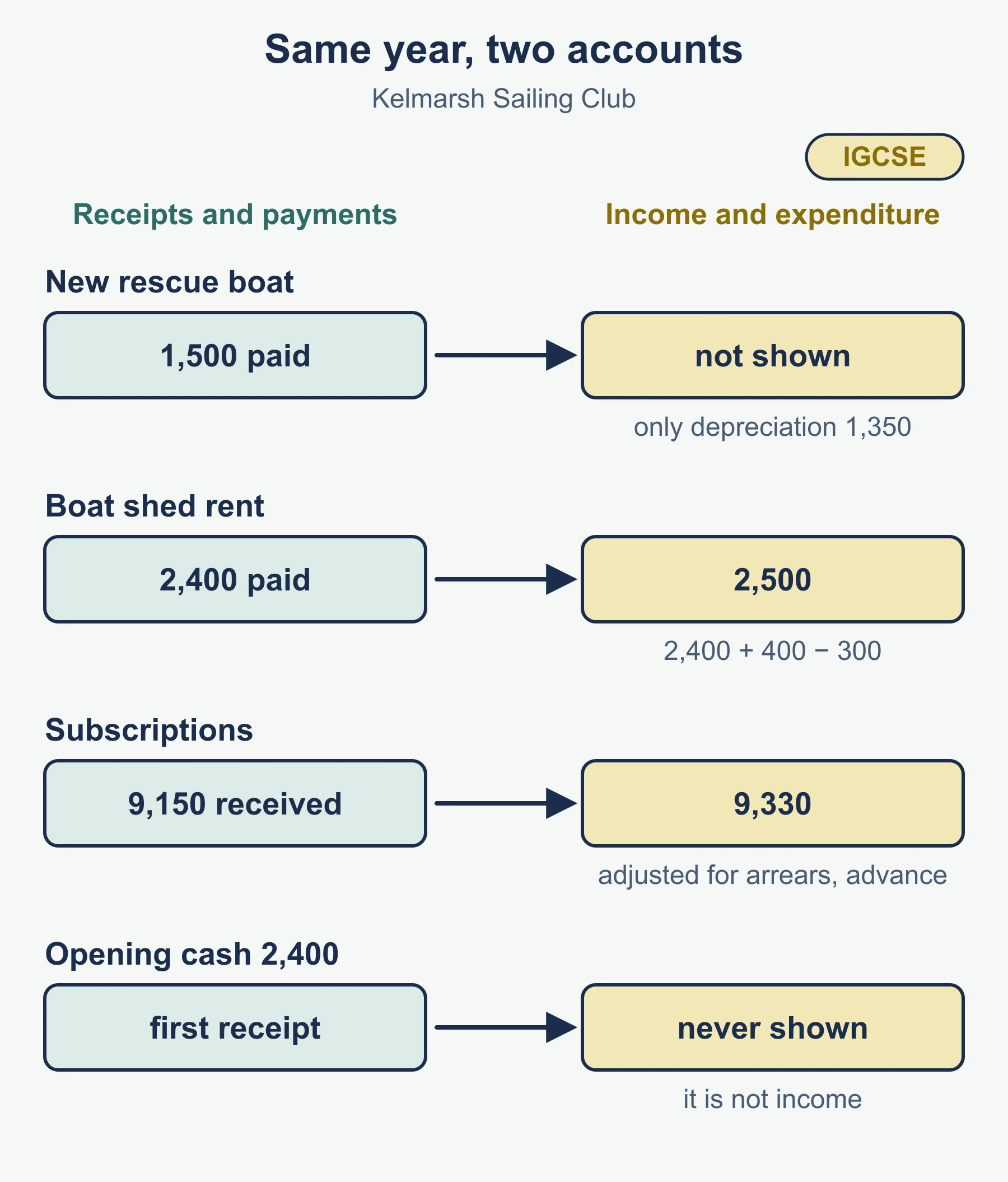
| Receipts and payments vs income and expenditure | Cash movements including capital items, with no adjustments, against revenue items for the year with adjustments |
| Capital and revenue items | Buying equipment is capital and appears in the statement of financial position; the depreciation charge is revenue and appears in the income and expenditure account |
| Arrears vs advance | Arrears are an asset (members owe the club); advance payments are a liability (the club owes service) |
| Written off vs allowance | A write-off removes a known bad amount from arrears; an allowance is a deduction for amounts that may not be paid |
| Accumulated fund vs capital | Same idea; a club uses the name accumulated fund |
| Surplus vs profit | Same calculation; a club uses the names surplus and deficit |
| Net result vs full figures | Only the profit or loss of an activity appears in the income and expenditure account, not its sales and costs |
Quick self-test
- On which side of a receipts and payments account is the opening cash and bank balance shown?
- Which account is the club’s equivalent of a statement of profit or loss?
- A club buys new equipment. Does the purchase appear in the income and expenditure account?
- Members paid 3,240 in subscriptions. Arrears were 120 at the start and 180 at the end. Advance payments were 60 at the start and 90 at the end. Calculate subscription income.
- A club paid 2,150 for refreshment supplies. Trade payables were 310 at the start and 260 at the end. Calculate purchases.
- Total assets are 21,400 and total liabilities 3,150. Calculate the accumulated fund.
- The opening accumulated fund was 18,250 and the club made a deficit of 640. Calculate the closing accumulated fund.
- Equipment cost 7,500, has a residual value of 500 and a life of 5 years. Calculate the straight-line depreciation for a year.
- Equipment has a net book value of 6,400 at the start of the year and is depreciated at 20% using the reducing balance method. Calculate the charge and the new net book value.
- Sports equipment was valued at 3,500 at the start of the year, the club bought 800 more, and the closing valuation is 3,600. Calculate depreciation.
- Insurance paid was 960, with 140 prepaid at the start and 170 prepaid at the end. Calculate the expense.
Answers
- On the receipts side, as the balance brought down.
- The income and expenditure account.
- No. The cost is capital expenditure and goes in the statement of financial position; only depreciation is in the income and expenditure account.
- 3,240 - 120 + 180 + 60 - 90 = 3,270.
- 2,150 + 260 - 310 = 2,100.
- 21,400 - 3,150 = 18,250.
- 18,250 - 640 = 17,610.
- (7,500 - 500) divided by 5 = 1,400.
- 20% of 6,400 = 1,280; new net book value 6,400 - 1,280 = 5,120.
- 3,500 + 800 - 3,600 = 700.
- 960 + 140 - 170 = 930.
Where marks are usually lost
- Adjusting the receipts and payments account, or including opening balances in the income and expenditure account.
- Treating capital purchases as expenditure.
- Using the cash received for subscriptions as income without adjusting for arrears and advance payments.
- Placing arrears as a liability and advance payments as an asset.
- Showing the sales and costs of an activity in the income and expenditure account as well as its profit or loss.
- Using cash paid as purchases without adjusting for trade payables.
- Writing a bad debt as a reduction of income instead of as expenditure.
- Using the labels profit and capital where the question expects surplus and accumulated fund.
- Leaving out workings, so a single slip cannot be traced.
- Failing to check that the two sides of the statement of financial position agree.
Frequently asked questions
Why does a club not have capital or drawings? A club or society exists for its members rather than to make a profit for an owner, so it has no owner’s capital and no drawings. Its capital is the accumulated fund.
Where does the opening bank balance go in club accounts? The opening cash and bank balance goes on the receipts side of the receipts and payments account. It does not belong in the income and expenditure account.
How do you prepare a receipts and payments account? Write the opening cash and bank balance on the receipts side, list every receipt and payment from the cash book, then find the closing balance as the balancing figure on the payments side. Do not adjust for amounts owing, prepaid or depreciation.
How can you check club accounts are correct? Check that the two sides of the statement of financial position agree, with the accumulated fund plus liabilities equal to total assets. Showing workings makes any slip easier to trace.
Official syllabus
Source: Cambridge IGCSE Accounting 0452 syllabus for 2027, 2028 and 2029 (version 1), Cambridge University Press & Assessment, section 5.5. Names and amounts are invented.
Get free revision emails (optional)
Occasional emails with practice questions, worked explanations and links to free resources for the qualification and subjects you choose. No spam, and you can unsubscribe from any email. The free tools on this site never need an email.
Related resources
-
Revision notes
IGCSE Accounting: Analysis and Interpretation — Revision Notes
Quick recall for Cambridge IGCSE Accounting 0452 Topic 6: ten ratios, reading them, profit versus cash, comparing businesses, users and statement limits.
Accounting · Cambridge · IGCSE, O Level
Revise topic -
Study guides
IGCSE Accounting: Financial statements of limited companies (Cambridge 0452)
Full walk-through of limited company accounts for Cambridge IGCSE Accounting 0452: limited liability, equity, shares, debentures, and the three statements.
Accounting · Cambridge · IGCSE, O Level
Read guide -
Practice questions
IGCSE Accounting: Financial statements of limited companies (Cambridge 0452) – Practice Questions
Eleven original questions with worked answers on limited company accounts for Cambridge IGCSE Accounting 0452 section 5.3.
Accounting · Cambridge · IGCSE, O Level
Try questions
Related articles
-
teaching
A Level tuition in Dubai: Cambridge or Pearson Edexcel International A Level?
Schools in Dubai and Abu Dhabi teach either Cambridge International AS & A Level or Pearson Edexcel International A Level. How the two are structured, why it matters for tuition, and how online classes from Lahore work.
9 October 2026
-
curriculum guides
Choosing subjects at IGCSE and A Level
How subject choices at 14 and 16 affect university options later, and how to keep pathways open without overloading a timetable.
28 July 2026
Studying this with a teacher
Working through Accounting IGCSE, O LEVELS?
This page is free and stays free. If you would rather be taught it, Marlbridge runs Accounting classes one-to-one and in small groups of up to 15, online in your own time zone. The first trial class is free. WhatsApp replies within an hour (8am–11pm Pakistan time, every day); email the same day.
Cambridge Accounting teachers at Marlbridge

