
Study Guides
IGCSE Accounting: Incomplete records (Cambridge 0452)
Study guide to incomplete records for Cambridge IGCSE Accounting 0452: statements of affairs, missing figures, mark-up, margin and full statements.
- Subject
- Accounting
- Level
- IGCSE, O LEVELS
- Topic
- Preparation of financial statements
- Author
- Marlbridge Academic Team
- Updated
- Reviewed by
- Javaid Iqbal Sabri (what this means)
Aligned to Cambridge IGCSE O Level Accounting (0452, 7707), 2027-2029. Official specification (IGCSE) ; Official specification (O Level) .
Syllabus page (what it covers and how it is assessed): Cambridge IGCSE Accounting; Cambridge O Level Accounting.
Syllabus points this page covers
0452
- 5.6 Incomplete records
7707
- 5.6 Incomplete records
Found an error? Report a correction.
Want a teacher for this? Marlbridge teaches Accounting online. Request a free trial class.
Syllabus edition note. This resource follows the Cambridge IGCSE Accounting 0452 syllabus (and Cambridge O Level Accounting 7707, which has the same subject content for the same series) for exams in 2027, 2028 and 2029 (version 1), first examined in the March 2027 series in India and the June 2027 series elsewhere. If you sit 0452 in November 2026, you sit the 2026 syllabus (version 2), which differs: Paper 1 has 35 multiple-choice marks in 1 hour 15 minutes, not 40 marks in 1 hour 30 minutes; Topic 7 is “Accounting principles and policies”, without 7.2 Ethical considerations or 7.3 Technology and sustainability; 4.4 is “Irrecoverable debts and provision for doubtful debts”; income statements are named instead of statements of profit or loss; three-column running balance accounts are not required; Clubs and societies is 5.4 and Manufacturing accounts 5.5; and 6.3 is “Inter-firm comparison”. For this topic, the 2026 syllabus covers only trading and service businesses in 5.1 and limits drawings adjustments to goods taken by the owner for own use; for limited companies it excludes cumulative and non-cumulative preference shares, rights issues, share premium and capital redemption reserve but requires the difference between redeemable and non-redeemable preference shares (the 2027-2029 syllabus lists none of these); and for incomplete records it does not ask why businesses keep them or what their advantages are. If you sit in November 2026, work from the 2026 syllabus on the Cambridge International website.
This guide teaches syllabus section 5.6 Incomplete records from the Cambridge IGCSE Accounting 0452 syllabus for exams in 2027, 2028 and 2029 (version 1). It sits inside Topic 5, Preparation of financial statements, which gives a shorter overview and one example. Here you get every 5.6 point in depth, with new worked examples. Hub: Cambridge IGCSE Accounting. Checklist: printable checklist.
The syllabus says questions on incomplete records are asked only for sole trader businesses, never for service or manufacturing businesses. Every example below is a trading business.
What 5.6 asks you to do
| 5.6 point | Where it is taught |
|---|---|
| Why businesses keep different types of records | Section 1 |
| Advantages and disadvantages of not keeping a full set | Section 1 |
| Opening and closing statements of affairs | Section 2 |
| Profit or loss from changes in capital | Section 2 |
| Sales, purchases, gross profit, trade receivables, trade payables and other figures | Sections 3 and 5 |
| Statement of profit or loss and statement of financial position | Section 4 |
| Adjustments as in 5.1 | Section 4 |
| Mark-up, margin and inventory turnover for missing figures | Section 5 |
1. Why records are incomplete
Full double entry means every transaction is recorded twice, in ledger accounts, and checked by a trial balance. Many small sole traders do not do this. They keep what is cheap and useful: a cash book or bank statements, invoices filed in date order, and a list of who owes them money.
Why they choose this:
- The owner lacks bookkeeping knowledge.
- A bookkeeper or software costs money the business cannot spare.
- The business is small, so the owner can see most transactions personally.
- The owner mainly wants to know the bank balance and who owes what.
| Advantages of not keeping full records | Disadvantages |
|---|---|
| Lower cost: no bookkeeper or software | No trial balance, so errors stay hidden |
| Quicker and simpler day to day | Theft and fraud are harder to spot |
| Little accounting skill needed | Profit must be rebuilt, with less accuracy |
| Owner can still see cash and bank | Poor control of trade receivables and trade payables |
| Lenders and tax authorities may distrust the figures |
When the year ends, the owner or an accountant reconstructs the figures from what exists. Sections 2 to 5 show how.
2. Statements of affairs and profit from changes in capital
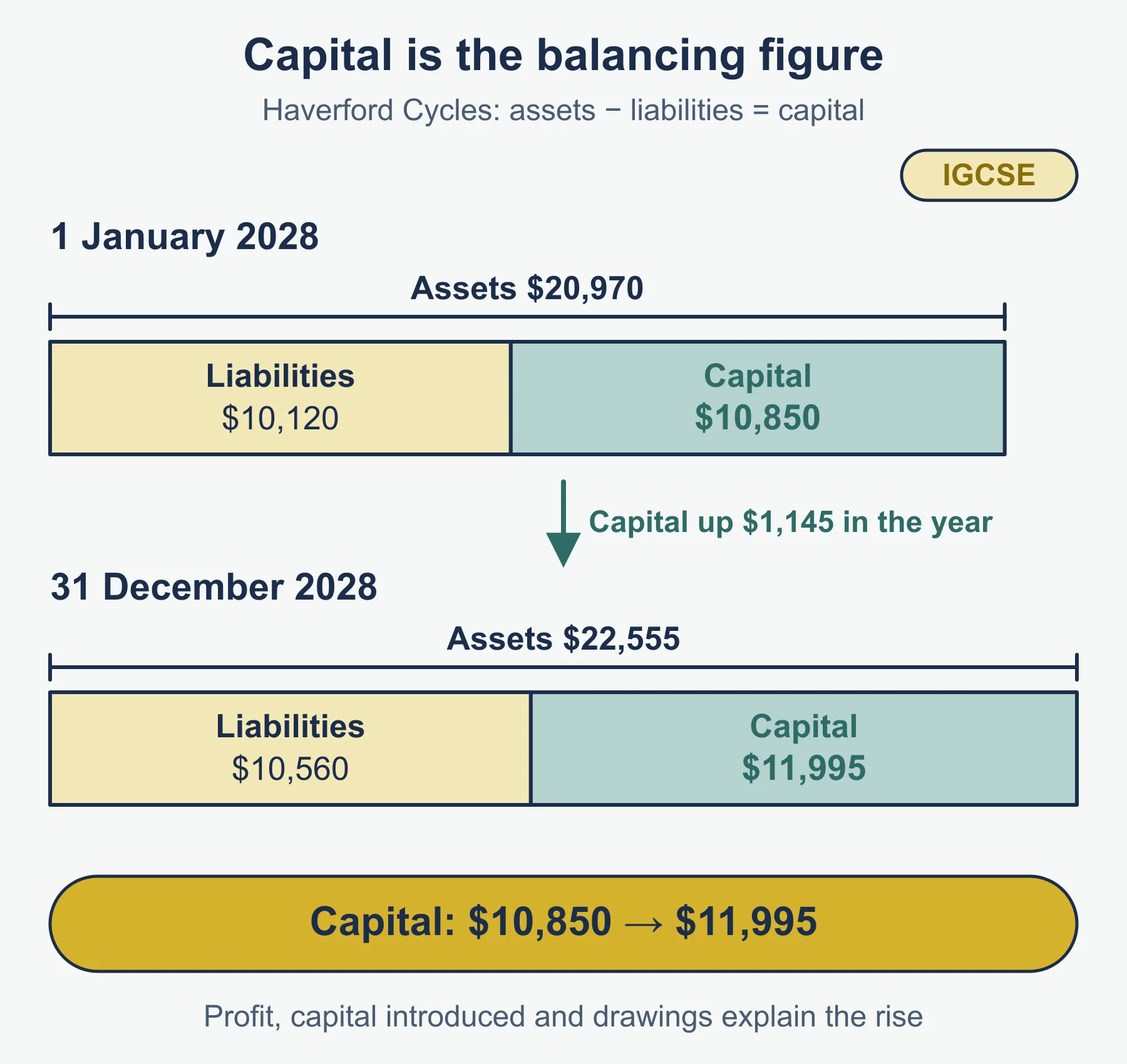
A statement of affairs lists assets and liabilities on one date. It has the same layout as a statement of financial position, and its balancing figure is capital (assets minus liabilities). The opening statement of affairs is at the start of the year and the closing statement at the end.
Haverford Cycles. Cordelia Haverford buys and sells bicycles. She keeps bank statements, a cash float and invoices only. Her balances:
| 1 Jan 2028 | 31 Dec 2028 | |
|---|---|---|
| Equipment at cost | 12,000 | 12,000 |
| Accumulated depreciation | 3,600 | to find |
| Inventory | 6,400 | 7,100 |
| Trade receivables | 3,200 | 3,900 |
| Allowance for irrecoverable debts | 160 | to find |
| Rent paid in advance | 600 | 650 |
| Bank | 2,350 | 3,720 |
| Cash float | 180 | 180 |
| Trade payables | 3,900 | 4,300 |
| Electricity owing | 220 | 260 |
| Interest-free loan from a relative | 6,000 | 6,000 |
Equipment is depreciated at 10% a year on cost (straight line), with no purchases or disposals. The closing allowance is 5% of closing trade receivables, which are after writing off an irrecoverable debt of 340. Bank summary for 2028: receipts from credit customers 61,400; cash sales banked 9,600; capital introduced 2,500. Payments: suppliers 43,800; rent 7,200; electricity 1,980; wages 6,900; general expenses 2,450 (including 360 for Cordelia’s private insurance); drawings unknown. She also took goods that cost 450 for her own use.
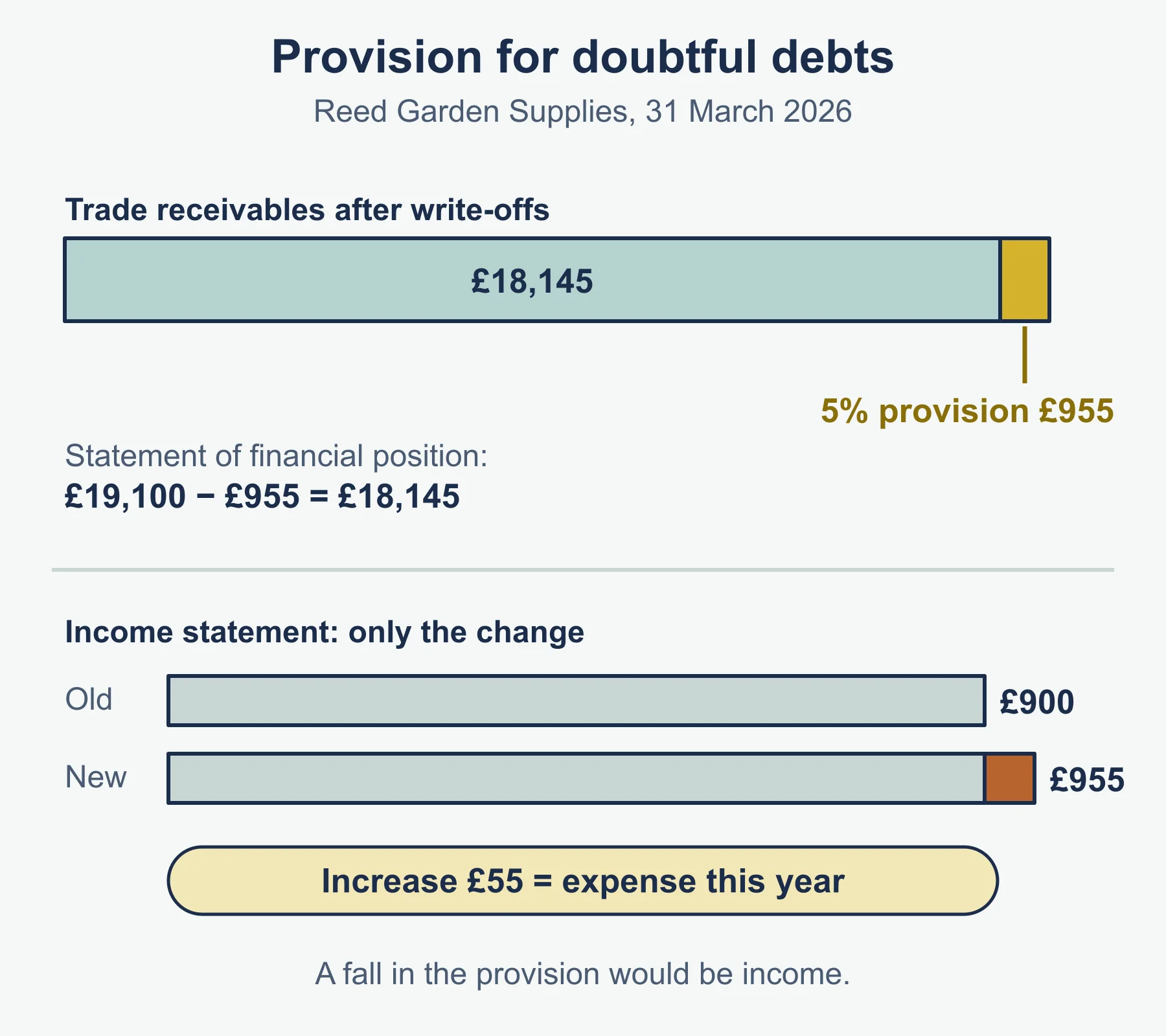
Accumulated depreciation at the end is 3,600 + (10% x 12,000) = 4,800. The allowance is 5% x 3,900 = 195.
Haverford Cycles: statements of affairs (amounts in dollars)
                                    1 Jan 2028   31 Dec 2028
Non-current assets (carrying amount)
  Equipment (12,000 - 3,600 / 4,800)     8,400         7,200
Current assets
  Inventory                              6,400         7,100
  Trade receivables less allowance       3,040         3,705
  Rent paid in advance                     600           650
  Bank                                   2,350         3,720
  Cash                                     180           180
                                        12,570        15,355
Current liabilities
  Trade payables                         3,900         4,300
  Electricity owing                        220           260
                                         4,120         4,560
Non-current liability: loan              6,000         6,000
Capital                                 10,850        11,995
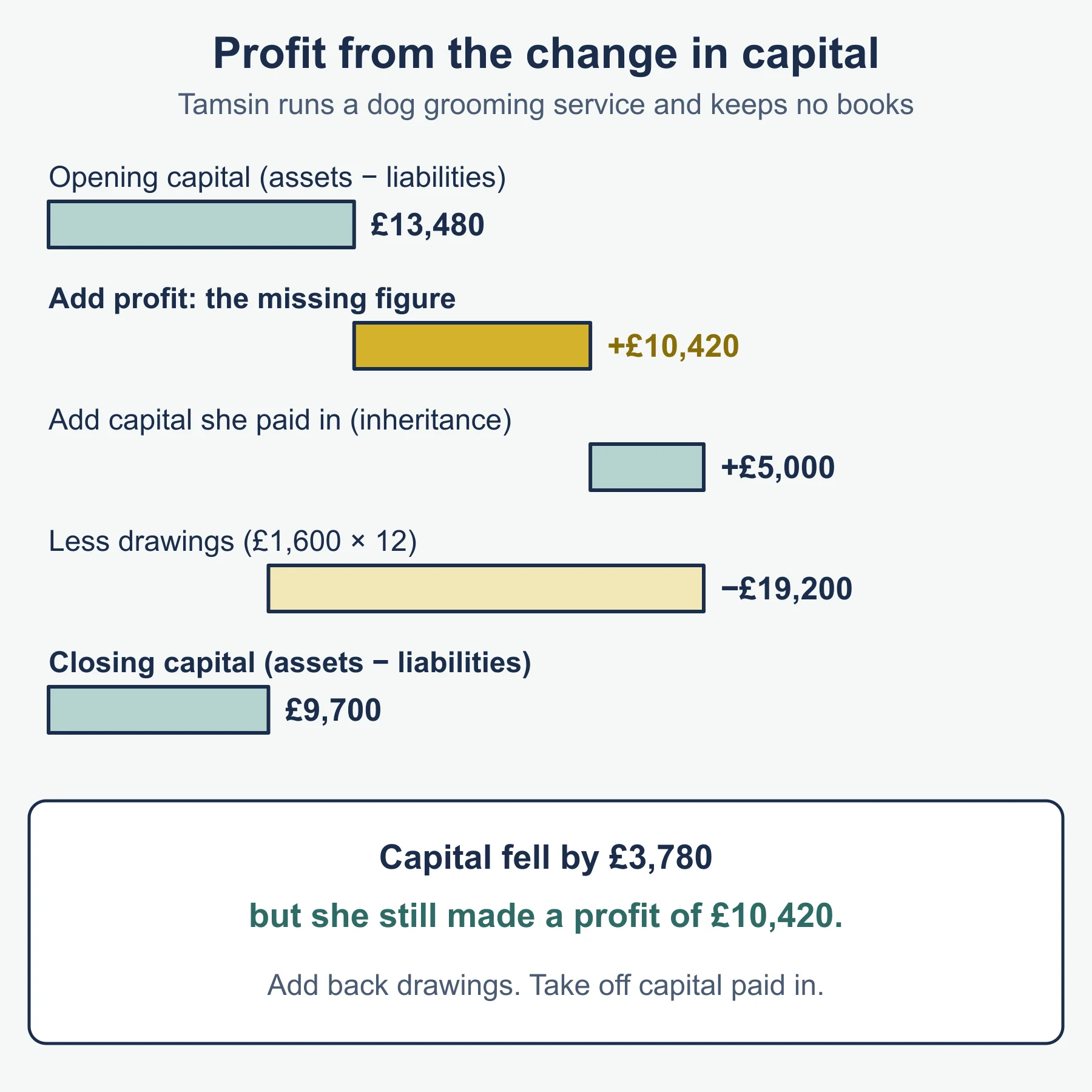
Profit from changes in capital. Capital rises when profit is made or capital is introduced, and falls with drawings. So:
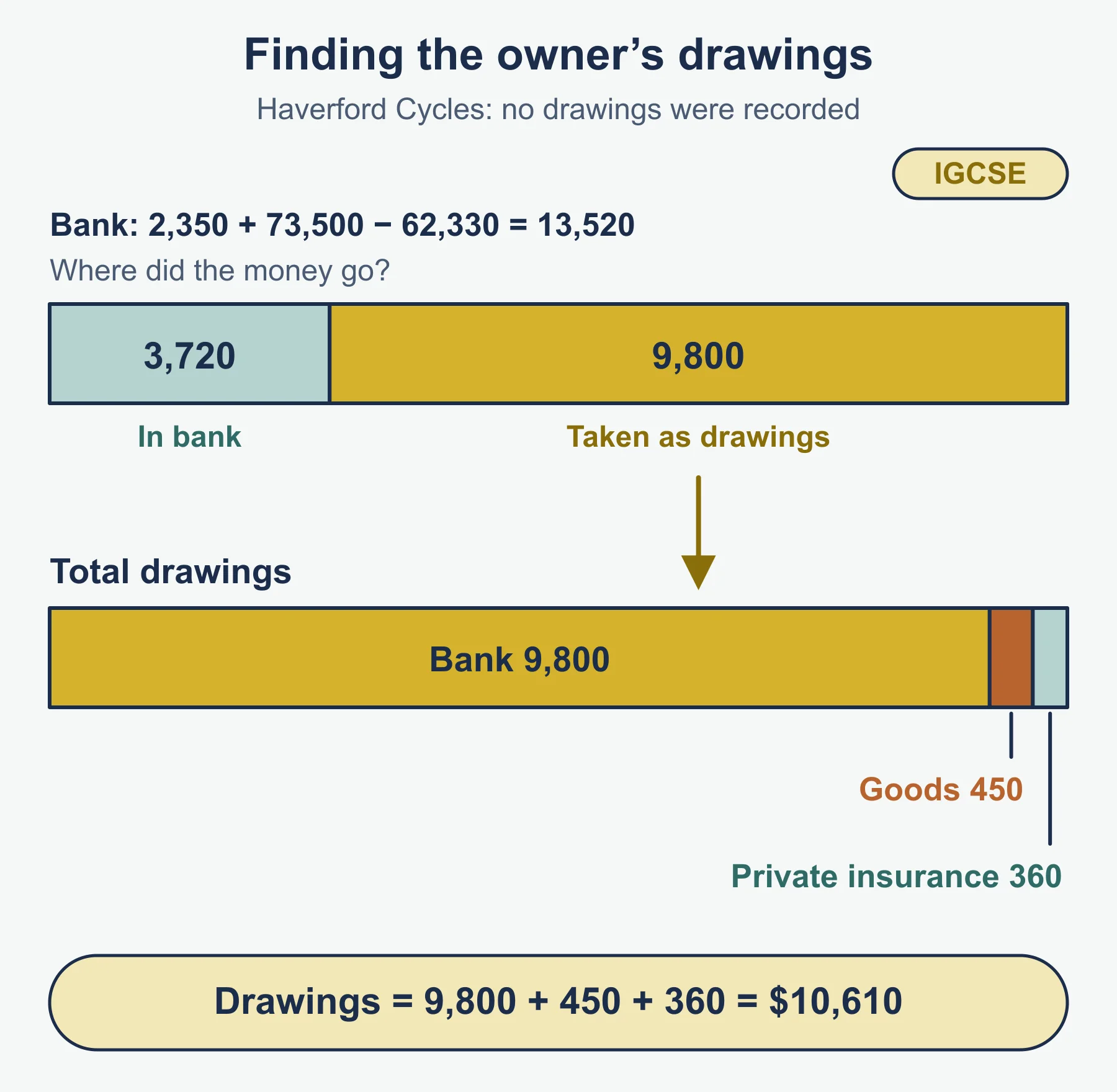
Profit = closing capital - opening capital + drawings - capital introducedThe bank summary gives the missing drawings: 2,350 + 73,500 receipts - 62,330 payments other than drawings - 3,720 closing bank = 9,800 taken from the bank. Total drawings are 9,800 + 450 goods + 360 private insurance = 10,610.
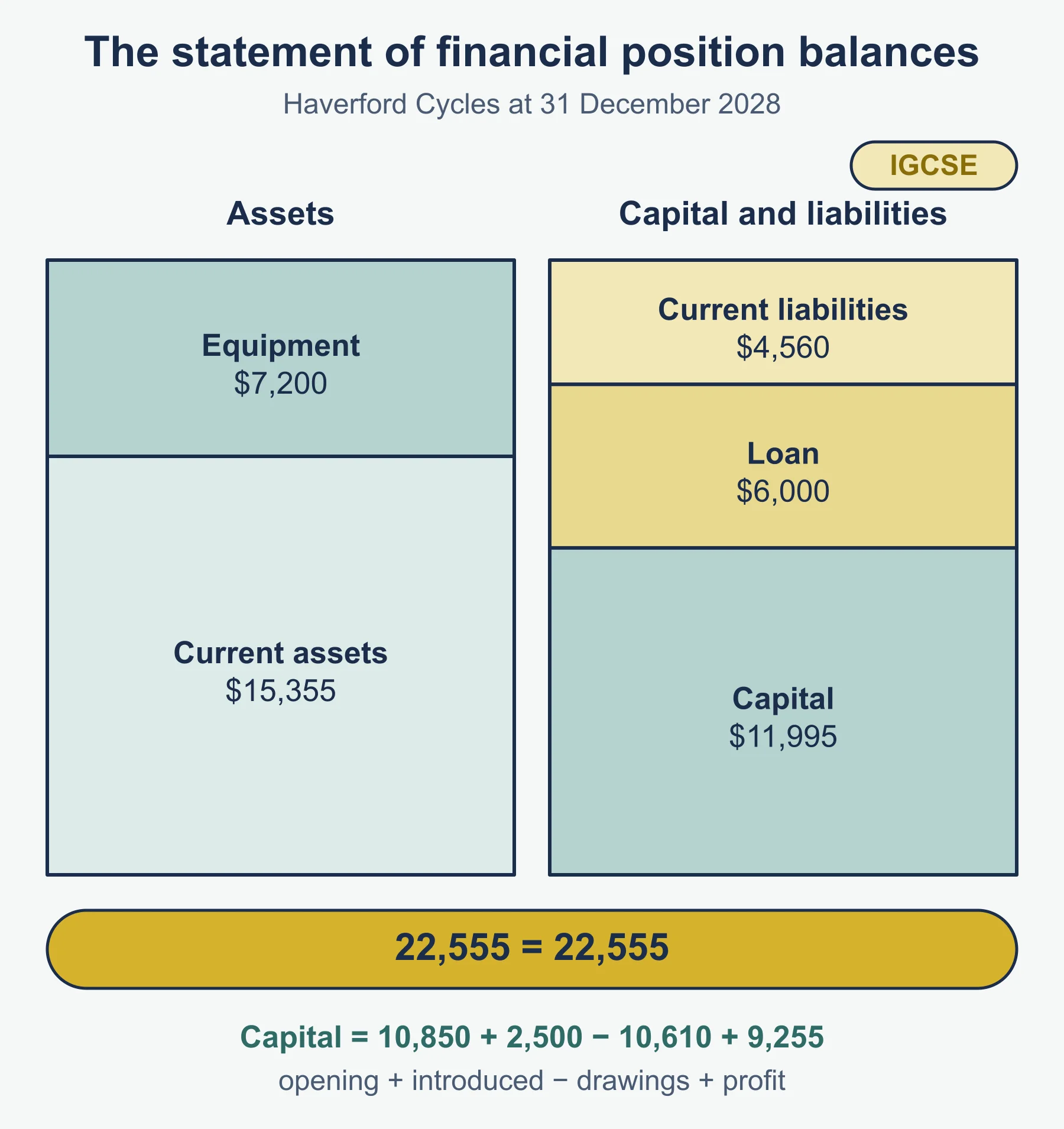
Profit = 11,995 - 10,850 + 10,610 - 2,500 = 9,255. A negative answer is a loss. This is a quick answer, but it gives no gross profit or expense detail, so Section 4 builds the statements.
3. Rebuilding sales, purchases and expenses
Treat each balance like a ledger account: opening balance plus additions, minus reductions, equals closing balance. Find the missing side.
Credit sales = 61,400 + 3,900 + 340 - 3,200 = 62,440
Revenue      = 62,440 + 9,600 cash sales      = 72,040
Purchases    = 43,800 + 4,300 - 3,900         = 44,200
Cost of goods taken for own use               =    450
Cash received plus the debt written off plus closing trade receivables must equal opening trade receivables plus credit sales. The same logic works for any missing figure: credit sales, receipts from customers, purchases or payments to suppliers. Expenses use the 5.1 adjustments:
Rent        = 600 + 7,200 - 650     = 7,150
Electricity = 1,980 - 220 + 260     = 2,020
General     = 2,450 - 360 private   = 2,090
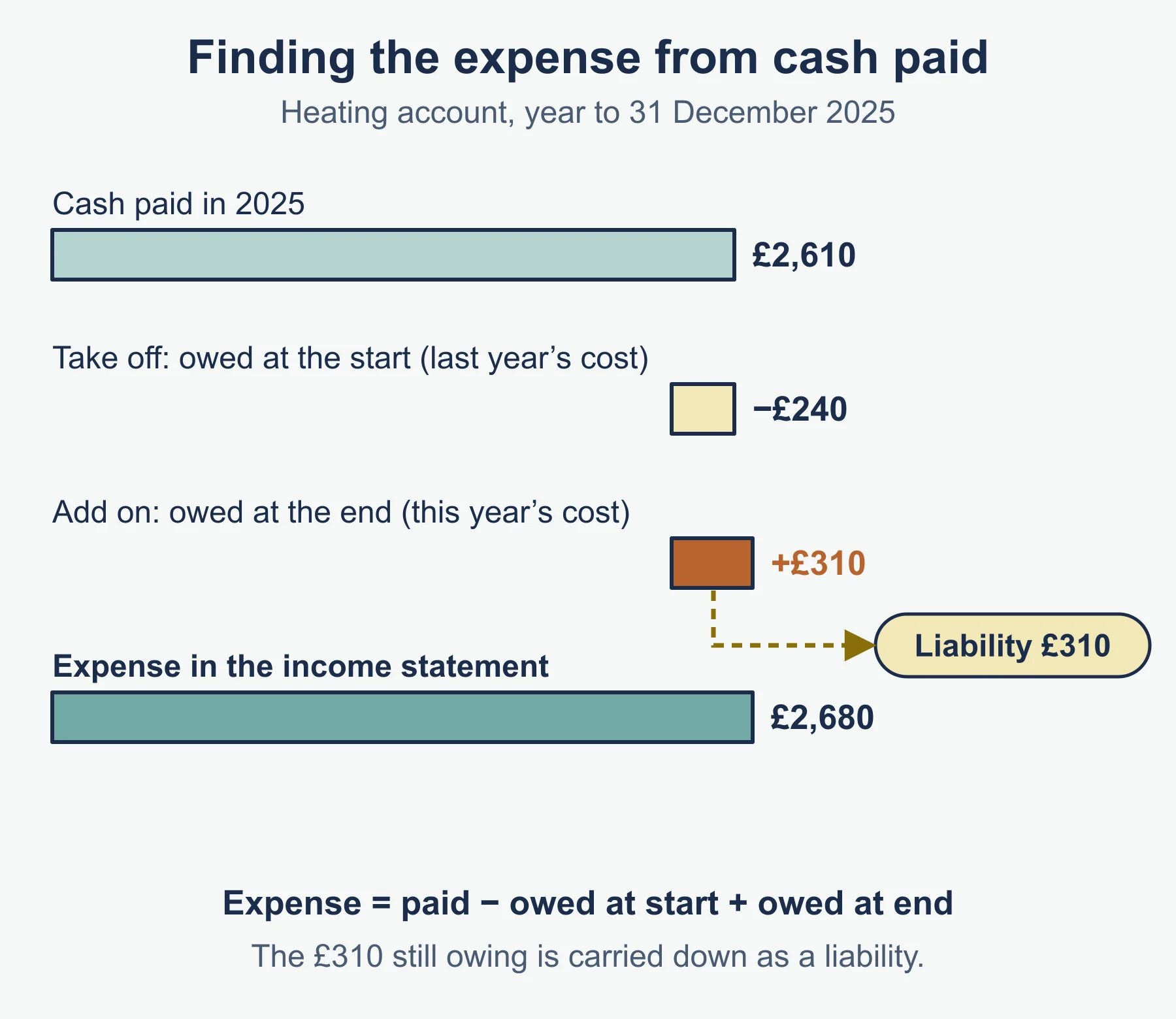
Allowance   = 195 - 160 (increase)  =    35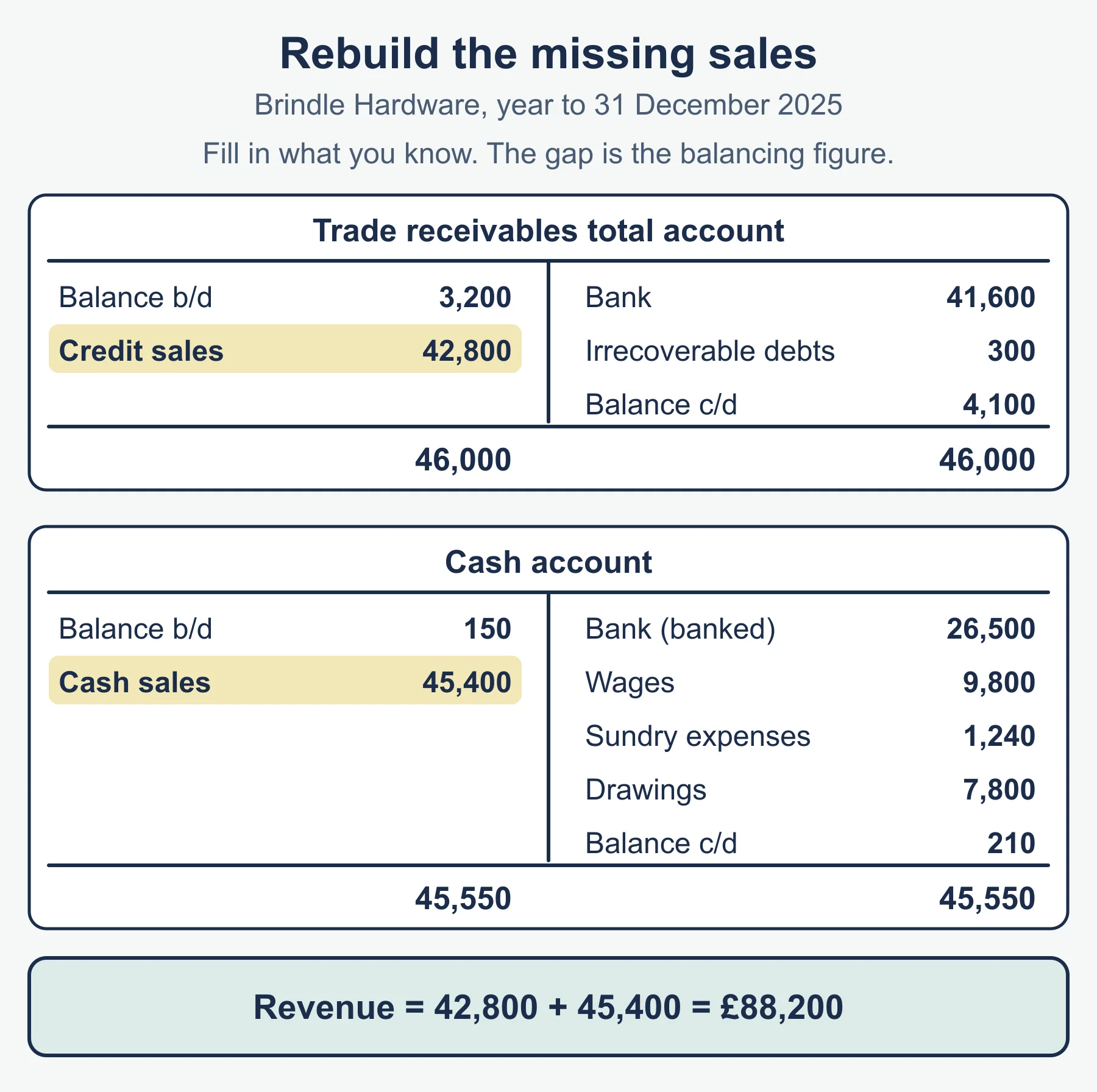
4. Statement of profit or loss and statement of financial position
Haverford Cycles
Statement of profit or loss for the year ended 31 December 2028 (dollars)
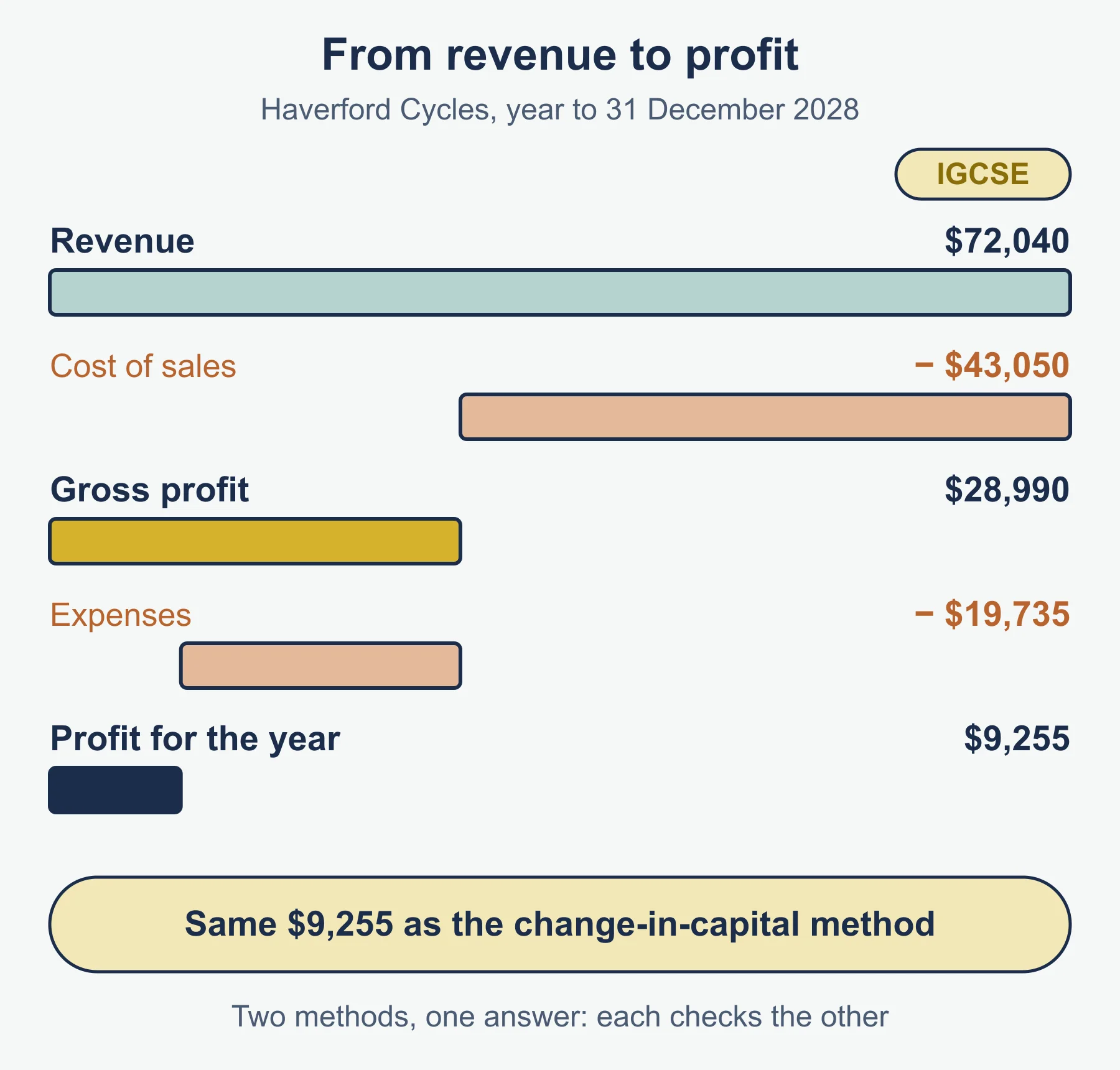
Revenue                                                72,040
Less Cost of sales
  Inventory 1 January 2028                 6,400
  Purchases (44,200 - 450)                43,750
                                          50,150
  Less Inventory 31 December 2028          7,100
                                                       43,050
Gross profit                                           28,990
Less Expenses
  Rent                                     7,150
  Electricity                              2,020
  Wages                                    6,900
  General expenses                         2,090
  Irrecoverable debts                        340
  Increase in allowance                       35
  Depreciation of equipment                1,200
                                                       19,735
Profit for the year                                     9,255
The profit of 9,255 matches the change-in-capital answer, so both methods check each other.
Statement of financial position at 31 December 2028 (dollars)
Non-current assets
  Equipment at cost                                12,000
  Less accumulated depreciation                     4,800
                                                    7,200
Current assets
  Inventory                              7,100
  Trade receivables              3,900
  Less allowance                   195   3,705
  Other receivables: rent prepaid          650
  Bank                                   3,720
  Cash                                     180
                                        15,355
Current liabilities
  Trade payables                         4,300
  Other payables: electricity              260
                                         4,560
Working capital                                    10,795
                                                   17,995
Non-current liability
  Loan                                              6,000
                                                   11,995
Capital
  Opening capital                                  10,850
  Add Capital introduced                            2,500
  Add Profit for the year                           9,255
                                                   22,605
  Less Drawings                                    10,610
                                                   11,995
All 5.1 adjustments appear here: depreciation (straight line above; reducing balance means a percentage of the carrying amount, and revaluation means opening value plus additions minus a closing valuation), prepaid and accrued items, irrecoverable debts, the allowance, and drawings of goods and of private expenses. Accrued and prepaid income work the same way on a revenue item such as rent received.
5. Mark-up, margin and inventory turnover
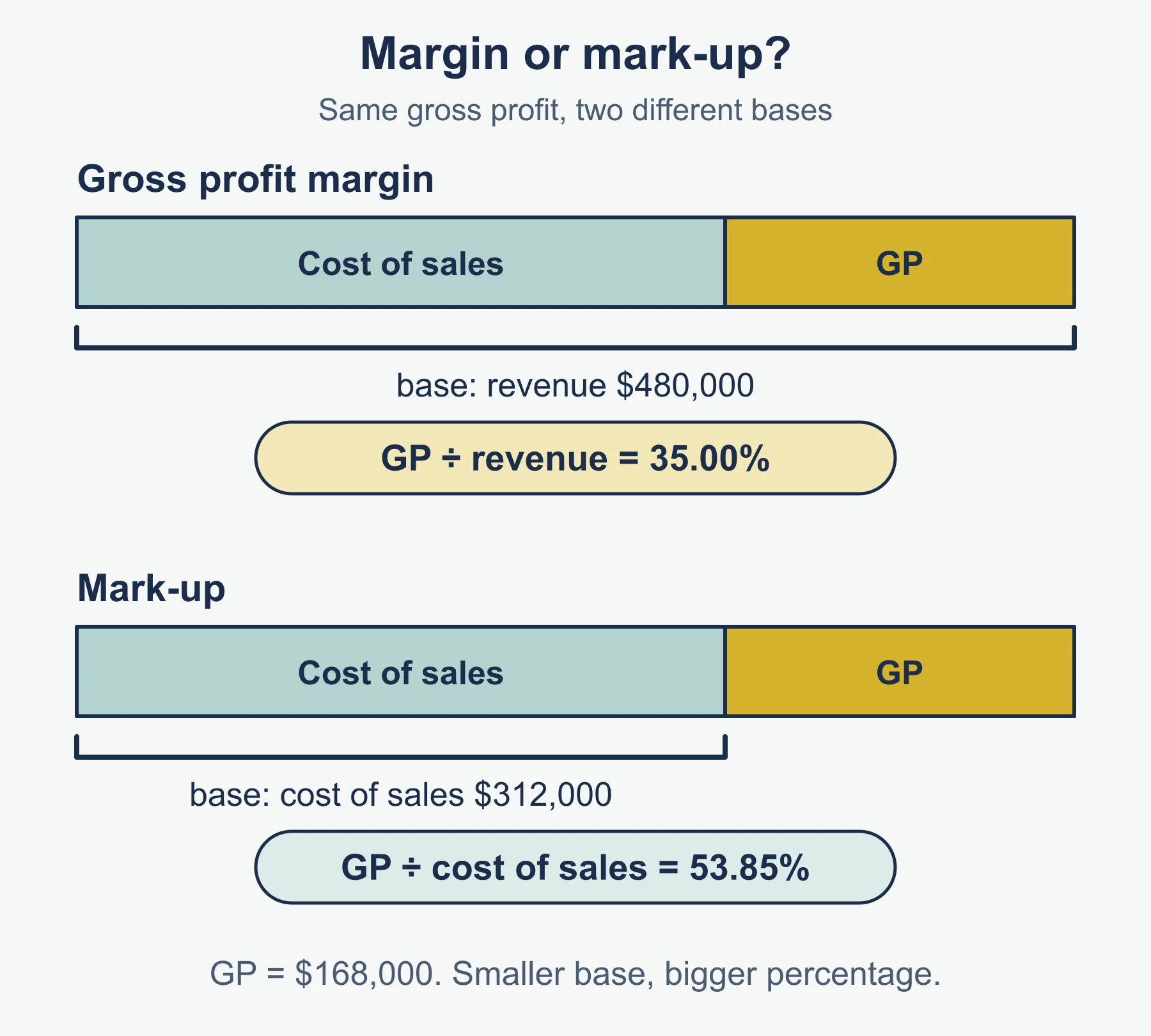
The syllabus formulas are the only ones accepted in answers:
Mark-up (%)                = Gross profit / Cost of sales x 100
Gross profit margin (%)    = Gross profit / Revenue x 100
Rate of inventory turnover = Cost of sales / Average inventory
For Haverford: margin 28,990 / 72,040 = 40.2%; mark-up 28,990 / 43,050 = 67.3%; average inventory (6,400 + 7,100) / 2 = 6,750, so turnover 6.4 times.
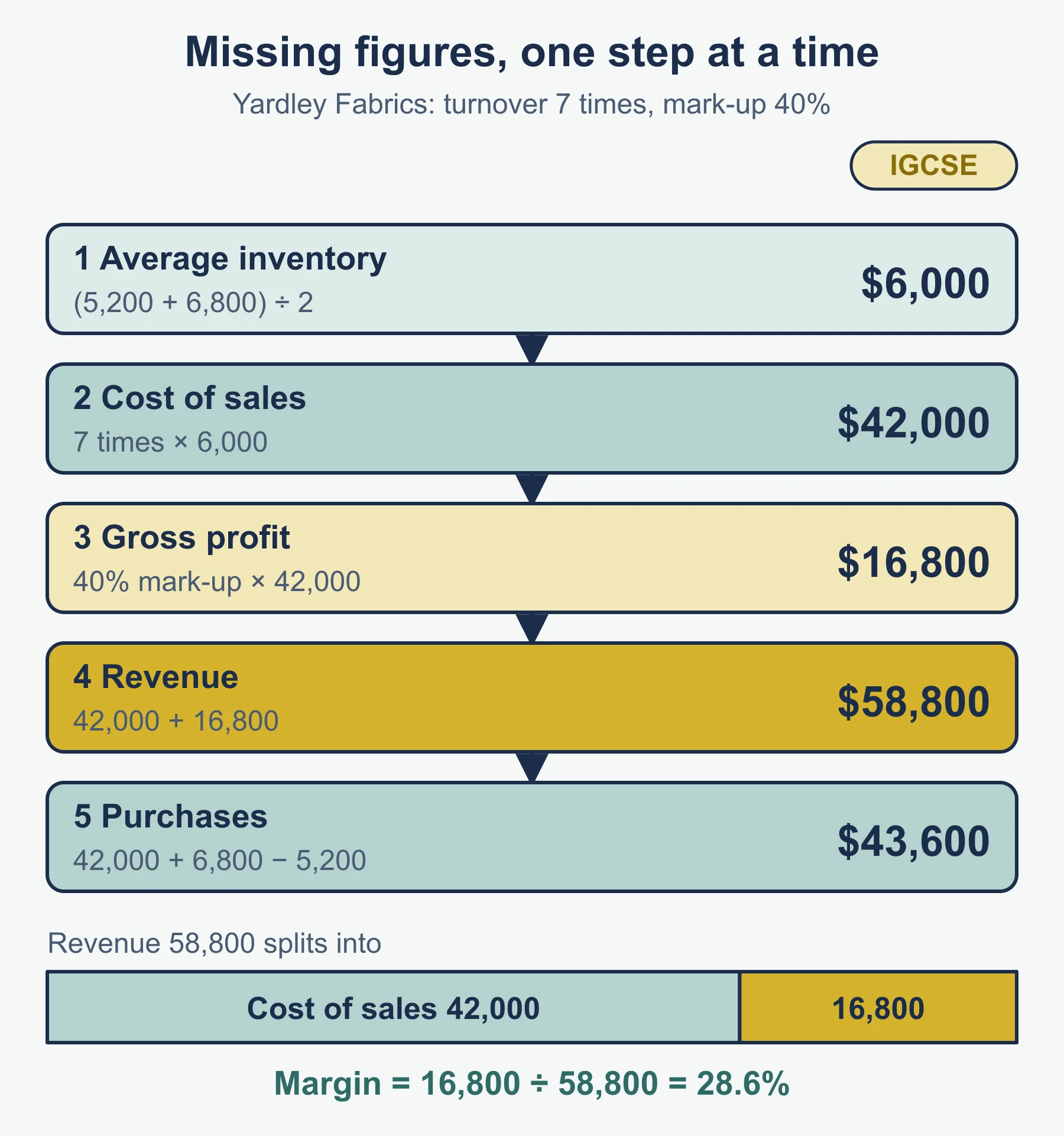
Now use them when something is missing. Yardley Fabrics (Felix Yardley) has inventory of 5,200 at the start and 6,800 at the end. Rate of inventory turnover is 7 times and mark-up is 40%.
Average inventory = (5,200 + 6,800) / 2     = 6,000
Cost of sales     = 7 x 6,000               = 42,000
Gross profit      = 40% x 42,000            = 16,800
Revenue           = 42,000 + 16,800         = 58,800
Purchases         = 42,000 + 6,800 - 5,200  = 43,600
If credit sales were 49,000, cash sales are 58,800 - 49,000 = 9,800. The margin is 16,800 / 58,800 = 28.6%.
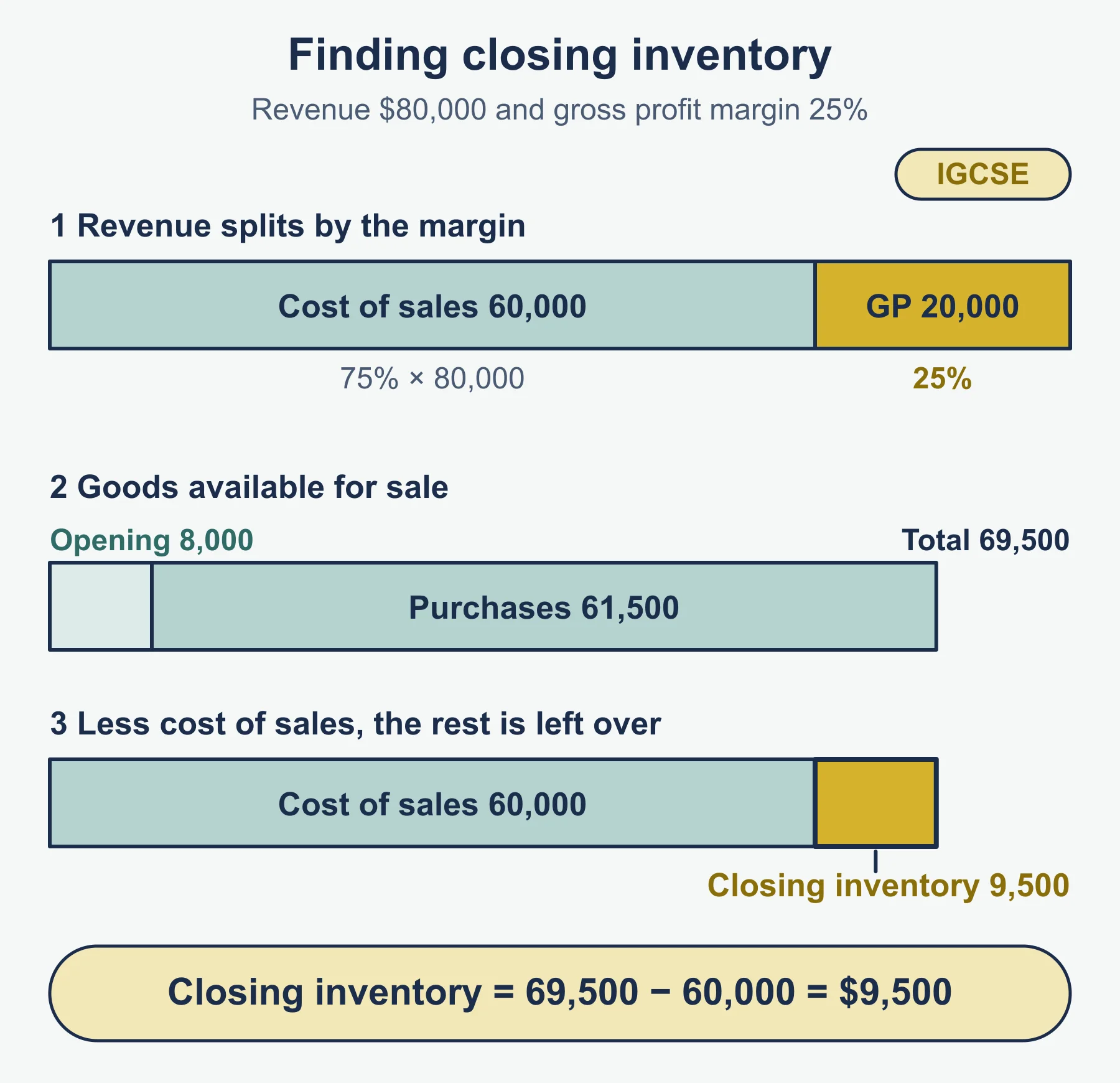
Another case: revenue 80,000, margin 25%. Cost of sales is 75% x 80,000 = 60,000. With opening inventory 8,000 and purchases 61,500, closing inventory = 8,000 + 61,500 - 60,000 = 9,500.
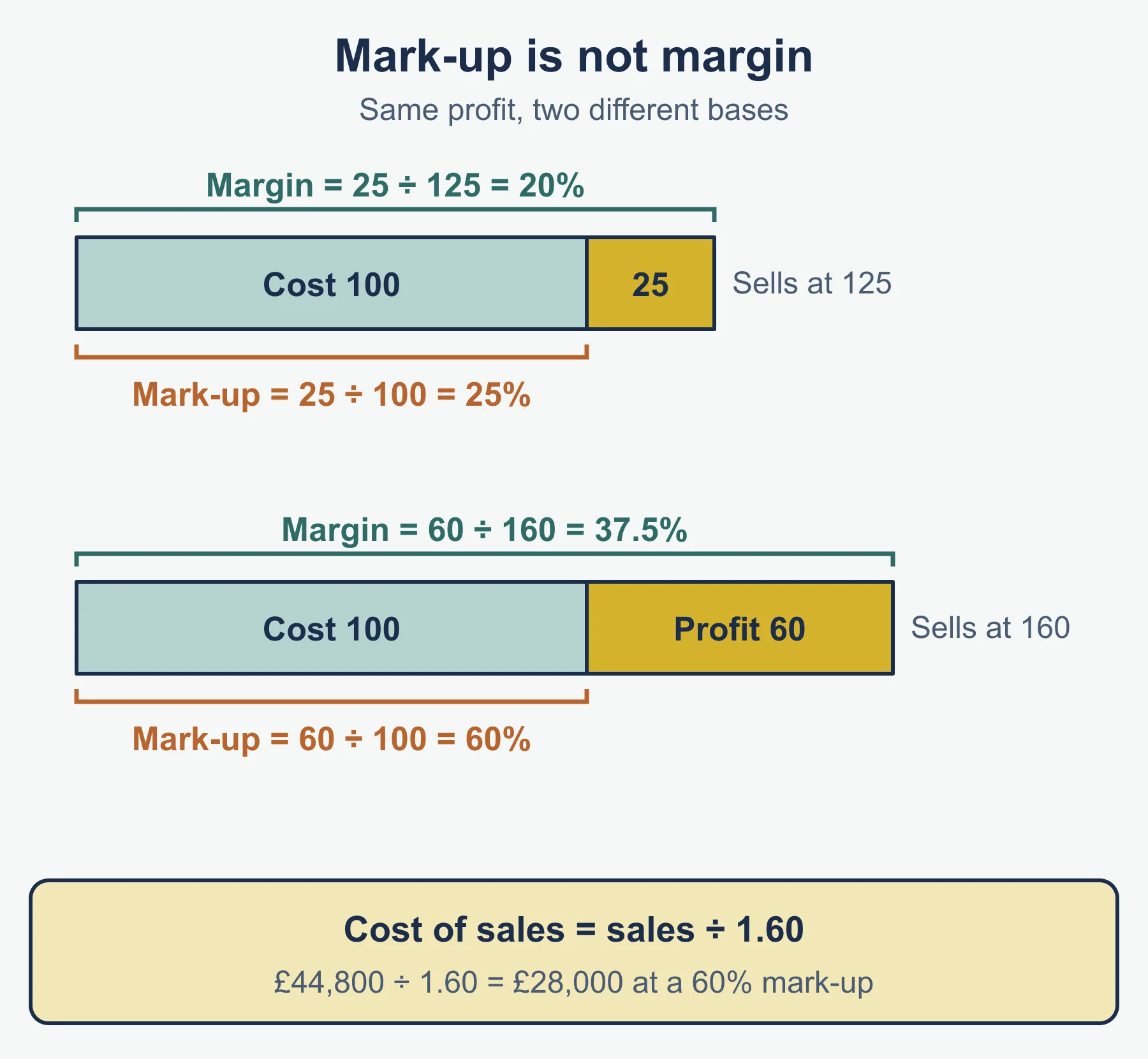
Converting. A margin of 20% means gross profit is 20 on revenue 100, so cost of sales is 80 and the mark-up is 20/80 = 25%. A mark-up of 25% converts back to a margin of 25/125 = 20%.
Common errors
- Forgetting that a debt written off reduces trade receivables without any cash coming in.
- Adding goods taken for own use to purchases instead of deducting them, then forgetting drawings.
- Putting private expenses in the statement of profit or loss as well as in drawings.
- Dividing gross profit by revenue when the question says mark-up.
- Using closing inventory alone as the figure in the inventory turnover formula.
- Charging the whole allowance as an expense instead of the change.
Next steps
- Revision notes for incomplete records
- Practice questions for incomplete records
- Topic 5 overview and 5.1 adjustments
- Topic 5 revision notes and Topic 5 practice
- Ratios in Topic 6
- Free 10-minute diagnostics
Frequently asked questions
Which businesses are examined on incomplete records in Cambridge IGCSE Accounting 0452? The syllabus says incomplete records questions are asked only for sole trader businesses, never for service or manufacturing businesses. Every example is therefore a trading sole trader.
Why do some sole traders keep incomplete records? The owner may lack bookkeeping knowledge, cannot spare the cost of a bookkeeper or software, can see most transactions personally in a small business, or mainly wants to know the bank balance and who owes what.
What is a statement of affairs? A statement of affairs lists assets and liabilities on one date, using the same layout as a statement of financial position. Its balancing figure is capital, equal to assets minus liabilities.
How do you convert a margin into a mark-up? A margin of 20% means gross profit is 20 on revenue of 100, so cost of sales is 80 and the mark-up is 20/80 = 25%. Converting back, a mark-up of 25% gives a margin of 25/125 = 20%.
How do you find closing inventory using a margin? Use the margin to find gross profit and so cost of sales, then rearrange the cost of sales calculation: closing inventory equals opening inventory plus purchases minus cost of sales.
Official syllabus
Cambridge IGCSE Accounting 0452 syllabus for 2027, 2028 and 2029 (version 1), Cambridge University Press & Assessment, section 5.6 and the Accounting ratios list.
Get free revision emails (optional)
Occasional emails with practice questions, worked explanations and links to free resources for the qualification and subjects you choose. No spam, and you can unsubscribe from any email. The free tools on this site never need an email.
Related resources
-
Revision notes
IGCSE Accounting: Analysis and Interpretation — Revision Notes
Quick recall for Cambridge IGCSE Accounting 0452 Topic 6: ten ratios, reading them, profit versus cash, comparing businesses, users and statement limits.
Accounting · Cambridge · IGCSE, O Level
Revise topic -
Practice questions
IGCSE Accounting: Incomplete records (Cambridge 0452) – Practice Questions
Original practice questions with worked answers on incomplete records for Cambridge IGCSE Accounting 0452: statements of affairs and missing figures.
Accounting · Cambridge · IGCSE, O Level
Try questions -
Revision notes
IGCSE Accounting: Incomplete records (Cambridge 0452) – Revision Notes
Condensed revision notes on incomplete records for Cambridge IGCSE Accounting 0452: formulas, methods, distinctions, a self-test and common lost marks.
Accounting · Cambridge · IGCSE, O Level
Revise topic
Related articles
-
teaching
A Level tuition in Dubai: Cambridge or Pearson Edexcel International A Level?
Schools in Dubai and Abu Dhabi teach either Cambridge International AS & A Level or Pearson Edexcel International A Level. How the two are structured, why it matters for tuition, and how online classes from Lahore work.
9 October 2026
-
curriculum guides
Choosing subjects at IGCSE and A Level
How subject choices at 14 and 16 affect university options later, and how to keep pathways open without overloading a timetable.
28 July 2026
Studying this with a teacher
Working through Accounting IGCSE, O LEVELS?
This page is free and stays free. If you would rather be taught it, Marlbridge runs Accounting classes one-to-one and in small groups of up to 15, online in your own time zone. The first trial class is free. WhatsApp replies within an hour (8am–11pm Pakistan time, every day); email the same day.
Cambridge Accounting teachers at Marlbridge

