
Revision Notes
IGCSE Accounting: Financial statements of partnerships (Cambridge 0452) – Revision Notes
Revision notes on partnership appropriation accounts, capital and current accounts for Cambridge IGCSE Accounting 0452, with a self-test.
- Subject
- Accounting
- Level
- IGCSE, O LEVELS
- Topic
- Preparation of financial statements
- Author
- Marlbridge Academic Team
- Updated
- Reviewed by
- Javaid Iqbal Sabri (what this means)
Aligned to Cambridge IGCSE O Level Accounting (0452, 7707), 2027-2029. Official specification (IGCSE) ; Official specification (O Level) .
Syllabus page (what it covers and how it is assessed): Cambridge IGCSE Accounting; Cambridge O Level Accounting.
Syllabus points this page covers
0452
- 5.2 Partnerships
7707
- 5.2 Partnerships
Found an error? Report a correction.
Want a teacher for this? Marlbridge teaches Accounting online. Request a free trial class.
Syllabus edition note. This resource follows the Cambridge IGCSE Accounting 0452 syllabus (and Cambridge O Level Accounting 7707, which has the same subject content for the same series) for exams in 2027, 2028 and 2029 (version 1), first examined in the March 2027 series in India and the June 2027 series elsewhere. If you sit 0452 in November 2026, you sit the 2026 syllabus (version 2), which differs: Paper 1 has 35 multiple-choice marks in 1 hour 15 minutes, not 40 marks in 1 hour 30 minutes; Topic 7 is “Accounting principles and policies”, without 7.2 Ethical considerations or 7.3 Technology and sustainability; 4.4 is “Irrecoverable debts and provision for doubtful debts”; income statements are named instead of statements of profit or loss; three-column running balance accounts are not required; Clubs and societies is 5.4 and Manufacturing accounts 5.5; and 6.3 is “Inter-firm comparison”. For this topic, the 2026 syllabus covers only trading and service businesses in 5.1 and limits drawings adjustments to goods taken by the owner for own use; for limited companies it excludes cumulative and non-cumulative preference shares, rights issues, share premium and capital redemption reserve but requires the difference between redeemable and non-redeemable preference shares (the 2027-2029 syllabus lists none of these); and for incomplete records it does not ask why businesses keep them or what their advantages are. If you sit in November 2026, work from the 2026 syllabus on the Cambridge International website.
Quick-recall notes for syllabus section 5.2 Partnerships, Cambridge IGCSE Accounting 0452, syllabus for exams in 2027, 2028 and 2029 (version 1). For full explanations and two long worked examples, read the study guide. Then test yourself with the practice questions. Links: course home, checklist, free diagnostics, and the wider Topic 5 revision notes.
The idea in five lines
- Two or more people own a partnership and divide its profit under an agreement.
- The statement of profit or loss stops at profit for the year.
- The appropriation account divides that profit between the partners.
- Each partner has a capital account (long term) and a current account (yearly).
- Year-end adjustments from 5.1 are made before the profit is shared.
Types of partnership business
| Type | What changes in the statements |
|---|---|
| Trading | Cost of sales and gross profit |
| Service | No cost of sales; fees less expenses |
| Manufacturing | Manufacturing account first; cost of production replaces purchases |
| Combination | Use the parts that match each activity |
Advantages and disadvantages: recall list
- For: more capital; shared skills; shared workload and risk; cover for absence; ideas discussed.
- Against: unlimited liability; profit shared; disagreements; slower decisions; one partner’s choices can bind the rest.
Partnership agreement
Why it matters: it fixes the rules in advance, so the accounts can be prepared and disputes are less likely. Contents to list: each partner’s capital, the ratio, interest rates (capital, drawings, loans), salaries and drawings limits.
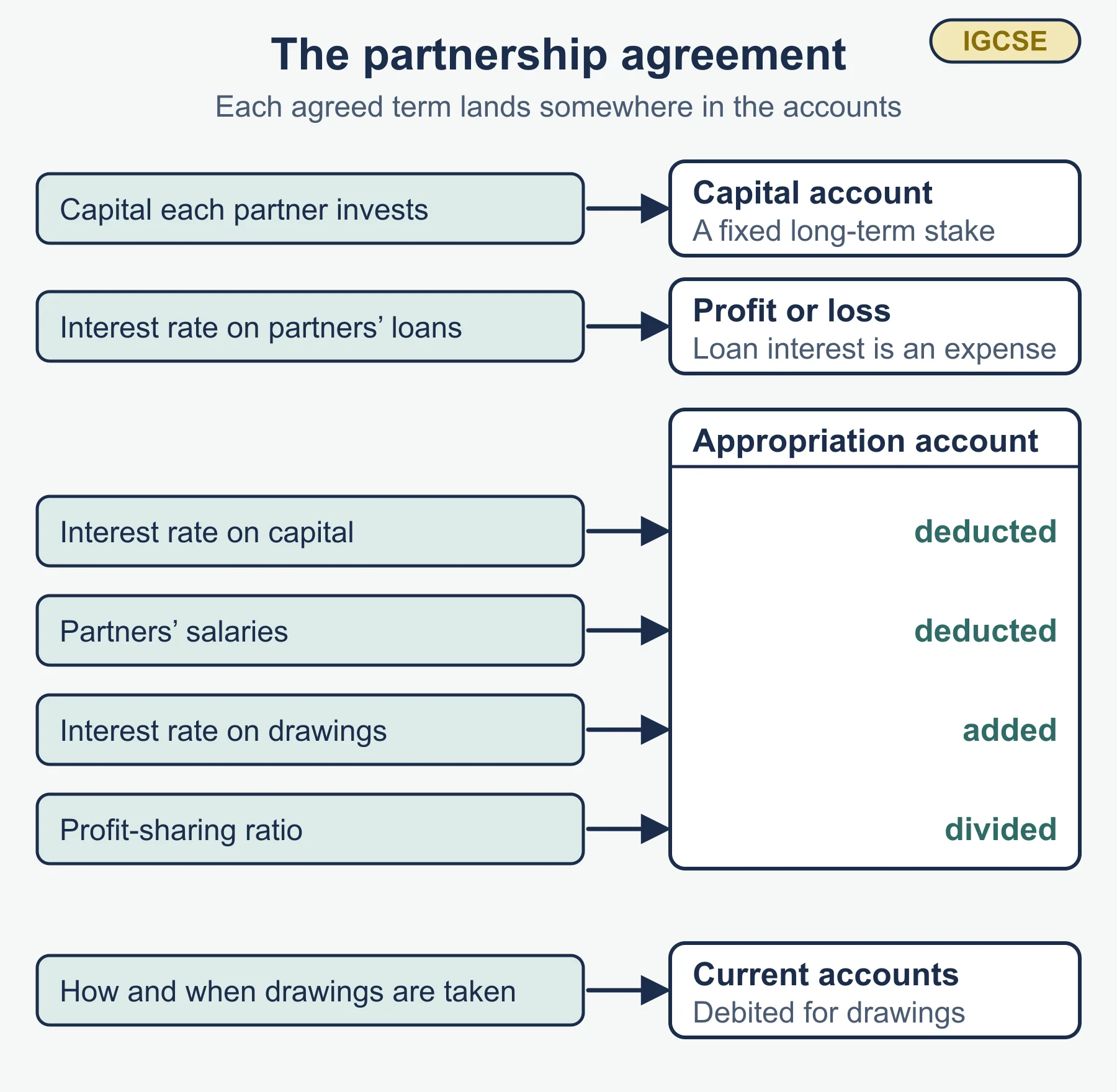
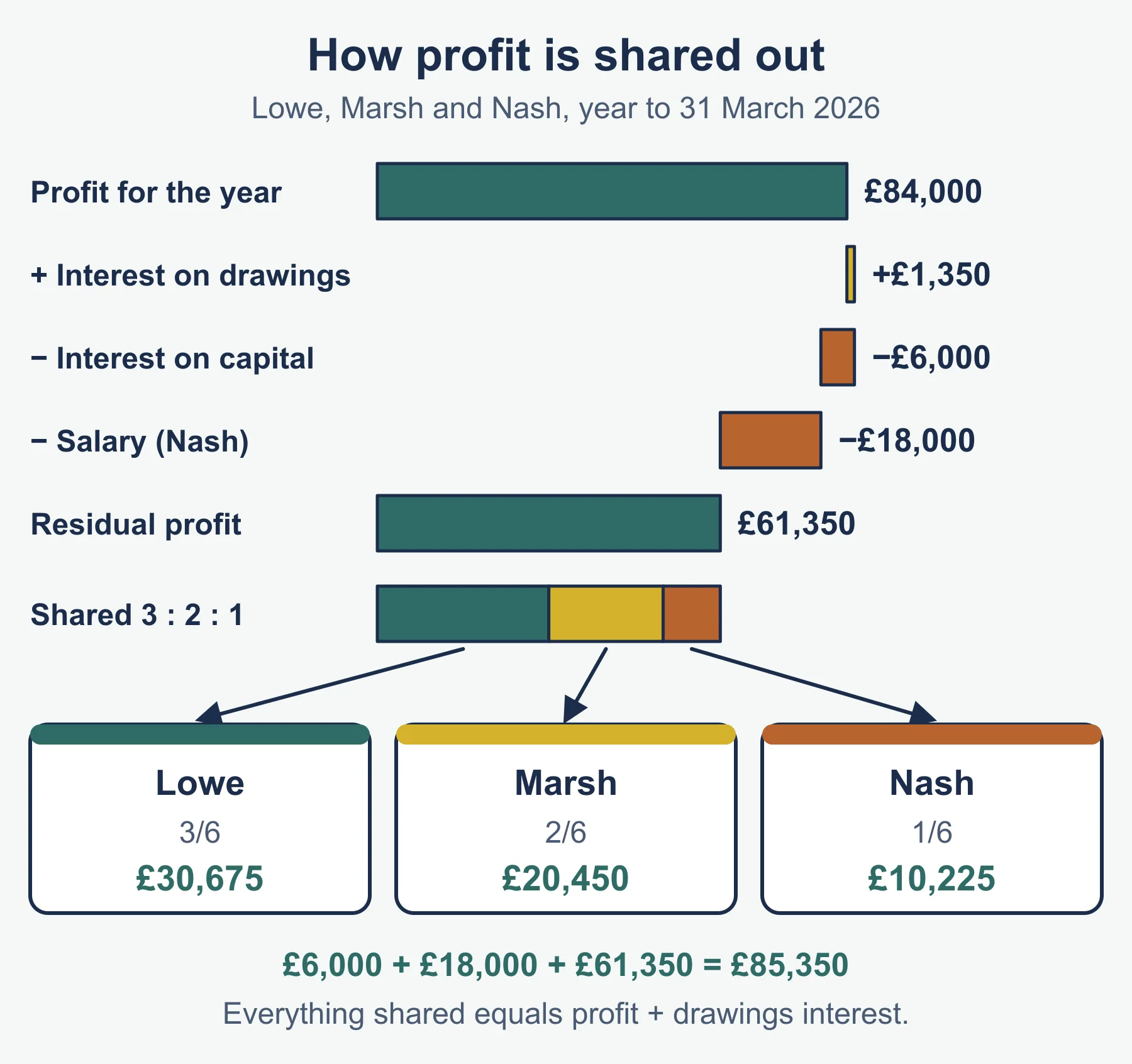
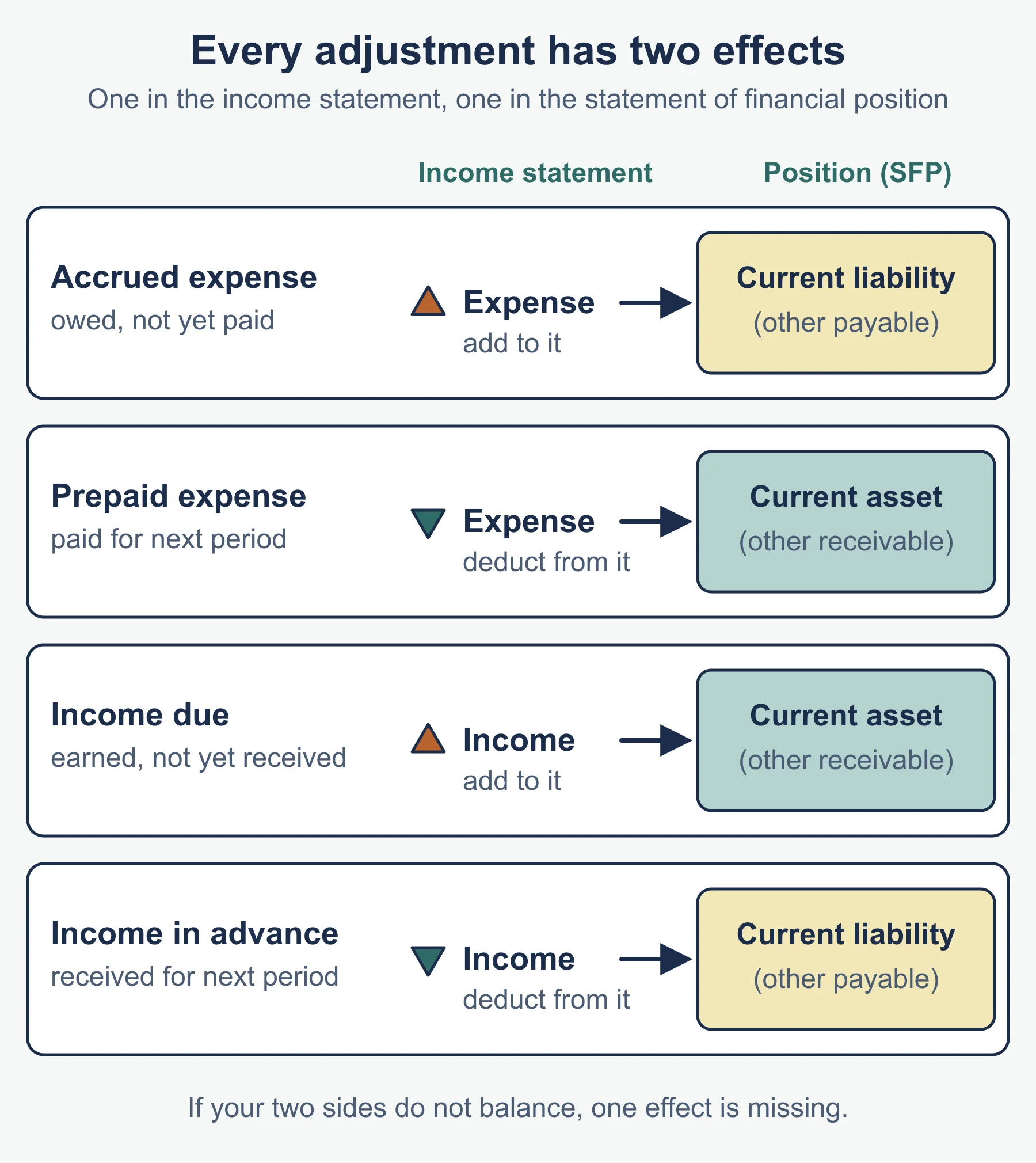
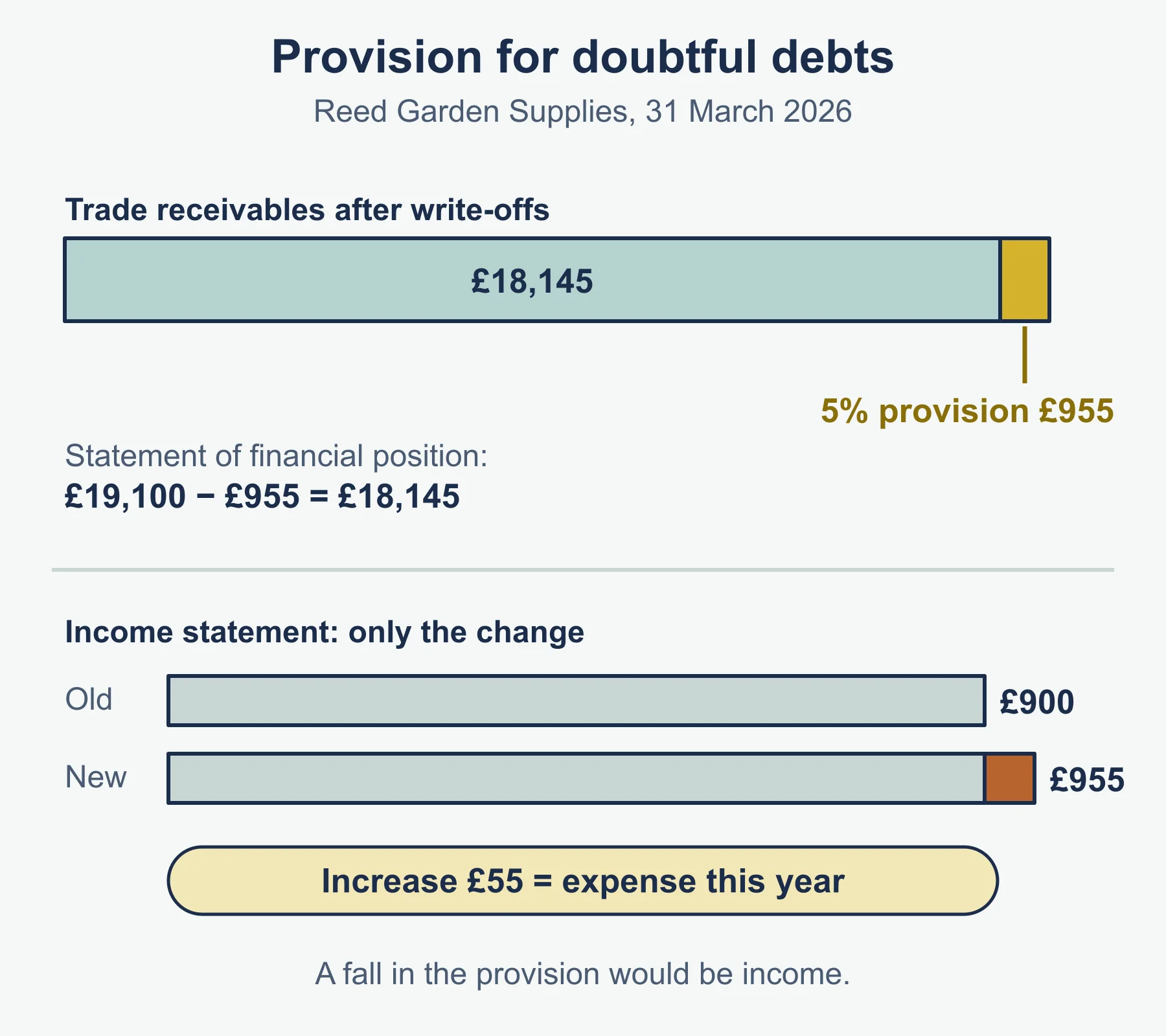
Where each item is placed
| Item | Statement | Direction |
|---|---|---|
| Interest on a partner’s loan | Business expense, before profit for the year | Credit current account if unpaid |
| Interest on capital | Appropriation account, deduct | Credit current account |
| Salary | Appropriation account, deduct | Credit current account |
| Interest on drawings | Appropriation account, add | Debit current account |
| Share of profit | Appropriation account, balance | Credit current account |
| Share of loss | Appropriation account, balance | Debit current account |
| Drawings | Not in either statement | Debit current account |
Method in steps
- Prepare the statement of profit or loss with all 5.1 adjustments and any loan interest. Stop at profit for the year.
- Start the appropriation account with that profit.
- Add interest on drawings.
- Deduct interest on capital and salaries.
- Share what remains in the profit-sharing ratio. A negative balance is a loss, shared in the same ratio.
- Post to the current accounts. Bring down the balances.
- Show capital and current accounts in the statement of financial position.
The 5.1 adjustments in one table
| Adjustment | Effect on profit | Statement of financial position |
|---|---|---|
| Expense owing | Expense increases | Other payable |
| Expense paid in advance | Expense decreases | Other receivable |
| Depreciation | Expense increases | Accumulated depreciation grows, carrying amount falls |
| Irrecoverable debt | Expense increases | Trade receivables fall |
| Change in allowance | Expense for the increase (income for a decrease) | Receivables shown net of allowance |
| Goods taken by owner | Reduces cost of sales or purchases | Added to that partner’s drawings |
Worked reminder
Farah Gillespie and Naveen Duggan run a physiotherapy practice. Profit before loan interest is $52,400. Duggan lent the firm $15,000 at 8%. Capital accounts (fixed): Gillespie $100,000, Duggan $60,000. The agreement gives 3% interest on capital, salaries (Gillespie $12,000, Duggan $4,000), interest on drawings (Gillespie $700, Duggan $400), and balance shared 3 : 2.
Loan interest 8% x 15,000 = 1,200
Profit for the year 52,400 - 1,200      51,200
Add interest on drawings (700 + 400)     1,100
                                        52,300
Less interest on capital 3,000 + 1,800   4,800
Less salaries 12,000 + 4,000            16,000
Balance of profit                       31,500
  Gillespie 3/5   18,900
  Duggan 2/5      12,600
Opening current accounts: Gillespie credit $1,500, Duggan debit $600. Drawings: Gillespie $30,000, Duggan $24,000.
Gillespie: 1,500 + 3,000 + 12,000 + 18,900 = 35,400 credits
           less 30,000 + 700 = 30,700 debits    -> credit 4,700
Duggan:    credits 1,800 + 4,000 + 1,200 + 12,600 = 19,600
           debits 600 + 24,000 + 400 = 25,000   -> debit 5,400
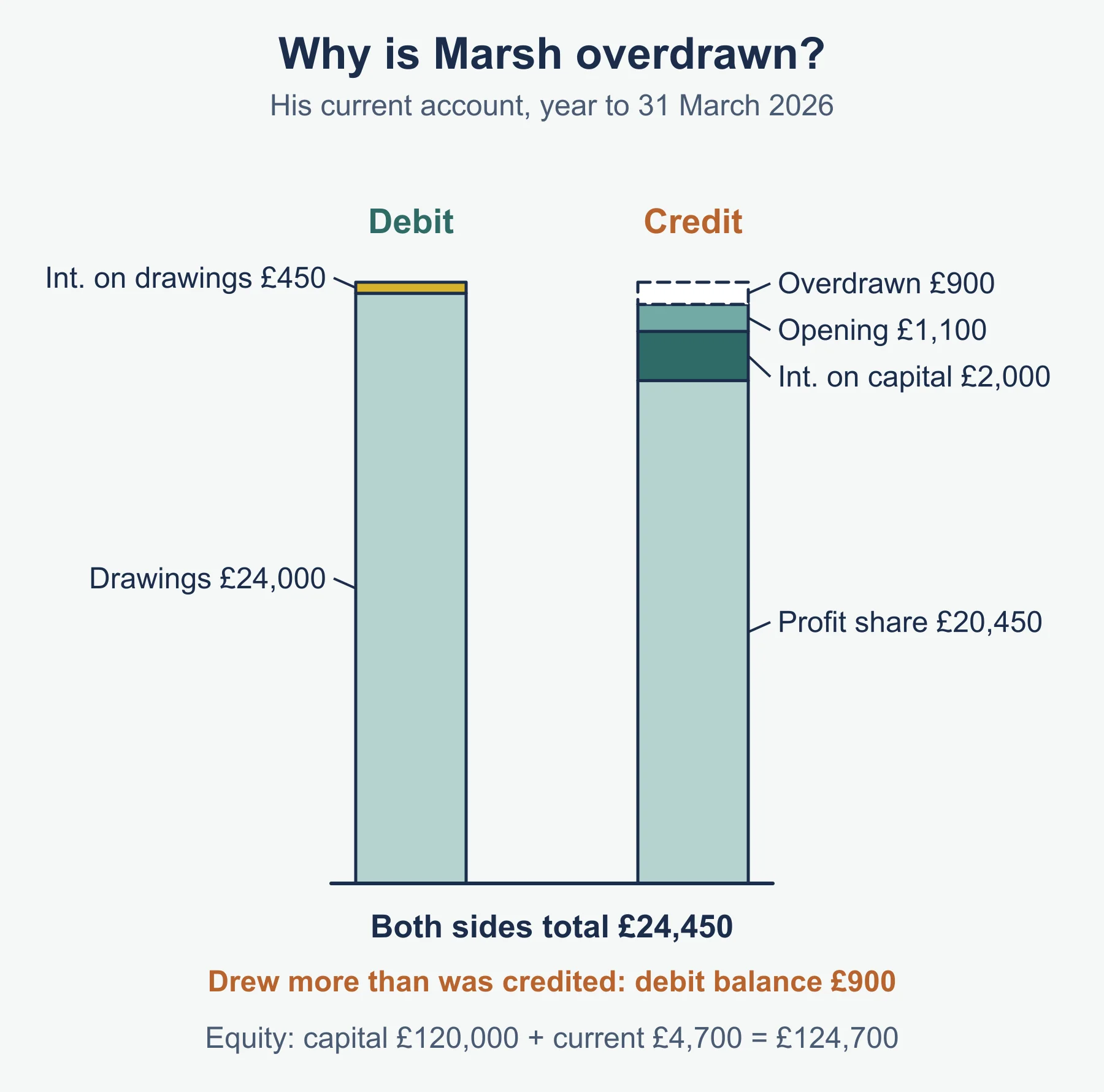
Statement of financial position extract: capital $160,000; current accounts $4,700 and ( $5,400), net ( $700); total $159,300. The $15,000 loan is a liability shown outside this total.
Ledger reminders
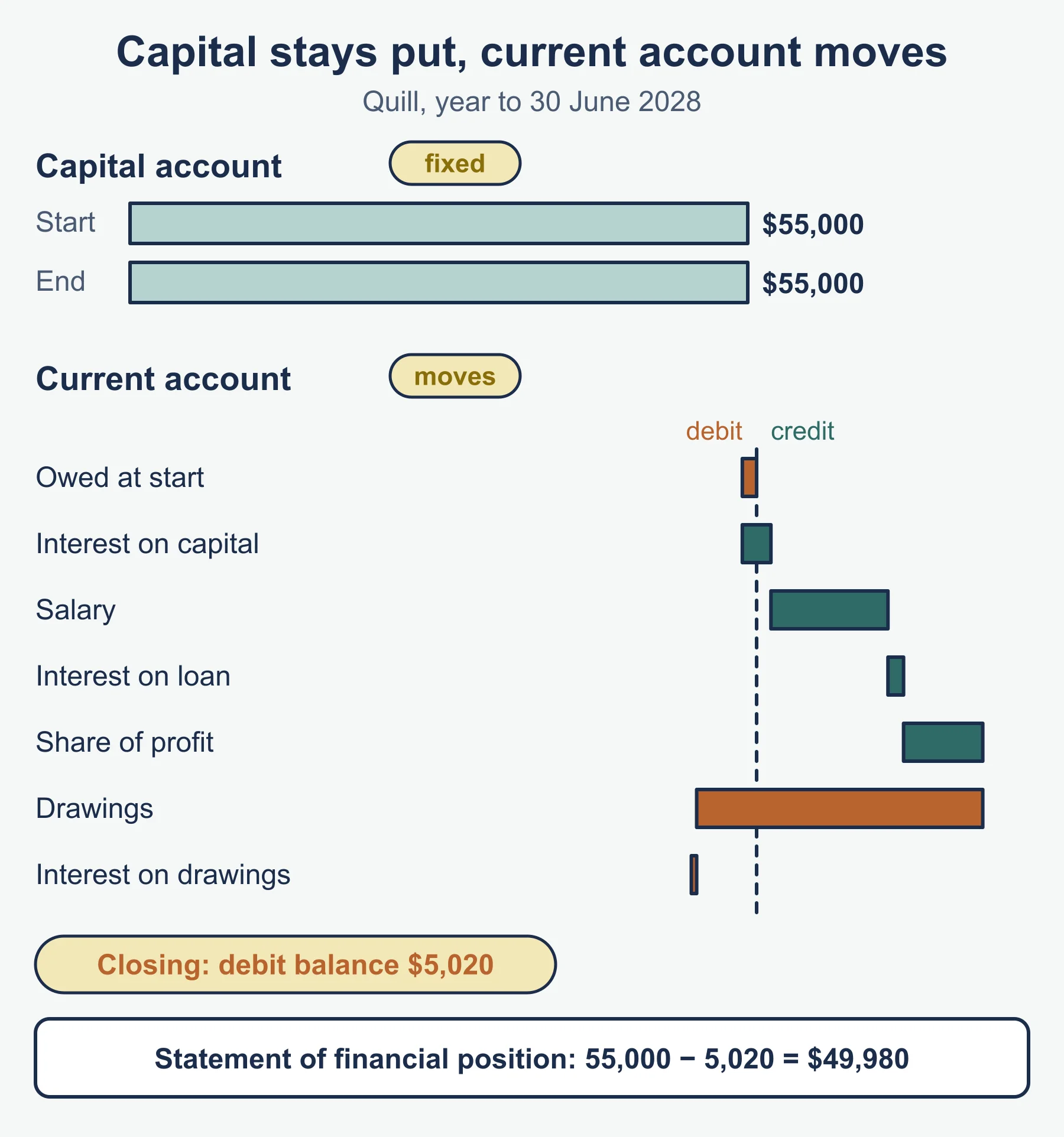
- Capital account: credit the opening balance and any capital introduced. With fixed capitals nothing else is posted, and the closing balance is brought down at the same amount.
- Capital account in ledger form (example): a partner opens the year with a credit balance of $40,000 and introduces a further 10,000 on 1 October.
Capital account: Hale
                         Balance b/d         40,000
                         Bank (1 October)    10,000
Balance c/d    50,000
               50,000                        50,000
Balance b/d 50,000- Current account, credit side: opening credit balance, interest on capital, salary, interest on the partner’s loan if unpaid, share of profit.
- Current account, debit side: opening debit balance, drawings, interest on drawings, share of loss.
- Balance each account with a total, then bring the balance down. With a debit balance, the carried-down figure sits on the credit side and the brought-down figure on the debit side.
Loss-year reminder
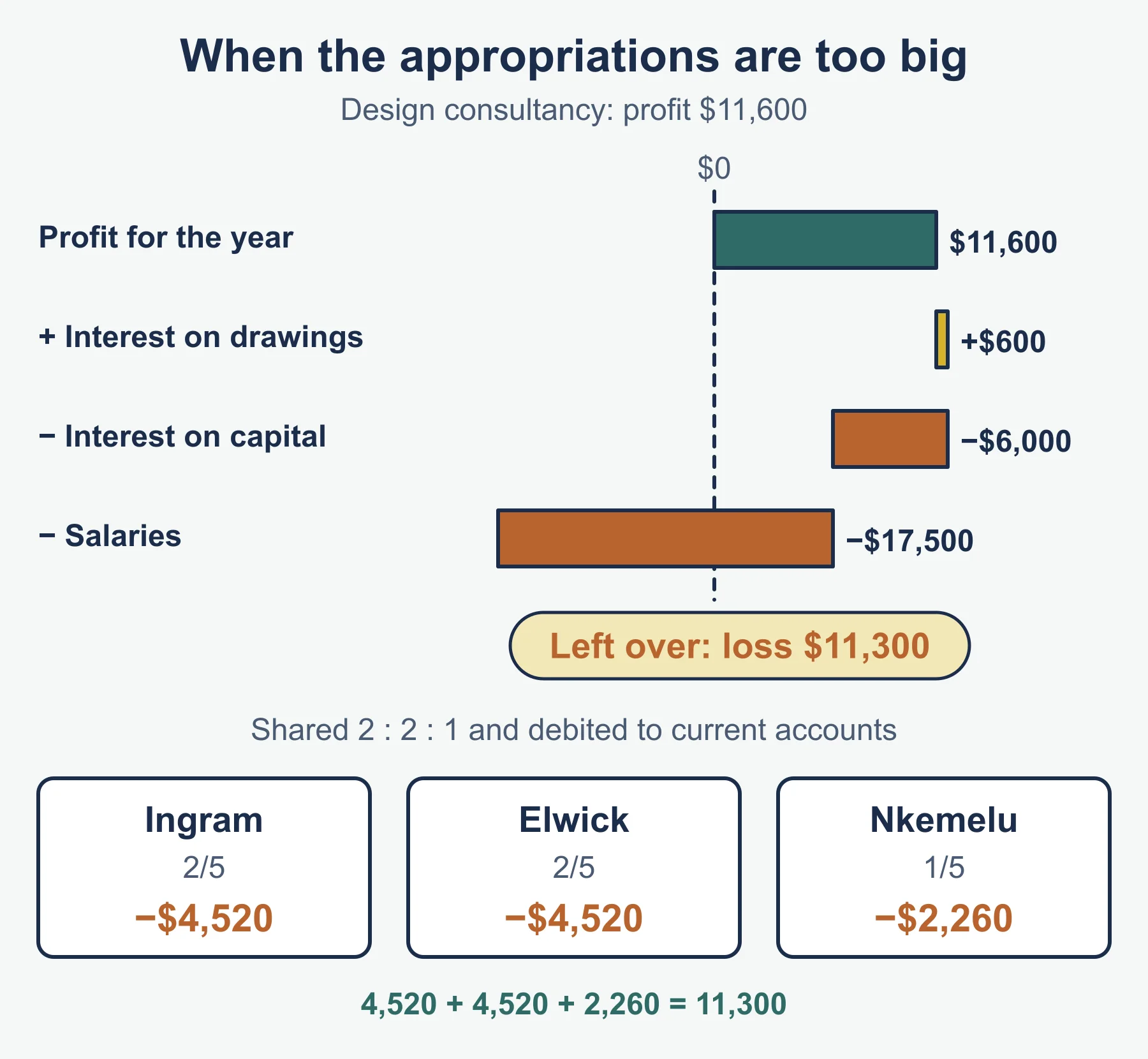
Profit for the year is $6,000. Interest on capital totals $4,000 and one salary is $5,000. The balance is $6,000 - $4,000 - $5,000 = ( $3,000), a loss. Shared equally, each partner is debited $1,500 in the current account, while interest and the salary are still credited.
Must-know distinctions
| Pair | Difference |
|---|---|
| Capital vs current account | Capital is long-term investment and normally fixed; current records yearly entitlements and withdrawals |
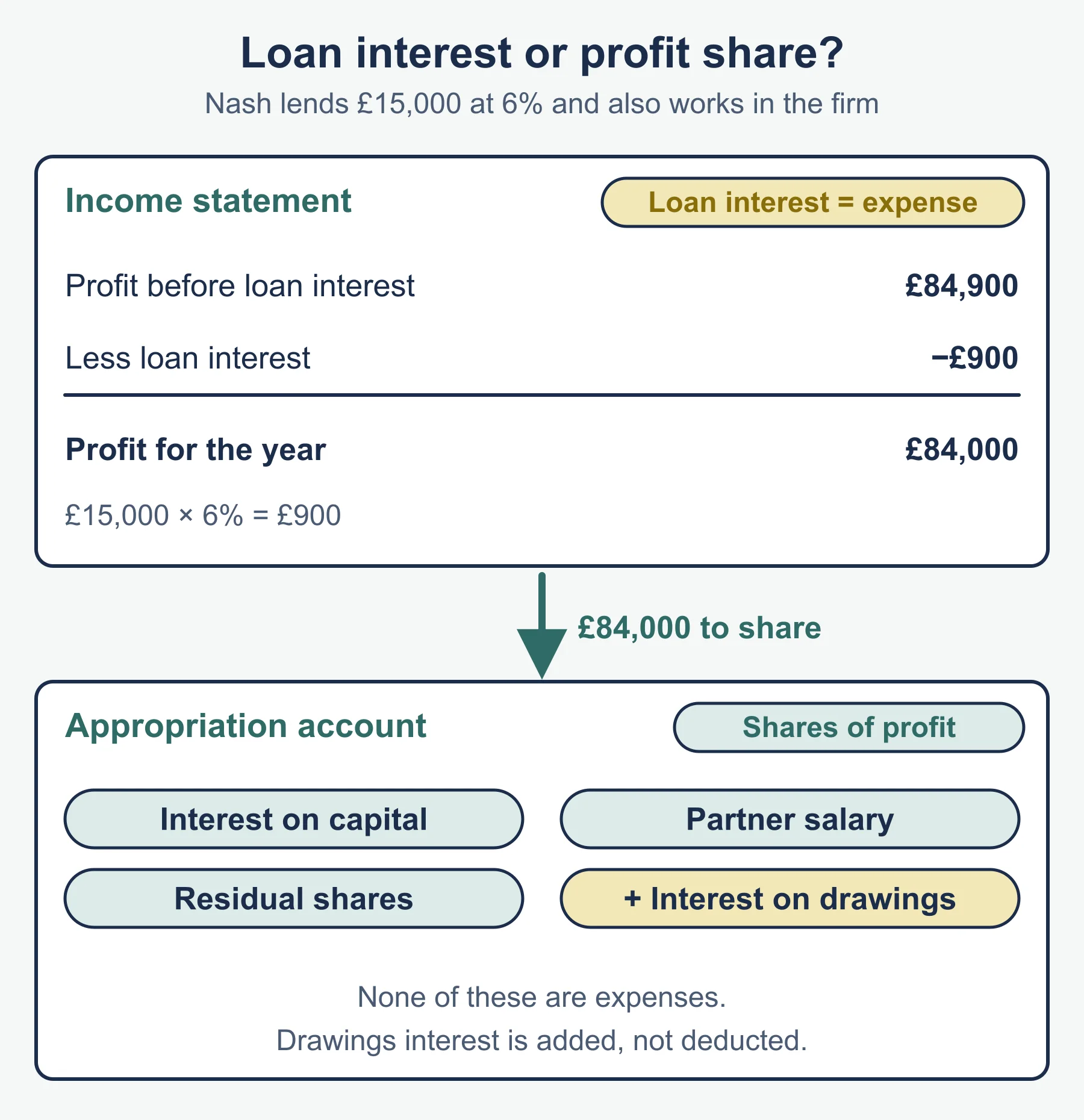
| Loan interest vs interest on capital | The loan is charged to profit as a business expense; interest on capital is an appropriation |
| Interest on drawings vs drawings | Interest is added in the appropriation account; drawings are never in it |
| Partner’s loan vs partner’s capital | Loan is a liability and earns loan interest; capital is equity |
| Profit vs balance of profit | Profit is before appropriations; the balance is what is shared in the ratio |
Quick self-test
- Two partners have capital of $40,000 and $25,000 with interest on capital at 6%. Find each partner’s interest.
- A balance of profit of $18,000 is shared 4 : 1. Find each share.
- The balance is a loss of $9,000, shared 2 : 1. Find each share and say which side of the current accounts it goes on.
- A partner lent the firm $12,000 at 5%. How much interest is charged, and where?
- Profit for the year is $28,000. Salary $9,000 and total interest on capital $2,500 are allowed; there is no interest on drawings. What is the balance to share?
- Profit for the year $36,000, interest on drawings $800, interest on capital $4,500, salary $6,000. What is the balance to share?
- State two items a partnership agreement might contain.
- Give one advantage and one disadvantage of a partnership compared with a sole trader.
- What does a debit balance on a partner’s current account mean?
- In a manufacturing partnership, what figure from the manufacturing account goes into the statement of profit or loss?
Answers
- $2,400 and $1,500.
- $14,400 and $3,600.
- $6,000 and $3,000, debited to the current accounts.
- $600, a business expense before profit for the year; the $12,000 is a non-current liability.
- $28,000 less $9,000 less $2,500 = $16,500.
- $36,000 plus $800 less $4,500 less $6,000 = $26,300.
- Any two: profit-sharing ratio, interest on capital, salaries, interest on drawings, interest on loans, capital contributed.
- For example: more capital is available; but liability is unlimited.
- The partner has taken out more than has been credited to them, so they owe the business that amount.
- The cost of production, in place of purchases.
Where marks are usually lost
- Using profit before loan interest to start the appropriation account.
- Subtracting interest on drawings.
- Posting drawings or the share of profit to a fixed capital account.
- Sharing a loss in the wrong ratio, or treating it as a negative profit that is simply ignored.
- Forgetting that interest on capital and salaries are still allowed in a loss year.
- Leaving a debit current account out of the statement of financial position, or adding it instead of deducting it.
- Placing a partner’s loan inside capital.
- Giving advantages without relating them to the facts in the question.
Frequently asked questions
What types of partnership business are there? A partnership can be a trading business, a service business with no cost of sales, a manufacturing business that prepares a manufacturing account first, or a combination. Every type ends at profit for the year, which the appropriation account then shares.
How is a debit balance on a partner’s current account shown? A debit balance means the partner has taken out more than has been credited. In the statement of financial position it is deducted, not added, when the partners’ capital and current accounts are totalled.
Is a partner’s loan part of capital? No. A partner’s loan is a liability of the business, so it is shown outside the partners’ capital and current accounts.
How is a loss shared between partners? A loss is shared in the profit-sharing ratio set by the agreement and debited to the current accounts. Sharing it in the wrong ratio or ignoring it are common errors.
Official syllabus
Cambridge IGCSE Accounting 0452 syllabus for exams in 2027, 2028 and 2029 (version 1), Cambridge University Press & Assessment, section 5.2 Partnerships.
Get free revision emails (optional)
Occasional emails with practice questions, worked explanations and links to free resources for the qualification and subjects you choose. No spam, and you can unsubscribe from any email. The free tools on this site never need an email.
Related resources
-
Revision notes
IGCSE Accounting: Analysis and Interpretation — Revision Notes
Quick recall for Cambridge IGCSE Accounting 0452 Topic 6: ten ratios, reading them, profit versus cash, comparing businesses, users and statement limits.
Accounting · Cambridge · IGCSE, O Level
Revise topic -
Study guides
IGCSE Accounting: Financial statements of sole traders (Cambridge 0452)
A worked guide to sole trader statements of profit or loss and financial position, with adjustments, for Cambridge IGCSE Accounting 0452 section 5.1.
Accounting · Cambridge · IGCSE, O Level
Read guide -
Practice questions
IGCSE Accounting: Financial statements of sole traders (Cambridge 0452) – Practice Questions
Original practice questions with worked answers on sole trader statements and year-end adjustments for Cambridge IGCSE Accounting 0452 section 5.1.
Accounting · Cambridge · IGCSE, O Level
Try questions
Related articles
-
teaching
A Level tuition in Dubai: Cambridge or Pearson Edexcel International A Level?
Schools in Dubai and Abu Dhabi teach either Cambridge International AS & A Level or Pearson Edexcel International A Level. How the two are structured, why it matters for tuition, and how online classes from Lahore work.
9 October 2026
-
curriculum guides
Choosing subjects at IGCSE and A Level
How subject choices at 14 and 16 affect university options later, and how to keep pathways open without overloading a timetable.
28 July 2026
Studying this with a teacher
Working through Accounting IGCSE, O LEVELS?
This page is free and stays free. If you would rather be taught it, Marlbridge runs Accounting classes one-to-one and in small groups of up to 15, online in your own time zone. The first trial class is free. WhatsApp replies within an hour (8am–11pm Pakistan time, every day); email the same day.
Cambridge Accounting teachers at Marlbridge

