
Revision Notes
IGCSE Business: Business and the environment (Cambridge 0264) – Revision Notes
Condensed revision notes for Cambridge IGCSE Business 0264 section 6.3: environmental harm, business responses and the effects of legal controls.
- Subject
- Business
- Level
- IGCSE
- Topic
- External influences on business activity
- Author
- Marlbridge Academic Team
- Updated
- Reviewed by
- Salman Ahmad (what this means)
Aligned to Cambridge IGCSE Business (0264), For examination in 2027, 2028 and 2029. Official specification .
Syllabus page (what it covers and how it is assessed): Cambridge IGCSE Business.
Syllabus points this page covers
0264
- 6.3 Business and the environment
Found an error? Report a correction.
Need help with this topic? Request a free trial class for IGCSE Business (0450 / 0264).
These notes condense section 6.3, Business and the environment, of the Cambridge IGCSE Business 0264 syllabus for examination in 2027, 2028 and 2029. The single syllabus point is 6.3.1, Environmental issues. Read the study guide first for full explanations, then test yourself with the practice questions. The course hub and the printable checklist track progress, and the free diagnostics show gaps. All businesses and figures below are invented, and laws are described in general terms because they differ between countries.
The four things to know
- How business activity can negatively affect the environment, for example pollution and depletion of resources.
- Why businesses may respond to environmental issues, for example improved reputation and increased sales.
- How businesses may respond.
- The effects of legal controls over business activity that affects the environment: how, what and where to produce or sell, and the influence on costs.
Key definitions
| Term | Meaning |
|---|---|
| Pollution | Harmful substances or energy released into air, water or land, or noise that disturbs people |
| Depletion of resources | Using natural resources faster than they are replaced, or using up resources that cannot be replaced |
| Non-renewable resource | A resource that cannot be replaced once used, such as coal or oil |
| Renewable resource | A resource that can regrow or be replaced, such as timber, if not over-used |
| Environmental issue | A problem where business activity harms or uses up the natural environment |
| Legal control | A rule made by government that a business must follow |
| External cost | A cost of a business decision paid by people other than the business |
| Reputation | What customers, employees and the public think of a business |
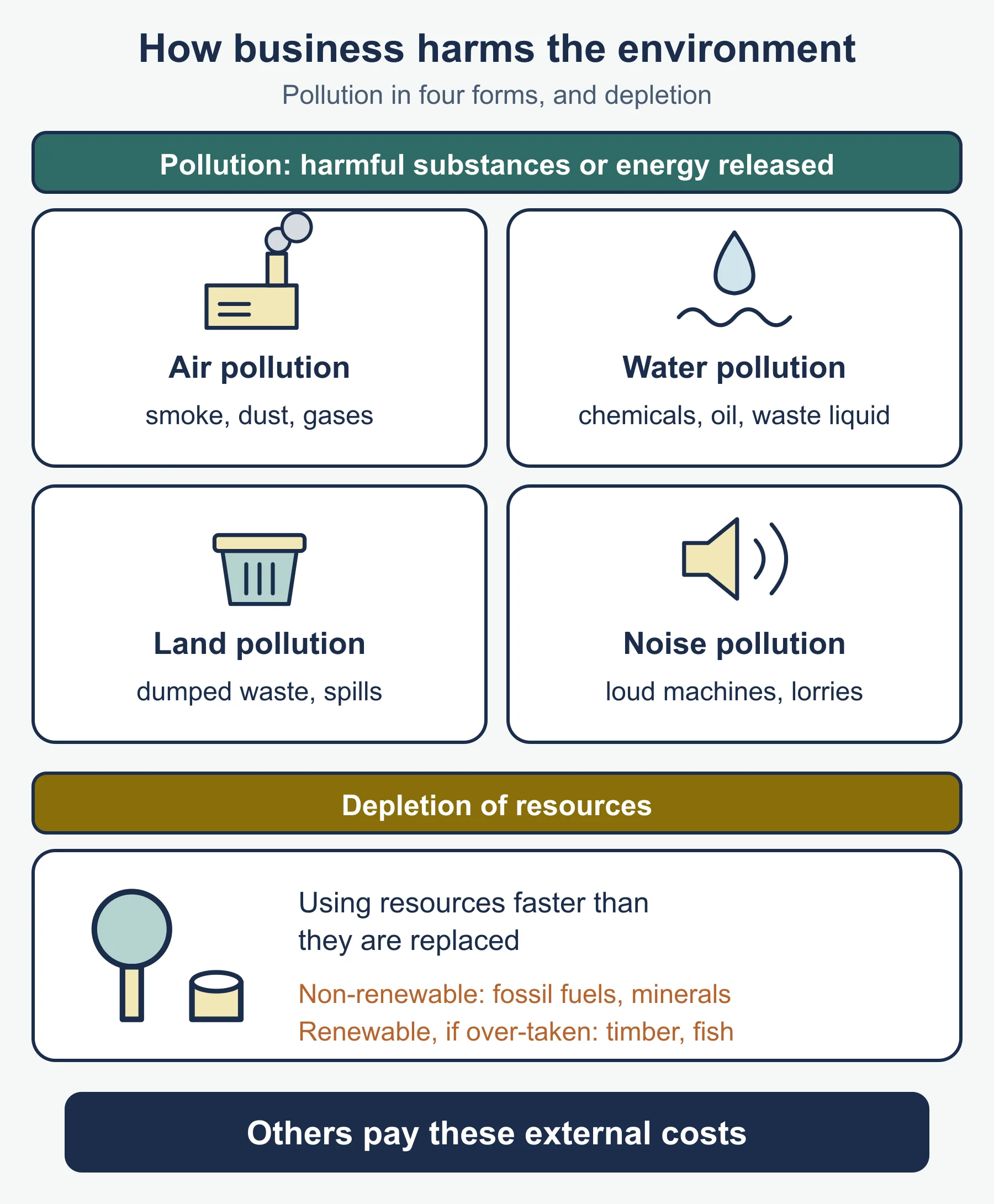
Negative effects on the environment
| Type | Typical cause in business |
|---|---|
| Air pollution | Smoke and gases from factories, power and vehicles |
| Water pollution | Waste liquid, chemicals or oil entering rivers or the sea |
| Land pollution | Dumped waste, spilled chemicals, used packaging |
| Noise pollution | Machinery, lorries, night work near homes |
| Depletion of resources | Mining, felling trees, over-fishing, using fuel |
Exam habit: name the type of harm, then link it to what this business does.
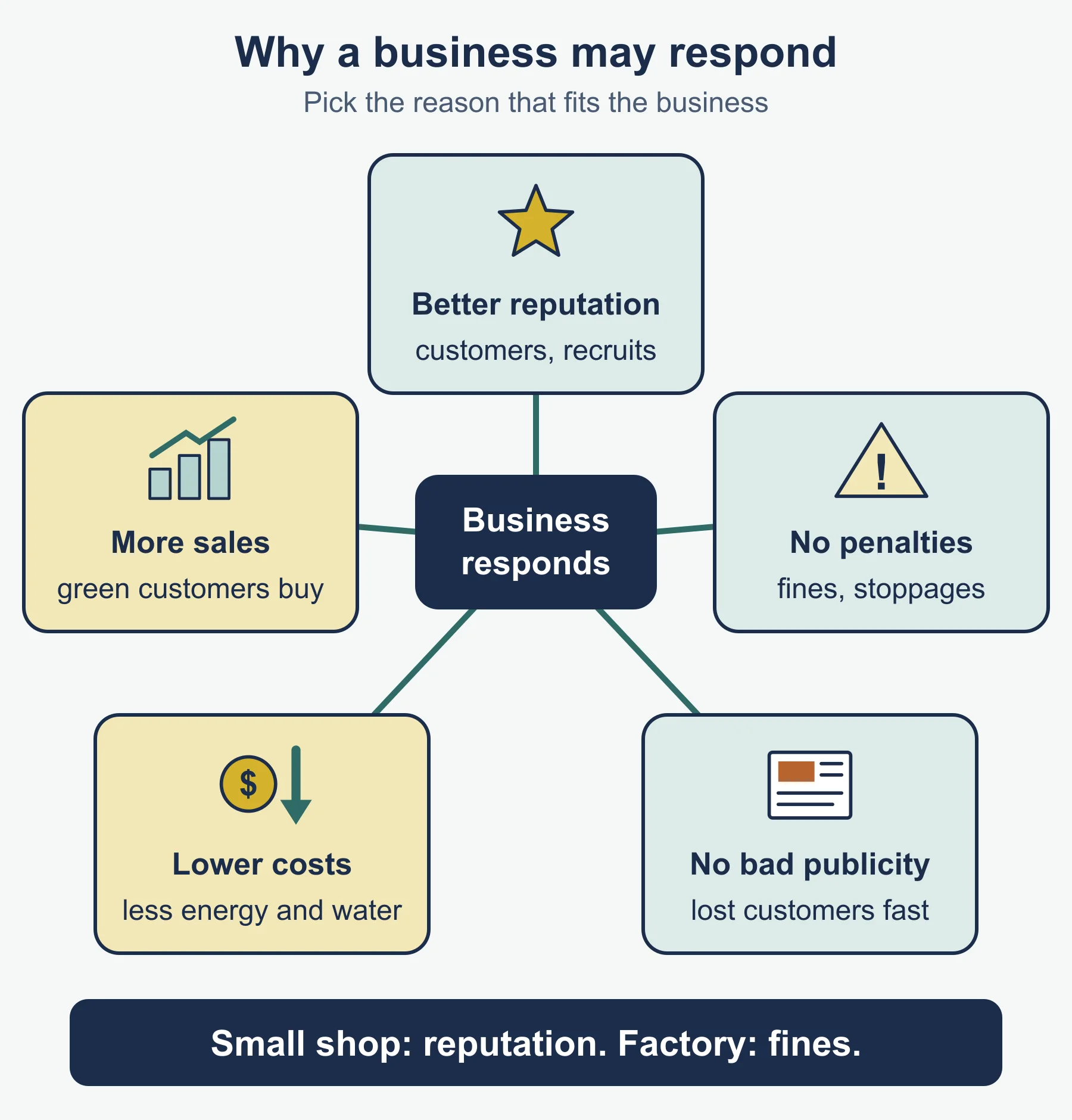
Why respond?
- Improved reputation: customers, staff and neighbours think better of the firm.
- Increased sales: some customers choose businesses with a good record.
- Avoid fines, bans or loss of permission to trade.
- Lower costs from using less energy, water or packaging.
- Avoid bad publicity after a pollution incident.
Only the first two are named in the syllabus, and the word “for example” means others count if you explain them.
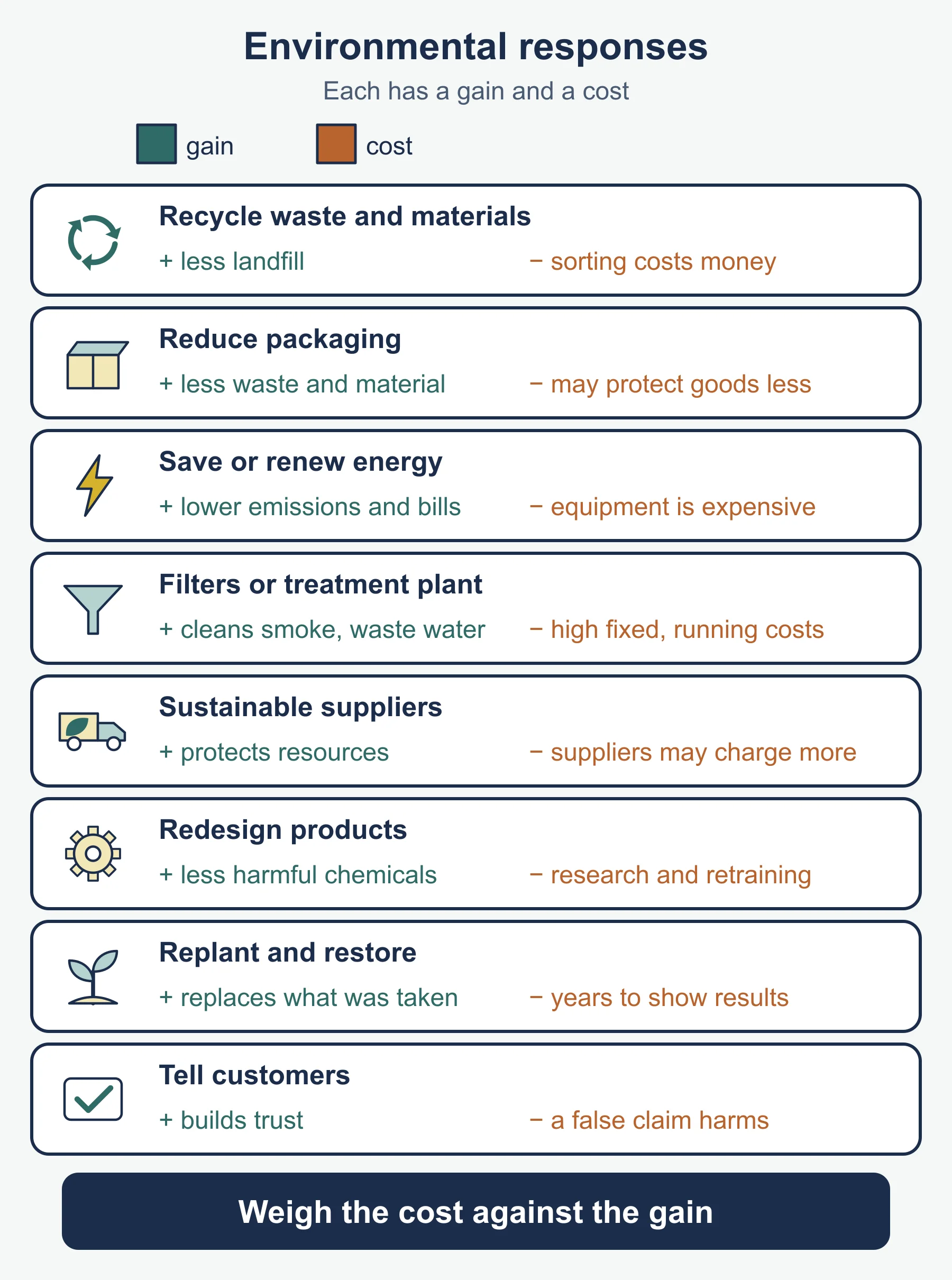
How might a business respond?
| Response | Gain | Cost or risk |
|---|---|---|
| Recycle waste | Less waste, lower material use | Sorting costs |
| Cut packaging | Less waste, cheaper materials | Less protection |
| Renewable or lower energy | Fewer emissions, lower bills | Expensive equipment |
| Filters and treatment plant | Cleaner output | High fixed and running costs |
| Sustainable suppliers | Protects resources | Higher input prices |
| Redesign product or process | Less material or harmful input | Research and training |
| Replant or restore land | Replaces what was taken | Slow results |
Effects of legal controls
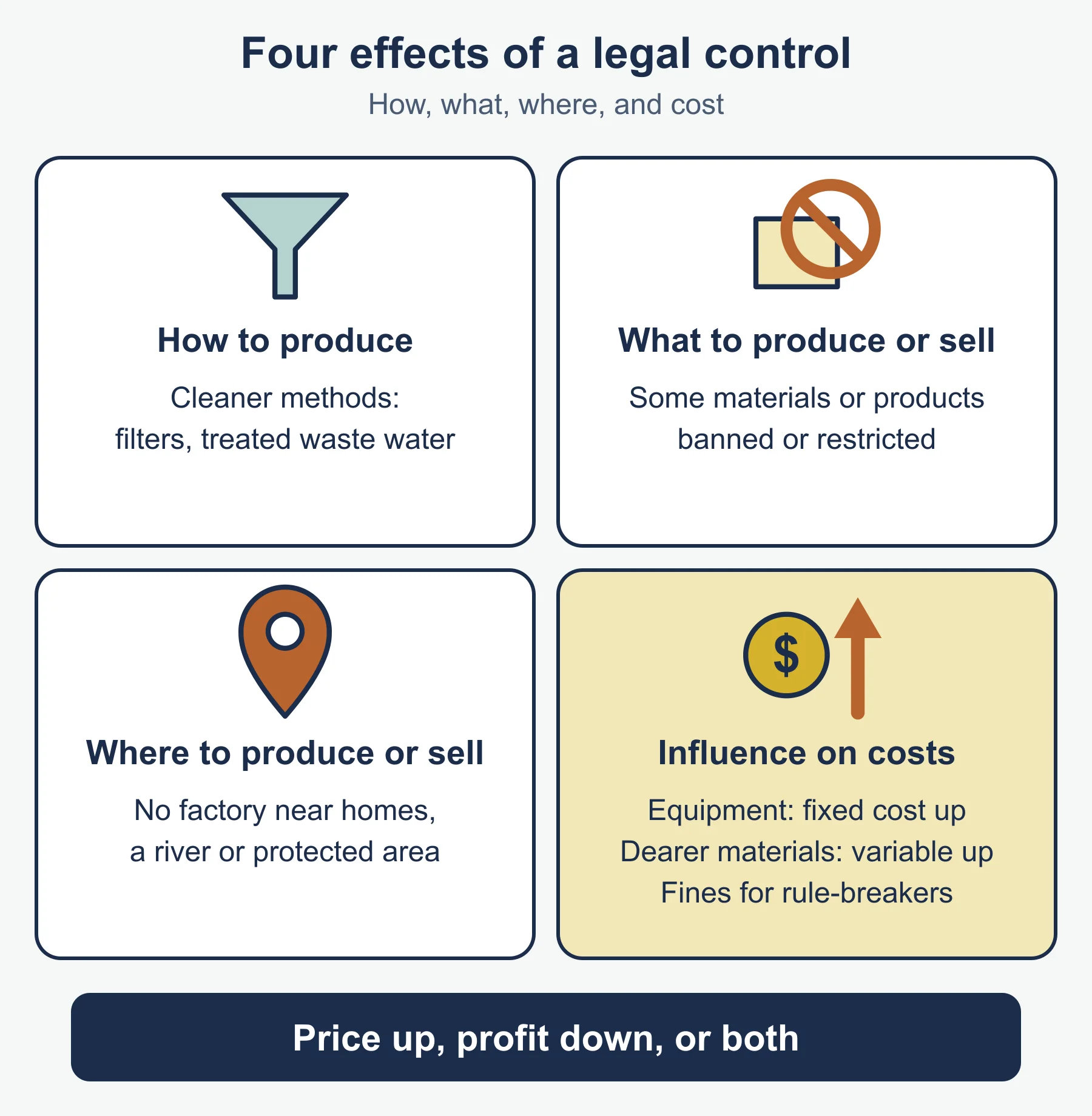
| Effect | What it means | Example |
|---|---|---|
| How to produce | Must use cleaner methods | Treat waste water before release |
| What to produce or sell | Products or materials may be banned or limited | A harmful chemical cannot be used in a product |
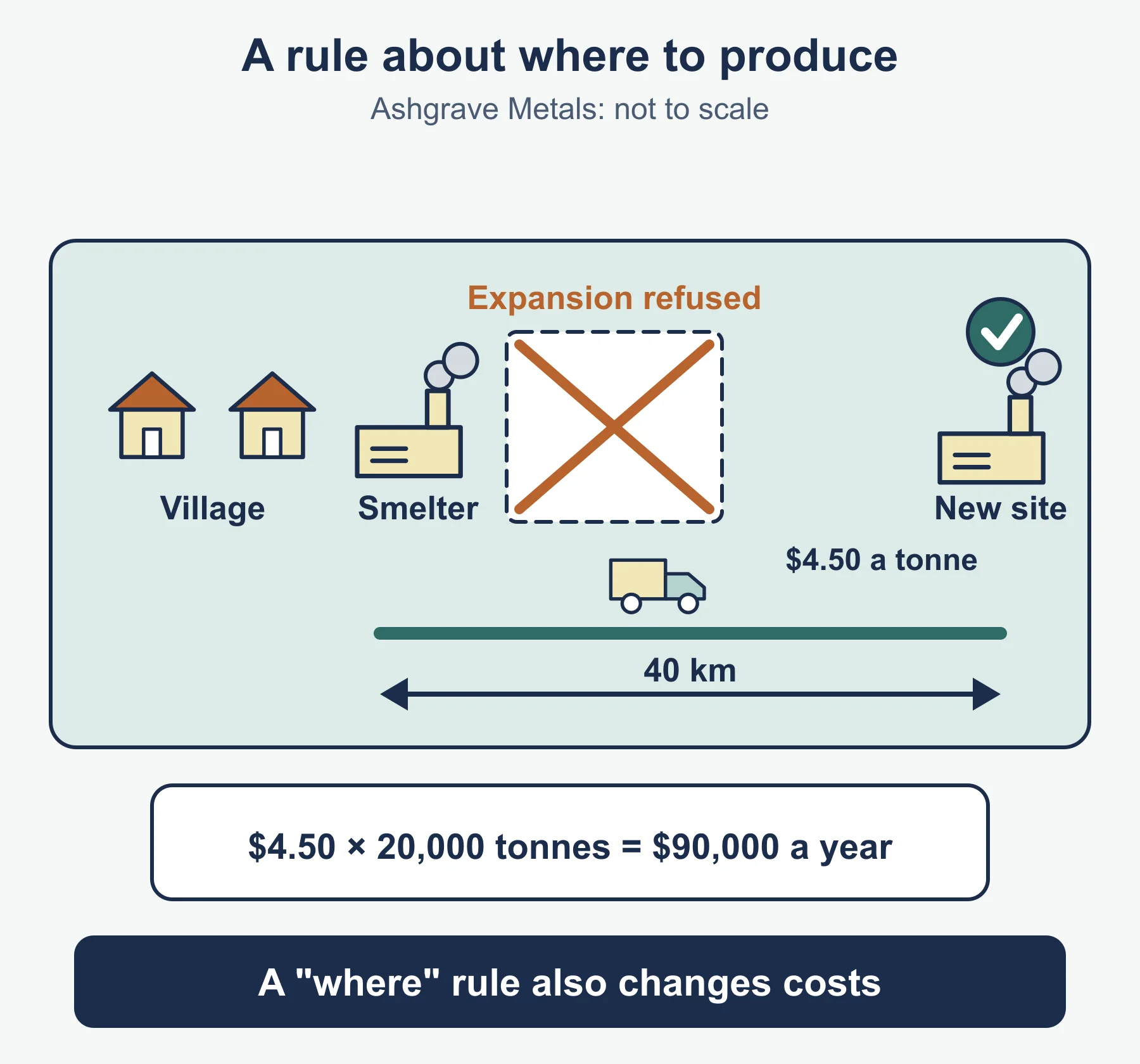
| Where to produce or sell | Limits on location | A noisy factory refused a site near homes |
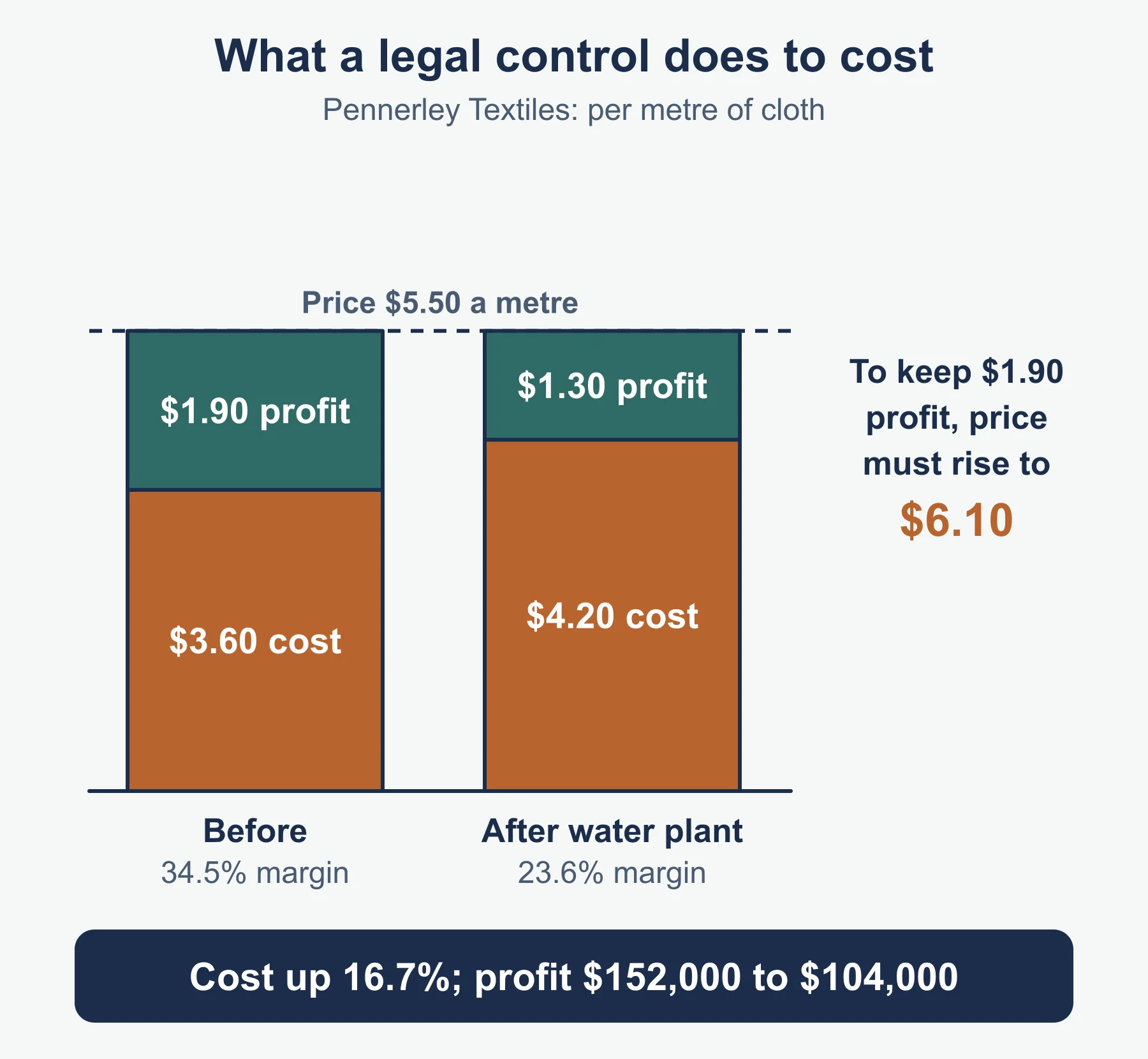
| Costs | Usually rise | New equipment, dearer materials, fines |
Possible effects of higher costs: a higher selling price, lower profit, lost sales if rivals charge less, or a search for savings elsewhere. Legal controls can also help a business that already meets high standards.
Method in steps: a legal-control cost question
- Work out total cost before: fixed costs + (variable cost per unit × units).
- Work out total cost after, adding any new fixed and variable costs.
- Average cost = total cost ÷ number of units. The syllabus lists this formula in its formulas and ratios section.
- Compare, and state the change in money and in percentage if asked.
- Say what the business might do: raise the price, accept less profit, or change its plans.
Worked reminder: Ladlow Printers
Ladlow Printers makes 500,000 leaflets a year. Fixed costs are 150,000 dollars and variable cost is 0.30 dollars per leaflet. A rule on ink disposal adds 18,000 dollars a year to fixed costs and 0.02 dollars to each leaflet’s variable cost.
- Before: 150,000 + (0.30 × 500,000) = 300,000 dollars; average cost = 300,000 ÷ 500,000 = 0.60 dollars.
- After: 168,000 + (0.32 × 500,000) = 328,000 dollars; average cost = 328,000 ÷ 500,000 = 0.656 dollars.
- Total cost rises by 28,000 dollars, a rise of about 9.3% in average cost.
- Comment: a rise of about 5.6 cents a leaflet may be passed on to customers if rivals face the same rule.
Short scenario: a response with savings
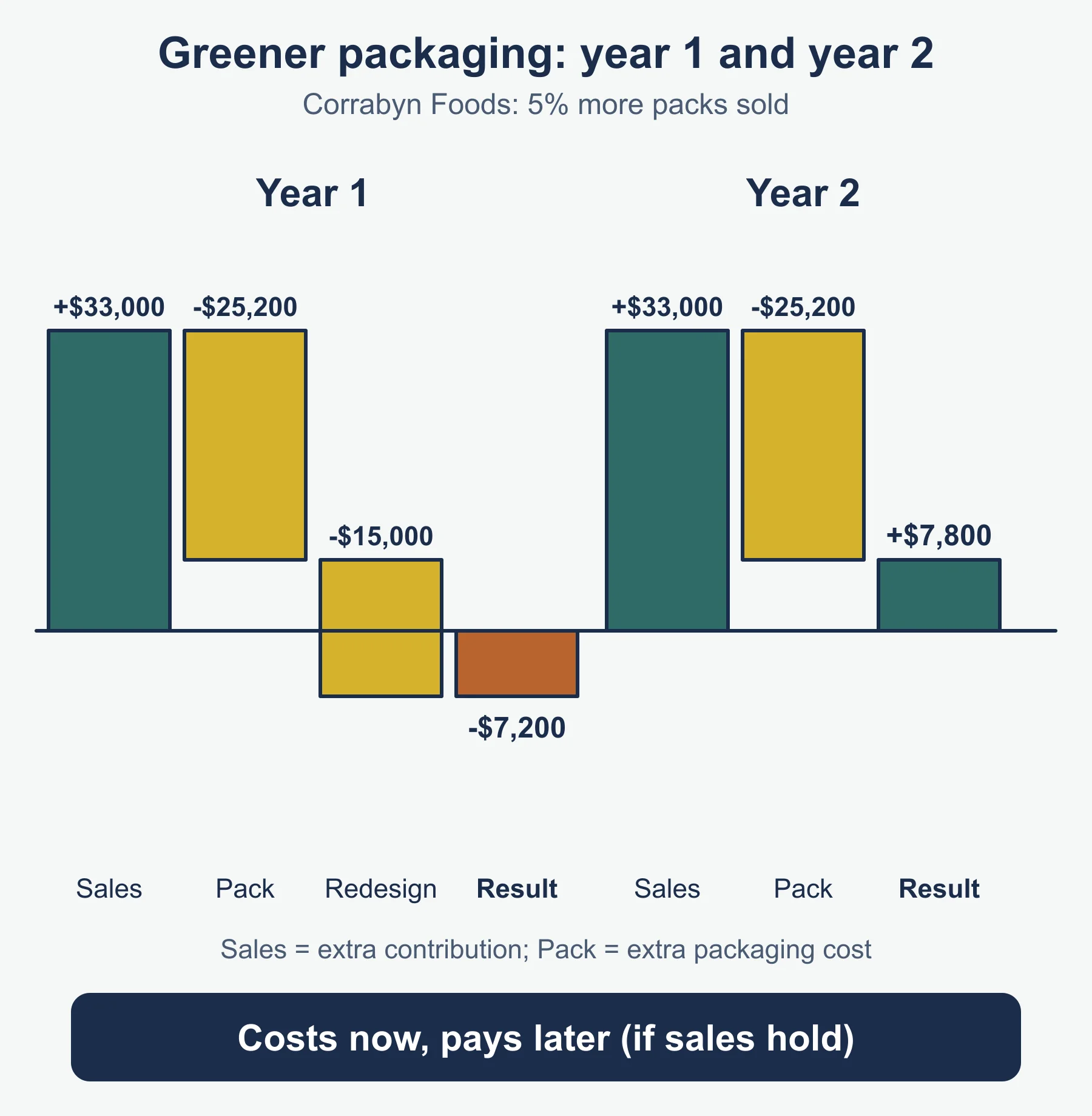
Cathcart Tiles spends 27,000 dollars on equipment that recycles waste clay. It saves 9,000 dollars a year in raw materials. The saving over three years equals the spend: 9,000 × 3 = 27,000. After three years the saving is extra profit, as long as the equipment lasts and works as expected. The firm may also gain from a better reputation. Risk: if output falls, the saving falls too.
Evaluation skills for this topic
When asked to recommend and justify, the syllabus asks you to make a decision supported by evidence. A good answer has three parts.
- A clear choice.
- Reasons using details from the case, such as costs, size and location of the business, and who its customers are.
- A short comment on the other side, for example “the cost is high, but the sales gain over several years is likely to outweigh it”.
Useful angles are the short run against the long run, the size of the firm, how much customers care, and what the law demands.
Must-know distinctions
- Pollution vs depletion: pollution adds harmful things to the environment; depletion uses up what is already there.
- Renewable vs non-renewable: one can be replaced and the other cannot.
- A response vs a legal control: a response is a choice by the business; a legal control is a rule it must follow.
- Fixed vs variable cost effects: a treatment plant mainly raises fixed cost; dearer materials raise variable cost.
- Cost vs benefit: costs often come first, benefits later.
Quick self-test
- State two types of pollution caused by business activity.
- Define depletion of resources.
- Give two reasons why a business might respond to environmental issues.
- Outline two ways a business could reduce harm to the environment.
- State the four effects of legal controls that the syllabus names.
- A firm makes 20,000 units. Fixed costs are 40,000 dollars and variable cost is 2 dollars per unit. A rule adds 10,000 dollars to fixed costs. Calculate the new average cost.
- Explain why a legal control might change where a firm produces.
- Explain one reason a business might increase its prices after a new legal control.
- Explain one risk of spending money on environmental improvements.
- Explain why a claim about being environmentally friendly can harm a business if it is untrue.
Answers
- Any two from air, water, land and noise pollution.
- Using up natural resources faster than they can be replaced, or using up resources that cannot be replaced.
- Any two from improved reputation, increased sales, avoiding fines, lower costs, avoiding bad publicity.
- Any two sensible methods, each outlined, such as recycling waste or installing filters.
- How to produce, what to produce or sell, where to produce or sell, and costs.
- Total cost before = 40,000 + (2 × 20,000) = 80,000 dollars. After = 50,000 + 40,000 = 90,000 dollars. Average cost = 90,000 ÷ 20,000 = 4.50 dollars.
- The rule may refuse permission to produce in a place, for example near homes or a river, so the firm has to use another site.
- The control raises the cost of each unit, so a higher price protects the profit margin.
- The cost may be paid at once while the sales gain or saving comes later or fails to appear, which cuts profit in the short run.
- Customers who find out may stop trusting the business, which damages its reputation and its sales.
Where marks are usually lost
- Naming “pollution” without a type or any link to the business in the question.
- Describing a response without any cost, or a cost without a gain.
- Assuming every response raises sales. Some customers do not care or will not pay more.
- Listing laws by name. The syllabus asks for effects, so describe them in general terms.
- Mixing up fixed costs and variable costs when adding the cost of a new control.
- Leaving a calculation without units or without saying what the figure means.
- Writing a one-sided answer to a recommend and justify question.
- Repeating the stem of the question instead of using its details.
Frequently asked questions
What is the difference between pollution and depletion of resources? Pollution adds harmful substances, energy or noise to the air, water or land. Depletion of resources means using natural resources faster than they are replaced, or using up non-renewable resources.
Why might a business respond to environmental issues? The syllabus names improved reputation and increased sales as examples. Other valid reasons include avoiding fines or bans, lowering costs by using less energy, water or packaging, and avoiding bad publicity.
Do you need to name specific environmental laws in IGCSE Business? No. The syllabus asks for the effects of legal controls, so describe them in general terms, such as their effect on how, what and where a business produces and on its costs.
Does every environmental response increase sales? No. Some customers do not care or will not pay more, so an answer should weigh the cost of the response against its likely gain.
Official syllabus
Cambridge IGCSE Business 0264 syllabus for examination in 2027, 2028 and 2029, published by Cambridge University Press & Assessment (Cambridge International Education), section 6.3 Business and the environment.
Get free revision emails (optional)
Occasional emails with practice questions, worked explanations and links to free resources for the qualification and subjects you choose. No spam, and you can unsubscribe from any email. The free tools on this site never need an email.
Related resources
-
Study guides
IGCSE Business: Business and the international economy (Cambridge 0264)
Study guide to globalisation, tariffs, quotas, MNCs, external costs and benefits and exchange rates for Cambridge IGCSE Business 0264, with examples.
Business · Cambridge · IGCSE
Read guide -
Practice questions
IGCSE Business: Business and the international economy (Cambridge 0264) – Practice Questions
Original practice questions with worked answers on globalisation, tariffs, MNCs, external costs and exchange rates for Cambridge IGCSE Business 0264.
Business · Cambridge · IGCSE
Try questions -
Revision notes
IGCSE Business: Business and the international economy (Cambridge 0264) – Revision Notes
Condensed revision notes on globalisation, tariffs, quotas, MNCs, external costs and benefits and exchange rates for Cambridge IGCSE Business 0264.
Business · Cambridge · IGCSE
Revise topic
Related articles
-
teaching
A Level tuition in Dubai: Cambridge or Pearson Edexcel International A Level?
Schools in Dubai and Abu Dhabi teach either Cambridge International AS & A Level or Pearson Edexcel International A Level. How the two are structured, why it matters for tuition, and how online classes from Lahore work.
9 October 2026
-
curriculum guides
Choosing subjects at IGCSE and A Level
How subject choices at 14 and 16 affect university options later, and how to keep pathways open without overloading a timetable.
28 July 2026
Studying this with a teacher
Working through Business IGCSE?
This page is free and stays free. If you would rather be taught it, Marlbridge runs Business classes one-to-one and in small groups of up to 15, online in your own time zone. The first trial class is free. WhatsApp replies within an hour (8am–11pm Pakistan time, every day); email the same day.
Cambridge Business teachers at Marlbridge

