
Study Guides
IGCSE Business: Business and the environment (Cambridge 0264)
A full study guide to Cambridge IGCSE Business 0264 section 6.3: environmental harm, why and how firms respond, and the effect of legal controls.
- Subject
- Business
- Level
- IGCSE
- Topic
- External influences on business activity
- Author
- Marlbridge Academic Team
- Updated
- Reviewed by
- Salman Ahmad (what this means)
Aligned to Cambridge IGCSE Business (0264), For examination in 2027, 2028 and 2029. Official specification .
Syllabus page (what it covers and how it is assessed): Cambridge IGCSE Business.
Syllabus points this page covers
0264
- 6.3 Business and the environment
Found an error? Report a correction.
Need help with this topic? Request a free trial class for IGCSE Business (0450 / 0264).
This guide covers section 6.3, Business and the environment, of the Cambridge IGCSE Business 0264 syllabus for examination in 2027, 2028 and 2029. The section has one syllabus point, 6.3.1 Environmental issues. All candidates study the same content, and the syllabus says both papers are based on all the subject content. For quick recall use the revision notes, then test yourself with the practice questions. The course hub and the printable checklist track what you have covered, and the free diagnostics show where to start.
All businesses, people and figures below are invented. Laws differ between countries, so legal controls are described in general terms and no particular law is named. A different section, legal controls on marketing, covers laws about promotion and faulty goods. This guide is about laws that affect the environment.
What this section covers
| Syllabus point | What you must be able to do |
|---|---|
| Negative effects | Explain how business activity can harm the environment, for example pollution and depletion of resources |
| Why respond | Explain why a business may respond to environmental issues, for example improved reputation and increased sales |
| How respond | Explain how a business may respond to environmental issues |
| Legal controls | Explain the effects of legal controls over business activity that affects the environment: how, what and where to produce or sell, and the influence on costs |
How business activity can harm the environment
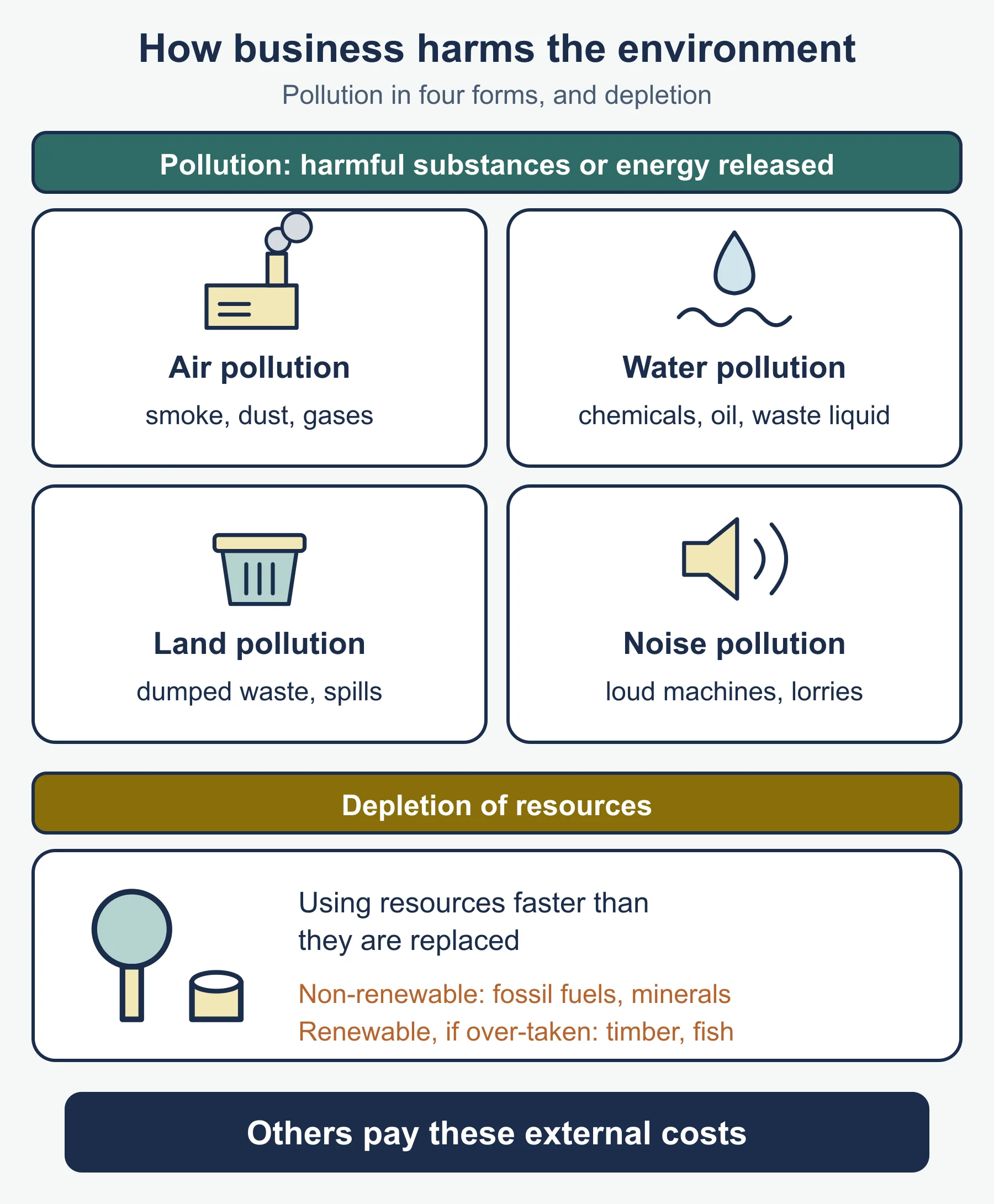
Every business uses resources and creates something the environment has to absorb. Two main kinds of harm are named in the syllabus.
Pollution
Pollution is the release of harmful substances or energy into the environment. It comes in several forms.
- Air pollution: smoke, dust and gases from factories, power generation and vehicles.
- Water pollution: chemicals, oil or waste liquid flowing into rivers, lakes or the sea.
- Land pollution: dumped waste, spilled chemicals and rubbish from packaging that is thrown away.
- Noise pollution: loud machinery, lorries or night-time activity near homes.
Depletion of resources
Depletion of resources means using up natural resources faster than they can be replaced. Fossil fuels and minerals are non-renewable: once used, they are gone. Renewable resources such as timber and fish can also be depleted if a business takes more than nature can regrow.
Pollution and depletion also create external costs. These are costs that fall on people other than the business, such as neighbours who breathe dirty air. The business does not pay them unless a law, a fine or public pressure makes it.
Worked example: spotting the harm
Orrinsford Furniture makes tables from hardwood. Its sawmill runs from 6 am to 10 pm. Offcuts are burned in an open pit. Delivery lorries pass through a village.
- Air pollution: smoke from burning offcuts.
- Depletion of resources: hardwood trees are felled and the firm does not say whether it replants.
- Noise pollution: the sawmill’s long hours and the lorries.
To earn full credit in an exam, name the harm and tie it to the business. “Burning offcuts in an open pit puts smoke into the air near the village” scores better than “it causes pollution”.
Why a business may respond
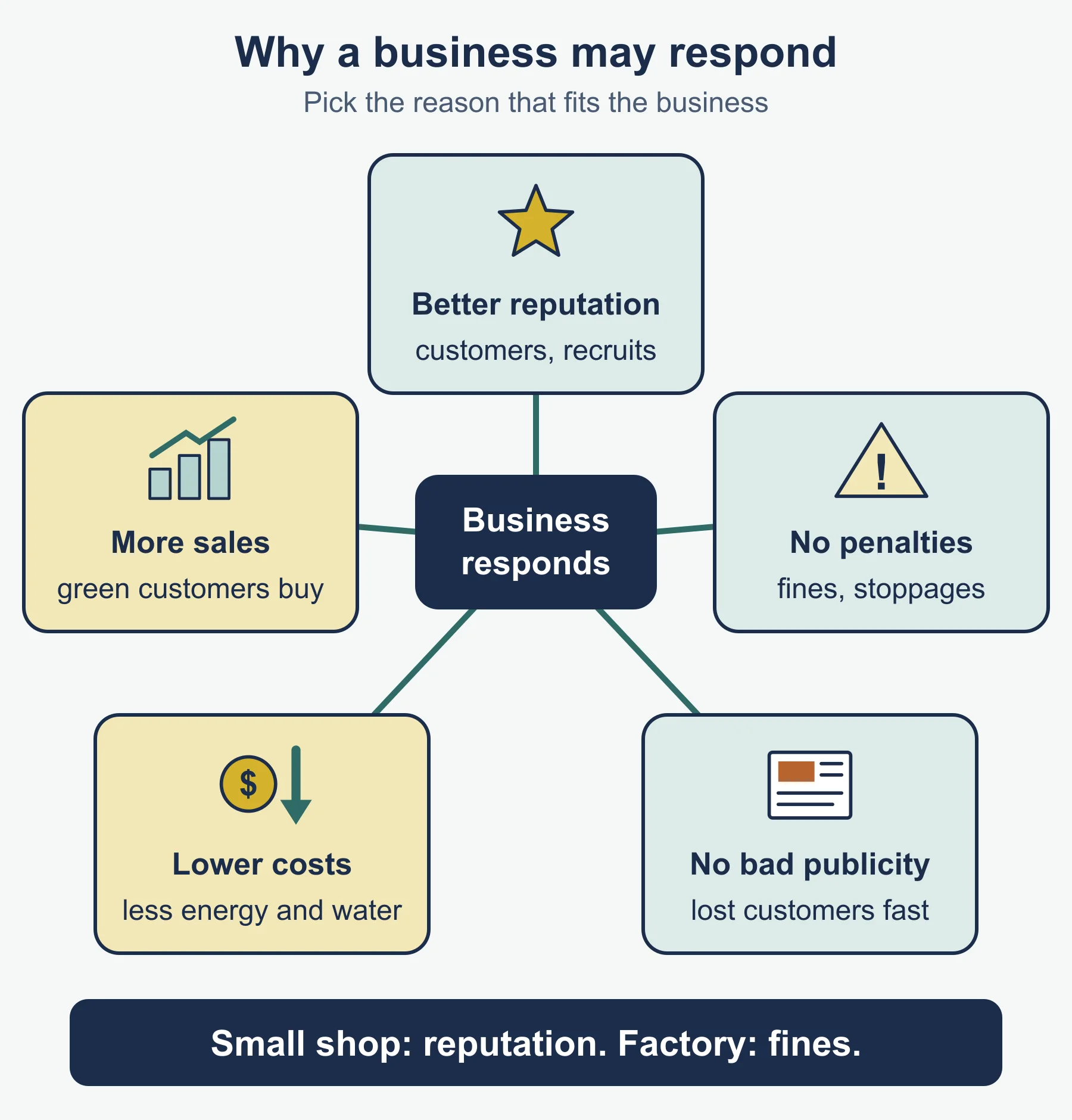
A business can ignore the environment, but many choose to act. The syllabus names two reasons and uses “e.g.”, so other sensible reasons also count.
- Improved reputation. Customers, local people and potential employees may think better of a business seen to care. A good reputation can make it easier to recruit staff and to keep customers.
- Increased sales. Some customers prefer to buy from a business with a good environmental record, and are sometimes willing to pay a higher price. Others, such as large firms choosing suppliers, may refuse to buy from a firm that pollutes.
- Avoiding legal penalties. A firm that breaks an environmental law may pay fines, be forced to stop production or lose its permission to trade.
- Lower costs. Using less energy, less packaging or less water cuts bills.
- Avoiding bad publicity. A pollution incident in the news can cost a business customers quickly.
Always ask which reason fits the business in the question. A small shop selling to local families is more likely to be moved by reputation. A large factory is more likely to be moved by fines and legal controls.
How a business may respond
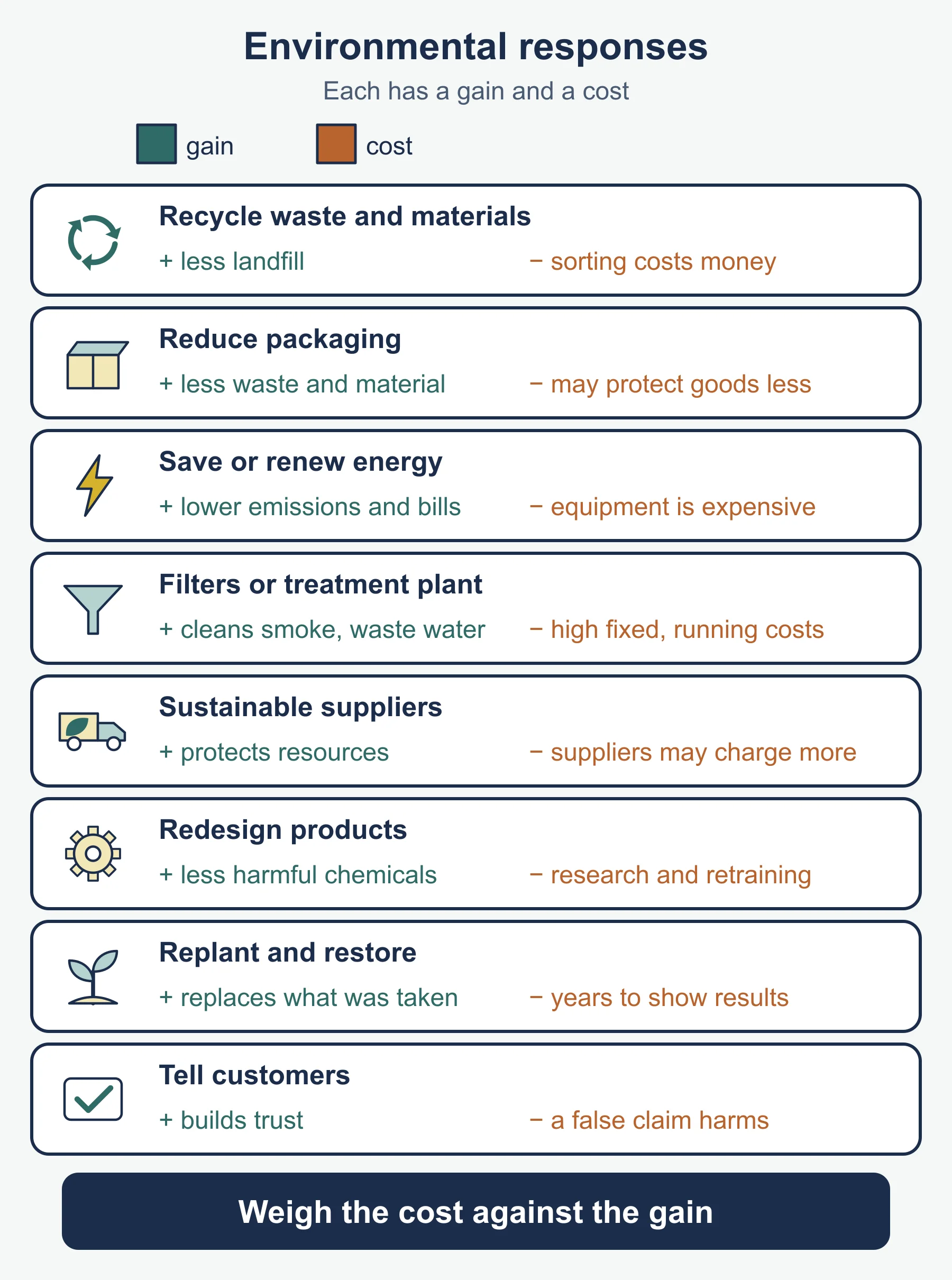
The syllabus does not list set responses, so you need to be able to suggest sensible ones and explain what each one achieves and costs.
| Response | What it does | Possible drawback |
|---|---|---|
| Recycling waste and using recycled materials | Reduces waste sent to landfill and the use of new raw materials | Sorting and processing cost money |
| Reducing packaging | Cuts waste and may cut material costs | Thinner packaging may protect goods less well |
| Using renewable energy or saving energy | Lowers harmful emissions and may cut energy bills | Equipment is expensive to buy |
| Installing filters or treatment plant | Cleans smoke or waste water before release | High fixed cost, and running costs |
| Sourcing from sustainable suppliers | Protects resources such as forests | Suppliers may charge more |
| Redesigning products or processes | Uses less material or harmful chemicals | Research and retraining cost time and money |
| Replanting, restoring land | Replaces what has been taken | Takes years to show results |
| Giving information to customers | Builds trust, for example by labelling | A claim that is not true harms reputation |
Worked example: a response with a cost and a gain
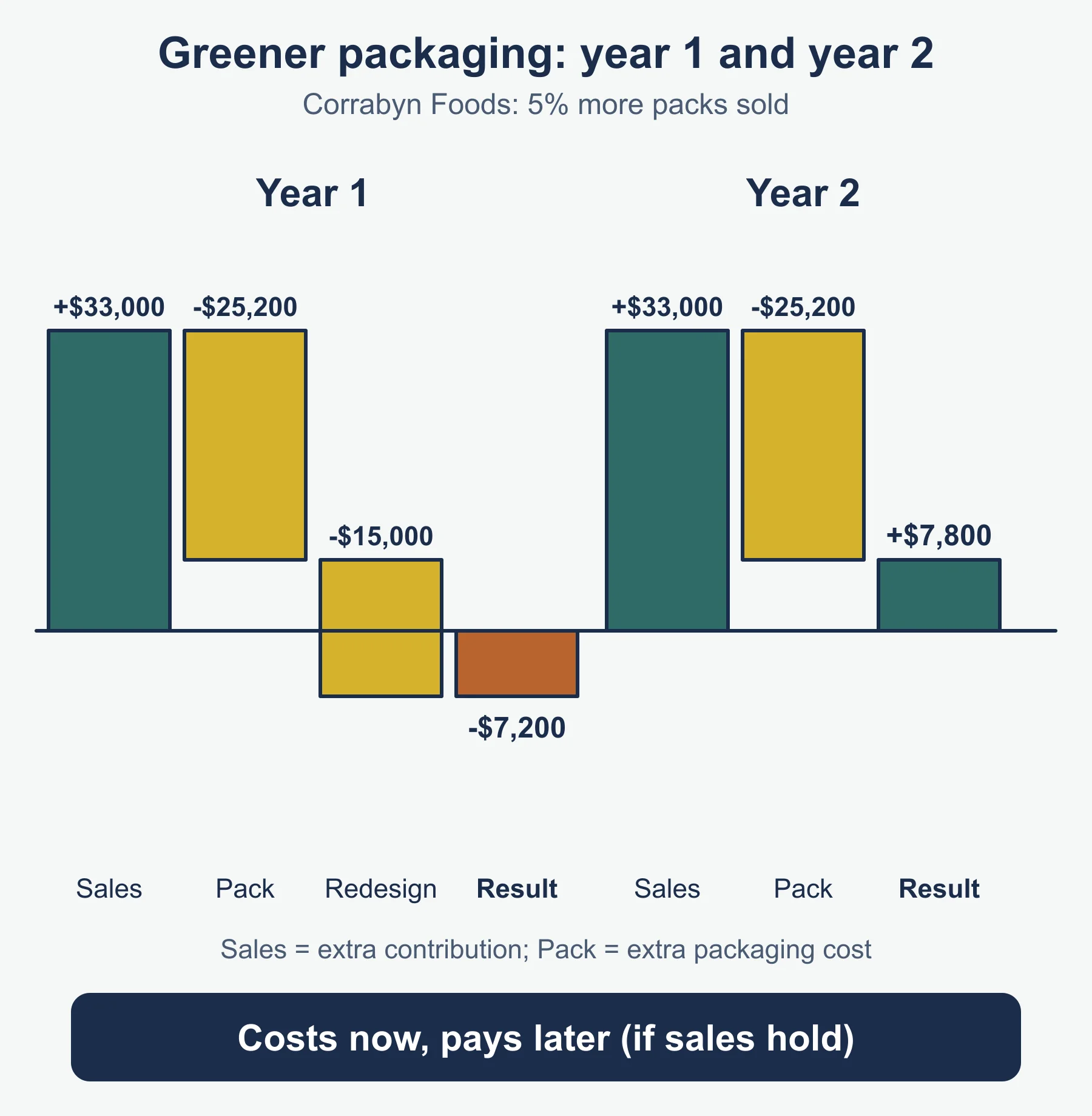
Corrabyn Foods sells 600,000 packs of biscuits a year at 3.00 dollars each. The variable cost is 1.90 dollars per pack. The firm changes to recycled card packaging, which costs 0.04 dollars more per pack, plus a one-off redesign cost of 15,000 dollars. The firm expects sales to rise by 5% because of its new image.
- Extra packs sold: 5% of 600,000 = 30,000 packs.
- Contribution per pack: 3.00 − 1.90 = 1.10 dollars.
- Extra contribution: 30,000 × 1.10 = 33,000 dollars.
- Extra packaging cost: 0.04 × 630,000 packs = 25,200 dollars.
- Year one: 33,000 − 25,200 − 15,000 = a loss of 7,200 dollars on this decision.
- Year two, with no redesign cost: 33,000 − 25,200 = a gain of 7,800 dollars.
The judgement: in the first year the change costs money. In later years it pays, as long as the sales rise lasts. The firm may also gain in ways the numbers do not show, such as a better reputation. A good answer states the figures, then weighs the short run against the long run.
Legal controls over business activity
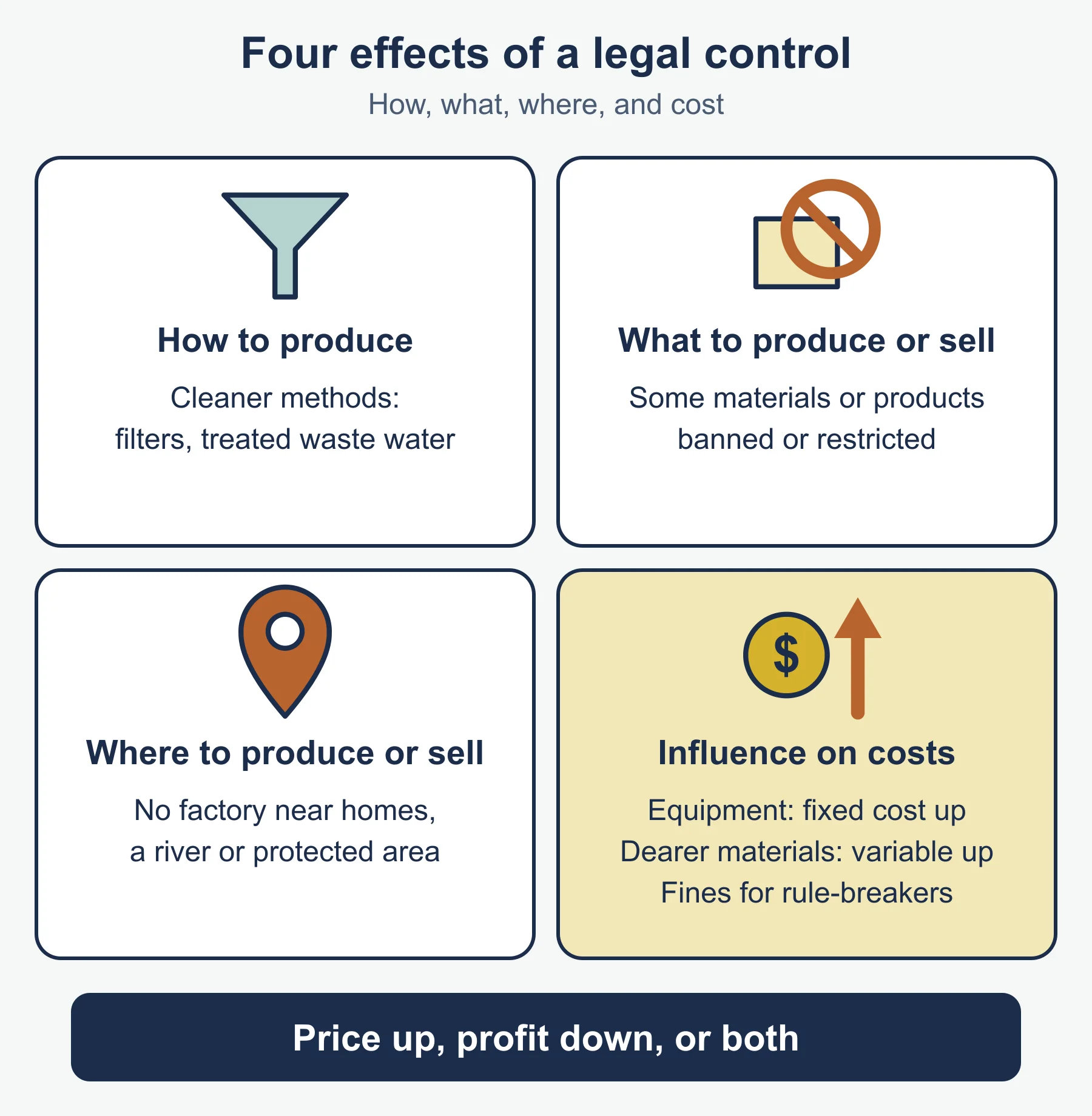
Governments pass laws to limit the harm business activity does to the environment. Laws differ between countries, so you only need to describe their effects in general terms. The syllabus lists four effects: how, what and where a business produces or sells, and the influence on costs.
How to produce
A law may require a business to use cleaner methods. Examples are fitting filters to chimneys, treating waste water before release, or keeping noise below a limit. The business must change its production method and may need new equipment.
What to produce or sell
A law may ban or restrict some products or materials. A firm might be unable to use a harmful chemical in its paint, or sell a product that is unsafe for the environment. It must then find a substitute or change its range.
Where to produce or sell
A law may limit where certain activities can take place. A noisy or polluting factory may be refused permission near homes, a river or a protected area. The firm may have to build on a different site, or stop selling a product in a country that bans it.
Influence on costs
Legal controls usually raise costs. New equipment raises fixed costs. More expensive materials or extra treatment raise variable costs. Fines add costs for firms that break the rules. Higher costs may cause the business to raise its selling price, accept lower profit or both. Controls can also create benefits. Customers may trust a firm that follows the rules, and a firm that already meets high standards may gain over rivals that struggle to keep up.
Worked example: the cost of a legal control
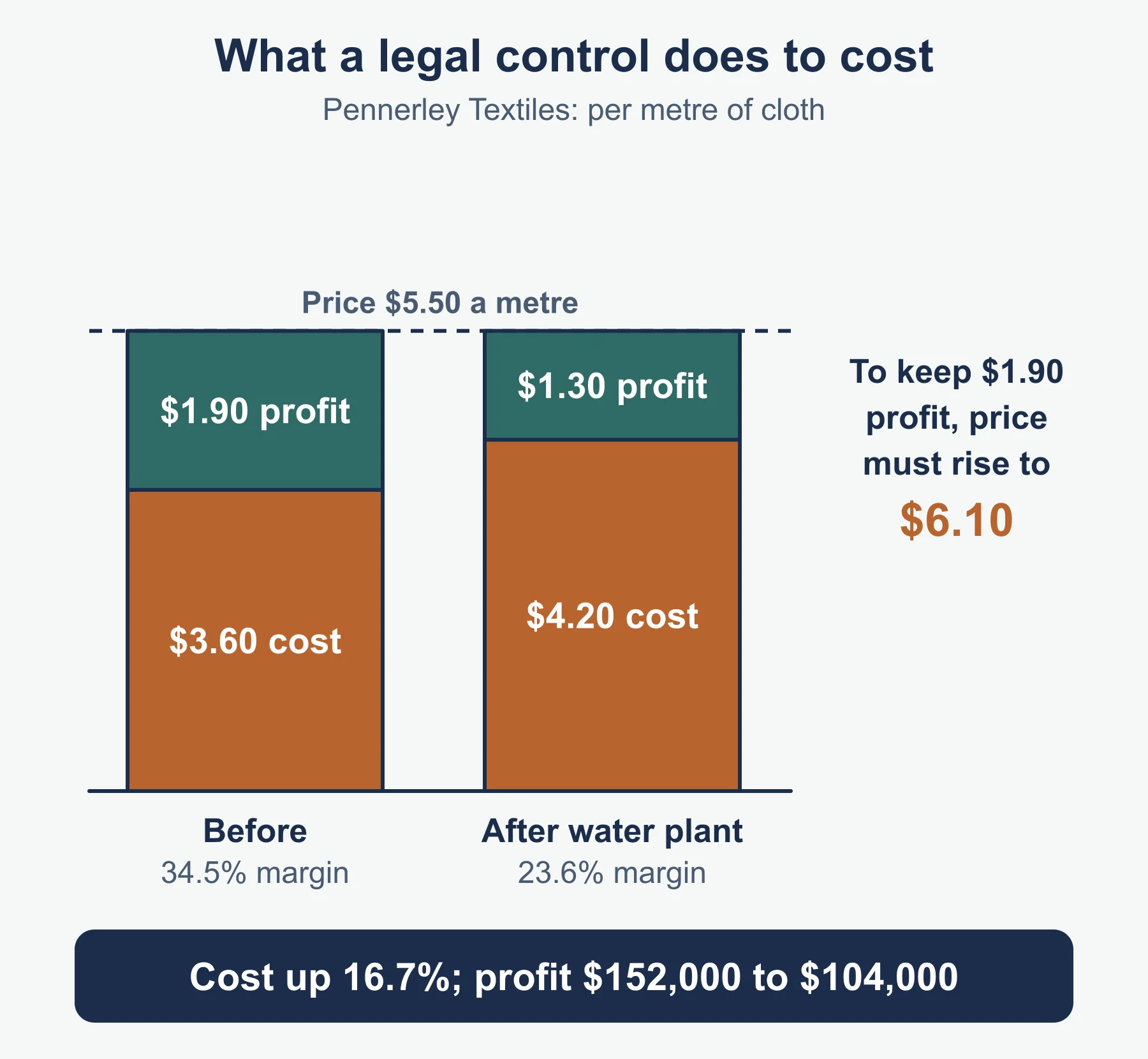
Pennerley Textiles dyes 80,000 metres of cloth a year and sells it for 5.50 dollars a metre. Fixed costs are 120,000 dollars a year and variable cost is 2.10 dollars a metre. A new rule requires a water treatment plant. This adds 36,000 dollars a year to fixed costs and 0.15 dollars to the variable cost of each metre.
Before the rule:
- Total cost = 120,000 + (2.10 × 80,000) = 288,000 dollars.
- Average cost = 288,000 ÷ 80,000 = 3.60 dollars.
- Revenue = 5.50 × 80,000 = 440,000 dollars, so profit = 440,000 − 288,000 = 152,000 dollars.
- Profit margin = 152,000 ÷ 440,000 × 100 = 34.5%.
After the rule:
- Total cost = 156,000 + (2.25 × 80,000) = 336,000 dollars.
- Average cost = 336,000 ÷ 80,000 = 4.20 dollars, a rise of 0.60 dollars, or about 16.7%.
- Profit = 440,000 − 336,000 = 104,000 dollars, and the profit margin falls to 23.6%.
If Pennerley kept its profit at 152,000 dollars, it would need to raise the price to (336,000 + 152,000) ÷ 80,000 = 6.10 dollars. Customers might then buy from rivals, so the business has to weigh the price rise against lower profit.
Worked example: a rule about where to produce
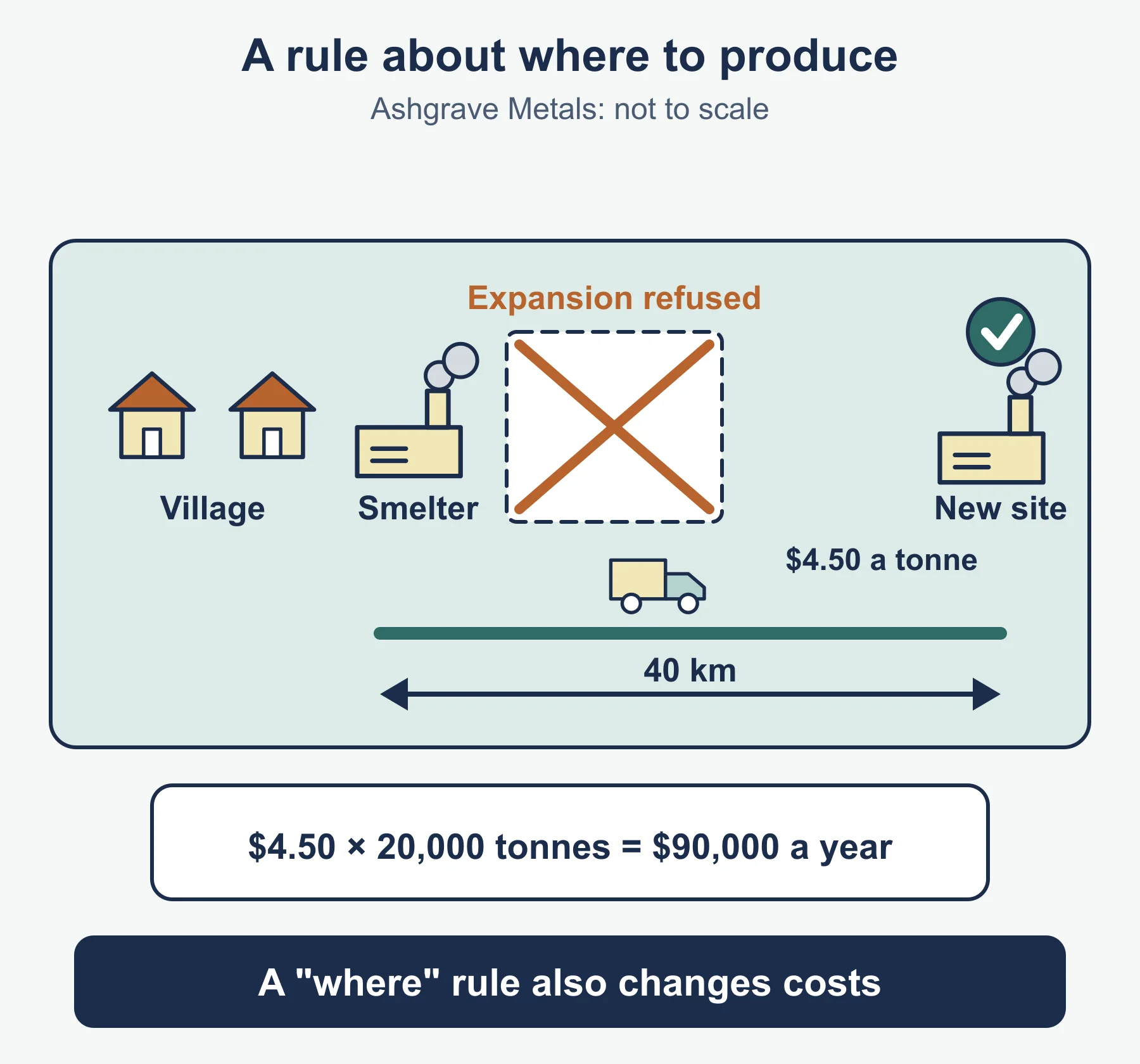
Ashgrave Metals is refused permission to expand its smelter beside a village. The only other site is 40 km away. Moving adds 4.50 dollars per tonne in transport for 20,000 tonnes a year, so 90,000 dollars a year. The firm weighs this cost against giving up the expansion. Note that the rule affected where it produces and also its costs.
Writing good exam answers
The syllabus includes the skill of making recommendations. In several places it asks you to “recommend and justify” a choice for a given situation. On this topic a good answer follows these steps.
- Identify the environmental issue in the question, using the business’s own details.
- Explain the effect, linking cause to consequence to the business, for example “so costs rise, which may force a higher price”.
- Weigh up: compare costs and benefits and the short run with the long run.
- Reach a decision and support it with evidence from the case, using the justify command word: support a case with evidence or argument.
Common errors
- Writing “pollution” with no type or link to the business.
- Treating environmental action as always profitable. It can reduce profit, especially in the short run.
- Forgetting that legal controls may affect where and what a business produces, as well as how.
- Describing a response without its cost, or a cost without its possible gain.
- Saying a legal control stops all pollution. A control limits harm, and firms may still break it.
- Making vague claims about reputation without saying who thinks better of the business, and why that matters to sales.
- Changing the figures in a calculation after working out the costs. Check each step.
Next steps
Work through the practice questions, keep the revision notes beside you for recall, and tick off the checklist. The course hub lists other topics, and the diagnostics are a quick check of what you still need to revise.
Frequently asked questions
What are the four types of pollution? The four types are air pollution, water pollution, land pollution and noise pollution. In an answer, name the type and tie it to what the business in the question does.
What are external costs? External costs are costs of pollution and resource depletion that fall on people other than the business, such as neighbours who breathe dirty air. The business does not pay them unless a law, a fine or public pressure makes it.
How do legal controls affect a business? Environmental laws can control how a business produces, what it produces or sells, and where it produces or sells. They usually raise costs, which may lead to higher prices, lower profit or lost sales.
How can a business reduce its environmental impact? Responses include recycling waste, reducing packaging, using renewable energy or saving energy, installing filters, sourcing from sustainable suppliers, redesigning products or processes, and restoring land. Each response has a drawback, such as extra cost, to weigh against its gain.
Official syllabus
Cambridge IGCSE Business 0264 syllabus for examination in 2027, 2028 and 2029, published by Cambridge University Press & Assessment (Cambridge International Education), section 6.3 Business and the environment.
Get free revision emails (optional)
Occasional emails with practice questions, worked explanations and links to free resources for the qualification and subjects you choose. No spam, and you can unsubscribe from any email. The free tools on this site never need an email.
Related resources
-
Practice questions
IGCSE Business: Business and the environment (Cambridge 0264) – Practice Questions
Original practice questions with worked answers on business and the environment for Cambridge IGCSE Business 0264, with calculation and case items.
Business · Cambridge · IGCSE
Try questions -
Revision notes
IGCSE Business: Business and the environment (Cambridge 0264) – Revision Notes
Condensed revision notes for Cambridge IGCSE Business 0264 section 6.3: environmental harm, business responses and the effects of legal controls.
Business · Cambridge · IGCSE
Revise topic -
Study guides
IGCSE Business: Business and the international economy (Cambridge 0264)
Study guide to globalisation, tariffs, quotas, MNCs, external costs and benefits and exchange rates for Cambridge IGCSE Business 0264, with examples.
Business · Cambridge · IGCSE
Read guide
Related articles
-
teaching
A Level tuition in Dubai: Cambridge or Pearson Edexcel International A Level?
Schools in Dubai and Abu Dhabi teach either Cambridge International AS & A Level or Pearson Edexcel International A Level. How the two are structured, why it matters for tuition, and how online classes from Lahore work.
9 October 2026
-
curriculum guides
Choosing subjects at IGCSE and A Level
How subject choices at 14 and 16 affect university options later, and how to keep pathways open without overloading a timetable.
28 July 2026
Studying this with a teacher
Working through Business IGCSE?
This page is free and stays free. If you would rather be taught it, Marlbridge runs Business classes one-to-one and in small groups of up to 15, online in your own time zone. The first trial class is free. WhatsApp replies within an hour (8am–11pm Pakistan time, every day); email the same day.
Cambridge Business teachers at Marlbridge

