
Revision Notes
OCR A Level Business: Measures of performance: financial and non-financial (H431) – Revision Notes
Condensed recall notes on financial and non-financial measures of performance for OCR A Level Business H431: ratios, cash flow, variances and a self-test.
- Subject
- Business
- Level
- A LEVELS
- Topic
- Business objectives and strategic decisions
- Author
- Marlbridge Academic Team
- Updated
- Reviewed by
- Salman Ahmad (what this means)
Aligned to OCR A Level Business (H431), Version 2.1 (January 2026), for first assessment in 2017; final assessment summer 2027. Official specification .
Syllabus page (what it covers and how it is assessed): OCR A Level Business.
Syllabus points this page covers
H431
- 1.11 Measures of performance: financial and non-financial
Found an error? Report a correction.
Need help with this topic? Request a free trial class for A Level Business (H431).
These notes condense the Measures of performance: financial and non-financial content point of the OCR A Level Business H431 specification (Version 2.1, January 2026; final assessment summer 2027). For full explanations and longer worked examples, read the study guide, then test yourself with the practice questions.
Related pages: the OCR A Level Business hub, the printable checklist, the free 10-minute diagnostics, and the wider unit revision notes and study guide.
The two families of measure
| Family | Examples named in the specification | Typical strength | Typical weakness |
|---|---|---|---|
| Financial | Final accounts, ratio analysis, gearing, cash flow, budgets, variance analysis | Precise, comparable | Looks backwards; misses quality and people |
| Non-financial | Market share, resource utilisation, environmental impact, quality, customer satisfaction | Early warning; links to objectives | Hard to compare; does not show profit |
Use both. The specification asks you to evaluate performance using financial and non-financial measures together.
Profit measures
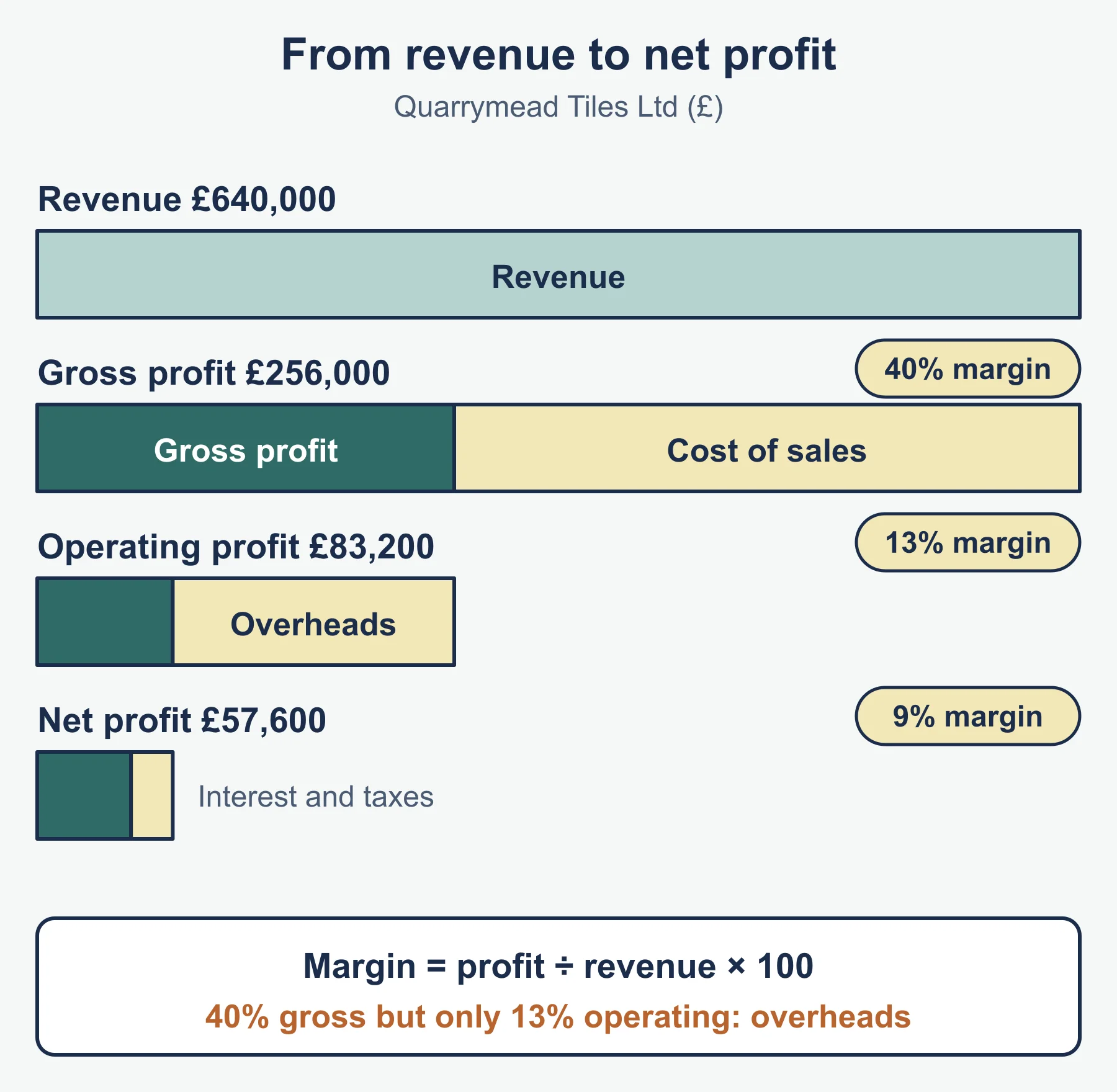
- Gross profit: sales revenue less cost of sales.
- Operating profit: gross profit less operating expenses.
- Net profit: operating profit less finance costs (and tax, where given).
Final accounts are the income statement (trading over a period) and the statement of financial position (assets, liabilities and equity at one date).
Ratios at a glance
Standard forms (the specification does not print formulas, so state yours if a question does not).
| Group | Measure | Calculation |
|---|---|---|
| Liquidity | Current ratio | current assets divided by current liabilities |
| Liquidity | Acid test | current assets less inventory, divided by current liabilities |
| Profitability | Gross margin | gross profit as % of sales revenue |
| Profitability | Net margin | net profit as % of sales revenue |
| Profitability | ROCE | operating profit as % of capital employed |
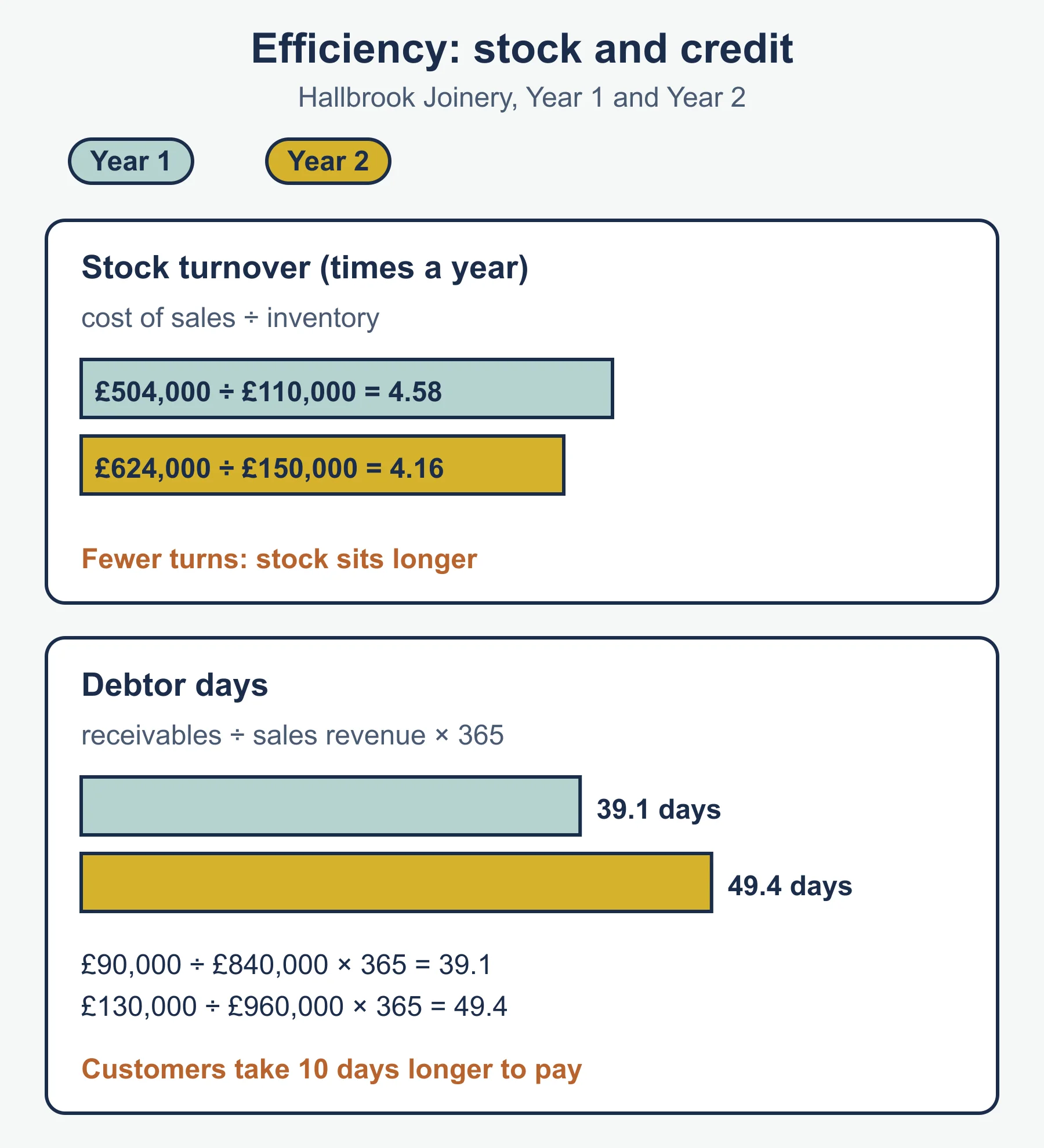
| Efficiency | Stock turnover | cost of sales divided by inventory |
| Efficiency | Debtor days | receivables divided by sales revenue, times 365 |
| Solvency | Gearing | non-current liabilities as % of capital employed |
| Solvency | Interest cover | operating profit divided by finance costs |
Method in steps
- Write the formula before the numbers.
- Pick the right figures (operating profit for ROCE, not net profit, unless told otherwise).
- Calculate, then give units: %, times, days.
- Compare: with last year, a target, or a rival.
- Explain the cause and the consequence for a named stakeholder.
- Judge: how serious, and what it depends on.
Worked reminder: Redwick Tiles Ltd
Sales revenue £200,000, cost of sales £120,000, operating expenses £50,000, finance costs £4,000, inventory £25,000, receivables £20,000, cash £5,000, current liabilities £30,000, non-current liabilities £75,000, capital employed £250,000.
- Gross profit £80,000, so gross margin 40.0%.
- Operating profit £30,000; net profit £26,000, so net margin 13.0%.
- Current ratio 50,000 / 30,000 = 1.67; acid test 25,000 / 30,000 = 0.83.
- ROCE 30,000 / 250,000 = 12.0%; gearing 75,000 / 250,000 = 30.0%; interest cover 30,000 / 4,000 = 7.5 times.
- Stock turnover 120,000 / 25,000 = 4.8 times; debtor days 20,000 / 200,000 x 365 = 36.5 days.
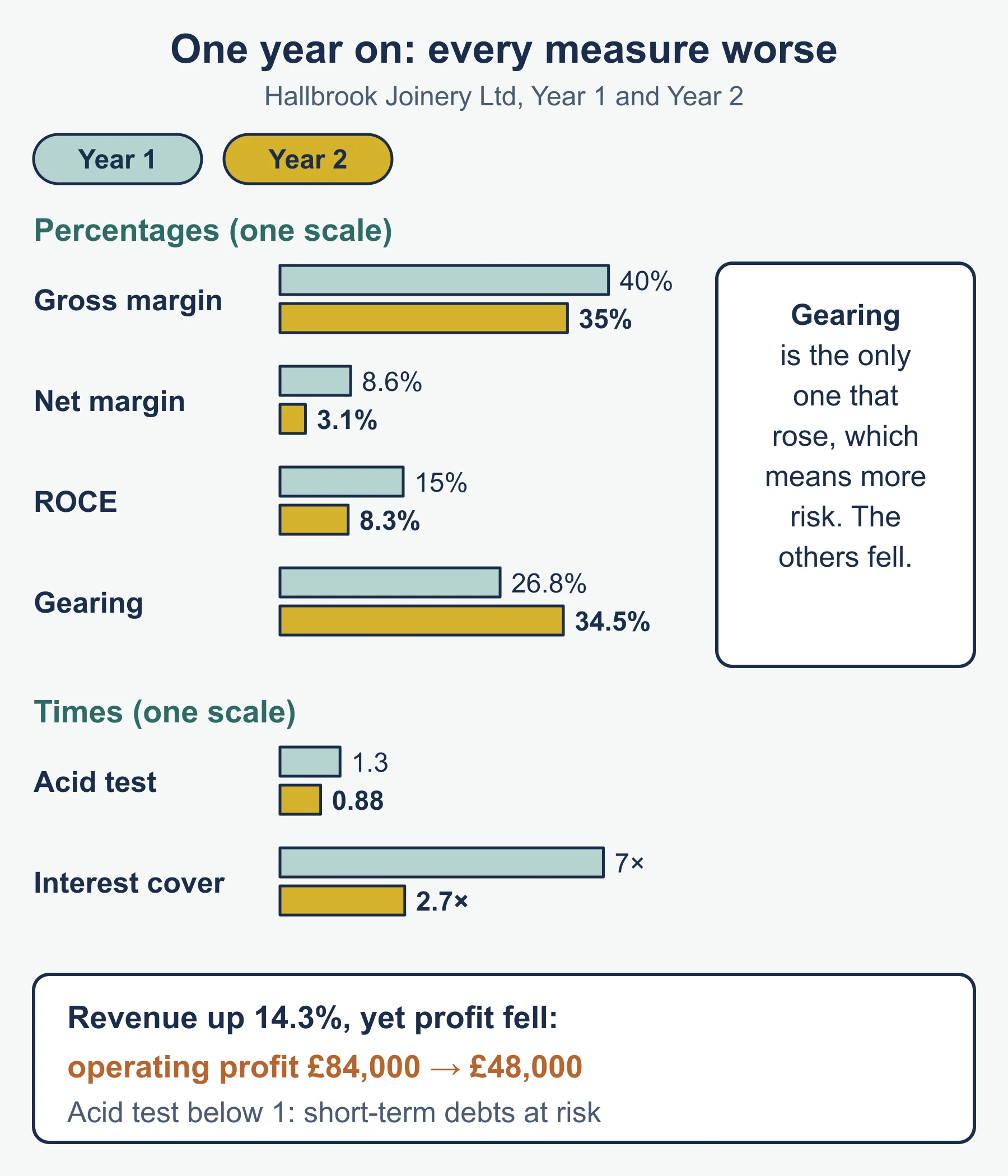
An acid test of 0.83 is below 1, so liquid assets do not fully cover current liabilities. That need not be fatal if inventory sells quickly, so say what it depends on.
Must-know distinctions
| Pair | Key difference |
|---|---|
| Profit and cash flow | Profit is revenue minus costs; cash flow is money moving. Credit, inventory, depreciation and capital spending drive them apart |
| Cash-flow forecast and cash-flow statement | Forecast looks ahead and plans; statement records what happened |
| Liquidity, profitability, efficiency | Ability to pay short-term debts; return on sales or capital; use of assets and credit |
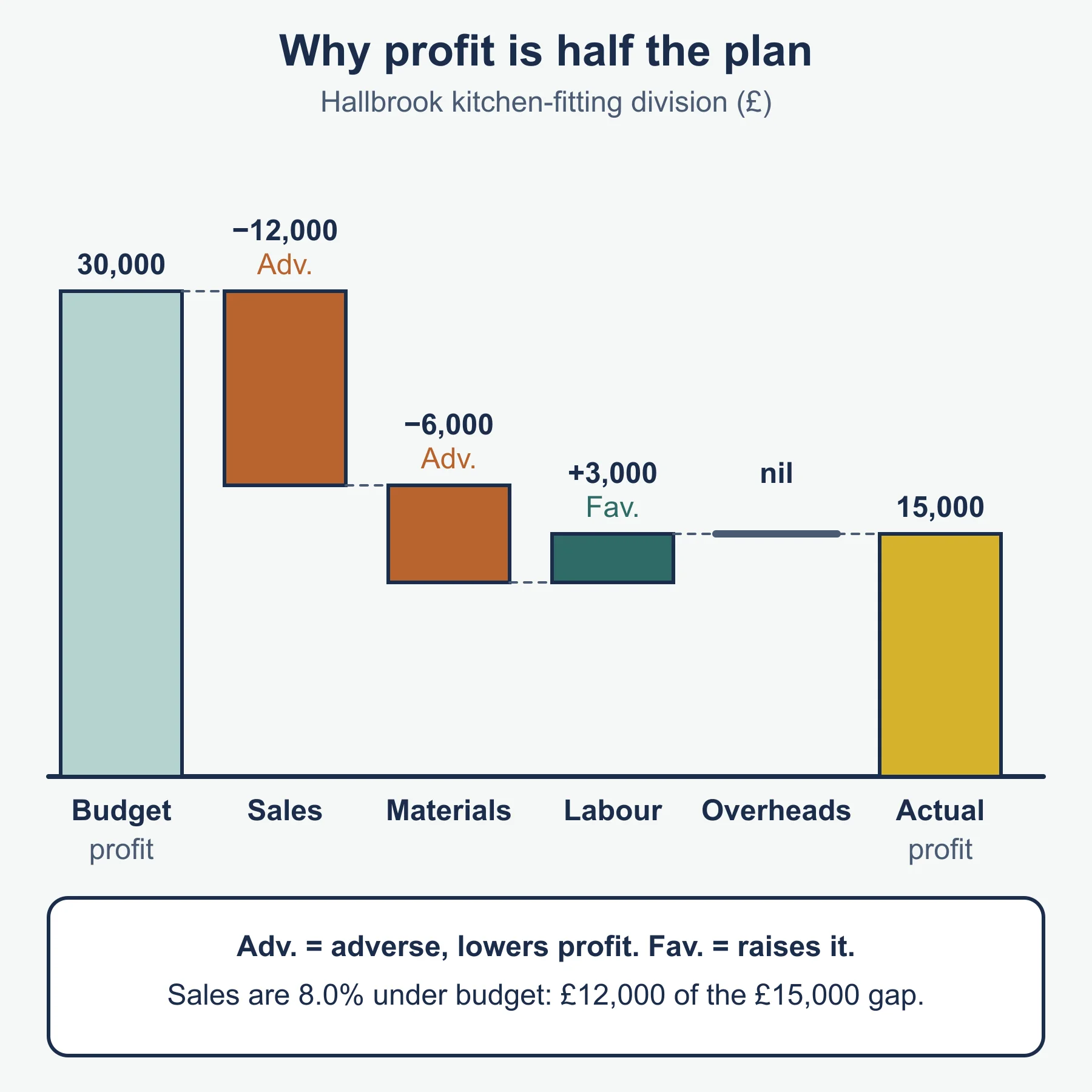
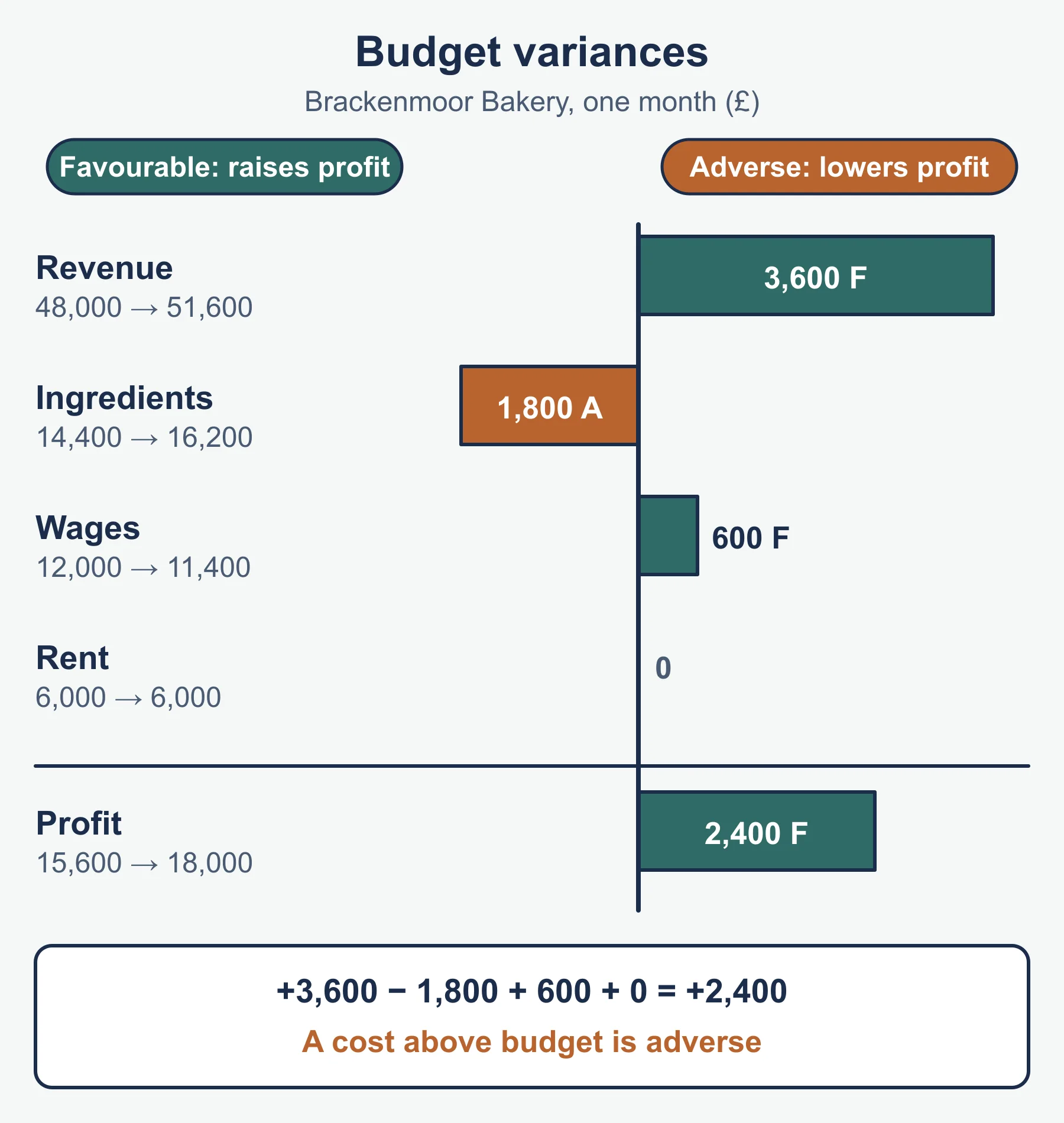
| Favourable and adverse variance | Favourable raises profit; adverse reduces it |
| Budget and variance | The plan; the gap between plan and actual |
| Gearing and liquidity | Long-term borrowing burden; short-term payment ability |
Cash-flow problems and responses
Causes: slow-paying customers, heavy stock buying, large one-off spending, seasonal sales, falling revenue. Responses: overdraft or loan (costly, raises gearing), faster debt collection (may upset customers), longer credit from suppliers (may harm relations), delaying or leasing purchases. Judge by the size and length of the gap.
Variance rules
Revenue above budget: favourable. Costs above budget: adverse. Costs below budget: favourable. Redwick budgeted a monthly delivery cost of £18,000 and spent £19,500: a variance of £1,500 adverse. Variances show where to investigate, not the reason. Causes may be external (supplier prices) or internal (a poor budget).
Why published accounts are incomplete
- They report the past, not the future.
- They omit quality, morale, loyalty and environmental harm.
- They depend on judgements about depreciation and valuation.
- They rarely show market position or rivals.
- A year-end snapshot can hide seasonal swings.
Non-financial measures
| Measure | Example indicator | Why it matters |
|---|---|---|
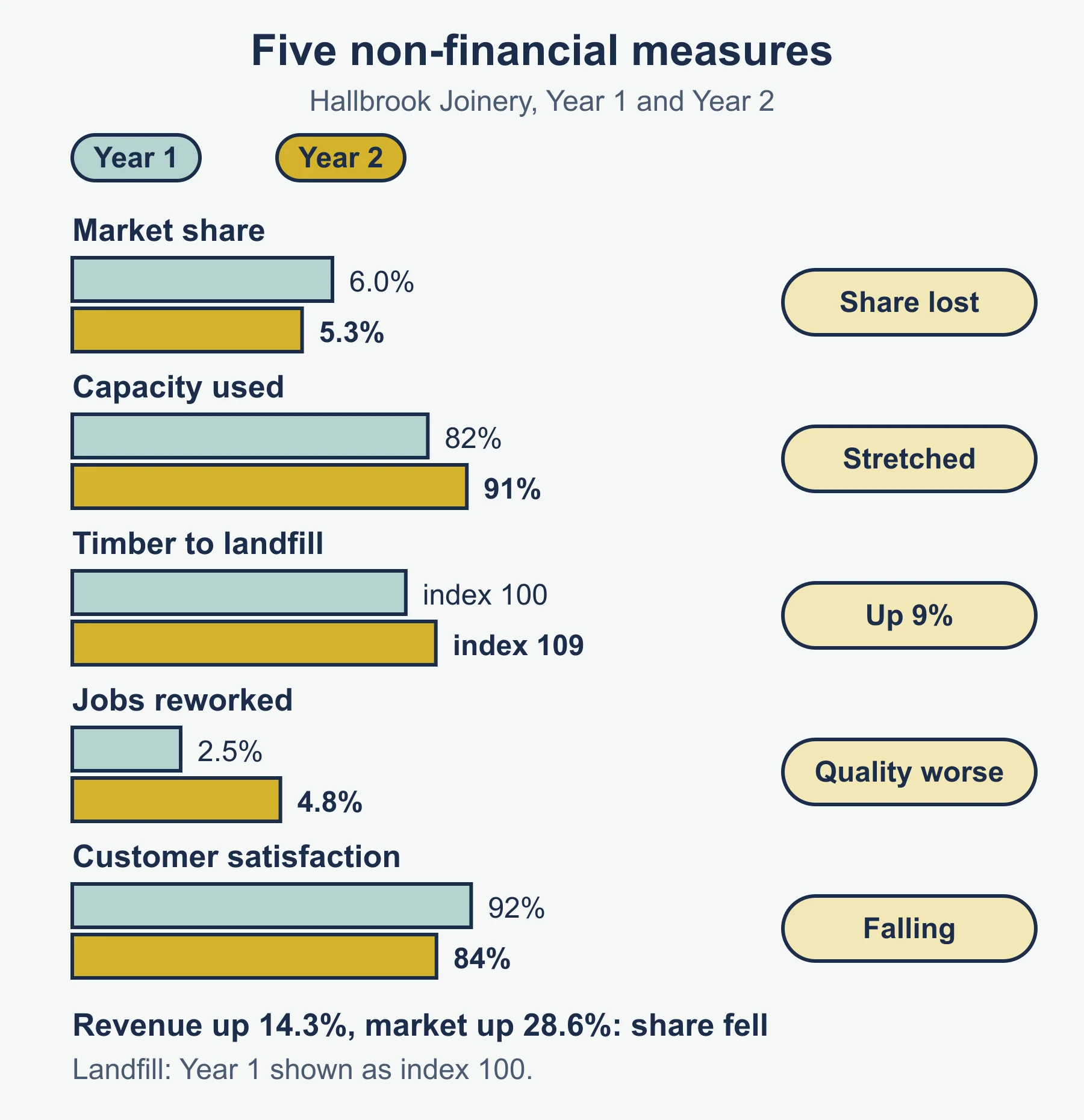
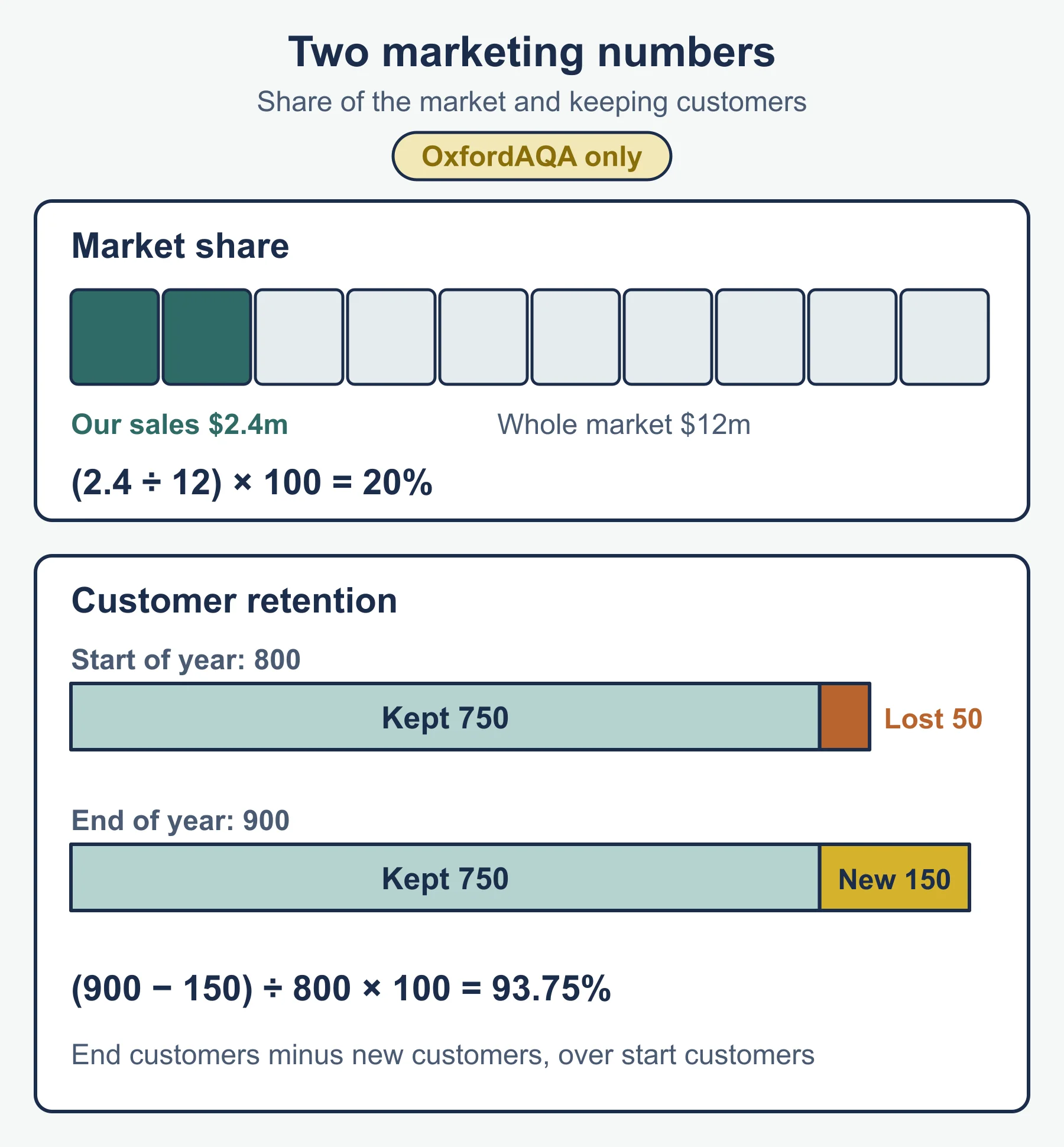
| Market share | Business sales / market sales, as % (£3.2m of £40m is 8.0%) | Shows competitive standing |
| Resource utilisation | Capacity used, machine hours, staff time | Spots waste or overload |
| Environmental impact | Waste, emissions, energy per unit | Reputation, cost, regulation |
| Quality | Defect and return rates | Protects reputation |
| Customer satisfaction | Survey scores, complaints, repeat custom | Predicts future sales |
| Others (etc.) | Staff turnover, delivery times | Link to people and service objectives |
Why measure, and the trade-offs
Reasons: to check progress against objectives, to compare with past and rivals, to control costs, to inform decisions, to report to stakeholders. Advantages: sharper decisions, early warnings, accountability. Disadvantages: cost and time, focus on what is easy to count, short-term pressure, possible manipulation.
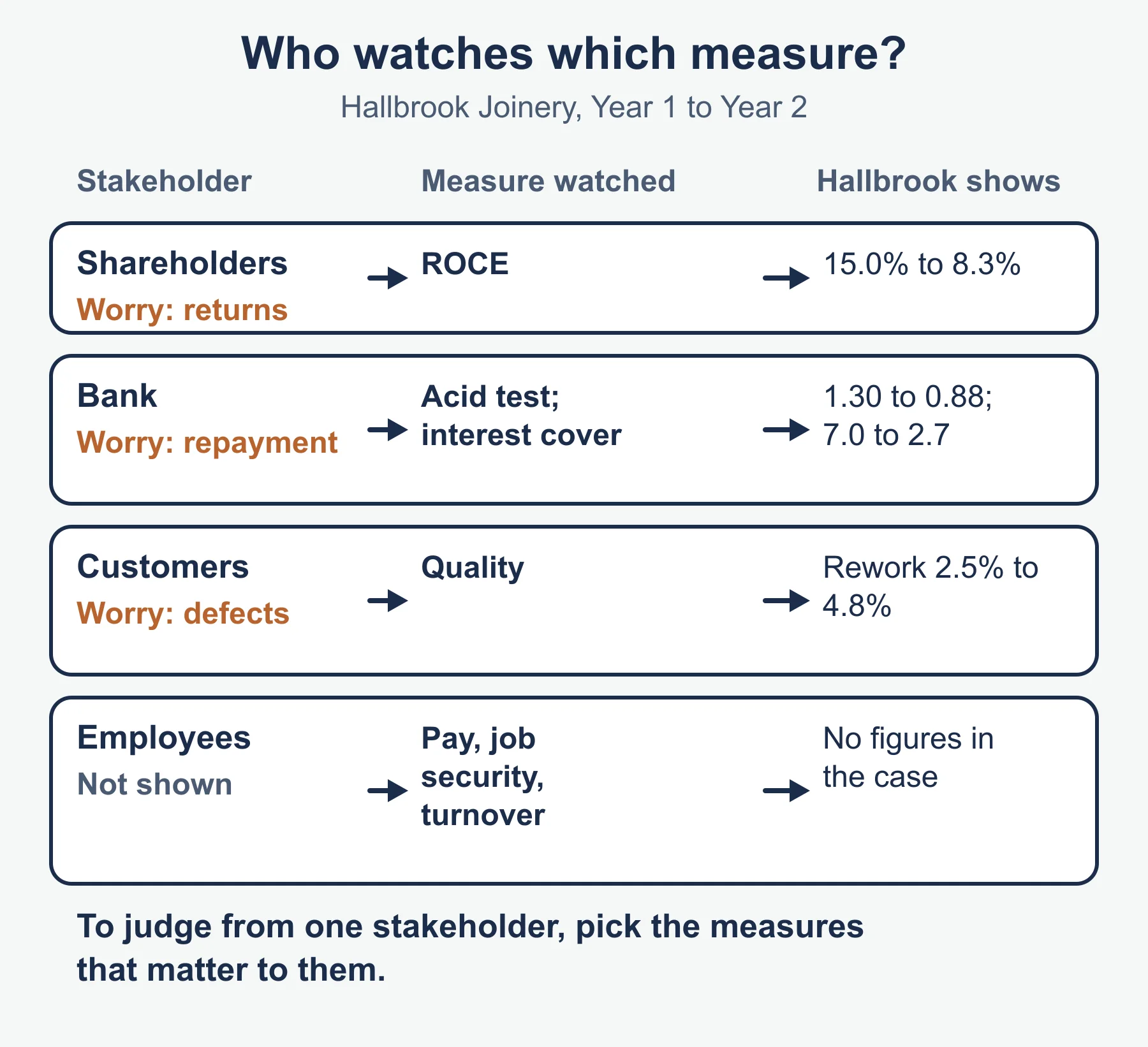
Stakeholder lens
| Stakeholder | Likely priority measures |
|---|---|
| Shareholders | Profit margins, ROCE, returns |
| Lenders | Gearing, interest cover, liquidity |
| Employees | Pay, job security, staff turnover |
| Customers | Quality, satisfaction |
| Suppliers | Payables record, liquidity |
| Community | Environmental impact, local jobs |
Worked reminder: cash flow against profit
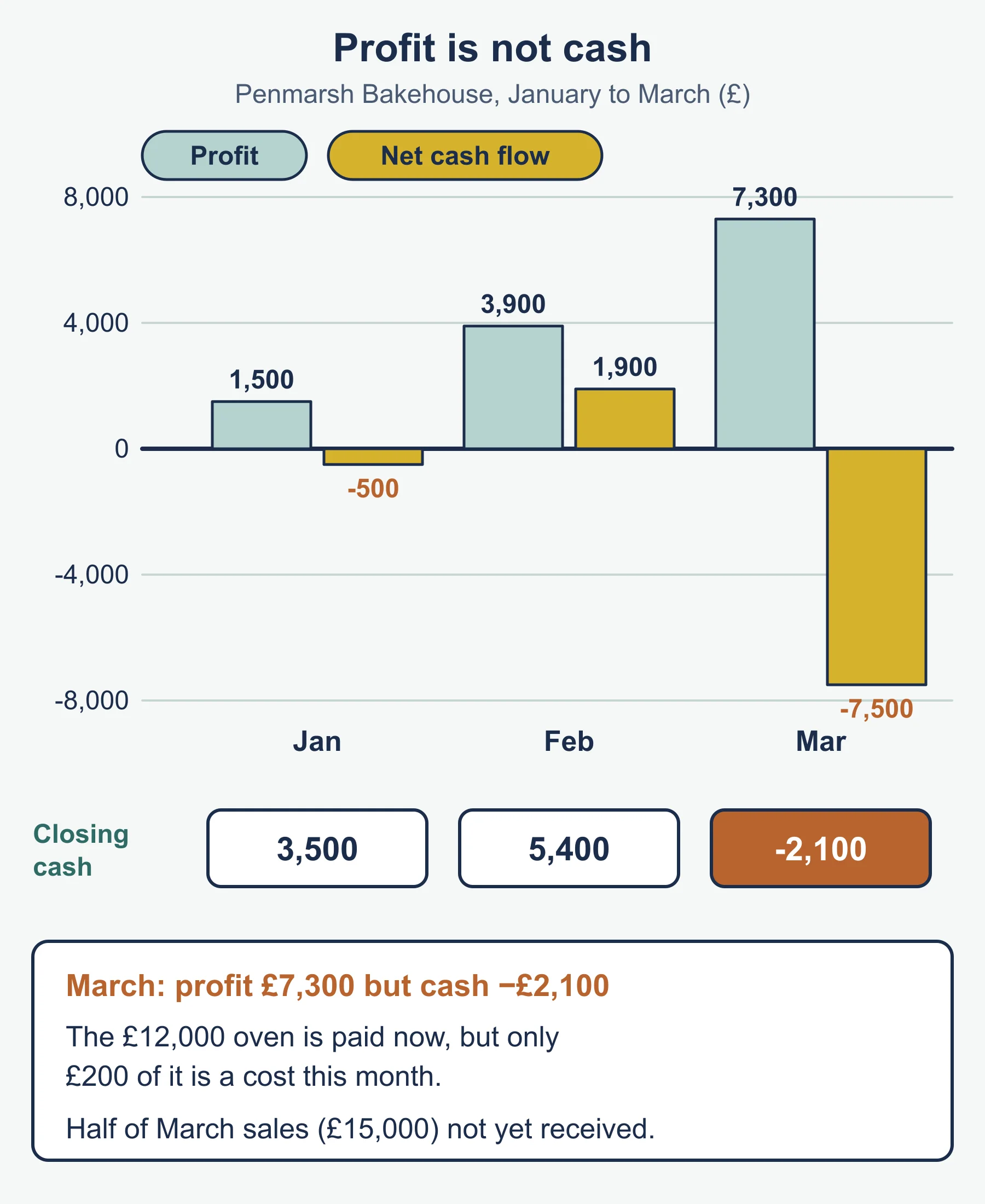
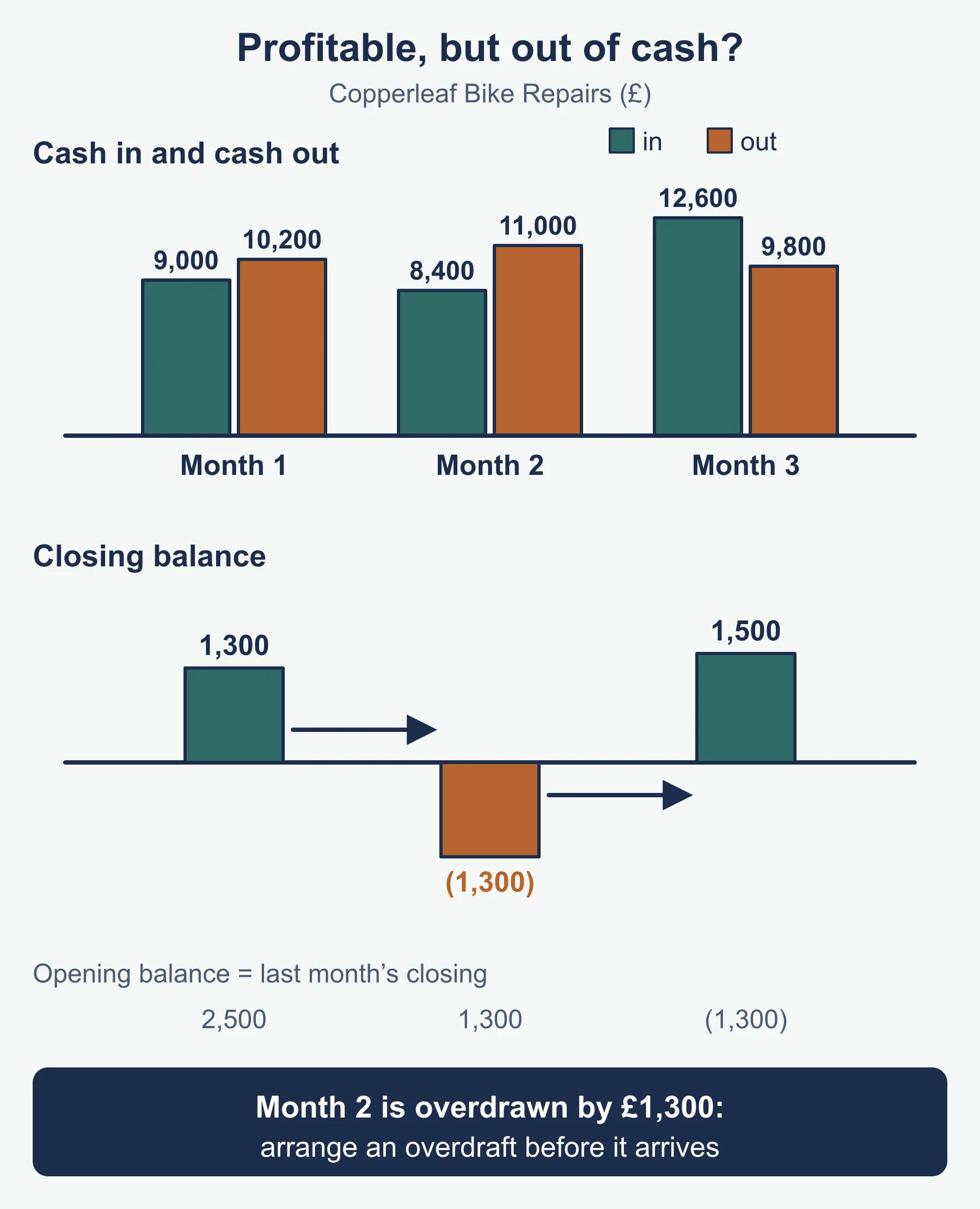
In one month Redwick records sales revenue of £25,000 and running costs of £21,000, so profit is £4,000 (depreciation ignored). Customers actually pay £22,000, and the business pays £21,000 of costs plus the £6,000 van.
- Cash in £22,000, cash out £27,000, so net cash flow -£5,000.
- With £5,000 opening cash, closing cash is £0.
A profit and a zero bank balance sit side by side. The gap comes from late-paying customers and spending on a non-current asset.
Evaluating performance: a template
- Pick the measures that fit the question’s stakeholder or objective.
- Calculate and compare each one with a past year, a target or a rival.
- Say what each shows and why it moved.
- Set the financial picture against the non-financial one: do they agree?
- Weigh the points that support success against those that suggest weakness.
- Reach a judgement, stating what it depends on, such as the length of the trend, the reliability of the data or the business’s objectives.
A good conclusion names the single most important measure for the stakeholder in question and says why. A weak one repeats the figures.
Quick self-test
- State one financial and one non-financial measure of performance.
- Redwick’s cost of sales rises to £130,000 on the same revenue. Calculate the new gross margin.
- Which is the stricter test of liquidity: current ratio or acid test?
- Redwick spends £6,000 on a van paid in cash. Does it change profit this month?
- Costs are £7,500 under budget. Favourable or adverse?
- A business has sales of £3.2m in a market worth £40m. State its market share.
- Why can a profitable business still fail?
- Which ratio group does debtor days belong to?
- State two limits of published accounts.
- Name one stakeholder who would pay close attention to interest cover, and why.
Answers
- Examples: net profit (financial); customer satisfaction score (non-financial).
- Gross profit £70,000, so gross margin 35.0%.
- The acid test, because it excludes inventory, which is slower to turn into cash.
- No, apart from any depreciation charge. Cash falls by £6,000 immediately, which shows how cash and profit differ.
- Favourable: lower cost raises profit.
- 8.0%.
- It may run out of cash because customers pay late or money is tied up in inventory and equipment.
- Efficiency.
- They are historic, and they omit non-financial matters such as quality or morale.
- A lender or bank, because interest cover shows whether profit can meet loan interest.
Where marks are usually lost
- Giving a ratio without units, or without writing the formula.
- Describing a figure (“it went up”) with no cause or consequence.
- Using net profit when the ratio needs operating profit.
- Treating high gearing as always bad, with no mention of what it depends on.
- Confusing liquidity with profitability.
- Labelling every variance adverse.
- Listing non-financial measures with no link to the business in the case.
- Evaluating from one viewpoint only when the question names several stakeholders.
- Ending an “evaluate” answer without a reasoned judgement.
Frequently asked questions
What is the difference between liquidity and profitability? Liquidity is the ability to pay short-term debts, judged by the current ratio and acid test. Profitability is how well the business turns revenue or capital into profit, judged by margins and ROCE; confusing the two is a common error.
Which profit figure do ratios such as ROCE use? Use operating profit where the ratio needs it, as in ROCE and operating margin. Using net profit instead is a common way to lose marks.
What does interest cover show? Interest cover = operating profit ÷ finance costs, a solvency measure that shows how many times profit covers the interest the business must pay. A low figure means a fall in profit could make interest hard to meet.
Should non-financial measures be used alongside financial ones? Yes. Measures such as market share, capacity utilisation, staff turnover and emissions show what the accounts miss, but each must be linked to the business in the case.
Official syllabus
OCR Level 3 Advanced GCE in Business (H431), Version 2.1 (January 2026), OCR; section Measures of Performance: financial and non-financial, Business objectives and strategy.
Get free revision emails (optional)
Occasional emails with practice questions, worked explanations and links to free resources for the qualification and subjects you choose. No spam, and you can unsubscribe from any email. The free tools on this site never need an email.
Related resources
-
Study guides
OCR A Level Business: Mission statement and Corporate social responsibility (CSR) (H431)
Study guide to mission statements and corporate social responsibility for OCR A Level Business, with worked examples and evaluation skills.
Business · OCR · A Level
Read guide -
Practice questions
OCR A Level Business: Mission statement and Corporate social responsibility (CSR) (H431) – Practice Questions
Original practice questions with worked answers on mission statements and CSR for OCR A Level Business, mixing short answers, calculations and cases.
Business · OCR · A Level
Try questions -
Revision notes
OCR A Level Business: Mission statement and Corporate social responsibility (CSR) (H431) – Revision Notes
Condensed revision notes on mission statements and CSR for OCR A Level Business, with evaluation checklists and a short self-test.
Business · OCR · A Level
Revise topic
Related articles
-
teaching
A Level tuition in Dubai: Cambridge or Pearson Edexcel International A Level?
Schools in Dubai and Abu Dhabi teach either Cambridge International AS & A Level or Pearson Edexcel International A Level. How the two are structured, why it matters for tuition, and how online classes from Lahore work.
9 October 2026
-
curriculum guides
Choosing subjects at IGCSE and A Level
How subject choices at 14 and 16 affect university options later, and how to keep pathways open without overloading a timetable.
28 July 2026
Studying this with a teacher
Working through Business A LEVELS?
This page is free and stays free. If you would rather be taught it, Marlbridge runs Business classes one-to-one, online in your own time zone. One-to-one only for this course: Rs 6,000 per class in Pakistan, with other currencies on the fees page. The first trial class is free. WhatsApp replies within an hour (8am–11pm Pakistan time, every day); email the same day.
OCR Business teachers at Marlbridge
