
Revision Notes
OxfordAQA A-Level Business: The nature and purpose of business and Types of business ownership (9625/9725) – Revision Notes
Condensed OxfordAQA International AS Business notes on 3.1.1.1 and 3.1.1.2: formulas, ownership table, key distinctions and a checked self-test.
- Subject
- Business
- Level
- AS LEVEL
- Topic
- What is business?
- Author
- Marlbridge Academic Team
- Updated
- Reviewed by
- Salman Ahmad (what this means)
Aligned to OxfordAQA A Level Business (9625, 9725), 9625: first teaching September 2018 (current cohorts). 9725: first teaching September 2026 (AS) / September 2027 (A2), the successor specification.. Official specification .
Syllabus page (what it covers and how it is assessed): OxfordAQA A Level Business.
Found an error? Report a correction.
Need help with this topic? Request a free trial class for A Level Business (9625 / 9725).
Condensed recall for the final weeks. For full explanations and worked examples, use the study guide.
These notes cover sections 3.1.1.1 The nature and purpose of business and 3.1.1.2 Types of business ownership of the OxfordAQA International AS and A-level Business specifications 9625 (AS exams May/June 2019 onwards) and 9725 (AS exams May/June 2027 onwards). Both are Unit 1 content. Points are tagged both, 9625 or 9725, because the wording of the two specifications differs. Revise the tagged points for the one you are following. Examples of motivations, challenges, why start-ups fail, and advantages and disadvantages are Marlbridge’s own wording.
Links: course hub · printable checklist · practice questions · free 10-minute diagnostics · earlier What is business? revision notes
Key terms (9625)
| Term | One-line meaning |
|---|---|
| Inputs | Land, labour, capital, enterprise |
| Transformation process | What the business does to turn inputs into outputs |
| Outputs | Goods (physical) and services (not physical) |
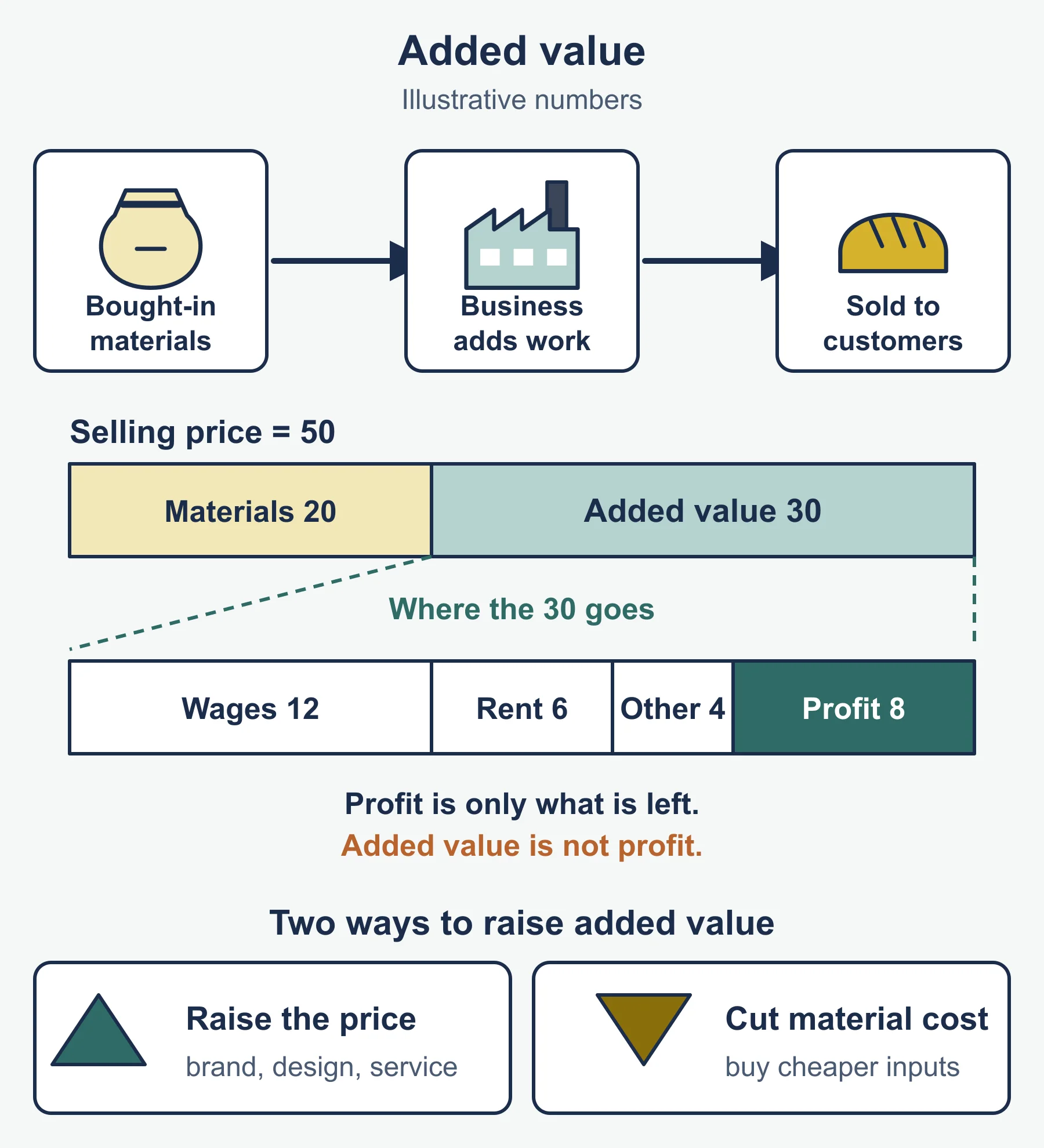
| Adding value | Output worth more to customers than the input cost |
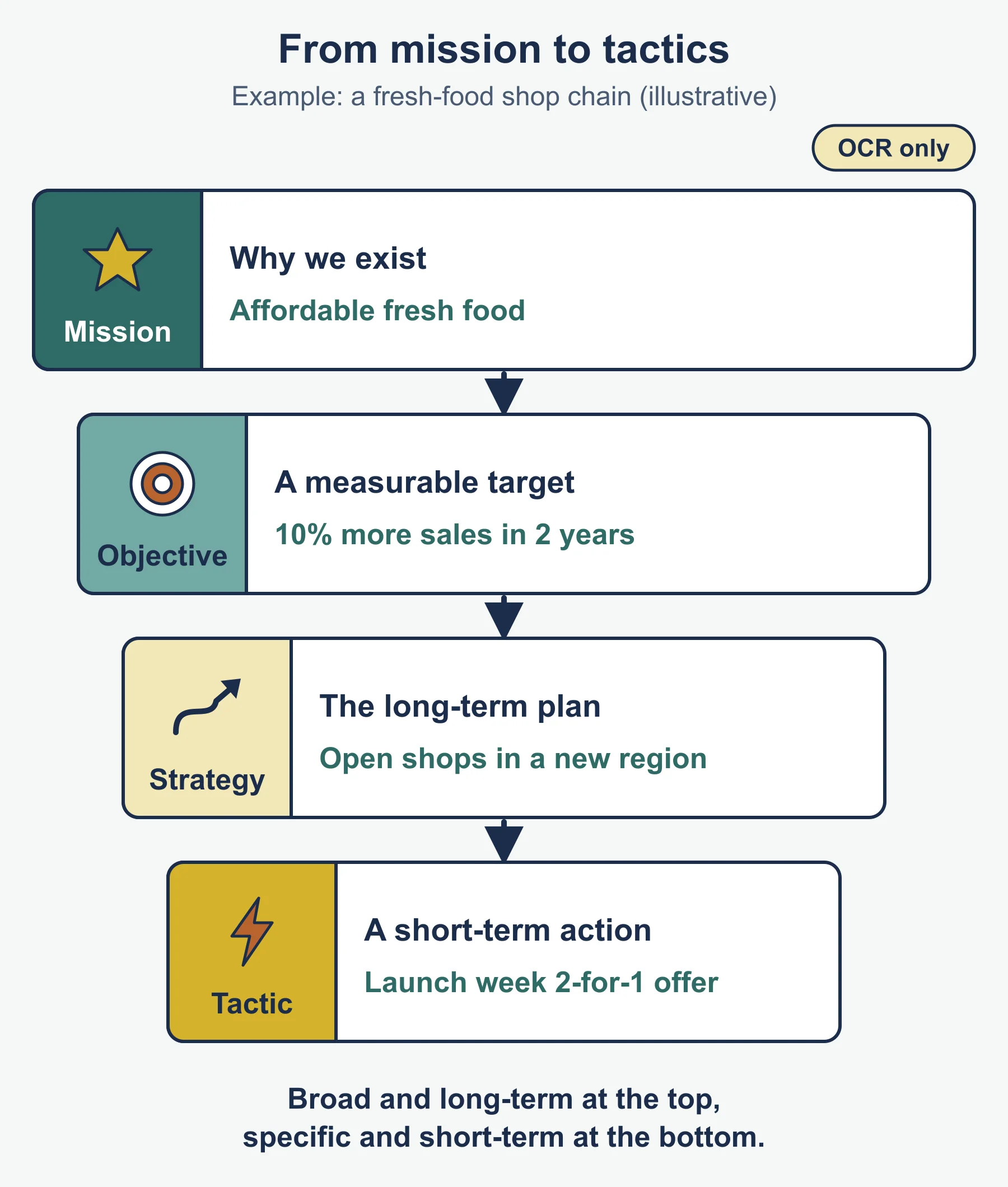
| Strategy / tactics | Long-term plan / short-term actions |
| Profit | Revenue minus costs |
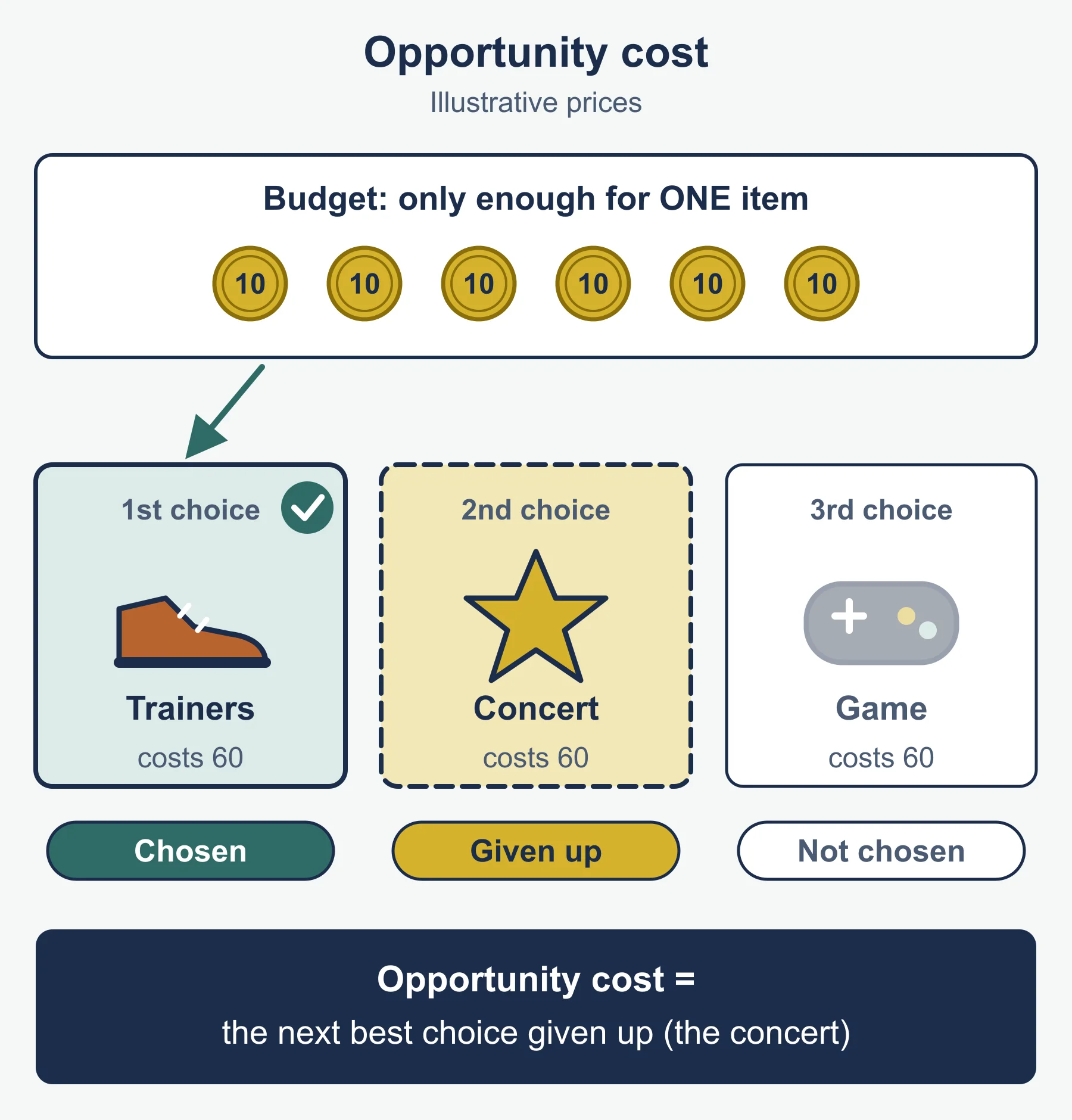
| Opportunity cost | Next best alternative given up |
| Efficiency | Producing more from unchanged inputs, or the same from less |
| Competitiveness | How well the firm does against rivals |
| Risk | Chance the outcome is worse than planned |
| KPIs | Measures used to track performance against targets |
| Customers / consumers | Those who buy / those who use |
| Owners / managers | Risk-takers who supply capital / people who run the firm day to day |
| Business functions | Marketing, operations, human resources, finance and so on |
| Ethical influences | Views of right and wrong that shape decisions |
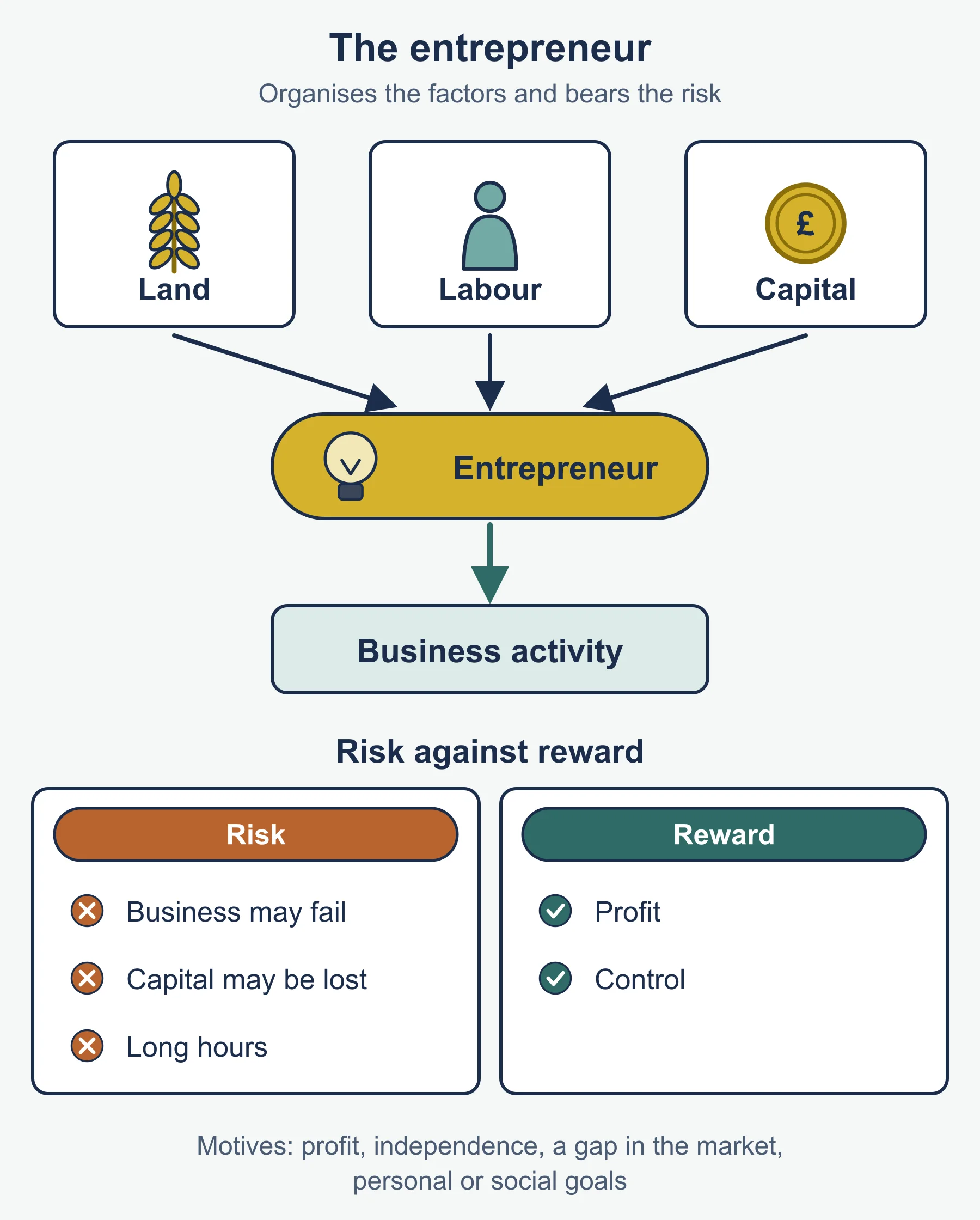
Entrepreneurs
- Motives (both): 9725 names financial and non-financial; our examples are income, wealth, independence, passion, flexibility, helping others.
- Characteristics (both; 9725 names them): risk taker, resilient, hard working, creative, passionate, innovative, adaptable.
- Challenges (both): capital, uncertain demand, cash flow, long hours, personal risk.
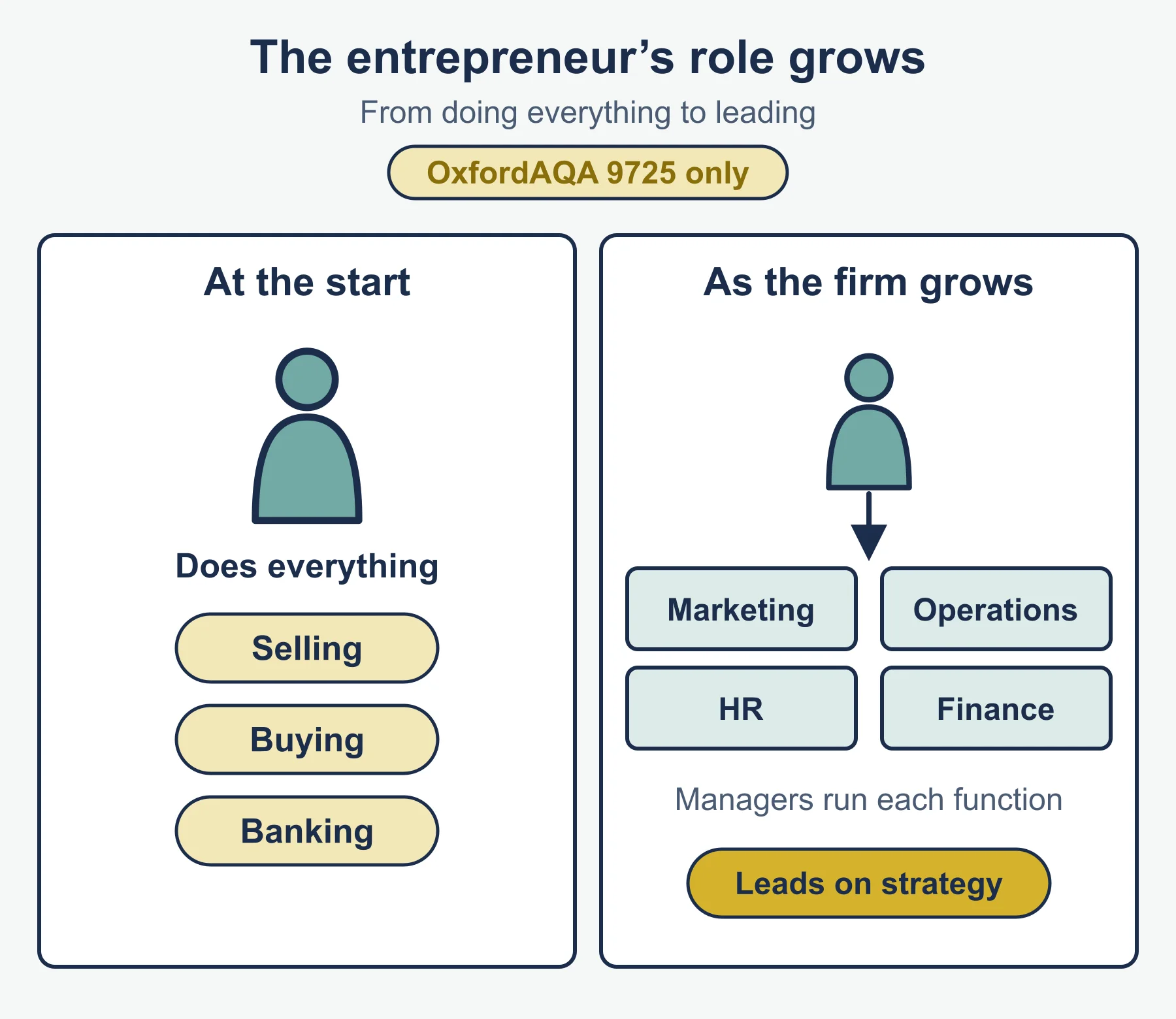
- Role as the firm grows (9725): from doing everything to delegating and leading strategy.
- Opportunity (9625): a gap, an unmet need or a better way of doing something.
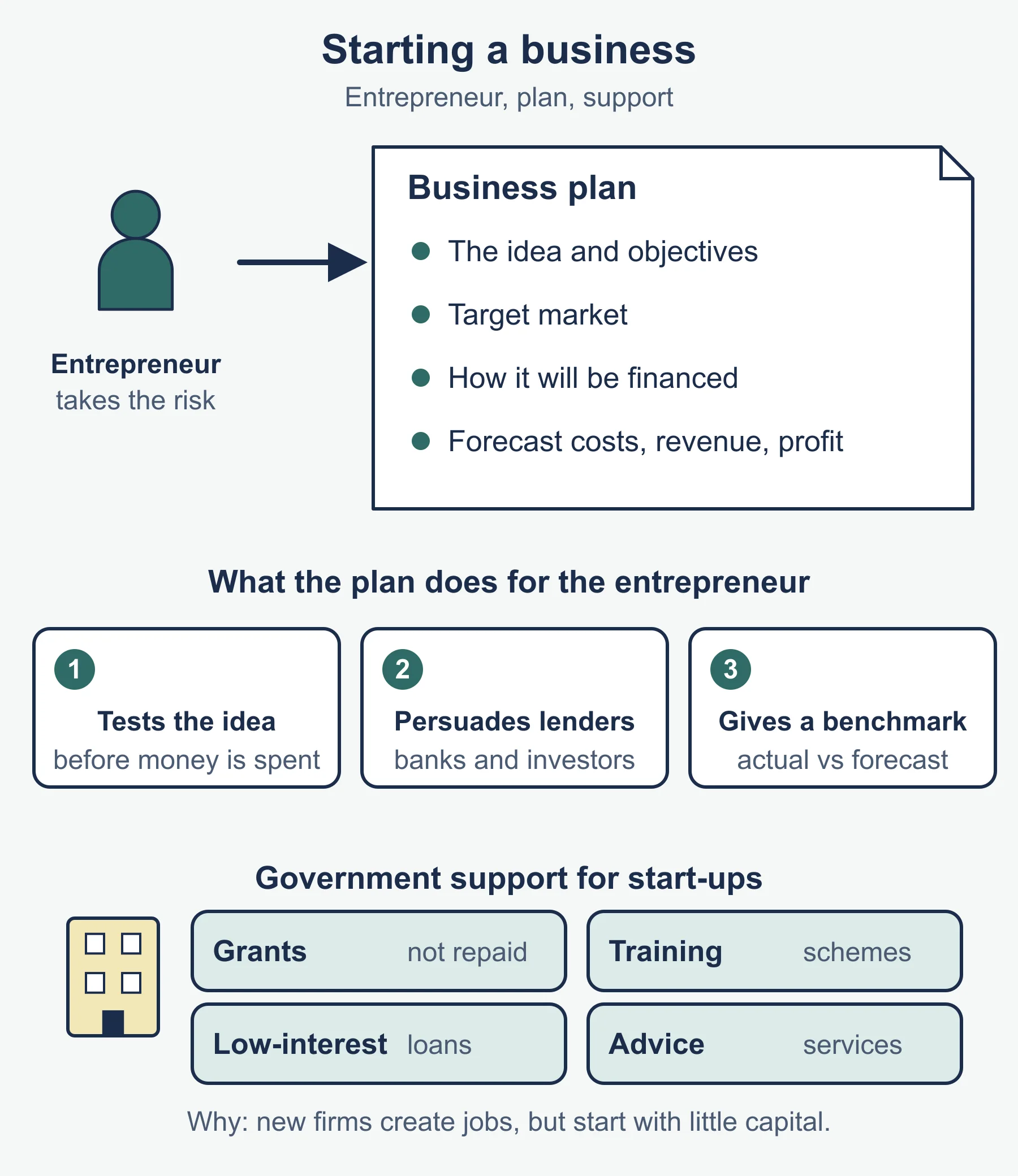
- Environment and government (9625): finance, tax, regulation, skills and stability shape success. Governments support start-ups for jobs, competition and tax, through grants, loans, tax breaks and advice.
- Number and type of start-ups (9625): economic conditions, ease of borrowing, attitudes to risk, skills.
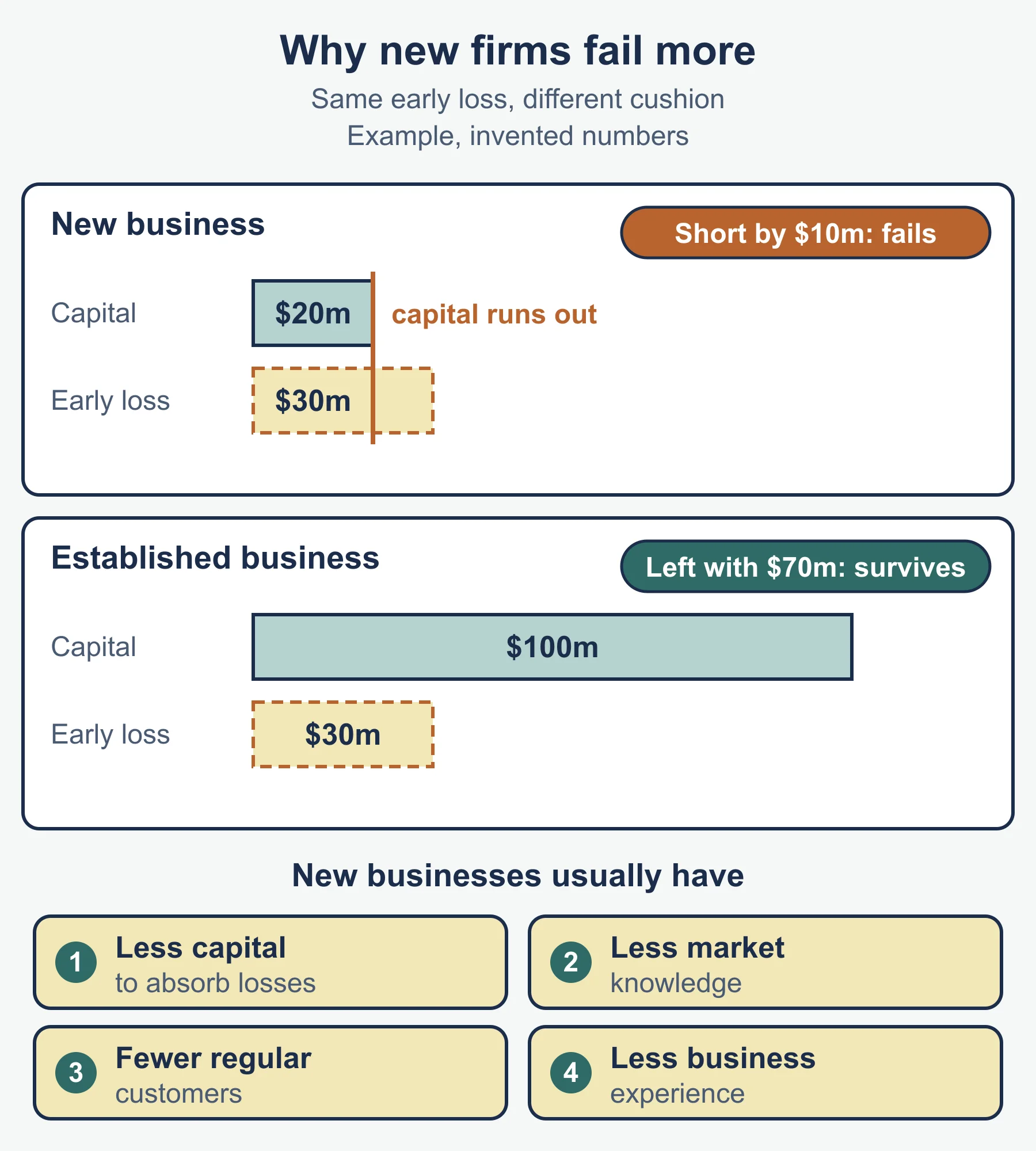
- Why start-ups fail (9625): poor cash flow, weak research, too little capital, weak management, underestimated costs.
- Impact on economy and society (9625): jobs, incomes, tax, growth, choice; also pollution or lost local trade.
Objectives, SMART and plans
| Point | Notes |
|---|---|
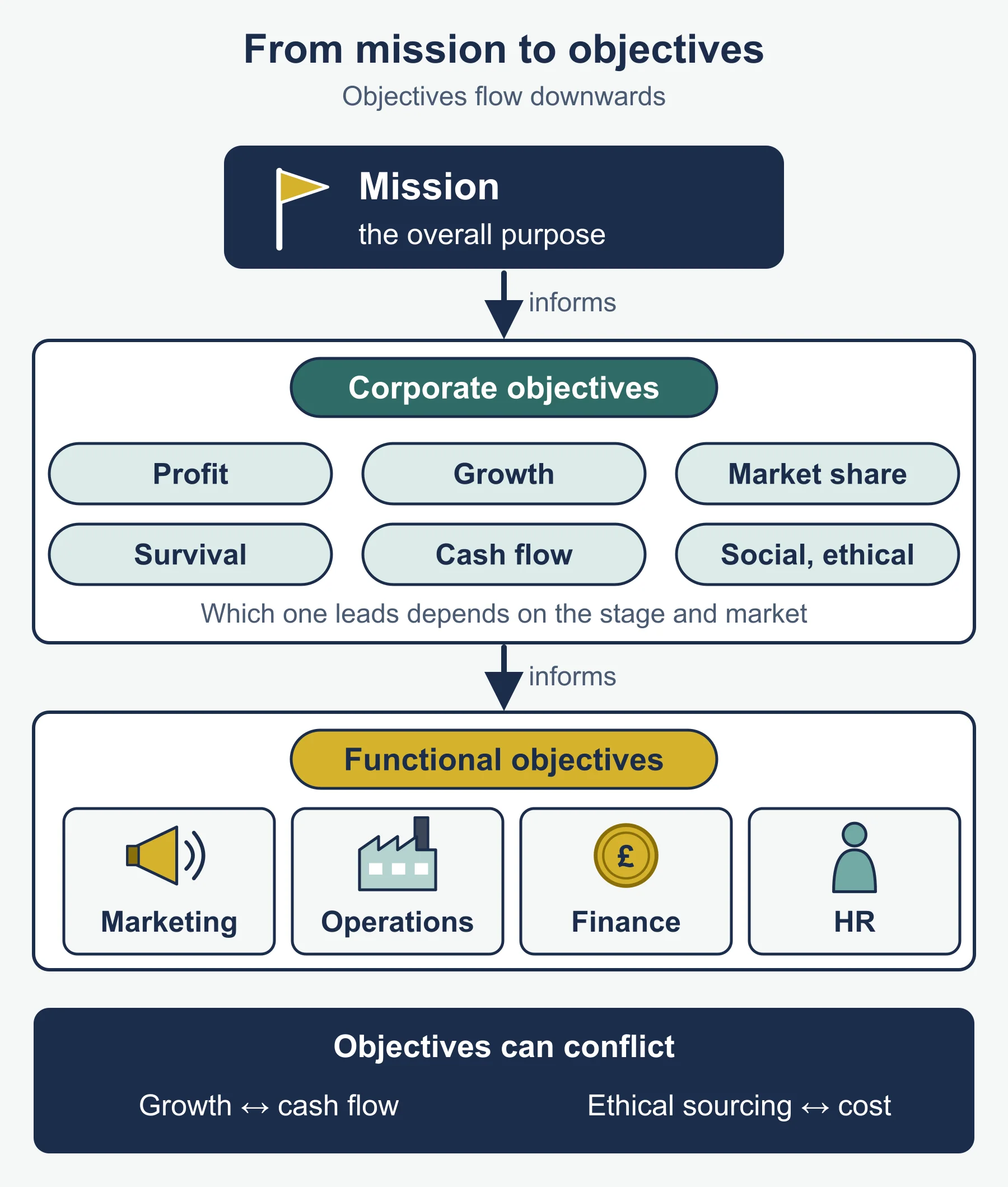
| Typical objectives | Survival, profit, growth, cash flow, social (both); personal and ethical (9625) |
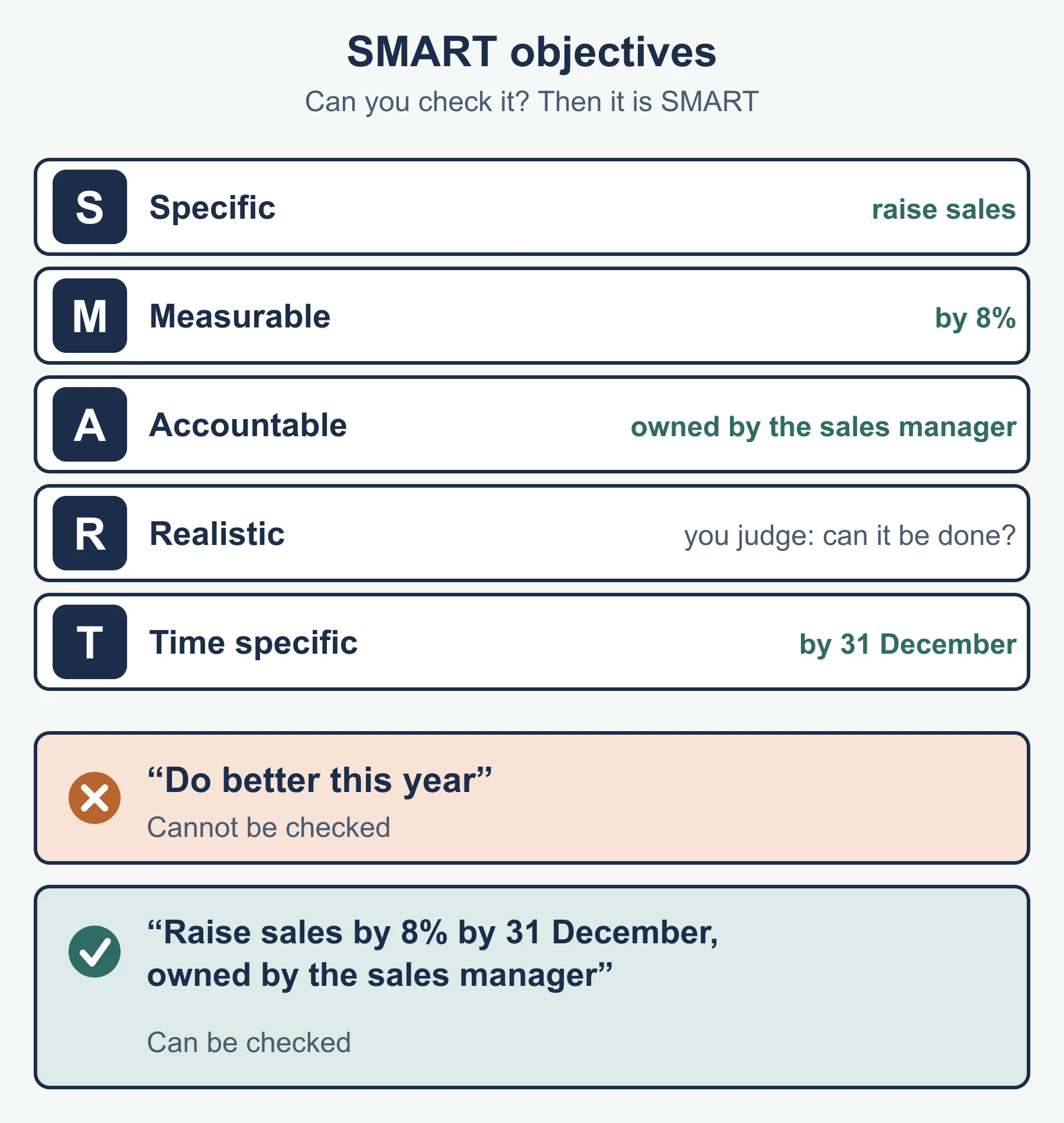
| SMART (9725 wording) | Specific, Measurable, Accountable, Realistic, Time specific |
| Value of objectives | Direction, measuring success, motivation, basis for choosing |
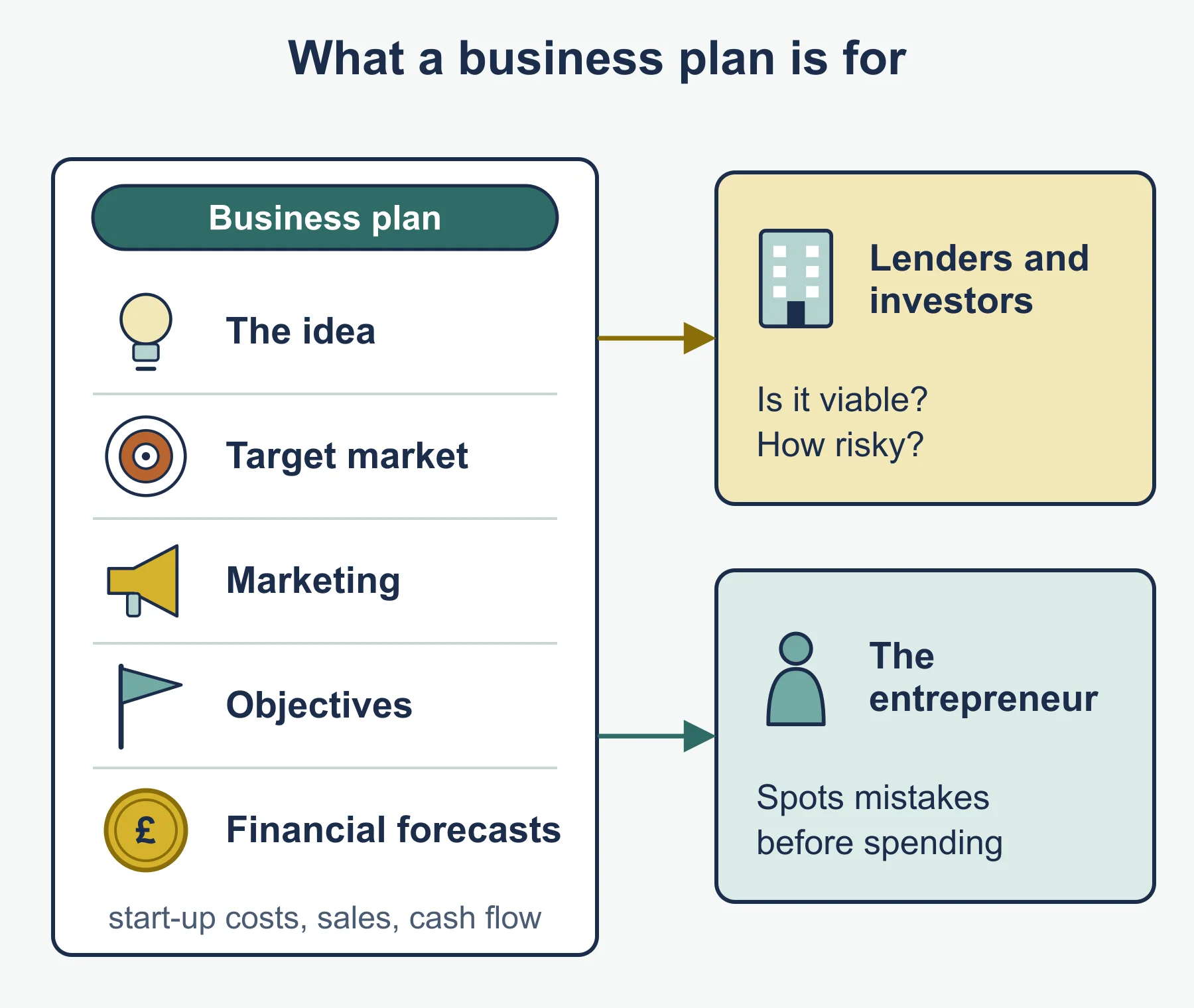
| Plan elements (9725) | Ownership, objectives, target market and market analysis, competitor analysis, USP, financial analysis |
| Benefits of a plan | Clear thinking, early warning of weakness, helps win finance |
| Limitations | Time-consuming, forecasts can be wrong, goes out of date |
| Competitiveness (both; 9725 adds meaning and significance) | Ability to win customers against rivals |
Method: writing a SMART objective. Pick a measure, give a target number, add a deadline, name who is responsible, and check it is realistic.
Decision trees (9625)
| Item | Standard form |
|---|---|
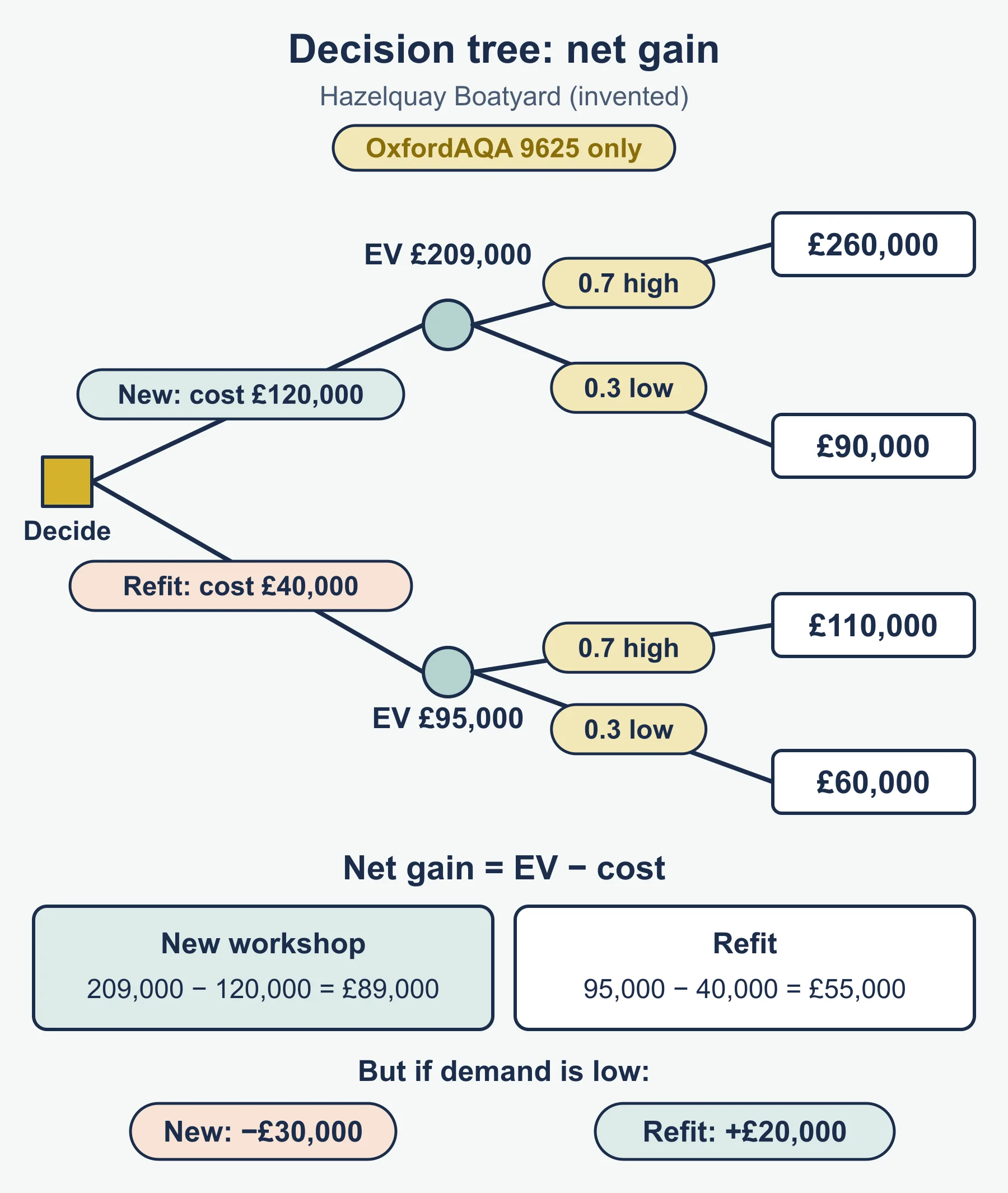
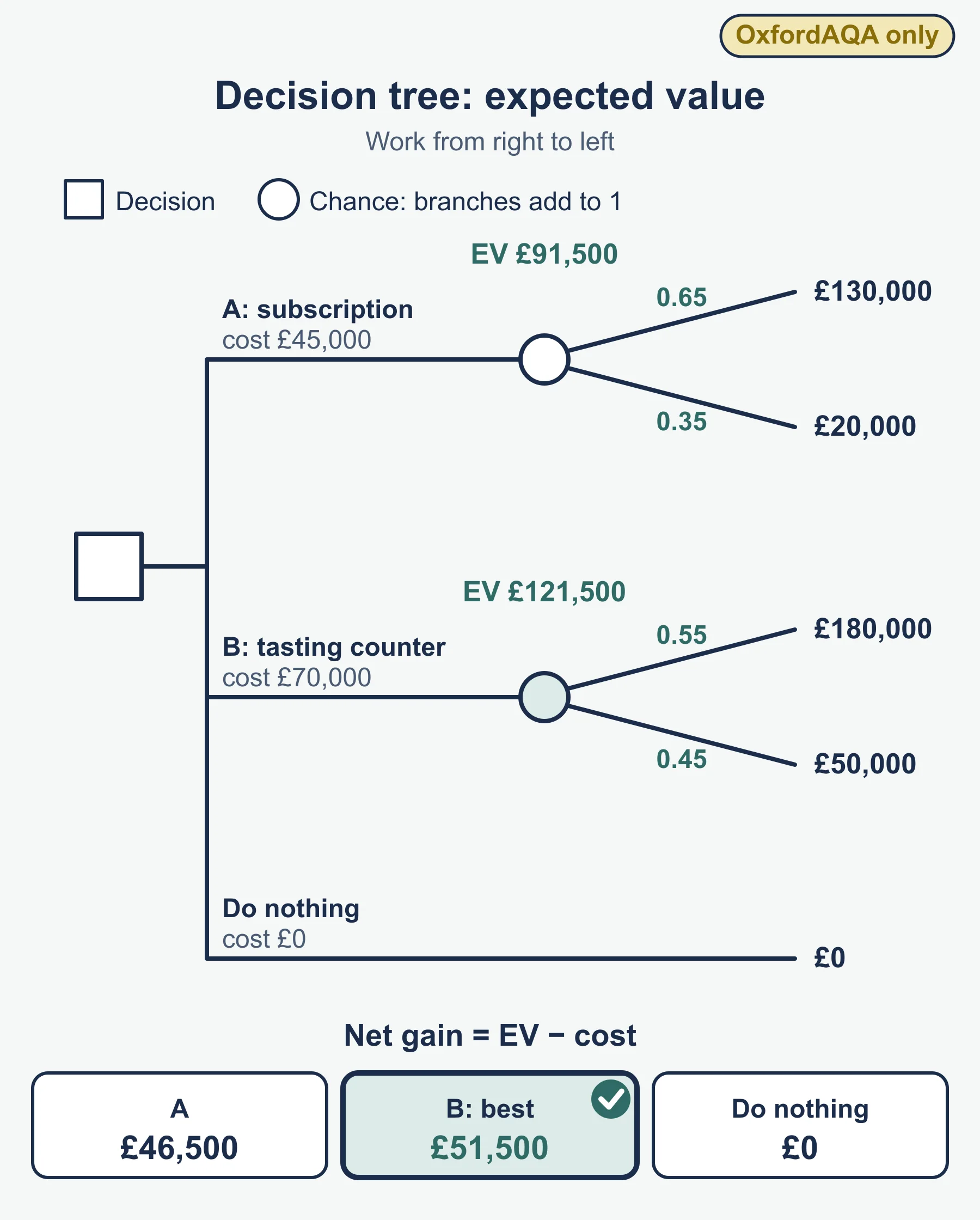
| Expected value | Sum of (probability x outcome) for each branch |
| Net gain | Expected value minus cost of that option |
Method in steps. (1) Draw squares for decisions and circles for chance events. (2) Check probabilities on each circle add to 1. (3) Work out expected value for each option. (4) Subtract that option’s cost. (5) Compare net gains. (6) Comment on risk, the worst case and how reliable the probabilities are.
Worked reminder. Cost £15,000. 0.4 chance of £50,000 and 0.6 chance of £10,000. EV = 20,000 + 6,000 = £26,000. Net gain = 26,000 - 15,000 = £11,000.
Limitations: estimated probabilities, no non-financial factors, average outcome may never occur.
Types of business
| Type | Owner and liability | Key point | Spec |
|---|---|---|---|
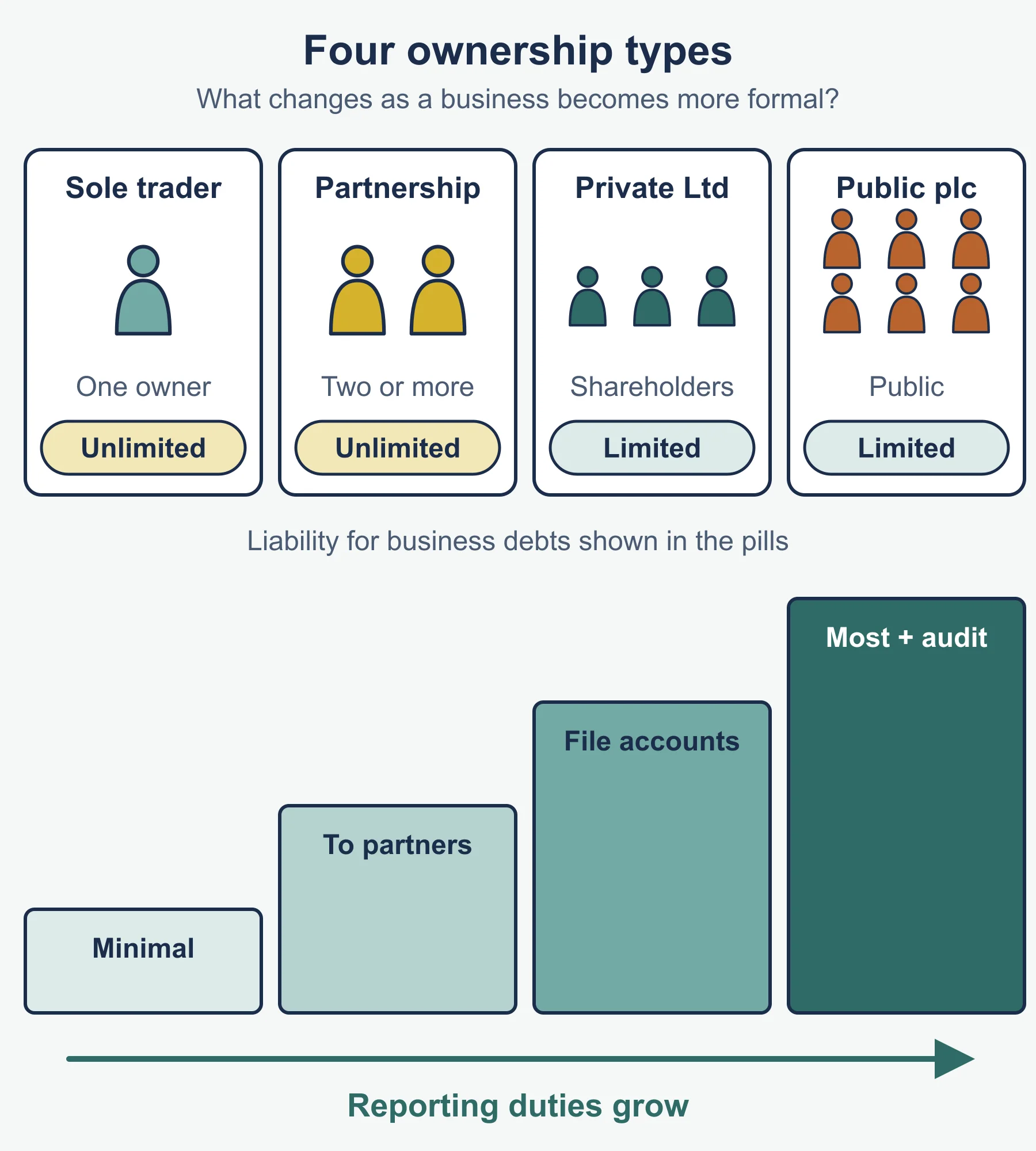
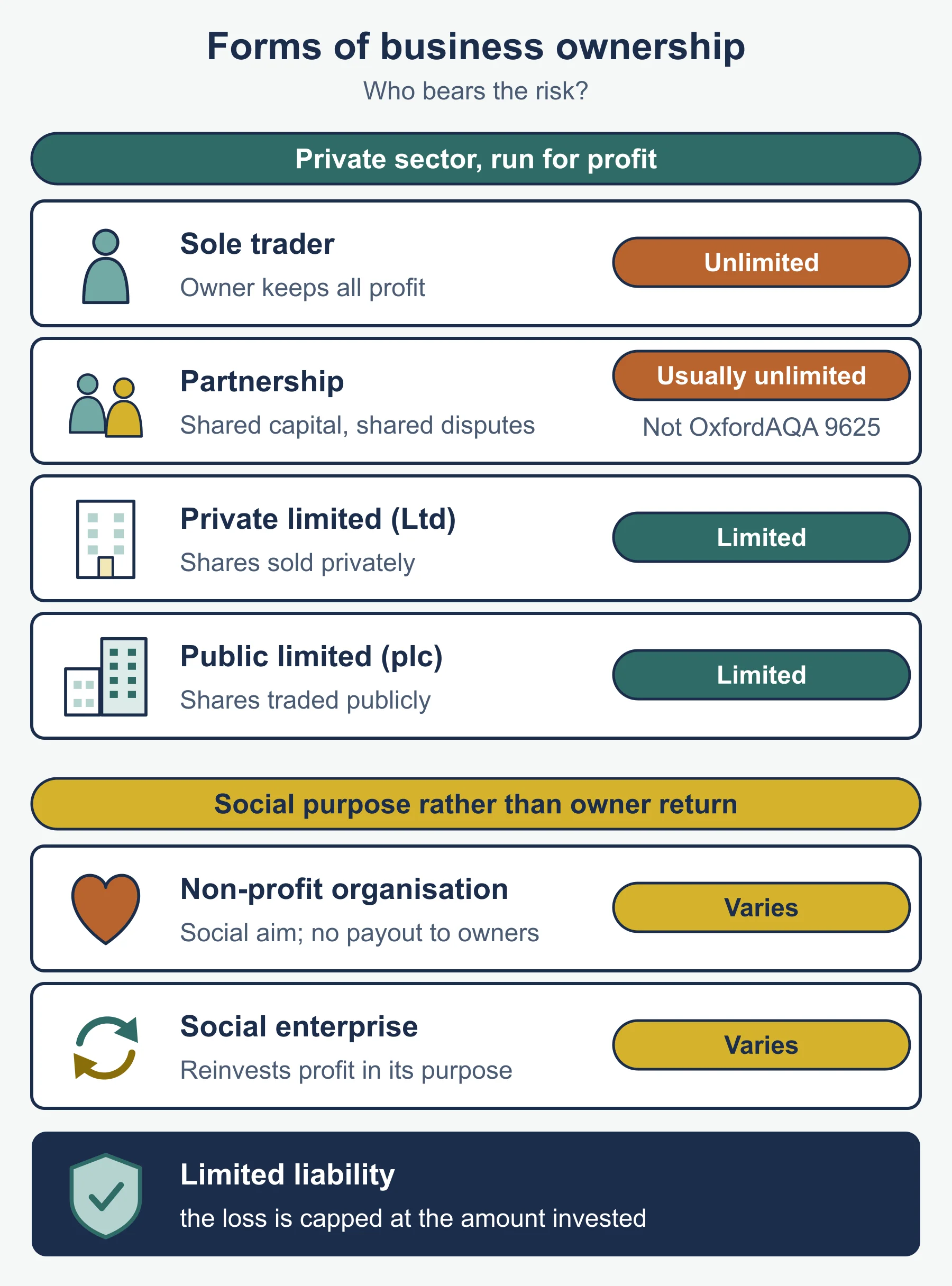
| Sole trader | One owner, unlimited | Full control and profit; limited finance | both |
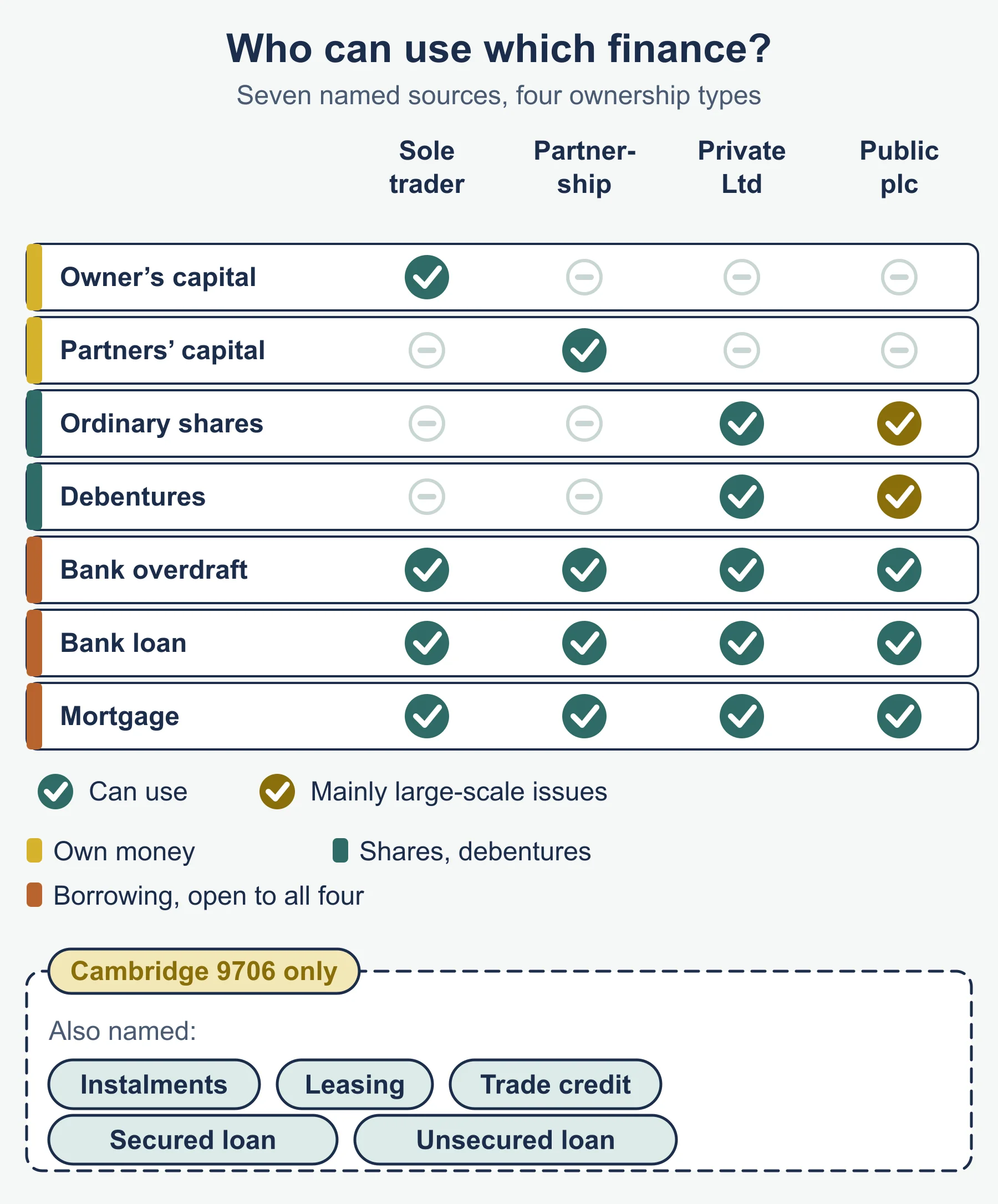
| Partnership | Two or more, usually unlimited | More capital and skills; disputes | 9725 |
| Ltd | Limited, shares not public | Can raise capital privately | both |
| plc | Limited, shares public | Large funds; scrutiny and takeover risk | both |
| Social enterprise / charity / non-profit | Social aim; surplus reinvested | Lower profit | both |
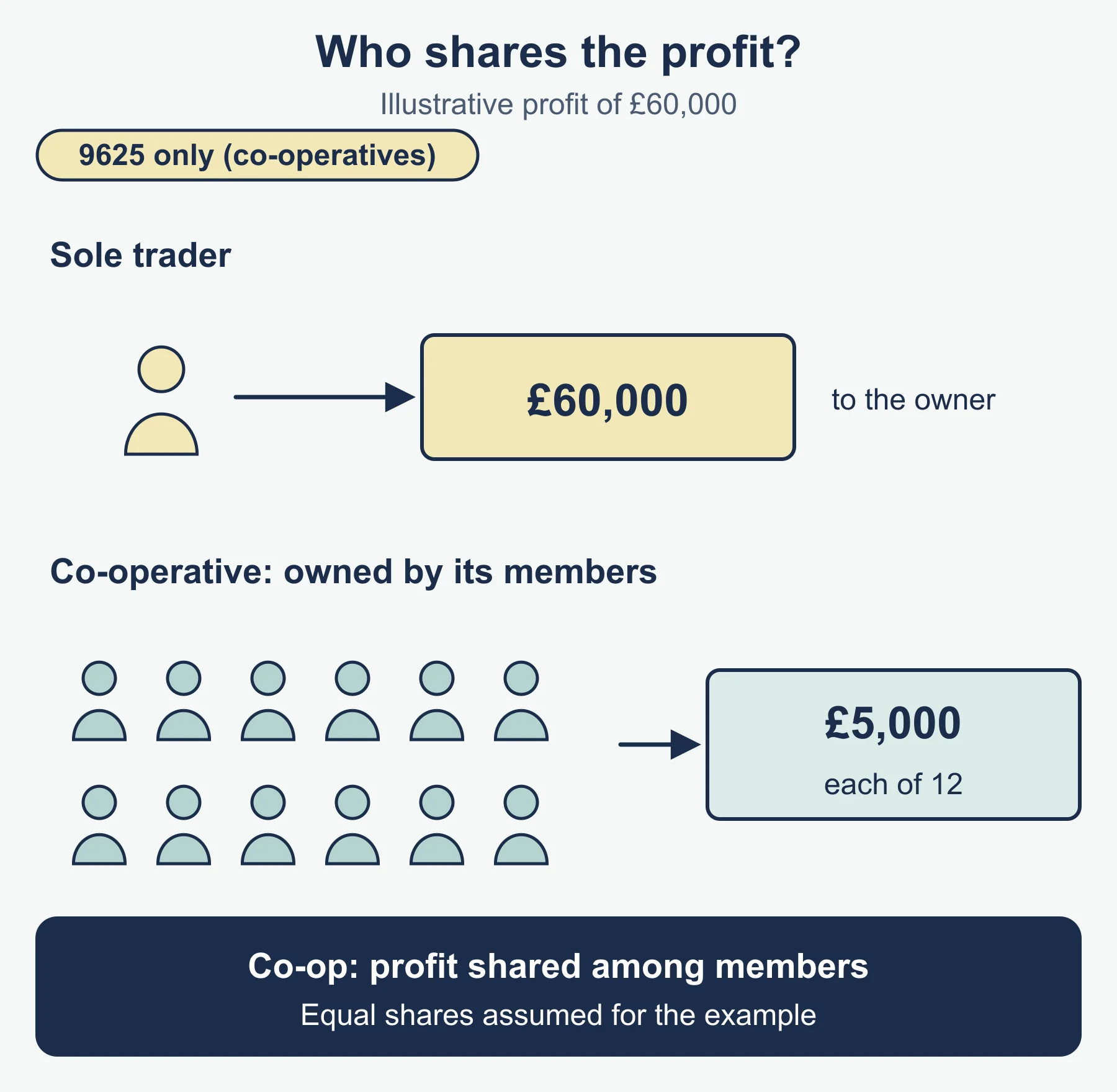
| Co-operative | Owned by members | Profit shared among members | 9625 |
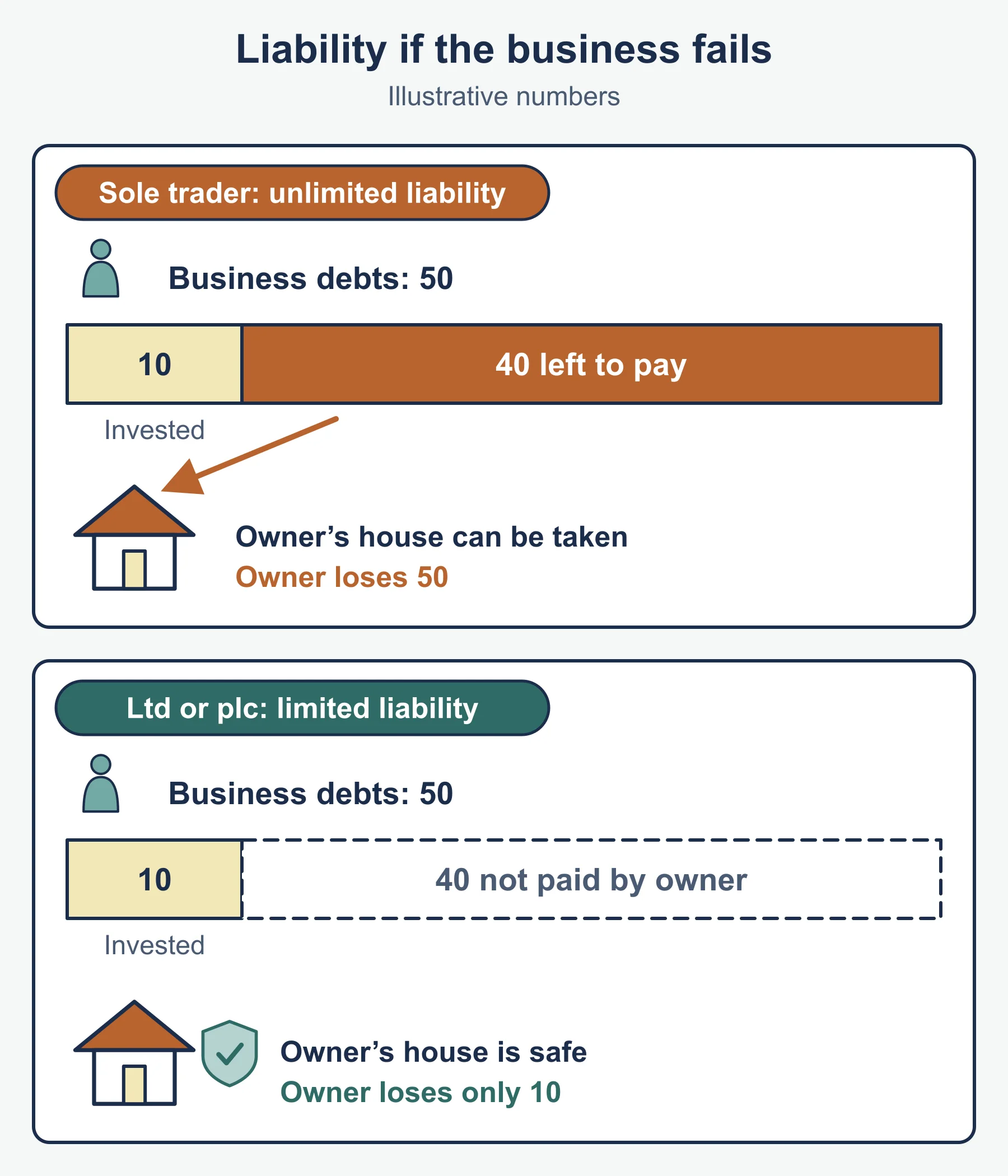
- Unlimited liability: personal assets can pay business debts. Limited liability: the shareholder’s loss is capped at the sum put in.
- Compare using: objectives, sources of finance, distribution of profits, liability (both); control (9725).
- Influences on the business population (9625, our wording): economy, ease of finance, regulation, attitudes to risk, skills.
- Change of form: a sole trader may become a Ltd for limited liability and investors; a Ltd may become a plc to raise large sums, accepting more regulation and loss of control.
- Private sector: in the hands of individuals or shareholders. Public sector: government owns and runs it. A plc is private sector.
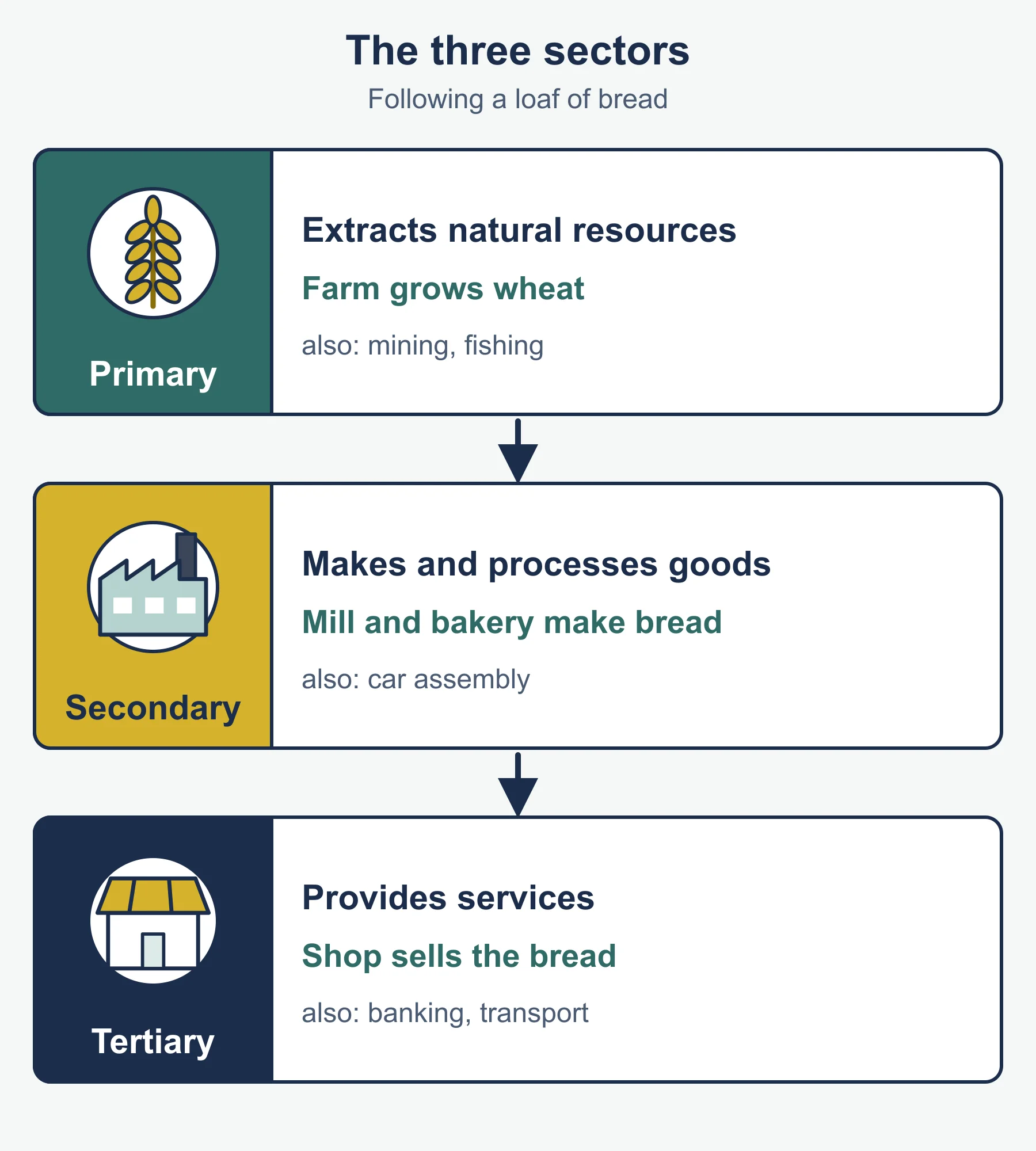
- Sectors: primary (extract), secondary (make), tertiary (serve).
- Family business: loyalty and long-term view against conflict and succession problems.
- Small business: flexible, personal service against limited finance and buying power. SMEs versus large (9625): large firms gain economies of scale and finance but can be slower and less personal.
Shareholders
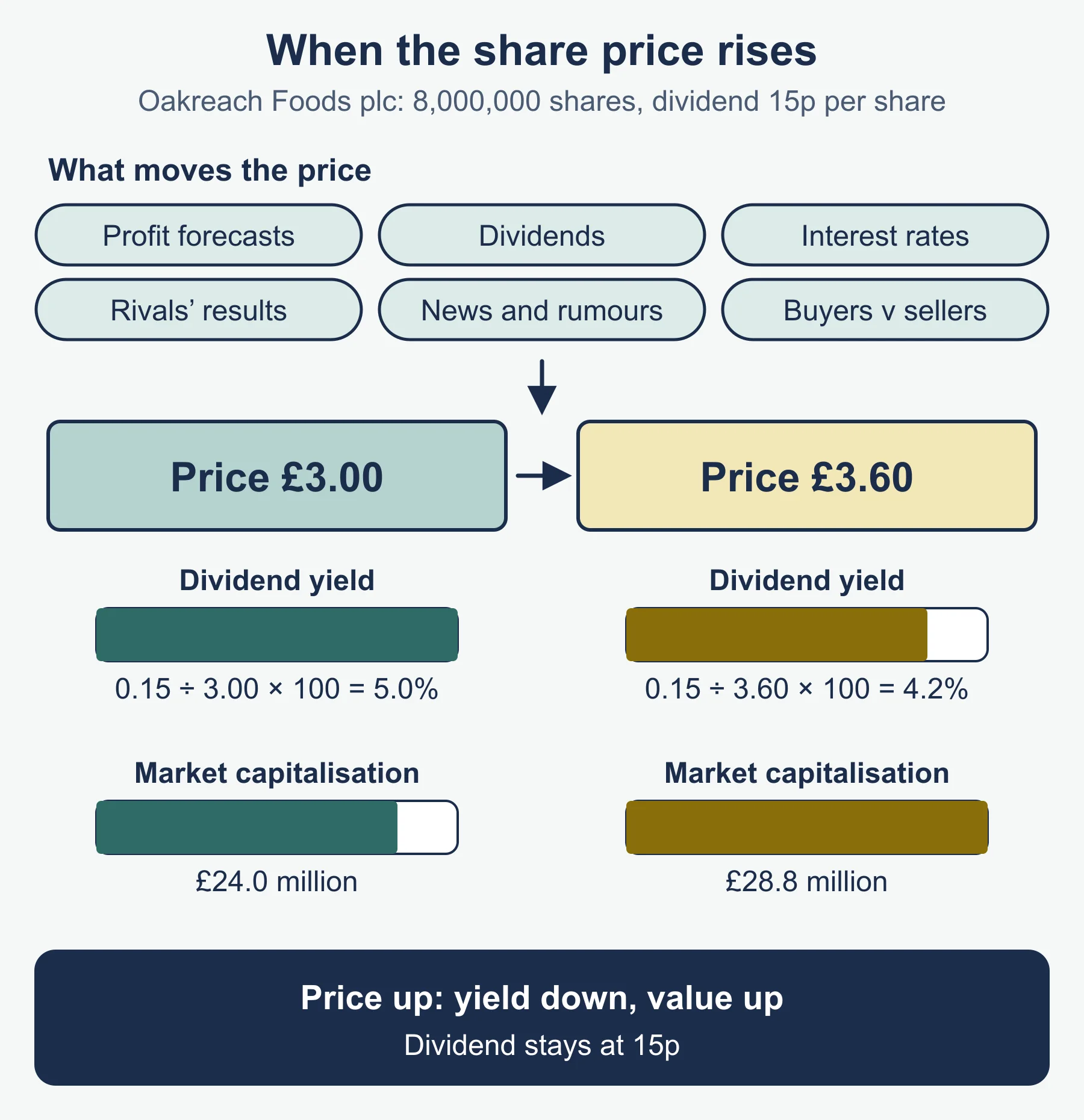
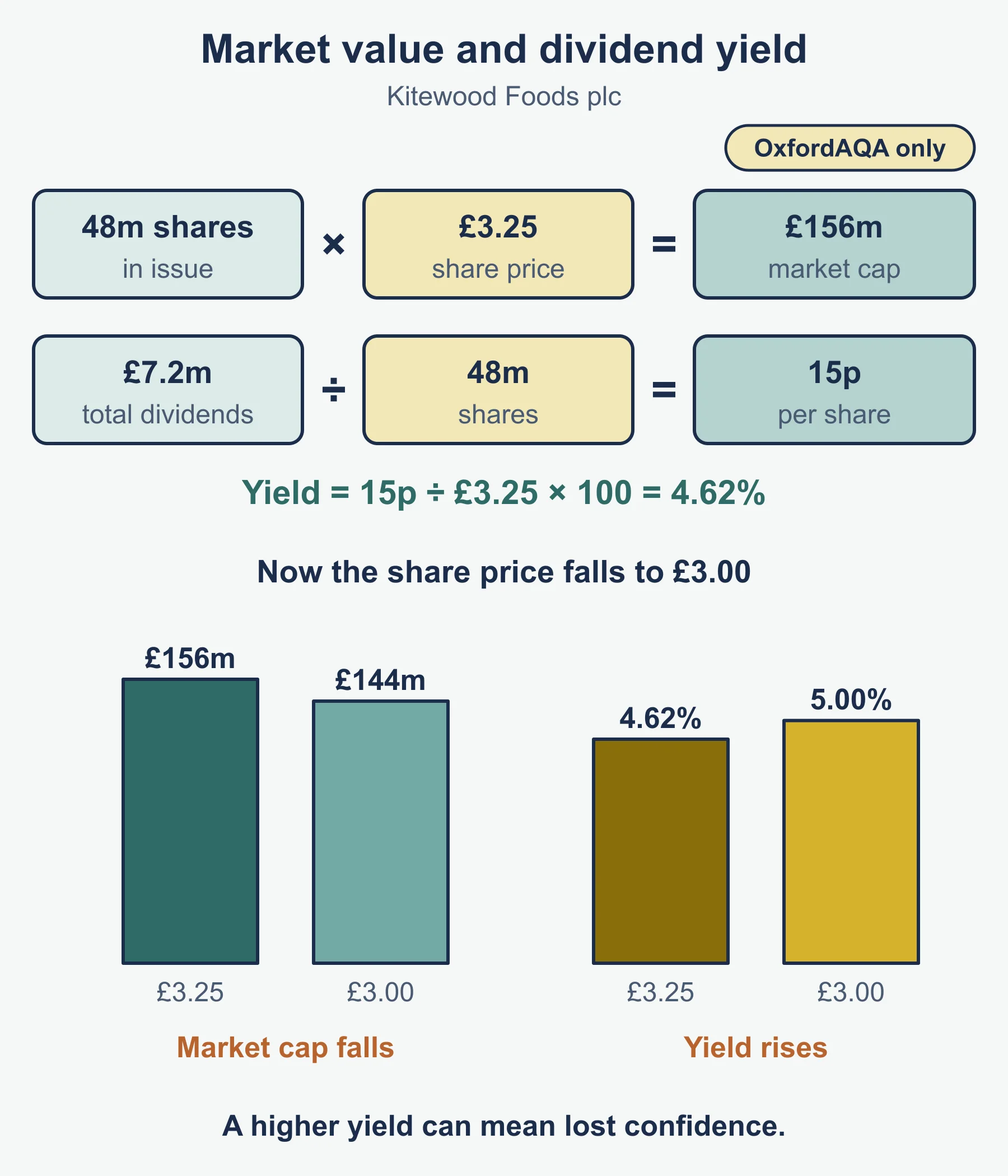
Dividend per share = total dividend / number of shares
Dividend yield (%) = dividend per share / share price x 100
Market capitalisation = share price x number of shares issued
These are the standard forms (9725 asks for all three calculations; 9625 names yield calculation and market capitalisation). Worked reminder: 5,000,000 shares and a total dividend of £400,000 give 8p per share; at a price of £2.00 the yield is 4%. Why invest: dividends, rise in share price, a say in decisions, backing the firm’s aims. Share capital (equity) is money raised by selling shares. Share price moves with profit and forecasts, dividends, the economy, interest rates, rivals, news, and demand for and supply of the shares. A fall can bring takeover risk and weaker confidence.
Stakeholders
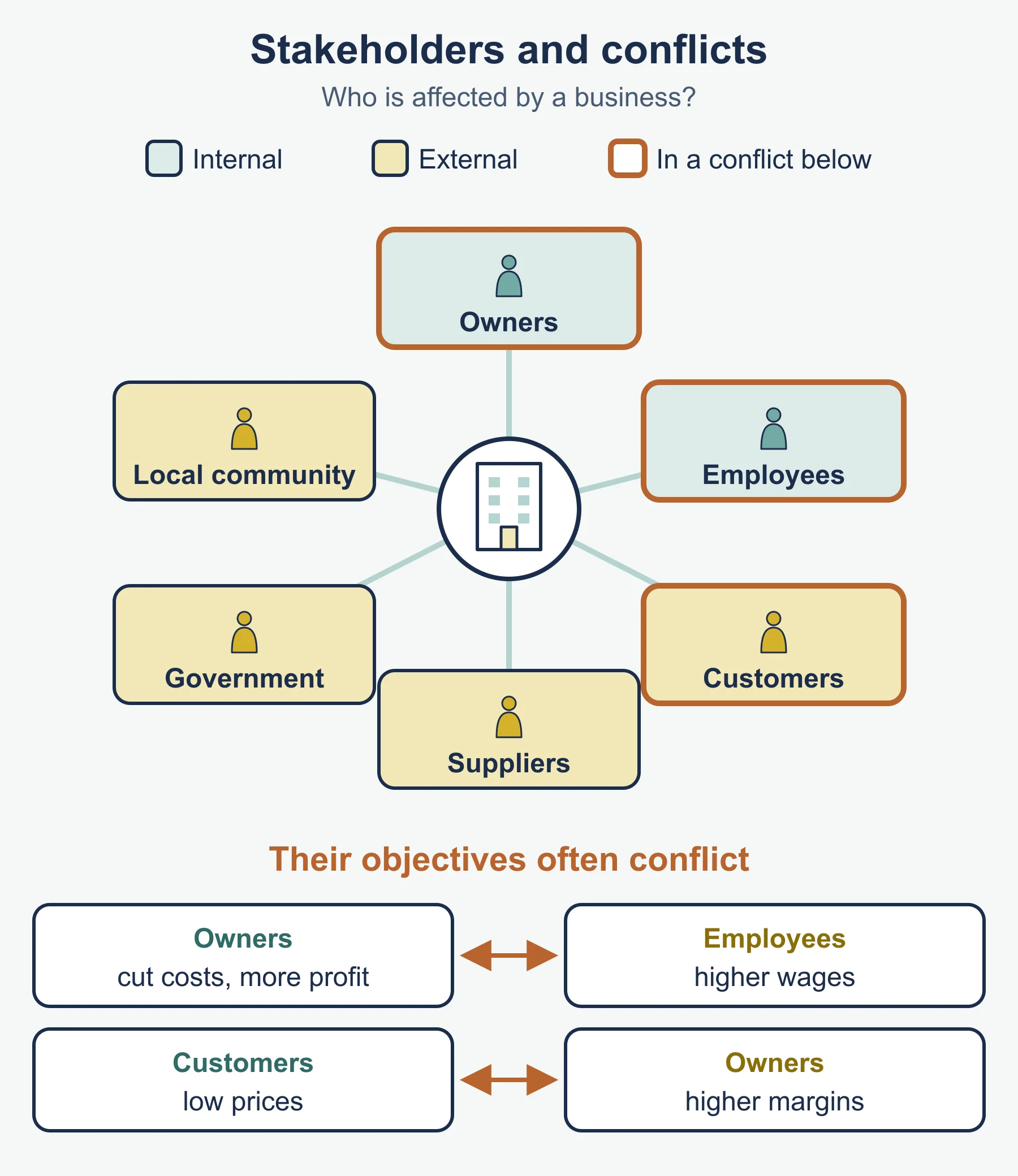
| Internal | External |
|---|---|
| Owners/shareholders, employees | Customers, suppliers, community, government, creditors (9725) |
For any change, name the stakeholder, state the effect and say whether it helps or harms. Interests often conflict, for example shareholders want dividends while employees want pay.
Must-know distinctions
- Strategy (long-term plan) against tactics (short-term actions).
- Customer (buys) against consumer (uses).
- Owner (risk and capital) against manager (daily running).
- Plc (a type of company) against public sector (government-run).
- Dividend per share (money per share) against dividend yield (percentage of price) against market capitalisation (total value of the shares).
- Expected value (before cost) against net gain (after cost).
Quick self-test
- Define opportunity cost.
- List the four inputs.
- State four key elements of a business plan (9725).
- A project costs £15,000. It has a 0.4 chance of returning £50,000 and a 0.6 chance of returning £10,000. Calculate the net gain.
- A company has 2,000,000 shares and pays a total dividend of £120,000. Its share price is £1.50. Calculate the dividend per share, dividend yield and market capitalisation.
- A company has 6,000,000 shares priced at 80p. Calculate its market capitalisation.
- A dividend per share of 12p on a price of £2.40 gives what yield?
- Classify a quarry, a bakery making loaves and a bank by sector.
- Which type of business is listed only in 9725, and which only in 9625?
- Why is a plc not part of the public sector?
Answers
- The value of the best alternative forgone.
- Land, labour, capital, enterprise.
- Any four of ownership, objectives, target market and market analysis, competitor analysis, USP, financial analysis.
- EV = 0.4 x 50,000 + 0.6 x 10,000 = 20,000 + 6,000 = £26,000. Net gain = 26,000 - 15,000 = £11,000.
- Dividend per share = 120,000 / 2,000,000 = 6p. Yield = 0.06 / 1.50 x 100 = 4%. Market capitalisation = 1.50 x 2,000,000 = £3,000,000.
- 0.80 x 6,000,000 = £4,800,000.
- 0.12 / 2.40 x 100 = 5%.
- Quarry primary, bakery secondary, bank tertiary.
- Partnerships are in 9725 only. Co-operatives are in 9625 only.
- A plc is owned by private shareholders, not by government, so it is private sector.
Where marks are usually lost
- Stopping at expected value and forgetting to subtract the cost to find net gain.
- Writing “limited liability protects the business” instead of saying the shareholder’s loss is limited to the amount invested.
- Giving a list of stakeholders without saying how a named decision affects each.
- Describing a business plan’s benefits with no limitation, or the reverse.
- Quoting yield as pence rather than a percentage, or mixing pence and pounds in a calculation.
- Mixing up customers and consumers when the case study separates them.
- Giving generic advantages of a company form with no tie to the case business.
- Using partnerships or co-operatives without checking which specification you follow.
- Making a recommendation with no reason for the choice and no condition on which it depends.
Frequently asked questions
What are the four inputs a business uses? The four inputs are land, labour, capital and enterprise. Businesses transform these inputs into outputs.
What is the difference between unlimited and limited liability? With unlimited liability, the owner’s personal assets can be used to pay business debts. With limited liability, the business still owes the whole debt, but a shareholder’s loss is limited to the amount they invested.
What is the difference between a customer and a consumer? A customer is the person who buys the product, while a consumer is the person who uses it. They are not always the same person.
How do you calculate dividend per share and dividend yield? Dividend per share is the total dividend divided by the number of shares. Dividend yield is dividend per share divided by the share price, multiplied by 100, with both figures in the same units.
Official syllabus
OxfordAQA International AS and A-level Business (9625), Version 3.1, and OxfordAQA International AS and A-level Business (9725), Version 1.1, sections 3.1.1.1 and 3.1.1.2. Publisher: OxfordAQA.
Get free revision emails (optional)
Occasional emails with practice questions, worked explanations and links to free resources for the qualification and subjects you choose. No spam, and you can unsubscribe from any email. The free tools on this site never need an email.
Related resources
-
Study guides
OxfordAQA A-Level Business: The external environment (9625/9725)
A worked study guide to market conditions, barriers to entry, and the effects of incomes, interest and exchange rates, input costs and competition.
Business · OxfordAQA · AS Level
Read guide -
Practice questions
OxfordAQA A-Level Business: The external environment (9625/9725) – Practice Questions
Twelve original questions with worked answers on market size, share, concentration ratio, barriers to entry, income elasticity and external changes.
Business · OxfordAQA · AS Level
Try questions -
Revision notes
OxfordAQA A-Level Business: The external environment (9625/9725) – Revision Notes
Condensed recall notes on market size, share, concentration ratio, barriers to entry, income elasticity and external changes for OxfordAQA Business.
Business · OxfordAQA · AS Level
Revise topic
Related articles
-
teaching
A Level tuition in Dubai: Cambridge or Pearson Edexcel International A Level?
Schools in Dubai and Abu Dhabi teach either Cambridge International AS & A Level or Pearson Edexcel International A Level. How the two are structured, why it matters for tuition, and how online classes from Lahore work.
9 October 2026
-
curriculum guides
Choosing subjects at IGCSE and A Level
How subject choices at 14 and 16 affect university options later, and how to keep pathways open without overloading a timetable.
28 July 2026
Studying this with a teacher
Working through Business AS LEVEL?
This page is free and stays free. If you would rather be taught it, Marlbridge runs Business classes one-to-one and in small groups of up to 15, online in your own time zone. The first trial class is free. WhatsApp replies within an hour (8am–11pm Pakistan time, every day); email the same day.
OxfordAQA Business teachers at Marlbridge
