
Study Guides
OxfordAQA IGCSE Computer Science (9210): Arithmetic operations in a programming language
Study guide to OxfordAQA IGCSE Computer Science 9210 section 3.2.3: the arithmetic operators, real division, and DIV and MOD with traced program examples.
- Subject
- Computer Science
- Level
- IGCSE
- Topic
- Topic 2 – Programming
- Author
- Marlbridge Academic Team
- Updated
- Reviewed by
- Harris Khan (what this means)
Aligned to OxfordAQA IGCSE Computer Science (9210), For teaching from September 2017, exams from May/June 2019. Official specification .
Syllabus page (what it covers and how it is assessed): OxfordAQA IGCSE Computer Science.
Syllabus points this page covers
9210
- 3.2.3 Arithmetic operations in a programming language
Found an error? Report a correction.
Need help with this topic? Request a free trial class for IGCSE Computer Science (9210).
This guide covers section 3.2.3 Arithmetic operations in a programming language of OxfordAQA International
GCSE Computer Science (9210). You must “be familiar with and be able to use” addition, subtraction,
multiplication, real division, and integer division, including remainders. The specification describes integer
division as “usually a two-stage process” that uses modular arithmetic: 11 divided by 2 gives the integer quotient
11 DIV 2 = 5 and the remainder 11 MOD 2 = 1. The Programming Fundamentals study
guide introduces the operators; this guide
shows how they are used to solve problems in programs.
The operators
| Operation | Pseudocode | Example | Result | Result type |
|---|---|---|---|---|
| Addition | + |
8 + 5 |
13 |
Integer if both operands are integers |
| Subtraction | - |
8 - 5 |
3 |
Integer if both operands are integers |
| Multiplication | * |
8 * 5 |
40 |
Integer if both operands are integers |
| Real division | / |
8 / 5 |
1.6 |
Real |
| Integer division | DIV |
8 DIV 5 |
1 |
Integer |
| Remainder (modulus) | MOD |
8 MOD 5 |
3 |
Integer |
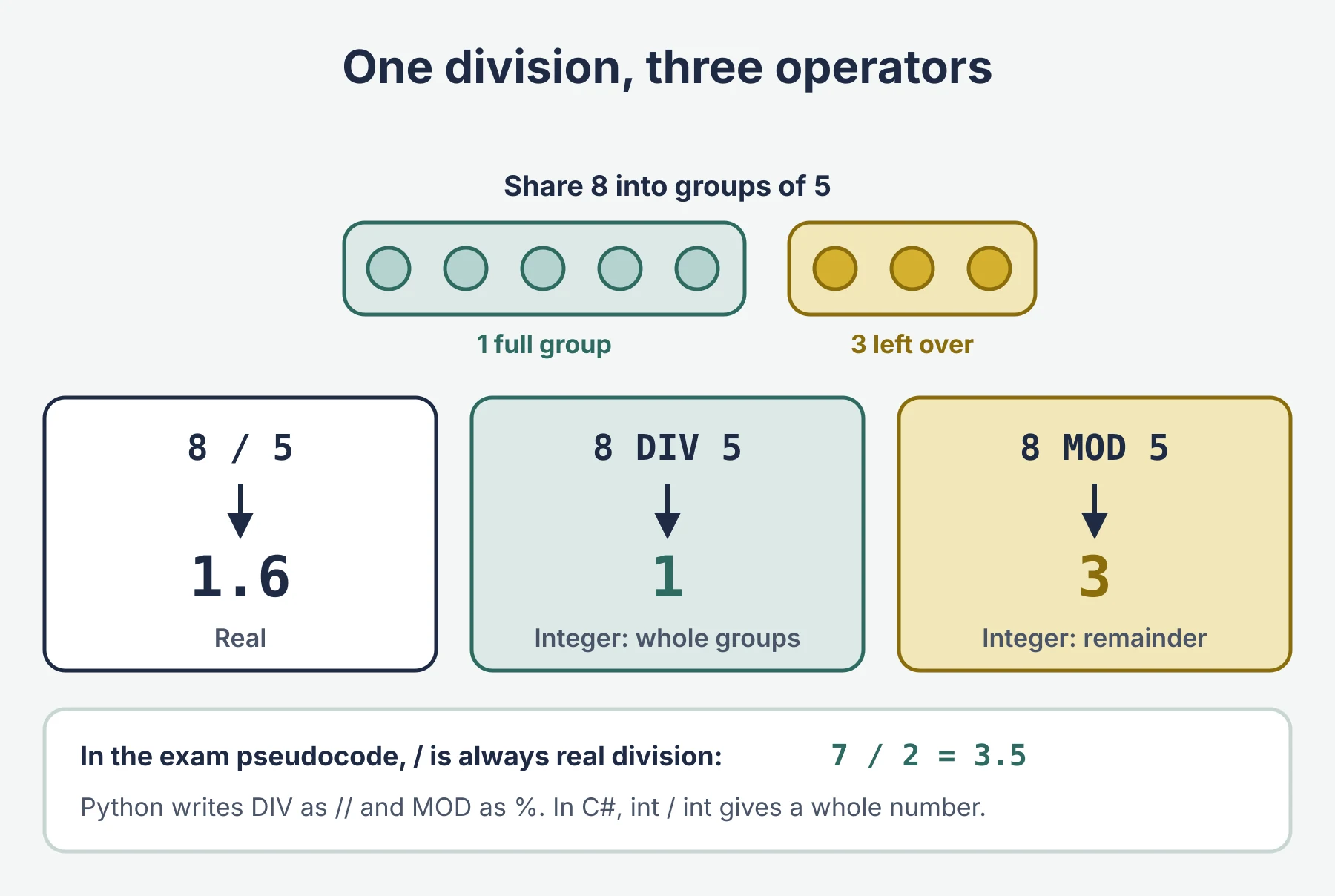
In everyday maths, × and ÷ are used; in programs * and / are used, and your language may write DIV and
MOD differently (Python uses // and %, for example). In the exam’s pseudocode, / is always real
division: 7 / 2 is 3.5, even though both numbers are integers. Be aware that in some languages, such as C#,
dividing one integer by another with / gives a whole-number answer, which is a common source of bugs in
real programs.
Integer division as a two-stage process
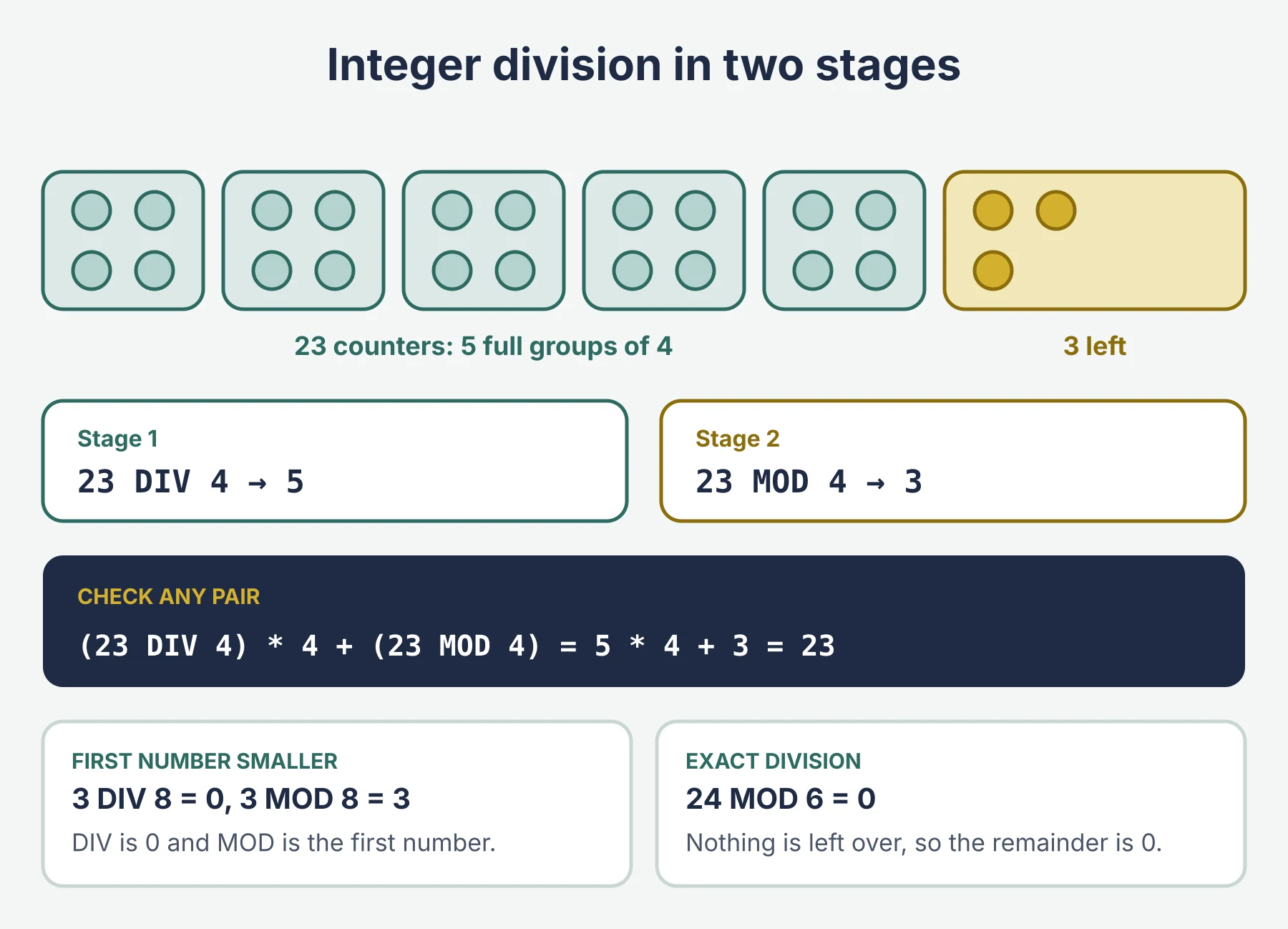
When you divide 23 by 4 by hand you get “5 remainder 3”. A program needs two operations to get both parts:
23 DIV 4→ 5, the number of whole times 4 goes into 23;23 MOD 4→ 3, what is left over.
The two results are always linked: (23 DIV 4) * 4 + (23 MOD 4) = 5 * 4 + 3 = 23. You can use this to check
any DIV and MOD pair you calculate. Two special cases catch people out:
- When the first number is smaller than the second,
DIVis 0 andMODis the first number:3 DIV 8 = 0,3 MOD 8 = 3. - When the division is exact,
MODis 0:24 MOD 6 = 0.
Where DIV and MOD are used
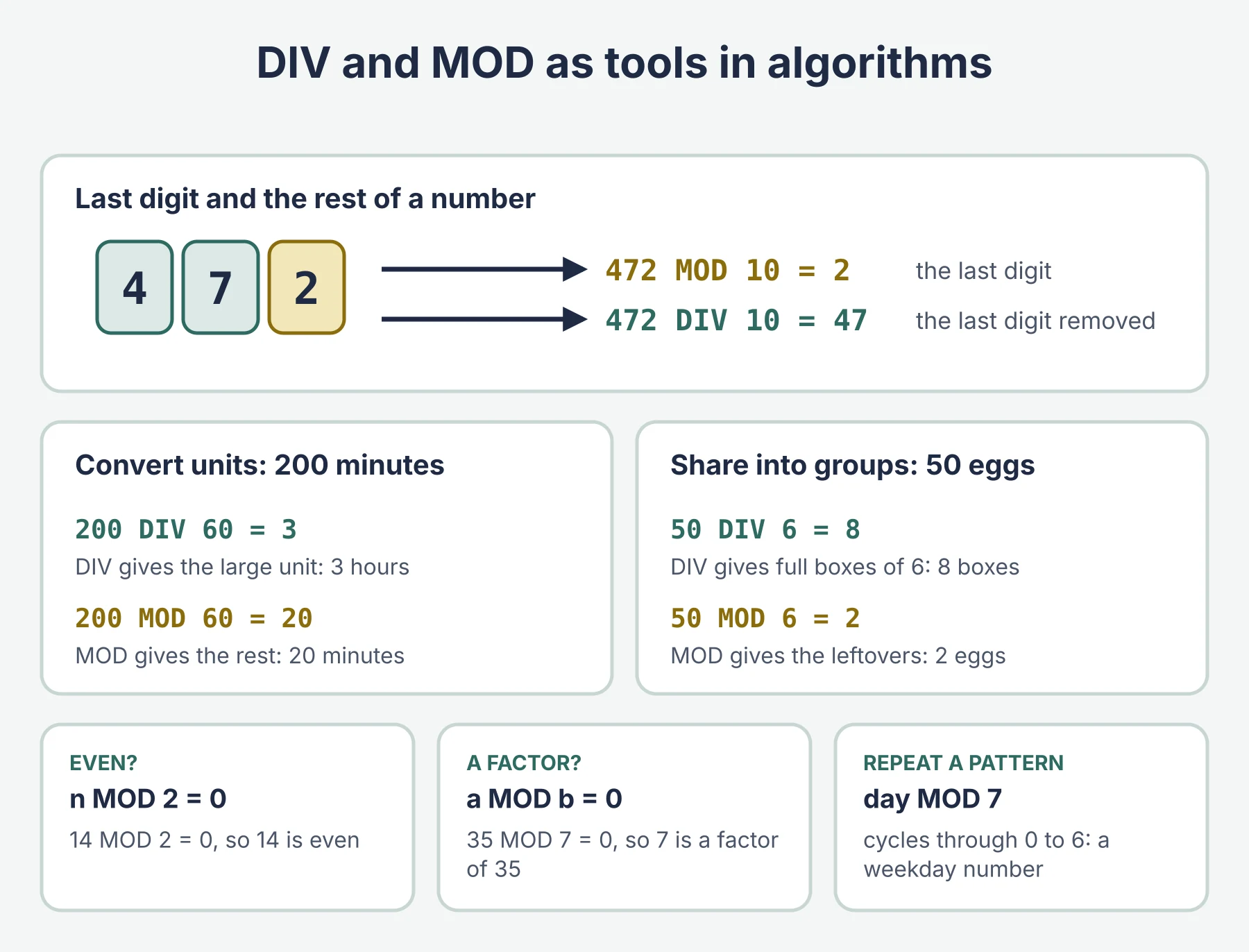
These operators are tested less as calculations and more as tools in algorithms:
| Task | Technique | Example |
|---|---|---|
| Test whether a number is even | n MOD 2 = 0 |
14 MOD 2 = 0, so 14 is even |
| Test whether one number divides another | a MOD b = 0 |
35 MOD 7 = 0, so 7 is a factor of 35 |
| Get the last digit of a whole number | n MOD 10 |
472 MOD 10 = 2 |
| Remove the last digit | n DIV 10 |
472 DIV 10 = 47 |
| Convert units | DIV for the large unit, MOD for the rest |
200 minutes: 200 DIV 60 = 3 hours, 200 MOD 60 = 20 minutes |
| Share items into groups | DIV for full groups, MOD for leftovers |
50 eggs in boxes of 6: 8 full boxes, 2 left |
| Repeat a pattern | MOD cycles through 0 to n − 1 |
day MOD 7 gives a weekday number |
Worked example 1: converting seconds
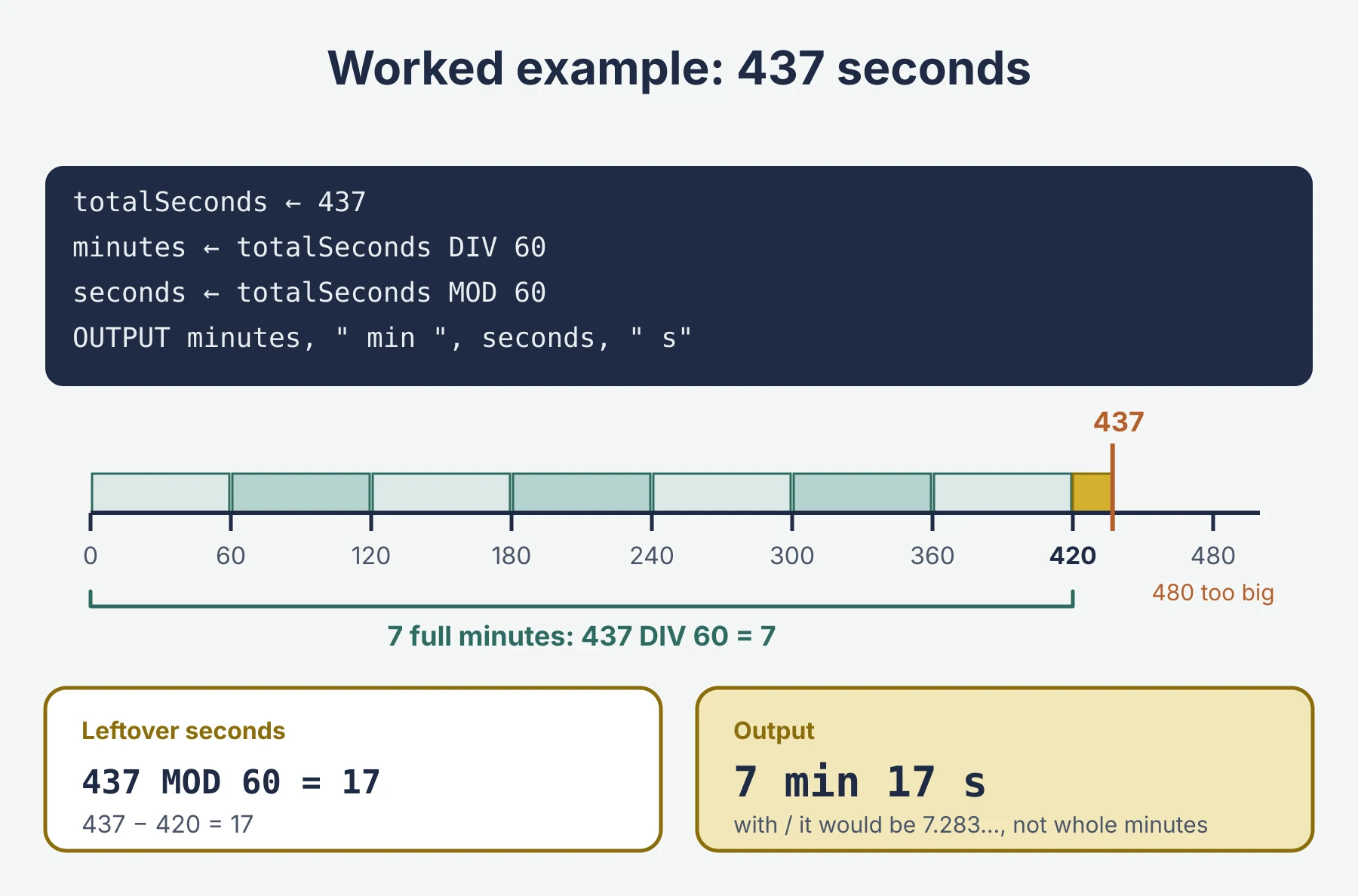
A running app stores a time in seconds and must display it as minutes and seconds.
totalSeconds ← 437
minutes ← totalSeconds DIV 60
seconds ← totalSeconds MOD 60
OUTPUT minutes, " min ", seconds, " s"
437 DIV 60 = 7 because 7 × 60 = 420 and 8 × 60 = 480 is too big. 437 MOD 60 = 437 − 420 = 17. The output is
7 min 17 s. Using / instead of DIV would give 7.283…, which is not a number of whole minutes.
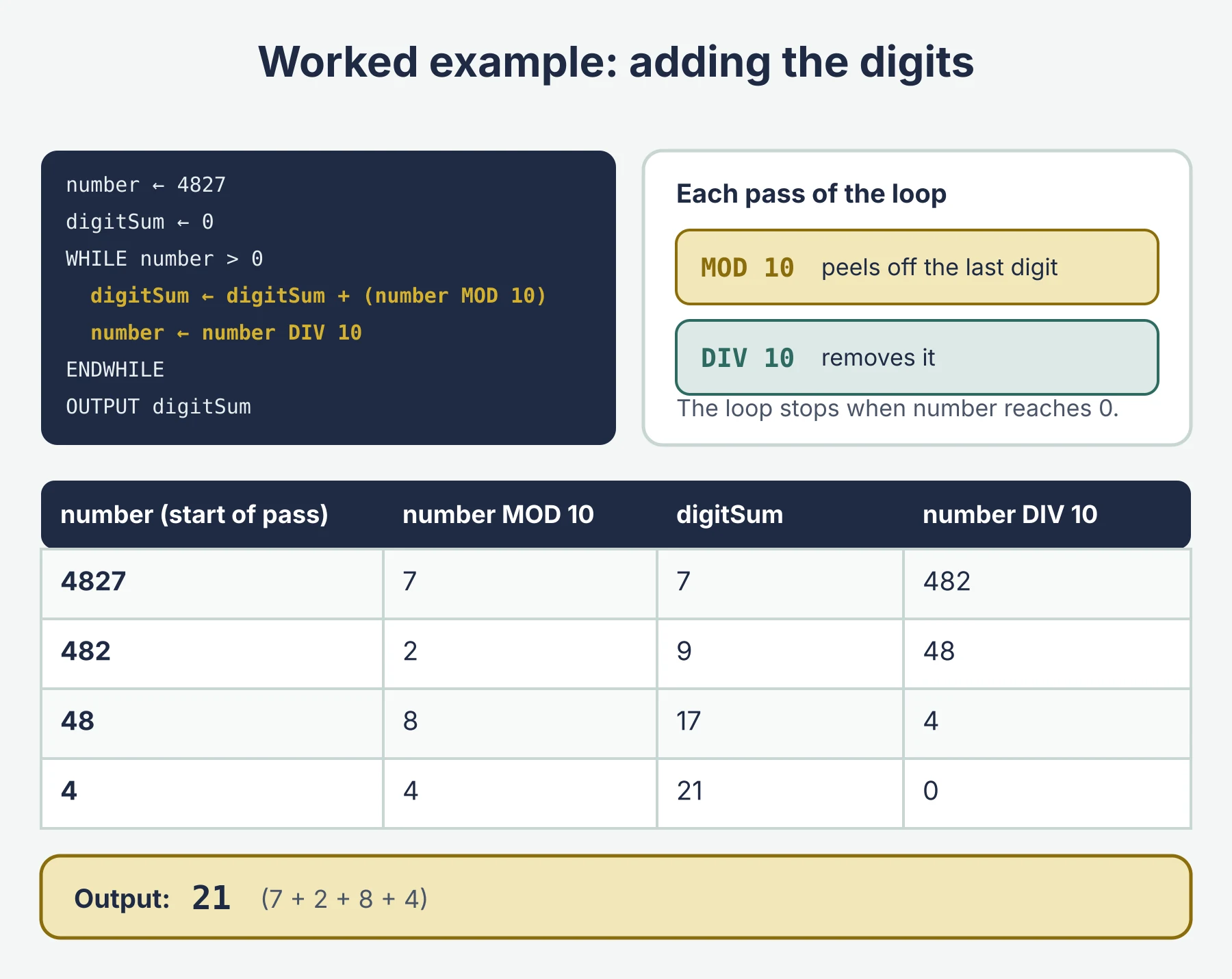
Worked example 2: adding the digits of a number
number ← 4827
digitSum ← 0
WHILE number > 0
  digitSum ← digitSum + (number MOD 10)
  number ← number DIV 10
ENDWHILE
OUTPUT digitSum| number (start of pass) | number MOD 10 | digitSum | number DIV 10 |
|---|---|---|---|
| 4827 | 7 | 7 | 482 |
| 482 | 2 | 9 | 48 |
| 48 | 8 | 17 | 4 |
| 4 | 4 | 21 | 0 |
When number reaches 0 the loop stops and 21 is output. MOD 10 peels off the last digit and DIV 10
removes it, which is the pattern behind many digit-processing questions.
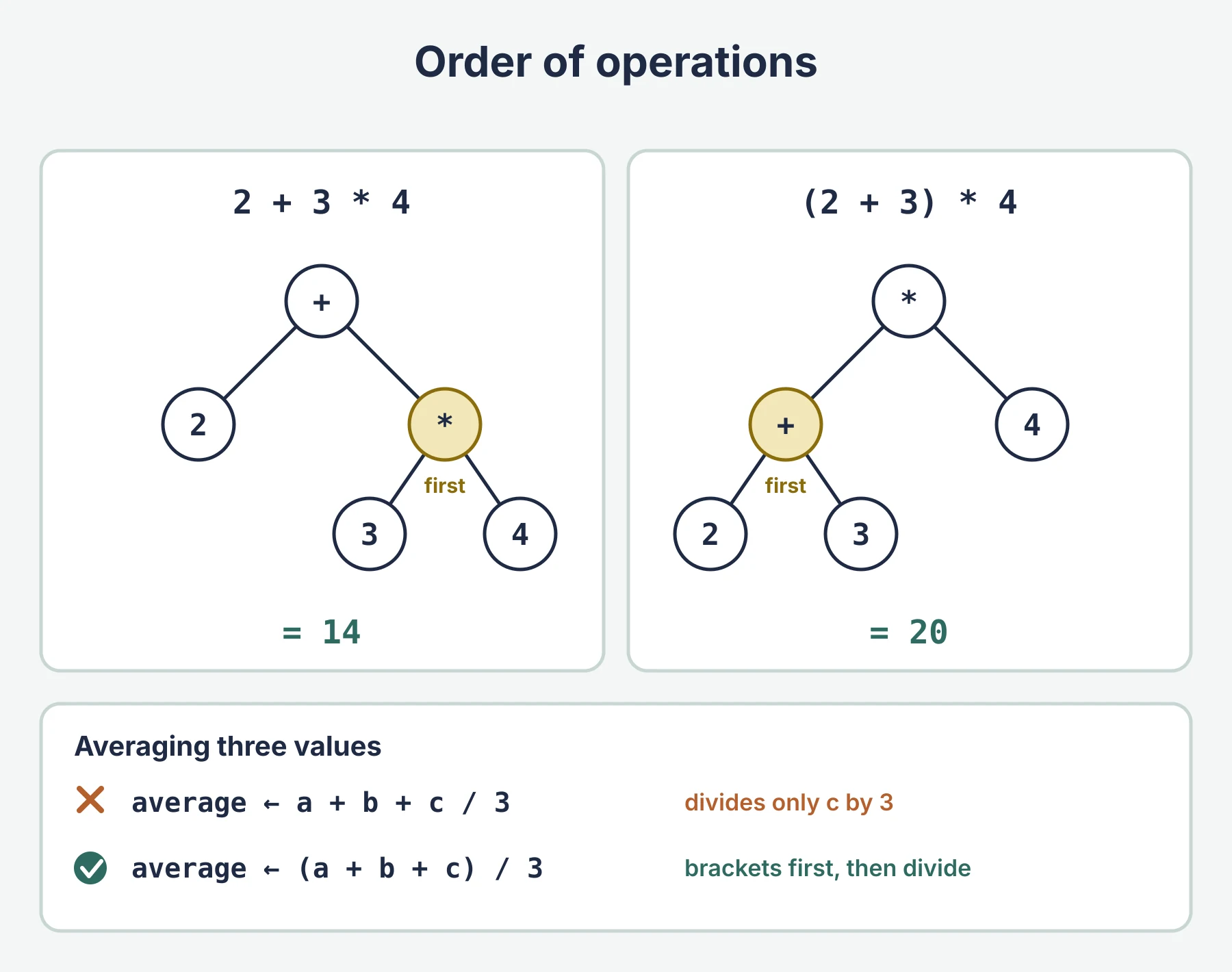
Order of operations
Programs apply the usual mathematical order: multiplication and division (including DIV and MOD) before
addition and subtraction, and brackets first. So 2 + 3 * 4 is 14, while (2 + 3) * 4 is 20. A common
error is average ← a + b + c / 3, which divides only c by 3. The correct statement is
average ← (a + b + c) / 3. When writing your own answers, add brackets whenever the order could be misread; they
cost nothing and remove doubt.
Annotated model answer
Question: A delivery company packs bottles into crates of 12. Write pseudocode that takes the number of bottles as input and outputs the number of full crates and the number of bottles left over. [4]
bottles ← STRING_TO_INT(USERINPUT)
fullCrates ← bottles DIV 12
leftOver ← bottles MOD 12
OUTPUT fullCrates
OUTPUT leftOver
Why it scores: input is taken (and converted, since keyboard input arrives as a string); DIV gives the full
crates; MOD gives the leftovers; both are output. With an input of 150, it outputs 12 and 6
(12 × 12 = 144, 150 − 144 = 6). Using / would earn no mark for the crate count because 12.5 is not a whole
number of crates.
Common mistakes
- Swapping DIV and MOD.
DIVis the whole-number quotient;MODis the remainder. - Thinking
MODgives a decimal.17 MOD 5is2, never0.4. - Using
/where a whole number is needed, such as a count of groups or pages. - Forgetting brackets when averaging:
(a + b) / 2, nota + b / 2. - Stating that
n MOD 2 = 1tests for even numbers. It tests for odd numbers. - Assuming
7 / 2is 3 in the exam. In the specification’s pseudocode it is 3.5. - Negative numbers. Languages differ in how they apply
DIVandMODto negative values, so avoid relying on them, and work only with the values a question gives.
Exam technique
- Calculate or state the value: show the quotient and remainder working, for example “60 × 7 = 420, 437 − 420 = 17”.
- Write pseudocode: store each result in a meaningfully named variable before outputting it, so the examiner can see which operator produced which value.
- Trace questions with
MODandDIV: add a column for each expression, as in Worked example 2. - Explain why an operator was chosen: link it to the data (“a number of crates must be whole, so
DIVis used”).
Quick-recall tables and a self-test are in the arithmetic operations revision notes, and you can apply these techniques in the arithmetic operations practice questions. Arithmetic results are often tested inside conditions, which is the subject of the relational operations study guide.
Related resources
-
Practice questions
OxfordAQA IGCSE Computer Science (9210): Arithmetic operations in a programming language – Practice Questions
Original OxfordAQA IGCSE Computer Science 9210 practice questions with full answers on arithmetic operators, real division, DIV, MOD and tracing calculations.
Computer Science · OxfordAQA · IGCSE
Try questions -
Revision notes
OxfordAQA IGCSE Computer Science (9210): Arithmetic operations in a programming language – Revision Notes
Revision notes for OxfordAQA IGCSE Computer Science 9210 section 3.2.3: arithmetic operators, real division, DIV and MOD patterns, exam traps and a self-test.
Computer Science · OxfordAQA · IGCSE
Revise topic -
Study guides
OxfordAQA IGCSE Computer Science (9210): Boolean operations in a programming language
Study guide to OxfordAQA IGCSE Computer Science 9210 section 3.2.5: NOT, AND and OR in loop and IF conditions, evaluation order, and common logic errors.
Computer Science · OxfordAQA · IGCSE
Read guide
Get free revision emails (optional)
Occasional emails with practice questions, worked explanations and links to free resources for the qualification and subjects you choose. No spam, and you can unsubscribe from any email. The free tools on this site never need an email.