
Study Guides
OxfordAQA IGCSE Computer Science (9210): Classification of programming languages and translators
Study guide to OxfordAQA IGCSE Computer Science 9210 section 3.2.13: machine code, assembly, high-level languages, compilers, interpreters and assemblers.
- Subject
- Computer Science
- Level
- IGCSE
- Topic
- Topic 2 – Programming
- Author
- Marlbridge Academic Team
- Updated
- Reviewed by
- Harris Khan (what this means)
Aligned to OxfordAQA IGCSE Computer Science (9210), For teaching from September 2017, exams from May/June 2019. Official specification .
Syllabus page (what it covers and how it is assessed): OxfordAQA IGCSE Computer Science.
Syllabus points this page covers
9210
- 3.2.13 Classification of programming languages and translators
Found an error? Report a correction.
Need help with this topic? Request a free trial class for IGCSE Computer Science (9210).
This guide covers section 3.2.13 Classification of programming languages and translators of OxfordAQA International GCSE Computer Science (9210). The specification asks you to “know that there are different levels of programming language”, low-level and high-level, to “explain the main differences” between them, and to “know that machine code and assembly language are considered to be low-level languages and explain the differences between them”. You must also understand the “three common types of program translator”, interpreter, compiler and assembler, explain how they differ and “understand when it would be appropriate to use each”. A compact summary is in the data structures, subroutines and translators study guide; this guide explains the reasoning behind each comparison so that you can answer “explain” and “discuss” questions.
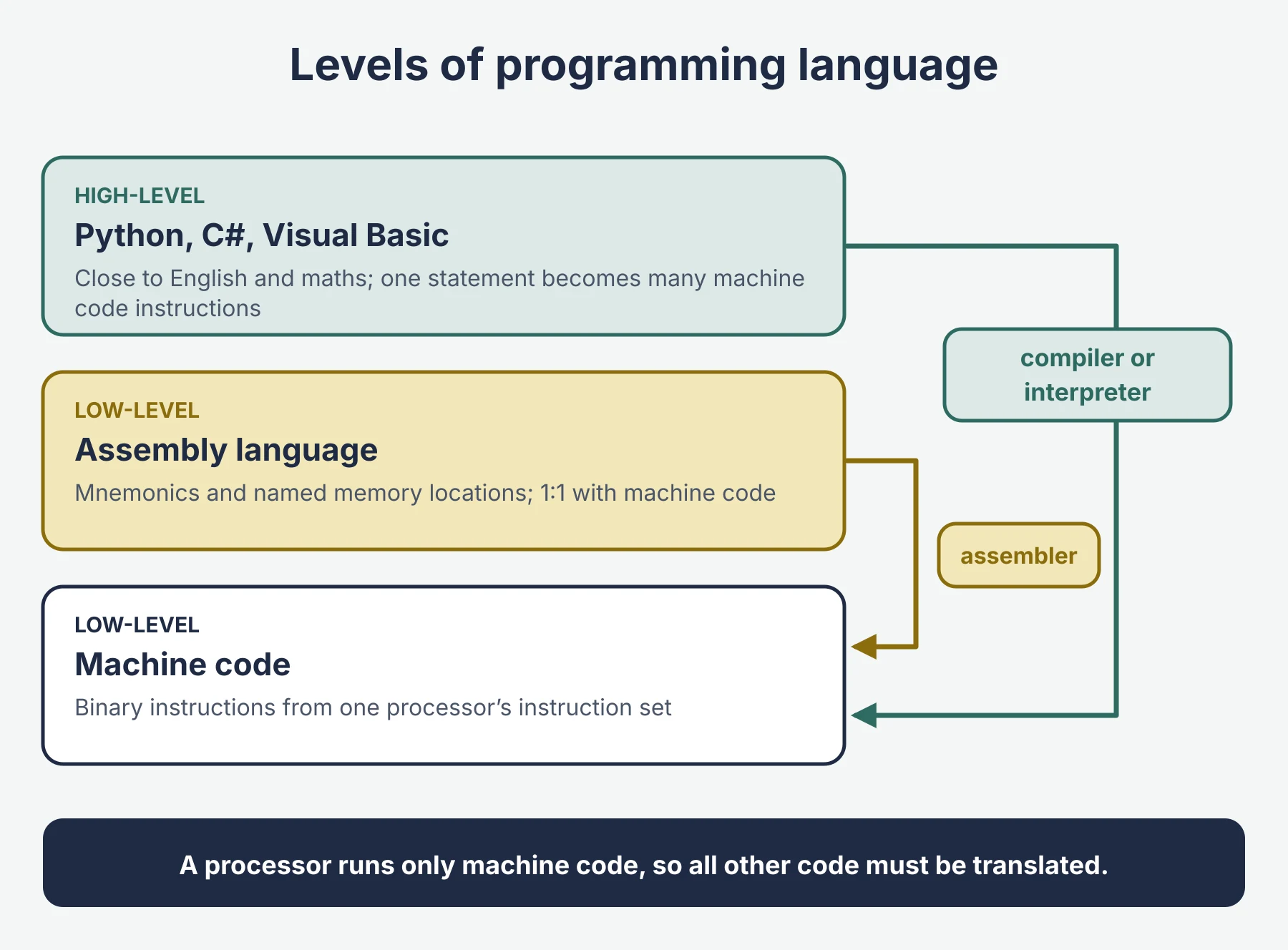
Machine code: the only language a processor runs
A processor can execute only machine code: instructions expressed in binary. Each type of processor has its own instruction set, the set of machine code instructions it understands, so machine code is specific to a processor or family of processors. A program in machine code for one family will not run on a processor from a different family.
The specification’s key consequence: all program code written in high-level or assembly languages must ultimately be translated into machine code before a processor can carry it out.
Assembly language
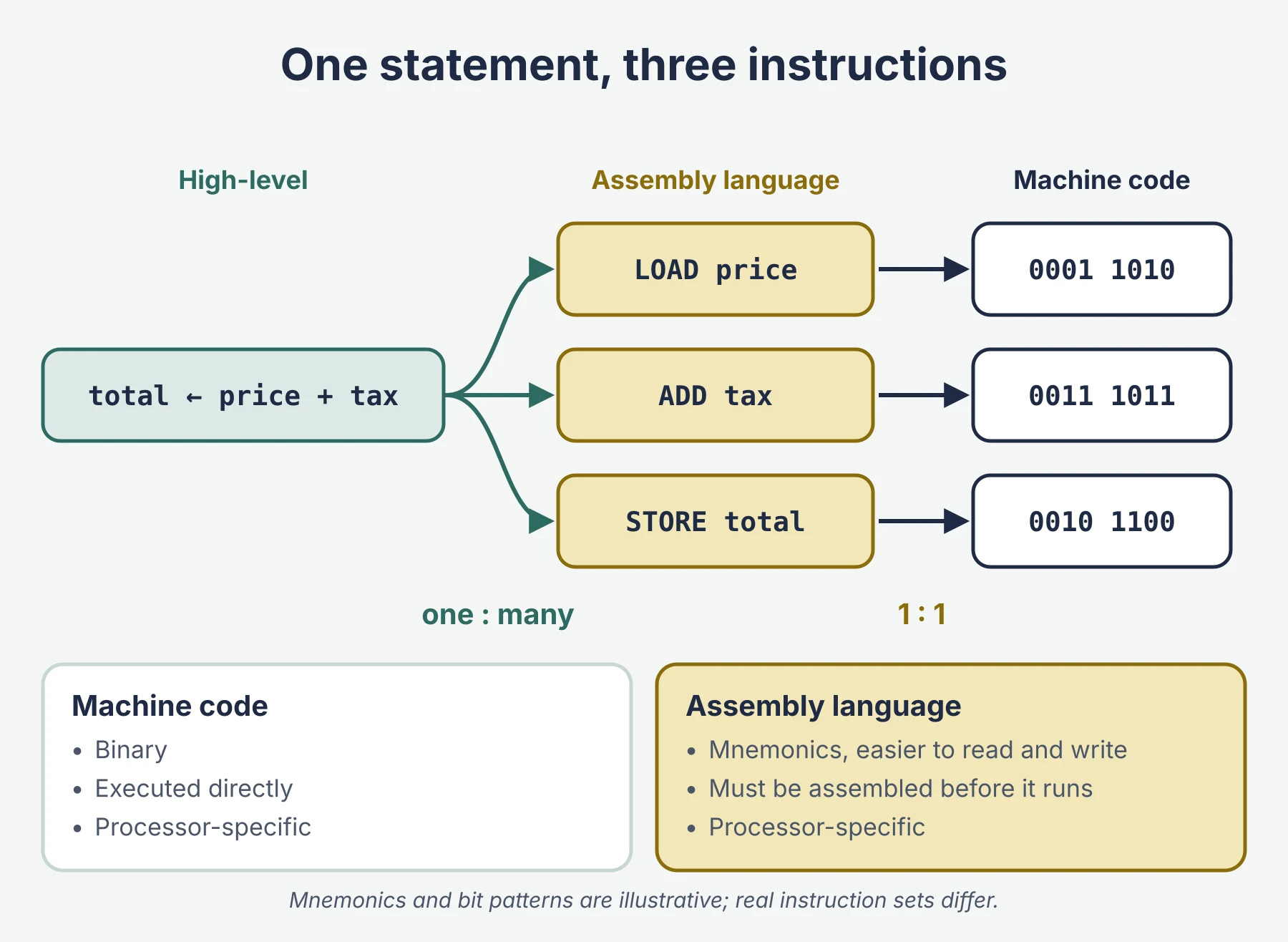
Writing binary directly is slow and error-prone, so assembly language replaces each binary instruction with a short, readable mnemonic, and lets the programmer use names for memory locations. Assembly language has a 1:1 correspondence with machine code: each line of assembly language becomes exactly one machine code instruction. An illustrative fragment (the mnemonics and bit patterns are invented for the example; real instruction sets differ) might be:
| Assembly language | Meaning | Machine code (illustrative) |
|---|---|---|
LOAD price |
Copy the value of price into the processor |
0001 1010 |
ADD tax |
Add the value of tax to it |
0011 1011 |
STORE total |
Copy the result into total |
0010 1100 |
In a high-level language the same task is a single statement, total ← price + tax. That contrast, three
instructions against one, is the heart of the difference between the two levels.
Machine code and assembly compared: both are low-level and processor-specific. Machine code is binary and is executed directly; assembly uses mnemonics, is easier for people to read and write, and must be assembled before it can run. Because of the 1:1 correspondence, an assembly programmer still controls exactly which instructions the processor executes.
High-level languages
Python, C# and Visual Basic are high-level languages. Their statements are closer to English and mathematical notation, and one statement usually translates into many machine code instructions. The specification says students should understand that most programs are written in high-level languages and explain why:
- they are easier to write, read and understand, so programs are produced faster;
- they are easier to debug and maintain, because the code shows what it is meant to do;
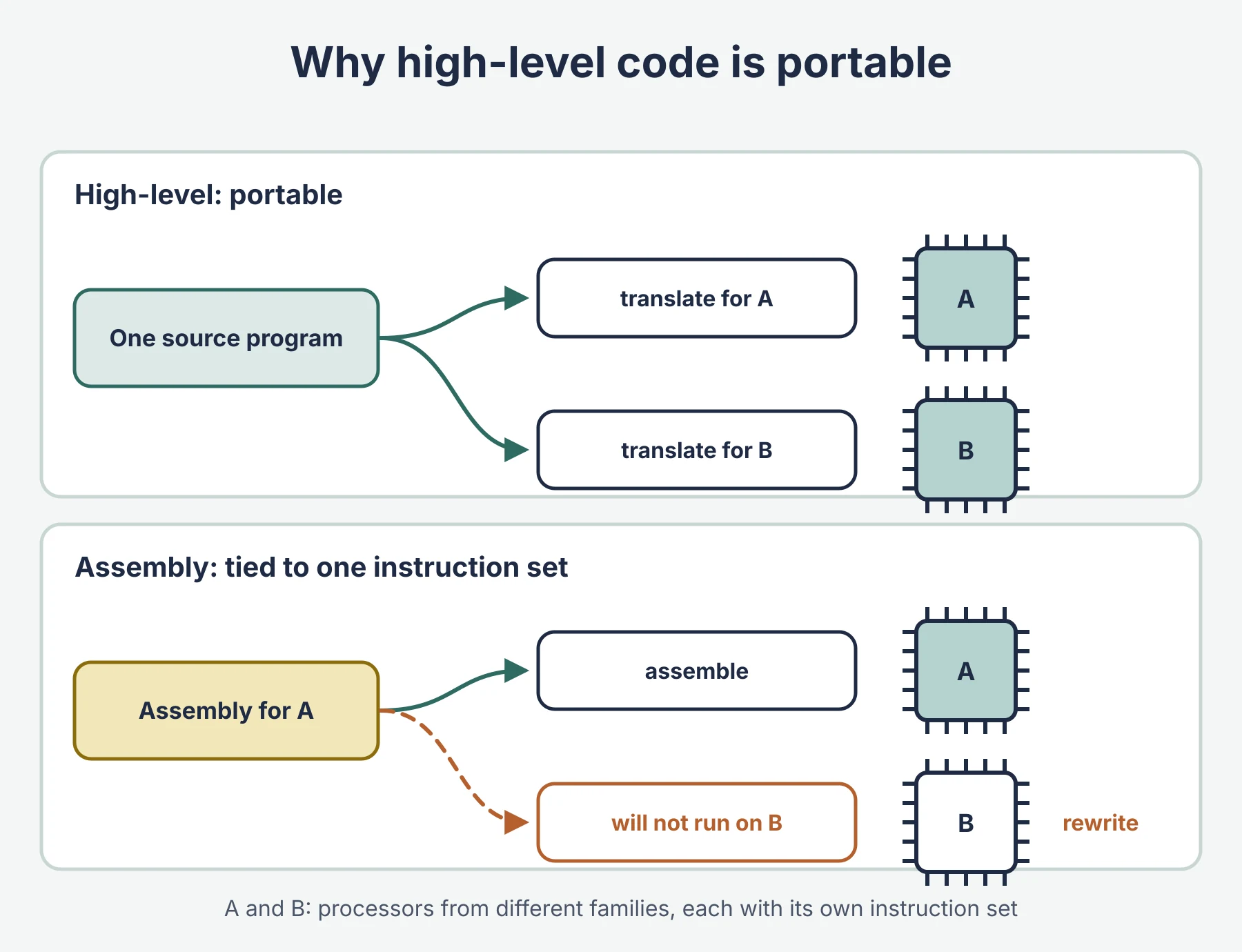
- they are portable: the same source code can be translated for different processors, instead of being rewritten for each instruction set;
- they provide built-in features such as selection, iteration, data structures and string handling, which in assembly would need many instructions each.
Why low-level languages are still used
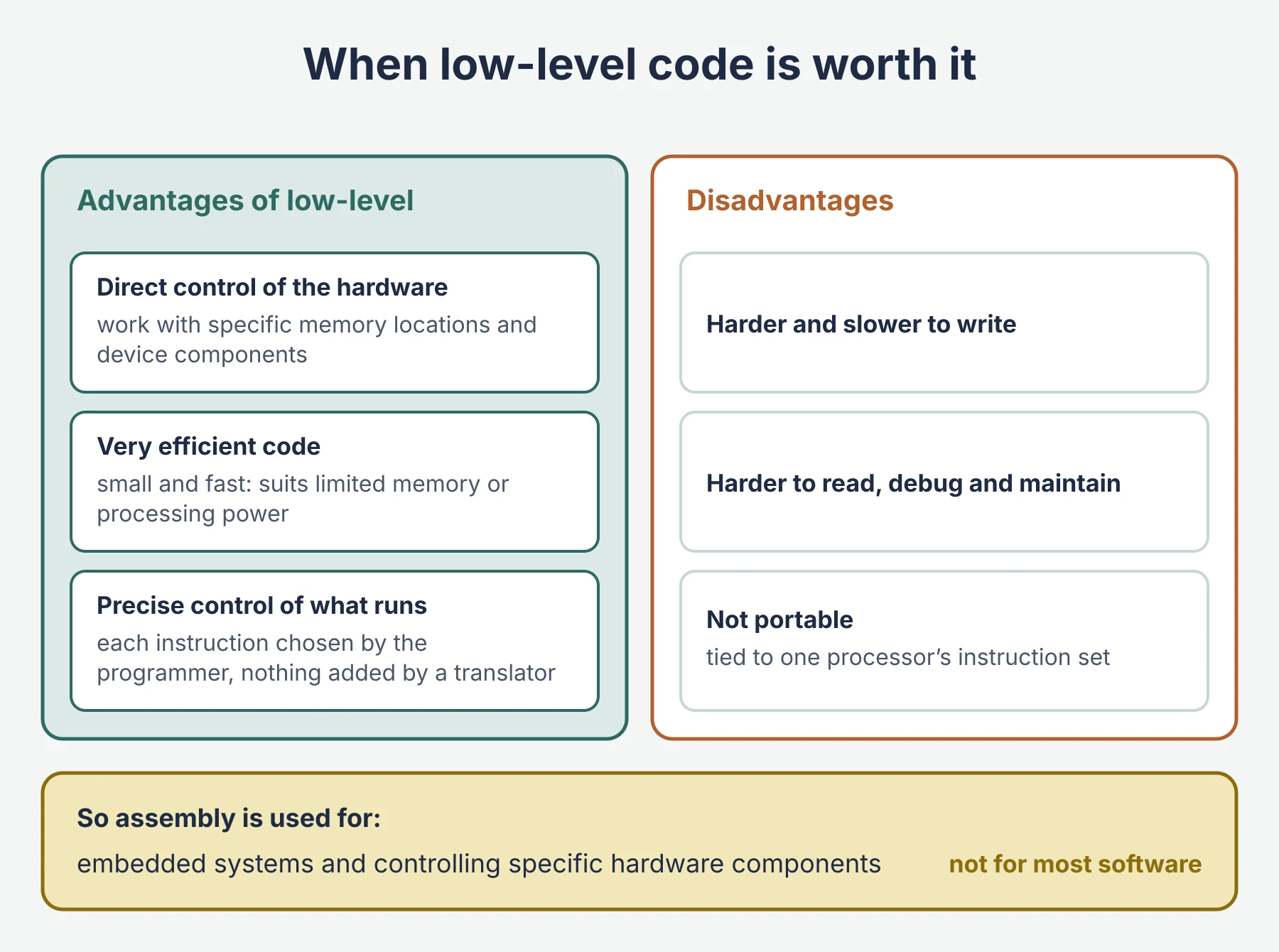
Assembly language is often used to develop software for embedded systems and for controlling specific hardware components. In these situations its advantages matter:
| Low-level advantage | Why it matters |
|---|---|
| Direct control of the hardware | The programmer can work with specific memory locations and device components |
| Code can be very efficient | Programs can be small and fast, which suits devices with limited memory or processing power |
| Precise control of what is executed | Each instruction is chosen by the programmer, with nothing added by a translator |
The disadvantages explain why it is not used for most software: it is harder and slower to write, harder to read, debug and maintain, and not portable, because it is tied to one processor’s instruction set.
The three translators
| Compiler | Interpreter | Assembler | |
|---|---|---|---|
| Translates | High-level language | High-level language | Assembly language |
| Generates machine code directly? | Yes | No | Yes |
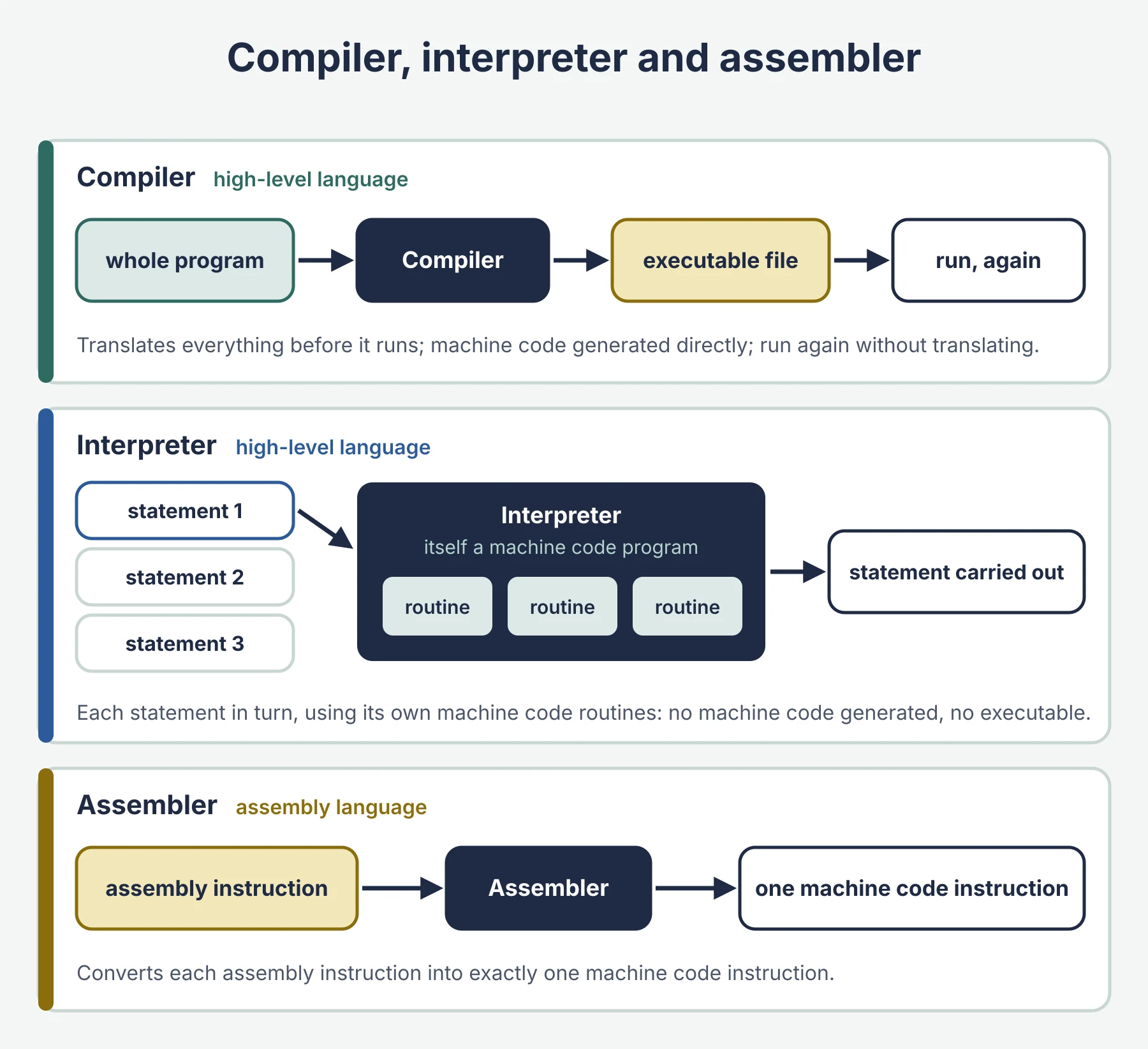
| How it works | Translates the whole program into machine code before it runs | Takes each statement in turn and carries it out by calling machine code subroutines within its own code | Converts each assembly instruction into one machine code instruction |
| Output | An executable file that can be run again without translating | No executable; the program is translated every time it runs | Machine code |
The interpreter row is the one most often answered wrongly. The specification is explicit that interpreters do not generate machine code directly: the interpreter is itself a machine code program, and for each statement it analyses, it runs its own pre-written machine code routines that carry that statement out.
When to use each translator
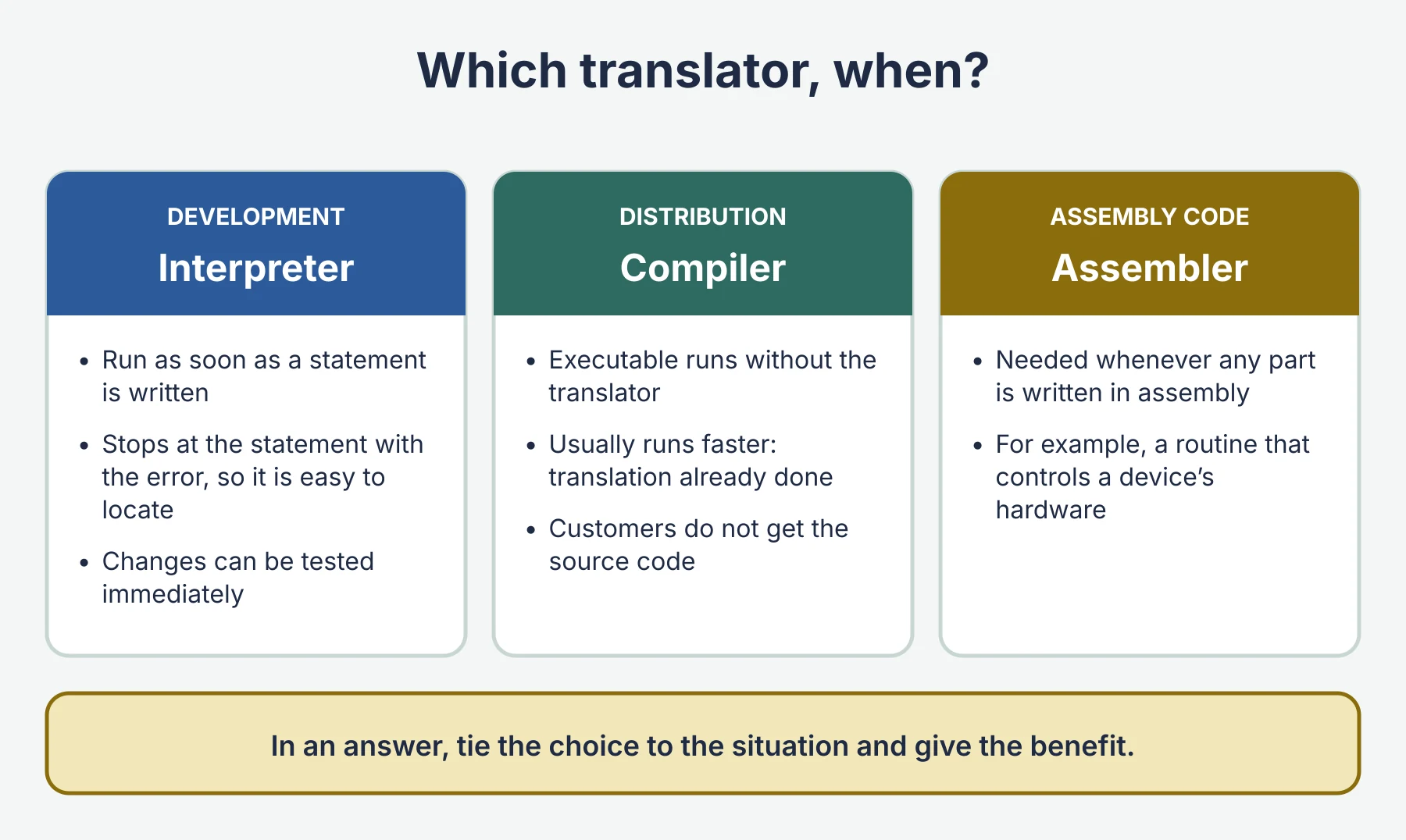
Interpreter, during development. The program can be run as soon as a statement is written, without waiting for the whole program to be translated, and execution stops at the statement where an error occurs, which makes that error easy to locate. Changes can be tested immediately.
Compiler, for distribution. The finished program becomes an executable that runs without the translator being present, usually runs faster because translation has already been done, and does not give customers the source code.
Assembler, for assembly language. Whenever the program, or part of it, has been written in assembly language (for example, a routine that controls a device’s hardware), an assembler is needed to produce the machine code.
Annotated model answer
Question: A company is developing a game for several types of games console, each with a different processor. Explain why the developers would write the game in a high-level language rather than in assembly language. [4]
Model answer: Assembly language is specific to one processor’s instruction set, so the game would have to be rewritten for each type of console. A high-level language is portable: the same source code can be translated for each processor. A game is a large program, and high-level code is quicker to write and easier to debug and maintain, so the game can be finished and updated more quickly.
Why it scores: it makes two distinct points, portability and ease of development, and each is linked to the scenario (several processors; a large program that will be updated). Answers that say “high-level is easier” without saying why, or without using the scenario, usually gain only part of the credit.
Common mistakes
- Saying an interpreter produces machine code or an executable.
- Saying a compiler translates “line by line”. It translates the whole program before it runs.
- Calling assembly language high-level because it uses words.
- Forgetting that machine code is processor-specific, so it is not portable.
- Saying assembly has “a few” machine code instructions per line. The correspondence is exactly 1:1.
- Choosing a translator with no reason tied to the situation (testing, distribution, assembly code).
Exam technique
- Explain the differences: compare like with like, for example “a compiler translates the whole program before running; an interpreter translates and runs each statement in turn”.
- Discuss when to use: link each translator to a stage or situation and give the benefit.
- Use the specification’s terms: instruction set, mnemonic, 1:1 correspondence, embedded system, portable.
Revise the comparisons quickly in the classification of programming languages and translators revision notes and practise written answers in the classification of programming languages and translators practice questions. Embedded systems are also part of Topic 4, Computer systems.
Related resources
-
Practice questions
OxfordAQA IGCSE Computer Science (9210): Classification of programming languages and translators – Practice Questions
Original OxfordAQA IGCSE Computer Science 9210 practice questions with answers on machine code, assembly, high-level languages and the three translators.
Computer Science · OxfordAQA · IGCSE
Try questions -
Revision notes
OxfordAQA IGCSE Computer Science (9210): Classification of programming languages and translators – Revision Notes
Revision notes for OxfordAQA IGCSE Computer Science 9210 section 3.2.13: low- and high-level languages, the three translators, exam traps and a self-test.
Computer Science · OxfordAQA · IGCSE
Revise topic -
Study guides
OxfordAQA IGCSE Computer Science (9210): Data structures
Study guide to OxfordAQA IGCSE Computer Science 9210 section 3.2.6: one- and two-dimensional arrays, records and arrays of records in simple solutions.
Computer Science · OxfordAQA · IGCSE
Read guide
Get free revision emails (optional)
Occasional emails with practice questions, worked explanations and links to free resources for the qualification and subjects you choose. No spam, and you can unsubscribe from any email. The free tools on this site never need an email.