
Revision Notes
Edexcel A Level Urdu (9UR0): The Creation of Pakistan, 1947 (قیامِ پاکستان) – Revision Notes
9UR0 Theme 4.1 notes on the creation of Pakistan in 1947 (قیامِ پاکستان): causes, events, consequences, a model paragraph and a self-test.
- Subject
- Urdu Language
- Level
- A LEVELS
- Topic
- Theme 4: Aspects of Pakistani politics (پاکستانی سیاست کے رُخ)
- Author
- Marlbridge Academic Team
- Updated
- Reviewed by
- Farheen Zehra (what this means)
Aligned to Pearson Edexcel A Level Urdu Language (9UR0), 2018. Official specification .
Syllabus page (what it covers and how it is assessed): Pearson Edexcel A Level Urdu Language.
Syllabus points this page covers
9UR0
- 4.1 قیامِ پاکستان (1947)
Found an error? Report a correction.
Need help with this topic? Request a free trial class for A Level Urdu Language (9UR0).
Revision notes for sub-theme 4.1 of Theme 4 in Pearson Edexcel A Level Urdu (9UR0): the creation of Pakistan in 1947 (قیامِ پاکستان (1947)). For the wider theme, read the 9UR0 subject guide and the Paper 1 study guide.
Context
Theme 4 is پاکستانی سیاست کے رُخ (aspects of Pakistani politics). Its three sub-themes are the creation of Pakistan in 1947, the feudal system, and environmental issues (the research subject). Research for Theme 4 must be based on Pakistan.
Key terms
| Urdu | Meaning |
|---|---|
| قیام | creation, founding |
| آزادی | independence |
| تقسیم | partition |
| ہجرت | migration |
| مہاجر | migrant |
| مسلم لیگ | the Muslim League |
| تحریکِ پاکستان | the Pakistan Movement |
| برصغیر | the (Indian) subcontinent |
| برطانوی راج | British rule |
| کانگریس | the (Indian National) Congress |
| دو قومی نظریہ | the two-nation theory |
| قراردادِ پاکستان | the Pakistan (Lahore) Resolution |
| یومِ آزادی | Independence Day (14 August) |
| یومِ پاکستان | Pakistan Day (23 March) |
| مطالبہ | demand |
| جدوجہد | struggle |
| قیادت | leadership |
| فسادات | riots, communal violence |
| پناہ گزین | refugee |
| سرحد | border |
| قربانی | sacrifice |
| دارالحکومت | capital city |
| معرضِ وجود میں آنا | to come into being |
Key facts
- Pakistan came into being in 1947, with the partition of British India into two independent states, India and Pakistan.
- قائدِ اعظم is the title of Muhammad Ali Jinnah (محمد علی جناح), founder of Pakistan and its first Governor-General.
- دو قومی نظریہ (two-nation theory): the idea that Muslims and Hindus of the subcontinent were two separate nations; the basis of the demand for Pakistan.
- قراردادِ پاکستان: the Pakistan (Lahore) Resolution, passed in Lahore in March 1940, calling for Muslim-majority areas to form independent states. Check dates and wording against your sources before using them.
Issues and perspectives
Causes: the road to 1947. The All-India Muslim League was founded in 1906 in Dhaka to represent Muslim political interests. Thinkers and leaders argued that Muslims had a distinct religious, cultural and historical identity: Sir Syed Ahmad Khan is often associated with early forms of this idea, and Allama Muhammad Iqbal (علامہ اقبال), in his 1930 address at Allahabad, set out the vision of a Muslim homeland in north-western India. Under Jinnah’s leadership the League adopted the Lahore Resolution at its session in Lahore in March 1940; the resolution was moved on 23 March, the date now marked each year as یومِ پاکستان. Many Muslims feared that in a united, independent India with a Hindu majority their rights and identity would not be protected.
Events of 1947. After the Second World War Britain decided to leave India. The plan announced in June 1947 provided for partition, and a boundary commission drew the new border. Pakistan was created on 14 August 1947, celebrated as یومِ آزادی. Karachi became the first capital, Jinnah became Governor-General and Liaquat Ali Khan the first Prime Minister. At that time Pakistan had two wings, West and East Pakistan; the eastern wing became Bangladesh in 1971.
Consequences. Partition was followed by one of the largest migrations in history: Muslims moved to Pakistan and Hindus and Sikhs to India, often on foot or in crowded trains. Communal violence (فسادات) killed very large numbers of people, and many families were separated. The new state faced the task of settling refugees, building a government almost from nothing, and disputes over the division of assets and over Kashmir. Jinnah died in September 1948, only about a year after independence.
Different perspectives.
- Celebration: for many Pakistanis 1947 is a story of freedom, sacrifice (قربانی) and the achievement of a homeland, remembered every 14 August.
- Trauma: for families who lost relatives, homes and land, the memory is also one of grief. Urdu literature, including Khadija Mastur’s novel Aangan, shows how the politics of the time reached into ordinary homes.
- Historians’ debates: historians still discuss whether partition could have been avoided, how far British decisions and timing contributed to the violence, and what kind of state the founders intended. You do not need to settle these debates, but showing that they exist adds depth.
Writing about 1947
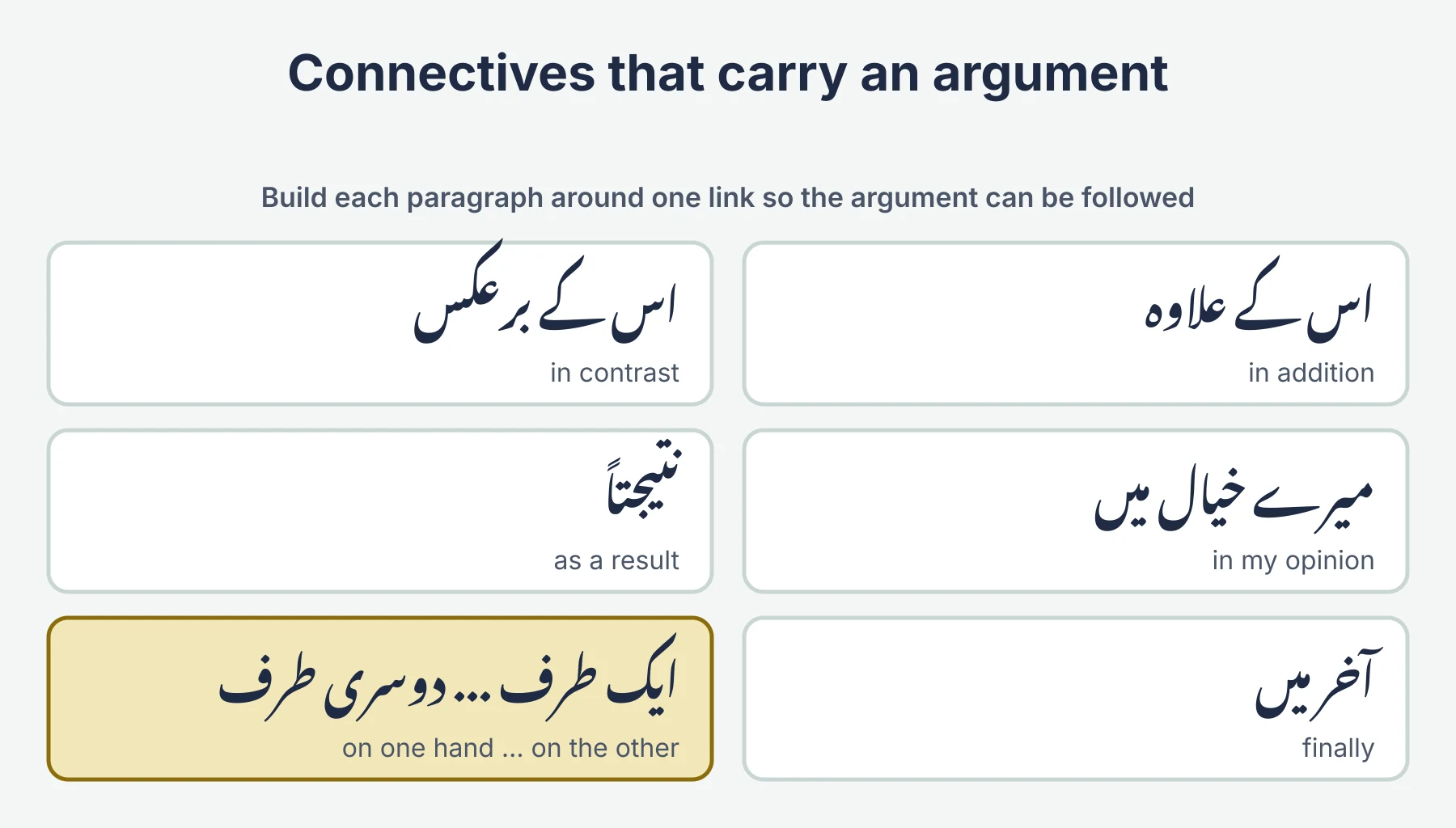
Give causes, events and consequences in order, name the terms in Urdu, and keep to facts you have checked in a source. Where you give an opinion, support it with a reason and use a connective such as نتیجتاً or اس کے علاوہ.
Useful sentences with grammar notes
- پاکستان 14 اگست 1947 کو معرضِ وجود میں آیا۔ (Pakistan came into being on 14 August 1947.) Dates take کو; پاکستان takes masculine agreement, so آیا.
- تقسیم کے وقت لاکھوں لوگوں کو اپنا گھر بار چھوڑنا پڑا۔ (At the time of partition, vast numbers of people had to leave their homes.) Obligation with کو + infinitive + پڑنا; گھر بار is masculine, so چھوڑنا پڑا.
- قائدِ اعظم کی قیادت میں مسلم لیگ نے ایک الگ وطن کا مطالبہ کیا۔ (Under the Quaid-e-Azam’s leadership, the Muslim League demanded a separate homeland.) With نے, the verb agrees with مطالبہ (masculine): کیا.
- 23 مارچ 1940 کو لاہور میں قراردادِ پاکستان پیش کی گئی۔ (The Pakistan Resolution was presented in Lahore on 23 March 1940.) Passive agreeing with قرارداد (feminine): پیش کی گئی. The same pattern gives منظور کی گئی (was passed).
- آزادی کی خوشی کے ساتھ ساتھ ہجرت کا دکھ بھی اس دور کی یادوں کا حصہ ہے۔ (Alongside the joy of independence, the pain of migration is also part of the memories of that era.) کے ساتھ ساتھ (along with) is useful for balance.
Model paragraph
قیامِ پاکستان برصغیر کی تاریخ کا ایک اہم موڑ تھا۔ دو قومی نظریے کے مطابق مسلمان اور ہندو دو الگ قومیں تھے، اس لیے مسلم لیگ نے قائدِ اعظم محمد علی جناح کی قیادت میں مسلم اکثریتی علاقوں کے لیے الگ وطن کا مطالبہ کیا۔ مارچ 1940 میں لاہور میں منظور ہونے والی قراردادِ پاکستان اس جدوجہد کا ایک سنگِ میل تھی۔ تاہم آزادی کی خوشی کے ساتھ تقسیم کا دکھ بھی آیا، کیونکہ فسادات میں بے شمار لوگ مارے گئے اور لاکھوں خاندانوں کو اپنا گھر بار چھوڑ کر ہجرت کرنی پڑی۔ میرے خیال میں 1947 کو صرف ایک سیاسی واقعہ نہیں بلکہ ایک انسانی تجربہ بھی سمجھنا چاہیے۔
Translation: The creation of Pakistan was an important turning point in the history of the subcontinent. According to the two-nation theory, Muslims and Hindus were two separate nations, so the Muslim League, under the leadership of Quaid-e-Azam Muhammad Ali Jinnah, demanded a separate homeland for the Muslim-majority areas. The Pakistan Resolution, passed in Lahore in March 1940, was a milestone in this struggle. However, with the joy of independence came the pain of partition, because countless people were killed in the riots and vast numbers of families had to leave their homes and migrate. In my opinion, 1947 should be understood not only as a political event but also as a human experience.
Why it works: cause, key event and consequence appear in order; the facts are ones you can verify; and تاہم turns the paragraph from celebration to cost. Note ہجرت کرنی پڑی: the infinitive agrees with ہجرت (feminine), so کرنی, and قرارداد … سنگِ میل تھی agrees with the feminine subject.
Discussion and essay prompts
- «دو قومی نظریہ قیامِ پاکستان کی بنیاد تھا۔» (The two-nation theory was the foundation of the creation of Pakistan.) Explain and evaluate.
- «آزادی کی قیمت بہت بھاری تھی۔» (The price of independence was very heavy.) Discuss with reference to partition and migration.
- Why do 14 August and 23 March matter to Pakistanis today?
- How did the problems of 1947 shape the early years of the new state?
Exam traps
- Quoting dates, figures or wording from memory without checking.
- Telling a narrative with no analysis.
- Confusing ہجرت (migration) with تقسیم (partition).
- Mixing up 23 March (Lahore Resolution, Pakistan Day) and 14 August (Independence Day).
- Giving precise death or migration totals; estimates vary, so describe the scale in words.
- Writing about the other side of the border with hostility; analyse, do not insult.
Self-test
- What does قیامِ پاکستان mean?
- Who is the قائدِ اعظم?
- What is the دو قومی نظریہ?
- When and where was the Lahore Resolution passed?
- Which country must Theme 4 research be based on?
- When and where was the All-India Muslim League founded?
- Which thinker set out the vision of a Muslim homeland in his 1930 Allahabad address?
- What are یومِ آزادی and یومِ پاکستان, and their dates?
- Who became Pakistan’s first Prime Minister, and which city was the first capital?
- Name two consequences of partition.
- In 23 مارچ 1940 کو لاہور میں قراردادِ پاکستان پیش کی گئی, why is the verb کی گئی?
- Translate: ‘Pakistan came into being on 14 August 1947’.
Answers: 1. The creation (founding) of Pakistan. 2. Muhammad Ali Jinnah, founder of Pakistan and its first Governor-General. 3. The two-nation theory: Muslims and Hindus of the subcontinent were two separate nations. 4. In Lahore, in March 1940. 5. Pakistan. 6. In 1906, in Dhaka. 7. Allama Muhammad Iqbal. 8. Independence Day (14 August) and Pakistan Day (23 March). 9. Liaquat Ali Khan; Karachi. 10. For example, mass migration, communal violence, separated families, the refugee crisis and the Kashmir dispute. 11. It is a passive agreeing with قرارداد, which is feminine. 12. پاکستان 14 اگست 1947 کو معرضِ وجود میں آیا۔
Related resources
-
Revision notes
Edexcel A Level Urdu (9UR0): Environmental Issues in Pakistan – Revision Notes
9UR0 Theme 4.3 notes on environmental measures in Pakistan, the research subject: issues, measures, vocabulary, a model paragraph and a self-test.
Urdu Language · Pearson Edexcel · A Level
Revise topic -
Revision notes
Edexcel A Level Urdu (9UR0): The Feudal System (جاگیرداری نظام) – Revision Notes
9UR0 Theme 4.2 notes on the feudal system (جاگیرداری نظام): history, criticisms, reform, key terms, a model paragraph and a self-test.
Urdu Language · Pearson Edexcel · A Level
Revise topic -
Study guides
Edexcel A Level Urdu (9UR0): Environmental Issues in Pakistan
9UR0 research subject 4.3: government action on climate and pollution, disaster measures and foreign aid agencies, with Section C research planning.
Urdu Language · Pearson Edexcel · A Level
Read guide
Get free revision emails (optional)
Occasional emails with practice questions, worked explanations and links to free resources for the qualification and subjects you choose. No spam, and you can unsubscribe from any email. The free tools on this site never need an email.