
Revision Notes
Edexcel A Level Urdu (9UR0): Aangan (آنگن) – Revision Notes
9UR0 notes on the prescribed novel Aangan (آنگن) by Khadija Mastur (1999): themes, technique, a model paragraph, essay prompts and a self-test.
- Subject
- Urdu Language
- Level
- A LEVELS
- Topic
- Prescribed literary texts and films
- Author
- Marlbridge Academic Team
- Updated
- Reviewed by
- Farheen Zehra (what this means)
Aligned to Pearson Edexcel A Level Urdu Language (9UR0), 2018. Official specification .
Syllabus page (what it covers and how it is assessed): Pearson Edexcel A Level Urdu Language.
Syllabus points this page covers
9UR0
- 5.1 آنگن — خدیجہ مستور (1999) novel
Found an error? Report a correction.
Need help with this topic? Request a free trial class for A Level Urdu Language (9UR0).
Revision notes for 5.1 in the prescribed literary texts and films of Pearson Edexcel A Level Urdu (9UR0), Paper 2. For the full explanation of the paper, read the Translation into Urdu and Written Response to Works study guide and the Paper 2 revision notes.
The work
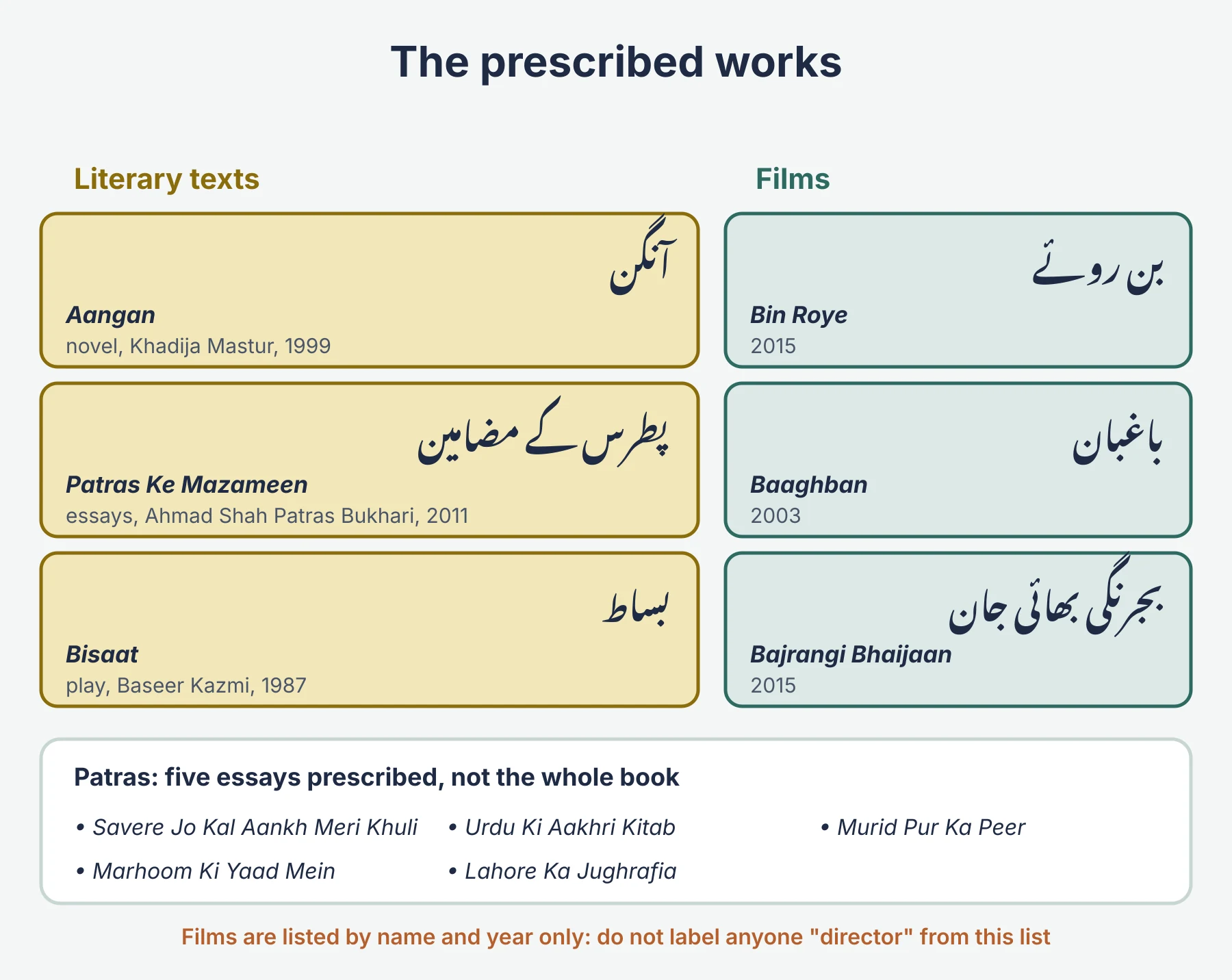
- Title: آنگن (Aangan)
- Author: خدیجہ مستور (Khadija Mastur)
- Year: 1999
- Form: novel; a prescribed literary text in Appendix 1 of the specification.
1999 is the year printed in the specification’s list. The novel itself was first published in 1962, so do not describe it as a novel written in the 1990s. Khadija Mastur was one of the leading women fiction writers in Urdu, and she settled in Pakistan after independence.
What the novel is about
Aangan is set in a Muslim household in north India in the years before Partition, and ends after the creation of Pakistan. The story is seen largely through the experience of a young woman, عالیہ (Aliya), who grows up in her extended family’s home. The great political conflict of the period, between supporters of the Congress and of the Muslim League, enters the house itself: members of the same family take opposite sides, and political arguments affect marriages, loyalties and futures.
Use this summary only as orientation. In the exam you need your own detailed references to scenes, characters and turning points, gathered from reading the novel.
Key themes and issues
- The courtyard as a world. The title آنگن means the courtyard at the centre of a traditional house, where the women of the family spend much of their lives. It can be read as a symbol of the limited space allowed to women, and of the household as a small version of the wider society.
- Politics and the family. National events are shown through their effect on one home: the novel asks what political commitment costs the people around the committed person.
- Women’s lives and choices. Marriage, education, dependence and the freedom to decide one’s own future are recurring concerns. Consider which women in the novel are trapped, which resist, and what the novel suggests about the price of each path.
- Class and service. The household includes servants and poorer relatives; notice how they are treated and what this reveals about hierarchy.
- Partition and migration. The ending connects the family story to the creation of Pakistan; compare the hopes attached to the new country with what the characters actually find.
Form and technique
- Narrative focus: because events are filtered through Aliya’s observation, the reader experiences politics as a young woman inside the home would, not as a leader or historian would.
- Setting as meaning: the house and its courtyard are more than a backdrop; ask how movement into or out of the house marks change.
- Characterisation through conflict: characters reveal themselves through their political positions and through how they treat others in the household.
- Structure and time: note how the novel moves through time and where it begins and ends; the shape of the story affects how we judge what happens.
- Language: dialogue gives each character a voice; collect a few short phrases (a few words each) that show a character’s attitude.
How it is examined
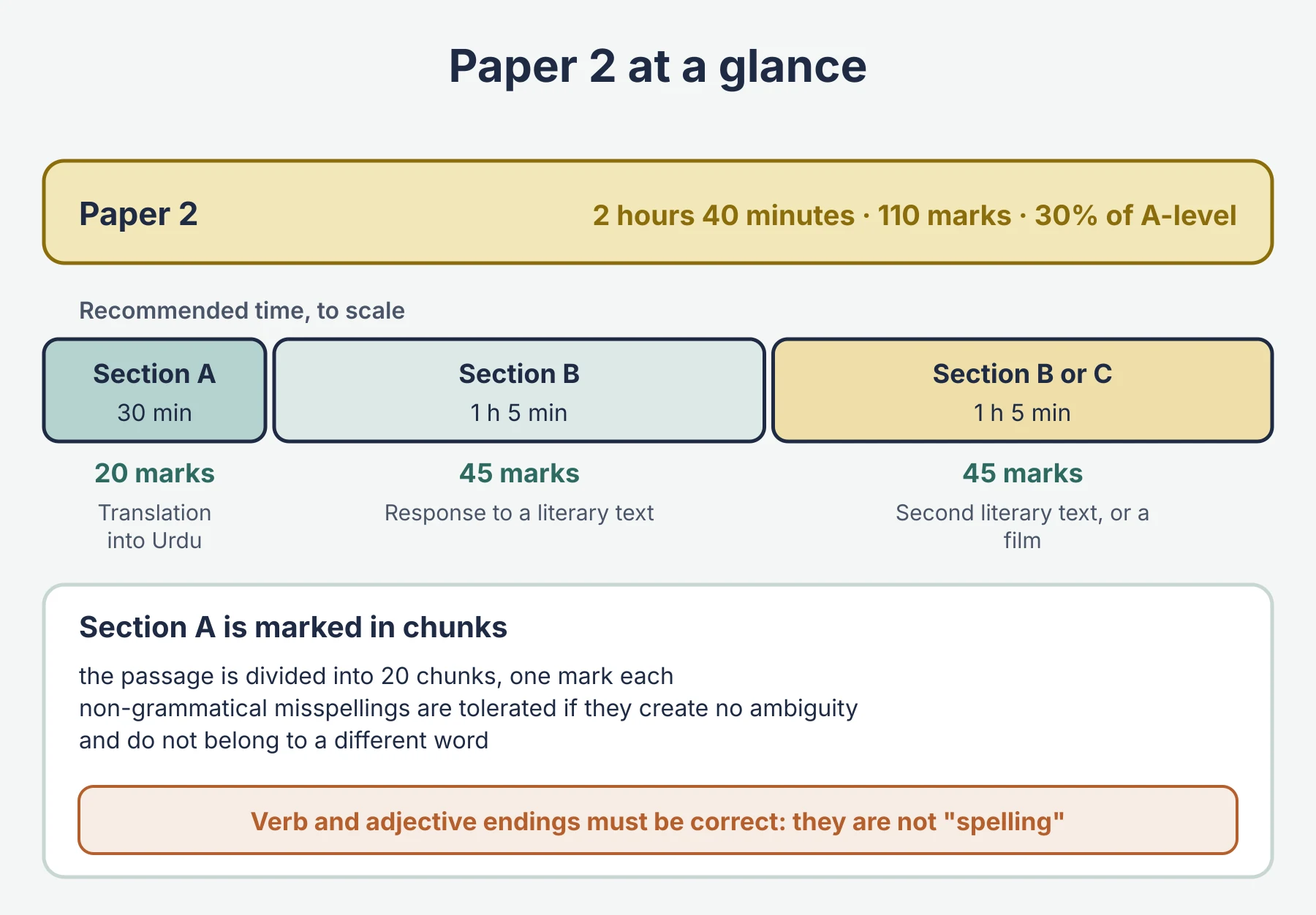
- Paper 2 is 2 hours 40 minutes, 110 marks, 30% of the A Level.
- Section B (literary text) is worth 45 marks and about 1 hour 5 minutes; you choose from two questions.
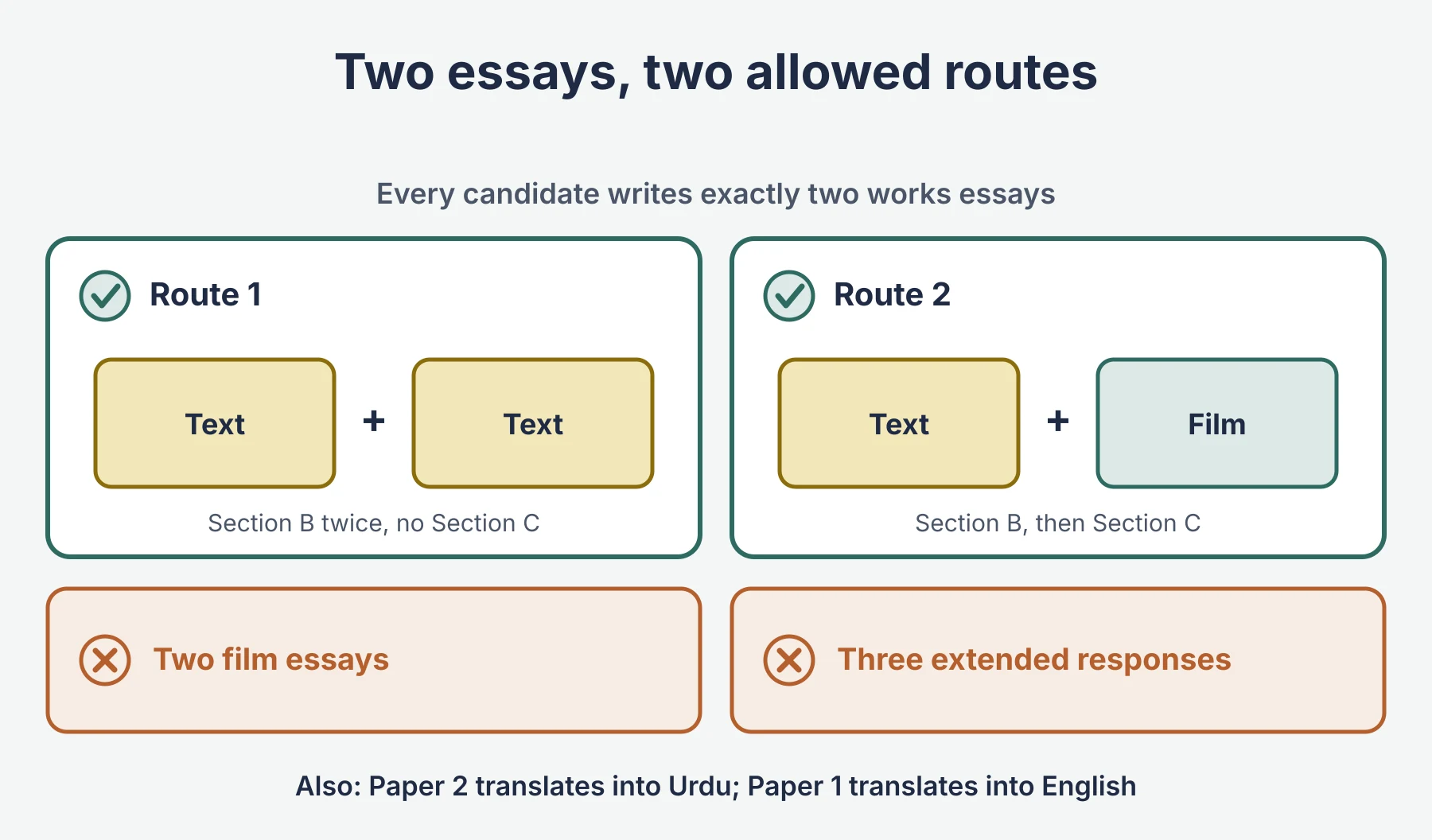
- You write exactly two extended responses: two literary texts, or one literary text and one film. Two films is never allowed.
- Marking criteria: critical and analytical response with cultural or social insight (AO4), range of grammatical structures and vocabulary (AO3), and accuracy of language (AO3). There are no AO1 or AO2 marks on Paper 2.
Approach and skills
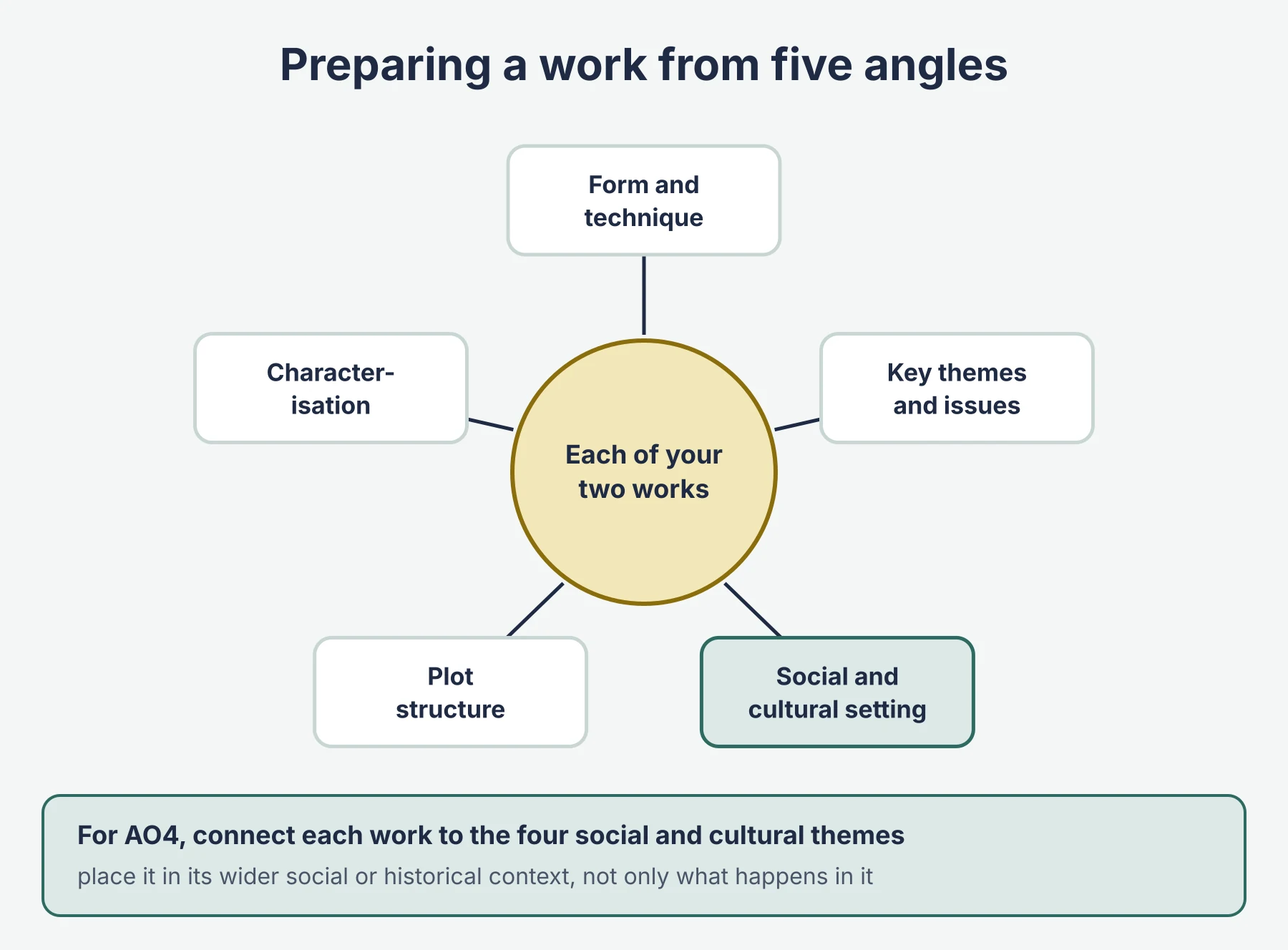
- Prepare against five angles: form and technique, key themes and issues, characterisation, plot structure, social and cultural setting.
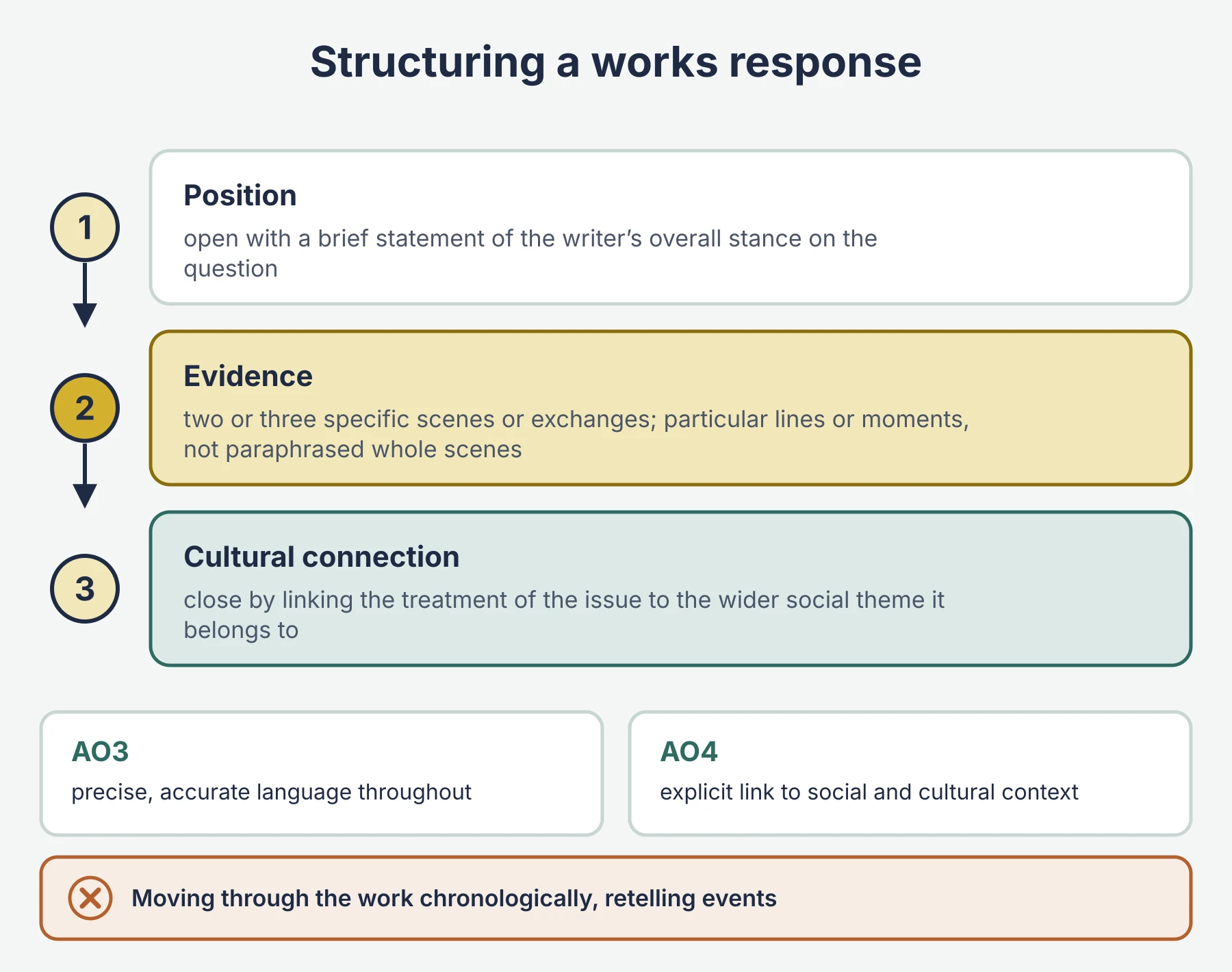
- Structure each answer as position, evidence, cultural connection: state your stance, support it with two or three specific points (not a retelling), then link the writer’s or film’s treatment of an issue to a broader social or cultural theme.
- Write in controlled Urdu with correct agreement, tense and spelling, and plan before you write.
- Use your own prepared references from the work; this page does not replace studying it.
The novel links naturally to Theme 4: see the notes on the creation of Pakistan in 1947.
Vocabulary for writing about the novel
| Urdu | Meaning |
|---|---|
| ناول | novel |
| ناول نگار | novelist |
| مصنفہ | author (female) |
| کردار | character |
| مرکزی کردار | main character |
| کردار نگاری | characterisation |
| راوی | narrator |
| پلاٹ | plot |
| موضوع | theme, subject |
| علامت | symbol |
| اسلوب | style |
| مکالمہ | dialogue |
| منظر نگاری | description of scenes and setting |
| سماجی پس منظر | social background |
| تقسیمِ ہند | the partition of India |
| کشمکش | inner conflict, struggle |
| گھریلو زندگی | domestic life |
| طبقاتی فرق | class difference |
Useful sentences with grammar notes
- آنگن کو گھر کی عورتوں کی محدود دنیا کی علامت سمجھا جا سکتا ہے۔ (The courtyard can be seen as a symbol of the limited world of the household’s women.) Passive with سکنا; because the subject is marked with کو, the verb is masculine singular.
- عالیہ کے ذریعے مصنفہ ایک حساس لڑکی کی کشمکش دکھاتی ہیں۔ (Through Aliya, the author shows the inner conflict of a sensitive girl.) The respectful plural دکھاتی ہیں is used for the author; it stays feminine.
- ناول میں سیاست گھر کے اندر تک پہنچ جاتی ہے۔ (In the novel, politics reaches right inside the home.) سیاست is feminine, so پہنچ جاتی ہے.
- اس ناول کی کہانی تقسیمِ ہند کے پس منظر میں بیان کی گئی ہے۔ (The story of this novel is told against the background of the partition of India.) Passive agreeing with کہانی (feminine).
Model paragraph
Task: how does the novel show the effect of politics on family life?
خدیجہ مستور کے ناول “آنگن” میں سیاست صرف جلسوں اور اخباروں تک محدود نہیں رہتی بلکہ گھر کے آنگن میں داخل ہو جاتی ہے۔ ناول میں ایک ہی خاندان کے افراد کانگریس اور مسلم لیگ کی حمایت میں بٹ جاتے ہیں، اور یہ اختلاف رشتوں میں تلخی پیدا کرتا ہے۔ عالیہ ان جھگڑوں کو قریب سے دیکھتی ہے، اسی لیے قاری بھی تقسیم سے پہلے کے سیاسی ماحول کو ایک گھر کی نظر سے دیکھتا ہے۔ میرے خیال میں مصنفہ کا یہ طریقہ بہت مؤثر ہے، کیونکہ اس سے پتا چلتا ہے کہ تاریخ کے بڑے واقعات عام لوگوں، خاص طور پر عورتوں، کی زندگیوں پر کس طرح اثر انداز ہوتے ہیں۔
Translation: In Khadija Mastur’s novel Aangan, politics is not confined to rallies and newspapers but enters the courtyard of the home. In the novel, members of a single family are divided in their support for the Congress and the Muslim League, and this disagreement creates bitterness in their relationships. Aliya watches these quarrels closely, which is why the reader too sees the political atmosphere before Partition through the eyes of one household. In my view the author’s method is very effective, because it shows how the great events of history affect the lives of ordinary people, especially women.
Why it works: position, then evidence, then a cultural connection. In a real answer, add two or three specific scenes from your own reading after the second sentence; the frame alone would not reach the top of the AO4 range.
Essay prompts to prepare
- «ناول “آنگن” میں عورت کی زندگی کی عکاسی کا تجزیہ کیجیے۔» (Analyse the portrayal of women’s lives in Aangan.)
- «“آنگن” میں سیاست خاندان کو جوڑتی کم اور توڑتی زیادہ ہے۔» (In Aangan, politics divides the family more than it unites it.) To what extent do you agree?
- Explore the significance of the title آنگن.
- How does the novel present the hopes and disappointments of Partition?
Useful command phrases: تجزیہ کیجیے (analyse), جائزہ لیجیے (examine, evaluate), وضاحت کیجیے (explain), آپ کس حد تک متفق ہیں؟ (to what extent do you agree?).
Exam traps
- Retelling the story without connecting it to a theme weakens the AO4 mark.
- Attempting three responses, or choosing two films.
- Running over time on the first response and squeezing the second.
- Calling it a 1990s novel because of the date in the specification list.
- Writing about Partition in general historical terms with no reference to the novel’s characters and scenes.
- Quoting long passages; a few well-chosen words, explained, are worth more.
Self-test
- Who wrote آنگن, in what year, and in what form?
- Which Paper 2 section covers it?
- Name the five preparation angles.
- Which assessment objectives apply?
- What answer structure is recommended?
- When was the novel first published, and what does the 1999 date refer to?
- Who is the central figure through whose experience much of the story is seen?
- What does the title mean, and how can it be read symbolically?
- Which two political movements divide the family?
- Give the Urdu for ‘characterisation’ and ‘symbol’.
- Why is the verb دکھاتی ہیں in عالیہ کے ذریعے مصنفہ … کشمکش دکھاتی ہیں?
- Which Theme 4 sub-theme links most closely to the novel?
Answers: 1. خدیجہ مستور, 1999, a novel. 2. Section B, 45 marks, about 1 hour 5 minutes. 3. Form and technique, key themes and issues, characterisation, plot structure, social and cultural setting. 4. AO4 and AO3 (range and accuracy of language); no AO1 or AO2. 5. Position, evidence, cultural connection. 6. In 1962; 1999 is the year printed in the specification’s list. 7. عالیہ (Aliya). 8. The courtyard of a traditional house; it can be read as a symbol of women’s limited world and of the household as a small version of society. 9. The Congress and the Muslim League. 10. کردار نگاری and علامت. 11. It is the respectful plural for the female author, so it is feminine plural. 12. Sub-theme 4.1, the creation of Pakistan in 1947.
Related resources
-
Revision notes
Edexcel A Level Urdu (9UR0): Baaghban (باغبان) – Revision Notes
9UR0 notes on the prescribed film Baaghban (باغبان), Ravi Chopra (2003): themes, film technique, a model paragraph and a self-test.
Urdu Language · Pearson Edexcel · A Level
Revise topic -
Revision notes
Edexcel A Level Urdu (9UR0): Bajrangi Bhaijaan (بجرنگی بھائی جان) – Revision Notes
9UR0 notes on the prescribed film Bajrangi Bhaijaan (بجرنگی بھائی جان), Kabir Khan (2015): themes, technique, a model paragraph and a self-test.
Urdu Language · Pearson Edexcel · A Level
Revise topic -
Revision notes
Edexcel A Level Urdu (9UR0): Bin Roye (بن روئے) – Revision Notes
9UR0 notes on the prescribed film Bin Roye (بن روئے), Momina Duraid (2015): themes, film technique, a model paragraph and a self-test.
Urdu Language · Pearson Edexcel · A Level
Revise topic
Get free revision emails (optional)
Occasional emails with practice questions, worked explanations and links to free resources for the qualification and subjects you choose. No spam, and you can unsubscribe from any email. The free tools on this site never need an email.