
Revision Notes
OxfordAQA IGCSE Computer Science (9210): Data structures – Revision Notes
Revision notes for OxfordAQA IGCSE Computer Science 9210 section 3.2.6: arrays, two-dimensional arrays, records, arrays of records, traps and a self-test.
- Subject
- Computer Science
- Level
- IGCSE
- Topic
- Topic 2 – Programming
- Author
- Marlbridge Academic Team
- Updated
- Reviewed by
- Harris Khan (what this means)
Aligned to OxfordAQA IGCSE Computer Science (9210), For teaching from September 2017, exams from May/June 2019. Official specification .
Syllabus page (what it covers and how it is assessed): OxfordAQA IGCSE Computer Science.
Syllabus points this page covers
9210
- 3.2.6 Data structures
Found an error? Report a correction.
Need help with this topic? Request a free trial class for IGCSE Computer Science (9210).
Condensed notes for section 3.2.6 Data structures of OxfordAQA International GCSE Computer Science (9210). Full worked examples are in the data structures study guide.
What the specification asks
- Understand the concept of data structures.
- Use arrays (or equivalent) in the design of solutions to simple problems: one- and two-dimensional only; a Python list is acceptable.
- Use records (or equivalent): C# structs, Visual Basic structures, Python classes used in a non-object-oriented way.
Concept
A data structure stores several related items under one name, organised so they can be processed together (usually with a loop).
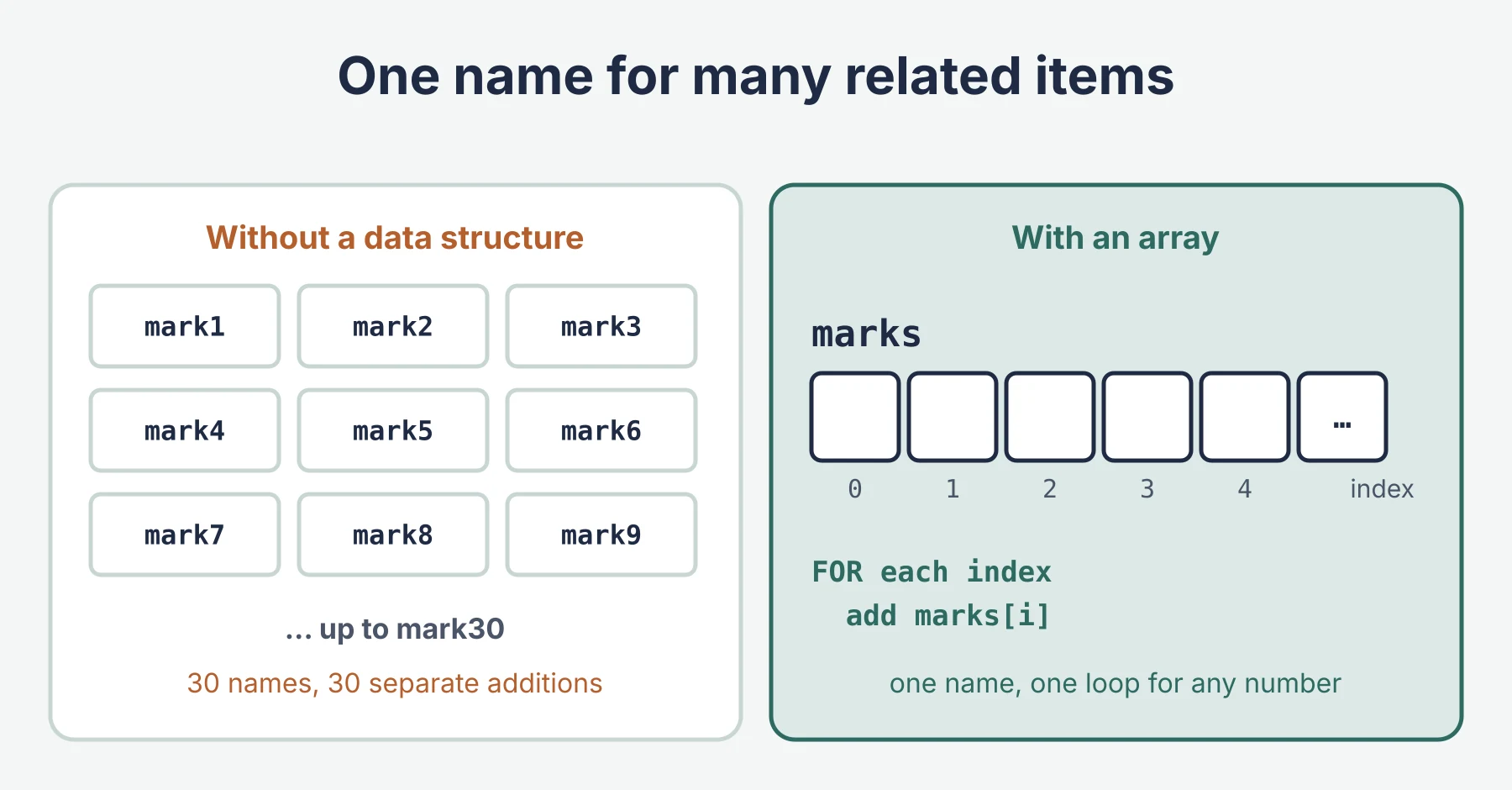
Arrays at a glance
| Feature | One-dimensional | Two-dimensional |
|---|---|---|
| Shape | A list | A table (rows and columns) |
| Indexes needed | 1: a[i] |
2: t[row][col] |
| Data types | All elements the same type | All elements the same type |
| Typical loop | One FOR loop |
Nested FOR loops |
| Example | 7 daily step counts | Seats in a 10 × 20 theatre |
- Indexes start at 0 in the specification’s pseudocode: an array of length
nhas indexes0ton - 1. LEN(a)gives the number of elements.- Assignment to an element:
a[2] ← 50.
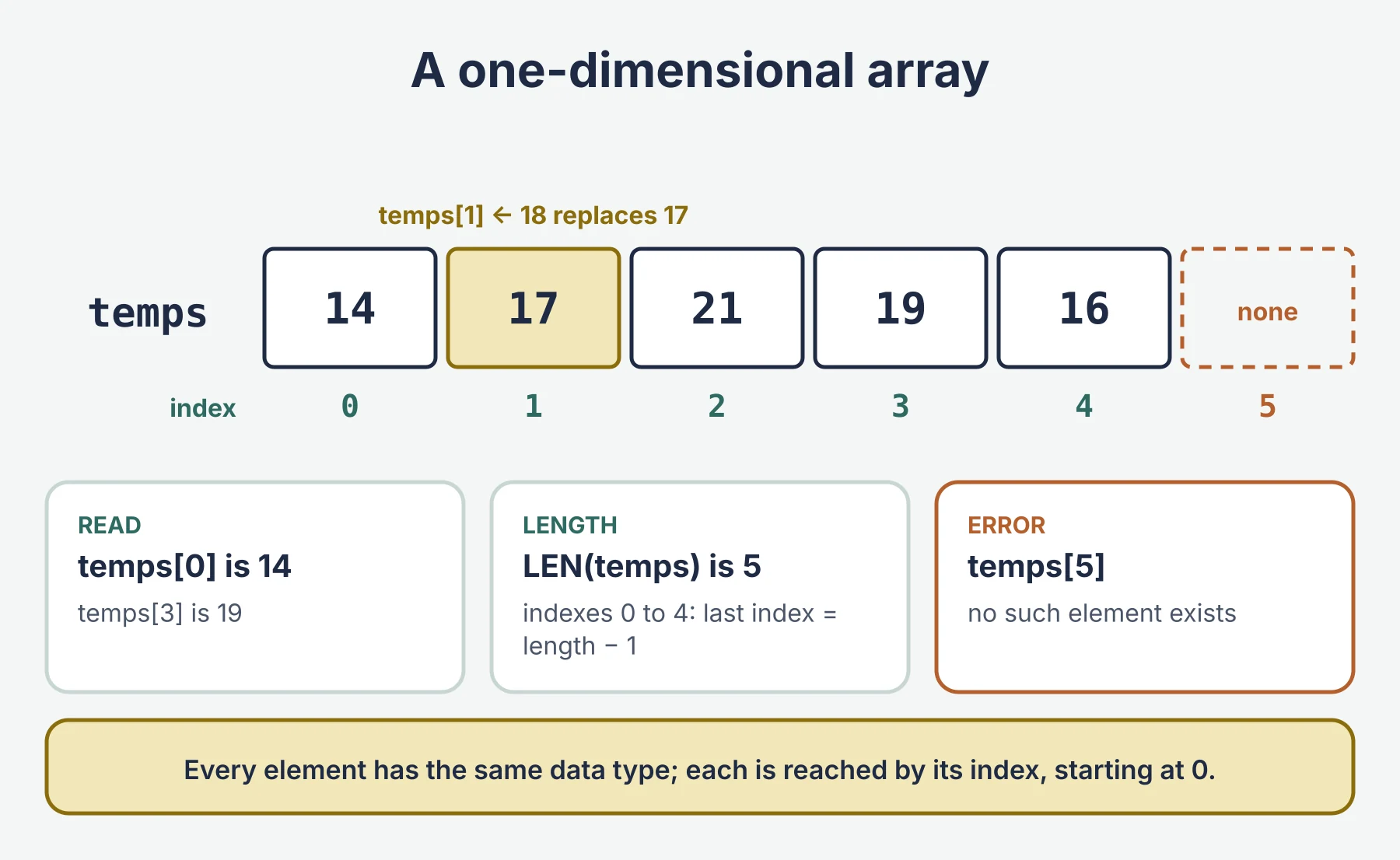
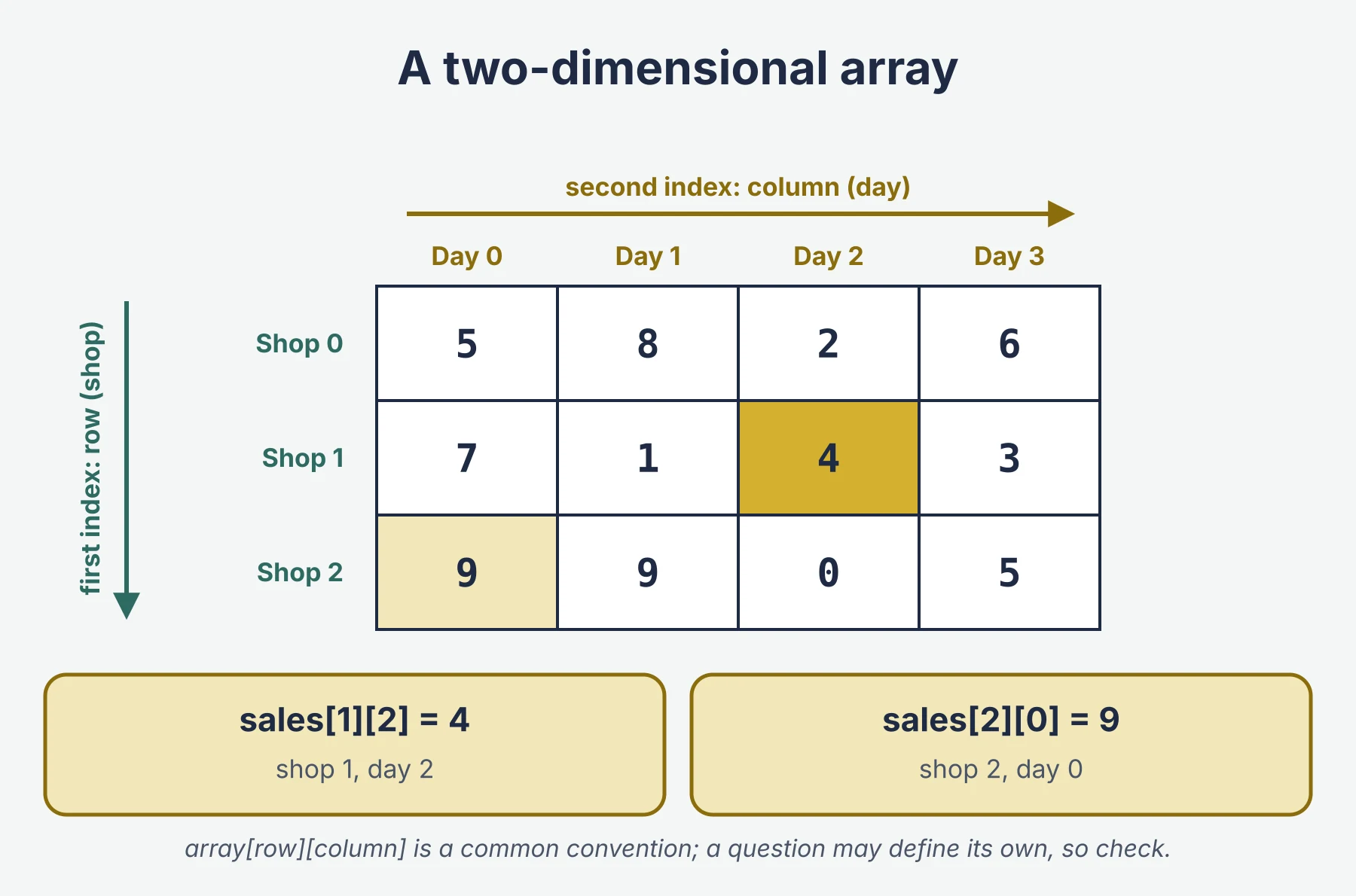
Standard array algorithms
total ← 0                          -- total and average
FOR i ← 0 TO LEN(a) - 1
  total ← total + a[i]
ENDFOR
average ← total / LEN(a)

count ← 0                          -- count matching items
FOR i ← 0 TO LEN(a) - 1
  IF a[i] > 50 THEN
    count ← count + 1
  ENDIF
ENDFOR
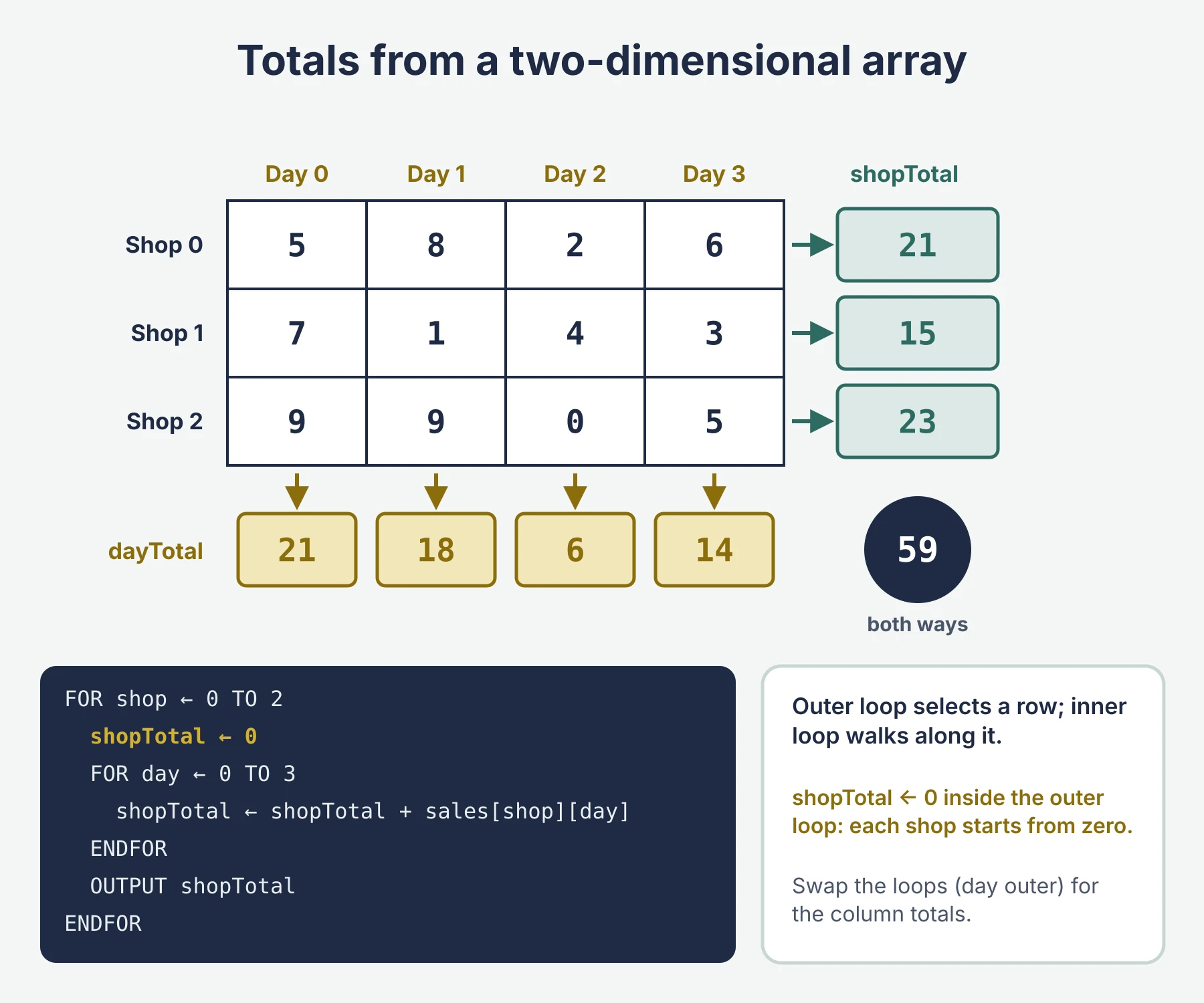
For a 2D array, nest the loops: outer for rows, inner for columns. Reset a row total inside the outer loop.
Records at a glance
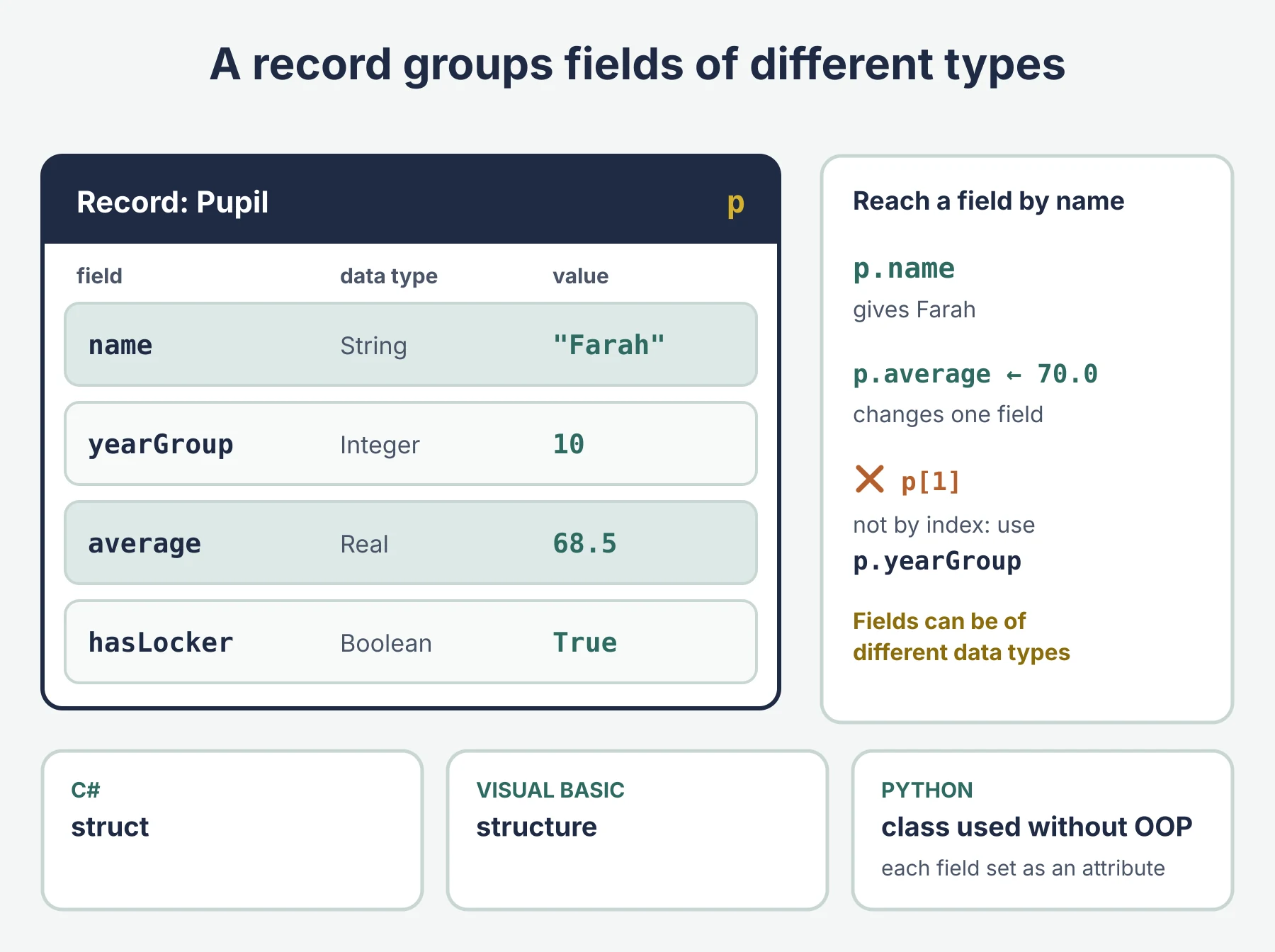
RECORD Car
  reg : String
  year : Integer
  price : Real
  electric : Boolean
ENDRECORD
c ← Car("KP19 XLM", 2019, 12500.0, False)
OUTPUT c.reg- A record holds fields of different types about one item.
- Fields are reached by name with dot notation:
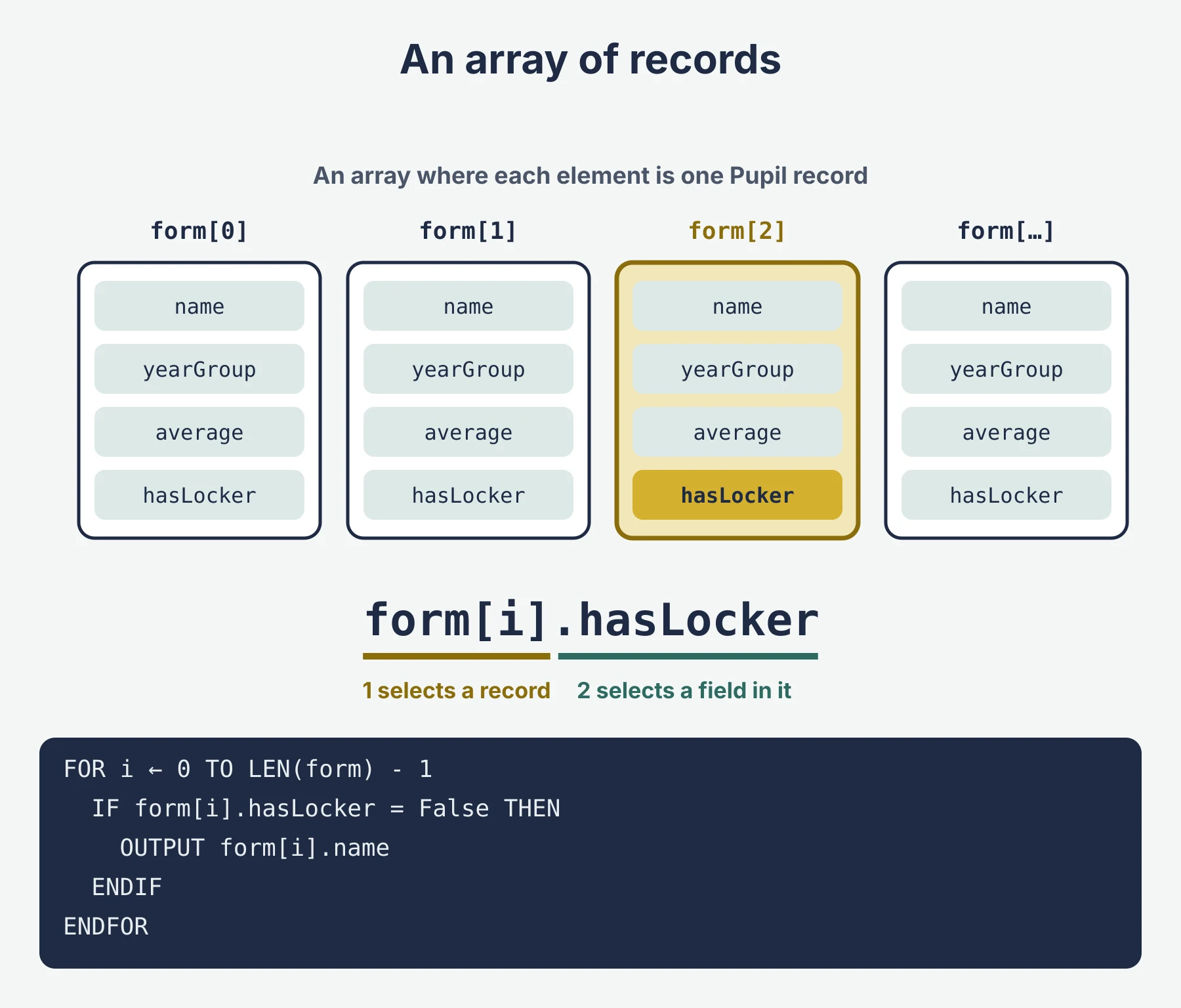
c.year. - An array of records stores many items:
garage[i].price.
Array or record?
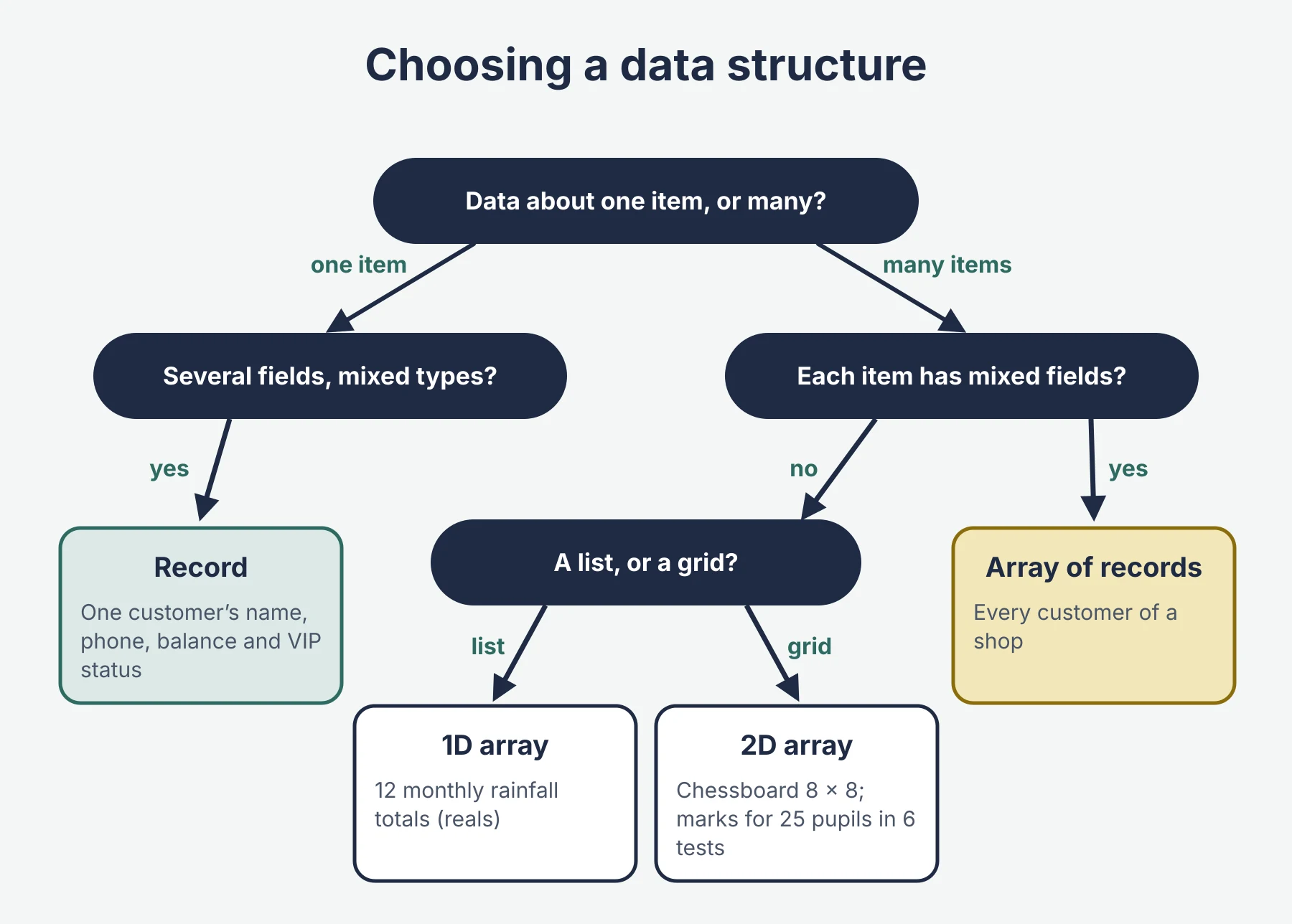
| Question to ask | If yes |
|---|---|
| Many values, all the same type? | Array |
| Values arranged as a grid or table of one type? | 2D array |
| One item with several properties of different types? | Record |
| Many items, each with several properties? | Array of records |
Mini trace: a column total
grid ← [[3, 1, 4],
        [1, 5, 9],
        [2, 6, 5]]
colTotal ← 0
FOR row ← 0 TO 2
  colTotal ← colTotal + grid[row][2]
ENDFOR
OUTPUT colTotal
The column index is fixed at 2 and the row index changes, so the loop adds 4, 9 and 5: the output is 18.
Fixing the row index and changing the column index instead would add along a row. In a trace, write the array out
as a grid and tick each element as it is used.
Key terms
| Term | Meaning |
|---|---|
| Data structure | An organised collection of related data stored under one name |
| Array | A fixed-size, ordered collection of elements of the same data type |
| Element | One item in an array |
| Index | The position number used to reach an element (starting at 0) |
| Two-dimensional array | An array arranged in rows and columns, reached with two indexes |
| Record | A structure of named fields that can be of different data types |
| Field | One named item of data within a record |
Exam traps
- Last index is
LEN(a) - 1, notLEN(a). - Arrays hold one type; mixed types need a record.
- Row/column order: check how the question defines
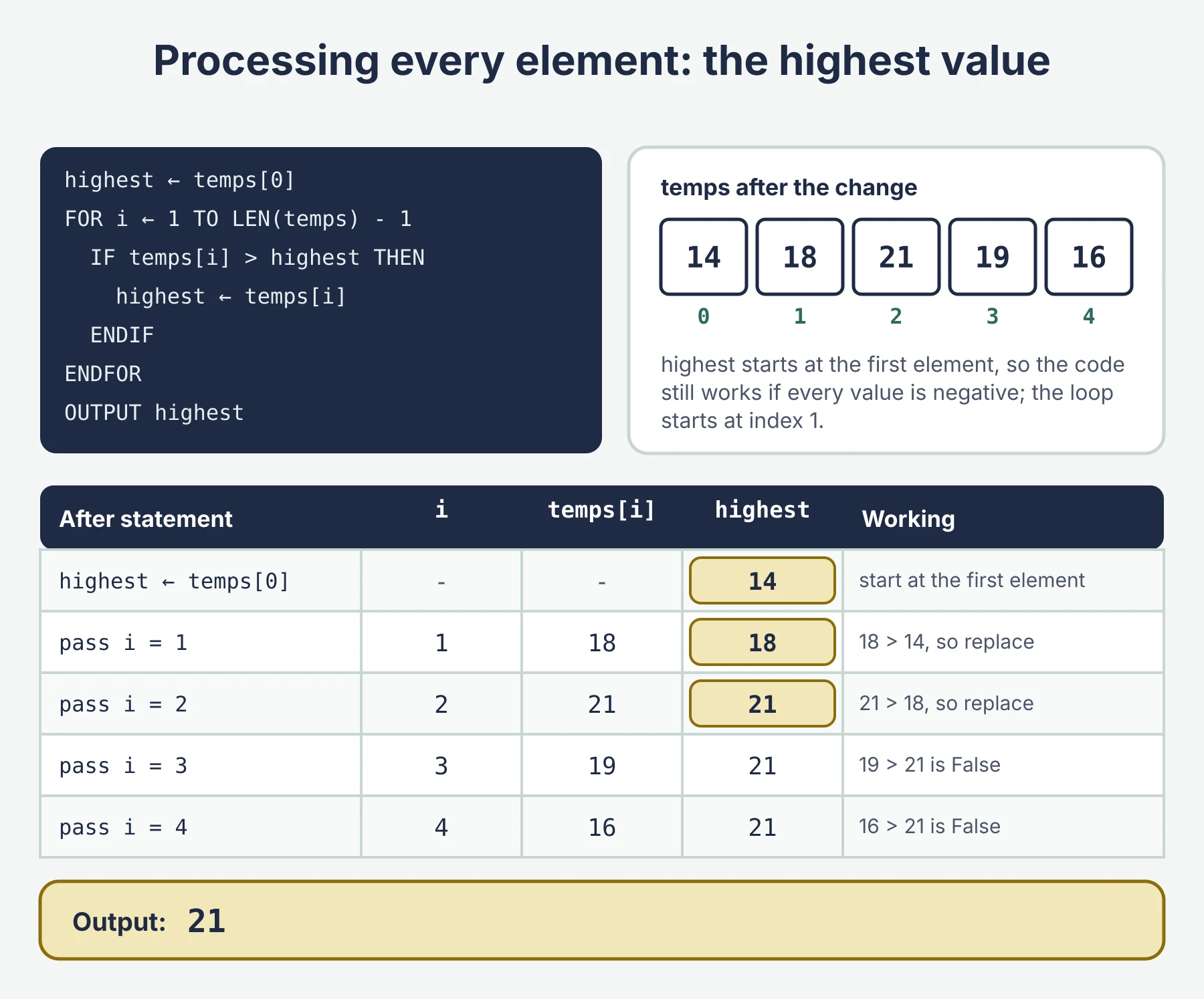
[row][col]. - Highest/lowest: start with the first element, not 0, in case all values are negative (or all above 0 for a lowest).
- Totals reset in the wrong loop give running totals instead of separate ones.
- Field access:
p.name, notp[name]orname.p. - Dimensions: give both, such as “8 rows by 3 columns”.
Self-test
- Define the term data structure.
- State one difference between an array and a record.
nums ← [4, 9, 2, 7]. State the value ofnums[2].- State the last valid index of an array with 12 elements.
- Give the most suitable structure for the noughts and crosses board in a game.
- Give the most suitable structure for one film’s title, year, length in minutes and whether it has subtitles.
grid ← [[1, 2, 3], [4, 5, 6]]. State the value ofgrid[1][0], using[row][col].- How many elements does the array in question 7 hold?
- Write code to output every element of an array
names. - State the name used for the equivalent of a record in C#.
- An array of records
teamstores players with a fieldgoals. Write an expression for the goals of the player at indexi. - Explain why the code below may give the wrong lowest value:
lowest ← 0, then a loop that setslowest ← a[i]whena[i] < lowest.
Answers:
- An organised way of storing a collection of related data items under one name.
- An array holds elements of the same data type reached by index; a record holds fields that can be different types, reached by name.
-
-
- A 3 × 3 two-dimensional array (of characters or strings).
- A record.
-
-
FOR i ← 0 TO LEN(names) - 1,OUTPUT names[i],ENDFOR.- A struct.
team[i].goals.- If every value is above 0, no element is less than
lowest, so 0 is output even though it is not in the array; start withlowest ← a[0].
More resources on this topic
Related resources
-
Study guides
OxfordAQA IGCSE Computer Science (9210): Data types
Study guide to section 3.2.1 of OxfordAQA IGCSE Computer Science 9210: what a data type is and how to choose integer, real, Boolean, character or string.
Computer Science · OxfordAQA · IGCSE
Read guide -
Practice questions
OxfordAQA IGCSE Computer Science (9210): Data types – Practice Questions
Original practice questions with mark-scheme answers on OxfordAQA IGCSE Computer Science 9210 data types: choosing and justifying integer, real and string.
Computer Science · OxfordAQA · IGCSE
Try questions -
Revision notes
OxfordAQA IGCSE Computer Science (9210): Data types – Revision Notes
Revision notes on OxfordAQA IGCSE Computer Science 9210 section 3.2.1: the five data types, choosing them for real data, key terms, exam traps and a self-test.
Computer Science · OxfordAQA · IGCSE
Revise topic
Get free revision emails (optional)
Occasional emails with practice questions, worked explanations and links to free resources for the qualification and subjects you choose. No spam, and you can unsubscribe from any email. The free tools on this site never need an email.