
Revision Notes
OxfordAQA IGCSE Computer Science (9210): Data types – Revision Notes
Revision notes on OxfordAQA IGCSE Computer Science 9210 section 3.2.1: the five data types, choosing them for real data, key terms, exam traps and a self-test.
- Subject
- Computer Science
- Level
- IGCSE
- Topic
- Topic 2 – Programming
- Author
- Marlbridge Academic Team
- Updated
- Reviewed by
- Harris Khan (what this means)
Aligned to OxfordAQA IGCSE Computer Science (9210), For teaching from September 2017, exams from May/June 2019. Official specification .
Syllabus page (what it covers and how it is assessed): OxfordAQA IGCSE Computer Science.
Syllabus points this page covers
9210
- 3.2.1 Data types
Found an error? Report a correction.
Need help with this topic? Request a free trial class for IGCSE Computer Science (9210).
Condensed notes for section 3.2.1 Data types of OxfordAQA International GCSE Computer Science (9210). For full explanations and a worked example, use the data types study guide.
What the specification asks
- Understand the concept of a data type.
- Understand and use integer, real, Boolean, character, string appropriately.
- Languages may use other names (real may be called float); exams use the general names.
The concept in one line
A data type defines what kind of value is held, which operations can be done on it and how it is stored in binary.
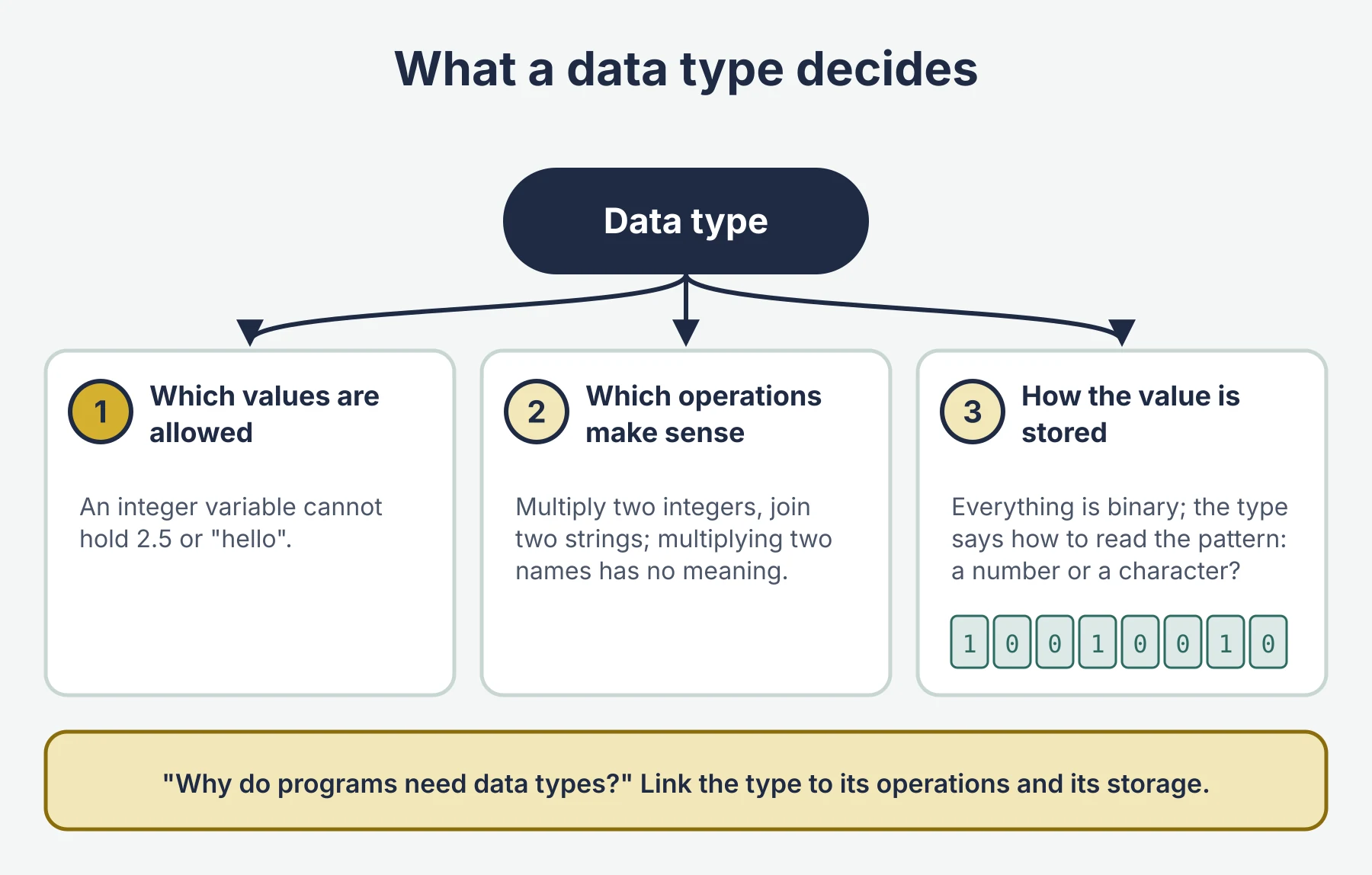
The five types
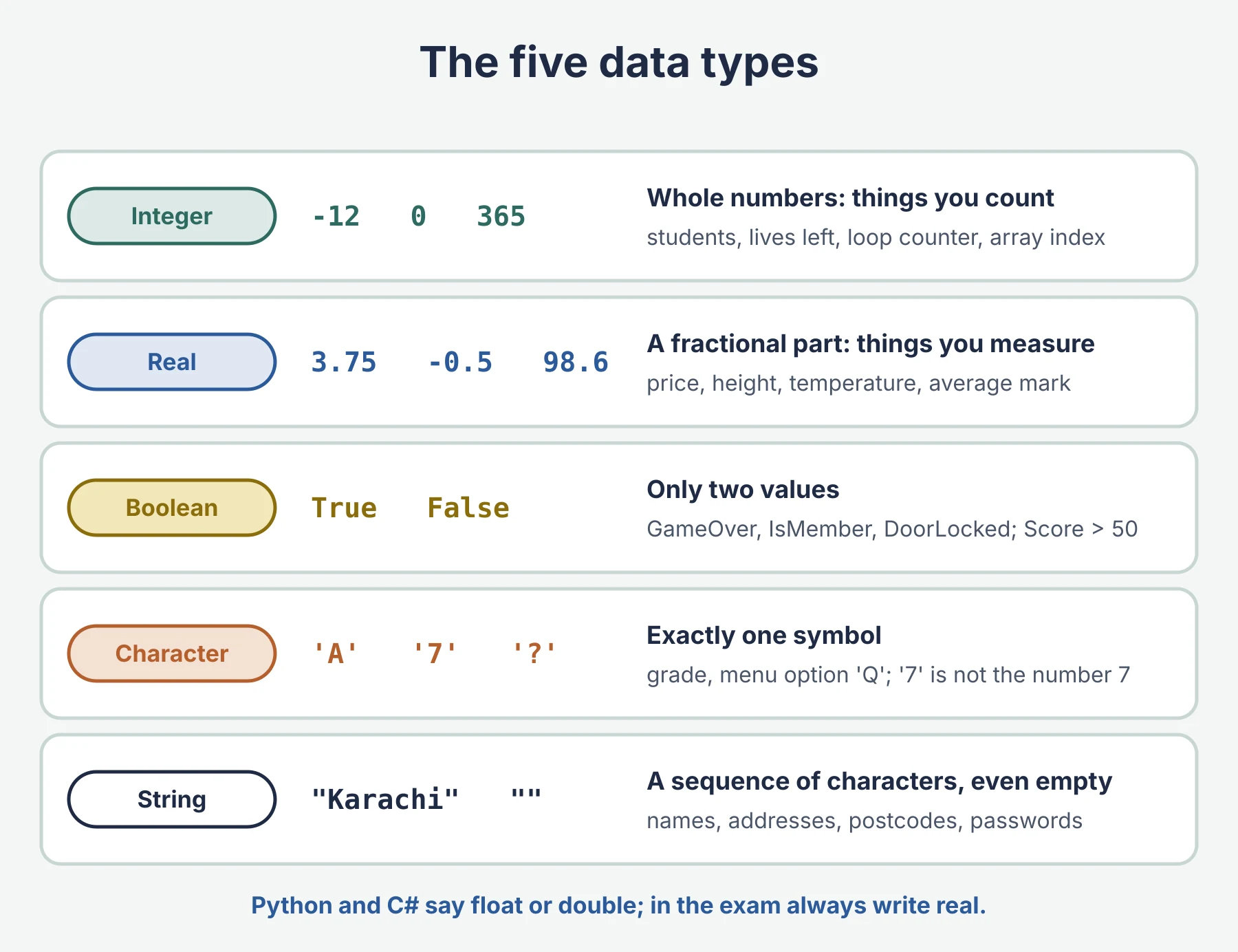
| Type | Holds | Examples | Typical uses |
|---|---|---|---|
| Integer | Whole numbers (positive, negative, zero) | -4, 0, 120 |
Counts, ages in years, scores, loop counters, array indexes |
| Real | Numbers with a fractional part | 2.5, -0.25, 19.99 |
Prices, lengths, temperatures, averages |
| Boolean | True or False only | True |
Flags and states: LoggedIn, Found, GameOver |
| Character | Exactly one symbol | 'B', '9', '#' |
Grade letter, menu choice, one-letter code |
| String | A sequence of characters (can be empty) | "Lahore", "" |
Names, postcodes, phone numbers, passwords |
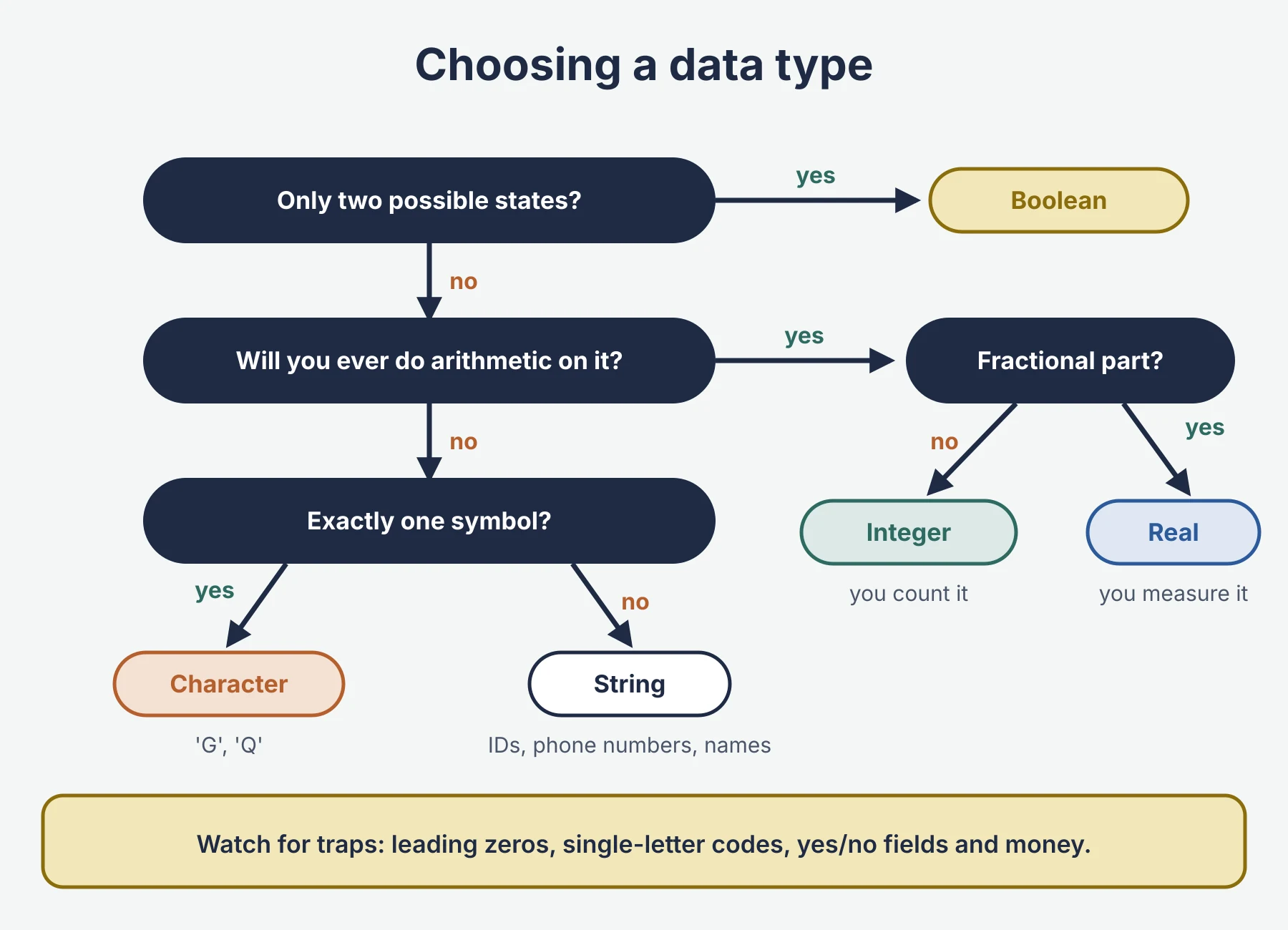
Decision rules for choosing a type
- Only two states? → Boolean.
- Exactly one symbol, always? → character.
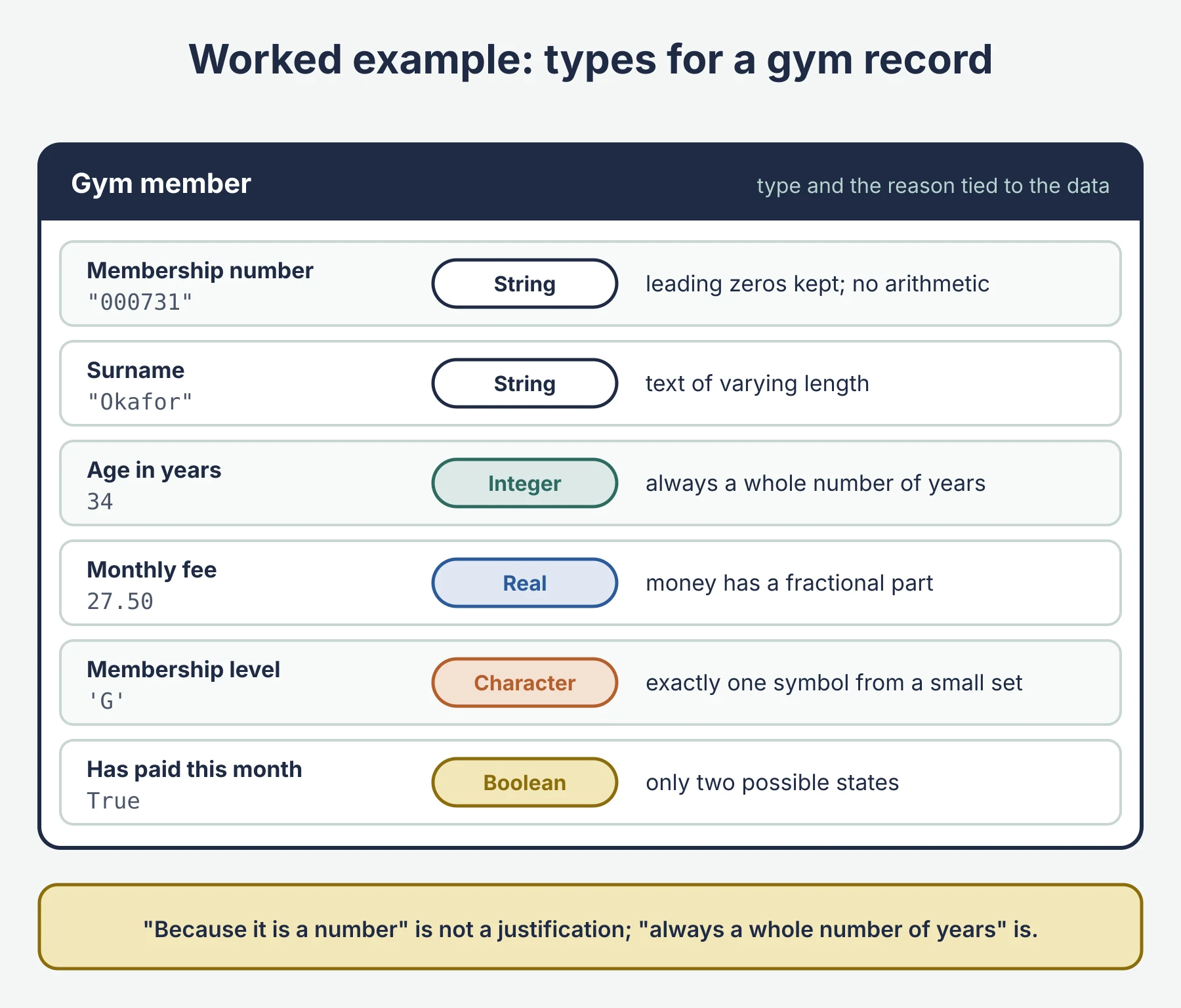
- Contains letters, spaces or symbols, or has leading zeros? → string.
- A number you never do arithmetic on (an identifier)? → string.
- A number that can have a fractional part (measured, money, averages)? → real.
- A whole number you count or calculate with? → integer.
Apply the rules in this order and the awkward cases sort themselves out: a phone number reaches rule 3 or 4 before it reaches rule 6.
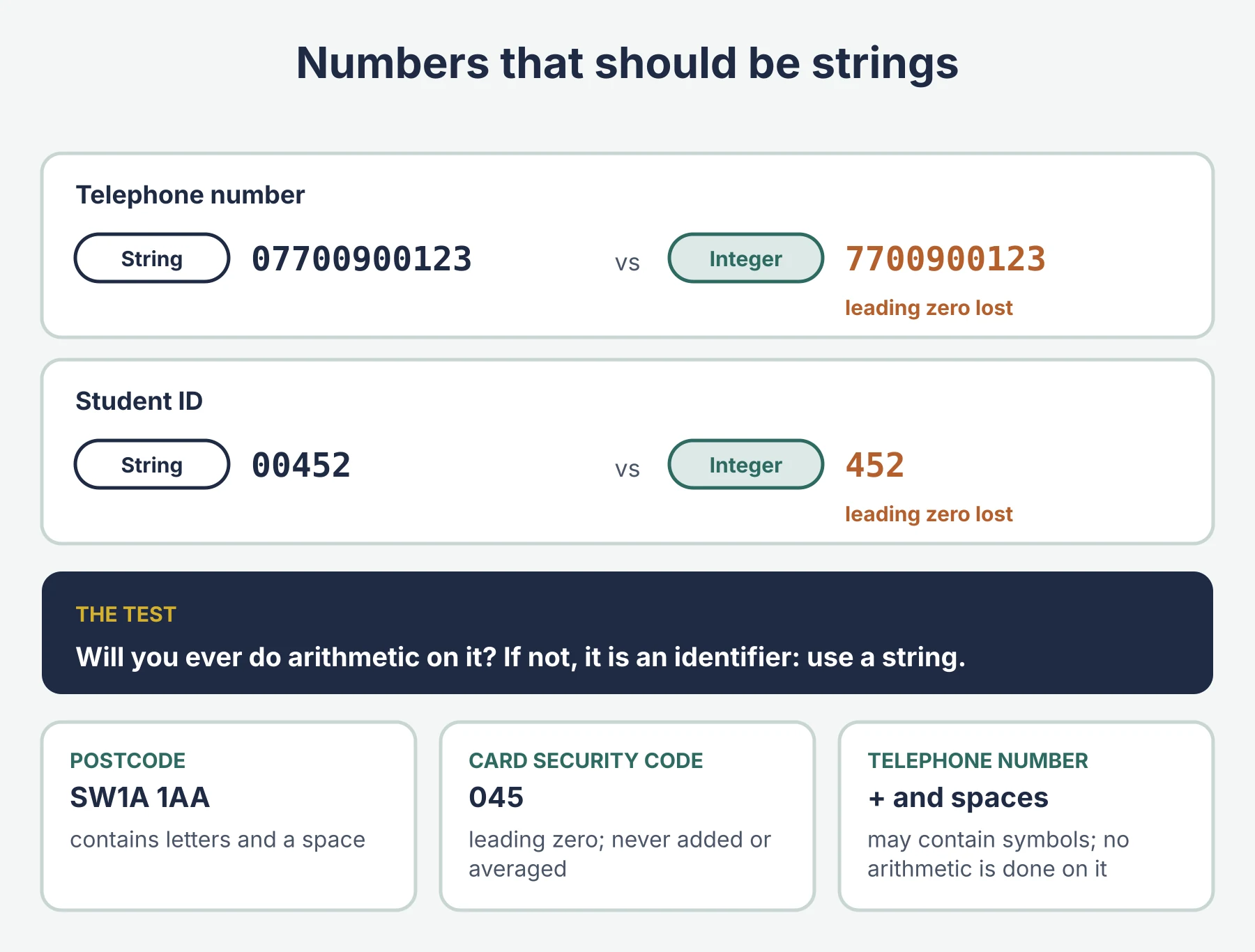
Typical exam data and the right answer
| Data | Type | Key reason |
|---|---|---|
| Number of pupils in a class | Integer | Counted, always whole |
| Average mark of a class | Real | Division usually gives a fractional part |
Mobile number 07911 123456 |
String | Leading zero, space, no arithmetic |
| Whether a book is on loan | Boolean | Two states |
Shoe size 7.5 |
Real | Can be a half size |
Year group 10 |
Integer | Whole number, may be compared |
Blood group "AB+" |
String | More than one symbol |
Answer to a multiple-choice question 'C' |
Character | One symbol |
Bank account number 00123456 |
String | Leading zeros, identifier |
How type affects operations
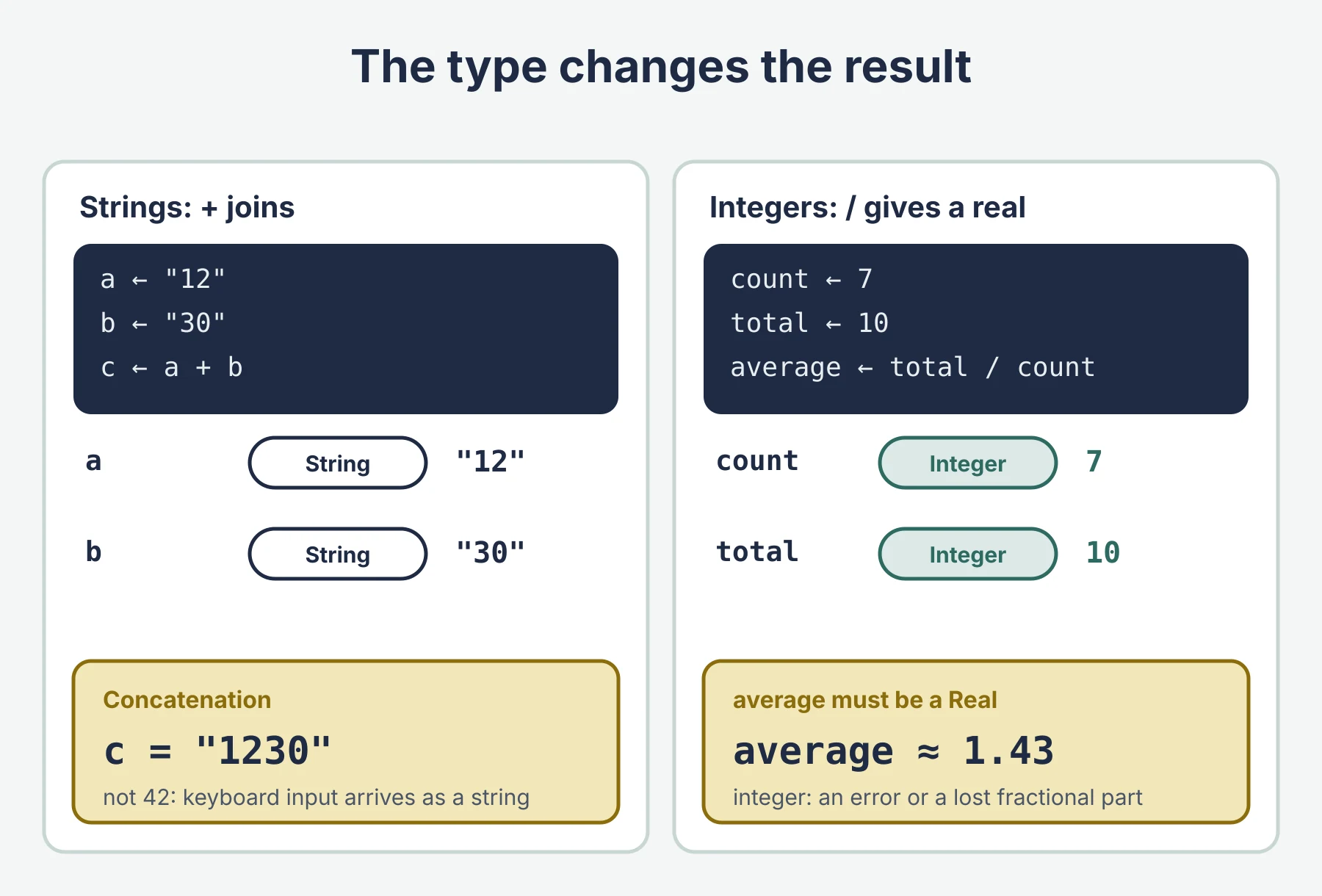
"12" + "30"gives"1230"(string concatenation);12 + 30gives42.- Keyboard input usually arrives as a string, so convert it before arithmetic (string conversion is 3.2.8).
- Real division
/gives a real result, so store it in a real variable even if both inputs are integers. - A Boolean can be used directly as a condition:
IF Found THENneeds no= True.
Key terms
| Term | Meaning |
|---|---|
| Data type | The kind of value a variable, constant or field holds, which fixes the allowed values and operations |
| Integer | A whole number with no fractional part |
| Real | A number that may have a fractional part (often called float in languages) |
| Boolean | A type with only the values True and False |
| Character | A single letter, digit, symbol or space |
| String | An ordered sequence of zero or more characters |
| Empty string | A string containing no characters, written "" |
Exam traps
- “Float” in an answer where the specification name is real. Use the exam’s names.
- Phone numbers and IDs as integers. Leading zeros vanish; arithmetic on them is meaningless.
- “Integer, because it is a number.” That is not a justification. Say why it is whole and why it is calculated with.
- Money as integer. Unless the question says amounts are stored in whole pence or cents, money is real.
- Character versus string.
'Y'is a character;"Yes"is a string. If the data could ever be longer than one symbol, it is a string. - Storing yes/no answers as strings when a Boolean is more appropriate.
- Two types for one item. A table asking for “the most appropriate” type wants one answer, not a list.
Self-test
- Define the term data type.
- State the most appropriate data type for the number of goals scored in a football match.
- State the most appropriate data type for the distance a runner covers, in kilometres.
- Explain why a student ID such as
004571should be stored as a string. - Give the value of
caftera ← "4",b ← "5",c ← a + b. - State one difference between a character and a string.
- A variable stores whether an alarm is set. State the data type and give one reason.
- A program calculates
total / countwhere both are integers. State the type the result should be stored in. - State the name used in the exam for the type some languages call float.
- Identify the error in this choice: “A postcode is stored as an integer.”
- Suggest a type for a hotel room number such as
214, and justify it. - Explain why using a Boolean is better than storing the strings “Yes” and “No”.
Answers:
- The kind of value a variable or constant can hold, which determines the values allowed, the operations that can be performed and how the value is stored.
- Integer.
- Real.
- The leading zeros would be lost if it were stored as an integer, and no arithmetic is ever done on an ID.
"45"(concatenation of two strings).- A character holds exactly one symbol; a string holds a sequence of any number of characters, including none.
- Boolean, because the alarm is either set or not set: there are only two states.
- Real, because real division can produce a fractional part.
- Real.
- Postcodes contain letters and often a space, so an integer cannot hold them; use a string.
- Either answer can be credited with the right reason: integer if the program compares or calculates with room
numbers (for example, the first digit as the floor); string if it is only an identifier and some rooms might
include letters, such as
"214B". - A Boolean has only two possible values, so it cannot be misspelt or given an unexpected value such as “yes” in lower case, and it can be used directly in a condition.
More resources on this topic
- Data types study guide
- Data types practice questions
- Programming Fundamentals revision notes (sections 3.2.1 to 3.2.5 together)
Related resources
-
Study guides
OxfordAQA IGCSE Computer Science (9210): Input/output and file handling
Study guide to OxfordAQA IGCSE Computer Science 9210 section 3.2.7: keyboard input, screen output, and reading from and writing to text files step by step.
Computer Science · OxfordAQA · IGCSE
Read guide -
Practice questions
OxfordAQA IGCSE Computer Science (9210): Input/output and file handling – Practice Questions
Original OxfordAQA IGCSE Computer Science 9210 practice questions with answers on keyboard input, screen output and reading and writing text files.
Computer Science · OxfordAQA · IGCSE
Try questions -
Revision notes
OxfordAQA IGCSE Computer Science (9210): Input/output and file handling – Revision Notes
Revision notes for OxfordAQA IGCSE Computer Science 9210 section 3.2.7: keyboard input, display output, reading and writing text files, traps and a self-test.
Computer Science · OxfordAQA · IGCSE
Revise topic
Get free revision emails (optional)
Occasional emails with practice questions, worked explanations and links to free resources for the qualification and subjects you choose. No spam, and you can unsubscribe from any email. The free tools on this site never need an email.