
Revision Notes
OxfordAQA IGCSE Computer Science (9210): Input/output and file handling – Revision Notes
Revision notes for OxfordAQA IGCSE Computer Science 9210 section 3.2.7: keyboard input, display output, reading and writing text files, traps and a self-test.
- Subject
- Computer Science
- Level
- IGCSE
- Topic
- Topic 2 – Programming
- Author
- Marlbridge Academic Team
- Updated
- Reviewed by
- Harris Khan (what this means)
Aligned to OxfordAQA IGCSE Computer Science (9210), For teaching from September 2017, exams from May/June 2019. Official specification .
Syllabus page (what it covers and how it is assessed): OxfordAQA IGCSE Computer Science.
Syllabus points this page covers
9210
- 3.2.7 Input/output and file handling
Found an error? Report a correction.
Need help with this topic? Request a free trial class for IGCSE Computer Science (9210).
Condensed notes for section 3.2.7 Input/output and file handling of OxfordAQA International GCSE Computer Science (9210). The worked examples are in the input/output and file handling study guide.
What the specification asks
- Obtain user input from a keyboard.
- Output data and information from a program to the computer display.
- Read from and write to a text file.
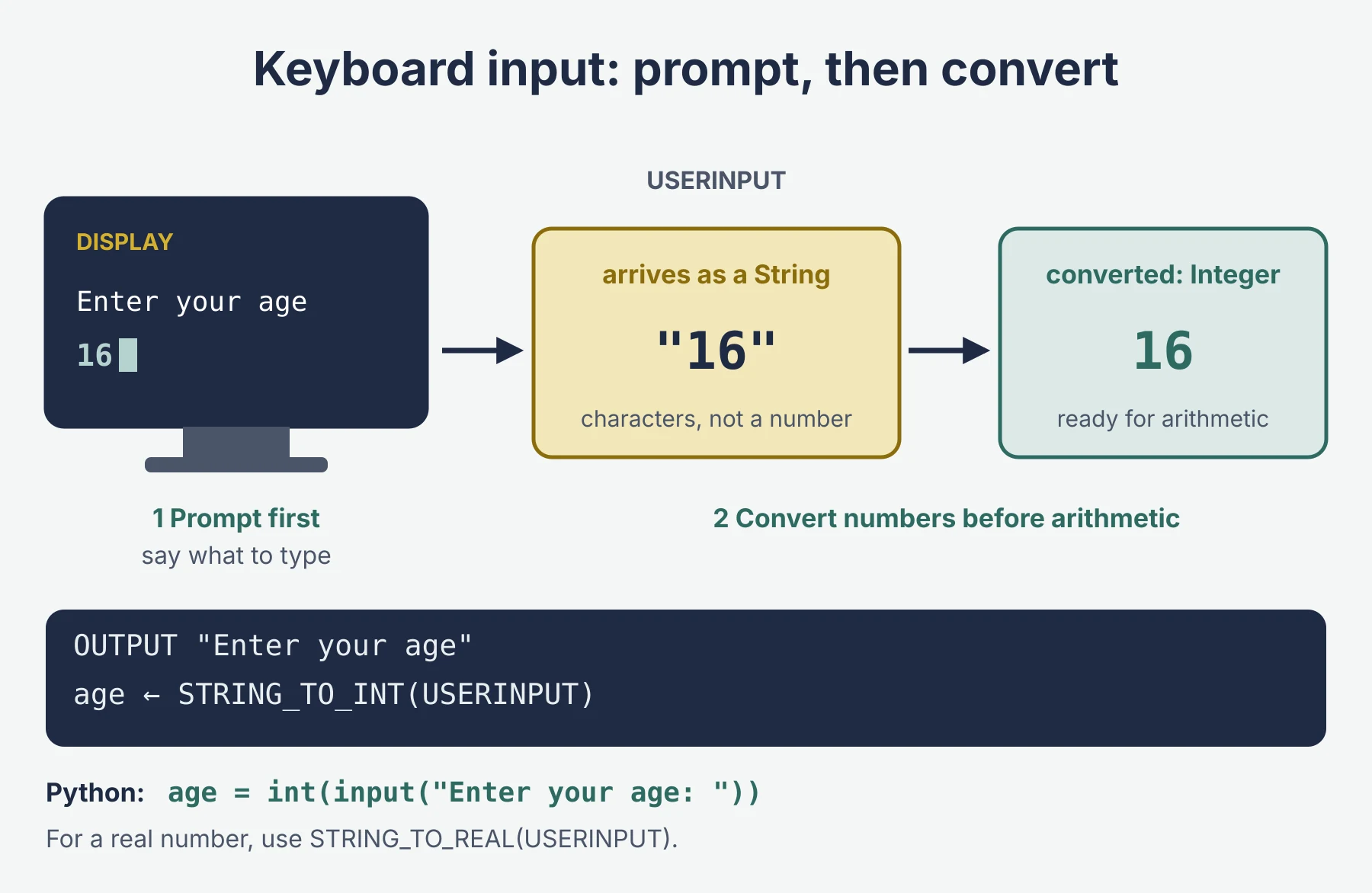
Keyboard input
name ← USERINPUTstores what the user types.- Prompt first:
OUTPUT "Enter the quantity". - Input is a string: convert before arithmetic,
qty ← STRING_TO_INT(USERINPUT). - Python:
qty = int(input("Enter the quantity: ")).
Display output
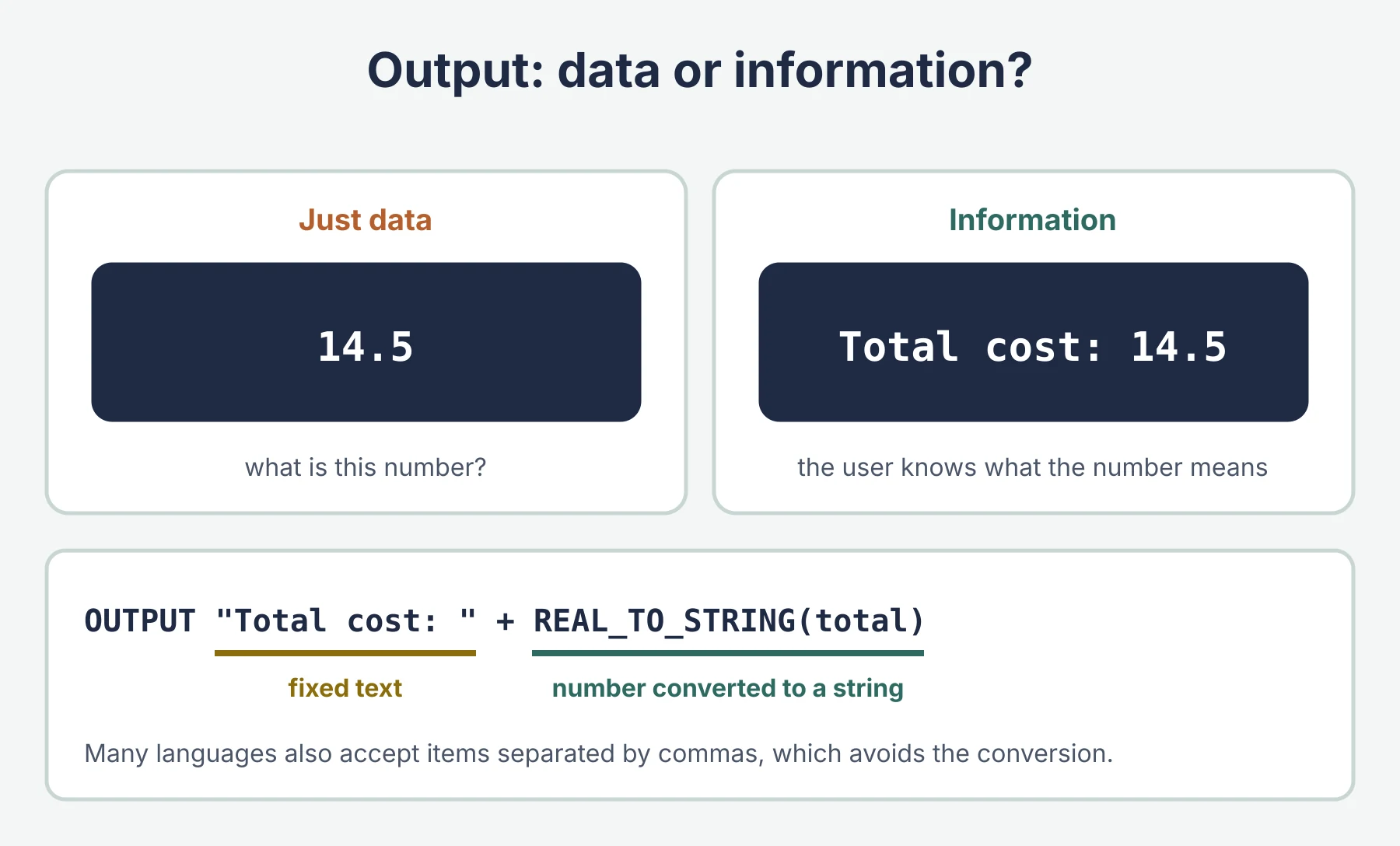
OUTPUTsends text or values to the screen.- Label values so the output is information, not just data:
OUTPUT "Average: " + REAL_TO_STRING(avg). - Joining with
+needs strings on both sides; convert numbers first.
Why text files
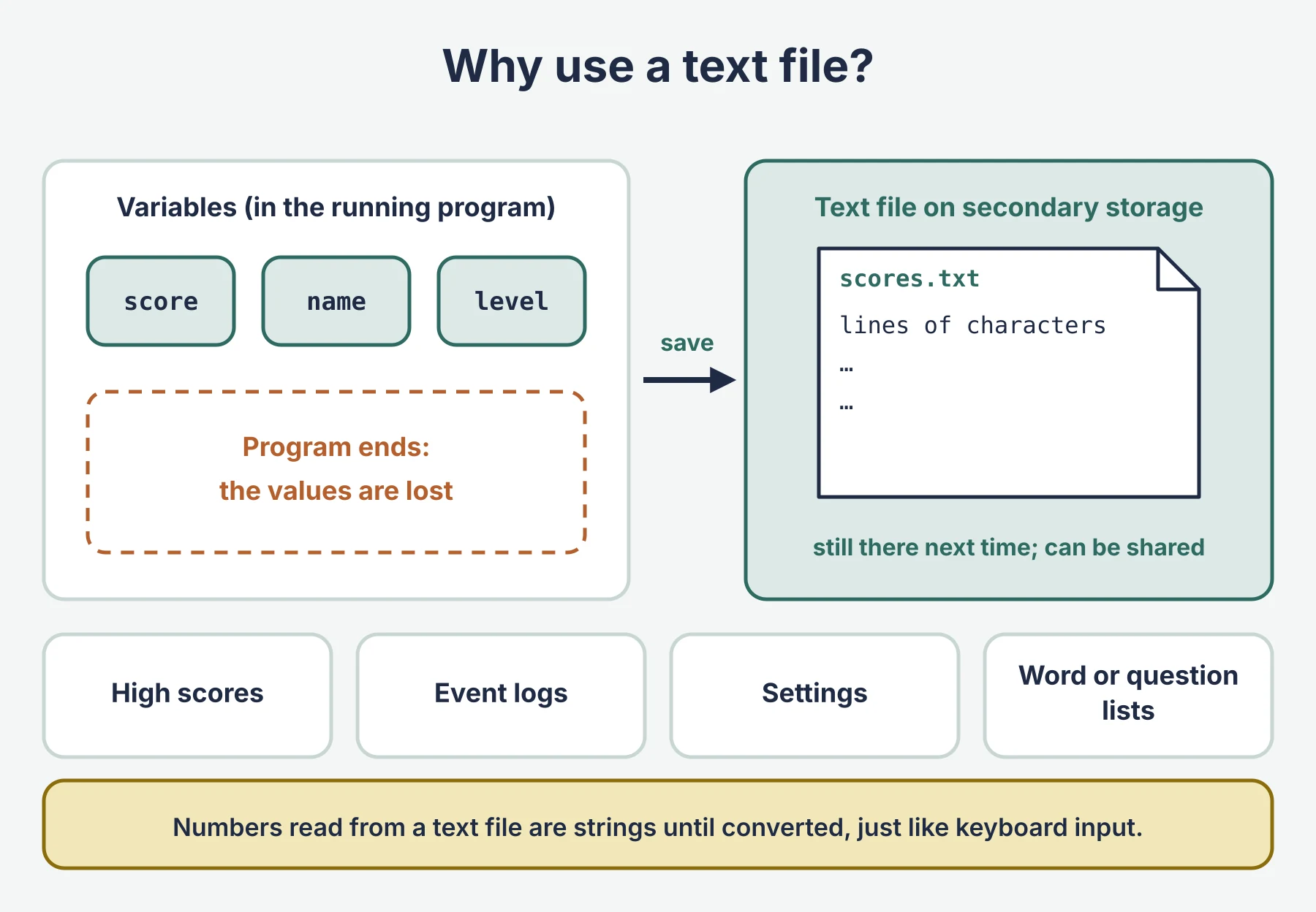
| Variables | Text files |
|---|---|
| Lost when the program ends | Kept on secondary storage after the program ends |
| Only available to this run of the program | Can be reused next time and shared with other programs |
| Hold any data type | Hold lines of characters (numbers must be converted) |
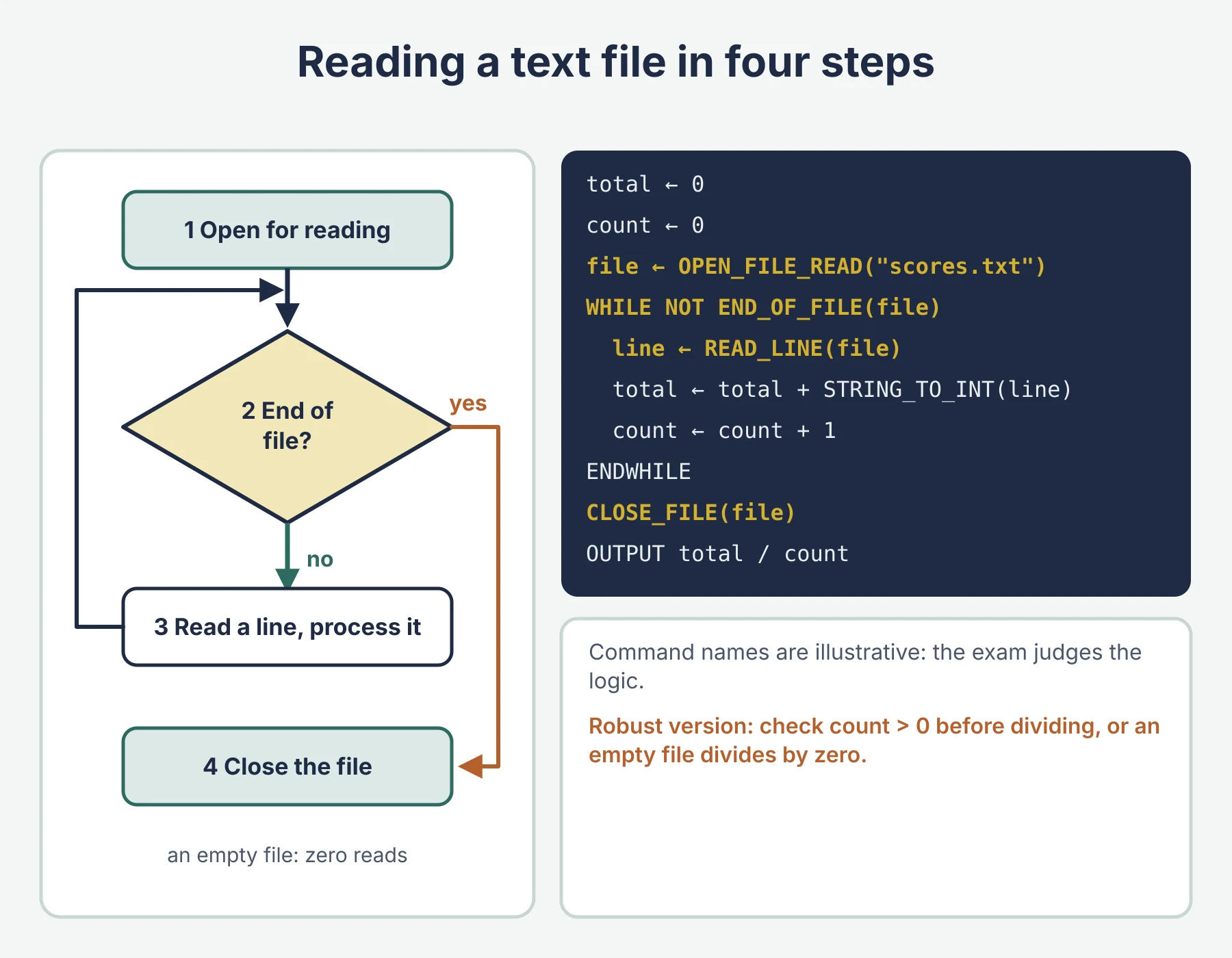
Reading a text file: four steps
- Open for reading.
- Loop until end of file (
WHILE NOT END_OF_FILE(file)), so an empty file gives zero reads. - Read a line and process it (convert if numeric).
- Close the file.
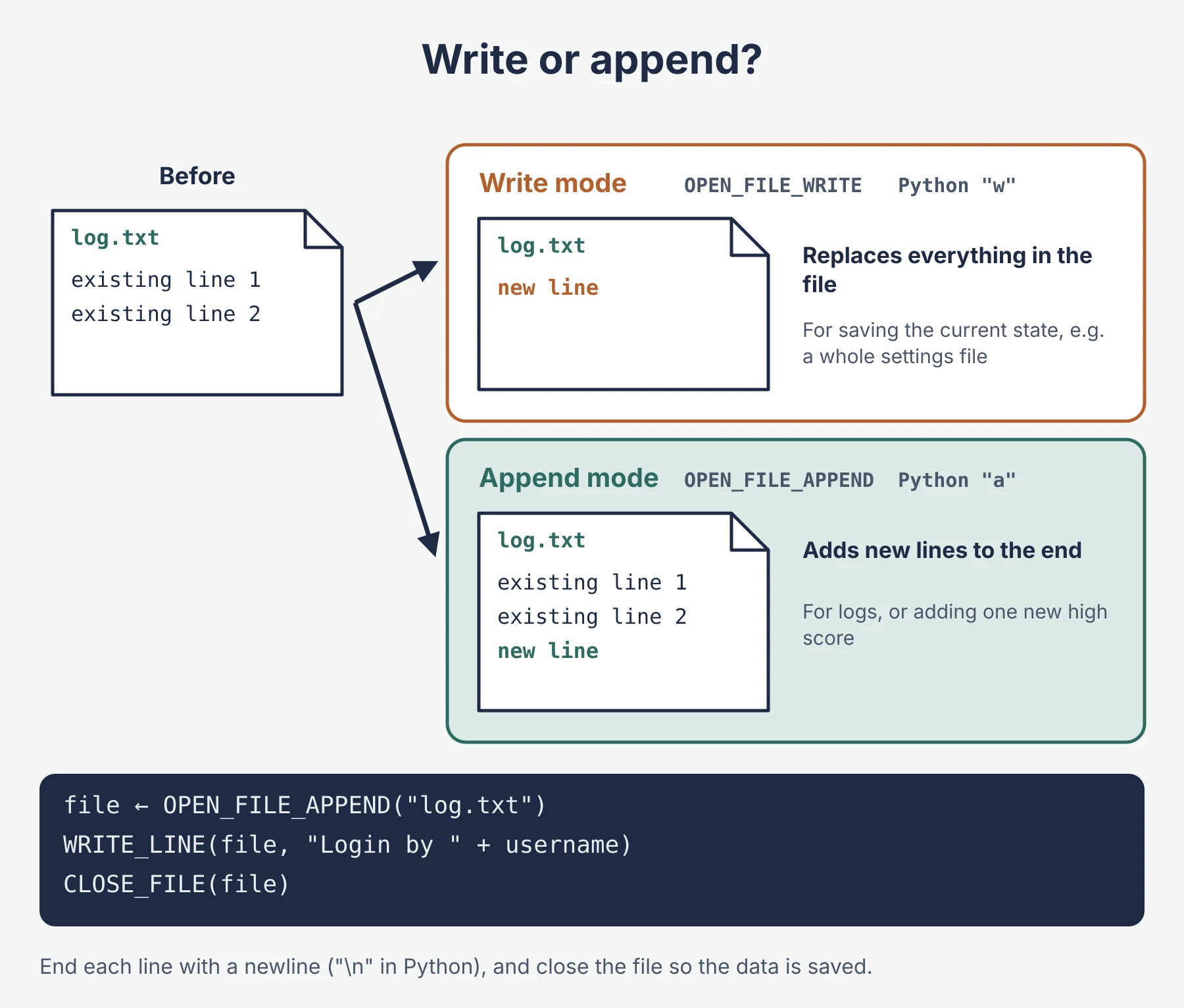
Writing a text file
| Mode | Existing contents | Typical use |
|---|---|---|
| Write | Replaced | Save a complete set of data, create a new file |
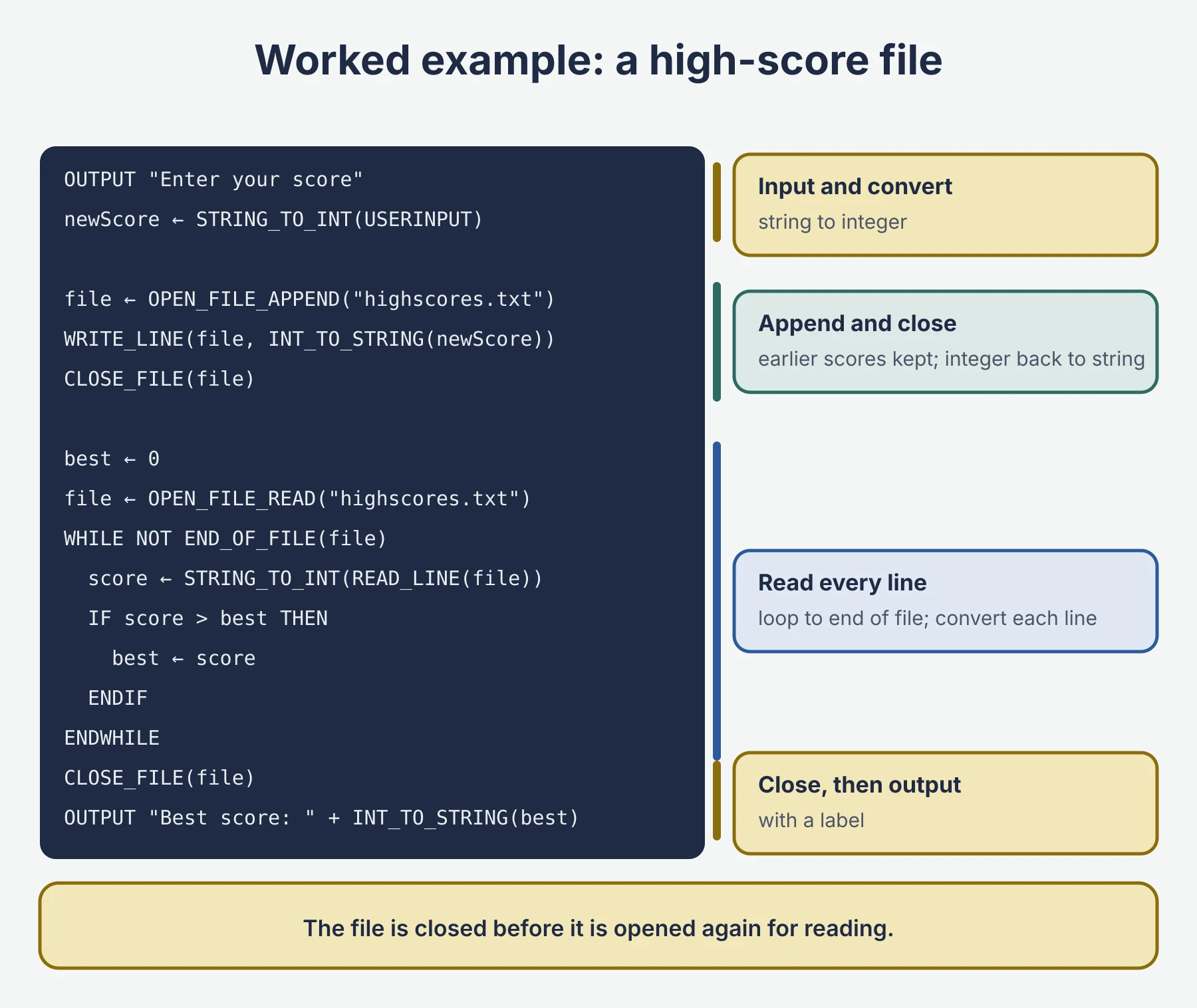
| Append | Kept; new lines added at the end | Log entries, adding a new score |
Steps: open (choose mode) → write each line (convert numbers to strings) → close.
Python modes: "r" read, "w" write, "a" append. Add "\n" at the end of each line when using write.
Why close a file
- Makes sure all data is saved to storage.
- Releases the file so other programs (or later parts of the same program) can open it.
Template code
file ← OPEN_FILE_READ("words.txt")       -- count lines that start with "s"
count ← 0
WHILE NOT END_OF_FILE(file)
  word ← READ_LINE(file)
  IF SUBSTRING(0, 0, word) = "s" THEN
    count ← count + 1
  ENDIF
ENDWHILE
CLOSE_FILE(file)
OUTPUT "Words starting with s: " + INT_TO_STRING(count)
(File command names are illustrative; any suitable names are accepted if the logic is clear. SUBSTRING(0, 0, word) is the first character, counting from 0.)
Python equivalents
| Task | Python |
|---|---|
| Input a whole number | n = int(input("Enter n: ")) |
| Output a labelled value | print("Total:", total) |
| Read every line | with open("data.txt", "r") as f: then for line in f: |
| Add a line to a file | with open("log.txt", "a") as f: then f.write(entry + "\n") |
Key terms
| Term | Meaning |
|---|---|
| Input | Data entered into a program, here from the keyboard |
| Output | Data or information sent from a program, here to the display |
| Prompt | A message telling the user what to enter |
| Text file | A file of lines of characters stored on secondary storage |
| Open | Connect a program to a file for reading, writing or appending |
| End of file | The point at which there are no more lines to read |
| Append | Add data to the end of an existing file without removing what is there |
| Close | Finish using a file so data is saved and the file is released |
Exam traps
- Missing conversion of input or file lines before arithmetic.
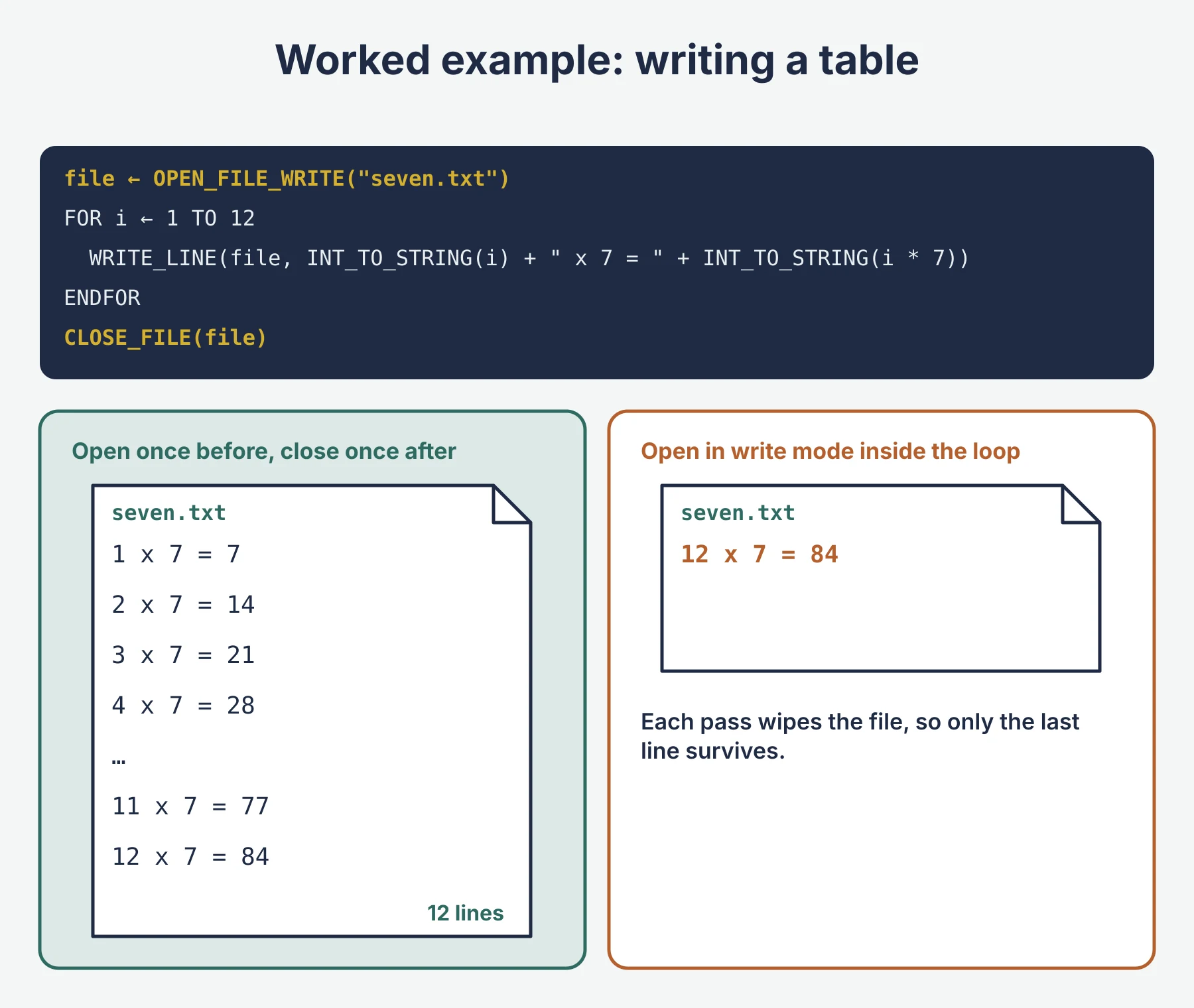
- Write mode where append was needed, wiping earlier data.
- File opened or closed inside the loop.
- Fixed-count loops for files of unknown length.
- Forgetting to close the file.
- Unlabelled output when the question asks for a meaningful message.
- Concatenating a number with a string without converting it.
Self-test
- State why a prompt should be output before
USERINPUT. - State the data type of a value entered at the keyboard before conversion.
- Give one reason a program saves data to a text file.
- List the four steps for reading every line of a text file.
- Explain the difference between write mode and append mode.
- State two reasons for closing a file.
- Why is a
WHILEloop with the condition at the start suitable for reading a file? - A program reads
"7"from a file and adds it to 3 without converting. What might happen? - Which mode should be used for a log of every login?
- Give the Python mode letter for appending.
- A program opens a file in write mode, writes one line and closes it, all inside a loop that runs 5 times. How many lines does the file contain at the end?
- Rewrite
OUTPUT "Score " + scoreso it works whenscoreis an integer.
Answers:
- So the user knows what data to enter (and in what form).
- String.
- Any one: the data is kept after the program ends; it can be loaded next time; it can be shared with other programs.
- Open the file for reading; loop until the end of the file; read and process each line; close the file.
- Write mode replaces the file’s existing contents; append mode keeps them and adds new lines at the end.
- To make sure the data is saved to storage, and to release the file for other programs.
- If the file is empty, the condition is False at the start, so no line is read.
- An error, or
"73"if the language joins the values as strings, instead of 10. - Append.
"a".- One (each opening wipes the file, so only the last line remains).
OUTPUT "Score " + INT_TO_STRING(score).
More resources on this topic
Related resources
-
Study guides
OxfordAQA IGCSE Computer Science (9210): Programming concepts
Study guide to OxfordAQA IGCSE Computer Science 9210 section 3.2.2: declarations, constants, assignment, definite and indefinite loops, nesting and identifiers.
Computer Science · OxfordAQA · IGCSE
Read guide -
Practice questions
OxfordAQA IGCSE Computer Science (9210): Programming concepts – Practice Questions
Original OxfordAQA IGCSE Computer Science 9210 practice questions with answers on statement types, constants, loops, nesting and identifier names.
Computer Science · OxfordAQA · IGCSE
Try questions -
Revision notes
OxfordAQA IGCSE Computer Science (9210): Programming concepts – Revision Notes
Revision notes for OxfordAQA IGCSE Computer Science 9210 section 3.2.2: statement types, constants, loop choice, nesting, identifiers, traps and a self-test.
Computer Science · OxfordAQA · IGCSE
Revise topic
Get free revision emails (optional)
Occasional emails with practice questions, worked explanations and links to free resources for the qualification and subjects you choose. No spam, and you can unsubscribe from any email. The free tools on this site never need an email.